REVIEW 4 major objections 4 minor 52 references
DFDNet: Dynamic Frequency-Guided De-Flare Network
T0 review · 4 major / 4 minor · reviewed 2026-08-06 · deepseek-v4-flash
Pith's one-line read Flare artifacts are easiest to separate in the frequency domain, and a network built on that idea beats all compared deflare methods.
desk verdict Solid engineering but the ablation baseline is copied from published Flare7k++ numbers, so the module contributions are unproven; the SOTA claim is also overstated. read the letter →
The pith
A machine-rendered reading of the paper's core claim, the machinery that carries it, and where it could break.
The reading
What carries the argument
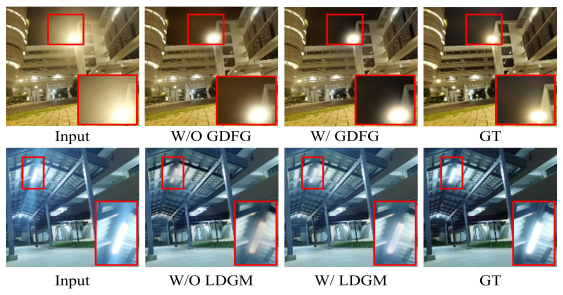
The load-bearing object is the global dynamic frequency-domain guidance module (GDFG). It applies a discrete Fourier transform to the feature map, multiplies the spectrum by a multichannel weight $W = \sum_i T_i(X) \Phi_i$, where $\Phi_i$ are $N$ learnable complex masks and $T_i$ are softmax-normalized coefficients produced by global average pooling followed by an MLP, then applies the inverse transform and adds a residual connection. Because the weights depend on the input, the filter is content-adaptive rather than a fixed global filter. The second component is the local detail guidance module (LDGM), a contrastive loss on randomly cropped patches that treats restored-image patches as queries, co-located reference patches as positives, and the remaining patches as negatives. The paper also uses a frequency-domain loss $L_{FFT}$ that takes L1 distances between the amplitudes and phases of the restored and reference images' Fourier transforms.
What would settle it
Retrain the Table 4 baseline (Uformer without GDFG, LDGM, or the frequency loss) using the paper's own code and pipeline, and compare its Flare7K++ real-test PSNR with the reported 27.633 dB; if the retrained baseline comes out materially above that value or if DFDNet's margin over it shrinks without the modules, the attribution of the improvements to GDFG and LDGM fails. An equally direct check is to feed the predicted flare maps from GDFG against the annotated masks in Flare7K++: if the maps do not highlight the marked glare and streak regions better than the backbone's output, the decoupling claim is unsupported.
Extended reading notes
Core claim
The central discovery the authors are trying to establish is that content and flare artifact information can be decoupled in the frequency domain by a learnable, input-adaptive filter, and that this decoupling transfers to real images. Concretely, the paper claims that large-scale flares add broadband energy and directional radial patterns to the mid- and high-frequency spectrum, that a per-channel dynamic Fourier mask computed from global average pooling and an MLP can suppress those components, and that a phase-and-amplitude L1 loss in the Fourier domain sharpens this separation. The local contrastive module is presented as the counterpart that realigns damaged patches near the light source with the reference image, fixing the detail loss that pure frequency filtering would cause. The combined system is claimed to outperform every compared method on all reported paired and unpaired benchmarks, with e.g. 28.030 dB PSNR on the Flare7K++ real test set versus 27.662 dB for the closest competitor.
Load-bearing premise
The load-bearing premise is that the Table 4 baseline row is a Uformer retrained from scratch under the same data pipeline, augmentation, and training protocol as the full DFDNet; if that row is instead the original published Flare7K++ model, the reported gains from GDFG and LDGM are not attributable to the modules.
Editorial extensions
If this is right
- If the reported comparisons are taken at face value, DFDNet is the current best deflare method on Flare7K++ real and synthetic tests, with the largest gains concentrated in G-PSNR and S-PSNR, the metrics that score flare-region fidelity.
- The GDFG module alone improves the Uformer backbone's real-test PSNR from 27.633 to 27.740 dB, and adding the frequency loss raises it to 27.951 dB, so each proposed component contributes a measurable, separable improvement.
- The combination of GDFG and LDGM yields a predicted flare map that covers annotated glare, streak, and light-source regions without misclassifying the light source itself, which the paper presents as evidence that global frequency guidance and local contrastive alignment are complementary.
- Because flare removal improves object detection and semantic segmentation in the paper's downstream experiments, the restoration quality transfers to practical vision tasks rather than only to image-quality metrics.
Reading between the lines
- The Table 4 ablation baseline is numerically identical to the published Flare7K++ row in Table 1 (PSNR 27.633, SSIM 0.894, G-PSNR 23.949, S-PSNR 22.603); if that row is the original model rather than a Uformer retrained under the paper's exact pipeline, then the reported per-module gains (e.g. +0.107 dB for GDFG) mix architectural benefit with training-protocol differences, so the isolated module
- The same 'dynamic Fourier mask from channel statistics' recipe is a general mechanism: any optical artifact with a directional spectral signature, such as anamorphic flare, diffraction spikes, or raindrop streaks, could be attacked with the same input-adaptive frequency weighting instead of the fixed filters used in existing restoration networks.
- A cheap, testable extension is to take a pretrained deflare network that lacks frequency guidance and bolt on a GDFG module at its bottleneck; the paper's inference-time increase is only about 0.018 s, so the mechanism should be portable to other U-shaped restoration models.
Editorial analysis
A structured set of objections, weighed in public.
Referee Report
Summary. The manuscript proposes DFDNet, a Uformer-style network for nighttime lens-flare removal, with two main components: a global dynamic frequency-domain guidance (GDFG) module that applies learnable, input-dependent spectral filters, and a local detail guidance module (LDGM) based on contrastive learning. The training objective combines L1/MSE perceptual losses, a frequency-domain L1 loss on magnitude and phase, and the LDGM contrastive loss. Experiments are reported on Flare7K++ real and synthetic test sets, on unpaired real-world benchmarks, and in ablations over the modules, the number of frequency filter bases N, the LDGM temperature tau, and the loss weights alpha and lambda. The paper claims state-of-the-art results on most paired metrics and on the unpaired no-reference metrics.
Significance. If the central claims are established, the paper would make a useful contribution to flare removal: the frequency-domain analysis in Figures 1 and 2 is a plausible motivation, the GDFG module is clearly specified with an algorithmic description, the code is promised publicly, and the reported numbers on Flare7K++ show consistent gains on PSNR/SSIM/LPIPS/G-PSNR over the strongest prior methods. The frequency loss in Eq. (10) is a standard supervised objective and does not introduce circularity. The main significance rests on the ablations in Tables 4-7, which currently do not establish the contribution of the individual modules because the baseline is not demonstrably a controlled retraining.
major comments (4)
- [Table 4] The ablation baseline row ('x x x') reports PSNR 27.633, SSIM 0.894, LPIPS 0.0428, G-PSNR 23.949, and S-PSNR 22.603 on the Flare7K++ real test set. These are exactly the values listed for the published Flare7K++ method in Table 1, to three decimal places. If the baseline is simply the published Flare7K++ result rather than a Uformer-based model retrained under the same data pipeline, augmentation, and training protocol as the full DFDNet, then the incremental gains attributed to GDFG, LDGM, and the frequency loss are not internally controlled. The paper should retrain the baseline under identical conditions and report the numbers; otherwise the central module-contribution claim is unsupported.
- [Eq. (7)] As written, Eq. (7) is not the standard InfoNCE contrastive loss. The denominator is printed as exp(v·v+/tau + sum_n exp(v·v_n^-/tau)), which makes the ratio equal to exp(-sum_n exp(v·v_n^-/tau)), so increasing similarity to negatives would not behave as described in the text. The intended expression is presumably exp(v·v+/tau) / [exp(v·v+/tau) + sum_n exp(v·v_n^-/tau)]. The correct formula should be given, and the implementation should be checked against it, because the LDGM contribution is a central claim.
- [Sec. 4.3.1, Tables 5-7] The hyperparameters N, tau, alpha, and lambda are each selected by comparing G-PSNR and S-PSNR computed on the Flare7K++ test set. There is no validation split or cross-validation, and no error bars or repeated-run variance are reported. Selecting hyperparameters directly on the test set risks overfitting the reported metrics and makes the claimed margins difficult to interpret. The authors should either use a held-out validation set for model selection or report the uncertainty and demonstrate that the conclusions are stable.
- [Sec. 4.2.1, Table 1] The statement that 'our method achieves optimal performance across all the metrics' is contradicted by the paper's own tables. In Table 1, FPro achieves a higher real S-PSNR (23.405 vs 23.300), and in Table 2, FPro achieves a higher MUSIQ (64.901 vs 64.702). The claim should be revised to a precise statement of which metrics are best and where DFDNet is not first, and the discussion should address those cases.
minor comments (4)
- [Table 1] The 'Ours dagger' row, which uses the Flare7K dataset as the training set, is not discussed in the text. If it is intended as a comparison of training-data influence, it should be described; otherwise it may confuse the reader.
- [Sec. 3.4 / Eq. (10)] The frequency loss uses L1 on amplitude and phase after the DFT. It would be helpful to state explicitly whether the phase is wrapped or unwrapped, since L1 on wrapped phase can behave discontinuously.
- [Algorithm 1] The notation for the dynamic weight sum in Algorithm 1 starts at i=1 in the displayed 'W = sum_{i=1}^N T_i Phi_i' but the previous text uses a similar expression with i=0; the indexing should be made consistent.
- [Throughout] Several minor typographical issues appear, including 'Conact' for concatenation near Eq. (2) and inconsistent capitalization in Section titles such as 'Frequent Analysis' in Section 2.2. A careful proofread would improve readability.
Circularity Check
No significant circularity: the claimed gains are empirical outcomes of supervised training, not derivations from the method's own definitions.
full rationale
The paper's derivation chain is empirical rather than circular. DFDNet is trained with supervised losses (Eq. 9 L1+MSE, Eq. 10 FFT magnitude/phase L1, Eq. 7 contrastive loss) in which the reference image appears only as supervision, not as part of the model's definition. The GDFG module (Eqs. 3-5) is a learnable frequency-domain filter whose weights are generated from input features; it does not encode the target metric or the reference image by construction. The frequency-loss and contrastive-loss objectives are standard supervised terms, and the reported PSNR/SSIM improvements are measured outcomes, not consequences of the loss definitions. The paper's self-citations (e.g., Refs. [18], [29], [44]) appear only in related-work context and are not load-bearing for the central claim. One experimental-validity concern is that the ablation baseline row in Table 4 (PSNR 27.633, SSIM 0.894, LPIPS 0.0428, G-PSNR 23.949, S-PSNR 22.603) is numerically identical to the published Flare7K++ row in Table 1, suggesting the baseline may be an external checkpoint rather than a re-trained Uformer under the same protocol; this undermines attribution of the module gains, but it is an experimental-control issue, not a circular derivation. No equation in the paper reduces to its own inputs, and no fitted parameter is renamed as a prediction.
Assumptions & free parameters
free parameters (4)
- temperature tau of LDGM contrastive loss =
0.07
- number of dynamic frequency filter bases N =
4
- perceptual loss weight alpha =
2
- frequency loss weight lambda =
1.0
assumptions (5)
- domain assumption The Flare7K++ synthetic training pipeline produces paired flare-corrupted and clean data representative enough for a model trained on it to generalize to real nighttime flares.
- domain assumption The frequency-domain L1 loss on amplitude and phase (Eq. 10) is an effective training signal for restoring flare-free content.
- domain assumption The contrastive loss in Eq. (7) aligns light-source regions with the reference, and this is sufficient to prevent local detail loss.
- standard math Standard DFT/IDFT definitions and backpropagation through them are assumed correct.
- domain assumption PSNR, SSIM, G-PSNR, and S-PSNR computed on the Flare7k++ test sets are reliable indicators of flare-removal quality.
Cite this review
Pith. "Pith review of DFDNet: Dynamic Frequency-Guided De-Flare Network." pith.science (2026). https://pith.science/paper/X6AXVBCT
@misc{pith2026250717489,
  author       = {Pith},
  title        = {Pith review of: DFDNet: Dynamic Frequency-Guided De-Flare Network},
  year         = {2026},
  howpublished = {\url{https://pith.science/paper/X6AXVBCT}},
  note         = {Machine review of arXiv:2507.17489}
}
read the original abstract
Strong light sources in nighttime photography frequently produce flares in images, significantly degrading visual quality and impacting the performance of downstream tasks. While some progress has been made, existing methods continue to struggle with removing large-scale flare artifacts and repairing structural damage in regions near the light source. We observe that these challenging flare artifacts exhibit more significant discrepancies from the reference images in the frequency domain compared to the spatial domain. Therefore, this paper presents a novel dynamic frequency-guided deflare network (DFDNet) that decouples content information from flare artifacts in the frequency domain, effectively removing large-scale flare artifacts. Specifically, DFDNet consists mainly of a global dynamic frequency-domain guidance (GDFG) module and a local detail guidance module (LDGM). The GDFG module guides the network to perceive the frequency characteristics of flare artifacts by dynamically optimizing global frequency domain features, effectively separating flare information from content information. Additionally, we design an LDGM via a contrastive learning strategy that aligns the local features of the light source with the reference image, reduces local detail damage from flare removal, and improves fine-grained image restoration. The experimental results demonstrate that the proposed method outperforms existing state-of-the-art methods in terms of performance. The code is available at \href{https://github.com/AXNing/DFDNet}{https://github.com/AXNing/DFDNet}.
Figures


Figures from the paper (12 more)




Reference graph
Works this paper leans on
-
[1]
Auto removal of bright spot from images captured against flashing light source
CS Asha, Sooraj Kumar Bhat, Deepa Nayak, and Chaithra Bhat. Auto removal of bright spot from images captured against flashing light source. In 2019 IEEE In- ternational Conference on Distributed Computing, VLSI, Electrical Circuits and Robotics (DISCOVER), pages 1–6. IEEE, 2019
work page 2019
-
[2]
The 2018 pirm challenge on perceptual image super-resolution
Yochai Blau, Roey Mechrez, Radu Timofte, Tomer Michaeli, and Lihi Zelnik- Manor. The 2018 pirm challenge on perceptual image super-resolution. In Pro- ceedings of the European conference on computer vision (ECCV) workshops , pages 0–0, 2018
work page 2018
-
[3]
Liquid-filled camera for the measurement of high-contrast images
Paul A Boynton and Edward F Kelley. Liquid-filled camera for the measurement of high-contrast images. In Cockpit Displays X , volume 5080, pages 370–378. SPIE, 2003
work page 2003
-
[4]
Retinexformer: One-stage retinex-based transformer for low-light im- age enhancement
Yuanhao Cai, Hao Bian, Jing Lin, Haoqian Wang, Radu Timofte, and Yulun Zhang. Retinexformer: One-stage retinex-based transformer for low-light im- age enhancement. In Proceedings of the IEEE/CVF international conference on computer vision, pages 12504–12513, 2023
work page 2023
-
[5]
Floris Chabert. Automated lens flare removal. In Technical report. Department of Electrical Engineering, Stanford University, 2015. 28
work page 2015
-
[6]
Antireflection coating using metamaterials and identification of its mechanism
Hou-Tong Chen, Jiangfeng Zhou, John F O’Hara, Frank Chen, Abul K Azad, and Antoinette J Taylor. Antireflection coating using metamaterials and identification of its mechanism. Physical review letters, 105(7):073901, 2010
work page 2010
-
[7]
Image restoration via frequency selection
Yuning Cui, Wenqi Ren, Xiaochun Cao, and Alois Knoll. Image restoration via frequency selection. IEEE Transactions on Pattern Analysis and Machine Intelli- gence, 2023
work page 2023
-
[8]
Flare7k: A phenomenological nighttime flare removal dataset
Yuekun Dai, Chongyi Li, Shangchen Zhou, Ruicheng Feng, and Chen Change Loy. Flare7k: A phenomenological nighttime flare removal dataset. Advances in Neural Information Processing Systems, 35:3926–3937, 2022
work page 2022
Show all 52 references
-
[9]
Flare7k ++: Mixing synthetic and real datasets for nighttime flare removal and beyond
Yuekun Dai, Chongyi Li, Shangchen Zhou, Ruicheng Feng, Yihang Luo, and Chen Change Loy. Flare7k ++: Mixing synthetic and real datasets for nighttime flare removal and beyond. IEEE Transactions on Pattern Analysis and Machine Intelligence, 46(11):7041–7055, 2024
2024
-
[10]
Nighttime smartphone reflective flare removal using optical center symmetry prior
Yuekun Dai, Yihang Luo, Shangchen Zhou, Chongyi Li, and Chen Change Loy. Nighttime smartphone reflective flare removal using optical center symmetry prior. In Proceedings of the IEEE/CVF Conference on Computer Vision and Pat- tern Recognition, pages 20783–20791, 2023
2023
-
[11]
Generating aligned pseudo-supervision from non-aligned data for image restoration in under-display camera
Ruicheng Feng, Chongyi Li, Huaijin Chen, Shuai Li, Jinwei Gu, and Chen Change Loy. Generating aligned pseudo-supervision from non-aligned data for image restoration in under-display camera. In Proceedings of the IEEE/CVF Conference on Computer Vision and Pattern Recognition , ...
2023
-
[12]
Removing di ffraction image artifacts in under-display camera via dynamic skip connection network
Ruicheng Feng, Chongyi Li, Huaijin Chen, Shuai Li, Chen Change Loy, and Jinwei Gu. Removing di ffraction image artifacts in under-display camera via dynamic skip connection network. In Proceedings of the ieee/cvf conference on computer vision and pattern recognition, pages 662...
2021
-
[13]
Exploring richer and more accurate information via 29 frequency selection for image restoration
Hu Gao and Depeng Dang. Exploring richer and more accurate information via 29 frequency selection for image restoration. IEEE Transactions on Circuits and Systems for Video Technology, 35(3):2689–2700, 2025
2025
-
[14]
Frequency domain task-adaptive network for restoring images with combined degradations
Hu Gao, Bowen Ma, Ying Zhang, Jingfan Yang, Jing Yang, and Depeng Dang. Frequency domain task-adaptive network for restoring images with combined degradations. Pattern Recognition, 158:111057, 2025
2025
-
[15]
Underwater image restoration through a prior guided hybrid sense approach and extensive benchmark analysis
Xiaojiao Guo, Xuhang Chen, Shuqiang Wang, and Chi-Man Pun. Underwater image restoration through a prior guided hybrid sense approach and extensive benchmark analysis. IEEE Transactions on Circuits and Systems for Video Tech- nology, 2025
2025
-
[16]
R2rnet: Low-light image enhancement via real-low to real- normal network
Jiang Hai, Zhu Xuan, Ren Yang, Yutong Hao, Fengzhu Zou, Fang Lin, and Songchen Han. R2rnet: Low-light image enhancement via real-low to real- normal network. Journal of Visual Communication and Image Representation , 90:103712, 2023
2023
-
[17]
Reti-di ff: Illumination degradation image restoration with retinex-based latent di ffusion model
Chunming He, Chengyu Fang, Yulun Zhang, Longxiang Tang, Jinfa Huang, Kai Li, Zhenhua Guo, Xiu Li, and Sina Farsiu. Reti-di ff: Illumination degradation image restoration with retinex-based latent di ffusion model. In The Thirteenth International Conference on Learning Represen...
2025
-
[18]
Optimizing 4d lookup table for low-light video enhancement via wavelet priori
Jinhong He, Minglong Xue, Wenhai Wang, and Mingliang Zhou. Optimizing 4d lookup table for low-light video enhancement via wavelet priori. arXiv preprint arXiv:2409.08585, 2024
2024 arXiv
-
[19]
Wavedm: Wavelet-based di ffusion models for image restoration
Yi Huang, Jiancheng Huang, Jianzhuang Liu, Mingfu Yan, Yu Dong, Jiaxi Lyu, Chaoqi Chen, and Shifeng Chen. Wavedm: Wavelet-based di ffusion models for image restoration. IEEE Transactions on Multimedia, 2024
2024
-
[20]
Mfd- net: Multi-frequency deflare network for e fficient nighttime flare removal
Yiguo Jiang, Xuhang Chen, Chi-Man Pun, Shuqiang Wang, and Wei Feng. Mfd- net: Multi-frequency deflare network for e fficient nighttime flare removal. The Visual Computer, pages 1–14, 2024. 30
2024
-
[21]
Pedestrian detection with super-resolution reconstruction for low- quality image
Yi Jin, Yue Zhang, Yigang Cen, Yidong Li, Vladimir Mladenovic, and Viach- eslav V oronin. Pedestrian detection with super-resolution reconstruction for low- quality image. Pattern Recognition, 115:107846, 2021
2021
-
[22]
Musiq: Multi-scale image quality transformer
Junjie Ke, Qifei Wang, Yilin Wang, Peyman Milanfar, and Feng Yang. Musiq: Multi-scale image quality transformer. In Proceedings of the IEEE/CVF interna- tional conference on computer vision, pages 5148–5157, 2021
2021
-
[23]
Segment anything
Alexander Kirillov, Eric Mintun, Nikhila Ravi, Hanzi Mao, Chloe Rolland, Laura Gustafson, Tete Xiao, Spencer Whitehead, Alexander C Berg, Wan-Yen Lo, et al. Segment anything. In Proceedings of the IEEE/CVF international conference on computer vision, pages 4015–4026, 2023
2023
-
[24]
Flare-free vision: Empowering uformer with depth insights
Yousef Kotp and Marwan Torki. Flare-free vision: Empowering uformer with depth insights. In ICASSP 2024-2024 IEEE International Conference on Acous- tics, Speech and Signal Processing (ICASSP), pages 2565–2569. IEEE, 2024
2024
-
[25]
Residual denoising di ffusion models
Jiawei Liu, Qiang Wang, Huijie Fan, Yinong Wang, Yandong Tang, and Liangqiong Qu. Residual denoising di ffusion models. In Proceedings of the IEEE/CVF Conference on Computer Vision and Pattern Recognition, pages 2773– 2783, 2024
2024
-
[26]
Image restoration with mean-reverting stochastic di fferential equations
Ziwei Luo, Fredrik K Gustafsson, Zheng Zhao, Jens Sj ¨olund, and Thomas B Sch¨on. Image restoration with mean-reverting stochastic di fferential equations. In Proceedings of the 40th International Conference on Machine Learning, pages 23045–23066, 2023
2023
-
[27]
Thin-film optical filters
H Angus Macleod and H Angus Macleod. Thin-film optical filters. CRC press, 2010
2010
-
[28]
completely blind
Anish Mittal, Rajiv Soundararajan, and Alan C Bovik. Making a “completely blind” image quality analyzer. IEEE Signal processing letters , 20(3):209–212, 2012
2012
-
[29]
Kan see in the dark
Aoxiang Ning, Minglong Xue, Jinhong He, and Chengyun Song. Kan see in the dark. IEEE Signal Processing Letters, 2025. 31
2025
-
[30]
Gr-gan: A unified adversarial framework for single image glare removal and denoising
Cong Niu, Ke Li, Di Wang, Wenxuan Zhu, Haojie Xu, and Jinhui Dong. Gr-gan: A unified adversarial framework for single image glare removal and denoising. Pattern Recognition, 156:110815, 2024
2024
-
[31]
Light source guided single-image flare removal from unpaired data
Xiaotian Qiao, Gerhard P Hancke, and Rynson WH Lau. Light source guided single-image flare removal from unpaired data. In Proceedings of the IEEE/CVF International Conference on Computer Vision, pages 4177–4185, 2021
2021
-
[32]
Learning depth-density priors for fourier-based unpaired image restoration
Yuanjian Qiao, Mingwen Shao, Leiquan Wang, and Wangmeng Zuo. Learning depth-density priors for fourier-based unpaired image restoration. IEEE Transac- tions on Circuits and Systems for Video Technology, 34(4):2604–2618, 2023
2023
-
[33]
Harmonizing light and darkness: A symphony of prior-guided data synthesis and adaptive focus for nighttime flare removal
Lishen Qu, Shihao Zhou, Jinshan Pan, Jinglei Shi, Duosheng Chen, and Jufeng Yang. Harmonizing light and darkness: A symphony of prior-guided data synthesis and adaptive focus for nighttime flare removal. arXiv preprint arXiv:2404.00313, 2024
2024 arXiv
-
[34]
Nighttime visibility enhancement by in- creasing the dynamic range and suppression of light e ffects
Aashish Sharma and Robby T Tan. Nighttime visibility enhancement by in- creasing the dynamic range and suppression of light e ffects. In Proceedings of the IEEE/CVF Conference on Computer Vision and Pattern Recognition , pages 11977–11986, 2021
2021
-
[35]
E fficient frequency feature aggregation transformer for image super-resolution
Jianwen Song, Arcot Sowmya, and Changming Sun. E fficient frequency feature aggregation transformer for image super-resolution. Pattern Recognition, page 111735, 2025
2025
-
[36]
Hard-negative sampling with cascaded fine- tuning network to boost flare removal performance in the nighttime images
Soonyong Song and Heechul Bae. Hard-negative sampling with cascaded fine- tuning network to boost flare removal performance in the nighttime images. In Proceedings of the IEEE /CVF Conference on Computer Vision and Pattern Recognition, pages 2843–2852, 2023
2023
-
[37]
Self-supervised polarization image dehazing method via frequency domain generative adversarial networks
Rui Sun, Long Chen, Tanbin Liao, and Zhiguo Fan. Self-supervised polarization image dehazing method via frequency domain generative adversarial networks. Pattern Recognition, 165:111615, 2025. 32
2025
-
[38]
Automatic flare spot artifact detection and removal in photographs
Patricia Vitoria and Coloma Ballester. Automatic flare spot artifact detection and removal in photographs. Journal of Mathematical Imaging and Vision , 61(4):515–533, 2019
2019
-
[39]
Uformer: A general u-shaped transformer for image restora- tion
Zhendong Wang, Xiaodong Cun, Jianmin Bao, Wengang Zhou, Jianzhuang Liu, and Houqiang Li. Uformer: A general u-shaped transformer for image restora- tion. In Proceedings of the IEEE/CVF conference on computer vision and pattern recognition, pages 17683–17693, 2022
2022
-
[40]
Image qual- ity assessment: from error visibility to structural similarity
Zhou Wang, Alan C Bovik, Hamid R Sheikh, and Eero P Simoncelli. Image qual- ity assessment: from error visibility to structural similarity. IEEE transactions on image processing, 13(4):600–612, 2004
2004
-
[41]
How to train neural networks for flare re- moval
Yicheng Wu, Qiurui He, Tianfan Xue, Rahul Garg, Jiawen Chen, Ashok Veer- araghavan, and Jonathan T Barron. How to train neural networks for flare re- moval. In Proceedings of the IEEE/CVF International Conference on Computer Vision, pages 2239–2247, 2021
2021
-
[42]
Fre- prompter: Frequency self-prompt for all-in-one image restoration.Pattern Recog- nition, 161:111223, 2025
Zhijian Wu, Wenhui Liu, Jingchao Wang, Jun Li, and Dingjiang Huang. Fre- prompter: Frequency self-prompt for all-in-one image restoration.Pattern Recog- nition, 161:111223, 2025
2025
-
[43]
Illumination guided attentive wavelet network for low-light image enhancement
Jingzhao Xu, Mengke Yuan, Dong-Ming Yan, and Tieru Wu. Illumination guided attentive wavelet network for low-light image enhancement. IEEE Transactions on Multimedia, 25:6258–6271, 2022
2022
-
[44]
Unified image restoration and enhancement: Degradation calibrated cycle recon- struction diffusion model
Minglong Xue, Jinhong He, Shivakumara Palaiahnakote, and Mingliang Zhou. Unified image restoration and enhancement: Degradation calibrated cycle recon- struction diffusion model. Pattern Recognition, page 112073, 2025
2025
-
[45]
Depth anything: Unleashing the power of large-scale unlabeled data
Lihe Yang, Bingyi Kang, Zilong Huang, Xiaogang Xu, Jiashi Feng, and Heng- shuang Zhao. Depth anything: Unleashing the power of large-scale unlabeled data. In Proceedings of the IEEE/CVF Conference on Computer Vision and Pat- tern Recognition, pages 10371–10381, 2024. 33
2024
-
[46]
Multi-expert adap- tive selection: Task-balancing for all-in-one image restoration
Xiaoyan Yu, Shen Zhou, Huafeng Li, and Liehuang Zhu. Multi-expert adap- tive selection: Task-balancing for all-in-one image restoration. arXiv preprint arXiv:2407.19139, 2024
2024 arXiv
-
[47]
Ff-former: Swin fourier transformer for nighttime flare removal
Dafeng Zhang, Jia Ouyang, Guanqun Liu, Xiaobing Wang, Xiangyu Kong, and Zhezhu Jin. Ff-former: Swin fourier transformer for nighttime flare removal. In Proceedings of the IEEE /CVF Conference on Computer Vision and Pattern Recognition, pages 2824–2832, 2023
2023
-
[48]
The unreasonable effectiveness of deep features as a perceptual metric
Richard Zhang, Phillip Isola, Alexei A Efros, Eli Shechtman, and Oliver Wang. The unreasonable effectiveness of deep features as a perceptual metric. In Pro- ceedings of the IEEE conference on computer vision and pattern recognition , pages 586–595, 2018
2018
-
[49]
Single image reflection separation with perceptual losses
Xuaner Zhang, Ren Ng, and Qifeng Chen. Single image reflection separation with perceptual losses. In Proceedings of the IEEE conference on computer vision and pattern recognition, pages 4786–4794, 2018
2018
-
[50]
Optical flow in the dark
Yinqiang Zheng, Mingfang Zhang, and Feng Lu. Optical flow in the dark. In Proceedings of the IEEE/CVF conference on computer vision and pattern recog- nition, pages 6749–6757, 2020
2020
-
[51]
Seeing the unseen: A frequency prompt guided transformer for im- age restoration
Shihao Zhou, Jinshan Pan, Jinglei Shi, Duosheng Chen, Lishen Qu, and Jufeng Yang. Seeing the unseen: A frequency prompt guided transformer for im- age restoration. In European Conference on Computer Vision , pages 246–264. Springer, 2024
2024
-
[52]
Improving lens flare removal with general-purpose pipeline and multiple light sources recovery
Yuyan Zhou, Dong Liang, Songcan Chen, Sheng-Jun Huang, Shuo Yang, and Chongyi Li. Improving lens flare removal with general-purpose pipeline and multiple light sources recovery. In Proceedings of the IEEE /CVF international conference on computer vision, pages 12969–12979, 2023. 34
2023
Reviewed August 6, 2026 · model on record in the stance chip above.
Discussion (0). Sign in to comment.