REVIEW 4 major objections 4 minor 21 references
iRonCub 3: The Jet-Powered Flying Humanoid Robot
T0 review · 4 major / 4 minor · reviewed 2026-08-07 · deepseek-v4-flash
Pith's one-line read The paper demonstrates the first liftoff of a jet-powered humanoid robot, using a whole-body controller that shifts weight support from ground contact to turbine thrust.
desk verdict First jet-powered humanoid liftoff is real and worth publishing, but the unmeasured crane tether needs addressing before the claim is fully clean. read the letter →
The pith
A machine-rendered reading of the paper's core claim, the machinery that carries it, and where it could break.
The reading
What carries the argument
The load-bearing object is the takeoff-phase centroidal momentum equation $G[J]\dot{h} = A(q)T + \alpha m g e_3$, where $G[J]$ is the centroidal momentum matrix, $A(q)T$ collects the thrust forces, $m g e_3$ is gravity, and the scalar $\alpha$ interpolates between full ground support ($\alpha=0$) and full thrust compensation of weight ($\alpha=1$). This parameter lets the model predictive controller treat takeoff as a continuous weight-transfer problem rather than a discrete contact-switch event. The controller itself, an LPV MPC, couples this centroidal model with a nonlinear second-order model of jet thrust dynamics, and it outputs both turbine throttle and target joint positions at rates matched to the different actuators.
What would settle it
Instrument the crane tether or safety cables with a load cell during a repeat liftoff: if the measured tether tension decreases while the robot is ascending, or if the robot's z coordinate rises while the tether still carries a substantial fraction of its weight, the claim that the liftoff was produced by jet thrust alone would be refuted.
Extended reading notes
Core claim
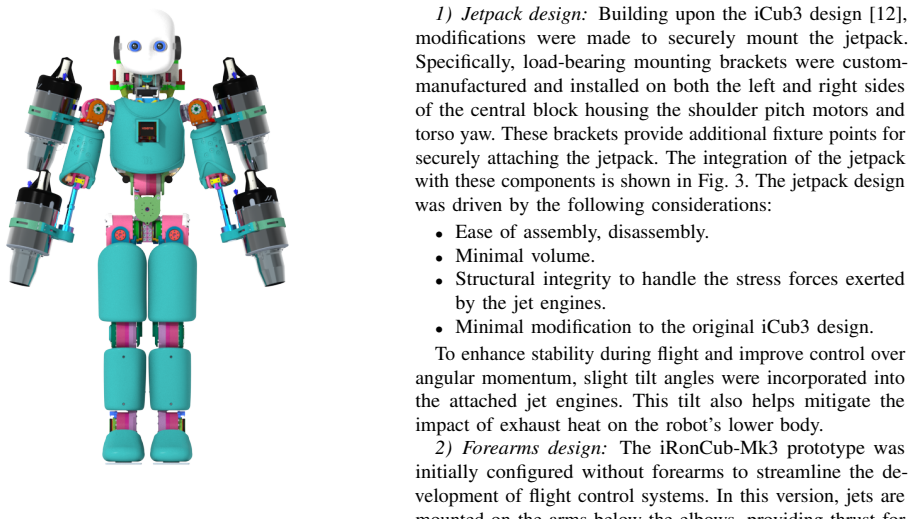
The paper's central claim is that iRonCub-Mk3, a humanoid built on the iCub3 platform and equipped with four small turbojet turbines, achieved liftoff from the ground under jet thrust for the first time. The flight controller is a Linear Parameter Varying Model Predictive Controller that tracks a center-of-mass reference by commanding both joint positions and turbine throttle. During the takeoff phase, the controller uses the centroidal momentum equation modified with a parameter $\alpha$ that scales the fraction of body weight compensated by thrust; when $\alpha$ reaches one, the robot detaches from the ground. In the real experiment the robot maintained roll, pitch, and yaw within about five degrees, drifted roughly 20 cm in one horizontal direction and 60 cm in the other, was airborne for about three seconds, touched down, lifted off again for another three seconds, and then was automatically shut down when orientation error exceeded a threshold. Simulation tests, using the same software, showed the controller tracking a vertical takeoff and a square trajectory with low mean absolute error.
Load-bearing premise
The crane tether and loose safety cables are treated as carrying no significant vertical load, so the observed rise in the z coordinate is credited entirely to jet thrust.
Editorial extensions
If this is right
- A humanoid-shaped body can be lifted off the ground by turbines mounted on its own forearms and back, making aerial humanoid mobility an experimental reality rather than a simulation-only concept.
- The same software stack runs in simulation and on hardware, so the validated simulator can be used to develop more aggressive flight maneuvers before risking the physical platform.
- Attitude can be held within roughly five degrees during a jet-powered liftoff, indicating that orientation stabilization is feasible even under turbine-induced vibration.
- The observed horizontal drift and the double liftoff show that the next step is improving thrust and base-pose estimation rather than re-designing the mechanical platform from scratch.
Reading between the lines
- A direct measurement of tether load share would settle whether the liftoff is fully self-powered; the paper does not instrument the tether, so this is the first check a skeptical reader would run.
- The same $\alpha$ weight-transfer parameter could be extended to transition phases beyond takeoff, such as touchdown and landing, where the robot must hand weight back from thrust to ground contact.
- Because the jet throttle loop runs at 10 Hz while joint control runs at 1000 Hz, the multi-rate coupling is a likely bottleneck for rejecting disturbances; testing with faster turbine actuation or explicit multi-rate control is a natural next experiment.
- If the approach scales, whole-body MPC with centroidal momentum plus actuator-level thrust models could become a general template for other legged platforms equipped with unconventional thrusters.
Editorial analysis
A structured set of objections, weighed in public.
Referee Report
Summary. The paper reports the design, simulation, and first hardware experiments of iRonCub-Mk3, a humanoid robot equipped with four JetCat P250 Pro turbines. The methods include mechanical integration, a UKF-based thrust estimator, base-pose estimation, and a linear parameter-varying MPC. Simulation results show a takeoff and a square trajectory; the hardware experiment reports a roughly 3-second liftoff with horizontal drift, a touchdown, a second liftoff, and an automatic shutdown. The central claim is that this is the first liftoff of a jet-powered humanoid robot.
Significance. If the central claim is substantiated, the paper is a meaningful proof-of-feasibility milestone for aerial humanoid mobility. The manuscript is candid about drift, touchdown, and auto-shutdown, and the description of the outdoor test infrastructure is useful. The FEM analysis with 750 N loads and the use of the same software stack in simulation and hardware are strengths. However, the hardware result rests on the unverified assumption that the crane tether and safety cables carry negligible vertical load, and the simulation validation is incomplete because the error-metric sentence is unfinished. As written, the evidence supports an observed altitude increase under an unmeasured external support configuration, not an unassisted self-powered liftoff.
major comments (4)
- [III and Fig. 12] The central hardware claim is not supported by the reported measurements because the load share of the crane tether and safety cables is never quantified. Section III states that the robot is 'suspended from a 2-meter-high crane' and Fig. 12 shows cables anchored to concrete bollards, but no tether tension, cable slack, or load-cell data are reported. If the tether or cables carried any of the robot's weight, the z increase in Fig. 14 could occur with total jet thrust below body weight. The paper needs either to instrument the tether and report tension/slack during the trial, or to reduce the claim to an observed altitude increase under an unmeasured external support configuration.
- [IV-A] The simulation results section cuts off at 'The Mean Absolute Error (MAE)' with no numeric values, yet the conclusion in Section V states that the robot demonstrated 'accurate tracking with low mean absolute errors.' This is an unsupported claim as written. The authors should report the actual MAE values for the CoM position and orientation tracking in Fig. 13, and should avoid calling the simulation a validation in the absence of those numbers.
- [II-E.1 and IV-B] The alpha parameter in Eq. (2) is a controller-side compensation fraction, not a measured quantity. Alpha reaching one in Fig. 16 means the controller assumes the thrust forces fully compensate the weight term, not that an external force sensor measured zero tether load. Therefore Fig. 16 does not rule out tether assistance, and the text should not imply that alpha indicates detachment or unassisted liftoff.
- [IV-B] The hardware evidence consists of a single trial in which the robot 'stays airborne for roughly 3s, briefly touches down, and then lifts off again' before automatic shutdown. For a first-of-its-kind claim, one trial is suggestive but not sufficient to demonstrate a repeatable controlled liftoff; at minimum, a second trial or a clear statement of the selection criteria for reporting this trial should be provided.
minor comments (4)
- [III] The text describes the robot as both 'suspended from' the crane and 'securely tethered' to it; clarify whether the crane is a load-bearing suspension or a safety restraint, since this distinction is essential to interpreting the experiment.
- [Fig. 14] The caption labels light-blue regions as 'airborne,' but the paper does not define the criterion used to determine the airborne state (e.g., foot-contact sensors, height threshold, or video annotation); this should be stated explicitly.
- [II-C and II-F] The middleware name is spelled 'Y ARP' in two places; it should be 'YARP'.
- [II-E.1] Please report the robot's total mass and the estimated thrust-to-weight ratio; this would contextualize whether the four turbines are capable of self-lift in the first place.
Circularity Check
No significant circularity: the hardware liftoff is an independent observation, and the model-based components are supported by prior test-bench identification rather than by the claim itself.
full rationale
The paper's central claim is an experimental one: that iRonCub-Mk3 achieved a brief, tethered liftoff from the ground under jet thrust (Abstract; Section IV-B; Figs. 14-16). This claim rests on measured quantities — the estimated CoM height increase and the recorded turbine thrust profiles — and is not derived by construction from the controller or the simulation. The jet dynamics model used in the UKF and MPC is cited to the authors' earlier test-bench identification work [16], [17]; that work is itself an empirical system-identification effort, not an ansatz or a restatement of the present liftoff result. The simulation in Section IV-A uses the same software components and the same jet model, and therefore demonstrates internal consistency of the control stack rather than predicting the hardware outcome; but the paper does not dress the simulation up as the experimental result. The parameter alpha in Eq. 2 is a commanded compensation fraction within the take-off controller, not a fitted or measured quantity that is later renamed as a prediction; the liftoff is identified from the measured z trajectory, not from alpha reaching one. The unmeasured tether/crane load sharing is a genuine validity concern for the 'self-powered liftoff' interpretation, but it is an unsupported external assumption, not a circular reduction of the paper's derivation to its own inputs. No step in the paper reduces a claimed result to an equivalent input by definition, by fitted-parameter renaming, or by a load-bearing self-citation chain. Accordingly, no circularity steps are identified.
Assumptions & free parameters
free parameters (2)
- alpha (thrust-weight compensation parameter) =
hand-scheduled 0 to 1 during takeoff
- Jet engine model coefficients =
not reported in this paper
assumptions (3)
- domain assumption Centroidal momentum dynamics are a valid plant model for near-hover whole-body control.
- domain assumption The jet engine thrust model identified on the test bench remains valid on the robot.
- domain assumption The base pose estimate from the IMU and depth camera is accurate enough for closed-loop control.
Cite this review
Pith. "Pith review of iRonCub 3: The Jet-Powered Flying Humanoid Robot." pith.science (2026). https://pith.science/paper/X6NUMB4G
@misc{pith2026250601125,
  author       = {Pith},
  title        = {Pith review of: iRonCub 3: The Jet-Powered Flying Humanoid Robot},
  year         = {2026},
  howpublished = {\url{https://pith.science/paper/X6NUMB4G}},
  note         = {Machine review of arXiv:2506.01125}
}
read the original abstract
This article presents iRonCub 3, a jet-powered humanoid robot, and its first flight experiments. Unlike traditional aerial vehicles, iRonCub 3 aims to achieve flight using a full-body humanoid form, which poses unique challenges in control, estimation, and system integration. We highlight the robot's current mechanical and software architecture, including its propulsion system, control framework, and experimental infrastructure. The control and estimation framework is first validated in simulation by performing a takeoff and tracking a reference trajectory. Then, we demonstrate, for the first time, a liftoff of a jet-powered humanoid robot - an initial but significant step toward aerial humanoid mobility. Also, we detail how the experimental area around a jet-powered humanoid robot should be designed in order to deal with a level of complexity that is substantially superior than indoor humanoid robot experiments.
Figures


Figures from the paper (11 more)


Reference graph
Works this paper leans on
-
[16]
Modeling, identification and control of model jet engines for jet powered robotics
Giuseppe L’Erario, Luca Fiorio, Gabriele Nava, Fabio Bergonti, Hosameldin Awadalla Omer Mohamed, Emilio Benenati, Silvio Traver- saro, and Daniele Pucci. Modeling, identification and control of model jet engines for jet powered robotics. IEEE Robotics and Automation Letters, 5(2):2070–2077, 2020
work page 2020
-
[18]
Unified multi-rate model predictive control for a jet-powered humanoid robot, 2025
Davide Gorbani, Giuseppe L’Erario, Hosameldin Awadalla Omer Mohamed, and Daniele Pucci. Unified multi-rate model predictive control for a jet-powered humanoid robot, 2025
work page 2025
-
[1]
Aerial manipulation: A literature review
Fabio Ruggiero, Vincenzo Lippiello, and Anibal Ollero. Aerial manipulation: A literature review. IEEE Robotics and Automation Letters, 3(3):1957–1964, 2018
work page 1957
-
[2]
A bipedal walking robot that can fly, slackline, and skateboard
Kyunam Kim, Patrick Spieler, Elena-Sorina Lupu, Alireza Ramezani, and Soon-Jo Chung. A bipedal walking robot that can fly, slackline, and skateboard. Science Robotics , 6(59):eabf8136, 2021
work page 2021
-
[3]
Zhifeng Huang, Biao Liu, Jiapeng Wei, Qingsheng Lin, Jun Ota, and Yun Zhang. Jet-hr1: Two-dimensional bipedal robot step over large obstacle based on a ducted-fan propulsion system. In 2017 IEEE-RAS 17th International Conference on Humanoid Robotics (Humanoids) , pages 406–411, 2017
work page 2017
-
[4]
Guillermo Heredia, Antonio Enrique Jimenez-Cano, I. Sanchez, D. Llorente, V ´ıctor M. Vega, J. Braga, Jos ´e ´Angel Acosta, and Anibal Ollero. Control of a multirotor outdoor aerial manipulator. In 2014 IEEE/RSJ International Conference on Intelligent Robots and Systems , pages 3417–3422, Sep. 2014
work page 2014
-
[5]
A novel hexapod robot design with flight capability
Mark Pitonyak and Ferat Sahin. A novel hexapod robot design with flight capability. In 2017 12th System of Systems Engineering Conference (SoSE), pages 1–6, June 2017
work page 2017
-
[6]
Design and experimental validation of hytaq, a hybrid terrestrial and aerial quadrotor
Arash Kalantari and Matthew Spenko. Design and experimental validation of hytaq, a hybrid terrestrial and aerial quadrotor. In 2013 IEEE International Conference on Robotics and Automation , pages 4445–4450, May 2013
work page 2013
Show all 21 references
-
[7]
Aerial and terrestrial locomotion control of lift assisted insect biobots
Alper Bozkurt, Amit Lal, and Robert Gilmour. Aerial and terrestrial locomotion control of lift assisted insect biobots. In 2009 Annual International Conference of the IEEE Engineering in Medicine and Biology Society , pages 2058–2061, Sept 2009
2009
-
[8]
A bioinspired multi-modal flying and walking robot
Ludovic Daler, Stefano Mintchev, Cesare Stefanini, and Dario Floreano. A bioinspired multi-modal flying and walking robot. Bioinspiration & Biomimetics, 10(1):016005, 2015
2015
-
[9]
A flying robot with adaptive morphology for multi-modal locomotion
Ludovic Daler, Julien Lecoeur, Patrizia Bernadette H ¨ahlen, and Dario Floreano. A flying robot with adaptive morphology for multi-modal locomotion. In 2013 IEEE/RSJ Int. Conf. on Intelligent Robots and Systems, pages 1361–1366, Nov 2013
2013
-
[10]
Momentum control of an underactuated flying humanoid robot
Daniele Pucci, Silvio Traversaro, and Francesco Nori. Momentum control of an underactuated flying humanoid robot. IEEE Robotics and Automation Letters , 3(1):195–202, 2018
2018
-
[11]
Position and attitude control of an underactuated flying humanoid robot
Gabriele Nava, Luca Fiorio, Silvio Traversaro, and Daniele Pucci. Position and attitude control of an underactuated flying humanoid robot. In 2018 IEEE-RAS 18th International Conference on Humanoid Robots (Humanoids) , pages 1–9, 2018
2018
-
[12]
icub3 avatar system: Enabling remote fully immersive embodiment of humanoid robots
Stefano Dafarra, Ugo Pattacini, Giulio Romualdi, Lorenzo Rapetti, Riccardo Grieco, Kourosh Darvish, Gianluca Milani, Enrico Valli, Ines Sorrentino, Paolo Maria Viceconte, et al. icub3 avatar system: Enabling remote fully immersive embodiment of humanoid robots. Science Robotic...
2024
-
[13]
Momentum-based extended kalman filter for thrust estimation on flying multibody robots
Hosameldin Awadalla Omer Mohamed, Gabriele Nava, Giuseppe L’Erario, Silvio Traversaro, Fabio Bergonti, Luca Fiorio, Punith Reddy Vanteddu, Francesco Braghin, and Daniele Pucci. Momentum-based extended kalman filter for thrust estimation on flying multibody robots. IEEE Robotic...
2022
-
[14]
A middle way for robotics middleware
Paul Fitzpatrick, Elena Ceseracciu, Daniele E Domenichelli, Ali Paikan, Giorgio Metta, and Lorenzo Natale. A middle way for robotics middleware. Journal of Software Engineering for Robotics , 5(2):42–49, 2014
2014
-
[15]
Nonlinear in-situ calibration of strain-gauge force/torque sensors for humanoid robots
Hosameldin Awadalla Omer Mohamed, Gabriele Nava, Punith Reddy Vanteddu, Francesco Braghin, and Daniele Pucci. Nonlinear in-situ calibration of strain-gauge force/torque sensors for humanoid robots. In 2023 IEEE-RAS 22nd International Conference on Humanoid Robots (Humanoids), ...
2023
-
[17]
Nonlinear model identification and observer design for thrust estimation of small-scale turbojet engines
Affaf Junaid Ahamad Momin, Gabriele Nava, Giuseppe L’Erario, Hosameldin Awadalla Omer Mohamed, Fabio Bergonti, Punith Reddy Vanteddu, Francesco Braghin, and Daniele Pucci. Nonlinear model identification and observer design for thrust estimation of small-scale turbojet engines....
2022
-
[19]
Centroidal dynamics of a humanoid robot
David E Orin, Ambarish Goswami, and Sung-Hee Lee. Centroidal dynamics of a humanoid robot. Autonomous robots, 35:161–176, 2013
2013
-
[20]
Design and use paradigms for gazebo, an open-source multi-robot simulator
Nathan Koenig and Andrew Howard. Design and use paradigms for gazebo, an open-source multi-robot simulator. In 2004 IEEE/RSJ international conference on intelligent robots and systems (IROS)(IEEE Cat. No. 04CH37566) , volume 3, pages 2149–2154. Ieee, 2004
2004
-
[21]
Yarp based plugins for gazebo simulator
Enrico Mingo Hoffman, Silvio Traversaro, Alessio Rocchi, Mirko Ferrati, Alessandro Settimi, Francesco Romano, Lorenzo Natale, Antonio Bicchi, Francesco Nori, and Nikos G Tsagarakis. Yarp based plugins for gazebo simulator. In Modelling and Simulation for Autonomous Systems: Fi...
2014
Reviewed August 7, 2026 · model on record in the stance chip above.
Discussion (0). Sign in to comment.