Kaonic Copper and Fluorine Absolute Yields Measurement with a CZT-based Detection System at DAΦNE
Pith reviewed 2026-05-19 17:25 UTC · model grok-4.3
The pith
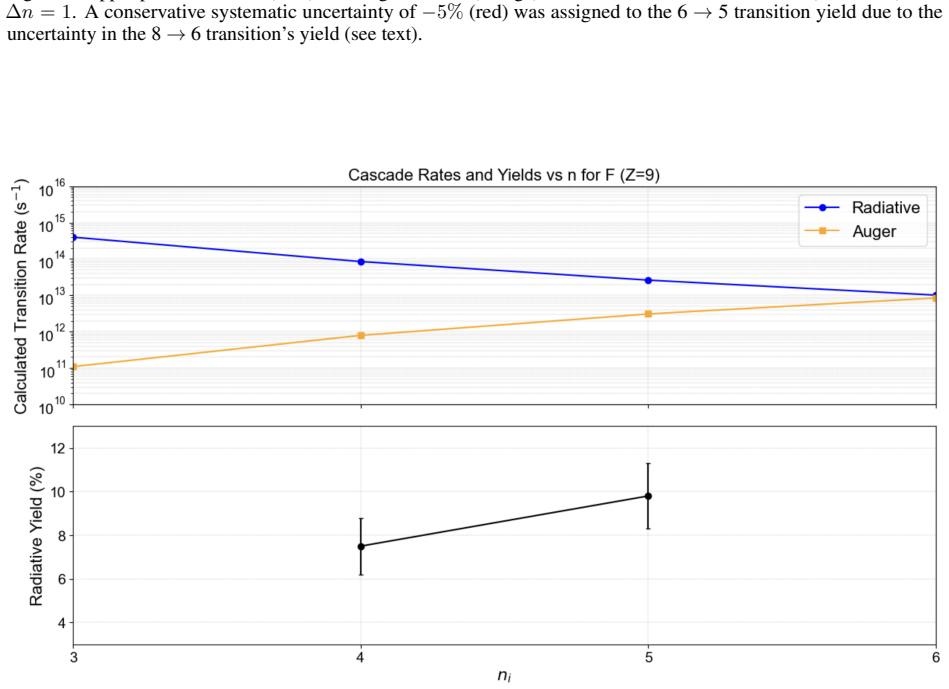
Absolute X-ray yields for kaonic copper and fluorine show strong-interaction effects beginning at the n=4 level in fluorine.
A machine-rendered reading of the paper's core claim, the machinery that carries it, and where it could break.
Core claim
The central claim is that absolute yields per stopped kaon have been determined for several X-ray transitions in kaonic copper and fluorine, and that the observed suppression of the 4→3 yield in fluorine constitutes evidence for the onset of strong-interaction effects at n=4, from which a conservative lower bound on the strong-interaction width is derived.
What carries the argument
Absolute yield per stopped kaon for each observed X-ray line, obtained by dividing background-subtracted counts by the detection efficiency calculated with a dedicated Geant4 Monte Carlo model of the entire experimental setup.
If this is right
- Cascade models for exotic atoms must incorporate strong-interaction effects already at n=4 for light systems such as fluorine.
- Experimental studies can now reach intermediate atomic levels where strong-interaction modifications are present but not directly visible through energy shifts or widths.
- CZT detectors enable high-resolution X-ray spectroscopy of kaonic atoms in collider environments without cryogenic cooling.
- New quantitative constraints are available for refining predictions of radiative and Auger rates in the presence of nuclear capture.
Where Pith is reading between the lines
- The same CZT-based method could be applied to other light kaonic atoms to map how the onset of strong-interaction effects changes with nuclear charge.
- The derived lower limit on the n=4 width supplies a concrete benchmark that theoretical kaon-nucleus potential models can be tested against.
- If the suppression pattern is confirmed in additional data sets, it would motivate dedicated measurements aimed at extracting the actual width rather than only its lower bound.
Load-bearing premise
The Geant4 Monte Carlo simulation of the full experimental setup accurately determines the detection efficiencies for the observed X-ray transitions.
What would settle it
A direct measurement of the strong-interaction width at the n=4 level in kaonic fluorine that lies below the reported lower limit would falsify the interpretation of the yield suppression as evidence for strong-interaction effects.
Figures


read the original abstract
\noindent In this work, new measurements of absolute X-ray yields for several transitions in kaonic copper and, for the first time, in kaonic fluorine are reported. The data were collected by the SIDDHARTA-2 collaboration at the DA$\Phi$NE collider using a novel room-temperature Cadmium Zinc Telluride (CZT) detection system. Detection efficiencies were evaluated through a dedicated Geant4 Monte Carlo simulation of the full experimental setup, enabling the extraction of absolute yields per stopped kaon. \noindent The measured yields exhibit a systematic dependence on the principal quantum number, reflecting the interplay between radiative transitions, Auger de-excitation, and strong-interaction-induced nuclear capture. In kaonic fluorine, a suppression of the 4$\to$3 transition yield relative to higher-n transitions is observed, providing evidence for the onset of strong-interaction effects already at the $n=4$ level. From this behaviour, a conservative lower limit on the corresponding strong-interaction width is derived. \noindent These results provide new quantitative constraints for cascade models of exotic atoms and extend experimental access to intermediate atomic levels where strong-interaction effects are not directly observable via level shifts and widths. They also establish CZT-based detection as a powerful and versatile approach for high-resolution X-ray spectroscopy of kaonic atoms in collider environments.
Editorial analysis
A structured set of objections, weighed in public.
Referee Report
Summary. The paper reports new absolute X-ray yields for several transitions in kaonic copper and, for the first time, in kaonic fluorine, measured with a CZT-based detector at DAΦNE by the SIDDHARTA-2 collaboration. Efficiencies are obtained from a dedicated Geant4 Monte Carlo simulation of the full setup to convert observed counts into yields per stopped kaon. The yields show a systematic n-dependence; in fluorine a suppression of the 4→3 transition relative to higher-n lines is interpreted as the onset of strong-interaction effects at n=4, from which a conservative lower limit on the corresponding strong-interaction width is derived.
Significance. If the simulation-based efficiencies are shown to be reliable, the results would supply new quantitative constraints on cascade models for exotic atoms and extend experimental access to intermediate levels where strong-interaction effects first appear but are not yet visible in shifts or widths. The demonstration of a room-temperature CZT system for high-resolution kaonic-atom spectroscopy in a collider environment would also be of technical interest for future measurements.
major comments (1)
- [Abstract / Data Analysis] Abstract and data-analysis section: the central extraction of absolute yields per stopped kaon and the reported suppression of the 4→3 transition in fluorine both rest on the Geant4-derived efficiencies. No numerical results, error budgets, or validation of the simulation (e.g., against radioactive sources, known kaonic-hydrogen lines, or empty-target runs) are provided, leaving the systematic uncertainty on solid angle, attenuation, energy-dependent CZT response, and kaon-stopping distribution unquantified. This directly scales all reported yields and therefore the relative suppression used to set the lower limit on the strong-interaction width.
Simulated Author's Rebuttal
We thank the referee for the careful reading of the manuscript, the positive evaluation of its significance, and the recommendation for major revision. We agree that additional details on the Geant4 simulation and its validation are required to strengthen the presentation of the absolute yields and the derived lower limit. We address the major comment below and will incorporate the necessary revisions.
read point-by-point responses
-
Referee: [Abstract / Data Analysis] Abstract and data-analysis section: the central extraction of absolute yields per stopped kaon and the reported suppression of the 4→3 transition in fluorine both rest on the Geant4-derived efficiencies. No numerical results, error budgets, or validation of the simulation (e.g., against radioactive sources, known kaonic-hydrogen lines, or empty-target runs) are provided, leaving the systematic uncertainty on solid angle, attenuation, energy-dependent CZT response, and kaon-stopping distribution unquantified. This directly scales all reported yields and therefore the relative suppression used to set the lower limit on the strong-interaction width.
Authors: We agree that the current manuscript lacks sufficient detail on the efficiency determination and its validation. In the revised version we will add a dedicated subsection to the data-analysis section that describes the Geant4 model of the full DAΦNE setup, including the kaon beam line, target, and CZT detector array. Numerical efficiency values for each transition (with statistical and systematic uncertainties) will be tabulated. Validation will be presented through comparisons with calibration data from radioactive sources positioned at the target location and with known kaonic-hydrogen X-ray lines recorded in earlier SIDDHARTA runs. The systematic uncertainty budget will explicitly quantify contributions from solid-angle coverage, material attenuation, energy-dependent CZT response, and the kaon-stopping distribution (obtained from both simulation and empty-target runs). These updated uncertainties will be propagated to the absolute yields and to the relative suppression factor used for the fluorine lower-limit estimate, allowing readers to assess the robustness of the result. revision: yes
Circularity Check
No circularity: absolute yields extracted from data counts divided by independent Geant4 efficiencies
full rationale
The paper is a pure experimental measurement reporting absolute X-ray yields per stopped kaon for kaonic copper and fluorine transitions. Yields are obtained by dividing observed peak areas by detection efficiencies computed from a dedicated Geant4 Monte Carlo simulation of the full setup; this is a standard, externally modelable conversion step that does not reduce to a fitted parameter or self-definition by construction. No derivation chain, uniqueness theorem, ansatz smuggling, or self-citation load-bearing is invoked. The reported suppression in the fluorine 4→3 yield and the derived lower limit on strong-interaction width follow directly from the measured ratios once efficiencies are applied, with no evidence that the simulation was tuned on the same dataset used for the yields. The work is therefore self-contained against external benchmarks.
Axiom & Free-Parameter Ledger
axioms (2)
- domain assumption The Geant4 Monte Carlo accurately models photon transport, detector response, and geometry of the SIDDHARTA-2 setup at DAΦNE.
- standard math Radiative transitions, Auger de-excitation, and strong-interaction nuclear capture are the dominant processes determining X-ray yields in kaonic atoms.
Lean theorems connected to this paper
-
IndisputableMonolith/Cost/FunctionalEquation.leanwashburn_uniqueness_aczel unclear?
unclearRelation between the paper passage and the cited Recognition theorem.
Detection efficiencies were evaluated through a dedicated Geant4 Monte Carlo simulation of the full experimental setup, enabling the extraction of absolute yields per stopped kaon.
-
IndisputableMonolith/Foundation/AbsoluteFloorClosure.leanreality_from_one_distinction unclear?
unclearRelation between the paper passage and the cited Recognition theorem.
From this behaviour, a conservative lower limit on the corresponding strong-interaction width is derived.
What do these tags mean?
- matches
- The paper's claim is directly supported by a theorem in the formal canon.
- supports
- The theorem supports part of the paper's argument, but the paper may add assumptions or extra steps.
- extends
- The paper goes beyond the formal theorem; the theorem is a base layer rather than the whole result.
- uses
- The paper appears to rely on the theorem as machinery.
- contradicts
- The paper's claim conflicts with a theorem or certificate in the canon.
- unclear
- Pith found a possible connection, but the passage is too broad, indirect, or ambiguous to say the theorem truly supports the claim.
Reference graph
Works this paper leans on
-
[1]
E. Friedman, A. Gal, C. J. Batty, Density dependent K- nuclear optical potentials from kaonic atoms, Nucl. Phys. A 579 (1994) 518–538.doi:10.1016/0375-9474(94)90921-0
-
[2]
C. J. Batty, E. Friedman, A. Gal, Strong interaction physics from hadronic atoms, Phys. Rept. 287 (1997) 385–445. doi:10.1016/S0370-1573(97)00011-2
-
[3]
On the pole content of coupled channels chiral approaches used for the $\bar{K}N$ system
A. Ciepl´y, M. Mai, U.-G. Meißner, J. Smejkal, On the pole content of coupled channels chiral approaches used for the ¯KN system, Nucl. Phys. A 954 (2016) 17–40. arXiv:1603.02531, doi:10.1016/j.nuclphysa.2016. 04.031
work page internal anchor Pith review Pith/arXiv arXiv doi:10.1016/j.nuclphysa.2016 2016
-
[4]
Curceanu, et al., The modern era of light kaonic atom experiments, Rev
C. Curceanu, et al., The modern era of light kaonic atom experiments, Rev. Mod. Phys. 91 (2) (2019) 025006. doi:10.1103/RevModPhys.91.025006
-
[5]
F. Artibani, et al., The Odyssey of Kaonic Atoms Studies at the DAΦNE Collider: From DEAR to SIDDHARTA-2, Acta Phys. Polon. B 55 (5) (2024) 5–A2.doi:10.5506/APhysPolB.55.5-A2
-
[6]
J. Zmeskal, From kaonic atoms to kaonic nuclei: A search for antikaon-mediated bound nuclear systems, Prog. Part. Nucl. Phys. 61 (2008) 512–550.doi:10.1016/j.ppnp.2008.02.002
-
[7]
T. Aramaki, et al., A Measurement of Atomic X-ray Yields in Exotic Atoms and Implications for an Antideuteron-Based Dark Matter Search, Astropart. Phys. 49 (2013) 52–62. arXiv:1303.3871, doi:10.1016/ j.astropartphys.2013.08.003
work page internal anchor Pith review Pith/arXiv arXiv 2013
-
[8]
T. E. O. Ericson, F. Scheck, K- nuclear interactions and yields of kaonic x-rays, Nucl. Phys. B 19 (1970) 450–476. doi:10.1016/0550-3213(70)90361-5
-
[9]
C. Curceanu, F. Sgaramella, M. Bazzi, T. Hashimoto, M. Iliescu, A. Scordo, D. Sirghi, F. Sirghi, Light kaonic atoms as probes of fundamental interactions in strange systems, Prog. Part. Nucl. Phys. 147 (2026) 104226. doi:10.1016/j.ppnp.2026.104226
-
[10]
Feasibility guidelines for kaonic-atom experiments with ultra-high-resolution X-ray spectrometry
E. Friedman, S. Okada, Feasibility guidelines for kaonic-atom experiments with ultra-high-resolution X-ray spectrometry, Nucl. Phys. A 915 (2013) 170–178. arXiv:1306.4147, doi:10.1016/j.nuclphysa.2013.07. 005
work page internal anchor Pith review Pith/arXiv arXiv doi:10.1016/j.nuclphysa.2013.07 2013
-
[11]
J. ´Obertov´a, `A. Ramos, J. Mareˇs, Antikaon absorption in the nuclear medium: The role of hadron self-energies and implications for kaonic atoms, Phys. Rev. C 112 (5) (2025) 055201. arXiv:2508.07921, doi:10.1103/ xqs5-v55b
-
[12]
V . E. Markushin, T. S. Jensen, Atomic cascade and X-ray yields in light exotic atoms, Nucl. Phys. A 691 (2001) 318–321.doi:10.1016/S0375-9474(01)01051-X
-
[13]
T. Koike, Cascade Calculation of Kaonic Nitrogen Atoms Involving the Electron Refilling Process, in: 3rd Asia Pacific Conference on Few-Body Problems in Physics (APFB05), 2007, pp. 171–174. doi:10.1142/ 9789812706881_0032
work page 2007
-
[14]
Ishiwatari, et al., Kaonic nitrogen X-ray transition yields in a gaseous target, Phys
T. Ishiwatari, et al., Kaonic nitrogen X-ray transition yields in a gaseous target, Phys. Lett. B 593 (2004) 48–54. doi:10.1016/j.physletb.2004.04.055
-
[15]
X-ray transition yields of low-Z kaonic atoms produced in Kapton
M. Bazzi, et al., X-ray transition yields of low-Z kaonic atoms produced in Kapton, Nucl. Phys. A 916 (2013) 30–47.arXiv:1306.5912,doi:10.1016/j.nuclphysa.2013.07.007
work page internal anchor Pith review Pith/arXiv arXiv doi:10.1016/j.nuclphysa.2013.07.007 2013
-
[16]
$K$-series X-ray yield measurement of kaonic hydrogen atoms in a gaseous target
M. Bazzi, et al., K-series X-ray yield measurement of kaonic hydrogen atoms in a gaseous target, Nucl. Phys. A 954 (2016) 7–16.arXiv:1603.00094,doi:10.1016/j.nuclphysa.2016.03.047. 14 Kaonic Copper and Fluorine Absolute Yields Measurement with a CZT-based Detection System at DAΦNE
work page internal anchor Pith review Pith/arXiv arXiv doi:10.1016/j.nuclphysa.2016.03.047 2016
-
[17]
F. Sgaramella, et al., Kaonic Helium-4 L-series Yield Measurement at 2.25 g/l Density by SIDDHARTA-2 at DAΦNE, Acta Phys. Polon. Supp. 17 (1) (2024) 1–A8.doi:10.5506/APhysPolBSupp.17.1-A8
-
[18]
Sgaramella, et al., High precision X-ray spectroscopy of kaonic neon, Phys
F. Sgaramella, et al., High precision X-ray spectroscopy of kaonic neon, Phys. Lett. B 865 (2025) 139492. arXiv:2412.16101,doi:10.1016/j.physletb.2025.139492
-
[19]
Milardi, et al., Present status of the DAFNE upgrade and perspectives, Int
C. Milardi, et al., Present status of the DAFNE upgrade and perspectives, Int. J. Mod. Phys. A 24 (2009) 360–368. doi:10.1142/S0217751X09043687
-
[20]
C. Milardi, et al., Preparation Activity for the Siddharta-2 Run at DAΦNE, in: 9th International Particle Accelerator Conference, IPAC2018, Vancouver BC Canada, 2018.doi:10.18429/JACoW-IPAC2018-MOPMF088
-
[21]
Milardi, et al., DAΦNE Commissioning for SIDDHARTA-2 Experiment, JACoW IPAC2021 (2021) TUPAB001
C. Milardi, et al., DAΦNE Commissioning for SIDDHARTA-2 Experiment, JACoW IPAC2021 (2021) TUPAB001. doi:10.18429/JACoW-IPAC2021-TUPAB001
-
[22]
C. Milardi, et al., DAFNE operation strategy for the observation of the kaonic deuterium, JACoW IPAC2024 (2024) WEPR17.doi:10.18429/JACoW-IPAC2024-WEPR17
-
[23]
F. Sirghi, et al., SIDDHARTA-2 apparatus for kaonic atoms research on the DAΦNE collider, JINST 19 (11) (2024) P11006.arXiv:2311.16144,doi:10.1088/1748-0221/19/11/P11006
-
[24]
L. Abbene, G. Gerardi, High-rate dead-time corrections in a general purpose digital pulse processing system, Journal of Synchrotron Radiation 22 (5) (2015) 1190–1201, publisher: International Union of Crystallography. doi:10.1107/S1600577515013776. URL//scripts.iucr.org/cgi-bin/paper?pp5071
-
[25]
L. Abbene, G. Gerardi, G. Raso, F. Principato, N. Zambelli, G. Benassi, M. Bettelli, A. Zappettini, Development of new CdZnTe detectors for room-temperature high-flux radiation measurements, J Synchrotron Rad 24 (2) 429–438, publisher: International Union of Crystallography.doi:10.1107/S1600577517000194. URL//scripts.iucr.org/cgi-bin/paper?pp5097
-
[26]
L. Abbene, F. Principato, G. Gerardi, A. Buttacavoli, D. Cascio, M. Bettelli, N. S. Amad `e, P. Seller, M. C. Veale, O. Fox, K. Sawhney, S. Zanettini, E. Tomarchio, A. Zappettini, Room-temperature x-ray response of cadmium–zinc–telluride pixel detectors grown by the vertical bridgman technique 27 (2) 319–328, publisher: International Union of Crystallogra...
-
[27]
Skurzok, et al., Characterization of the SIDDHARTA-2 luminosity monitor, JINST 15 (10) (2020) P10010
M. Skurzok, et al., Characterization of the SIDDHARTA-2 luminosity monitor, JINST 15 (10) (2020) P10010. arXiv:2008.05472,doi:10.1088/1748-0221/15/10/P10010
-
[28]
L. Abbene, et al., First Stability Characterization for a CZT Detection System in an e+e− Collider Environment, Sensors 24 (23) (2024) 7562.arXiv:2410.11294,doi:10.3390/s24237562
-
[29]
F. Artibani, et. al., Time-based selection of kaonic atom x-ray events with quasi-hemispherical czt detectors at the daϕne collider, Measurement Science and Technology 37 (3) (2026) 035108. doi:10.1088/1361-6501/ ae3203. URLhttps://doi.org/10.1088/1361-6501/ae3203
-
[30]
J. P. Santos, F. Parente, S. Boucard, P. Indelicato, J. P. Desclaux, X-ray energies of circular transitions and electron screening in kaonic atoms, Physical Review A 71 (3) (2005) 032501, publisher: American Physical Society. doi:10.1103/PhysRevA.71.032501. URLhttps://link.aps.org/doi/10.1103/PhysRevA.71.032501
-
[31]
C. E. Wiegand, Measurement of k-minus-mesonic x-ray spectra of medium and heavy elements, Phys. Rev. Lett. 22 (1969) 1235–1238.doi:10.1103/PhysRevLett.22.1235
-
[32]
C. E. Wiegand, G. L. Godfrey, MEASUREMENTS OF X-RAYS AND gamma RAYS FROM STOPPED KAONS, Phys. Rev. A 9 (1974) 2282.doi:10.1103/PhysRevA.9.2282. 15 Kaonic Copper and Fluorine Absolute Yields Measurement with a CZT-based Detection System at DAΦNE
-
[33]
Sgaramella, et al., First measurement of kaonic helium-4 M-series transitions, J
F. Sgaramella, et al., First measurement of kaonic helium-4 M-series transitions, J. Phys. G 51 (5) (2024) 055103. arXiv:2310.20584,doi:10.1088/1361-6471/ad34ea
-
[34]
G. R. Burbidge, A. H. de Borde, The mesonic auger effect, Phys. Rev. 89 (1953) 189–193. doi:10.1103/ PhysRev.89.189. URLhttps://link.aps.org/doi/10.1103/PhysRev.89.189
-
[35]
Manti, et al., Precision test of bound-state QED at intermediate Z with kaonic neon, Phys
S. Manti, et al., Precision test of bound-state QED at intermediate Z with kaonic neon, Phys. Rev. A 113 (2) (2026) 022815.arXiv:2508.08161,doi:10.1103/rry5-tdqb
-
[36]
J. ´Obertov´a, E. Friedman, J. Mareˇs, A. Ramos, On K −-nuclear interaction, K −-nuclear quasibound states and K − atoms, EPJ Web Conf. 271 (2022) 07003.doi:10.1051/epjconf/202227107003. 16
discussion (0)
Sign in with ORCID, Apple, or X to comment. Anyone can read and Pith papers without signing in.