REVIEW 4 major objections 5 minor 68 references
Hierarchically-Refined Label Attention Network for Sequence Labeling
T0 review · 4 major / 5 minor · reviewed 2026-08-14 · deepseek-v4-flash
Pith's one-line read Stacked attention over label embeddings, refined layer by layer, gives sequence taggers higher accuracy than BiLSTM-CRF while decoding in time linear in the number of labels.
desk verdict A fresh output-layer architecture with real speed gains, but the 'similar parameters, better accuracy' headline dies on the paper's own dev table; still merits review. read the letter →
The pith
A machine-rendered reading of the paper's core claim, the machinery that carries it, and where it could break.
The reading
What carries the argument
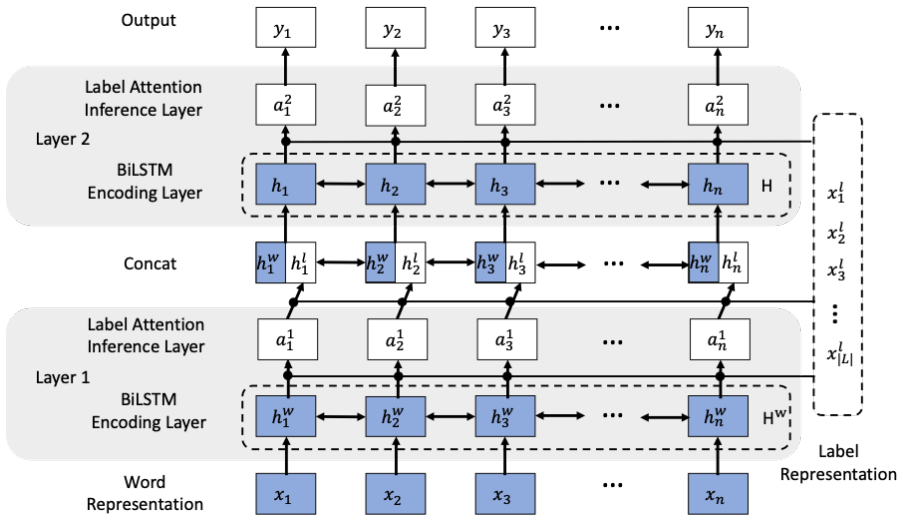
The load-bearing mechanism is the label-attention sublayer: a learnable label embedding matrix $X^l \in \mathbb{R}^{|L|\times d_h}$ serves as both keys and values, the BiLSTM hidden states $H^w$ serve as queries, and multi-head scaled dot-product attention produces $\alpha = \mathrm{softmax}(QK^T/\sqrt{d_h})$, a per-word distribution over labels. The layer output is $H = [H^w; H^l]$ with $H^l = \alpha V$ plus residual, feeding the refined distribution into the next stacked layer. This turns the softmax output layer itself into a recurrent refinement step: each layer's label distribution becomes input representation for the next, propagating long-range label information while decoding remains a per-word argmax with no Viterbi search.
What would settle it
Train BiLSTM-LAN, BiLSTM-softmax, and BiLSTM-CRF on a synthetic tagging corpus in which the correct tag of a late word is dictated by a far-earlier word (for example, positions 1 and 20 must share a tag) and local cues are deliberately uninformative; if LAN does not beat softmax and approach the long-range CRF oracle, the claimed mechanism of hierarchical refinement is not capturing long-distance label dependencies.
Extended reading notes
Core claim
The central discovery is the hierarchically-refined label attention network (BiLSTM-LAN), a multi-layer tagger in which each layer contains a BiLSTM encoder and a label-attention inference sublayer. The sublayer treats the label embedding matrix as keys and values, computes scaled dot-product attention from the BiLSTM hidden states, and reads off a softmax label distribution for each word; the weighted sum of label embeddings is concatenated with the hidden state and passed to the next layer. Repeating this refines each word's marginal label distribution using increasingly global information, so the model represents label-sequence structure without enumerating label sequences or assuming Markov transitions. A single-layer LAN is identical to BiLSTM-softmax, so the observed gains come from hierarchical refinement rather than from label embeddings alone. The paper reports significant accuracy gains over BiLSTM-CRF and BiLSTM-softmax on WSJ POS tagging, eight UD treebanks, OntoNotes 5.0 NER, and CCGBank, with decoding complexity $O(|L|n)$ rather than $O(|L|^2 n)$.
Load-bearing premise
The architecture's accuracy rests on assuming that several rounds of refining each word's label probabilities can encode how labels constrain one another across a sentence, even though no step ever enforces a globally consistent label sequence.
Editorial extensions
If this is right
- Because decoding is $O(|L|n)$ instead of $O(|L|^2 n)$, the model makes tasks with very large label inventories, such as CCG supertagging with hundreds of categories, substantially cheaper at both training and test time.
- Any BiLSTM-softmax tagger can be converted into a LAN by stacking LAN layers over the same label embedding table, turning the output layer into a refinement module without changing the training objective.
- The reported gains on all eight multilingual treebanks suggest the refinement mechanism transfers across languages and tag sets, not just English.
- Because a single-layer LAN reduces to BiLSTM-softmax, improvements are attributable to hierarchical refinement rather than to label embeddings alone, as the ablation study shows.
- The visualizable label embeddings and attention weights give an interpretable view of tag similarity and model decisions, which CRF transition matrices do not directly offer.
Reading between the lines
- A natural testable extension is to put LAN layers on top of a pretrained transformer encoder; the paper only experiments with BiLSTM encoders, so it does not show whether iterative label refinement still helps when the encoder already produces strong contextual representations.
- The layer-by-layer refinement can be viewed as amortized approximate inference over label marginals, similar in spirit to mean-field updates on a label graph; comparing LAN's marginals to those of a chain CRF on simple synthetic sequences would show whether the stack is approximating the same distribution.
- Since the final prediction is a per-word argmax, LAN outputs can violate hard label-transition constraints that a CRF would enforce, such as NER tag-scheme patterns; a concrete check is to count illegal transitions in LAN predictions on OntoNotes.
- The complexity result is stated in terms of label count, so the practical speed advantage should be largest for tasks with very large label sets and short sequences, which is exactly the CCG supertagging regime the paper tests.
Signed reviews
Editorial analysis
A structured set of objections, weighed in public.
Referee Report
Summary. The manuscript proposes BiLSTM-LAN, a stacked sequence labeling architecture in which each layer adds an attention sublayer over learned label embeddings; the attention weight matrix is interpreted as a per-word marginal label distribution and is fed hierarchically to the next layer. The authors argue that this hierarchical refinement captures long-range label dependencies without CRF's Markov transitions, and claim accuracy gains over BiLSTM-CRF and BiLSTM-softmax at similar parameter counts, with decoding complexity O(|L|n). Experiments cover English and multilingual POS tagging, OntoNotes 5.0 NER, and CCG supertagging, with code released. The paper also includes visualizations of label embeddings and attention weights.
Significance. If the central claims hold, BiLSTM-LAN is a useful alternative to CRF output layers for neural sequence labeling: it offers interpretable label distributions, an asymptotic decoding speedup, and competitive accuracy on several benchmarks. Strengths include the breadth of the empirical study, the release of code, and the explicit ablation of the attention sublayer. However, the 'similar number of parameters' claim and the statistical support need to be tightened before the contribution is fully established, and the theoretical statement about label bias is currently unsupported.
major comments (4)
- [Section 5.3, Table 2] The claim in the abstract and Section 1 that BiLSTM-LAN improves accuracy 'with similar number of parameters' is not supported by the paper's own development results. The best LAN configuration (label embedding 400, hidden 400, 3 layers) reaches 97.63 with 10.0M parameters, while the best CRF configuration (400/1) reaches 97.57 with 5.5M parameters, and at a matched budget LAN 200/3 (5.7M) achieves 97.53, below CRF. Tables 5, 7, 8, and 9 never report baseline parameter counts, so the reader cannot verify the matched-size assertion. Please add parameter-matched comparisons and report parameter counts for all final systems.
- [Section 7 and Sections 4.4-4.5] The conclusion asserts 'in theory and empirical results prove that BiLSTM-LAN effective solve label bias issue,' but the paper contains no formal treatment of label bias. Section 4.5 only establishes that a single-layer LAN is equivalent to BiLSTM-softmax, and Section 4.2 defines the attention computation; no argument shows that the stacked locally normalized marginals converge to, or approximate, the globally consistent label sequence distribution. Please either remove the theory claim or provide a concrete analysis, such as a comparison with CRF marginals on a simple chain, that substantiates it.
- [Section 5.4, Tables 8-9] Statistical significance is claimed at p<0.01 for NER and CCG supertagging, but no variance, number of runs, or test procedure is reported for these tasks; Table 5 provides mean plus standard deviation for POS only. Without specifying the paired or comparison test and the run-to-run variance, the significance claims for NER and CCG cannot be evaluated. Please report repeated-run statistics or explicitly state which single-run comparison is used.
- [Section 4.2] The multi-head attention formulation and the final output equation are ambiguous. It is not specified which attention matrix alpha is used for the final prediction when k>1 heads are concatenated, and the output equation appears to identify alpha with the full |L| x n matrix even though multi-head attention produces k such matrices. In addition, the definitions of Q, K, and V are not updated to account for the projection matrices WQ_i, WK_i, and WV_i, which makes the dimensions in 'Hl = concat(head_1,...,head_k) + Hw' unclear. Please rewrite this passage with exact tensor dimensions and specify how the final label distribution is derived from the last layer's attention heads.
minor comments (5)
- [Table 3] The ablation 'LAN w/o attention' does not control for parameter count, since removing attention sublayers changes model size; the comparison therefore conflates architecture with capacity. Please report parameter counts for both variants.
- [Global] There are several typographical errors, including 'In paticular' in Section 4.2, 'effective solve label bias issue' in Section 7, and 'Tabel 11' in Appendix A. These should be corrected.
- [Section 4.2] In the output equation, the subscripts of y are inconsistent: the matrix uses columns for labels while the argmax expression indexes positions over n. Please use consistent indexing.
- [Table 5] The caption says 'Our results are same as Table 6 of Yang et al. (2018)' but Table 6 reports different numbers for that baseline; please clarify whether this refers to the implementation or to an exact reproduction.
- [Figures 1 and 2] The figures are hard to read: axis labels, hidden-state dimensions, and the attention-weight values are not clearly defined. Consider higher-resolution figures with explicit notation.
Circularity Check
No significant circularity: the paper's central claims are empirical benchmark comparisons, and no equation reduces the claimed result to fitted parameters or to definitional equivalences.
full rationale
The paper's central claim is an empirical architecture comparison: BiLSTM-LAN improves tagging accuracy and speed over BiLSTM-CRF and BiLSTM-softmax. Section 4.5 explicitly notes that a single-layer BiLSTM-LAN is identical to a single-layer BiLSTM-softmax model, but this equivalence is not used to derive the multi-layer results; the reported gains are benchmark measurements on held-out test data. Hyperparameters are tuned on development sets and final numbers are reported on test sets in Tables 5-9, so the outputs are genuine predictions rather than fitted quantities renamed as predictions. The attention mechanism and label embeddings are attributed to standard external work (Vaswani et al., 2017; Wang et al., 2015; Zhang et al., 2018a), not to a same-author uniqueness theorem or ansatz smuggled in by citation. The same-author citations (NCRF++ and Yang et al., 2018) are used for implementation and baseline reproduction, with code released and results externally testable; they are not load-bearing circular support. A skeptical concern about parameter-count comparability in Table 2 is a question about whether the empirical evidence supports the paper's claim, not a circularity, because it does not involve a fitted parameter being relabeled as a prediction or an equation reducing to its own inputs.
Assumptions & free parameters
free parameters (4)
- label_embedding_size =
400
- hidden_size =
400 for English and CCG, 200 for other languages
- number_of_BiLSTM-LAN_layers =
3 for POS, 4 for NER, 5 for CCG
- number_of_attention_heads =
5
assumptions (5)
- domain assumption Locally normalized attention over label embeddings can encode sequence-level label dependencies when stacked.
- domain assumption Cross-entropy training on final-layer marginals will produce meaningful refinements in lower layers.
- domain assumption BiLSTM hidden states are sufficient context for the label attention to resolve ambiguity.
- domain assumption Published benchmark results cited in Tables 6, 8, and 9 are directly comparable despite differing external resources and implementations.
- standard math Softmax, attention, and backpropagation follow standard definitions.
Cite this review
Pith. "Pith review of Hierarchically-Refined Label Attention Network for Sequence Labeling." pith.science (2026). https://pith.science/paper/X6YBNSU4
@misc{pith2026190808676,
  author       = {Pith},
  title        = {Pith review of: Hierarchically-Refined Label Attention Network for Sequence Labeling},
  year         = {2026},
  howpublished = {\url{https://pith.science/paper/X6YBNSU4}},
  note         = {Machine review of arXiv:1908.08676}
}
read the original abstract
CRF has been used as a powerful model for statistical sequence labeling. For neural sequence labeling, however, BiLSTM-CRF does not always lead to better results compared with BiLSTM-softmax local classification. This can be because the simple Markov label transition model of CRF does not give much information gain over strong neural encoding. For better representing label sequences, we investigate a hierarchically-refined label attention network, which explicitly leverages label embeddings and captures potential long-term label dependency by giving each word incrementally refined label distributions with hierarchical attention. Results on POS tagging, NER and CCG supertagging show that the proposed model not only improves the overall tagging accuracy with similar number of parameters, but also significantly speeds up the training and testing compared to BiLSTM-CRF.
Figures


Figures from the paper (3 more)


Reference graph
Works this paper leans on
-
[1]
URL: " 'urlintro :=
ENTRY address author booktitle chapter edition editor howpublished institution journal key month note number organization pages publisher school series title type volume year eprint doi pubmed url lastchecked label extra.label sort.label short.list INTEGERS output.state before.all mid.sentence after.sentence after.block STRINGS urlintro eprinturl eprintpr...
-
[2]
write newline
" write newline "" before.all 'output.state := FUNCTION n.dashify 't := "" t empty not t #1 #1 substring "-" = t #1 #2 substring "--" = not "--" * t #2 global.max substring 't := t #1 #1 substring "-" = "-" * t #2 global.max substring 't := while if t #1 #1 substring * t #2 global.max substring 't := if while FUNCTION word.in bbl.in capitalize " " * FUNCT...
-
[3]
Rami Al-Rfou, Bryan Perozzi, and Steven Skiena. 2013. http://www.aclweb.org/anthology/W13-3520 Polyglot: Distributed word representations for multilingual nlp . In Proceedings of the Seventeenth Conference on Computational Natural Language Learning, pages 183--192, Sofia, Bulgaria. Association for Computational Linguistics
work page 2013
-
[4]
Dzmitry Bahdanau, Kyunghyun Cho, and Yoshua Bengio. 2014. Neural machine translation by jointly learning to align and translate. arXiv preprint arXiv:1409.0473
arXiv 2014
-
[5]
Peng Chen, Zhongqian Sun, Lidong Bing, and Wei Yang. 2017. https://doi.org/10.18653/v1/D17-1047 Recurrent attention network on memory for aspect sentiment analysis . In Proceedings of the 2017 Conference on Empirical Methods in Natural Language Processing, pages 452--461. Association for Computational Linguistics
-
[6]
Jason P.C. Chiu and Eric Nichols. 2016. https://doi.org/10.1162/tacl_a_00104 Named entity recognition with bidirectional LSTM - CNN s . Transactions of the Association for Computational Linguistics, 4:357--370
-
[7]
Kevin Clark, Minh-Thang Luong, Christopher D. Manning, and Quoc Le. 2018. https://doi.org/10.18653/v1/D18-1217 Semi-supervised sequence modeling with cross-view training . In Proceedings of the 2018 Conference on Empirical Methods in Natural Language Processing, pages 1914--1925, Brussels, Belgium. Association for Computational Linguistics
-
[8]
C\' cero Nogueira Dos Santos and Bianca Zadrozny. 2014. http://dl.acm.org/citation.cfm?id=3044805.3045095 Learning character-level representations for part-of-speech tagging . In Proceedings of the 31st International Conference on International Conference on Machine Learning - Volume 32, ICML'14, pages II--1818--II--1826. JMLR.org
arXiv 2014
Show all 68 references
-
[9]
Timothy Dozat and Christopher D Manning. 2016. Deep biaffine attention for neural dependency parsing. arXiv preprint arXiv:1611.01734
2016 arXiv
-
[10]
Greg Durrett and Dan Klein. 2014. https://doi.org/10.1162/tacl_a_00197 A joint model for entity analysis: Coreference, typing, and linking . Transactions of the Association for Computational Linguistics, 2:477--490
2014 doi
-
[11]
Abbas Ghaddar and Phillippe Langlais. 2018. https://www.aclweb.org/anthology/C18-1161 Robust lexical features for improved neural network named-entity recognition . In Proceedings of the 27th International Conference on Computational Linguistics, pages 1896--1907, Santa Fe, Ne...
2018
-
[12]
Qipeng Guo, Xipeng Qiu, Pengfei Liu, Yunfan Shao, Xiangyang Xue, and Zheng Zhang. 2019. https://doi.org/10.18653/v1/N19-1133 Star-transformer . In Proceedings of the 2019 Conference of the North A merican Chapter of the Association for Computational Linguistics: Human Language...
2019 doi
-
[13]
Karl Moritz Hermann, Tom\' a s Ko c isk\' y , Edward Grefenstette, Lasse Espeholt, Will Kay, Mustafa Suleyman, and Phil Blunsom. 2015. http://dl.acm.org/citation.cfm?id=2969239.2969428 Teaching machines to read and comprehend . In Proceedings of the 28th International Conferen...
2015
-
[14]
Julia Hockenmaier and Mark Steedman. 2007. https://doi.org/10.1162/coli.2007.33.3.355 Ccgbank: A corpus of ccg derivations and dependency structures extracted from the penn treebank . Comput. Linguist., 33(3):355--396
2007 doi
-
[15]
Eduard Hovy, Mitchell Marcus, Martha Palmer, Lance Ramshaw, and Ralph Weischedel. 2006. http://dl.acm.org/citation.cfm?id=1614049.1614064 Ontonotes: The 90\ In Proceedings of the Human Language Technology Conference of the NAACL, Companion Volume: Short Papers, NAACL-Short '06...
2006
-
[16]
Zhiheng Huang, Wei Xu, and Kai Yu. 2015. http://dblp.uni-trier.de/db/journals/corr/corr1508.html#HuangXY15 Bidirectional lstm-crf models for sequence tagging. CoRR, abs/1508.01991
2015 arXiv
-
[17]
Rudolf Kadlec, Martin Schmid, Ond r ej Bajgar, and Jan Kleindienst. 2016. https://doi.org/10.18653/v1/P16-1086 Text understanding with the attention sum reader network . In Proceedings of the 54th Annual Meeting of the Association for Computational Linguistics (Volume 1: Long ...
2016 doi
-
[18]
Eliyahu Kiperwasser and Yoav Goldberg. 2016. https://transacl.org/ojs/index.php/tacl/article/view/885 Simple and accurate dependency parsing using bidirectional LSTM feature representations . TACL , 4:313--327
2016
-
[19]
Lafferty, Andrew McCallum, and Fernando C
John D. Lafferty, Andrew McCallum, and Fernando C. N. Pereira. 2001. http://dl.acm.org/citation.cfm?id=645530.655813 Conditional random fields: Probabilistic models for segmenting and labeling sequence data . In Proceedings of the Eighteenth International Conference on Machine...
2001
-
[20]
Guillaume Lample, Miguel Ballesteros, Sandeep Subramanian, Kazuya Kawakami, and Chris Dyer. 2016. https://doi.org/10.18653/v1/N16-1030 Neural architectures for named entity recognition . In Proceedings of the 2016 Conference of the North American Chapter of the Association for...
2016 doi
-
[21]
Mike Lewis, Kenton Lee, and Luke Zettlemoyer. 2016. https://doi.org/10.18653/v1/N16-1026 Lstm ccg parsing . In Proceedings of the 2016 Conference of the North American Chapter of the Association for Computational Linguistics: Human Language Technologies, pages 221--231. Associ...
2016 doi
-
[22]
Qi Li, Tianshi Li, and Baobao Chang. 2016. https://doi.org/10.18653/v1/D16-1035 Discourse parsing with attention-based hierarchical neural networks . In Proceedings of the 2016 Conference on Empirical Methods in Natural Language Processing, pages 362--371. Association for Comp...
2016 doi
-
[23]
Jiangming Liu and Yue Zhang. 2017. http://aclweb.org/anthology/E17-2091 Attention modeling for targeted sentiment . In Proceedings of the 15th Conference of the European Chapter of the Association for Computational Linguistics: Volume 2, Short Papers, pages 572--577. Associati...
2017
-
[24]
Liyuan Liu, Jingbo Shang, Frank Xu, Xiang Ren, Huan Gui, Jian Peng, and Jiawei Han. 2017. Empower sequence labeling with task-aware neural language model. arXiv preprint arXiv:1709.04109
2017 arXiv
-
[25]
Xuezhe Ma and Eduard Hovy. 2016. https://doi.org/10.18653/v1/P16-1101 End-to-end sequence labeling via bi-directional lstm-cnns-crf . In Proceedings of the 54th Annual Meeting of the Association for Computational Linguistics (Volume 1: Long Papers), pages 1064--1074. Associati...
2016 doi
-
[26]
Christopher D. Manning. 2011. Part-of-speech tagging from 97 \ linguistics? In Computational Linguistics and Intelligent Text Processing, pages 171--189, Berlin, Heidelberg. Springer Berlin Heidelberg
2011
-
[27]
Marcus, Mary Ann Marcinkiewicz, and Beatrice Santorini
Mitchell P. Marcus, Mary Ann Marcinkiewicz, and Beatrice Santorini. 1993. http://dl.acm.org/citation.cfm?id=972470.972475 Building a large annotated corpus of english: The penn treebank . Comput. Linguist., 19(2):313--330
1993
-
[28]
Jinseok Nam, Eneldo Loza Menc \' a, and Johannes F \" u rnkranz. 2016. http://www.aaai.org/ocs/index.php/AAAI/AAAI16/paper/view/12058 All-in text: Learning document, label, and word representations jointly . In Proceedings of the 30th AAAI Conference on Artificial Intelligence...
2016
-
[29]
o rstell, Cristina Bosco, Gosse Bouma, Sam Bowman, Adriane Boyd, Aljoscha Burchardt, Marie Candito, Bernard Caron, Gauthier Caron, G \
Joakim Nivre, Mitchell Abrams, Z eljko Agi \'c , Lars Ahrenberg, Lene Antonsen, Maria Jesus Aranzabe, Gashaw Arutie, Masayuki Asahara, Luma Ateyah, Mohammed Attia, Aitziber Atutxa, Liesbeth Augustinus, Elena Badmaeva, Miguel Ballesteros, Esha Banerjee, Sebastian Bank, Verginic...
2018
-
[30]
Mark Palatucci, Dean Pomerleau, Geoffrey E Hinton, and Tom M Mitchell. 2009. http://papers.nips.cc/paper/3650-zero-shot-learning-with-semantic-output-codes.pdf Zero-shot learning with semantic output codes . In Y. Bengio, D. Schuurmans, J. D. Lafferty, C. K. I. Williams, and A...
2009
-
[31]
Fuchun Peng, Fangfang Feng, and Andrew McCallum. 2004. https://doi.org/10.3115/1220355.1220436 Chinese segmentation and new word detection using conditional random fields . In Proceedings of the 20th International Conference on Computational Linguistics, COLING '04, Stroudsbur...
2004
-
[32]
Jeffrey Pennington, Richard Socher, and Christopher D. Manning. 2014. http://www.aclweb.org/anthology/D14-1162 Glove: Global vectors for word representation . In Empirical Methods in Natural Language Processing (EMNLP), pages 1532--1543
2014
-
[33]
Barbara Plank, Anders S gaard, and Yoav Goldberg. 2016. https://doi.org/10.18653/v1/P16-2067 Multilingual part-of-speech tagging with bidirectional long short-term memory models and auxiliary loss . In Proceedings of the 54th Annual Meeting of the Association for Computational...
2016 doi
-
[34]
Sameer Pradhan, Alessandro Moschitti, Nianwen Xue, Hwee Tou Ng, Anders Bj \"o rkelund, Olga Uryupina, Yuchen Zhang, and Zhi Zhong. 2013. https://www.aclweb.org/anthology/W13-3516 Towards robust linguistic analysis using O nto N otes . In Proceedings of the Seventeenth Conferen...
2013
-
[35]
Sameer Pradhan, Alessandro Moschitti, Nianwen Xue, Olga Uryupina, and Yuchen Zhang. 2012. https://www.aclweb.org/anthology/W12-4501 C o NLL -2012 shared task: Modeling multilingual unrestricted coreference in O nto N otes . In Joint Conference on EMNLP and C o NLL - Shared Tas...
2012
-
[36]
Lev Ratinov and Dan Roth. 2009. http://dl.acm.org/citation.cfm?id=1596374.1596399 Design challenges and misconceptions in named entity recognition . In Proceedings of the Thirteenth Conference on Computational Natural Language Learning, CoNLL '09, pages 147--155, Stroudsburg, ...
2009
-
[37]
Nils Reimers and Iryna Gurevych. 2017. Optimal hyperparameters for deep lstm-networks for sequence labeling tasks. arXiv preprint arXiv:1707.06799
2017 arXiv
-
[38]
Rush, Sumit Chopra, and Jason Weston
Alexander M. Rush, Sumit Chopra, and Jason Weston. 2015. https://doi.org/10.18653/v1/D15-1044 A neural attention model for abstractive sentence summarization . In Proceedings of the 2015 Conference on Empirical Methods in Natural Language Processing, pages 379--389. Associatio...
2015 doi
-
[39]
Yanyao Shen, Hyokun Yun, Zachary Lipton, Yakov Kronrod, and Animashree Anandkumar. 2017. https://doi.org/10.18653/v1/W17-2630 Deep active learning for named entity recognition . In Proceedings of the 2nd Workshop on Representation Learning for NLP , pages 252--256, Vancouver, ...
2017 doi
-
[40]
Natalia Silveira, Timothy Dozat, Marie-Catherine de Marneffe, Samuel Bowman, Miriam Connor, John Bauer, and Christopher D. Manning. 2014. A gold standard dependency corpus for E nglish. In Proceedings of the Ninth International Conference on Language Resources and Evaluation (...
2014
-
[41]
Manning, and Andrew Y
Richard Socher, Milind Ganjoo, Christopher D. Manning, and Andrew Y. Ng. 2013. http://dl.acm.org/citation.cfm?id=2999611.2999716 Zero-shot learning through cross-modal transfer . In Proceedings of the 26th International Conference on Neural Information Processing Systems - Vol...
2013
-
[42]
Anders S gaard and Yoav Goldberg. 2016. https://doi.org/10.18653/v1/P16-2038 Deep multi-task learning with low level tasks supervised at lower layers . In Proceedings of the 54th Annual Meeting of the Association for Computational Linguistics (Volume 2: Short Papers), pages 23...
2016 doi
-
[43]
Emma Strubell, Patrick Verga, Daniel Andor, David Weiss, and Andrew McCallum. 2018. http://aclweb.org/anthology/D18-1548 Linguistically-informed self-attention for semantic role labeling . In Proceedings of the 2018 Conference on Empirical Methods in Natural Language Processin...
2018
-
[44]
Emma Strubell, Patrick Verga, David Belanger, and Andrew McCallum. 2017. https://doi.org/10.18653/v1/D17-1283 Fast and accurate entity recognition with iterated dilated convolutions . In Proceedings of the 2017 Conference on Empirical Methods in Natural Language Processing, pa...
2017 doi
-
[45]
Jian Tang, Meng Qu, and Qiaozhu Mei. 2015. Pte: Predictive text embedding through large-scale heterogeneous text networks. In Proceedings of the 21th ACM SIGKDD International Conference on Knowledge Discovery and Data Mining, pages 1165--1174. ACM
2015
-
[46]
Zhiyang Teng and Yue Zhang. 2018. http://aclweb.org/anthology/C18-1011 Two local models for neural constituent parsing . In Proceedings of the 27th International Conference on Computational Linguistics, pages 119--132. Association for Computational Linguistics
2018
-
[47]
Manning, and Yoram Singer
Kristina Toutanova, Dan Klein, Christopher D. Manning, and Yoram Singer. 2003. https://doi.org/10.3115/1073445.1073478 Feature-rich part-of-speech tagging with a cyclic dependency network . In Proceedings of the 2003 Conference of the North American Chapter of the Association ...
2003
-
[48]
Lifu Tu and Kevin Gimpel. 2018. Learning approximate inference networks for structured prediction. In Proceedings of International Conference on Learning Representations (ICLR)
2018
-
[49]
Lifu Tu and Kevin Gimpel. 2019. https://doi.org/10.18653/v1/N19-1335 Benchmarking approximate inference methods for neural structured prediction . In Proceedings of the 2019 Conference of the North A merican Chapter of the Association for Computational Linguistics: Human Langu...
2019 doi
-
[50]
Vaswani, Y
A. Vaswani, Y. Bisk, K. Sagae, and R. Musa. 2016 a . http://yonatanbisk.com/papers/2016-NAACLShort.pdf Supertagging with LSTMs . In Proc. NAACL
2016
-
[51]
Ashish Vaswani, Yonatan Bisk, Kenji Sagae, and Ryan Musa. 2016 b . https://doi.org/10.18653/v1/N16-1027 Supertagging with lstms . In Proceedings of the 2016 Conference of the North American Chapter of the Association for Computational Linguistics: Human Language Technologies, ...
2016 doi
-
[52]
Ashish Vaswani, Noam Shazeer, Niki Parmar, Jakob Uszkoreit, Llion Jones, Aidan N Gomez, ukasz Kaiser, and Illia Polosukhin. 2017. http://papers.nips.cc/paper/7181-attention-is-all-you-need.pdf Attention is all you need . In I. Guyon, U. V. Luxburg, S. Bengio, H. Wallach, R. Fe...
2017
-
[53]
Guoyin Wang, Chunyuan Li, Wenlin Wang, Yizhe Zhang, Dinghan Shen, Xinyuan Zhang, Ricardo Henao, and Lawrence Carin. 2018 a . Joint embedding of words and labels for text classification. arXiv preprint arXiv:1805.04174
2018 arXiv
-
[54]
Lu Wang, Shoushan Li, Changlong Sun, Luo Si, Xiaozhong Liu, Min Zhang, and Guodong Zhou. 2018 b . http://aclweb.org/anthology/C18-1215 One vs. many qa matching with both word-level and sentence-level attention network . In Proceedings of the 27th International Conference on Co...
2018
-
[55]
Xun Wang, Katsuhito Sudoh, and Masaaki Nagata. 2015. https://doi.org/10.3115/v1/N15-1030 Empty category detection with joint context-label embeddings . In Proceedings of the 2015 Conference of the North American Chapter of the Association for Computational Linguistics: Human L...
2015 doi
-
[56]
Wei Wu, Houfeng Wang, Tianyu Liu, and Shuming Ma. 2018. http://aclweb.org/anthology/D18-1408 Phrase-level self-attention networks for universal sentence encoding . In Proceedings of the 2018 Conference on Empirical Methods in Natural Language Processing, pages 3729--3738. Asso...
2018
-
[57]
Yingwei Xin, Ethan Hart, Vibhuti Mahajan, and Jean-David Ruvini. 2018. https://doi.org/10.18653/v1/D18-1279 Learning better internal structure of words for sequence labeling . In Proceedings of the 2018 Conference on Empirical Methods in Natural Language Processing, pages 2584...
2018 doi
-
[58]
Chang Xu, Cecile Paris, Surya Nepal, and Ross Sparks. 2018. http://aclweb.org/anthology/P18-2123 Cross-target stance classification with self-attention networks . In Proceedings of the 56th Annual Meeting of the Association for Computational Linguistics (Volume 2: Short Papers...
2018
-
[59]
Wenduan Xu, Michael Auli, and Stephen Clark. 2015. https://doi.org/10.3115/v1/P15-2041 Ccg supertagging with a recurrent neural network . In Proceedings of the 53rd Annual Meeting of the Association for Computational Linguistics and the 7th International Joint Conference on Na...
2015 doi
-
[60]
Jie Yang, Shuailong Liang, and Yue Zhang. 2018. http://aclweb.org/anthology/C18-1327 Design challenges and misconceptions in neural sequence labeling . In Proceedings of the 27th International Conference on Computational Linguistics (COLING)
2018
-
[61]
Jie Yang and Yue Zhang. 2018. http://aclweb.org/anthology/P18-4013 Ncrf++: An open-source neural sequence labeling toolkit . In Proceedings of the 56th Annual Meeting of the Association for Computational Linguistics
2018
-
[62]
Michihiro Yasunaga, Jungo Kasai, and Dragomir Radev. 2018. https://doi.org/10.18653/v1/N18-1089 Robust multilingual part-of-speech tagging via adversarial training . In Proceedings of the 2018 Conference of the North American Chapter of the Association for Computational Lingui...
2018 doi
-
[63]
Honglun Zhang, Liqiang Xiao, Wenqing Chen, Yongkun Wang, and Yaohui Jin. 2018 a . http://aclweb.org/anthology/D18-1484 Multi-task label embedding for text classification . In Proceedings of the 2018 Conference on Empirical Methods in Natural Language Processing, pages 4545--45...
2018
-
[64]
Yuan Zhang, Hongshen Chen, Yihong Zhao, Qun Liu, and Dawei Yin. 2018 b . https://doi.org/10.24963/ijcai.2018/637 Learning tag dependencies for sequence tagging . In Proceedings of the Twenty-Seventh International Joint Conference on Artificial Intelligence, IJCAI-18 , pages 45...
2018 doi
-
[65]
Yue Zhang, Qi Liu, and Linfeng Song. 2018 c . http://aclweb.org/anthology/P18-1030 Sentence-state lstm for text representation . In Proceedings of the 56th Annual Meeting of the Association for Computational Linguistics (Volume 1: Long Papers), pages 317--327. Association for ...
2018
-
[66]
Zhang and V
Z. Zhang and V. Saligrama. 2016. https://doi.org/10.1109/CVPR.2016.649 Zero-shot learning via joint latent similarity embedding . In 2016 IEEE Conference on Computer Vision and Pattern Recognition (CVPR), pages 6034--6042
2016 doi
-
[67]
Jie Zhou and Wei Xu. 2015. https://doi.org/10.3115/v1/P15-1109 End-to-end learning of semantic role labeling using recurrent neural networks . In Proceedings of the 53rd Annual Meeting of the Association for Computational Linguistics and the 7th International Joint Conference ...
2015 doi
-
[68]
Peng Zhou, Wei Shi, Jun Tian, Zhenyu Qi, Bingchen Li, Hongwei Hao, and Bo Xu. 2016. https://doi.org/10.18653/v1/P16-2034 Attention-based bidirectional long short-term memory networks for relation classification . In Proceedings of the 54th Annual Meeting of the Association for...
2016 doi
Reviewed August 14, 2026 · model on record in the stance chip above.
Discussion (0). Continue with ORCID to comment.