REVIEW 4 major objections 6 minor 78 references
TurboVSR: Fantastic Video Upscalers and Where to Find Them
T0 review · 4 major / 6 minor · reviewed 2026-08-06 · deepseek-v4-flash
Pith's one-line read Diffusion video super-resolution can run 100× faster without losing quality, this paper argues, by compressing video into a far smaller latent space and cutting sampling steps to four.
desk verdict A genuinely fast and clever diffusion VSR system whose 'on par' claim rests on perceptual metrics and an unvalidated autoencoder choice; worth refereeing, but the authors need to close the evaluation gaps. read the letter →
The pith
A machine-rendered reading of the paper's core claim, the machinery that carries it, and where it could break.
The reading
What carries the argument
The load-bearing components are: (1) the LTX-VAE autoencoder, which compresses video latents by 32× spatially and 8× temporally, reducing token sequences by 32× relative to common image autoencoders; (2) factorized conditioning, which decomposes video super-resolution into super-resolving the first frame and then super-resolving the remaining frames conditioned on that high-resolution first frame plus the low-resolution rest, easing convergence when token lengths exceed the pre-trained model's range; (3) shortcut models with non-uniform bootstrap paths, which condition the network on both noise level and step size, enabling 4-step sampling through a self-consistency loss; and (4) tile-wise inference with Gaussian-weighted fusion and a fixed initial noise, which allows arbitrary resolutions and video lengths without visible seams.
What would settle it
Measure the reconstruction fidelity of the LTX-VAE autoencoder on 1080p video frames containing fine textures, fast motion, and repetitive regular patterns—scenarios the paper itself flags as weak points—using quantitative metrics such as LPIPS or PSNR on high-frequency bands. If the reconstructed latents cannot closely reproduce the original detail, TurboVSR's output would be bottlenecked by the autoencoder and its claim of matching state-of-the-art perceptual quality would fail on such inputs; this can be checked directly by comparing the autoencoder reconstruction against the source frames and against the final super-resolved output.
Extended reading notes
Core claim
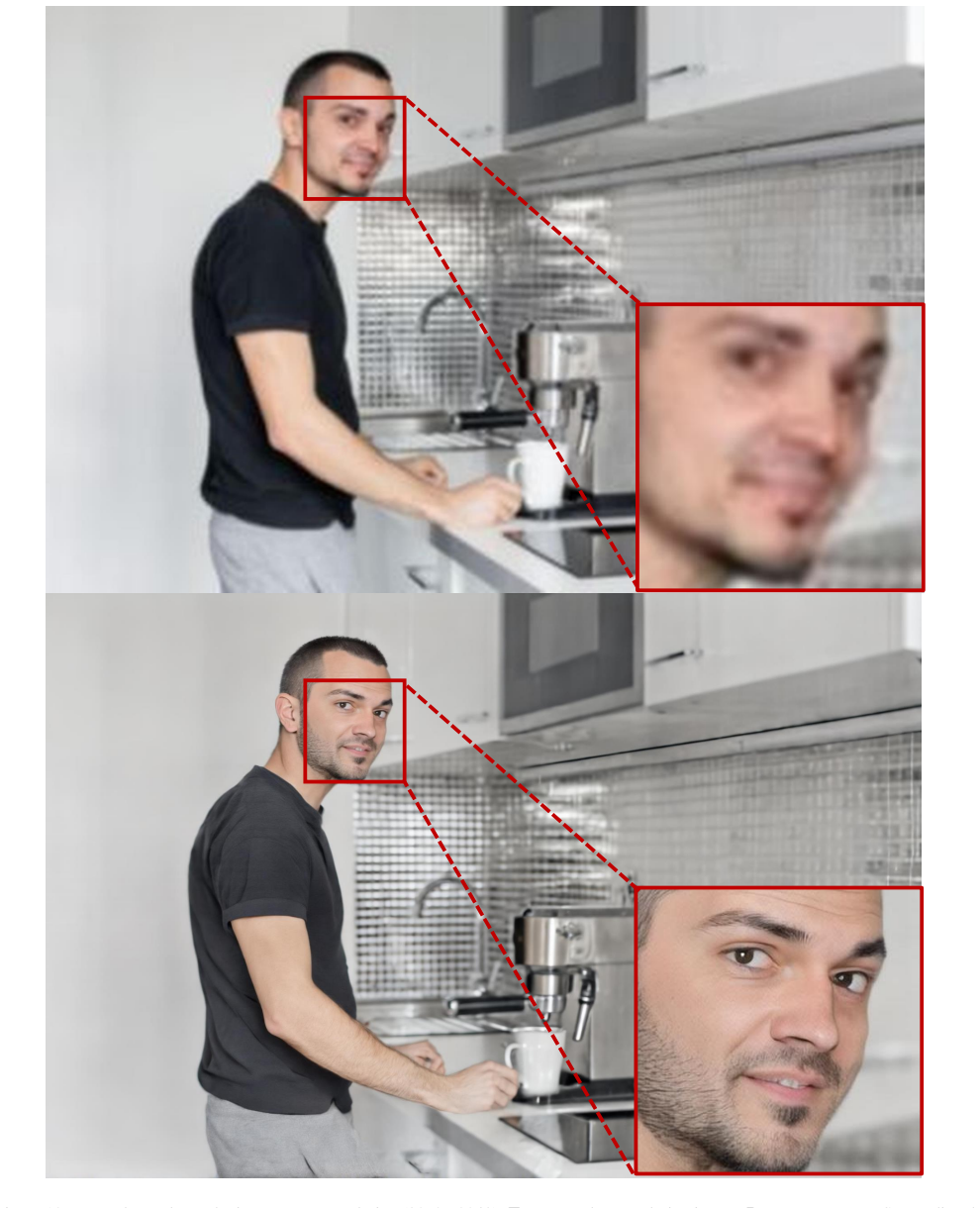
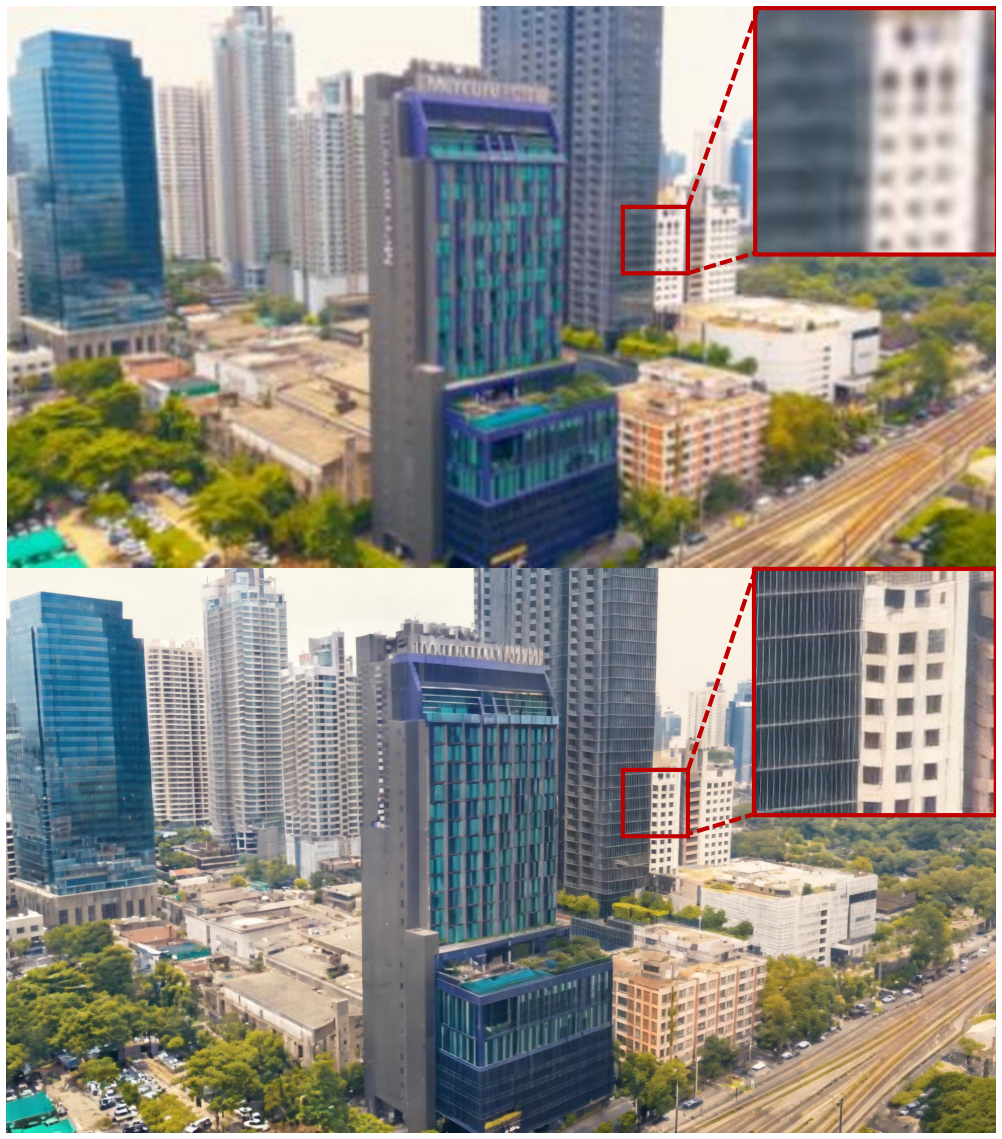
The paper's central claim is that an aggressively compressed latent space, normally considered a liability for generative models, is actually well suited to super-resolution because the degraded input provides strong conditioning that compensates for information lost in compression. On this basis, TurboVSR integrates LTX-VAE's 32×32×8 compression with factorized conditioning and non-uniform shortcut sampling, and reports that it performs on par with state-of-the-art diffusion-based video super-resolution methods while taking only about 7 seconds to process a 2-second 1080p video on a single H20 GPU, a speedup of roughly two orders of magnitude.
Load-bearing premise
The paper assumes, based on a visual comparison rather than quantitative reconstruction metrics, that LTX-VAE's 32×32×8 compression preserves enough fine detail to support super-resolution; if the autoencoder discards high-frequency information that super-resolution is meant to add, the efficiency gains would come at the cost of the very detail the method promises.
Editorial extensions
If this is right
- If the speedup transfers to real deployment, diffusion-based video super-resolution becomes usable for near-real-time enhancement of consumer video, not just offline processing.
- The claim implies that high-compression autoencoders, previously reserved for fast generation, are a viable foundation for restoration tasks where the input gives strong conditioning.
- The non-uniform shortcut sampling strategy could be applied to other high-resolution diffusion tasks that currently suffer from many-step inference.
- Because the model treats images as one-frame videos, a single trained upscaler can serve both image and video super-resolution, simplifying deployment.
- The efficiency gain makes higher-than-1080p super-resolution, such as 4K image upscaling, computationally reachable with generative detail.
Reading between the lines
- The same recipe—aggressive latent compression plus factorized conditioning—may extend to other ill-posed restoration tasks such as deblurring, denoising, or frame interpolation, where the conditioning signal is similarly strong.
- The 'on par' claim rests mostly on non-reference metrics and a small user study; a rigorous paired comparison on real-world aligned data, with reference metrics, would tell whether the perceptual parity holds outside the chosen benchmarks.
- The 4K results are presented qualitatively, so the method's upper ceiling for fine-detail generation at very high resolutions remains an open question rather than an established capability.
- The reliance on a fixed initial noise for inter-tile consistency suggests the method's temporal stability may be sensitive to noise selection, a factor worth probing across diverse content types.
Editorial analysis
A structured set of objections, weighed in public.
Referee Report
Summary. The paper proposes TurboVSR, a diffusion-based video super-resolution method designed for high efficiency through three main components: an LTX-VAE autoencoder with 32x32x8 spatial-temporal compression, a factorized conditioning scheme that first super-resolves the initial frame and then conditions the remaining frames on that result and on the low-resolution input, and a non-uniform shortcut model that reduces the number of sampling steps. Inference is further accelerated by tile-wise processing with Gaussian-weighted fusion for arbitrary resolutions and lengths. The central claims are that TurboVSR performs on par with state-of-the-art diffusion-based VSR methods while being more than 100 times faster (about 7 seconds for a 2-second 1080p video, or 140 ms per 1080p frame), and that the design enables image super-resolution beyond 1080p, including 4K results.
Significance. If the claims are supported, TurboVSR would be a substantial practical advance: it would bring generative video super-resolution from tens of minutes per short clip down to a few seconds at comparable perceptual quality. The paper also makes a broader architectural point that a 32x32x8 video autoencoder, despite its large reconstruction error, can support super-resolution when conditional information is strong and when conditioning is factorized; the factorized conditioning idea is a clean response to token-length distribution shift. The ablations on shortcut sampling and the reported 4K image results are useful. However, the significance is conditional on evidence quality: the 'on par' claim rests largely on non-reference metrics and a user study without statistical details, and the autoencoder-sufficiency premise is verified only qualitatively. No code or trained models are released, which further limits reproducibility. If the quantitative gaps are addressed, this would be a strong contribution to efficient generative SR.
major comments (4)
- [§3.2, Figure 3] The claim that LTX-VAE's 32x32x8 compression 'is sufficient to support SR tasks' is load-bearing for the entire efficiency design, yet it is supported only by a qualitative reconstruction comparison. The text itself concedes that LTX-VAE has 'larger reconstruction errors' that are compensated by 'imaginative capability' and that it 'performs less effectively with rapid motion and repetitive, regular textures,' and the supplementary 4K section admits anatomical errors 'slightly more pronounced' than state-of-the-art models. Since super-resolution is precisely about producing high-frequency detail, an autoencoder that loses or invents detail in exactly those regimes caps the achievable output quality regardless of the diffusion model. No quantitative reconstruction metrics (e.g., LPIPS, DISTS, high-frequency band error, or temporal consistency) are reported. Please provide such measurements on representative content, including fast-motion and texture-rich clips, and analyze how reconstruction fidelity translates to final SR quality; otherwise the 'on par with SOTA' claim is untested.
- [Table 3, §4.3] The paper's assertion that TurboVSR is 'on par with state-of-the-art' is not consistently supported by the reported benchmark numbers. On UDM10, TurboVSR 4-step achieves DOVER 79.81 vs. Upscale-A-Video's 81.74, MUSIQ 56.07 vs. 62.53, and lower PSNR/SSIM than several baselines; on VideoLQ, TurboVSR's NIQE (4.99) is worse than both Upscale-A-Video (4.433) and MGLDVSR (5.18 is worse only than MGLD; actually MGLD is 5.18, so Turbo is slightly better than MGLD but worse than Upscale). Even on SPMCS, where TurboVSR leads on DOVER, its MUSIQ is below Upscale-A-Video and its NIQE is above it. The statement that the evaluation 'focus primarily on the non-reference metrics' does not resolve this, because the non-reference metrics themselves do not show a uniform advantage. Please define a precise criterion for 'on par,' report confidence intervals or statistical significance for the differences, and qualify the abstract claim accordingly.
- [§4.2, Table 2] The user study is presented as evidence that TurboVSR 'exhibits superior generalization' and has the 'best success rate,' but the table reports no number of participants, no number of videos, and no error bars or confidence intervals, and no statistical significance test is described. Scores are normalized per user to [0,100], but without knowing the sample size or per-video variance, a difference of 2.5 percentage points in success rate (97.5% vs. 95%) could be noise. Please provide the participant count, video count, per-item variance, and results of a paired statistical test (e.g., bootstrap or Wilcoxon signed-rank) for the key comparisons, or downgrade the strength of the claim.
- [Table 3, latency rows] The 100+ times speedup is a central claim, but the latency comparison needs a precise measurement protocol. It is unclear whether the baseline latencies (24,032 ms/frame for Upscale-A-Video, 37,822 ms for MGLDVSR, etc.) were re-measured on the same NVIDIA H20 GPU with the same software stack, number of sampling steps, and VAE decoding included, or whether they are taken from other papers or vendor-reported numbers. If the baselines were not re-run in a controlled setting, the speedup factor may be inflated by differences in hardware, framework, or configuration. Please describe the exact measurement setup, including step counts and whether latency includes autoencoder encode/decode and text-condition generation.
minor comments (6)
- [§4.6, text near Table 5] The sentence 'This is mainly attributed to more failure of super resolution. and the blurry outputs leads trivial improvements in reference metrics' is grammatically broken and logically confusing; please rewrite it to state which model had more failures and why the PSNR/SSIM pattern follows.
- [Table 1] The column label 'Pix-to-Token Comp. Ratio' is ambiguous, and the value 8196 for LTX-VAE appears to be a typo for 8192 (32x32x8). Please clarify the definition and correct the number.
- [Abstract / Conclusion] The phrase 'state-of-the-art' is used without specifying which methods or which benchmark threshold defines 'on par.' Please define the comparison set and the criterion for 'on par' explicitly.
- [§3.4, Eq. (4)-(5)] The paper does not report sensitivity to the hand-picked set T = {0.6, 0.7, 0.8, 0.9, 1} in the shortcut sampling; a small ablation (e.g., uniform d-range vs. this set) would strengthen the claim that the non-uniform strategy is robust.
- [Throughout] There are several typos that should be corrected, including 'Quantatitive' in Table 3, 'an diffusion based' in the conclusion, and 'fall shorts' in §3.4.
- [§4.3] For VideoLQ, no PSNR or SSIM values are reported; please state whether these were omitted because ground truth is unavailable, and consider reporting them when possible for completeness.
Circularity Check
No circular derivation: the central quality and speed claims are benchmarked externally, and the few self-citations are not load-bearing.
full rationale
The paper's derivation chain is self-contained against external evidence. The efficiency claim follows from concrete engineering choices (LTX-VAE's 32x32x8 compression, factorized conditioning, and a shortcut model), and the on-par quality claim is grounded in external benchmark comparisons (Tables 3 and 4: SPMCS, UDM10, VideoLQ, DRealSR), a user study (Table 2), and ablations (Tables 5-7). The shortcut-model loss in Eq. (5) is by construction a self-consistency target using the model itself at half steps; this is the standard definition of consistency and shortcut training, not a fitted input renamed as a prediction. The claim that 4 inference steps match 10 is verified independently via quality metrics, not read off the training objective. The factorized-conditioning decomposition is validated by an ablation, and the non-uniform sampling choices are empirically tuned and then tested on held-out benchmarks. The paper does contain self-citations to prior work with overlapping authors (ControlNeXt [36], correspondence learning [53], Res-Captioner [43]), but these are used as ordinary references to existing methods, not as a uniqueness theorem or as a substitute for the paper's own ablations and benchmarks; none forbids alternatives or forces the reported conclusion. The weakest point is Section 3.2, where the sufficiency of LTX-VAE's high-compression reconstruction for super-resolution is asserted from a qualitative pilot study (Figure 3) with no quantitative reconstruction metrics, and the text itself concedes weaknesses on rapid motion and repetitive textures. This is a real evidence and correctness-risk gap, but it is not circularity: the claim is an empirically testable assumption about the autoencoder, not a reduction of the paper's output to its input. No equation is shown to equal itself by construction, and no fitted parameter is renamed as a prediction, so no significant circularity is present.
Assumptions & free parameters
free parameters (5)
- d scale set T =
{0.6, 0.7, 0.8, 0.9, 1}
- fixed initial noise =
not specified
- temporal overlap size =
9 frames
- DDPM noise augmentation range =
0 to 300 steps
- number of sampling steps =
4 (versus 10 for baseline)
assumptions (5)
- domain assumption LTX-VAE preserves sufficient high-frequency detail for super-resolution despite 32x32x8 compression.
- domain assumption Factorized conditioning reduces learning difficulty by letting the video model propagate details from a sharp first frame.
- domain assumption Non-uniform timestep sampling towards higher noise improves high-resolution shortcut models.
- domain assumption Tile-wise Gaussian-weighted fusion with fixed initial noise maintains spatiotemporal consistency.
- standard math Flow-matching and shortcut training objectives are valid for learning the few-step ODE.
Cite this review
Pith. "Pith review of TurboVSR: Fantastic Video Upscalers and Where to Find Them." pith.science (2026). https://pith.science/paper/X7EYHVLY
@misc{pith2026250623618,
  author       = {Pith},
  title        = {Pith review of: TurboVSR: Fantastic Video Upscalers and Where to Find Them},
  year         = {2026},
  howpublished = {\url{https://pith.science/paper/X7EYHVLY}},
  note         = {Machine review of arXiv:2506.23618}
}
abstract
Diffusion-based generative models have demonstrated exceptional promise in the video super-resolution (VSR) task, achieving a substantial advancement in detail generation relative to prior methods. However, these approaches face significant computational efficiency challenges. For instance, current techniques may require tens of minutes to super-resolve a mere 2-second, 1080p video. In this paper, we present TurboVSR, an ultra-efficient diffusion-based video super-resolution model. Our core design comprises three key aspects: (1) We employ an autoencoder with a high compression ratio of 32$\times$32$\times$8 to reduce the number of tokens. (2) Highly compressed latents pose substantial challenges for training. We introduce factorized conditioning to mitigate the learning complexity: we first learn to super-resolve the initial frame; subsequently, we condition the super-resolution of the remaining frames on the high-resolution initial frame and the low-resolution subsequent frames. (3) We convert the pre-trained diffusion model to a shortcut model to enable fewer sampling steps, further accelerating inference. As a result, TurboVSR performs on par with state-of-the-art VSR methods, while being 100+ times faster, taking only 7 seconds to process a 2-second long 1080p video. TurboVSR also supports image resolution by considering image as a one-frame video. Our efficient design makes SR beyond 1080p possible, results on 4K (3648$\times$2048) image SR show surprising fine details.
Figures


Figures from the paper (10 more)




Reference graph
Works this paper leans on
-
[1]
Multidiffusion: Fusing diffusion paths for controlled image generation
Omer Bar-Tal, Lior Yariv, Yaron Lipman, and Tali Dekel. Multidiffusion: Fusing diffusion paths for controlled image generation. 2023. 2, 5
work page 2023
-
[2]
Align your latents: High-resolution video synthesis with la- tent diffusion models
Andreas Blattmann, Robin Rombach, Huan Ling, Tim Dock- horn, Seung Wook Kim, Sanja Fidler, and Karsten Kreis. Align your latents: High-resolution video synthesis with la- tent diffusion models. In CVPR, pages 22563–22575, 2023. 3
work page 2023
-
[3]
Video generation models as world simulators
Tim Brooks, Bill Peebles, Connor Holmes, Will DePue, Yufei Guo, Li Jing, David Schnurr, Joe Taylor, Troy Luh- man, Eric Luhman, Clarence Ng, Ricky Wang, and Aditya Ramesh. Video generation models as world simulators
-
[4]
Basicvsr: The search for essential compo- nents in video super-resolution and beyond
Kelvin CK Chan, Xintao Wang, Ke Yu, Chao Dong, and Chen Change Loy. Basicvsr: The search for essential compo- nents in video super-resolution and beyond. In CVPR, pages 4947–4956, 2021. 2
work page 2021
-
[5]
Basicvsr++: Improving video super- resolution with enhanced propagation and alignment
Kelvin CK Chan, Shangchen Zhou, Xiangyu Xu, and Chen Change Loy. Basicvsr++: Improving video super- resolution with enhanced propagation and alignment. In CVPR, pages 5972–5981, 2022. 2
work page 2022
-
[6]
Investigating tradeoffs in real-world video super-resolution
Kelvin CK Chan, Shangchen Zhou, Xiangyu Xu, and Chen Change Loy. Investigating tradeoffs in real-world video super-resolution. In CVPR, pages 5962–5971, 2022. 2, 6, 7
work page 2022
-
[7]
Deep compression autoencoder for efficient high-resolution diffu- sion models
Junyu Chen, Han Cai, Junsong Chen, Enze Xie, Shang Yang, Haotian Tang, Muyang Li, Yao Lu, and Song Han. Deep compression autoencoder for efficient high-resolution diffu- sion models. arXiv preprint arXiv:2410.10733, 2024. 3
arXiv 2024
-
[8]
Learning spatial adap- tation and temporal coherence in diffusion models for video super-resolution
Zhikai Chen, Fuchen Long, Zhaofan Qiu, Ting Yao, Wen- gang Zhou, Jiebo Luo, and Tao Mei. Learning spatial adap- tation and temporal coherence in diffusion models for video super-resolution. In CVPR, pages 9232–9241, 2024. 3
work page 2024
Show all 78 references
-
[9]
Scaling rec- tified flow transformers for high-resolution image synthesis
Patrick Esser, Sumith Kulal, Andreas Blattmann, Rahim Entezari, Jonas M ¨uller, Harry Saini, Yam Levi, Dominik Lorenz, Axel Sauer, Frederic Boesel, Dustin Podell, Tim Dockhorn, Zion English, and Robin Rombach. Scaling rec- tified flow transformers for high-resolution image synthesis
-
[10]
One step diffusion via shortcut models
Kevin Frans, Danijar Hafner, Sergey Levine, and Pieter Abbeel. One step diffusion via shortcut models. arXiv preprint arXiv:2410.12557, 2024. 2, 3, 5
2024 arXiv
-
[11]
Generative adversarial nets
Ian Goodfellow, Jean Pouget-Abadie, Mehdi Mirza, Bing Xu, David Warde-Farley, Sherjil Ozair, Aaron Courville, and Yoshua Bengio. Generative adversarial nets. NeurIPS, 27,
-
[12]
Animatediff: Animate your personalized text-to- image diffusion models without specific tuning
Yuwei Guo, Ceyuan Yang, Anyi Rao, Zhengyang Liang, Yaohui Wang, Yu Qiao, Maneesh Agrawala, Dahua Lin, and Bo Dai. Animatediff: Animate your personalized text-to- image diffusion models without specific tuning. In ICLR,
-
[13]
Photorealistic video generation with diffusion models
Agrim Gupta, Lijun Yu, Kihyuk Sohn, Xiuye Gu, Meera Hahn, Fei-Fei Li, Irfan Essa, Lu Jiang, and Jos ´e Lezama. Photorealistic video generation with diffusion models. In ECCV, pages 393–411. Springer, 2024. 3
2024
-
[14]
Ltx-video: Realtime video latent diffusion
Yoav HaCohen, Nisan Chiprut, Benny Brazowski, Daniel Shalem, Dudu Moshe, Eitan Richardson, Eran Levin, Guy Shiran, Nir Zabari, Ori Gordon, et al. Ltx-video: Realtime video latent diffusion. arXiv preprint arXiv:2501.00103 ,
-
[15]
Venhancer: Generative space-time enhancement for video generation
Jingwen He, Tianfan Xue, Dongyang Liu, Xinqi Lin, Peng Gao, Dahua Lin, Yu Qiao, Wanli Ouyang, and Ziwei Liu. Venhancer: Generative space-time enhancement for video generation. arXiv preprint arXiv:2407.07667, 2024. 3, 7
2024 arXiv
-
[16]
Kingma, Ben Poole, Mohammad Norouzi, David J
Jonathan Ho, William Chan, Chitwan Saharia, Jay Whang, Ruiqi Gao, Alexey Gritsenko, Diederik P. Kingma, Ben Poole, Mohammad Norouzi, David J. Fleet, and Tim Sali- mans. Imagen video: High definition video generation with diffusion models, 2022. 3
2022
-
[17]
Snapgen: Tam- ing high-resolution text-to-image models for mobile devices with efficient architectures and training
Dongting Hu, Jierun Chen, Xijie Huang, Huseyin Coskun, Arpit Sahni, Aarush Gupta, Anujraaj Goyal, Dishani Lahiri, Rajesh Singh, Yerlan Idelbayev, et al. Snapgen: Tam- ing high-resolution text-to-image models for mobile devices with efficient architectures and training. arXiv p...
2024 arXiv
-
[18]
Space-time correspondence as a contrastive random walk
Allan Jabri, Andrew Owens, and Alexei Efros. Space-time correspondence as a contrastive random walk. NeurIPS,
-
[19]
Pyramidal flow matching for efficient video generative modeling
Yang Jin, Zhicheng Sun, Ningyuan Li, Kun Xu, Hao Jiang, Nan Zhuang, Quzhe Huang, Yang Song, Yadong Mu, and Zhouchen Lin. Pyramidal flow matching for efficient video generative modeling. arXiv preprint arXiv:2410.05954 ,
-
[20]
Video super-resolution with convolutional neu- ral networks
Armin Kappeler, Seunghwan Yoo, Qiqin Dai, and Aggelos K Katsaggelos. Video super-resolution with convolutional neu- ral networks. IEEE transactions on computational imaging, 2(2):109–122, 2016. 2
2016
-
[21]
MUSIQ: multi-scale image quality transformer
Junjie Ke, Qifei Wang, Yilin Wang, Peyman Milanfar, and Feng Yang. MUSIQ: multi-scale image quality transformer. In ICCV, 2021. 6
2021
-
[22]
Hunyuanvideo: A systematic framework for large video generative models
Weijie Kong, Qi Tian, Zijian Zhang, Rox Min, Zuozhuo Dai, Jin Zhou, Jiangfeng Xiong, Xin Li, Bo Wu, Jianwei Zhang, et al. Hunyuanvideo: A systematic framework for large video generative models. arXiv preprint arXiv:2412.03603, 2024. 3
2024 arXiv
-
[23]
Learning blind video temporal consistency
Wei-Sheng Lai, Jia-Bin Huang, Oliver Wang, Eli Shechtman, Ersin Yumer, and Ming-Hsuan Yang. Learning blind video temporal consistency. In Proceedings of the European con- ference on computer vision (ECCV) , pages 170–185, 2018. 8
2018
-
[24]
Mucan: Multi-correspondence aggregation network for video super-resolution
Wenbo Li, Xin Tao, Taian Guo, Lu Qi, Jiangbo Lu, and Jiaya Jia. Mucan: Multi-correspondence aggregation network for video super-resolution. In ECCV, pages 335–351. Springer,
-
[25]
Lapar: Linearly-assembled pixel-adaptive re- gression network for single image super-resolution and be- yond
Wenbo Li, Kun Zhou, Lu Qi, Nianjuan Jiang, Jiangbo Lu, and Jiaya Jia. Lapar: Linearly-assembled pixel-adaptive re- gression network for single image super-resolution and be- yond. NeurIPS, 33:20343–20355, 2020. 2
2020
-
[26]
Best-buddy gans for highly detailed image super-resolution
Wenbo Li, Kun Zhou, Lu Qi, Liying Lu, and Jiangbo Lu. Best-buddy gans for highly detailed image super-resolution. In AAAI, pages 1412–1420, 2022. 2
2022
-
[27]
Diffvsr: Enhancing real-world video super-resolution with diffusion models for advanced visual quality and temporal consistency
Xiaohui Li, Yihao Liu, Shuo Cao, Ziyan Chen, Shaobin Zhuang, Xiangyu Chen, Yinan He, Yi Wang, and Yu Qiao. Diffvsr: Enhancing real-world video super-resolution with diffusion models for advanced visual quality and temporal consistency. arXiv preprint arXiv:2501.10110, 2025. 3
2025 arXiv
-
[28]
Snap- fusion: Text-to-image diffusion model on mobile devices within two seconds
Yanyu Li, Huan Wang, Qing Jin, Ju Hu, Pavlo Chemerys, Yun Fu, Yanzhi Wang, Sergey Tulyakov, and Jian Ren. Snap- fusion: Text-to-image diffusion model on mobile devices within two seconds. Advances in Neural Information Pro- cessing Systems, 36:20662–20678, 2023. 3
2023
-
[29]
Video super-resolution via deep draft-ensemble learning
Renjie Liao, Xin Tao, Ruiyu Li, Ziyang Ma, and Jiaya Jia. Video super-resolution via deep draft-ensemble learning. In ICCV, pages 531–539, 2015. 2
2015
-
[30]
Flow matching for genera- tive modeling
Yaron Lipman, Ricky TQ Chen, Heli Ben-Hamu, Maxim- ilian Nickel, and Matthew Le. Flow matching for genera- tive modeling. In The Eleventh International Conference on Learning Representations. 3
-
[31]
Flow straight and fast: Learning to generate and transfer data with rectified flow
Xingchao Liu, Chengyue Gong, et al. Flow straight and fast: Learning to generate and transfer data with rectified flow. In The Eleventh International Conference on Learning Repre- sentations. 2, 3
-
[32]
Step-video-t2v technical re- port: The practice, challenges, and future of video founda- tion model
Guoqing Ma, Haoyang Huang, Kun Yan, Liangyu Chen, Nan Duan, Shengming Yin, Changyi Wan, Ranchen Ming, Xi- aoniu Song, Xing Chen, et al. Step-video-t2v technical re- port: The practice, challenges, and future of video founda- tion model. arXiv preprint arXiv:2502.10248, 2025. 3
2025 arXiv
-
[33]
Solving diffusion odes with optimal boundary conditions for better image super-resolution
Yiyang Ma, Huan Yang, Wenhan Yang, Jianlong Fu, and Ji- aying Liu. Solving diffusion odes with optimal boundary conditions for better image super-resolution. In ICLR, 2024. 2, 6
2024
-
[34]
Handling motion blur in multi-frame super- resolution
Ziyang Ma, Renjie Liao, Xin Tao, Li Xu, Jiaya Jia, and Enhua Wu. Handling motion blur in multi-frame super- resolution. In CVPR, pages 5224–5232, 2015. 2
2015
-
[35]
Anish Mittal, Rajiv Soundararajan, and Alan C. Bovik. Mak- ing a ”completely blind” image quality analyzer. IEEE Sig- nal Process. Lett., 2013. 6
2013
-
[36]
Controlnext: Powerful and effi- cient control for image and video generation
Bohao Peng, Jian Wang, Yuechen Zhang, Wenbo Li, Ming- Chang Yang, and Jiaya Jia. Controlnext: Powerful and effi- cient control for image and video generation. arXiv preprint arXiv:2408.06070, 2024. 3
2024 arXiv
-
[37]
Ef- ficient diffusion transformer with step-wise dynamic atten- tion mediators
Yifan Pu, Zhuofan Xia, Jiayi Guo, Dongchen Han, Qixiu Li, Duo Li, Yuhui Yuan, Ji Li, Yizeng Han, Shiji Song, et al. Ef- ficient diffusion transformer with step-wise dynamic atten- tion mediators. In ECCV, pages 424–441. Springer, 2024. 3
2024
-
[38]
High-resolution image syn- thesis with latent diffusion models
Robin Rombach, Andreas Blattmann, Dominik Lorenz, Patrick Esser, and Bj¨orn Ommer. High-resolution image syn- thesis with latent diffusion models. In CVPR, 2022. 2, 3
2022
-
[39]
En- hancing perceptual quality in video super-resolution through temporally-consistent detail synthesis using diffusion mod- els
Claudio Rota, Marco Buzzelli, and Joost van de Weijer. En- hancing perceptual quality in video super-resolution through temporally-consistent detail synthesis using diffusion mod- els. In ECCV, pages 36–53. Springer, 2024. 3
2024
-
[40]
Frame-recurrent video super-resolution
Mehdi SM Sajjadi, Raviteja Vemulapalli, and Matthew Brown. Frame-recurrent video super-resolution. In CVPR, pages 6626–6634, 2018. 2
2018
-
[41]
Improved techniques for training consistency models
Yang Song and Prafulla Dhariwal. Improved techniques for training consistency models. In ICLR. 3
-
[42]
Consistency models
Yang Song, Prafulla Dhariwal, Mark Chen, and Ilya Sutskever. Consistency models. In ICML, pages 32211– 32252. PMLR, 2023. 3, 5
2023
-
[43]
Beyond pixels: Text enhances generalization in real-world image restoration
Haoze Sun, Wenbo Li, Jiayue Liu, Kaiwen Zhou, Yongqiang Chen, Yong Guo, Yanwei Li, Renjing Pei, Long Peng, and Yujiu Yang. Beyond pixels: Text enhances generalization in real-world image restoration. abs/2412.00878, 2024. 3
2024 arXiv
-
[44]
Detail-revealing deep video super-resolution
Xin Tao, Hongyun Gao, Renjie Liao, Jue Wang, and Jiaya Jia. Detail-revealing deep video super-resolution. In ICCV,
-
[45]
Tdan: Temporally-deformable alignment network for video super-resolution
Yapeng Tian, Yulun Zhang, Yun Fu, and Chenliang Xu. Tdan: Temporally-deformable alignment network for video super-resolution. In CVPR, pages 3360–3369, 2020. 2
2020
-
[46]
Modelscope text-to-video technical report
Jiuniu Wang, Hangjie Yuan, Dayou Chen, Yingya Zhang, Xiang Wang, and Shiwei Zhang. Modelscope text-to-video technical report. arXiv preprint arXiv:2308.06571, 2023. 3
2023 arXiv
-
[47]
Chan, and Chen Change Loy
Jianyi Wang, Zongsheng Yue, Shangchen Zhou, Kelvin C.K. Chan, and Chen Change Loy. Exploiting diffusion prior for real-world image super-resolution. 2024. 7
2024
-
[48]
Edvr: Video restoration with enhanced deformable convolutional networks
Xintao Wang, Kelvin CK Chan, Ke Yu, Chao Dong, and Chen Change Loy. Edvr: Video restoration with enhanced deformable convolutional networks. In CVPRW, pages 0–0,
-
[49]
Learn- ing correspondence from the cycle-consistency of time
Xiaolong Wang, Allan Jabri, and Alexei A Efros. Learn- ing correspondence from the cycle-consistency of time. In CVPR, 2019. 4
2019
-
[50]
Real-esrgan: Training real-world blind super-resolution with pure synthetic data
Xintao Wang, Liangbin Xie, Chao Dong, and Ying Shan. Real-esrgan: Training real-world blind super-resolution with pure synthetic data. In ICCV Workshops, 2021. 6
2021
-
[51]
Videocomposer: Compositional video synthesis with motion controllability
Xiang Wang, Hangjie Yuan, Shiwei Zhang, Dayou Chen, Ji- uniu Wang, Yingya Zhang, Yujun Shen, Deli Zhao, and Jin- gren Zhou. Videocomposer: Compositional video synthesis with motion controllability. NeurIPS, 36:7594–7611, 2023. 3
2023
-
[52]
Lavie: High-quality video generation with cascaded latent diffusion models
Yaohui Wang, Xinyuan Chen, Xin Ma, Shangchen Zhou, Ziqi Huang, Yi Wang, Ceyuan Yang, Yinan He, Jiashuo Yu, Peiqing Yang, et al. Lavie: High-quality video generation with cascaded latent diffusion models. IJCV, pages 1–20,
-
[53]
Unsupervised temporal correspondence learning for unified video object removal
Zhongdao Wang, Jinglu Wang, Xiao Li, Ya-Li Li, Yan Lu, and Shengjin Wang. Unsupervised temporal correspondence learning for unified video object removal. IEEE TIP, 2023. 4
2023
-
[54]
Component divide-and-conquer for real-world image super-resolution
Pengxu Wei, Ziwei Xie, Hannan Lu, Zongyuan Zhan, Qix- iang Ye, Wangmeng Zuo, and Liang Lin. Component divide-and-conquer for real-world image super-resolution. In ECCV, 2020. 7
2020
-
[55]
Exploring video quality assessment on user generated contents from aesthetic and technical perspectives
Haoning Wu, Erli Zhang, Liang Liao, Chaofeng Chen, Jing- wen Hou Hou, Annan Wang, Wenxiu Sun Sun, Qiong Yan, and Weisi Lin. Exploring video quality assessment on user generated contents from aesthetic and technical perspectives. In ICCV, 2023. 6
2023
-
[56]
Sparse videogen: Accelerating video diffusion transformers with spatial-temporal sparsity
Haocheng Xi, Shuo Yang, Yilong Zhao, Chenfeng Xu, Muyang Li, Xiuyu Li, Yujun Lin, Han Cai, Jintao Zhang, Dacheng Li, et al. Sparse videogen: Accelerating video diffusion transformers with spatial-temporal sparsity. arXiv preprint arXiv:2502.01776, 2025. 3
2025 arXiv
-
[57]
Sana: Efficient high-resolution image syn- thesis with linear diffusion transformers
Enze Xie, Junsong Chen, Junyu Chen, Han Cai, Haotian Tang, Yujun Lin, Zhekai Zhang, Muyang Li, Ligeng Zhu, Yao Lu, et al. Sana: Efficient high-resolution image syn- thesis with linear diffusion transformers. arXiv preprint arXiv:2410.10629, 2024. 3
-
[58]
Mitigating artifacts in real-world video super-resolution models
Liangbin Xie, Xintao Wang, Shuwei Shi, Jinjin Gu, Chao Dong, and Ying Shan. Mitigating artifacts in real-world video super-resolution models. In AAAI, pages 2956–2964,
-
[59]
Star: Spatial-temporal augmentation with text-to- video models for real-world video super-resolution
Rui Xie, Yinhong Liu, Penghao Zhou, Chen Zhao, Jun Zhou, Kai Zhang, Zhenyu Zhang, Jian Yang, Zhenheng Yang, and Ying Tai. Star: Spatial-temporal augmentation with text-to- video models for real-world video super-resolution. arXiv preprint arXiv:2501.02976, 2025. 3, 6, 7
2025 arXiv
-
[60]
Video enhancement with task-oriented flow
Tianfan Xue, Baian Chen, Jiajun Wu, Donglai Wei, and William T Freeman. Video enhancement with task-oriented flow. IJCV, 127:1106–1125, 2019. 2
2019
-
[61]
Mobile video diffusion
Haitam Ben Yahia, Denis Korzhenkov, Ioannis Lelekas, Amir Ghodrati, and Amirhossein Habibian. Mobile video diffusion. arXiv preprint arXiv:2412.07583, 2024. 3
2024 arXiv
-
[62]
Motion- guided latent diffusion for temporally consistent real-world video super-resolution
Xi Yang, Chenhang He, Jianqi Ma, and Lei Zhang. Motion- guided latent diffusion for temporally consistent real-world video super-resolution. In ECCV, pages 224–242. Springer,
-
[63]
Cogvideox: Text-to-video diffusion models with an expert transformer
Zhuoyi Yang, Jiayan Teng, Wendi Zheng, Ming Ding, Shiyu Huang, Jiazheng Xu, Yuanming Yang, Wenyi Hong, Xiao- han Zhang, Guanyu Feng, et al. Cogvideox: Text-to-video diffusion models with an expert transformer. arXiv preprint arXiv:2408.06072, 2024. 3
2024 arXiv
-
[64]
Magic 1-for-1: Generating one minute video clips within one minute
Hongwei Yi, Shitong Shao, Tian Ye, Jiantong Zhao, Qingyu Yin, Michael Lingelbach, Li Yuan, Yonghong Tian, Enze Xie, and Daquan Zhou. Magic 1-for-1: Generating one minute video clips within one minute. arXiv preprint arXiv:2502.07701, 2025. 3
2025 arXiv
-
[65]
Progressive fusion video super-resolution net- work via exploiting non-local spatio-temporal correlations
Peng Yi, Zhongyuan Wang, Kui Jiang, Junjun Jiang, and Jiayi Ma. Progressive fusion video super-resolution net- work via exploiting non-local spatio-temporal correlations. In ICCV, 2019. 6, 7
2019
-
[66]
One-step diffusion with distribution matching distillation
Tianwei Yin, Micha ¨el Gharbi, Richard Zhang, Eli Shecht- man, Fredo Durand, William T Freeman, and Taesung Park. One-step diffusion with distribution matching distillation. In CVPR, 2024. 5
2024
-
[67]
Resshift: Efficient diffusion model for image super- resolution by residual shifting
Zongsheng Yue, Jianyi Wang, and Chen Change Loy. Resshift: Efficient diffusion model for image super- resolution by residual shifting. In NeurIPS, 2023. 7
2023
-
[68]
Language- guided image tokenization for generation
Kaiwen Zha, Lijun Yu, Alireza Fathi, David A Ross, Cordelia Schmid, Dina Katabi, and Xiuye Gu. Language- guided image tokenization for generation. arXiv preprint arXiv:2412.05796, 2024. 3
2024 arXiv
-
[69]
The unreasonable effectiveness of deep features as a perceptual metric
Richard Zhang, Phillip Isola, Alexei A Efros, Eli Shecht- man, and Oliver Wang. The unreasonable effectiveness of deep features as a perceptual metric. In Proceedings of the IEEE conference on computer vision and pattern recogni- tion, pages 586–595, 2018. 8
2018
-
[70]
Flashvideo: Flowing fidelity to detail for efficient high-resolution video generation
Shilong Zhang, Wenbo Li, Shoufa Chen, Chongjian Ge, Peize Sun, Yida Zhang, Yi Jiang, Zehuan Yuan, Binyue Peng, and Ping Luo. Flashvideo: Flowing fidelity to detail for efficient high-resolution video generation. arXiv preprint arXiv:2502.05179, 2025. 3
2025
-
[71]
Realviformer: Investigating attention for real-world video super-resolution
Yuehan Zhang and Angela Yao. Realviformer: Investigating attention for real-world video super-resolution. In ECCV, pages 412–428. Springer, 2024. 2, 7
2024
-
[72]
Open-sora: Democratizing efficient video production for all
Zangwei Zheng, Xiangyu Peng, Tianji Yang, Chenhui Shen, Shenggui Li, Hongxin Liu, Yukun Zhou, Tianyi Li, and Yang You. Open-sora: Democratizing efficient video production for all. arXiv preprint arXiv:2412.20404, 2024. 3
2024 arXiv
-
[73]
Revisiting temporal alignment for video restora- tion
Kun Zhou, Wenbo Li, Liying Lu, Xiaoguang Han, and Jiangbo Lu. Revisiting temporal alignment for video restora- tion. In CVPR, pages 6053–6062, 2022. 2
2022
-
[74]
Spatio-temporal filter adaptive network for video deblurring
Shangchen Zhou, Jiawei Zhang, Jinshan Pan, Haozhe Xie, Wangmeng Zuo, and Jimmy Ren. Spatio-temporal filter adaptive network for video deblurring. InICCV, pages 2482– 2491, 2019. 2
2019
-
[75]
Upscale-a-video: Temporal- consistent diffusion model for real-world video super- resolution
Shangchen Zhou, Peiqing Yang, Jianyi Wang, Yihang Luo, and Chen Change Loy. Upscale-a-video: Temporal- consistent diffusion model for real-world video super- resolution. In CVPR, pages 2535–2545, 2024. 1, 2, 3, 6, 7 TURBO VSR: Fantastic Video Upscalers and Where to Find Them S...
2024
-
[76]
Training details Video data augmentation. Due to the scarcity of high- quality, high-resolution videos and the availability of high- quality, high-resolution images, we design a video data aug- mentation method based on static images. This is achieved by generating pseudo-vide...
-
[77]
Overall, T URBO VSR presents detail generation capability on par with or even superior to state- of-the-art methods
Qualitative Comparison We show several qualitative comparison with existing VSR methods in Figure 8. Overall, T URBO VSR presents detail generation capability on par with or even superior to state- of-the-art methods
-
[78]
This dataset includes diverse contents such as por- traits, landscapes, and animals, most of which are high- quality professionally generated content (PGC)
Details on 4K Resolution Image SR For 4K image SR, we divid the training into two stages, both of which utilize the same training dataset: a private 4K image dataset containing approximately 2 million sam- ples. This dataset includes diverse contents such as por- traits, lands...
Reviewed August 6, 2026 · model on record in the stance chip above.
Discussion (0). Sign in to comment.