REVIEW 2 major objections 4 minor 53 references
Greedy Algorithms for Hybrid Compressed Sensing
T0 review · 2 major / 4 minor · reviewed 2026-08-14 · deepseek-v4-flash
Pith's one-line read The paper proposes two greedy algorithms for hybrid compressed sensing—one-bit measurements for support detection, analog measurements for residue updates—and proves success-probability bounds for both.
desk verdict The hybrid-CS algorithms and Theorem 4 are worth a look, but the main theory is vacuous: an m_r×n matrix with m_r<n cannot satisfy RIP of order n, so Theorems 5–6 do not apply to the paper's own experiments. read the letter →
The pith
A machine-rendered reading of the paper's core claim, the machinery that carries it, and where it could break.
The reading
What carries the argument
The load-bearing object is the hybrid measurement pair $y_r = A_r\tilde{x}$ and $y_o = \operatorname{sign}(A_o\tilde{x})$ with $\tilde{x}=x+u$, together with a greedy selection rule. For a candidate support set $S$, the algorithms form the least-squares estimate $\tau_n(A_{rS}^{\dagger} y_r, S)$ and count how many of the one-bit inequalities $[y_o]_i \langle a_{o,i}, \hat{x}\rangle \ge 0$ it satisfies; the candidate with the largest count wins. Algorithm 1 then removes the contribution of the selected support from the linear measurements via the residue update $r_j = y_r - A_{r\Omega_j} A_{r\Omega_j}^{\dagger} y_r$, while Algorithm 2 repeatedly adds the best new index and prunes the worst current one. The theoretical bridge is the random-uniform-tessellation bound, restated for sparse signals in Theorem 4, which links normalized recovery error to the fraction of separating hyperplanes; the probability theorems then convert the sign-change probability for a single Gaussian hyperplane into binomial success counts.
What would settle it
Take any $m_r \times n$ measurement matrix $A_r$ with $m_r < n$, for instance the paper's simulation choice $m_r = 6$, $n = 256$. Pick a nonzero vector $v$ with $A_r v = 0$; then $\lVert A_r v \rVert_2 = 0$ while $\lVert v \rVert_2 > 0$, so the restricted-isometry inequality $(1-\delta_n)\lVert v \rVert_2^2 \le \lVert A_r v \rVert_2^2$ forces $\delta_n \ge 1$. Since the theorems assume $\delta_n \in (0, 0.5]$, their probability bounds cannot apply to any matrix of the intended size.
Extended reading notes
Core claim
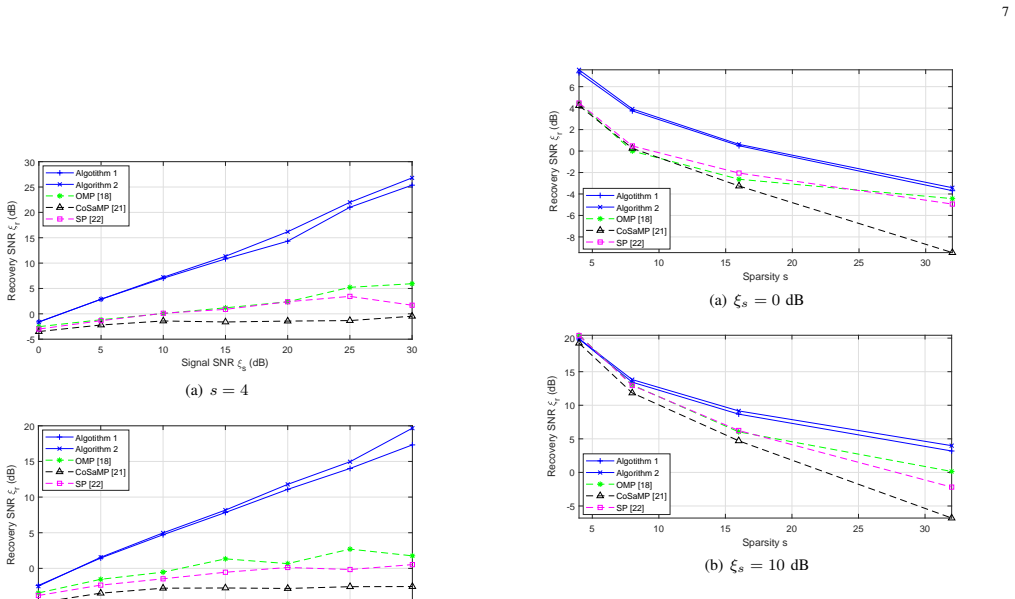
On the paper's own terms, the central claim is that support information can be extracted from binary measurements by a greedy counting rule, provided the candidate estimates are formed from the traditional linear measurements, and that a second greedy pass can repair a wrong initial support. Theorem 4 says that for sparse signals the normalized recovery error is bounded by $\delta + d_{A_o}(\tilde{x}, \hat{x})$, where $d_{A_o}$ is the fraction of one-bit hyperplanes separating the noisy signal from the estimate. Theorem 5 gives a lower bound on the probability that Algorithm 1 detects the true support after $s$ iterations, and Theorem 6 gives a lower bound on the probability that Algorithm 2 turns the initial support into the true support. The simulation section reports that both algorithms outperform three classic greedy algorithms for traditional compressed sensing under the same bit budget in noisy experiments.
Load-bearing premise
The main theorems assume the small linear measurement matrix preserves distances for every vector in the full $n$-dimensional space, but a matrix with more columns than rows always sends some nonzero vector to zero, so the assumption cannot hold in the regime the algorithms are designed for.
Editorial extensions
If this is right
- At a fixed storage budget, moving some budget from high-precision linear measurements to one-bit measurements can preserve or improve recovery accuracy; the simulations show the hybrid algorithms at 64s bits at least matching the classic greedy methods.
- Support detection can proceed without prior knowledge of signal energy: one-bit measurements decide direction, while linear measurements provide scale and the residue for the next iteration.
- The support-modification pass of Algorithm 2 means hybrid CS can be initialized from any rough support guess and then refined, so it can be chained after another detector.
- The random-tessellation error bound implies that the one-bit reconstruction error shrinks as the estimate satisfies more binary inequalities, which is exactly the score each greedy step maximizes.
Reading between the lines
- A natural repair, not explored in the paper, would replace the order-$n$ restricted isometry assumption with an order-$2s$ or coherence condition; whether the same proof skeleton then yields non-vacuous probability bounds is left open.
- The success bounds in Theorems 5 and 6 depend on per-iteration thresholds and reference values that the paper does not specify, so choosing those parameters is an empirical degree of freedom that could change which algorithm wins.
- The same greedy binary-inequality scoring could be applied to multi-bit or dithered quantized measurements and to block-sparse signals, since only the sign agreement between measurement and estimate is used in the selection rule.
Signed reviews
Editorial analysis
A structured set of objections, weighed in public.
Referee Report
Summary. The manuscript studies hybrid compressed sensing, in which measurements consist of noisy linear measurements y_r = A_r x + e_r and noisy binary measurements y_o = sign(A_o x + e_o). The authors first prove a theorem on random uniform tessellations for sparse signals (Theorem 4), and then propose two greedy algorithms that use the one-bit measurements for support detection and the linear measurements for residue updates and signal estimates. The main advertised theoretical results are Theorem 5, a lower bound on the probability that Algorithm 1 detects the true support after s iterations, and Theorem 6, a lower bound on the probability that Algorithm 2 turns an initial support into the true support. Simulations compare the two algorithms with OMP, SP, and CoSaMP under equal bit budgets for n=256 and several sparsity levels.
Significance. Hybrid compressed sensing is a relevant and under-studied problem, and the proposed algorithms are clearly specified and intuitively motivated. The simulation study covers a reasonable range of parameters and shows consistent gains over the selected classical greedy algorithms, which is an encouraging empirical result. The paper is also clearly written and does not rely on circular reasoning or fitted parameters in its theoretical statements. However, the central theoretical contribution is invalid: both algorithm theorems are conditioned on an impossible restricted-isometry assumption, and the proofs contain additional algebraic steps that fail within the range of the stated parameters. If the theorems were corrected, the paper could make a useful contribution; as it stands, the claimed guarantees are vacuous in the paper's own measurement regime.
major comments (2)
- [Section IV-A, Theorem 5; Section IV-B, Theorem 6] The assumption that A_r ∈ R^{m_r × n} satisfies the restricted isometry property of order n with δ_n ∈ (0, 0.5] is impossible whenever m_r < n, which is exactly the regime considered in this paper. For example, Section V-A sets n = 256 and m_r = ⌈1.5s⌉, so m_r = 6 for s = 4. By the rank-nullity theorem, every such A_r has a nonzero vector z in its nullspace; the RIP lower bound of order n would require (1 - δ_n)||z||_2^2 ≤ ||A_r z||_2^2 = 0, forcing δ_n ≥ 1. This contradicts δ_n < 1 and therefore the hypotheses of Theorems 5 and 6 are empty. Consequently, the probability lower bounds (25) and (26) do not apply to the algorithms as implemented in the simulations, and the principal theoretical claims of the paper are vacuous.
- [Appendix B, around Eq. (51); Appendix C, Eq. (60)] Even if one disregarded the impossible RIP order-n assumption, the proof of Theorem 5 contains a false inequality. The step (1 + sqrt((1 + δ_n)/(1 - δ_j))) ≤ 1 + sqrt(2) is asserted in the derivation of Eq. (51). Since Lemma 1 gives δ_j ≤ δ_n, the ratio (1 + δ_n)/(1 - δ_j) can be as large as (1 + δ_n)/(1 - δ_n), which equals 3 when δ_n = 0.5; hence sqrt(3) > sqrt(2) and the displayed bound fails for parameters allowed by the theorem. Similarly, the inference from the bound on ||e_r||_2 to the bound on ||u||_2 in Eq. (50) requires δ_n ≤ 1 - (1 + sqrt(2))/(2 + sqrt(2)) ≈ 0.293, which is not implied by δ_n ∈ (0, 0.5]. Theorem 6 uses the same argument through Eq. (60), so both probability bounds are demonstrably incorrect even under a hypothetical valid RIP assumption.
minor comments (4)
- [Theorem 6 statement] The initial detected support set is written as \tilde{Ω}_0 = {i_{s'+1}, i_{s'+2}, ..., i_{s'}}; the last index should be i_s, not i_{s'}. The proof in Appendix C correctly uses the index set {s'+1, ..., s}.
- [Figures 1 and 2] The legends in Figures 1 and 2 contain the typographical errors 'Algotithm 1' and 'Algotithm 2'; these should read 'Algorithm 1' and 'Algorithm 2'.
- [Section V-A and V-B] The simulation section does not report how the free threshold parameters c_j, n_j for Algorithm 1 and \hat{n}_j, \tilde{n}_j for Algorithm 2 are chosen; without this information, the reader cannot tell whether the simulation configuration is compatible with the conditions in Theorems 5 and 6, even setting aside the vacuous RIP assumption.
- [Definition 2] Definition 2 contains a typo: 'F or' should be 'For' at the beginning of the definition.
Circularity Check
No circularity: the probability theorems derive from external RIP and tessellation results; the unsatisfiable RIP-of-order-n assumption is a validity flaw, not a circular reduction.
full rationale
This paper's derivation chain is self-contained with respect to circularity concerns. Theorems 5 and 6 are proved from standard RIP lemmas (Lemma 1-3), normal tail bounds, binomial CDFs, and Lemma 4 (Goemans-Williamson sign-change probability); Theorem 4 uses Plan and Vershynin's tessellation theorem (Theorem 3) and the Baraniuk et al. quotient property (Corollary 1). These are external, parameter-free results reused as hypotheses; the paper does not fit a parameter and then rename it a prediction, and it does not invoke a self-citation as load-bearing. The only notable issue is internal: Theorems 5 and 6 assume Ar satisfies RIP of order n with delta_n in (0,0.5], but the intended hybrid-CS regime has m_r < n (e.g., Section V-A uses n=256, m_r = ceil(1.5s), so m_r <= 48); by rank-nullity any m_r x n matrix with m_r < n has a nonzero null vector z, forcing (1 - delta_n)||z||_2^2 <= 0 and hence delta_n >= 1, contradicting delta_n <= 0.5. That makes the theorem hypotheses empty in the simulation regime and invalidates the stated probability guarantees, but it is a correctness/validity defect, not a circularity: the conclusion is not assumed in the premises, nor is the success probability a fitted input. No circular step can be exhibited, so the score is 0.
Assumptions & free parameters
free parameters (2)
- Thresholds c_j, n_j (Algorithm 1 theorem)
- Thresholds \hat n_j, \tilde n_j (Algorithm 2 theorem)
assumptions (4)
- domain assumption The measurement matrices A_r and A_o have independent standard normal entries divided by sqrt(m_r) and sqrt(m_o).
- ad hoc to paper A_r satisfies the restricted isometry property of order n with δ_n in (0,0.5].
- ad hoc to paper The linear measurement noise satisfies ||e_r||2 ≤ (||x||2 - sqrt(2)||[x]_{Ω \ i1}||2) / (2 + sqrt(2)) with ||x||2 / ||[x]_{Ω \ i1}||2 ≥ sqrt(2).
- standard math Standard RIP lemmas (Lemmas 1, 2, 3) and Gaussian mean width bounds hold as cited from prior work.
Cite this review
Pith. "Pith review of Greedy Algorithms for Hybrid Compressed Sensing." pith.science (2026). https://pith.science/paper/XABULZA2
@misc{pith2026190806359,
  author       = {Pith},
  title        = {Pith review of: Greedy Algorithms for Hybrid Compressed Sensing},
  year         = {2026},
  howpublished = {\url{https://pith.science/paper/XABULZA2}},
  note         = {Machine review of arXiv:1908.06359}
}
read the original abstract
Compressed sensing (CS) is a technique which uses fewer measurements than dictated by the Nyquist sampling theorem. The traditional CS with linear measurements achieves efficient recovery performances, but it suffers from the large bit consumption due to the huge storage occupied by those measurements. Then, the one-bit CS with binary measurements is proposed and saves the bit budget, but it is infeasible when the energy information of signals is not available as a prior knowledge. Subsequently, the hybrid CS which combines the traditional CS and one-bit CS appears, striking a balance between the pros and cons of both types of CS. Considering the fact that the one-bit CS is optimal for the direction estimation of signals under noise with a fixed bit budget and that the traditional CS is able to provide residue information and estimated signals, we focus on the design of greedy algorithms, which consist of the main steps of support detection and recovered signal update, for the hybrid CS in this paper. We first propose a theorem on the random uniform tessellations for sparse signals to further investigate the properties of one-bit CS. Afterwards, we propose two greedy algorithms for the hybrid CS, with the one-bit CS responsible for support detection and traditional CS offering updated residues and signal estimates. For each of the proposed algorithms, we provide the corresponding theorem with proof to analyze their capabilities theoretically. Simulation results have demonstrated the efficacy of the proposed greedy algorithms under a limited bit budget in noisy environments.
Figures

Reference graph
Works this paper leans on
-
[46]
O ver- exposure Correction by Mixed One-Bit Compressive Sensing f or C- Arm CT,
X. Huang, Y . Xia, Y . Huang, J. Hornegger, and A. Maier, “O ver- exposure Correction by Mixed One-Bit Compressive Sensing f or C- Arm CT,” in Bildverarbeitung f¨ ur die Medizin 2017 , K. H. Maier- Hein, geb. Fritzsche, T. M. Deserno, geb. Lehmann, H. Handel s, and T. Tolxdorff, Eds. Berlin, Heidelberg: Springer Berlin Hei delberg, 2017, pp. 50–55
work page 2017
-
[1]
E. J. Candes, J. Romberg, and T. Tao, “Robust uncertainty principles: exact signal reconstruction from highly incomplete freque ncy informa- tion,” IEEE Transactions on Information Theory , vol. 52, no. 2, pp. 489–509, Feb 2006
work page 2006
-
[2]
D. L. Donoho, “Compressed sensing,” IEEE Transactions on Informa- tion Theory , vol. 52, no. 4, pp. 1289–1306, April 2006
work page 2006
-
[3]
M. Lustig, D. L. Donoho, J. M. Santos, and J. M. Pauly, “Com pressed Sensing MRI,” IEEE Signal Processing Magazine , vol. 25, no. 2, pp. 72–82, March 2008
work page 2008
-
[4]
Compressive Video Sensi ng: Algorithms, architectures, and applications,
R. G. Baraniuk, T. Goldstein, A. C. Sankaranarayanan, C. Studer, A. V eeraraghavan, and M. B. Wakin, “Compressive Video Sensi ng: Algorithms, architectures, and applications,” IEEE Signal Processing Magazine, vol. 34, no. 1, pp. 52–66, Jan 2017
work page 2017
-
[5]
Sparsi ty and Compressed Sensing in Radar Imaging,
L. C. Potter, E. Ertin, J. T. Parker, and M. Cetin, “Sparsi ty and Compressed Sensing in Radar Imaging,” Proceedings of the IEEE , vol. 98, no. 6, pp. 1006–1020, June 2010
work page 2010
-
[6]
Applica- tion of Compressive Sensing in Cognitive Radio Communicati ons: A Survey,
S. K. Sharma, E. Lagunas, S. Chatzinotas, and B. Otterste n, “Applica- tion of Compressive Sensing in Cognitive Radio Communicati ons: A Survey,” IEEE Communications Surveys Tutorials , vol. 18, no. 3, pp. 1838–1860, thirdquarter 2016
work page 2016
-
[7]
Y . C. Eldar and G. Kutyniok, Compressed sensing: theory and appli- cations. Cambridge University Press, 2012
work page 2012
Show all 53 references
-
[8]
Foucart and H
S. Foucart and H. Rauhut, A Mathematical Introduction to Compressive Sensing , ser. Applied and Numerical Harmonic Analysis. Springer New Y ork, 2013. [Online]. Available: https://books.google.com.tw/books?id=zb28BAAAQBAJ
2013
-
[9]
1-Bit compressive se nsing,
P . T. Boufounos and R. G. Baraniuk, “1-Bit compressive se nsing,” in 2008 42nd Annual Conference on Information Sciences and Sys tems, March 2008, pp. 16–21
2008
-
[10]
On the Trade-Off Between Bit Depth and Number of Samples for a Basic Approach to Structured Signal R ecovery Fromb-Bit Quantized Linear Measurements,
M. Slawski and P . Li, “On the Trade-Off Between Bit Depth and Number of Samples for a Basic Approach to Structured Signal R ecovery Fromb-Bit Quantized Linear Measurements,” IEEE Transactions on Information Theory , vol. 64, no. 6, pp. 4159–4178, June 2018
2018
-
[11]
A. Y . Carmi, L. Mihaylova, and S. J. Godsill, Compressed sensing & sparse filtering . Springer, 2014
2014
-
[12]
Stable signal re covery from incomplete and inaccurate measurements,
E. J. Candes, J. K. Romberg, and T. Tao, “Stable signal re covery from incomplete and inaccurate measurements,” Communications on Pure and Applied Mathematics: A Journal Issued by the Courant Ins titute of Mathematical Sciences , vol. 59, no. 8, pp. 1207–1223, 2006
2006
-
[13]
The Dantzig selector: Statistical estimation when p is much larger than n,
E. Candes, T. Tao et al. , “The Dantzig selector: Statistical estimation when p is much larger than n,” The annals of Statistics , vol. 35, no. 6, pp. 2313–2351, 2007
2007
-
[14]
Accelerate d Projected Gradient Method for Linear Inverse Problems with Sparsity Constraints,
I. Daubechies, M. Fornasier, and I. Loris, “Accelerate d Projected Gradient Method for Linear Inverse Problems with Sparsity Constraints,” Journal of F ourier Analysis and Applications , vol. 14, no. 5, pp. 764–792, Dec 2008. [Online]. Available: https://doi.org/10.1007/s00041...
2008 doi
-
[15]
A fast Iterative Shrinkage-Th resholding Algorithm with application to wavelet-based image deblurr ing
A. Beck and M. Teboulle, “A fast Iterative Shrinkage-Th resholding Algorithm with application to wavelet-based image deblurr ing.” in ICASSP, vol. 9. Citeseer, 2009, pp. 693–696
2009
-
[16]
Message-pas sing algorithms for compressed sensing,
D. L. Donoho, A. Maleki, and A. Montanari, “Message-pas sing algorithms for compressed sensing,” Proceedings of the National Academy of Sciences , vol. 106, no. 45, pp. 18 914–18 919, 2009. [Online]. Available: https://www.pnas.org/content/106/45/18914
2009
-
[17]
Gradient descent with sparsi fication: an iterative algorithm for sparse recovery with restricted isometry property
R. Garg and R. Khandekar, “Gradient descent with sparsi fication: an iterative algorithm for sparse recovery with restricted isometry property.” in ICML, vol. 9, 2009, pp. 337–344
2009
-
[18]
Iteratively reweighted al gorithms for compressive sensing,
R. Chartrand and Wotao Yin, “Iteratively reweighted al gorithms for compressive sensing,” in 2008 IEEE International Conference on Acoustics, Speech and Signal Processing , March 2008, pp. 3869–3872
2008
-
[19]
Bayesian Compressive Sensi ng,
S. Ji, Y . Xue, and L. Carin, “Bayesian Compressive Sensi ng,” IEEE Transactions on Signal Processing , vol. 56, no. 6, pp. 2346–2356, June 2008. 13
2008
-
[20]
Signal Recovery From Rand om Measurements Via Orthogonal Matching Pursuit,
J. A. Tropp and A. C. Gilbert, “Signal Recovery From Rand om Measurements Via Orthogonal Matching Pursuit,” IEEE Transactions on Information Theory , vol. 53, no. 12, pp. 4655–4666, Dec 2007
2007
-
[21]
Gradient Pursuits,
T. Blumensath and M. E. Davies, “Gradient Pursuits,” IEEE Transac- tions on Signal Processing , vol. 56, no. 6, pp. 2370–2382, June 2008
2008
-
[22]
Iterative Thresholdin g for Sparse Approximations,
T. Blumensath and M. E. Davies, “Iterative Thresholdin g for Sparse Approximations,” Journal of F ourier Analysis and Applications , vol. 14, no. 5, pp. 629–654, Dec 2008. [Online]. Available: https://doi.org/10.1007/s00041-008-9035-z
2008 doi
-
[23]
Subspace Pursuit for Compres sive Sensing Signal Reconstruction,
W. Dai and O. Milenkovic, “Subspace Pursuit for Compres sive Sensing Signal Reconstruction,” IEEE Transactions on Information Theory , vol. 55, no. 5, pp. 2230–2249, May 2009
2009
-
[24]
CoSaMP: Iterative signal reco very from incomplete and inaccurate samples,
D. Needell and J. Tropp, “CoSaMP: Iterative signal reco very from incomplete and inaccurate samples,” Applied and Computational Har- monic Analysis, vol. 26, no. 3, pp. 301 – 321, 2009. [Online]. Available: http://www.sciencedirect.com/science/article/pii/S1063520308000638
2009
-
[25]
Uniform Uncertainty Prin ciple and Signal Recovery via Regularized Orthogonal Matching Pursu it,
D. Needell and R. V ershynin, “Uniform Uncertainty Prin ciple and Signal Recovery via Regularized Orthogonal Matching Pursu it,” F oun- dations of Computational Mathematics , vol. 9, no. 3, pp. 317–334, Jun
-
[26]
Block-Spar se Signals: Uncertainty Relations and Efficient Recovery,
Y . C. Eldar, P . Kuppinger, and H. Bolcskei, “Block-Spar se Signals: Uncertainty Relations and Efficient Recovery,” IEEE Transactions on Signal Processing, vol. 58, no. 6, pp. 3042–3054, June 2010
2010
-
[27]
Sparse S olution of Un- derdetermined Systems of Linear Equations by Stagewise Ort hogonal Matching Pursuit,
D. L. Donoho, Y . Tsaig, I. Drori, and J. Starck, “Sparse S olution of Un- derdetermined Systems of Linear Equations by Stagewise Ort hogonal Matching Pursuit,” IEEE Transactions on Information Theory , vol. 58, no. 2, pp. 1094–1121, Feb 2012
2012
-
[28]
Generalized Orthogonal M atching Pursuit,
J. Wang, S. Kwon, and B. Shim, “Generalized Orthogonal M atching Pursuit,” IEEE Transactions on Signal Processing , vol. 60, no. 12, pp. 6202–6216, Dec 2012
2012
-
[29]
Multipath Matching Pursu it,
S. Kwon, J. Wang, and B. Shim, “Multipath Matching Pursu it,” IEEE Transactions on Information Theory , vol. 60, no. 5, pp. 2986–3001, May 2014
2014
-
[30]
A Systematic Rev iew of Compressive Sensing: Concepts, Implementations and Appli cations,
M. Rani, S. B. Dhok, and R. B. Deshmukh, “A Systematic Rev iew of Compressive Sensing: Concepts, Implementations and Appli cations,” IEEE Access , vol. 6, pp. 4875–4894, 2018
2018
-
[31]
A Review of Sparse Recovery Algorithms,
E. Crespo Marques, N. Maciel, L. Naviner, H. Cai, and J. Y ang, “A Review of Sparse Recovery Algorithms,” IEEE Access, vol. 7, pp. 1300– 1322, 2019
2019
-
[32]
Trust, Bu t V erify: Fast and Accurate Signal Recovery From 1-Bit Compressive Me asure- ments,
J. N. Laska, Z. Wen, W. Yin, and R. G. Baraniuk, “Trust, Bu t V erify: Fast and Accurate Signal Recovery From 1-Bit Compressive Me asure- ments,” IEEE Transactions on Signal Processing , vol. 59, no. 11, pp. 5289–5301, Nov 2011
2011
-
[33]
Robust 1-bit Compressive Sensing Us- ing Adaptive Outlier Pursuit,
M. Y an, Y . Y ang, and S. Osher, “Robust 1-bit Compressive Sensing Us- ing Adaptive Outlier Pursuit,” IEEE Transactions on Signal Processing , vol. 60, no. 7, pp. 3868–3875, July 2012
2012
-
[34]
A robust RFPI-bas ed 1-bit compressive sensing reconstruction algorithm,
A. Movahed, A. Panahi, and G. Durisi, “A robust RFPI-bas ed 1-bit compressive sensing reconstruction algorithm,” in 2012 IEEE Informa- tion Theory W orkshop, Sep. 2012, pp. 567–571
2012
-
[35]
One -Bit Measurements With Adaptive Thresholds,
U. S. Kamilov, A. Bourquard, A. Amini, and M. Unser, “One -Bit Measurements With Adaptive Thresholds,” IEEE Signal Processing Letters, vol. 19, no. 10, pp. 607–610, Oct 2012
2012
-
[36]
Robust 1-bit Compressed Sens ing and Sparse Logistic Regression: A Convex Programming Approach ,
Y . Plan and R. V ershynin, “Robust 1-bit Compressed Sens ing and Sparse Logistic Regression: A Convex Programming Approach ,” IEEE Transactions on Information Theory , vol. 59, no. 1, pp. 482–494, Jan 2013
2013
-
[37]
Robust 1-Bit Compressive Sensing via Binary Stable Embeddings of S parse V ectors,
L. Jacques, J. N. Laska, P . T. Boufounos, and R. G. Barani uk, “Robust 1-Bit Compressive Sensing via Binary Stable Embeddings of S parse V ectors,” IEEE Transactions on Information Theory , vol. 59, no. 4, pp. 2082–2102, April 2013
2013
-
[38]
One-Bit Compressed Sensing b y Linear Programming,
Y . Plan and R. V ershynin, “One-Bit Compressed Sensing b y Linear Programming,” Communications on Pure and Applied Mathematics , vol. 66, no. 8, pp. 1275–1297, 2013
2013
-
[39]
Efficient Algorithms for Rob ust One-bit Compressive Sensing,
L. Zhang, J. Yi, and R. Jin, “Efficient Algorithms for Rob ust One-bit Compressive Sensing,” in Proceedings of the 31st International Conference on Machine Learning , ser. Proceedings of Machine Learning Research, E. P . Xing and T. Jebara, Eds., vol. 32, no . 2. Bejing, China:...
2014
-
[40]
One-bit Compressed Sensing wi th the k-Support Norm,
S. Chen and A. Banerjee, “One-bit Compressed Sensing wi th the k-Support Norm,” in Proceedings of the Eighteenth International Conference on Artificial Intelligence and Statistics , ser. Proceedings of Machine Learning Research, G. Lebanon and S. V . N. Vishwanathan, Eds., vol....
2015
-
[41]
Ex- ponential Decay of Reconstruction Error From Binary Measur ements of Sparse Signals,
R. G. Baraniuk, S. Foucart, D. Needell, Y . Plan, and M. Wo otters, “Ex- ponential Decay of Reconstruction Error From Binary Measur ements of Sparse Signals,” IEEE Transactions on Information Theory , vol. 63, no. 6, pp. 3368–3385, June 2017
2017
-
[42]
A one-bit reweighte d iterative algorithm for sparse signal recovery,
Y . Shen, J. Fang, H. Li, and Z. Chen, “A one-bit reweighte d iterative algorithm for sparse signal recovery,” in 2013 IEEE International Conference on Acoustics, Speech and Signal Processing , May 2013, pp. 5915–5919
2013
-
[43]
Robust One-Bit Bayes ian Compressed Sensing with Sign-Flip Errors,
F. Li, J. Fang, H. Li, and L. Huang, “Robust One-Bit Bayes ian Compressed Sensing with Sign-Flip Errors,” IEEE Signal Processing Letters, vol. 22, no. 7, pp. 857–861, July 2015
2015
-
[44]
Greedy sparse signal reconstruction from sign mea- surements,
P . T. Boufounos, “Greedy sparse signal reconstruction from sign mea- surements,” in 2009 Conference Record of the F orty-Third Asilomar Conference on Signals, Systems and Computers , Nov 2009, pp. 1305– 1309
2009
-
[45]
One-Bit Compressed Sensing b y Greedy Algorithms,
W. Liu, D. Gong, and Z. Xu, “One-Bit Compressed Sensing b y Greedy Algorithms,” Numerical Mathematics: Theory, Methods and Applications, vol. 9, no. 2, p. 169–184, 2016
2016
-
[47]
Wadsworth and J
G. Wadsworth and J. Bryan, Introduction to Probability and Random V ariables , ser. A Wiley publication in mathematical statistics. McGraw-Hill, 1960. [Online]. Av ailable: https://books.google.com.tw/books?id=NNtQAAAAMAAJ
1960
-
[48]
Decoding by linear programming ,
E. J. Candes and T. Tao, “Decoding by linear programming ,” IEEE Transactions on Information Theory , vol. 51, no. 12, pp. 4203–4215, Dec 2005
2005
-
[49]
The restricted isometry property and it s implications for compressed sensing,
E. J. Cand` es, “The restricted isometry property and it s implications for compressed sensing,” Comptes Rendus Mathematique , vol. 346, no. 9, pp. 589 – 592, 2008. [Online]. Available: http://www.sciencedirect.com/science/article/pii/S1631073X08000964
2008
-
[50]
Stability and Instance Optimality fo r Gaussian Measurements in Compressed Sensing,
P . Wojtaszczyk, “Stability and Instance Optimality fo r Gaussian Measurements in Compressed Sensing,” F oundations of Computational Mathematics, vol. 10, no. 1, pp. 1–13, Feb 2010. [Online]. Available: https://doi.org/10.1007/s10208-009-9046-4
2010 doi
-
[51]
Improved Approxima tion Algo- rithms for Maximum Cut and Satisfiability Problems Using Sem idefinite Programming,
M. X. Goemans and D. P . Williamson, “Improved Approxima tion Algo- rithms for Maximum Cut and Satisfiability Problems Using Sem idefinite Programming,” J. ACM , vol. 42, no. 6, pp. 1115–1145, Nov. 1995. [Online]. Available: http://doi.acm.org/10.1145/227683.227684
1995
-
[52]
Dimension Reduction by Rando m Hyperplane Tessellations,
Y . Plan and R. V ershynin, “Dimension Reduction by Rando m Hyperplane Tessellations,” Discrete & Computational Geometry , vol. 51, no. 2, pp. 438–461, Mar 2014. [Online]. Available: https://doi.org/10.1007/s00454-013-9561-6
2014 doi
-
[2009]
Available: https://doi.org/10.1007/s10 208-008-9031-3
[Online]. Available: https://doi.org/10.1007/s10 208-008-9031-3
Reviewed August 14, 2026 · model on record in the stance chip above.
Discussion (0). Continue with ORCID to comment.