REVIEW 3 major objections 5 minor 82 references
Topological phases in two-legged Heisenberg ladders with alternating interactions
T0 review · 3 major / 5 minor · reviewed 2026-08-14 · deepseek-v4-flash
Pith's one-line read A two-leg spin ladder with alternating bonds shifted between the legs has two gapped phases, one a trivial Mott-insulator-like phase and one a topological Haldane-insulator-like phase with edge states, and the paper argues that the…
desk verdict Useful DMRG study of the staggered two-leg ladder, but the central SPT claim is not supported once you notice that at γ=1 the model reduces to a trivial alternating chain, and the paper never addresses this point. read the letter →
The pith
A machine-rendered reading of the paper's core claim, the machinery that carries it, and where it could break.
The reading
What carries the argument
The load-bearing object is the topological $\theta$ term in the continuum nonlinear $\sigma$ model, $\frac{i\theta}{4\pi}\int \varphi'\cdot(\varphi\times\dot{\varphi})$, obtained from a semiclassical spin-coherent-state ansatz in which the staggered field $\hat{\varphi}$ is uniform along each rung and fluctuations are small. The $\theta$ term is what distinguishes the two staggering patterns: it is zero for model A and nonzero for model B, and the condition $\theta=\pi$ predicts the critical point. On the numerical side, the classification is carried by two nonlocal order parameters, the parity operator $C_P^\alpha(r)$ and the string operator $C_S^\alpha(r)$, together with the degeneracy pattern of the entanglement spectrum, which is even in the symmetry-protected topological phase and odd in the trivial phase.
What would settle it
Perform a thermodynamic-limit simulation of model B on open ladders across $0 \le \gamma \le 1$: if the triplet gap extrapolates to a finite value at both $\gamma=0.35$ and $\gamma=0.4$, the claimed critical point is absent, and with it the statement that the topological term induces the transition. Alternatively, if an open ladder at $\gamma=0.2$ develops a degenerate ground-state manifold and an even-degenerate entanglement spectrum in the infinite-size limit, the identification of the trivial phase fails.
Extended reading notes
Core claim
The central discovery is that the model-B ladder, whose alternating couplings are staggered in opposite directions on the two legs, realizes two gapped phases whose boundary is set by the coefficient of a topological term. Starting from the standard semiclassical mapping of antiferromagnets to the O(3) nonlinear $\sigma$ model, adapted to ladders, the paper reduces the lattice model to a Lagrangian of the form $\mathcal{L} = \frac{1}{2g}(v_s^{-1}\dot{\varphi}^2 + v_s \varphi'^2) + \frac{i\theta}{4\pi}\varphi'\cdot(\varphi\times\dot{\varphi})$. With equal couplings the coefficient $\theta$ vanishes for columnar staggering (model A) and is nonzero for the shifted pattern (model B), reaching $\theta=\pi$ at $\gamma=-0.75$. Numerically the triplet gap closes near $\gamma\approx0.35$--$0.4$, and the two sides of the transition are distinguished by complementary nonlocal order parameters: parity order in the trivial phase, string order in the topological phase. In the topological phase, open ladders have a degenerate triplet of zero modes, nonzero edge-to-edge spin correlations, and an even-degenerate entanglement spectrum; the paper concludes that the presence of the topological term in the nonlinear $\sigma$ model induces a critical point separating an ordinary phase from a topological one.
Load-bearing premise
The derivation assumes the semiclassical mapping is quantitatively faithful, with a slowly varying staggered field uniform along a rung and small fluctuations, so that the value $\theta=\pi$ directly fixes $\gamma_c=-0.75$; if this link is wrong, the observed transition could still exist but the claim that the topological term controls it is unsupported.
Editorial extensions
If this is right
- At $\gamma>\gamma_c$ an open ladder hosts zero-energy edge modes: the first excited triplet becomes degenerate with the ground state, and edge-to-edge spin correlations plus a large concurrence between the two ends indicate entangled spin-1/2 edge degrees of freedom.
- The entanglement spectrum is a phase label: even degeneracy in the topological phase and odd degeneracy in the trivial phase, so the reduced density matrix of half a ladder distinguishes the two phases without edge probes.
- The parity and string order parameters are dual: parity is nonzero for $\gamma<\gamma_c$ and string order for $\gamma>\gamma_c$, giving a bulk diagnostic of the transition complementary to the gap.
- Entanglement entropy peaks where the gap closes, consistent with a genuine quantum phase transition between two gapped phases in the thermodynamic limit.
- The analytic contrast with model A, whose topological term vanishes, implies that it is the relative shift of the alternation between the legs, not the alternation itself, that produces the topological phase.
Reading between the lines
- Because the numerical $\gamma_c$ is roughly half the semiclassical value, a natural test is to compute the effective Berry phase directly from finite-size ground states and check whether the transition sits at the lattice $\gamma$ where that phase equals $\pi$; the paper does not attempt this renormalized-$\theta$ extraction.
- The same shifted-alternation construction, applied to three- or four-legged ladders, would test whether the topological term remains nonzero as the ladder widens; the paper only notes this as a future direction.
- The fermionized description of the ladder suggests that the Mott/Haldane distinction could be realized in two-component fermionic ladder systems with alternating hopping, where the same parity and string operators are measurable; this is an extrapolation beyond the paper's spin-language claims.
Signed reviews
Editorial analysis
A structured set of objections, weighed in public.
Referee Report
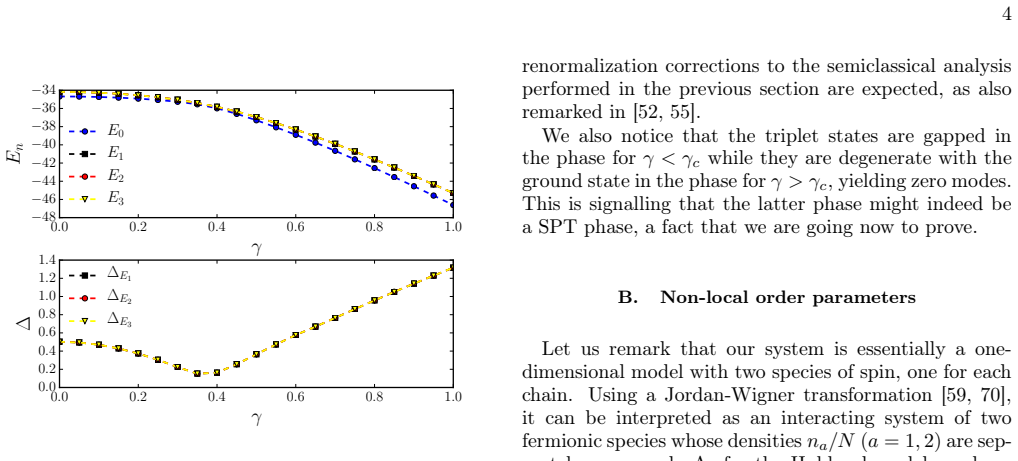
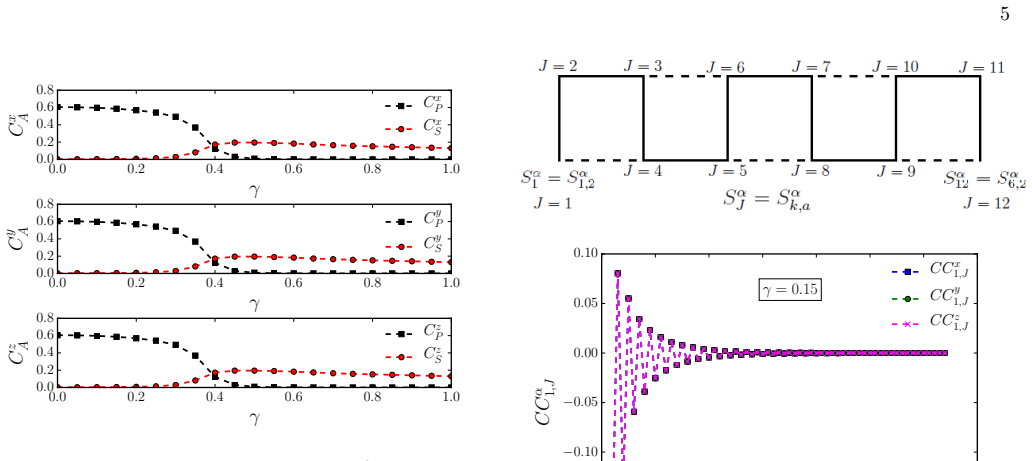
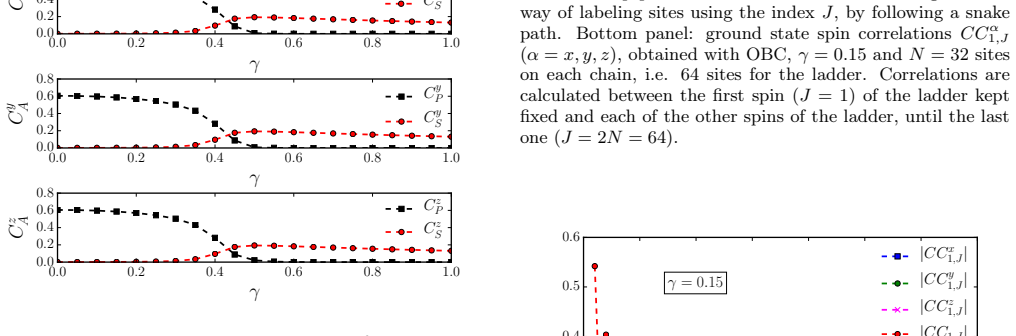
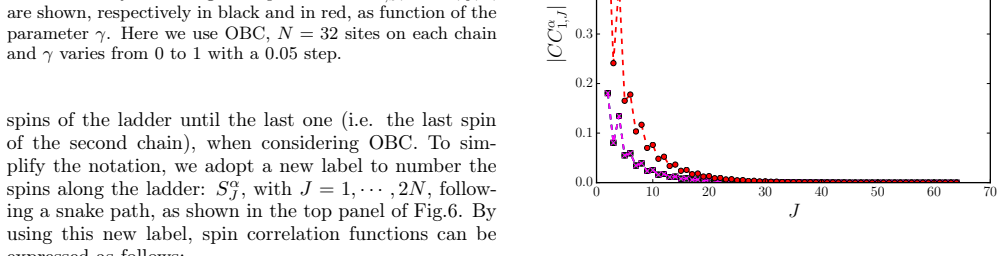
Summary. The manuscript studies the two-leg spin-1/2 Heisenberg ladder of Eq. (2) (model B), with staggered leg couplings where the alternation in one chain is shifted by one site relative to the other. In the continuum limit the authors derive an O(3) nonlinear sigma model with a topological theta-term (Eqs. (6)-(7)) and predict a critical point at gamma_c = -0.75, where theta = pi. DMRG data on energy gaps, parity and string order parameters, edge spin correlations, entanglement entropy, and entanglement spectrum degeneracy show a critical point near gamma = 0.35-0.4 separating two gapped phases: one with parity order and odd entanglement-spectrum degeneracy, and one with zero modes, string order, edge-edge correlations, and even entanglement-spectrum degeneracy. The paper concludes that the theta-term induces a transition from an ordinary (Mott-insulator-like) phase to a topological (Haldane-insulator-like) SPT phase.
Significance. The analytic derivation is a useful and non-circular step: the theta = pi prediction is parameter-free and is checked, not fitted, against the numerics, and the numerical critical point is located independently. The paper also presents a coherent set of numerical diagnostics for the existence of two distinct gapped phases and a critical region. However, the central SPT interpretation is not supported. At gamma = 1 the Hamiltonian reduces exactly to a trivial dimerized spin-1/2 chain, and the authors' own data show no additional transition between the numerical gamma_c and gamma = 1; the claimed topological phase is therefore adiabatically connected to a trivial phase. The numerical evidence for the phase structure may be correct, but the 'topological phases' claim, which is the paper's main result, is falsified by a solvable point inside the reported phase.
major comments (3)
- [§III.C, Eq. (2), Fig. 6] At gamma = 1, the leg couplings in Eq. (2) become 2 on chain-1 odd bonds and chain-2 even bonds, and 0 on the complementary bonds; with the snake labeling of Fig. 6 the Hamiltonian is exactly a spin-1/2 Heisenberg chain with alternating couplings 2 (strong leg bonds) and 1 (rungs). This is the standard dimerized chain, adiabatically connected to a product of singlets on the strong bonds, i.e., a gapped trivial phase. The authors' own gap data in Fig. 3 show no closure between the numerical gamma_c = 0.35-0.4 and gamma = 1, so the phase identified as 'topological' contains this exactly solvable trivial point. The zero-energy edge states for gamma > gamma_c are then the dangling spins left by the dimer covering, and the strong edge-edge correlation in Fig. 8 is the exponentially small coupling of those dangling spins. This contradicts the central conclusion that the gamma > gamma_c phase is an SPT Haldane insulator.
- [§III.D, Fig. 11] The even degeneracy of the entanglement spectrum is not a valid SPT diagnostic as presented. In the snake representation, the half-chain cut used for Fig. 11 cuts through a strong (2J) bond of the dimerized chain; a product of singlets has even Schmidt degeneracy for such a cut and odd degeneracy for a cut through a weak bond. The authors do not specify the cut position or demonstrate that the even degeneracy persists for cuts placed differently. Therefore Fig. 11 cannot distinguish an SPT phase from the trivial dimerized phase at gamma = 1.
- [§II and Conclusion] The analytic prediction theta_c = pi gives gamma_c = -0.75, whereas the numerical critical point is gamma = 0.35-0.4. The authors acknowledge in the Conclusion that they cannot determine whether the factor-of-two discrepancy comes from lattice effects, finite-size effects, or renormalization corrections. In itself this does not invalidate the existence of a critical point, but it means the quantitative link between the continuum theta and the lattice parameter gamma is uncontrolled; the SPT claim therefore rests entirely on the numerical diagnostics, which the preceding comments show are consistent with a trivial dimerized phase.
minor comments (5)
- [Fig. 13, fourth panel] The parity order parameter in the 'topological' phase at gamma = 0.8 is plotted on a scale of about 10^-4; the authors should report the extrapolated thermodynamic value with an uncertainty estimate to support the claim that it vanishes.
- [§III.C] The authors add a small term mu (sum_J S_J)^2 with mu = 10^-3 to select the singlet ground state; they should state whether the correlations and edge-state energies in Fig. 8 are computed with this perturbation present and whether the quoted concurrence sum in Eq. (13) is affected by it.
- [Eq. (9)] The string operator has both endpoints on chain 1; the authors should justify this choice and discuss how the result depends on the choice of endpoint chain, given the rung coupling between the chains.
- [Conclusion] The statement that the numerical gamma_c is 'very close to half' of the theoretical value could be made quantitative by citing the finite-size estimates gamma = 0.35 and 0.40 from the Appendix.
- [Introduction and References] There are minor typographical issues, including inconsistent notation 'NLσM' versus 'NL$\sigma$M' and the misspelling 'Dell'Arringa' for 'Dell'Aringa' in the introduction.
Circularity Check
No significant circularity: the θ=π prediction is parameter-free and checked, not fitted, against the numerics.
full rationale
The claimed derivation is not circular. The central analytic prediction is obtained by inserting the explicit staggered Hamiltonian of Eq. (2) into Haldane's semiclassical mapping of Eq. (4), integrating out fluctuations, and obtaining the NLσM coupling θ in Eq. (7). Setting J=1 and s=1/2 gives θ_c=π at γ_c=−0.75; this number is derived from the couplings, not fitted to the numerical data. The DMRG results locate the gap closure at γ≈0.35–0.4, a genuine discrepancy attributed to renormalization, lattice, and finite-size corrections, and the Appendix's finite-size scaling is an independent check that a transition exists. The phase diagnostics (parity order in Eq. (8), string order in Eq. (9), edge correlations, and entanglement-spectrum degeneracy) are standard external probes taken from [27–29], [71–73], and [75], and none is defined as 'the Haldane-insulator phase' by construction. Self-citations to [47], [50], [63], [72], and [73] supply method or formulas, not the target conclusion; [63] merely points to omitted algebra and is not used as a uniqueness or existence proof. The skeptical concern that at γ=1 the ladder becomes a trivial dimerized chain is a substantive correctness objection to the SPT classification, but it is not a circular reduction: the paper's equations do not make the topological conclusion an input. Hence no circular step is present; the score of 1 reflects only minor, non-load-bearing self-citation.
Assumptions & free parameters
assumptions (5)
- domain assumption Haldane continuum mapping applies to the two-leg spin-1/2 ladder with a slowly varying staggered field phi-hat(k,tau) uniform along each rung and small fluctuations l_a.
- domain assumption The topological term coefficient theta in Eq. (7) is the correct continuum limit of Hamiltonian (2); the calculation is not shown and is deferred to the master thesis [63].
- standard math The NLsigmaM with theta = pi is massless and all other theta values give gapped phases, so theta_c = pi marks the phase transition.
- domain assumption The Jordan-Wigner mapped fermionic model inherits the parity and string order parameters from Refs. [27-29], and these order parameters classify the phases as Mott-like and Haldane-like.
- domain assumption DMRG calculations with bond dimensions up to 500 and 7 to 40 sweeps have converged to the true ground state and low excitations.
Cite this review
Pith. "Pith review of Topological phases in two-legged Heisenberg ladders with alternating interactions." pith.science (2026). https://pith.science/paper/XAOJ4WSK
@misc{pith2026190808440,
  author       = {Pith},
  title        = {Pith review of: Topological phases in two-legged Heisenberg ladders with alternating interactions},
  year         = {2026},
  howpublished = {\url{https://pith.science/paper/XAOJ4WSK}},
  note         = {Machine review of arXiv:1908.08440}
}
abstract
We analyze the possible existence of topological phases in two-legged spin ladders considering a staggered interaction in both chains. When the staggered interaction in one chain is shifted by one site with respect to the other chain, the model can be mapped, in the continuum limit, into a non linear sigma model NL$\sigma$M plus a topological term which is nonvanishing when the number of legs is two. This implies the existence of a critical point which distinguishes two phases. We perform a numerical analysis of energy levels, parity and string non-local order parameters, correlation functions between $x,y,z$ components of spins at the edges of an open ladder, the degeneracy of the entanglement spectrum and the entanglement entropy in order to characterize these two different phases. Finally, we identify one phase with a Mott insulator and the other one with a Haldane insulator.
Figures


Figures from the paper (8 more)


Reference graph
Works this paper leans on
-
[1]
C. Degli Esposti Boschi, E. Ercolessi, G. Morandi, Low- Dimensional Spin Systems: Hidden Symmetries, Confor- mal Field Theories and Numerical Checks. In: B. J. Gru- ber, G. Marmo, N. Yoshinaga (eds) Symmetries in Sci- ence XI. Springer, Dordrecht (2004)
work page 2004
-
[2]
S.Sachdev, QuantumPhaseTransitions, CambridgeUni- versity Press (1998)
work page 1998
-
[3]
R. J. Baxter, Exactly Solved Models in Statistical Me- chanics, Academic Press (1989)
work page 1989
-
[4]
F. D. M. Haldane, Continuum dynamics of the 1-D Heisenberg antiferromagnet: Identification with the O(3) nonlinear sigma model, Phys. Lett. A93, 464 (1983)
work page 1983
-
[5]
F. D. M. Haldane, Nonlinear Field Theory of Large-Spin Heisenberg Antiferromagnets: Semiclassically Quantized Solitons of the One-Dimensional Easy-Axis N´eel State, Phys. Rev. Lett.50, 1153 (1983)
work page 1983
-
[6]
J. R. Klauder and B. S. Skagerstam, Coherent states, World Scientific, Singapore (1985)
work page 1985
-
[7]
Affleck, in Fields, strings and critical phenomena, eds
I. Affleck, in Fields, strings and critical phenomena, eds. E. Brezin and J. Zinn-Justin, North-Holland (1990)
work page 1990
-
[8]
Rajaraman, Solitons and instantons, North-Holland (1982)
R. Rajaraman, Solitons and instantons, North-Holland (1982)
work page 1982
Show all 82 references
-
[9]
Morandi, The role of topology in classical and quan- tum physics, Springer-Verlac (1992)
G. Morandi, The role of topology in classical and quan- tum physics, Springer-Verlac (1992)
1992
-
[10]
Read and S
N. Read and S. Sachdev, Some features of the phase dia- gram of the square lattice SU(N) antiferromagnet, Nucl. Phys. B 316, 609 (1989)
1989
-
[11]
A. M. Polyakov, Interaction of goldstone particles in two dimensions. Applications to ferromagnets and massive Yang-Mills fields, Phys. Lett. B59, 79 (1975)
1975
-
[12]
Affleck, T
I. Affleck, T. Kennedy, E. H. Lieb, and H. Tasaki, Rig- orous results on valence-bond ground states in antiferro- magnets, Phys. Rev. Lett.59, 799 (1987)
1987
-
[13]
Affleck, T
I. Affleck, T. Kennedy, E. H. Lieb, and H. Tasaki, Va- lence bond ground states in isotropic quantum antiferro- magnets, Comm. Math. Phys.115, 477 (1988)
1988
-
[14]
Kennedy and H
T. Kennedy and H. Tasaki, HiddenZ2×Z2 symmetry breaking in Haldane-gap antiferromagnets, Phys. Rev. B 45, 304 (1992)
1992
-
[15]
V. L. Berezinskii, Destruction of long-range order in one- dimensional and two-dimensional systems possessing a continuous symmetry group. II. Quantum systems, Sov. Phys. JEPT 34, 610 (1972)
1972
-
[16]
J. M. Kosterlitz and D. J. Thouless, Ordering, metasta- bility and phase transitions in two-dimensional systems, J. Phys. C6, 1181 (1973)
1973
-
[17]
P. C. Hohenberg, Existence of Long-Range Order in One and Two Dimensions, Phys. Rev.158, 383 (1967)
1967
-
[18]
N. D. Mermin and H. Wagner, Absence of Ferro- magnetism or Antiferromagnetism in One- or Two- Dimensional Isotropic Heisenberg Models, Phys. Rev. Lett. 17, 1133 (1966)
1966
-
[19]
Landau, On the theory of phase transitions, Zh
L. Landau, On the theory of phase transitions, Zh. Eksp. Teor. Fiz.7, 19 (1937)
1937
-
[20]
Gu and X.-G
Z.-C. Gu and X.-G. Wen, Tensor-entanglement-filtering renormalization approach and symmetry-protected topo- logical order, Phys. Rev. B80, 155131 (2009)
2009
-
[21]
A. P. Schnyder, S. Ryu, A. Furusaki and A. W. W. Lud- wig, Classification of topological insulators and super- conductors in three spatial dimensions, Phys. Rev. B78, 195125 (2008)
2008
-
[22]
Kitaev, Periodic table for topological insulators and superconductors, AIP Conference Proceedings1134, 22 (2009)
A. Kitaev, Periodic table for topological insulators and superconductors, AIP Conference Proceedings1134, 22 (2009)
2009
-
[23]
Wen, Symmetry-protected topological phases in noninteracting fermion systems, Phys
X.-G. Wen, Symmetry-protected topological phases in noninteracting fermion systems, Phys. Rev. B85, 085103 (2012)
2012
-
[24]
Fidkowski and A
L. Fidkowski and A. Kitaev, Effects of interactions on the topological classification of free fermion systems, Phys. Rev. B 81, 134509 (2010)
2010
-
[25]
M. Z. Hasan and C. L. Kane, Colloquium: Topological insulators, Rev. Mod. Phys.82, 3045 (2010)
2010
-
[26]
Qi and S.-C
X.-L. Qi and S.-C. Zhang, Topological insulators and su- perconductors, Rev. Mod. Phys.83, 1057 (2011)
2011
-
[27]
Montorsi and M
A. Montorsi and M. Roncaglia, Nonlocal Order Param- eters for the 1D Hubbard Model, Phys. Rev. Lett.109, 236404, (2012)
2012
-
[28]
Barbiero, A
L. Barbiero, A. Montorsi, and M. Roncaglia, How hid- den orders generate gaps in one-dimensional fermionic systems, Phys. Rev. B88, 035109 (2013)
2013
-
[29]
Montorsi, F
A. Montorsi, F. Dolcini, R. C. Iotti, and F. Rossi, Symmetry-protected topological phases of one- dimensional interacting fermions with spin-charge sep- aration, Phys. Rev. B95, 245108 (2017)
2017
-
[30]
Giamarchi, Quantum Physics in One Dimension, vol
T. Giamarchi, Quantum Physics in One Dimension, vol. 121 of International Series of Monographs on Physics, Clarendon, Oxford University Press (2004)
2004
-
[31]
F. D. M. Haldane, O(3) Nonlinearσ Modeland the Topo- logical Distinction between Integer- and Half-Integer- Spin Antiferromagnets in Two Dimensions, Phys. Rev. Lett. 61, 1029 (1988)
1988
-
[32]
Fradkin and M
E. Fradkin and M. Stone, Topological terms in one- and two-dimensional quantum Heisenberg antiferromagnets, Phys. Rev. B38, 7215 (1988)
1988
-
[33]
L. B. Ioffe and A. I. Larkin, Effective action of a two- dimensional antiferromagnet, Int. J. Mod. Phys. B2, 203 (1988)
1988
-
[34]
Dombre and N
T. Dombre and N. Read, Absence of the Hopf invariant in the long-wavelength action of two-dimensional quantum antiferomagnets, Phys. Rev. B38, 7181 (1988)
1988
-
[35]
Angelucci and G
A. Angelucci and G. Jug, Novel path integral approach to effective field theories for D-dimensional quantum spin systems, Int. J. Mod. Phys. B3, 1069 (1989)
1989
-
[36]
T. M. Rice, S. Golapan, and M. Sigrist, Superconductiv- ity, spin gaps and Luttinger liquids in a class of cuprates, Europhys. Letters 23, 445 (1993)
1993
-
[37]
Dagotto, J
E. Dagotto, J. Riera, and D. Scalapino, Superconductiv- ity in ladders and coupled planes, Phys. Rev. B45, 5744 (1992)
1992
-
[38]
Dagotto, Correlated electrons in high-temperature su- perconductors, Rev
E. Dagotto, Correlated electrons in high-temperature su- perconductors, Rev. Mod. Phys.66, 763 (1994)
1994
-
[39]
D. C. Johnston, J. W. Johnson, D. P. Goshorn, and A. J. Jacobson, Magnetic susceptibility of(VO )2P2O7: A one-dimensional spin-1/2 Heisenberg antiferromagnet with a ladder spin configuration and a singlet ground state, Phys. Rev. B35, 219 (1987)
1987
-
[40]
Hiroi, M
Z. Hiroi, M. Azuma, M. Takano, and Y. Bando, A new homologousseries Srn−1Cun+1O2n foundintheSrOCuO system treated under high pressure, J. Solid State Chem. 95, 230 (1991)
1991
-
[41]
Azuma, Z
M. Azuma, Z. Hiroi, M. Takano, K. Ishida, and Y. Ki- taoka, Observation of a Spin Gap inSrCu 2O3 Compris- 11 ing Spin-1 2 Quasi-1D Two-Leg Ladders, Phys. Rev. Lett. 73, 3463 (1994)
1994
-
[42]
Barnes and J
T. Barnes and J. Riera, Susceptibility and excitation spectrum of(VO )2P2O7 in ladder and dimer-chain mod- els, Phys. Rev. B50, 6817 (1994)
1994
-
[43]
Dagotto and T
E. Dagotto and T. M. Rice, Surprises on the Way from One- to Two- Dimensional Quantum Magnets: The Lad- der Materials, Science271, 618 (1996)
1996
-
[44]
D. V. Khveshchenko, Singlet pairing in the doublet-chain t-J model, Phys. Rev. B50, 380 (1994)
1994
-
[45]
ALMAIDEA
and in [48, 49]. As anticipated before, the topological term (7) is null for case A, yielding instead a nontrivial contribution in case B, which we will concentrate on in the following. It is well known [64] that the NLσM is gapped for all values of the coefficient of the topolo...
-
[46]
by using bosonization techniques, while, following the original Haldane’s mapping, Dell’Arringa et al. in
-
[47]
and Sierra in [48, 49] mapped the Heisenberg Hamil- tonian of a spin ladder into a NLσM which contains a topological term whose coefficientθ is proportional to both spin and number of legs, proving the above men- tioned conjecture. arXiv:1908.08440v3 [cond-mat.str-el] 15 Feb 202...
1908 arXiv
-
[48]
Sierra, The nonlinear sigma model and spin ladders, J
G. Sierra, The nonlinear sigma model and spin ladders, J. Phys. A: Math. Gen.29, 3299 (1996)
1996
-
[49]
S´en´echal, Semiclassical description of spin ladders, Phys
D. S´en´echal, Semiclassical description of spin ladders, Phys. Rev. B52, 15319 (1995)
1995
-
[50]
D. G. Shelton, A. A. Nersesyan and A. M. Tsvelik, An- tiferromagnetic spin ladders: Crossover between spin S = 1/2 andS = 1 chains, Phys. Rev. B53, 8521 (1996)
1996
-
[51]
Dell’Aringa, E
S. Dell’Aringa, E. Ercolessi, G. Morandi, P. Pieri, and M. Roncaglia, Effective Actions for Spin Ladders, Phys. Rev. Lett. 78, 2457 (1997)
1997
-
[52]
Such critical point separates two different gapped phases whose properties we want to investigate in this paper
for ladders, showing that in all cases a critical point is expected for the value of the parameter controlling the alternated interactions which yields a coefficient of the topological term θc = π. Such critical point separates two different gapped phases whose properties we want...
-
[53]
Sierra, Lectures Notes in Physics478, eds
G. Sierra, Lectures Notes in Physics478, eds. G. Sierra and M.A. Martin-Delgado, Springer-Verlag (1997)
1997
-
[54]
Campos Venuti, C
L. Campos Venuti, C. Degli Esposti Boschi, E. Ercolessi, F. Ortolani, G. Morandi, S. Pasini, and M. Roncaglia, Particle Content of the Nonlinear Sigma Model with Theta-Term: a lattice Model Investigation, J. Stat. Mech. 0504, L04004 (2005)
2005
-
[55]
Sato, N-leg integer-spin ladders and tubes in commen- surate external fields: Nonlinear sigma model approach, Phys
M. Sato, N-leg integer-spin ladders and tubes in commen- surate external fields: Nonlinear sigma model approach, Phys. Rev. B72, 104438 (2005)
2005
-
[56]
M. A. Martin-Delgado, R. Shankar, and G. Sierra, Phase Transitions in Staggered Spin Ladders, Phys. Rev. Lett. 77, 3443 (1996)
1996
-
[57]
Magnifico, D
G. Magnifico, D. Vodola, E. Ercolessi, S. P. Kumar, M. Müller, and A. Bermudez, Symmetry-protected topolog- ical phases in lattice gauge theories: TopologicalQED2, Phys. Rev. D99, 014503 (2019)
2019
-
[58]
Magnifico, D
G. Magnifico, D. Vodola, E. Ercolessi, S. P. Kumar, M. Müller, and A. Bermudez,ZN gauge theories coupled to topological fermions:QED2 with a quantum-mechanical θ angle, Phys. Rev. B100, 115152 (2019)
2019
-
[59]
M. A. Martin-Delgado, J. Dukelsky, and G. Sierra, Phase diagram of the 2-leg Heisenberg ladder with alternating dimerization, Phys. Lett. A250, 430 (1998)
1998
-
[60]
N. J. Robinson, A. Altland, R.Egger, N. M. Gergs, W. Li, D. Schuricht, A. M. Tsvelik, A. Weichselbaum, and R. M. Konik, Nontopological Majorana Zero Modes in Inho- mogeneous Spin Ladders, Phys. Rev. Lett.122, 027201 (2019)
2019
-
[61]
Chepiga, F
N. Chepiga, F. Michaud, and F. Mila, Berry phase in- vestigation of spin-S ladders, Phys. Rev. B 88, 184418 (2013)
2013
-
[62]
Totsuka and M
K. Totsuka and M. Suzuki, The spin-1/2 Heisenberg spin ladder with bond alternation, J. Phys.: Condens. Matter 7, 6079 (1995)
1995
-
[63]
Auerbach, Interacting Electrons and Quantum Mag- netism, Springer, 2 edition (1998)
A. Auerbach, Interacting Electrons and Quantum Mag- netism, Springer, 2 edition (1998)
1998
-
[64]
Fradkin, Field Theoriesof CondensedMatter Systems, Addison-Wesley, 1 edition (1991)
E. Fradkin, Field Theoriesof CondensedMatter Systems, Addison-Wesley, 1 edition (1991)
1991
-
[65]
Greven, R
M. Greven, R. J. Birgeneau, and U.-J. Wiese, Monte Carlo Study of Correlations in Quantum Spin Ladders, Phys. Rev. Lett.77, 1865 (1996)
1996
-
[66]
S. R. White, R. M. Noack, and D. J. Scalapino, Resonat- ing Valence Bond Theory of Coupled Heisenberg Chains, Phys. Rev. Lett.73, 886 (1994)
1994
-
[67]
Ghelli, Topological phases in spin lad- ders, Master Thesis, University of Bologna, https://amslaurea.unibo.it/17050/ (2018)
G. Ghelli, Topological phases in spin lad- ders, Master Thesis, University of Bologna, https://amslaurea.unibo.it/17050/ (2018)
2018
-
[68]
Shankar and N
R. Shankar and N. Read, Theθ = π nonlinear sigma model is massless, Nucl. Phys. B336, 457 (1990)
1990
-
[69]
S. R. White, Density-matrix algorithms for quantum renormalization groups, Phys. Rev. B48, 10345 (1993)
1993
-
[70]
S. R. White, Density matrix formulation for quan- tum renormalization groups, Phys. Rev. Lett.69, 2863 (1992)
1992
-
[71]
Verstraete, V
F. Verstraete, V. Murg, and J. I. Cirac, Matrix prod- uct states, projected entangled pair states, and varia- tional renormalization group methods for quantum spin systems, Adv. Phys.57, 143 (2008)
2008
-
[72]
Phys.326, 96 (2011)
U.Schollw ¨ock, Thedensity-matrixrenormalizationgroup in the age of matrix product states, Ann. Phys.326, 96 (2011)
2011
-
[73]
Or´us, A pratical introduction to tensor netwrks: Ma- trix product states and projected entangled pair states, Ann
R. Or´us, A pratical introduction to tensor netwrks: Ma- trix product states and projected entangled pair states, Ann. Phys. 349, 117 (2014)
2014
-
[74]
E. O. Gogolin, E. A. Nersesyan, and M. Tsvelik, Bosonization and Strongly Correlated Systems, Cam- bridge University Press (1998)
1998
-
[75]
Fazzini, F
S. Fazzini, F. Becca, and A. Montorsi, Nonlocal Par- ity Order in the Two-Dimensional Mott Insulator, Phys. Rev. Lett. 118, 157602 (2017)
2017
-
[76]
Degli Esposti Boschi, A
C. Degli Esposti Boschi, A. Montorsi, and M. Roncaglia, Brane parity orders in the insulating state of Hubbard ladders, Phys. Rev. B94, 085119 (2016)
2016
-
[77]
Campos Venuti, C
L. Campos Venuti, C. Degli Esposti Boschi, and M. Roncaglia, Long-Distance Entanglement in Spin Sys- tems, Phys. Rev. Lett.96, 247206 (2006)
2006
-
[78]
T. J. Osborne and F. Verstraete, General Monogamy In- equality for Bipartite Qubit Entanglement, Phys. Rev. Lett. 96, 220503 (2006)
2006
-
[79]
Pollmann, A
F. Pollmann, A. M. Turner, E. Berg, and M. Oshikawa, Entanglement spectrum of a topological phase in one di- mension, Phys. Rev. B81, 064439 (2010)
2010
-
[80]
Yamamoto, Ground-State Properties ofS = 1 Antifer- romagnetic Heisenberg Chains with Bond Alternation, J
S. Yamamoto, Ground-State Properties ofS = 1 Antifer- romagnetic Heisenberg Chains with Bond Alternation, J. Phys. Soc. Jpn.63, 4327 (1994)
1994
-
[81]
Affleck, Large-n Limit of SU (n) Quantum "Spin" Chains, Phys
I. Affleck, Large-n Limit of SU (n) Quantum "Spin" Chains, Phys. Rev. Lett.54, 966 (1985)
1985
-
[82]
ITensor Library, (version 2.1.1) http://itensor.org
Reviewed August 14, 2026 · model on record in the stance chip above.
Discussion (0). Continue with ORCID to comment.