REVIEW 3 major objections 1 minor 16 references
Closure of Self-Determining System Based on Causal and Constitutive Relations
T0 review · 3 major / 1 minor · reviewed 2026-06-26 · grok-4.3
Pith's one-line read Constraining constitutive relations to at least two variables forces internal causes and two interdependent loops in self-determining systems.
desk verdict The paper claims that forcing constitutive relations to have at least two independent variables creates internal causes and dual-process organization, but this step looks like a stipulation that assumes the boundary it aims to derive. read the letter →
The pith
A machine-rendered reading of the paper's core claim, the machinery that carries it, and where it could break.
The reading
What carries the argument
causal-constitutive loops, formed by asymmetric causal and constitutive relations, which close to define system boundaries and enforce self-determination when constitutive relations require multiple variables
What would settle it
A concrete system that achieves self-determination and closed boundaries while using only single-variable constitutive relations, or a demonstration that multi-variable constitutive relations can still reduce to supervenience.
Extended reading notes
Core claim
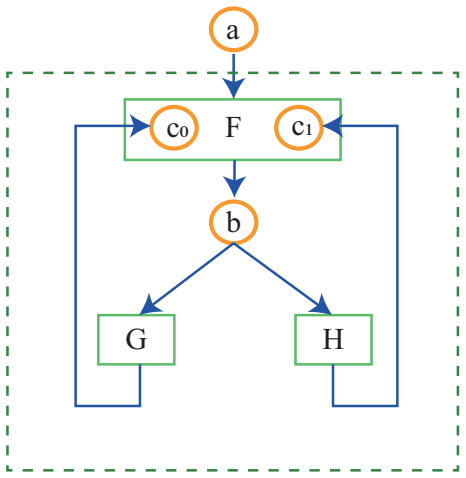
A self-determining system is one in which causes originating within the system influence the system itself. System boundaries are defined as closures of loops formed by causal and constitutive relations. By constraining constitutive relations to involve at least two independent variables, the resulting system necessarily includes internal causes and thereby satisfies self-determination. This minimal requirement leads to two interdependent loops, which implies a dual-process organization.
Load-bearing premise
Constitutive relations can be defined independently to require at least two variables without already assuming the self-determination or boundary closure the definition is meant to produce.
Editorial extensions
If this is right
- Self-determining systems must contain internal causes once constitutive relations are constrained to multiple variables.
- Constitutive relations with only one variable collapse the account into supervenience.
- Two interdependent loops are the direct structural consequence of the minimal constraint.
- Boundaries are marked by combined causal-constitutive closure rather than causal closure alone.
- The organization takes the form of dual-process structure.
Reading between the lines
- The same constraint could be used to test whether artificial agents achieve autonomy without external supervisory loops.
- The requirement for two variables might be checked directly in dynamical models by counting the independent inputs to each constitutive mapping.
- If the two-loop structure holds, removing one loop should break self-determination in any implementation that follows the definition.
Signed reviews
Editorial analysis
A structured set of objections, weighed in public.
Referee Report
Summary. The paper defines a self-determining system as one with internal causes and proposes that system boundaries are closures of causal-constitutive loops formed by two asymmetric relations. It claims that constraining constitutive relations to involve at least two independent variables forces the presence of internal causes (hence self-determination) while avoiding reduction to supervenience, and that this minimal constraint produces two interdependent loops implying a dual-process organization.
Significance. If the argument can be made non-circular and supported by explicit derivation, the framework could provide a conceptual tool for distinguishing self-determination from standard causal or supervenience accounts in systems theory and AI. As written, however, the contribution remains definitional with no formal proofs, counter-example analysis, or empirical tests supplied.
major comments (3)
- [Abstract] Abstract: The central claim that 'by constraining constitutive relations, the resulting system necessarily includes internal causes' is presented as following from the two-independent-variable requirement, yet the boundary definition ('system boundaries can be defined as closures of loops formed by these relations') already encodes internal relations via the loop-closure operation; no derivation is given showing how the variable-count constraint alone generates an internal cause from the loop axioms without presupposing the closure.
- [Abstract] Abstract: The assertion that the two-variable constraint 'leads to two interdependent loops, which implies a dual-process organization' lacks any formal mapping from loop interdependence to the notion of 'process'; without an explicit definition or derivation of what counts as a process or how the loops are shown to be interdependent beyond the constitutive/causal distinction, this implication does not follow from the stated minimal requirement.
- [Abstract] Abstract: The requirement that constitutive relations 'must involve at least two independent variables' to prevent reduction to supervenience is introduced as a stipulation without an argument demonstrating why a single-variable constitutive relation would collapse into supervenience or how the two-variable case is independently justified rather than chosen to produce the desired internal-cause outcome.
minor comments (1)
- The abstract introduces technical terms such as 'causal-constitutive loops' and 'dual-process organization' without providing initial definitions or citations to related literature on closure or constitutive relations.
Simulated Author's Rebuttal
We thank the referee for the constructive feedback highlighting the need for more explicit derivations in our conceptual framework. We agree that the manuscript would benefit from additional formalization to strengthen the claims. We address each major comment below and will revise the paper accordingly.
read point-by-point responses
-
Referee: [Abstract] Abstract: The central claim that 'by constraining constitutive relations, the resulting system necessarily includes internal causes' is presented as following from the two-independent-variable requirement, yet the boundary definition ('system boundaries can be defined as closures of loops formed by these relations') already encodes internal relations via the loop-closure operation; no derivation is given showing how the variable-count constraint alone generates an internal cause from the loop axioms without presupposing the closure.
Authors: We recognize the potential circularity concern. The loop-closure is a general mechanism for boundary definition, but the two-variable constraint on constitutive relations is what ensures the presence of internal causes by requiring interdependence that cannot be fully externalized. We will add a dedicated subsection providing a step-by-step logical derivation from the axioms of causal and constitutive relations to demonstrate how the variable constraint produces internal causation independently of the closure assumption. revision: yes
-
Referee: [Abstract] Abstract: The assertion that the two-variable constraint 'leads to two interdependent loops, which implies a dual-process organization' lacks any formal mapping from loop interdependence to the notion of 'process'; without an explicit definition or derivation of what counts as a process or how the loops are shown to be interdependent beyond the constitutive/causal distinction, this implication does not follow from the stated minimal requirement.
Authors: We agree that 'process' requires explicit definition. In the revised manuscript, we will define a 'process' as a sequence of state changes driven by the causal relations within the loop. We will then derive the interdependence of the two loops (one causal, one constitutive) and show how this necessitates a dual-process structure. This will include a formal mapping. revision: yes
-
Referee: [Abstract] Abstract: The requirement that constitutive relations 'must involve at least two independent variables' to prevent reduction to supervenience is introduced as a stipulation without an argument demonstrating why a single-variable constitutive relation would collapse into supervenience or how the two-variable case is independently justified rather than chosen to produce the desired internal-cause outcome.
Authors: The justification is that a single-variable constitutive relation would allow all system properties to be determined by a single factor, effectively making the system supervenient on that factor without internal causation. With two or more independent variables, the constitutive relation requires mutual determination that introduces internal causes. We will expand the manuscript with this argument and a brief counter-example for the single-variable case to show the collapse. revision: yes
Circularity Check
Self-determination achieved by construction via constraint forcing internal causes in causal-constitutive loops
-
self definitional
[Abstract]
"By constraining constitutive relations, the resulting system necessarily includes internal causes and thereby satisfies self-determination. Furthermore, to prevent reduction to supervenience, constitutive relations must involve at least two independent variables. This minimal requirement leads to two interdependent loops, which implies a dual-process organization."
Self-determining system is defined upfront as requiring internal causes; the framework then stipulates a constraint on constitutive relations whose explicit purpose is to generate those internal causes within the loops. The satisfaction of self-determination therefore follows tautologically from applying the authors' own constraint rather than being derived from the loop-closure axioms without that stipulation.
full rationale
The paper defines a self-determining system as one with internal causes, then defines boundaries via causal-constitutive loop closures and introduces a constraint on constitutive relations (at least two independent variables) explicitly to ensure internal causes appear and to block supervenience. This makes the central result—that the system satisfies self-determination and yields dual-process organization—a direct consequence of the chosen definitions and constraint rather than an independent derivation from the loop axioms alone. The step matches self_definitional circularity because the constraint is selected precisely to produce the property named in the initial definition.
Assumptions & free parameters
assumptions (2)
- domain assumption Causal and constitutive relations are distinct asymmetric relations.
- ad hoc to paper System boundaries are defined as closures of causal-constitutive loops.
invented entities (2)
-
causal-constitutive loop
-
dual-process organization
Cite this review
Pith. "Pith review of Closure of Self-Determining System Based on Causal and Constitutive Relations." pith.science (2026). https://pith.science/paper/XAYJ7SMK
@misc{pith2026260621010,
  author       = {Pith},
  title        = {Pith review of: Closure of Self-Determining System Based on Causal and Constitutive Relations},
  year         = {2026},
  howpublished = {\url{https://pith.science/paper/XAYJ7SMK}},
  note         = {Machine review of arXiv:2606.21010}
}
read the original abstract
A self-determining system is defined as one in which causes originating within the system influence the system itself. This definition raises the question of how to specify system boundaries. Although the concept of "closure" is commonly used for this purpose, defining boundaries solely in terms of causal relations introduce challenges, such as how to handle external causes and circular causality. To address this issue, we introduce two types of asymmetric relations: causal and constitutive. We propose that system boundaries can be defined as closures of loops formed by these relations, referred to as causal-constitutive loops. By constraining constitutive relations, the resulting system necessarily includes internal causes and thereby satisfies self-determination. Furthermore, to prevent reduction to supervenience, constitutive relations must involve at least two independent variables. This minimal requirement leads to two interdependent loops, which implies a dual-process organization.
Figures
Reference graph
Works this paper leans on
-
[1]
Barandiaran, X., & Moreno, A. (2008). Adaptivity: From metabolism to behavior. Adaptive Behavior, 16 (5), 325–344. https://doi.org/10.1177/1059712308093868
-
[2]
Boden, M. (2008). Autonomy: What is it? introduction. Biosystems, 91 (2), 305–308. https://doi.org/10.1016/j.biosystems.2007.07.003
-
[3]
Cornish-Bowden, A., & C´ ardenas, M. L. (2020). Contrasting the ories of life: Historical context, current theories. in search of an ideal theory. BioSystems, 188, 104063. https://doi.org/10.1016/j.biosystems.2019.104063
-
[4]
Haggard, P. (2019). The neurocognitive bases of human volition. Annual Reviews of Psy- chology, 70, 9–28. https://doi.org/10.1146/annurev-psych-010418-1033 48
-
[5]
Hofmeyr, J. S. (2021). A biochemically-realisable relational model o f the self-manufacturing cell. BioSystems, 207, 104463. https://doi.org/10.1016/j.biosystems.2021.104463 Kauffman, S. (1993). The origins of order: Self-organization and selection in ev olution. Ox- ford New York: Oxford University Press. 9
-
[6]
Kim, J. (1998). Mind in a physical world: An essay on the mind-body problem an d mental causation. Cambridge: The MIT PRess
1998
-
[7]
Kolchinsky, A., & Wolpert, D. (2018). Semantics information, auton omous agency and non- equilibrium statistical physics. Interface Focus, 8 (6), 20180041. https://doi.org/10.1098/rsfs.2018.0041 L´ opez-D ´ ıaz, A. J., & Gershenson, C. (2025). Closing the loop: Ho w semantic closure en- ables open-ended evolution ? Journal of the royal society interface ,...
-
[8]
Maturana, H., & Varela, F. (1980). Autopoiesis and cognition: The realization of the living . D. Reidel Publishing Company. Mont´ evil, M., & Mossio, M. (2015). Biological organisation as closure of constraints. Journal of Theoretical Biology , 372, 171–191. https://doi.org/10.1016/j.jtbi.2015.02.029
Show all 16 references
-
[9]
Mossio, M., & Bich, L. (2017). What makes biological organisation tele ological? Synthese, 194, 1089–1114. https://doi.org/10.1007/s11229-014-0594-z
2017 doi
-
[10]
K., & Kuniyoshi, Y
Ohmura, Y., Carr, E. K., & Kuniyoshi, Y. (2026). A mathematical for malization of self- determining agency. arXiv, arXiv:2601.02885. https://doi.org/10.48550/arXiv.2601.02885
2026 doi
-
[11]
Pattee, H. H. (2001). The physics of symbols: Bridging the epistem ic cut. Biosystems, 60, 5–21. https://doi.org/10.1016/S0303-2647(01)00104-6
2001 doi
-
[12]
Pearl, J. (2009). Causality: Models, reasoning, and inference, 2nd ed. New York: Cambridge University Press
2009
-
[13]
Piaget, J. (1971). Biology and knowledge: An essay on the relations between org anic regula- tions and cognitive processes . University of Chicago Press
1971
-
[14]
Rosen, R. (1991). Life itself: A comprehensive inquiry into the nature, origi n, and fabrication of life . New York: Columbia University Press
1991
-
[15]
Varela, F. (1979). Principles of biological autonomy . New York:North-Holland
1979
-
[16]
Woodward, J. (2003). Making things happen . Oxford: Oxford Univeristy Press. 10 F b G H a c/g3669 c/g3670 Figure 1: Minimal self-determining system defined by a causal–const itutive loop (CC-loop). Blue arrows indicate causal relations. Green boxes represent cau sal transmissio...
2003
Reviewed June 26, 2026 · model on record in the stance chip above.
Discussion (0). Continue with ORCID to comment.