REVIEW 4 major objections 4 minor 2 cited by
IntuiTF: MLLM-Guided Transfer Function Optimization for Direct Volume Rendering
T0 review · 4 major / 4 minor · reviewed 2026-08-06 · deepseek-v4-flash
Pith's one-line read An MLLM judge can evaluate volume renderings as well as expert radiologists, agreeing with them 77–85% of the time on pairwise comparisons.
desk verdict Solid MLLM-as-judge baseline for volume rendering; the user-intent generalization claim still needs a human study. read the letter →
The pith
A machine-rendered reading of the paper's core claim, the machinery that carries it, and where it could break.
The reading
What carries the argument
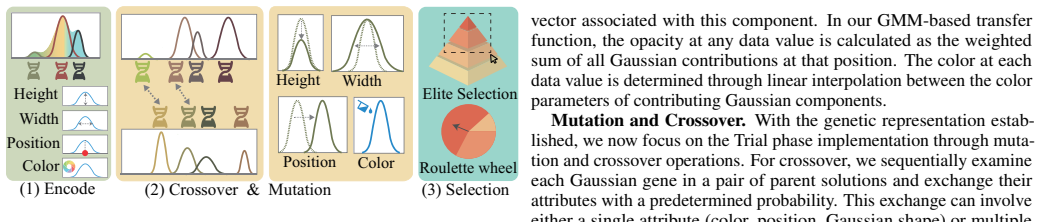
The load-bearing mechanism is the MLLM-guided pairwise evaluator. It receives two volume renderings, the user's intent (text, reference image, or both), and a fixed rubric; the MLLM judges which image is better on each aspect and outputs a preference or a tie. These votes are converted into numeric fitness through Elo ratings with Swiss-system pairing, then into a rank-based selection score whose pressure increases as optimization progresses, so early generations explore broadly and later generations concentrate on the best candidates. The explorer encodes each transfer function as a genome of Gaussian primitives—position, width, height, and color—and uses crossover, mutation, elitism, and roulette-wheel selection to implement the Trial and Replanning phases.
What would settle it
Give the MLLM evaluator and a panel of radiologists the same pairwise comparison task on CT pairs where the two renderings differ mainly in a dimension not in the rubric, such as noise suppression, slice-boundary artifacts, or quantitative fidelity to attenuation values, and check whether the MLLM's preferences still agree with the panel. Agreement near chance on such pairs would show that the rubric is incomplete.
Extended reading notes
Core claim
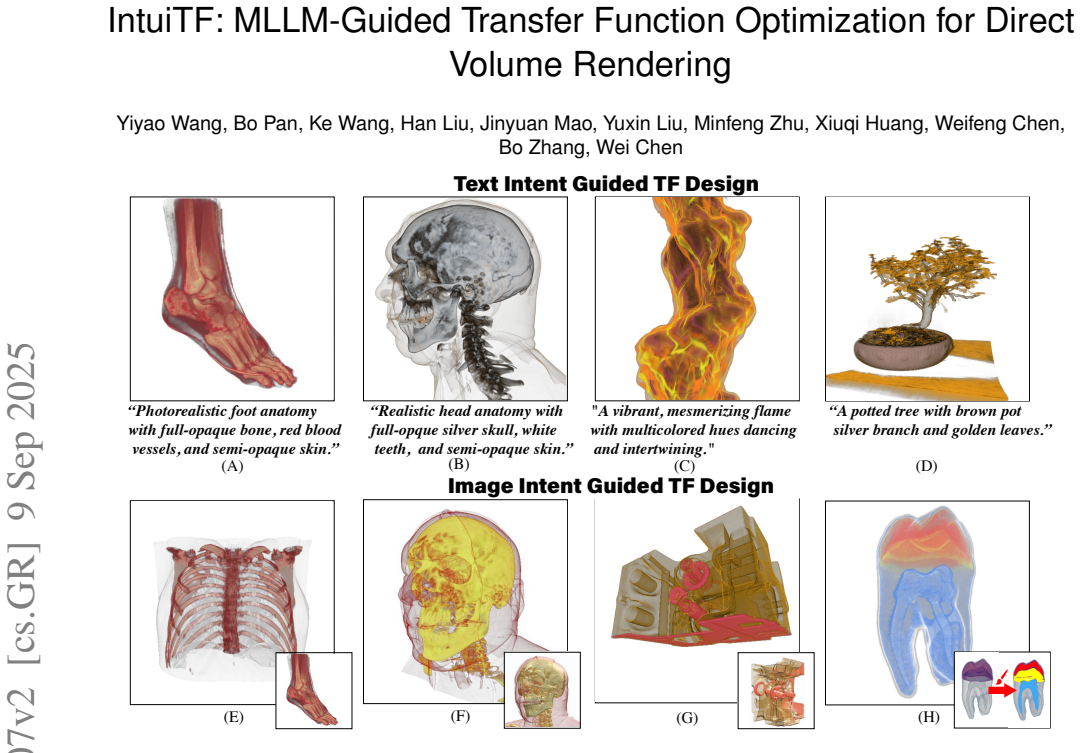
The central claim is that a frozen, general-purpose MLLM provides human-aligned evaluation of volume-rendered images, and that this evaluation is enough to drive evolutionary search over transfer functions. The evaluator asks the model to compare two renderings on three formal quality aspects—information richness, feature discrimination, and color-content harmony—alongside two intent-alignment dimensions for text and image input, then merges the aspect-level judgments into a single preference. Preferences are converted to fitness with an Elo rating system using Swiss-system pairing, and the fitness drives an evolutionary explorer whose genomes are Gaussian mixture transfer functions. The reported experiments show consistently higher agreement with expert judgments than information entropy on head, chest, feet, and tooth CT datasets, and three case studies argue that the full system generalizes across datasets and analytical goals without domain-specific training.
Load-bearing premise
The framework's five evaluation dimensions are assumed to be the complete set of considerations experts use when judging a volume rendering; if experts weigh something outside these dimensions, the optimizer will chase the wrong objective even when its pairwise choices match experts on the tested aspects.
Editorial extensions
If this is right
- Natural language and reference images become viable control signals for transfer function design, replacing hand-tuned histograms and quantitative heuristics.
- The same optimizer can be applied to a new volume dataset without retraining, because the evaluator's visual judgment comes from a pretrained MLLM rather than dataset-specific priors.
- The agreement scores suggest the MLLM evaluator can serve as a surrogate for human preference in large-scale transfer function search, where collecting expert labels for every candidate is impractical.
- An interactive system built on this optimizer can support workflows like 'make the pot transparent' or sketch-based coloring, lowering the barrier for non-specialist users.
- The large gap over the information-entropy baseline indicates that commonly used quantitative metrics may be systematically misaligned with expert preference in volume rendering.
Reading between the lines
- The same evaluator-plus-explorer pattern could transfer to other visual parameter search problems in visualization, such as colormap selection, lighting, or camera path design, because the rubric is not volume-specific.
- The fixed five-dimension rubric bounds the current evidence; adding dimensions like noise suppression or anatomical fidelity would require new validation, and the paper's expert interviews flag abstract simulation data as a case where text and image intent are hard to express.
- The reported cost (roughly 90 seconds per iteration and about $0.23 per API round with Gemini 2.0 Flash) suggests that distilling MLLM judgments into a small surrogate model, which the paper names as future work, could make the approach near-interactive.
Editorial analysis
A structured set of objections, weighed in public.
Referee Report
Summary. The paper proposes IntuiTF, a framework for transfer function (TF) optimization in direct volume rendering. It formalizes the expert TF design process as a Trial–Insight–Replanning cycle, implemented by an evolutionary explorer over a Gaussian-mixture TF representation and an MLLM-based evaluator that compares pairs of renderings on three quality aspects (information richness, feature discrimination, color-content harmony) and two intent-alignment dimensions (text, image). Pairwise evaluations are converted to Elo ratings used as fitness. The authors also present an interactive system and three case studies (image-guided medical visualization, text-guided plant exploration, sketch-based tooth coloring). Quantitative experiments compare the evaluator's preferences with human expert judgments on 190 image pairs per dataset across four medical datasets, report agreement with the information-entropy baseline, and analyze population-size/iteration effects on the evolutionary optimizer using the same MLLM evaluator as the ranking ground truth.
Significance. If the claims hold, IntuiTF is a potentially valuable step toward generalizable, intent-guided TF design: it leverages strong pretrained MLLMs instead of dataset-specific priors, and the agreement experiment with 28 medical experts provides a meaningful external anchor for the quality signal. The paper is also commendable for shipping source code, a demo video, and case studies that show the interactive workflow. The main strengths are the design of structured evaluation aspects and the human–machine comparison methodology adapted from GPTEval3D. However, as discussed below, the central generalization claim about user intent is not yet supported by the experiments, and the fitness update contains a concrete error. With additional validation and corrections the framework could be a solid contribution.
major comments (4)
- [Sec. 4.3 and Sec. 7.1] The human experiment in Sec. 7.1 tests only the three formal quality aspects (IR, FD, CH) using pairwise comparisons with no user intent specification. The two intent-alignment dimensions introduced in Sec. 4.3 (text alignment and image alignment) are never validated against human judgments or against an external objective. Since the paper's central claim is that IntuiTF aligns TF optimization with user intent and generalizes across analytical objectives, this is a load-bearing gap. The case studies are illustrative and the expert interviews are qualitative; neither provides a falsifiable measure of intent-alignment quality. To support the claim, the authors should add a human study in which text or reference-image intents are specified and the evaluator's preferences are compared with expert choices under those intents, or alternatively restrict the paper's claims to generic quality only.
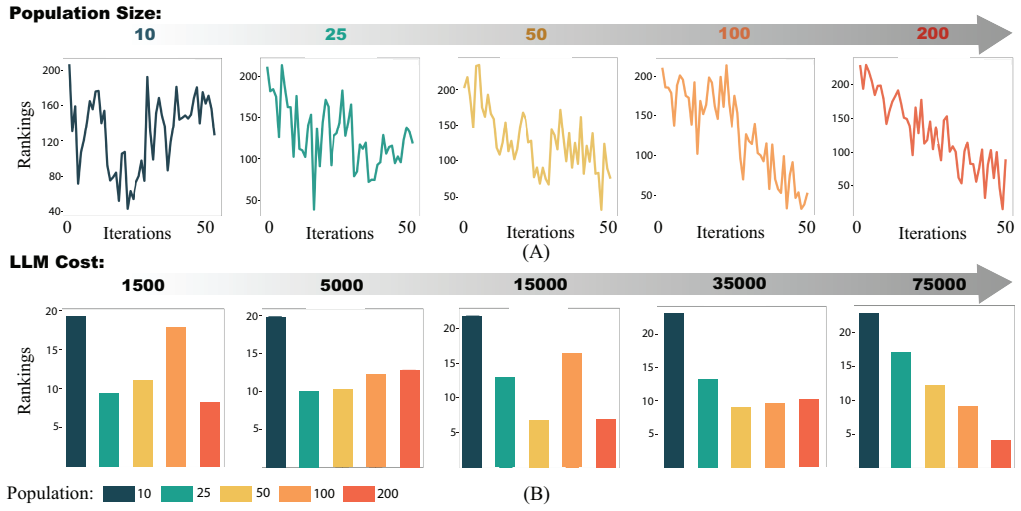
- [Sec. 7.2] The evolutionary-explorer evaluation uses the same MLLM evaluator both as the fitness function inside the optimizer and as the Elo-ranking ground truth for comparing final populations. This creates an internal consistency loop: the experiment shows that the explorer optimizes what the evaluator prefers, but it cannot establish that evolution improves human-perceived visualization quality or intent alignment. The claim in Sec. 7.2 that 'medium-small populations perform better... and larger populations... achieve superior results' is therefore only about the evaluator's own reward model. An independent evaluation (e.g., human ratings or a held-out objective) is needed before the explorer can be said to improve the human-aligned objective.
- [Sec. 4.3, Eq. (1)] The Elo expected-score formula appears to be incorrect. The written expression E = Pr('i better than j') = (1 / (1 + 10^{(σ_j − σ_i)/400}))^{−1} is not a probability: when the ratings are equal it evaluates to 2. The standard Elo formula is E = 1 / (1 + 10^{(σ_j − σ_i)/400}) (or the symmetric variant). With the current formula, Eq. (2) produces nonsensical rating updates (both players can lose points in a match). This error propagates into all fitness scores and therefore into every experiment that relies on Elo ratings, including Sec. 7.2.
- [Sec. 7 (overall)] Throughout Sec. 7, the only external quantitative benchmark is the information-entropy baseline, applied to the evaluator alone. There is no experiment that compares the full IntuiTF framework (explorer + evaluator) with any existing TF design method (e.g., stochastic search, learning-based priors, or text-to-TF approaches). The case studies do not quantify improvements over alternatives. Without such a comparison, the paper's claims of 'broad applicability' and 'effectiveness' for the complete framework remain unsupported, even if each component is individually plausible.
minor comments (4)
- [Sec. 7.1] The process for generating the 20 rendered images per dataset with 'quality uniformly distributed' is not described, and the agreement scores in Tables 1 and 2 are reported without confidence intervals or significance tests; please add error bars or bootstrapped intervals and a short description of image sampling.
- [Sec. 4.2] The selection-pressure parameters (min_pressure=1.2, max_pressure=4.0, k=2.0) are fixed without reporting sensitivity or ablation; since Sec. 7.2 varies only population size and iteration count, the optimality conclusions may depend on these choices.
- [Sec. 10] The conclusion repeatedly uses 'Trail-Insight-Replanning' while the rest of the paper uses 'Trial'; unify the terminology.
- [Sec. 7.3] In Sec. 7.3, 'each individual participates in log2(m)+2 comparison rounds' and the claimed O(n log m) complexity should distinguish comparisons from rounds; as written the reader may infer each round is one comparison per individual.
Circularity Check
No significant circularity; the evaluator is externally anchored to human judgments, and the Sec 7.2 self-scoring loop is an internal consistency check rather than a fitted prediction.
full rationale
The central quantitative claim, that the MLLM evaluator is human-aligned, is anchored to an external ground truth: 28 medical experts compared 190 image pairs per dataset and majority voting fixed the consensus labels (Sec. 7.1). The agreement scores in Table 1 are direct measurements against those labels, not outputs of a parameter fitted to the labels. The evaluation aspects (IR, FD, CH) are taken from prior transfer-function work (Sec. 4.3, refs [7,22]), and the MLLM-as-judge premise is independently supported by GPTEval3D (ref [40]) and by the paper's own human experiment. The Sec. 7.2 explorer study does use the same MLLM evaluator to rank final populations, so it is an internal-consistency loop: it shows that the optimizer improves the evaluator's score, not independently that it improves human-perceived quality. However, because the same three aspects were externally anchored in Sec. 7.1, this is a validity limitation rather than a definitional reduction. No fitted parameter is renamed as a prediction; Elo ratings and selection pressure are computed from stated formulas. User-intent dimensions (text alignment, image alignment) are not tested against humans in Sec. 7.1, and Sec. 8 notes limitations for abstract datasets and waiting time; these are evidence gaps, not circularity. Self-citations (refs [29], [38], [39]) appear in related work and technical background and are not load-bearing. No uniqueness theorem or ansatz is imported from the authors' prior work. Verdict: no significant circularity.
Assumptions & free parameters
free parameters (4)
- Selection pressure scheduling (min_pressure, max_pressure, k) =
1.2, 4.0, 2.0
- Elo K-factor =
32
- Mutation and crossover probabilities =
Not fixed numerically
- Number of Gaussian components n =
Not specified
assumptions (4)
- domain assumption MLLMs provide human-aligned perceptual assessment of volume renderings
- domain assumption The three quality aspects (information richness, feature discrimination, color-content harmony) plus intent-alignment dimensions are a sufficient decomposition of human TF quality
- domain assumption Gaussian mixture models are an expressive enough representation for effective transfer functions
- standard math Elo rating with Swiss-system tournaments yields a valid ordering of TF quality from pairwise comparisons
Cite this review
Pith. "Pith review of IntuiTF: MLLM-Guided Transfer Function Optimization for Direct Volume Rendering." pith.science (2026). https://pith.science/paper/XAZIUYEZ
@misc{pith2026250618407,
  author       = {Pith},
  title        = {Pith review of: IntuiTF: MLLM-Guided Transfer Function Optimization for Direct Volume Rendering},
  year         = {2026},
  howpublished = {\url{https://pith.science/paper/XAZIUYEZ}},
  note         = {Machine review of arXiv:2506.18407}
}
read the original abstract
Direct volume rendering (DVR) is a fundamental technique for visualizing volumetric data, where transfer functions (TFs) play a crucial role in extracting meaningful structures. However, designing effective TFs remains unintuitive due to the semantic gap between user intent and TF parameter space. Although numerous TF optimization methods have been proposed to mitigate this issue, existing approaches still face two major challenges: the vast exploration space and limited generalizability. To address these issues, we propose IntuiTF, a novel framework that leverages Multimodal Large Language Models (MLLMs) to guide TF optimization in alignment with user intent. Specifically, our method consists of two key components: (1) an evolution-driven explorer for effective exploration of the TF space, and (2) an MLLM-guided human-aligned evaluator that provides generalizable visual feedback on rendering quality. The explorer and the evaluator together establish an efficient Trial-Insight-Replanning paradigm for TF space exploration. We further extend our framework with an interactive TF design system. We demonstrate the broad applicability of our framework through three case studies and validate the effectiveness of each component through extensive experiments. We strongly recommend readers check our cases, demo video, and source code at: https://github.com/wyysteelhead/IntuiTF
Figures

Figures from the paper (5 more)


Forward citations
Cited by 2 Pith papers
-
SciVisAgentBench: A Benchmark for Evaluating Scientific Data Analysis and Visualization Agents
SciVisAgentBench provides 108 expert-crafted tasks and a mixed LLM-plus-deterministic evaluation pipeline for benchmarking AI agents that perform scientific visualization workflows.
-
HiLSVA: Design and Evaluation of a Human-in-the-Loop Agentic System for Scientific Visualization
HiLSVA shows that a human-in-the-loop LLM agent system can help novices and experts complete scientific visualization tasks, while human oversight adds measurable execution time.
Reference graph
Works this paper leans on
-
[1]
K. Ai, K. Tang, and C. Wang. Nli4volvis: Natural language interaction for volume visualization via llm multi-agents and editable 3d gaussian splatting.arXiv preprint arXiv:2507.12621, 2025. doi: 10.48550/arXiv. 2507.12621 2
- [2]
-
[3]
D. Chen, R. Chen, S. Zhang, Y . Wang, Y . Liu, H. Zhou, Q. Zhang, Y . Wan, P. Zhou, and L. Sun. MLLM-as-a-Judge: Assessing Multimodal LLM-as- a-Judge with Vision-Language Benchmark. InForty-first International Conference on Machine Learning, 2024. doi: 10.48550/arXiv.2402.04788 4
-
[4]
N. Chen, Y . Zhang, J. Xu, K. Ren, and Y . Yang. VisEval: A Benchmark for Data Visualization in the Era of Large Language Models.IEEE Transactions on Visualization and Computer Graphics, 31(1):1301–1311,
-
[5]
C. Correa and K.-L. Ma. Size-based Transfer Functions: A New V olume Exploration Technique.IEEE Transactions on Visualization and Computer Graphics, 14(6):1380–1387, 2008. doi: 10.1109/TVCG.2008.162 2
-
[6]
C. Correa and K.-L. Ma. Visibility Histograms and Visibility-Driven Transfer Functions.IEEE Transactions on Visualization and Computer Graphics, 17(2):192–204, 2011. doi: 10.1109/TVCG.2010.35 2
-
[7]
C. D. Correa and K.-L. Ma. Visibility-driven transfer functions. In2009 IEEE Pacific Visualization Symposium, pp. 177–184, 2009. doi: 10.1109/ PACIFICVIS.2009.4906854 2, 5
arXiv 2009
-
[8]
A. Dietrich and H. Haider. Human creativity, evolutionary algorithms, and predictive representations: The mechanics of thought trials.Psychonomic bulletin & review, 22:897–915, 2015. doi: 10.3758/s13423-014-0743-x 4
Show all 45 references
-
[9]
A. E. Elo and S. Sloan. The rating of chessplayers: Past and present.(No Title), 1978. 5
1978
-
[10]
S. Fang, T. Biddlecome, and M. Tuceryan. Image-based transfer function design for data exploration in volume visualization. InProceedings of IEEE Visualization, pp. 319–326. Piscataway, 1998. doi: 10.1109/VISUAL .1998.745319 2
1998
-
[11]
H. Guo, W. Li, and X. Yuan. Transfer Function Map. InProceedings of the IEEE Pacific Visualization Symposium, pp. 262–266. IEEE, Piscataway,
-
[12]
H. Guo, N. Mao, and X. Yuan. WYSIWYG (What You See is What You Get) V olume Visualization.IEEE Transactions on Visualization and Computer Graphics, 17(12):2106–2114, 2011. doi: 10.1109/TVCG.2011. 261 2
2011 doi
-
[13]
T. He, L. Hong, A. Kaufman, and H. Pfister. Generation of transfer functions with stochastic search techniques. InProceedings of the IEEE Visualization, pp. 227–234. IEEE, Piscataway. doi: 10.1109/VISUAL. 1996.568113 2
1996
-
[14]
Jeong, J
S. Jeong, J. Li, C. R. Johnson, S. Liu, and M. Berger. Text-based transfer function design for semantic volume rendering. In2024 IEEE Visualization and Visual Analytics (VIS), pp. 196–200. IEEE, 2024. doi: 10.1109/ VIS55277.2024.00047 2
2024
-
[15]
Jönsson, M
D. Jönsson, M. Falk, and A. Ynnerman. Intuitive Exploration of V olumet- ric Data Using Dynamic Galleries.IEEE Transactions on Visualization and Computer Graphics, 22(1):896–905, 2016. doi: 10.1109/TVCG.2015. 2467294 2
2016 doi
-
[16]
Kindlmann
G. Kindlmann. Semi-automatic generation of transfer functions for direct volume rendering. Master’s thesis, Cornell University, USA, 1999. doi: 10.1109/SVV.1998.729588 2
1999
-
[17]
Kniss, G
J. Kniss, G. Kindlmann, and C. Hansen. Multidimensional transfer func- tions for interactive volume rendering.IEEE Transactions on Visualization and Computer Graphics, 8(3):270–285, 2002. doi: 10.1109/TVCG.2002. 1021579 2
2002 doi
-
[18]
Kniss, S
J. Kniss, S. premoze, M. Ikits, A. Lefohn, C. Hansen, and E. Praun. Gaus- sian transfer functions for multi-field volume visualization. InProceedings of the IEEE Visualization, pp. 497–504, 2003. doi: 10.1109/VISUAL.2003 .1250412 2
2003 doi
-
[19]
Kniss, R
J. Kniss, R. Van Uitert, A. Stephens, G.-S. Li, T. Tasdizen, and C. Hansen. Statistically quantitative volume visualization. InProceedings of the IEEE Visualization, pp. 287–294. IEEE, Piscataway, 2005. doi: 10.1109/ VISUAL.2005.1532807 2
2005
-
[20]
S. Liu, H. Miao, and P.-T. Bremer. Paraview-mcp: An autonomous visualization agent with direct tool use.arXiv preprint arXiv:2505.07064,
-
[21]
S. Liu, H. Miao, Z. Li, M. Olson, V . Pascucci, and P.-T. Bremer. A V A: Towards Autonomous Visualization Agents through Visual Perception- Driven Decision-Making. InComputer Graphics Forum, vol. 43, p. e15093. Wiley Online Library, 2024. 2
2024
-
[22]
Ljung, J
P. Ljung, J. Krüger, E. Groller, M. Hadwiger, C. D. Hansen, and A. Ynner- man. State of the Art in Transfer Functions for Direct V olume Rendering. InComputer Graphics Forum, vol. 35, pp. 669–691. Wiley-Blackwell, New Jersey, 2016. doi: 10.1111/cgf.12934 1, 5
2016 doi
- [23]
-
[24]
S. Luo, S. Maji, and J. Dingliana. Intuitive transfer function editing using relative visibility histograms. 2018. 2
2018
-
[25]
Maciejewski, I
R. Maciejewski, I. Woo, W. Chen, and D. Ebert. Structuring Feature Space: A Non-Parametric Method for V olumetric Transfer Function Generation. IEEE Transactions on Visualization and Computer Graphics, 15(6):1473– 1480, 2009. doi: 10.1109/TVCG.2009.185 2
2009 doi
-
[26]
Lundstrom, P
C. Lundstrom, P. Ljung, and A. Ynnerman. Local Histograms for Design of Transfer Functions in Direct V olume Rendering.IEEE Transactions on Visualization and Computer Graphics, 12(6):1570–1579, 2006. doi: 10. 1109/TVCG.2006.100 2
2006
-
[27]
Marks, B
J. Marks, B. Andalman, P. A. Beardsley, W. Freeman, S. Gibson, J. Hod- gins, T. Kang, B. Mirtich, H. Pfister, W. Ruml, et al. Design galleries: A general approach to setting parameters for computer graphics and anima- tion. InProceedings of the 24th annual conference on Comput...
1997
-
[28]
Nguyen, C
N. Nguyen, C. Bohak, D. Engel, P. Mindek, O. Strnad, P. Wonka, S. Li, T. Ropinski, and I. Viola. Finding Nano- \" Otzi: Semi-Supervised V olume Visualization for Cryo-Electron Tomography.arXiv preprint arXiv:2104.01554, 2021. 2
2021
-
[29]
Mallick, O
T. Mallick, O. Yildiz, D. Lenz, and T. Peterka. Chatvis: Automating scien- tific visualization with a large language model. InSC24-W: Workshops of the International Conference for High Performance Computing, Net- working, Storage and Analysis, pp. 49–55, 2024. doi: 10.1109/SCW...
2024
-
[30]
Pfister, B
H. Pfister, B. Lorensen, C. Bajaj, G. Kindlmann, W. Schroeder, L. Avila, K. Raghu, R. Machiraju, and J. Lee. The transfer function bake-off.IEEE Computer Graphics and Applications, 21(3):16–22, 2001. doi: 10.1109/38 .920623 2, 3
2001 doi
-
[31]
F. d. M. Pinto and C. M. Freitas. V olume visualization and explo- ration through flexible transfer function design.Computers & Graphics, 32(4):420–429, 2008. doi: 10.1016/j.cag.2008.04.004 2
2008 doi
-
[32]
B. Pan, J. Lu, H. Li, W. Chen, Y . Wang, M. Zhu, C. Yu, and W. Chen. Differentiable Design Galleries: A Differentiable Approach to Explore the Design Space of Transfer Functions.IEEE Trans. Vis. Comput. Graph., 30(1):1369–1379, 2023. doi: 10.1109/TVCG.2023.3327371 2
2023
-
[33]
A. Schulz. 125 years swiss system. https://en.chessbase.com/post/125- years-swiss-system. ChessBase, published on June 17, 2020; accessed March 30, 2025. 5
2020
- [34]
-
[35]
Prauchner, C
J. Prauchner, C. Freitas, and J. Comba. Two-Level Interaction Approach for Transfer Function Specification. InBrazilian Symposium on Computer Graphics and Image Processing, pp. 265–272. Piscataway, 2005. doi: 10. 1109/SIBGRAPI.2005.52 2
2005
-
[36]
K. Tang, S. Yao, and C. Wang. ivr-gs: Inverse volume rendering for explorable visualization via editable 3d gaussian splatting.IEEE Transac- tions on Visualization and Computer Graphics, 31(6):3783–3795, 2025. doi: 10.1109/TVCG.2025.3567121 2
2025
-
[37]
Tzeng, E
F.-Y . Tzeng, E. B. Lum, and K.-L. Ma. An intelligent system approach to higher-dimensional classification of volume data.IEEE Transactions on visualization and computer graphics, 11(3):273–284, 2005. 2
2005
-
[38]
Tang and C
K. Tang and C. Wang. StyleRF-V olVis: Style Transfer of Neural Radi- ance Fields for Expressive V olume Visualization.IEEE Transactions on Visualization and Computer Graphics, 2024. 2
2024
-
[39]
Y . Wang, W. Chen, J. Zhang, T. Dong, G. Shan, and X. Chi. Efficient V ol- ume Exploration Using the Gaussian Mixture Model.IEEE Transactions on Visualization and Computer Graphics, 17(11):1560–1573, 2011. doi: 10.1109/TVCG.2011.97 2
2011 doi
-
[40]
T. Wu, G. Yang, Z. Li, K. Zhang, Z. Liu, L. Guibas, D. Lin, and G. Wet- zstein. Gpt-4v (ision) is a human-aligned evaluator for text-to-3d genera- tion. InProceedings of the IEEE/CVF conference on computer vision and pattern recognition, pp. 22227–22238, 2024. 4, 5, 7
2024
-
[42]
Y . Wu, H. Qu, K.-K. Chung, M.-Y . Chan, and H. Zhou. Quantitative effectiveness measures for direct volume rendered images. In2010 IEEE Pacific Visualization Symposium (PacificVis), pp. 1–8, 2010. doi: 10.1109/ PACIFICVIS.2010.5429623 2
2010
-
[43]
M. Yang, K. Tang, and C. Wang. Meta-inr: Efficient encoding of volumet- ric data via meta-learning implicit neural representation. In2025 IEEE 18th Pacific Visualization Conference (PacificVis), pp. 246–251, 2025. doi: 10.1109/PacificVis64226.2025.00030 2
2025
-
[44]
Wu and H
Y . Wu and H. Qu. Interactive Transfer Function Design Based on Editing Direct V olume Rendered Images.IEEE Transactions on Visualization and Computer Graphics, 13(5):1027–1040, 2007. doi: 10.1109/TVCG.2007. 1051 2
2007 doi
-
[2014]
doi: 10.1109/PacificVis.2014.24 2
2014 doi
-
[2025]
doi: 10.1109/TVCG.2024.3456320 4
2024
Reviewed August 6, 2026 · model on record in the stance chip above.
Discussion (0). Sign in to comment.