What Went Wrong with Data Lakes? A 15-Year Reality Check from the Field
Pith reviewed 2026-06-27 18:46 UTC · model grok-4.3
The pith
Data Lake failures stem mainly from organizational Governance Debt rather than technical shortcomings.
A machine-rendered reading of the paper's core claim, the machinery that carries it, and where it could break.
Core claim
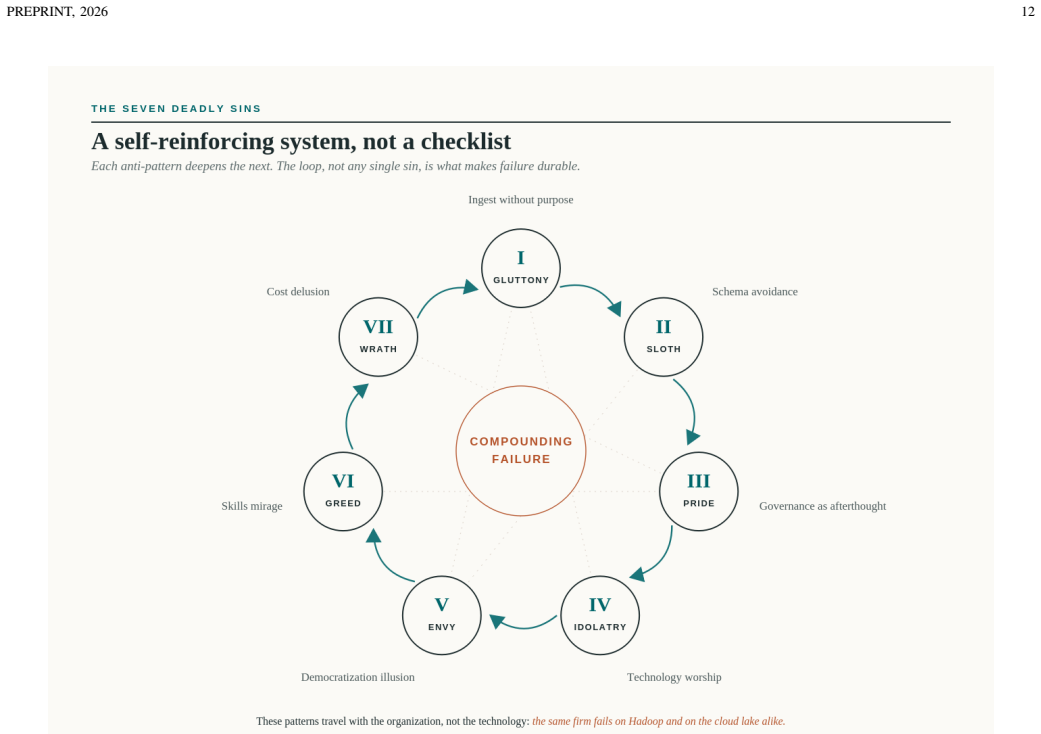
The central claim is that the root causes of Data Lake failures are organizational far more than technical, specifically the compounding cost of deferred governance decisions termed Governance Debt. Seven anti-patterns, called the Seven Deadly Sins of Data Lakes, recur across sources, and organizations exhibit governance gravity by reverting to warehouse-style approaches. A definition of Data Swamp with measurable indicators and a Governance Debt Assessment Model are provided to detect decay.
What carries the argument
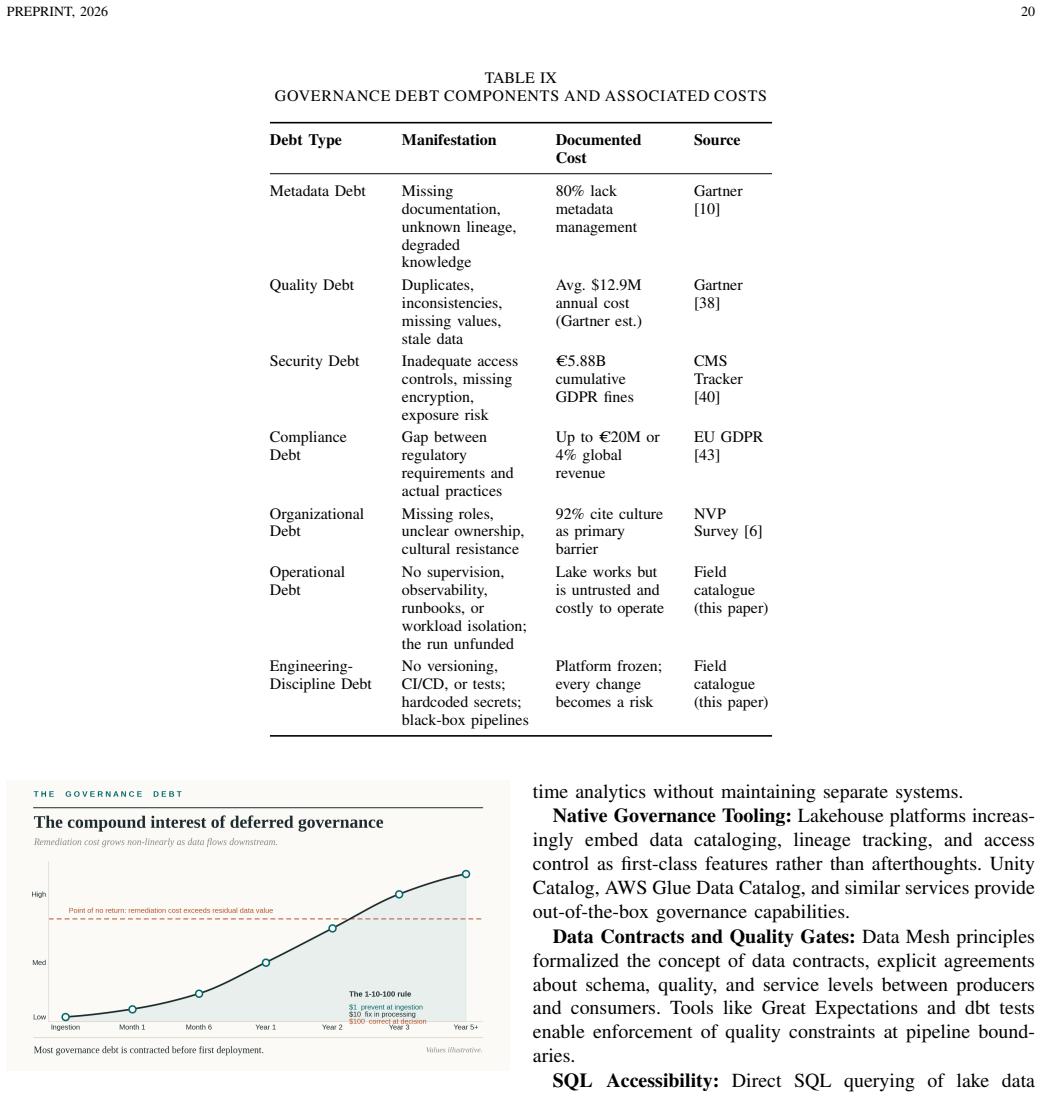
Governance Debt, the compounding cost of governance decisions organizations keep deferring, which explains the anti-patterns and high failure rates.
If this is right
- Data Lakehouse and Data Mesh paradigms have not resolved the organizational problems despite technological advances.
- Organizations drift toward structured approaches when governance challenges arise, a tendency called governance gravity.
- Early detection via the Governance Debt Assessment Model can prevent data systems from becoming swamps.
- Practitioner tools like the Reality Check Framework help address deferred decisions in data projects.
Where Pith is reading between the lines
- Similar patterns of deferred governance may undermine other emerging data management approaches beyond lakes and meshes.
- The emphasis on emerging-market experiences suggests that operational and engineering debts could be more pronounced in regions with limited resources.
- Quantifying Governance Debt in financial terms might help organizations prioritize governance investments from project start.
Load-bearing premise
The 64 sources and the catalogue of nearly 500 field reality checks are representative of the broader industry, with the identified anti-patterns being primary causal factors.
What would settle it
A comprehensive industry survey that finds technical limitations or implementation errors as the leading cause of data lake failures, or shows that projects with upfront governance still fail at similar rates.
Figures
read the original abstract
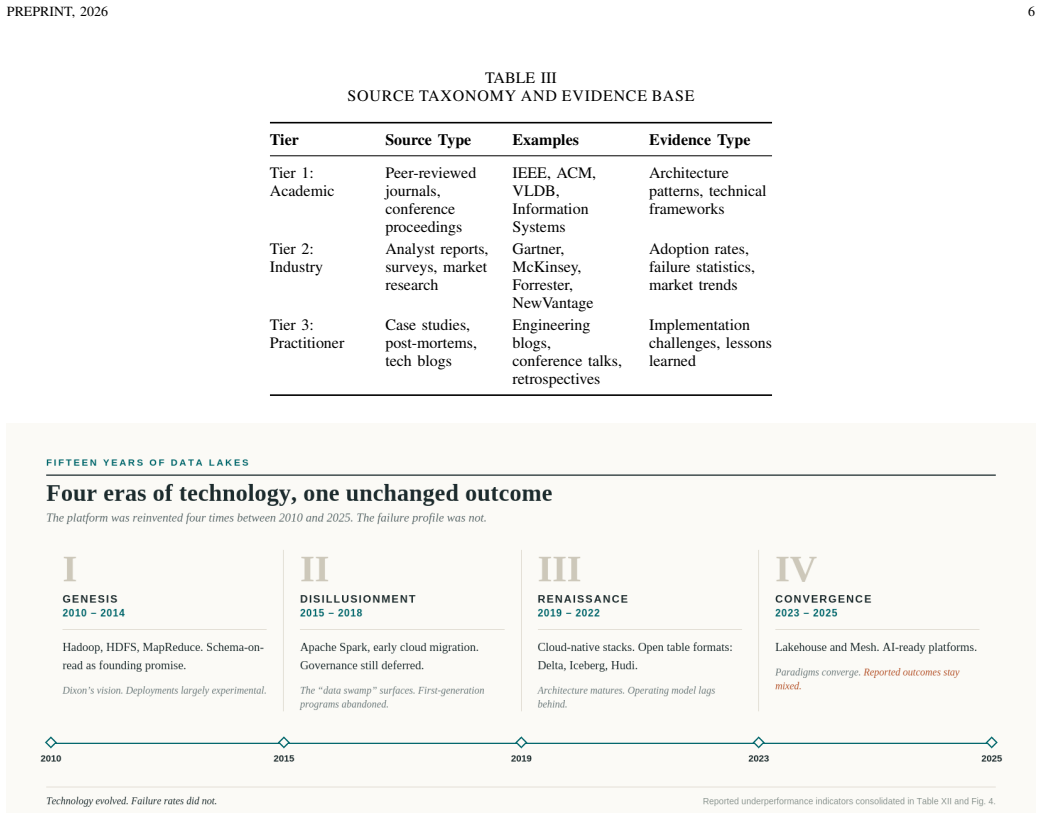
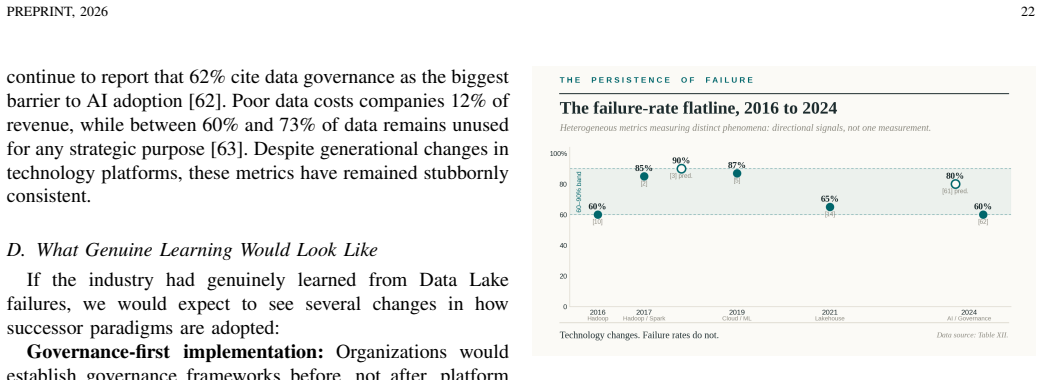
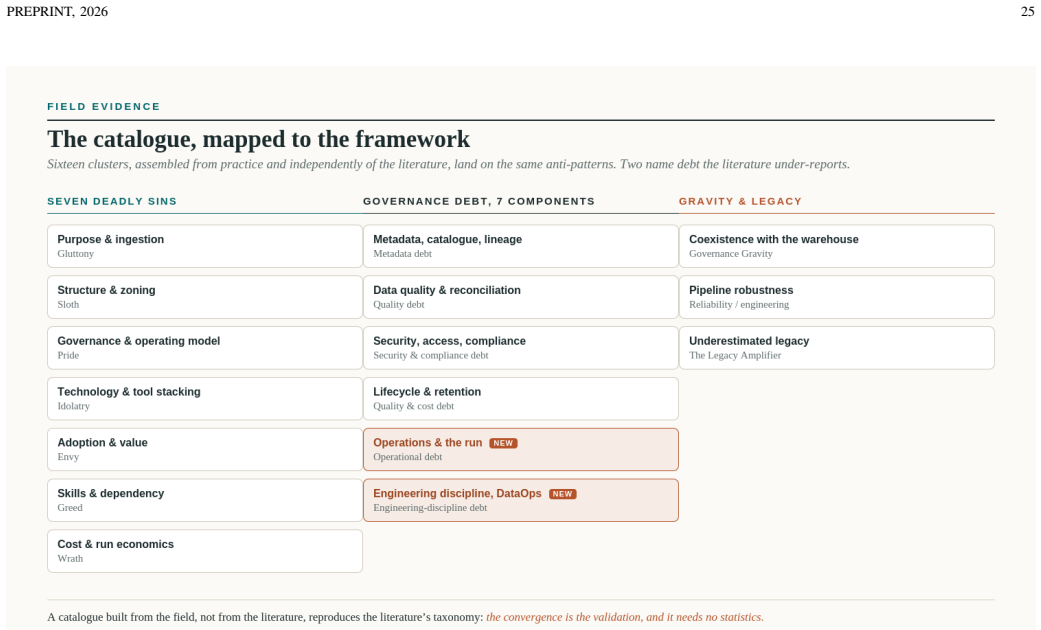
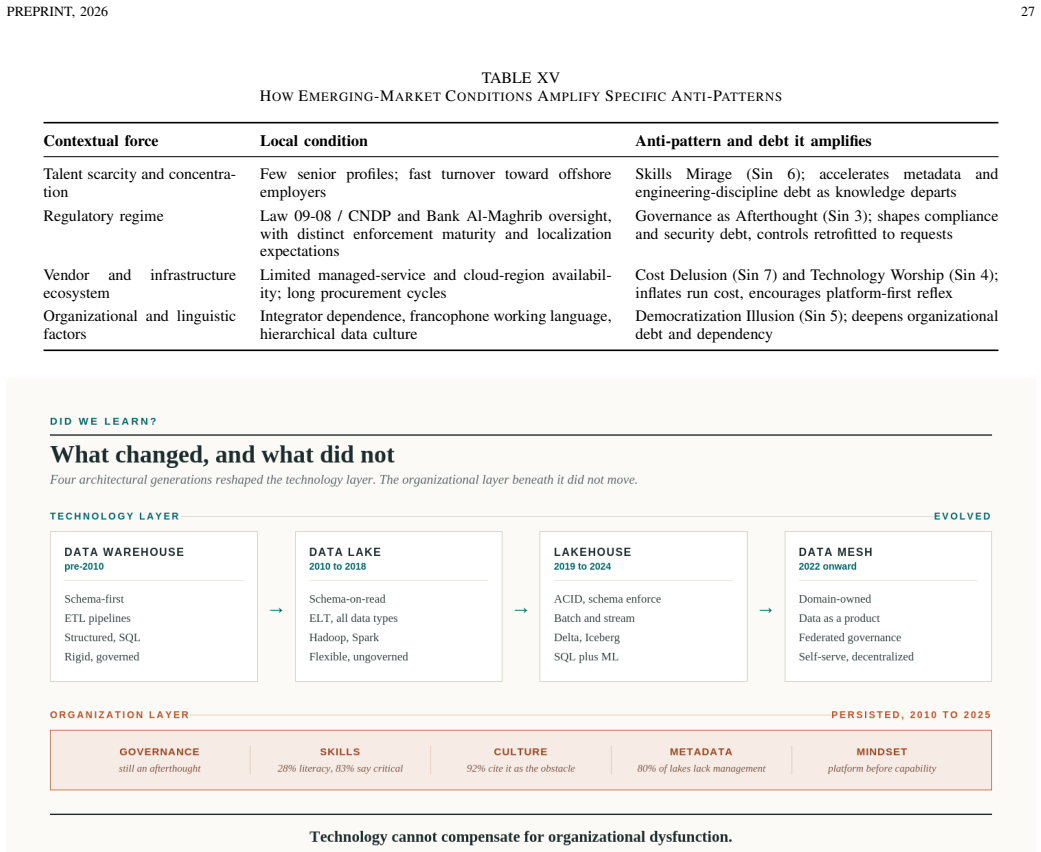
James Dixon introduced the Data Lake in 2010. The pitch was simple: store data raw, postpone schema, cut up-front transformation. It promised flexibility and easier analytics. Fifteen years on, that promise has mostly gone unmet: survey after survey reports high failure rates, whether a big data program, a Data Lake, or a data science effort. This paper asks why. Reading 64 sources across academic work, analyst reports, and practitioner accounts, we found seven recurring anti-patterns, the Seven Deadly Sins of Data Lakes, and offer an explanation for them: Governance Debt, the compounding cost of governance decisions organizations keep deferring. A second pattern surfaced on its own: when governance gets hard, organizations drift back toward structured, warehouse-style approaches, a pull we name governance gravity. The term Data Swamp is used loosely in the literature, so we give it a working definition with measurable indicators, plus a qualitative rubric, the Governance Debt Assessment Model, for catching decay early. The root causes are organizational far more than technical. We also asked whether the newer paradigms, Data Lakehouse and Data Mesh, absorbed the lesson; the technology advanced, the organizational record barely moved. For practitioners we provide two tools, a Reality Check Framework and a Stage-Based Intervention Matrix. The paper rests on more than the analyst literature: it draws on a primary catalogue of close to five hundred field reality checks recorded over fifteen years of building and rescuing enterprise Data Lakes in financial services and telecommunications across Morocco and West Africa. Assembled independently of that literature, the catalogue lands on the same anti-patterns, surfaces two dimensions the literature under-reports, operational debt and engineering-discipline debt, and reads the problem from an emerging-market vantage.
Editorial analysis
A structured set of objections, weighed in public.
Referee Report
Summary. The paper claims that Data Lakes have largely failed to deliver on their 2010 promise due to seven recurring anti-patterns (the 'Seven Deadly Sins'), which are primarily driven by organizational factors rather than technical ones—specifically 'Governance Debt,' defined as the compounding cost of deferred governance decisions. It synthesizes 64 literature sources with the author's independent catalogue of ~500 field observations from 15 years in financial services and telecom in Morocco and West Africa, introduces 'governance gravity' as a drift toward warehouse-style structures, provides a working definition and rubric for 'Data Swamp' via the Governance Debt Assessment Model, and supplies practitioner tools (Reality Check Framework, Stage-Based Intervention Matrix). It further argues that Data Lakehouse and Data Mesh have not resolved the underlying organizational issues.
Significance. If the central claims hold, the work would usefully shift emphasis from technical fixes to organizational governance in data platform design, offering concrete diagnostic and intervention tools grounded in an under-represented emerging-market perspective. The convergence between literature synthesis and long-term field catalogue is a strength, as is the explicit practitioner orientation and the identification of operational and engineering-discipline debt dimensions.
major comments (3)
- [the section on the Reality Check Framework and the catalogue] The section describing the primary catalogue of nearly 500 field reality checks: the claim of independence from the 64-source literature synthesis and the assertion that it 'lands on the same anti-patterns' cannot be evaluated because no selection criteria, sampling protocol, or inter-rater reliability measures are disclosed; this makes the corroboration vulnerable to post-hoc alignment.
- [the section presenting the Governance Debt Assessment Model] The abstract and the section presenting the Governance Debt Assessment Model: the model is offered as a qualitative rubric for early detection, yet no validation against independent outcome metrics, matched successful/failed project comparisons, or falsification tests is described, leaving the causal priority of Governance Debt over technical limits or skill gaps untested.
- [the section asking whether newer paradigms absorbed the lesson] The discussion of Data Lakehouse and Data Mesh: the claim that 'the organizational record barely moved' rests on the same observational sources without a systematic comparison of governance practices or failure rates before and after adoption of these paradigms.
minor comments (3)
- The introduction of invented terms such as 'governance gravity' and 'Governance Debt' would benefit from explicit discussion of how they relate to or differ from existing concepts in the cited literature (e.g., technical debt).
- Figure or table presenting the Seven Deadly Sins would improve readability; currently the anti-patterns are described narratively without a consolidated overview.
- The working definition of Data Swamp includes 'measurable indicators' but the text does not specify how these indicators would be quantified in practice.
Simulated Author's Rebuttal
We thank the referee for these focused methodological comments. They correctly identify the observational character of the work; we respond point by point and indicate the revisions we will make to increase transparency without altering the paper's scope or claims.
read point-by-point responses
-
Referee: [the section on the Reality Check Framework and the catalogue] The section describing the primary catalogue of nearly 500 field reality checks: the claim of independence from the 64-source literature synthesis and the assertion that it 'lands on the same anti-patterns' cannot be evaluated because no selection criteria, sampling protocol, or inter-rater reliability measures are disclosed; this makes the corroboration vulnerable to post-hoc alignment.
Authors: The catalogue comprises the lead author's contemporaneous field notes from roughly 500 engagements across financial services and telecommunications in Morocco and West Africa. It was assembled before the literature synthesis began, and the convergence with the Seven Deadly Sins was noted only after both were complete. Because the record is single-author and experiential rather than a designed multi-rater study, formal sampling protocols and inter-rater reliability statistics do not apply. We will add a dedicated subsection that states the catalogue's provenance, its qualitative and non-probabilistic nature, and the absence of those formal measures, thereby making the basis for the independence claim explicit. revision: yes
-
Referee: [the section presenting the Governance Debt Assessment Model] The abstract and the section presenting the Governance Debt Assessment Model: the model is offered as a qualitative rubric for early detection, yet no validation against independent outcome metrics, matched successful/failed project comparisons, or falsification tests is described, leaving the causal priority of Governance Debt over technical limits or skill gaps untested.
Authors: The Governance Debt Assessment Model is introduced as a practitioner heuristic derived from observed patterns, not as a validated diagnostic instrument. The manuscript does not present or claim statistical validation, matched-pair comparisons, or falsification tests; it positions the model as a qualitative early-warning rubric. We will revise the abstract and the model section to state its heuristic status more explicitly, to note the lack of formal validation as a limitation, and to avoid any implication of proven causal priority. revision: yes
-
Referee: [the section asking whether newer paradigms absorbed the lesson] The discussion of Data Lakehouse and Data Mesh: the claim that 'the organizational record barely moved' rests on the same observational sources without a systematic comparison of governance practices or failure rates before and after adoption of these paradigms.
Authors: The observation that organizational practices have shown limited change is drawn from the same body of field notes and recent literature sources already cited. A controlled pre/post comparison of governance practices or failure rates would require a different research design. We will qualify the statement in the discussion section to reflect its observational basis, remove any implication of systematic before-and-after measurement, and flag the need for future comparative work. revision: yes
Circularity Check
No circularity; observational synthesis from external literature and independent field catalogue
full rationale
The paper's central claim—that Governance Debt and organizational factors drive Data Lake failures—is advanced via synthesis of 64 cited external sources plus the author's separately assembled catalogue of ~500 field observations. No equations, derivations, fitted parameters, or self-referential definitions appear; the catalogue is explicitly described as assembled independently of the literature and used for corroboration rather than as a constructed input. No self-citation load-bearing steps, uniqueness theorems, or ansatzes smuggled via prior work are present. The analysis remains an interpretive review of observational accounts without reduction to its own inputs by construction.
Axiom & Free-Parameter Ledger
axioms (2)
- domain assumption The seven anti-patterns identified are the recurring and primary causes of Data Lake failure across the surveyed sources and field cases.
- domain assumption The author's 15-year catalogue of field reality checks was assembled independently of the literature and therefore provides corroborating evidence.
invented entities (5)
-
Governance Debt
no independent evidence
-
governance gravity
no independent evidence
-
Governance Debt Assessment Model
no independent evidence
-
Reality Check Framework
no independent evidence
-
Stage-Based Intervention Matrix
no independent evidence
Reference graph
Works this paper leans on
-
[1]
Pentaho, Hadoop, and Data Lakes,
J. Dixon, "Pentaho, Hadoop, and Data Lakes,"James Dixon's Blog, Oct. 14, 2010. [Online]. Available: https://jamesdixon.wordpress.com/2010/10/14/pentaho-hadoop-and- data-lakes/. Accessed: Jan. 24, 2026
2010
-
[2]
85% of big data projects fail, but your developers can help yours succeed,
N. Heudecker, cited in M. Asay, "85% of big data projects fail, but your developers can help yours succeed,"TechRepublic, Nov
-
[3]
Available: https://www.techrepublic.com/article/85-of- big-data-projects-fail-but-your-developers-can-help-yours-succeed/
[Online]. Available: https://www.techrepublic.com/article/85-of- big-data-projects-fail-but-your-developers-can-help-yours-succeed/. Ac- cessed: Jan. 24, 2026
2026
-
[4]
Gartner Says Beware of the Data Lake Fallacy,
Gartner, "Gartner Says Beware of the Data Lake Fallacy," Gartner, Jul
-
[5]
Available: https://www.gartner.com/en/newsroom/press- releases/2014-07-28-gartner-says-beware-of-the-data-lake-fallacy
[Online]. Available: https://www.gartner.com/en/newsroom/press- releases/2014-07-28-gartner-says-beware-of-the-data-lake-fallacy. Accessed: Jan. 24, 2026
2014
-
[6]
Big Data and AI Executive Survey 2020,
NewVantage Partners, "Big Data and AI Executive Survey 2020,"NewVantage Partners, 2020. [Online]. Available: https://www.businesswire.com/news/home/20200106005280/en/NewVantage- Partners-Releases-2020-Big-Data-and-AI-Executive-Survey. Accessed: Jan. 24, 2026
arXiv 2020
-
[7]
Why do 87% of data science projects never make it into production?,
VentureBeat, "Why do 87% of data science projects never make it into production?,"VentureBeat, Jul. 19, 2019. [Online]. Available: https://venturebeat.com/ai/why-do-87-of-data-science-projects-never- make-it-into-production/. Accessed: Jan. 24, 2026
2019
-
[8]
Data and AI Leadership Executive Survey 2022,
NewVantage Partners, "Data and AI Leadership Executive Survey 2022,"Wavestone, Jan. 2022. [Online]. Available: https://www.wavestone.us/insights/data-and-ai-leadership-executive- survey-2022/. Accessed: Jan. 24, 2026
2022
-
[9]
4 reasons big data projects fail, and 4 ways to succeed,
B. Muglia, cited in A. Woodie, "4 reasons big data projects fail, and 4 ways to succeed,"InfoWorld, May 2019. [On- line]. Available: https://www.infoworld.com/article/2260568/4-reasons- big-data-projects-failand-4-ways-to-succeed.html. Accessed: Jan. 24, 2026
arXiv 2019
-
[10]
Data Lakes: A Survey of Functions and Systems,
R. Hai, S. Geisler, and C. Quix, "Data Lakes: A Survey of Functions and Systems,"IEEE Trans. Knowl. Data Eng., vol. 35, no. 12, pp. 12571- 12590, Dec. 2023, doi: 10.1109/TKDE.2023.3270101
-
[11]
On Data Lake Architectures and Metadata Management,
P. N. Sawadogo and J. Darmont, "On Data Lake Architectures and Metadata Management,"J. Intell. Inf. Syst., vol. 56, no. 1, pp. 97-120, Feb. 2021, doi: 10.1007/s10844-020-00608-7
-
[12]
Gartner Predicts 2017: Data Lakes Face Significant Challenges,
Gartner, "Gartner Predicts 2017: Data Lakes Face Significant Challenges," Gartner, Dec. 2016. [Online]. Available: https://www.gartner.com/en/documents/3525520. Accessed: Jan. 24, 2026
arXiv 2017
-
[13]
Big Data: The Next Frontier for Innovation, Competition, and Productivity,
McKinsey Global Institute, "Big Data: The Next Frontier for Innovation, Competition, and Productivity,"McKinsey & Company, Jun. 2011. [Online]. Available: https://www.mckinsey.com/capabilities/mckinsey- digital/our-insights/big-data-the-next-frontier-for-innovation. Accessed: Jan. 24, 2026
2011
-
[14]
The Age of Analytics: Competing in a Data- Driven World,
McKinsey Global Institute, "The Age of Analytics: Competing in a Data- Driven World,"McKinsey & Company, Dec. 2016. [Online]. Available: https://www.mckinsey.com/capabilities/quantumblack/our-insights/the- age-of-analytics-competing-in-a-data-driven-world. Accessed: Jan. 24, 2026
2016
-
[15]
Data Lakes Revisited,
J. Dixon, "Data Lakes Revisited,"James Dixon's Blog, Sep. 25, 2014. [Online]. Available: https://jamesdixon.wordpress.com/2014/09/25/data- lakes-revisited/. Accessed: Jan. 24, 2026
2014
-
[16]
Digital Transformation: The Path to Value,
Boston Consulting Group, "Digital Transformation: The Path to Value,"BCG, Oct. 2021. [Online]. Available: https://www.bcg.com/publications/2021/digital-transformation-value. Accessed: Jan. 24, 2026
2021
-
[17]
Data Lakes: Turning Big Data into Business Value,
PricewaterhouseCoopers, "Data Lakes: Turning Big Data into Business Value,"PwC Technology Forecast, 2014. [Online]. Available: https://www.pwc.com/us/en/technology-forecast/2014/cloud- computing/features/data-lakes.html. Accessed: Jan. 24, 2026
2014
-
[18]
State of Data Literacy Report 2024,
DataCamp, "State of Data Literacy Report 2024,"DataCamp, 2024. [Online]. Available: https://www.datacamp.com/resources/reports/state- of-data-literacy-2024. Accessed: Jan. 24, 2026
2024
-
[19]
Data and AI Leadership Executive Survey 2024,
Wavestone (NewVantage Partners), "Data and AI Leadership Executive Survey 2024,"Wavestone, Jan. 2024. [Online]. Available: https://www.wavestone.com/en/insight/data-ai-leadership-executive- survey-2024/. Accessed: Jan. 24, 2026
2024
-
[20]
Fowler,Refactoring: Improving the Design of Existing Code
M. Fowler,Refactoring: Improving the Design of Existing Code. Boston, MA, USA: Addison-Wesley, 1999
1999
-
[21]
W. J. Brown, R. C. Malveau, H. W. McCormick III, and T. J. Mowbray, AntiPatterns: Refactoring Software, Architectures, and Projects in Crisis. New York, NY , USA: Wiley, 1998
1998
-
[22]
Data Swamp, Data Lake, Data Lakehouse: What to Know,
Alation, "Data Swamp, Data Lake, Data Lakehouse: What to Know,"Alation Blog, Oct. 2024. [Online]. Available: https://www.alation.com/blog/data-swamp-data-lake-data-lakehouse/. Accessed: Jan. 24, 2026
2024
-
[23]
The State of Data Culture Report,
Alation, "The State of Data Culture Report,"Alation Research,
-
[24]
Available: https://www.alation.com/resource- center/reports/state-of-data-culture-report/
[Online]. Available: https://www.alation.com/resource- center/reports/state-of-data-culture-report/. Accessed: Jan. 24, 2026
2026
-
[25]
Data Lake vs Data Swamp: Differences & Cautionary Steps,
Atlan, "Data Lake vs Data Swamp: Differences & Cautionary Steps,"Atlan Data Governance, Aug. 2023. [Online]. Available: https://atlan.com/data-lake-vs-data-swamp/. Accessed: Jan. 24, 2026
2023
-
[26]
Data Swamp: Is It Sinking You?,
Atlan, "Data Swamp: Is It Sinking You?,"Atlan Data Governance, Nov
-
[27]
Available: https://atlan.com/data-swamp/
[Online]. Available: https://atlan.com/data-swamp/. Accessed: Jan. 24, 2026
2026
-
[28]
Why Your Data Lake Became a Swamp & How Data Contracts Can Save It,
S. Guda, "Why Your Data Lake Became a Swamp & How Data Contracts Can Save It,"Medium, Aug. 2025. [Online]. Avail- able: https://medium.com/@sguda/data-lake-data-swamp-data-contracts. Accessed: Jan. 24, 2026
2025
-
[29]
Top 5 Causes of Data Swamps + 5 Early Warning Signs,
Cloudian, "Top 5 Causes of Data Swamps + 5 Early Warning Signs,"Cloudian Data Backup Guide, Aug. 2025. [Online]. Avail- able: https://cloudian.com/guides/data-backup/data-swamp/. Accessed: Jan. 24, 2026
2025
-
[30]
A Data Lake, You Call It? It's a Data Swamp,
B. P. C., "A Data Lake, You Call It? It's a Data Swamp,"KDnuggets,
-
[31]
Available: https://www.kdnuggets.com/data-lake-data- swamp
[Online]. Available: https://www.kdnuggets.com/data-lake-data- swamp. Accessed: Jan. 24, 2026
2026
-
[32]
Big Data and AI Executive Survey 2021,
NewVantage Partners, "Big Data and AI Executive Survey 2021,"NewVantage Partners, Jan. 2021. [Online]. Available: https://www.businesswire.com/news/home/20210104005022/en/NewVantage- Partners-Releases-2021-Big-Data-and-AI-Executive-Survey. Accessed: Jan. 24, 2026
arXiv 2021
-
[33]
Anatomy of a Hadoop Project Fail- ure,
A. Woodie, "Anatomy of a Hadoop Project Fail- ure,"Datanami, Mar. 17, 2017. [Online]. Available: https://www.datanami.com/2017/03/17/anatomy-hadoop-project-failure/. Accessed: Jan. 24, 2026
2017
-
[34]
Hadoop: The Chronicle of an Expected Decline,
SingleStore, "Hadoop: The Chronicle of an Expected Decline,"SingleStore Blog, Nov. 2023. [Online]. Available: https://www.singlestore.com/blog/hadoop-decline/. Accessed: Jan. 24, 2026
2023
-
[35]
How you can avoid failure with your Hadoop projects,
Kognitio, "How you can avoid failure with your Hadoop projects,"Kog- nitio Blog, 2015. [Online]. Available: https://kognitio.com/blog/hadoop- project-failure/. Accessed: Jan. 24, 2026
2015
-
[36]
Closing the Skills Gap: Statistics, Insights and Ac- tionable Steps,
Educate360, "Closing the Skills Gap: Statistics, Insights and Ac- tionable Steps,"Educate360 Blog, Aug. 2024. [Online]. Available: https://www.educate360.com/blog/skills-gap-statistics/. Accessed: Jan. 24, 2026
2024
-
[37]
Data Scientist Shortage: Current Demand and Future Job Outlook,
UC Riverside, "Data Scientist Shortage: Current Demand and Future Job Outlook,"UC Riverside Engineering Online, 2020. [Online]. Avail- able: https://engineeringonline.ucr.edu/blog/data-scientist-shortage/. Ac- cessed: Jan. 24, 2026
2020
-
[38]
Skills Gap Statistics,
ManpowerGroup and McKinsey, cited in Educate360, "Skills Gap Statistics,"Educate360, Aug. 2024. [Online]. Available: https://www.educate360.com/blog/skills-gap-statistics/. Accessed: Jan. 24, 2026
2024
-
[39]
The WyCash Portfolio Management System,
W. Cunningham, "The WyCash Portfolio Management System," in Proc. ACM SIGPLAN Conf. Object-Oriented Programming, Systems, Languages, and Applications (OOPSLA '92), Vancouver, BC, Canada, Oct. 1992, pp. 29-30, doi: 10.1145/157709.157715
-
[40]
Tech debt: Reclaiming tech equity,
McKinsey & Company, "Tech debt: Reclaiming tech equity,"McKinsey Digital, Oct. 2020. [Online]. Available: https://www.mckinsey.com/capabilities/mckinsey-digital/our- insights/tech-debt-reclaiming-tech-equity. Accessed: Jan. 24, 2026
2020
-
[41]
The Developer Coefficient: Software Engineering Efficiency and Its $300 Billion Impact on Global GDP,
Stripe, "The Developer Coefficient: Software Engineering Efficiency and Its $300 Billion Impact on Global GDP,"Stripe Research, Sep. 2018. [Online]. Available: https://stripe.com/reports/developer- coefficient-2018. Accessed: Jan. 24, 2026
2018
-
[42]
The State of Technical Debt 2023,
Stepsize, "The State of Technical Debt 2023,"Stepsize Research Re- port, 2023. [Online]. Available: https://www.stepsize.com/report/state- of-technical-debt-2023. Accessed: Jan. 24, 2026
2023
-
[43]
How to Improve Your Data Quality,
Gartner, "How to Improve Your Data Quality,"Gartner Research, 2021. [Online]. Available: https://www.gartner.com/smarterwithgartner/how- to-improve-your-data-quality. Accessed: Jan. 24, 2026
2021
-
[44]
Turn Data Quality Risks Into Revenue with ADM,
Acceldata, "Turn Data Quality Risks Into Revenue with ADM,"Acceldata Blog, Dec. 2025. [Online]. Available: PREPRINT, 2026 33 https://www.acceldata.io/blog/data-quality-risks. Accessed: Jan. 24, 2026
2025
-
[45]
GDPR Enforcement Tracker,
CMS Law, "GDPR Enforcement Tracker,"CMS Legal Services EEIG,
-
[46]
Available: https://www.enforcementtracker.com
[Online]. Available: https://www.enforcementtracker.com. Ac- cessed: Jan. 24, 2026
2026
-
[47]
Decision on Meta Platforms Ireland Ltd,
Irish Data Protection Commission, "Decision on Meta Platforms Ireland Ltd,"DPC Press Release, May 2023. [Online]. Avail- able: https://www.dataprotection.ie/en/news-media/press-releases/meta- ireland-fined. Accessed: Jan. 24, 2026
2023
-
[48]
Amazon hit with record EU data privacy fine,
Reuters, "Amazon hit with record EU data privacy fine,"Reuters, Jul. 30,
-
[49]
Available: https://www.reuters.com/technology/amazon- hit-with-886-million-eu-data-privacy-fine-2021-07-30/
[Online]. Available: https://www.reuters.com/technology/amazon- hit-with-886-million-eu-data-privacy-fine-2021-07-30/. Accessed: Jan. 24, 2026
2021
-
[50]
Regulation (EU) 2016/679 (Gen- eral Data Protection Regulation),
European Parliament and Council, "Regulation (EU) 2016/679 (Gen- eral Data Protection Regulation),"Official Journal of the Euro- pean Union, L 119, May 4, 2016. [Online]. Available: https://eur- lex.europa.eu/eli/reg/2016/679/oj. Accessed: Jan. 24, 2026
2016
-
[51]
Penalty Notice: British Air- ways,
UK Information Commissioner's Office, "Penalty Notice: British Air- ways,"ICO Enforcement Actions, Oct. 16, 2020. [Online]. Avail- able: https://ico.org.uk/action-weve-taken/enforcement/british-airways/. Accessed: Jan. 24, 2026
2020
-
[52]
Equifax Data Breach Settlement,
Federal Trade Commission, "Equifax Data Breach Settlement," FTC Consumer Information, Jul. 2019. [Online]. Available: https://www.ftc.gov/enforcement/refunds/equifax-data-breach- settlement. Accessed: Jan. 24, 2026
2019
-
[53]
Data Gravity in the Clouds,
D. McCrory, "Data Gravity in the Clouds,"Dave McCrory's Blog, Dec
-
[54]
Available: https://datagravitas.com/2010/12/07/data- gravity-in-the-clouds/
[Online]. Available: https://datagravitas.com/2010/12/07/data- gravity-in-the-clouds/. Accessed: Jan. 24, 2026
2010
-
[55]
StranglerFigApplication,
M. Fowler, "StranglerFigApplication,"Martin- Fowler.com, Jun. 2004. [Online]. Available: https://martinfowler.com/bliki/StranglerFigApplication.html. Accessed: Jan. 24, 2026
2004
-
[56]
Jones,Data Contracts: Building Reliable, Adaptive Data Pipelines
A. Jones,Data Contracts: Building Reliable, Adaptive Data Pipelines. Sebastopol, CA, USA: O'Reilly Media, 2023
2023
-
[57]
Kleppmann,Designing Data-Intensive Applications: The Big Ideas Behind Reliable, Scalable, and Maintainable Systems
M. Kleppmann,Designing Data-Intensive Applications: The Big Ideas Behind Reliable, Scalable, and Maintainable Systems. Sebastopol, CA, USA: O'Reilly Media, 2017
2017
-
[58]
OCC Assesses $80 Mil- lion Civil Money Penalty Against Capital One,
Office of the Comptroller of the Currency, "OCC Assesses $80 Mil- lion Civil Money Penalty Against Capital One,"OCC News Release 2020-101, Aug. 6, 2020. [Online]. Available: https://www.occ.gov/news- issuances/news-releases/2020/nr-occ-2020-101.html. Accessed: Jan. 24, 2026
2020
-
[59]
Big Companies Are Embracing Analytics, But Most Still Don't Have a Data-Driven Culture,
T. H. Davenport and R. Bean, "Big Companies Are Embracing Analytics, But Most Still Don't Have a Data-Driven Culture," Harvard Business Review, Feb. 2018. [Online]. Available: https://hbr.org/2018/02/big-companies-are-embracing-analytics-but- most-still-dont-have-a-data-driven-culture. Accessed: Jan. 24, 2026
2018
-
[60]
Data Lakehouse Market Size, Share, Growth 2024-2030,
Virtue Market Research, "Data Lakehouse Market Size, Share, Growth 2024-2030,"Virtue Market Research Report, 2024. [On- line]. Available: https://virtuemarketresearch.com/report/data-lakehouse- market. Accessed: Jan. 24, 2026
2024
-
[61]
Data Lake Market Size, Trends, Share & Growth Analysis 2030,
Mordor Intelligence, "Data Lake Market Size, Trends, Share & Growth Analysis 2030,"Mordor Intelligence Industry Report, Jul. 2025. [Online]. Available: https://www.mordorintelligence.com/industry- reports/data-lake-market. Accessed: Jan. 24, 2026
2030
-
[62]
The State of Data + AI,
Databricks, "The State of Data + AI,"Databricks Report, 2024. [Online]. Available: https://www.databricks.com/resources/report/state-of-data-ai. Accessed: Jan. 24, 2026
2024
-
[63]
Data Governance Trends and Best Practices,
TDWI, "Data Governance Trends and Best Practices,"TDWI Best Prac- tices Report, 2024. [Online]. Available: https://tdwi.org/research/data- governance-trends. Accessed: Jan. 24, 2026
2024
-
[64]
How to Move Beyond a Monolithic Data Lake to a Distributed Data Mesh,
Z. Dehghani, "How to Move Beyond a Monolithic Data Lake to a Distributed Data Mesh,"MartinFowler.com, May 2019. [Online]. Available: https://martinfowler.com/articles/data-monolith-to-mesh.html. Accessed: Jan. 24, 2026
2019
-
[65]
Data Mesh Principles: Concepts, Implementation, and Best Practices,
Acceldata, "Data Mesh Principles: Concepts, Implementation, and Best Practices,"Acceldata Blog, Apr. 2025. [Online]. Available: https://www.acceldata.io/blog/data-mesh-principles. Accessed: Jan. 24, 2026
2025
-
[66]
Data Warehouse and Data Vault Adoption Trends,
BARC, "Data Warehouse and Data Vault Adoption Trends,"BARC Info- graphic, Aug. 2024. [Online]. Available: https://barc-research.com/data- warehouse-trends. Accessed: Jan. 24, 2026
2024
-
[67]
Gartner Data Mesh 2026: Hype Cycle Analysis & Setup Guide,
Atlan, "Gartner Data Mesh 2026: Hype Cycle Analysis & Setup Guide,"Atlan Data Governance, Dec. 2025. [Online]. Avail- able: https://atlan.com/gartner-data-mesh-hype-cycle/. Accessed: Jan. 24, 2026
2026
-
[68]
Technology Radar V ol. 29,
ThoughtWorks, "Technology Radar V ol. 29,"Thought- Works Technology Radar, Oct. 2023. [Online]. Available: https://www.thoughtworks.com/radar. Accessed: Jan. 24, 2026
2023
-
[69]
Gartner Predicts 80% of D&A Governance Initiatives Will Fail by 2027,
Gartner, "Gartner Predicts 80% of D&A Governance Initiatives Will Fail by 2027,"Gartner Press Release, Feb. 2024. [Online]. Available: https://www.gartner.com/en/newsroom/press-releases/2024- 02-28-gartner-predicts-80-percent-of-data-and-analytics-governance- initiatives-will-fail-by-2027-due-to-a-lack-of-a-real-or-manufactured- crisis-. Accessed: Jan. 24, 2026
2027
-
[70]
The Governance Gap: Why 60% of AI Initiatives Fail,
Actian, "The Governance Gap: Why 60% of AI Initiatives Fail,"Actian Blog, Nov. 2025. [Online]. Available: https://www.actian.com/blog/ai- governance-gap. Accessed: Jan. 24, 2026
2025
-
[71]
The State of Data Governance and Management,
Forrester Research, "The State of Data Governance and Management,"Forrester Report, 2024. [Online]. Available: https://www.forrester.com/research/data-governance/. Accessed: Jan. 24, 2026
2024
-
[72]
Gartner Forecasts Worldwide IT Spending to Grow 9.8% in 2025,
Gartner, "Gartner Forecasts Worldwide IT Spending to Grow 9.8% in 2025,"Gartner Press Release, Jan. 2025. [Online]. Available: https://www.gartner.com/en/newsroom/press-releases/2025-01-21- gartner-forecasts-worldwide-it-spending-to-grow-9-point-8-percent-in-
2025
-
[73]
24, 2026
Accessed: Jan. 24, 2026
2026
-
[74]
Metadata Quality in the Era of Big Data and Unstructured Content,
W. Elouataoui, I. El Alaoui, and Y . Gahi, “Metadata Quality in the Era of Big Data and Unstructured Content,” inProc. Int. Conf. on Information, Communication and Cybersecurity, 2021
2021
-
[75]
An End-to- End Big Data Deduplication Framework based on Online Continuous Learning,
W. Elouataoui, I. El Alaoui, S. El Mendili, and Y . Gahi, “An End-to- End Big Data Deduplication Framework based on Online Continuous Learning,”Int. J. Adv. Comput. Sci. Appl. (IJACSA), vol. 13, no. 9, 2022
2022
-
[76]
A Secure Multi-User Database-as-a-Service Approach for Cloud Computing Privacy,
Y . Gahi and I. El Alaoui, “A Secure Multi-User Database-as-a-Service Approach for Cloud Computing Privacy,”Procedia Comput. Sci., vol. 160, pp. 811-818, 2019
2019
discussion (0)
Sign in with ORCID, Apple, or X to comment. Anyone can read and Pith papers without signing in.