Asymptotic Optimality of the High-Dimensional Gaussian Mechanism and Improved Low-Dimensional Mechanisms for Differential Privacy
Pith reviewed 2026-06-27 17:53 UTC · model grok-4.3
The pith
As dimension grows, no additive-noise mechanism improves on the Gaussian mechanism for differential privacy under strong privacy.
A machine-rendered reading of the paper's core claim, the machinery that carries it, and where it could break.
Core claim
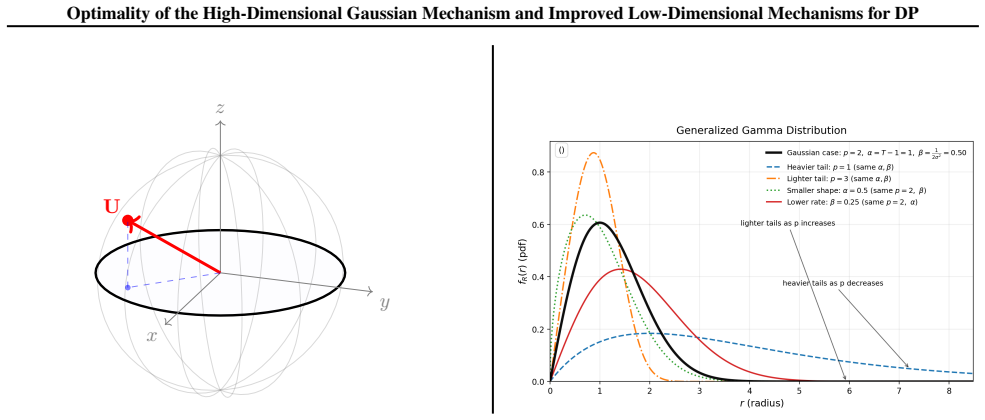
As the dimension T tends to infinity, the Gaussian mechanism achieves the optimal privacy-utility tradeoff among additive-noise mechanisms for the strong privacy parameters commonly used in practice. A new family of Spherical Generalized Gamma mechanisms is defined that encompasses the Gaussian and the l2 mechanism, with some members offering better tradeoffs in low dimensions and all admitting tight composition.
What carries the argument
The Spherical Generalized Gamma family of differential privacy mechanisms, which adds noise from a distribution whose density depends on the l2 norm in a generalized gamma way, enabling both asymptotic optimality analysis and improved low-dimensional variants.
If this is right
- Practitioners can rely on the Gaussian mechanism for high-dimensional queries without expecting better additive noise alternatives asymptotically.
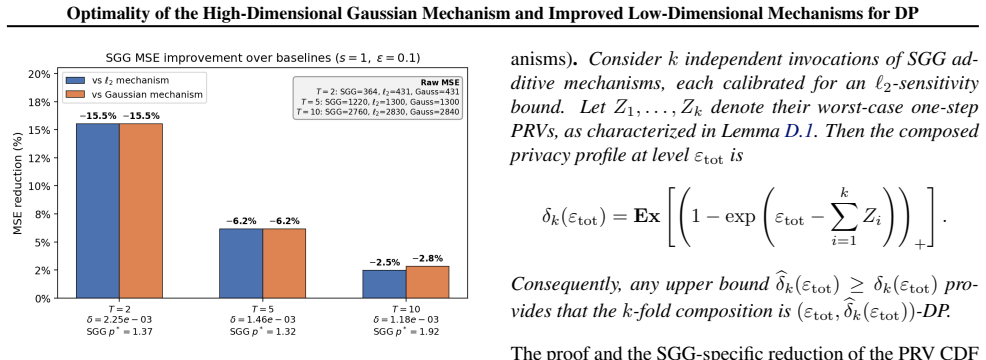
- In low dimensions, specific members of the Spherical Generalized Gamma family can achieve superior privacy-utility tradeoffs compared to Gaussian or l2 mechanisms.
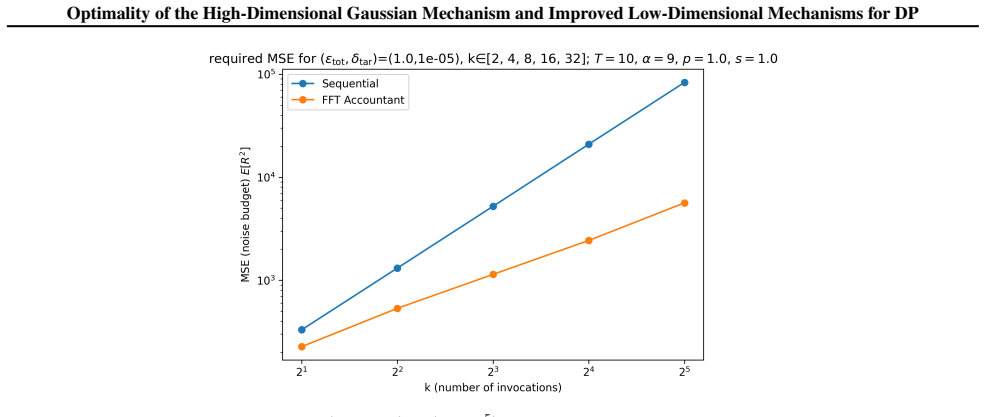
- The entire family admits tight composition, resolving the open question for the l2 mechanism.
Where Pith is reading between the lines
- This optimality result may extend to suggest that non-additive mechanisms or data-dependent noise could be necessary for further improvements in high dimensions.
- The family might be useful for designing mechanisms in other privacy settings or for queries with different sensitivities.
- Testing these mechanisms on real datasets in moderate dimensions could reveal practical gains.
Load-bearing premise
The result holds only for mechanisms that add noise from a fixed distribution independent of the input data.
What would settle it
An additive-noise mechanism that for sufficiently large T achieves a strictly better privacy-utility curve than the Gaussian mechanism under the same privacy parameters would falsify the asymptotic optimality claim.
Figures
read the original abstract
The additive noise mechanism is a foundational tool for differential privacy (DP) of $T$-dimensional real-valued vector queries. The Gaussian mechanism, utilizing Gaussian noise, is the mostly widely used such mechanism, due to its simplicity and strong privacy guarantees. In this work, we provide justification for this choice, showing that as the dimension $T\to\infty$, no additive-noise mechanism can asymptotically improve on the Gaussian mechanism's privacy--utility tradeoff for the strong privacy settings typically used.We also develop a new family of \emph{Spherical Generalized Gamma} DP mechanisms, which contains both the Gaussian mechanism and the recently studied $\ell_2$ mechanism (Joseph \emph{et al.}, ICML 2025). We identify members of this family that outperform both the Gaussian and $\ell_2$ mechanisms in certain low-dimensional settings, and show tight composition of all mechanisms in this family, answering an open question of Joseph \emph{et al.}~regarding the $\ell_2$ mechanism.
Editorial analysis
A structured set of objections, weighed in public.
Referee Report
Summary. The paper claims that as dimension T→∞, no additive-noise mechanism asymptotically improves on the Gaussian mechanism's privacy-utility tradeoff under the strong privacy settings typically used. It introduces the Spherical Generalized Gamma family (containing both the Gaussian and ℓ₂ mechanisms), identifies members that outperform both in certain low-dimensional regimes, and proves tight composition for the entire family (resolving an open question of Joseph et al.).
Significance. If the asymptotic optimality result holds, it supplies a clean theoretical justification for preferring the Gaussian mechanism in high-dimensional DP settings while the new family yields concrete low-dimensional improvements and resolves the composition question for the ℓ₂ mechanism. The explicit restriction to additive-noise mechanisms and the T→∞ regime keeps the claim precise and falsifiable.
minor comments (3)
- [§1] §1 (Introduction): the phrase 'strong privacy settings typically used' is used repeatedly but never given an explicit parameter regime (e.g., how ε and δ scale with T); a one-sentence clarification would help readers map the claim to concrete (ε,δ) pairs.
- [Theorem 3.2] Theorem 3.2 (or whichever states the optimality): the proof sketch in the abstract is clear, but the manuscript should explicitly state whether the result requires any regularity condition on the noise density beyond independence and identical distribution across coordinates.
- [Figure 2] Figure 2 (low-dimensional comparison): the utility metric on the y-axis is not labeled in the caption; add the exact expression (e.g., variance or MSE) for reproducibility.
Simulated Author's Rebuttal
We thank the referee for their positive assessment of the paper, accurate summary of the contributions, and recommendation for minor revision. No specific major comments were raised in the report.
Circularity Check
No significant circularity identified
full rationale
The paper's derivation of asymptotic optimality for the Gaussian mechanism as T→∞ is scoped explicitly to additive-noise mechanisms and proceeds via direct analysis of privacy-utility tradeoffs within that class, without any reduction to fitted parameters renamed as predictions, self-definitional constructions, or load-bearing self-citations. The Spherical Generalized Gamma family is introduced as a new parametric family containing the Gaussian and ℓ₂ mechanisms, with members identified for low-dimensional improvements and tight composition shown; these steps are constructive and independent of the optimality claim. No uniqueness theorems, ansatzes, or renamings are invoked in a manner that collapses the central result to its inputs by construction.
Axiom & Free-Parameter Ledger
Reference graph
Works this paper leans on
-
[1]
Brendan and Mironov, Ilya and Talwar, Kunal and Zhang, Li , title =
Abadi, M., Chu, A., Goodfellow, I. J., McMahan, H. B., Mironov, I., Talwar, K., and Zhang, L. Deep learning with differential privacy. In Weippl, E. R., Katzenbeisser, S., Kruegel, C., Myers, A. C., and Halevi, S. (eds.), ACM CCS 2016, pp.\ 308--318. ACM Press, October 2016. doi:10.1145/2976749.2978318
-
[2]
P., Felipe Gomez, J., Kosut, O., and Sankar, L
Alghamdi, W., Asoodeh, S., Calmon, F. P., Felipe Gomez, J., Kosut, O., and Sankar, L. Optimal multidimensional differentially private mechanisms in the large-composition regime. In 2023 IEEE International Symposium on Information Theory (ISIT), pp.\ 2195--2200, 2023. doi:10.1109/ISIT54713.2023.10206658
-
[3]
Differential privacy, 2016
Apple. Differential privacy, 2016
2016
-
[4]
and Wang, Y
Balle, B. and Wang, Y. Improving the gaussian mechanism for differential privacy: Analytical calibration and optimal denoising. In Dy, J. G. and Krause, A. (eds.), Proceedings of the 35th International Conference on Machine Learning, ICML 2018, Stockholmsm \" a ssan, Stockholm, Sweden, July 10-15, 2018 , volume 80 of Proceedings of Machine Learning Resear...
2018
-
[5]
and Wang, Y.-X
Balle, B. and Wang, Y.-X. Improving the gaussian mechanism for differential privacy: Analytical calibration and optimal denoising. In International Conference on Machine Learning (ICML), 2018 b
2018
-
[6]
Privacy amplification by subsampling: Tight analyses via couplings and divergences
Balle, B., Barthe, G., and Gaboardi, M. Privacy amplification by subsampling: Tight analyses via couplings and divergences. In Advances in Neural Information Processing Systems (NeurIPS), 2018
2018
-
[7]
Prochlo: Strong privacy for analytics in the crowd
Bittau, A., Úlfar Erlingsson, Maniatis, P., Mironov, I., Raghunathan, A., Lie, D., Rudominer, M., Kode, U., Tinnes, J., and Seefeld, B. Prochlo: Strong privacy for analytics in the crowd. In Proceedings of the Symposium on Operating Systems Principles (SOSP), pp.\ 441--459, 2017. URL https://arxiv.org/abs/1710.00901
Pith/arXiv arXiv 2017
-
[8]
Bun, M., Dwork, C., Rothblum, G. N., and Steinke, T. Composable and versatile privacy via truncated CDP . In Diakonikolas, I., Kempe, D., and Henzinger, M. (eds.), 50th ACM STOC, pp.\ 74--86. ACM Press, June 2018. doi:10.1145/3188745.3188946
-
[9]
J., and Zhang, L
Dong, J., Su, W. J., and Zhang, L. A central limit theorem for differentially private query answering. In Proceedings of the 35th International Conference on Neural Information Processing Systems, NIPS '21, Red Hook, NY, USA, 2021. Curran Associates Inc. ISBN 9781713845393
2021
-
[10]
Dong, J., Roth, A., and Su, W. J. Gaussian differential privacy. Journal of the Royal Statistical Society Series B, 84 0 (1): 0 3--37, February 2022. doi:10.1111/rssb.12454. URL https://ideas.repec.org/a/bla/jorssb/v84y2022i1p3-37.html
-
[11]
and Roth, A
Dwork, C. and Roth, A. The Algorithmic Foundations of Differential Privacy. Foundations and Trends in Theoretical Computer Science, 2014
2014
-
[12]
Our data, ourselves: Privacy via distributed noise generation
Dwork, C., Kenthapadi, K., McSherry, F., Mironov, I., and Naor, M. Our data, ourselves: Privacy via distributed noise generation. In Vaudenay, S. (ed.), EUROCRYPT 2006, volume 4004 of LNCS , pp.\ 486--503. Springer, Berlin, Heidelberg, May / June 2006 a . doi:10.1007/11761679_29
-
[13]
Proceedings of the Third Conference on Theory of Cryptography , pages =
Dwork, C., McSherry, F., Nissim, K., and Smith, A. Calibrating noise to sensitivity in private data analysis. In Halevi, S. and Rabin, T. (eds.), TCC 2006, volume 3876 of LNCS , pp.\ 265--284. Springer, Berlin, Heidelberg, March 2006 b . doi:10.1007/11681878_14
-
[14]
Fang, K. W. Symmetric multivariate and related distributions. Chapman and Hall/CRC, 2018
2018
-
[15]
Geng, Q. and Viswanath, P. Optimal noise adding mechanisms for approximate differential privacy. IEEE Transactions on Information Theory, 62 0 (2): 0 952--969, 2016. doi:10.1109/TIT.2015.2504972
-
[16]
Tight analysis of privacy and utility tradeoff in approximate differential privacy
Geng, Q., Ding, W., Guo, R., and Kumar, S. Tight analysis of privacy and utility tradeoff in approximate differential privacy. In Chiappa, S. and Calandra, R. (eds.), Proceedings of the Twenty Third International Conference on Artificial Intelligence and Statistics, volume 108 of Proceedings of Machine Learning Research, pp.\ 89--99. PMLR, 26--28 Aug 2020...
2020
-
[17]
Learn how gboard gets better, 2023
Google. Learn how gboard gets better, 2023
2023
-
[18]
Gopi, S., Lee, Y. T., and Wutschitz, L. Numerical composition of differential privacy. J. Priv. Confidentiality, 14 0 (1), 2024. doi:10.29012/JPC.870. URL https://doi.org/10.29012/jpc.870
-
[19]
Hardt, M. and Talwar, K. On the geometry of differential privacy. In Schulman, L. J. (ed.), 42nd ACM STOC, pp.\ 705--714. ACM Press, June 2010. doi:10.1145/1806689.1806786
-
[20]
and Li, P
Ji, T. and Li, P. Less is more: Revisiting the gaussian mechanism for differential privacy. In Balzarotti, D. and Xu, W. (eds.), USENIX Security 2024. USENIX Association, August 2024. URL https://www.usenix.org/conference/usenixsecurity24/presentation/ji
2024
-
[21]
Approximate differential privacy of the _2 mechanism
Joseph, M., Kulesza, A., and Yu, A. Approximate differential privacy of the _2 mechanism. In International Conference on Machine Learning (ICML), 2025
2025
-
[22]
Harnessing large-language models to generate private synthetic text, 2024
Kurakin, A., Ponomareva, N., Syed, U., MacDermed, L., and Terzis, A. Harnessing large-language models to generate private synthetic text, 2024. URL https://arxiv.org/abs/2306.01684
arXiv 2024
-
[23]
Generalized gaussian mechanism for differential privacy
Liu, F. Generalized gaussian mechanism for differential privacy. IEEE Transactions on Knowledge and Data Engineering, 31 0 (4): 0 747--756, 2019. doi:10.1109/TKDE.2018.2845388
-
[24]
Lu, Y., Magdon-Ismail, M., Wei, Y., and Zikas, V. The normal distributions indistinguishability spectrum and its application to privacy-preserving machine learning, 2023. URL https://arxiv.org/abs/2309.01243. arXiv:2309.01243
Pith/arXiv arXiv 2023
-
[25]
Eureka: A general framework for black-box differential privacy estimators
Lu, Y., Magdon-Ismail, M., Wei, Y., and Zikas, V. Eureka: A general framework for black-box differential privacy estimators. In 2024 IEEE Symposium on Security and Privacy (SP), pp.\ 913--931. IEEE, 2024
2024
-
[26]
Graphical-model based estimation and inference for differential privacy
Mckenna, R., Sheldon, D., and Miklau, G. Graphical-model based estimation and inference for differential privacy. In Chaudhuri, K. and Salakhutdinov, R. (eds.), Proceedings of the 36th International Conference on Machine Learning, volume 97 of Proceedings of Machine Learning Research, pp.\ 4435--4444. PMLR, 09--15 Jun 2019. URL https://proceedings.mlr.pre...
2019
-
[27]
Rinberg, R., Shumailov, I., Singhal, V., Cummings, R., and Papernot, N. Beyond laplace and gaussian: Exploring the generalized gaussian mechanism for private machine learning, 2025. URL https://arxiv.org/abs/2506.12553
arXiv 2025
-
[28]
DP-CGAN: Differentially Private Synthetic Data and Label Generation
Torkzadehmahani, R., Kairouz, P., and Paten, B. DP-CGAN: Differentially Private Synthetic Data and Label Generation . In 2019 IEEE/CVF Conference on Computer Vision and Pattern Recognition Workshops (CVPRW), pp.\ 98--104, Los Alamitos, CA, USA, June 2019. IEEE Computer Society. doi:10.1109/CVPRW.2019.00018. URL https://doi.ieeecomputersociety.org/10.1109/...
-
[29]
PATE - GAN : Generating synthetic data with differential privacy guarantees
Yoon, J., Jordon, J., and van der Schaar, M. PATE - GAN : Generating synthetic data with differential privacy guarantees. In International Conference on Learning Representations, 2019. URL https://openreview.net/forum?id=S1zk9iRqF7
2019
-
[30]
PrivSyn : Differentially Private Data Synthesis
Zhang, Z., Wang, T., Li, N., Honorio, J., Backes, M., He, S., Chen, J., and Zhang, Y. PrivSyn : Differentially Private Data Synthesis . In 30th USENIX Security Symposium (USENIX Security 21), pp.\ 929--946. USENIX Association, August 2021. ISBN 978-1-939133-24-3. URL https://www.usenix.org/conference/usenixsecurity21/presentation/zhang-zhikun
2021
discussion (0)
Sign in with ORCID, Apple, or X to comment. Anyone can read and Pith papers without signing in.