REVIEW 3 major objections 4 minor 44 references
Viscosity's impact on nutrient uptake along the gut
T0 review · 3 major / 4 minor · reviewed 2026-08-16 · deepseek-v4-flash
Pith's one-line read Shear-thinning chyme changes the gut's uptake pattern: it boosts absorption under segmentation while leaving peristaltic waste clearance intact, supported by finite-element simulations and an analytical peristalsis criterion.
desk verdict A credible Newtonian-vs-shear-thinning comparison of gut contraction patterns with a nice peristaltic scaling law, but the central viscosity–diffusivity mechanism is never shown to be implemented. read the letter →
The pith
A machine-rendered reading of the paper's core claim, the machinery that carries it, and where it could break.
The reading
What carries the argument
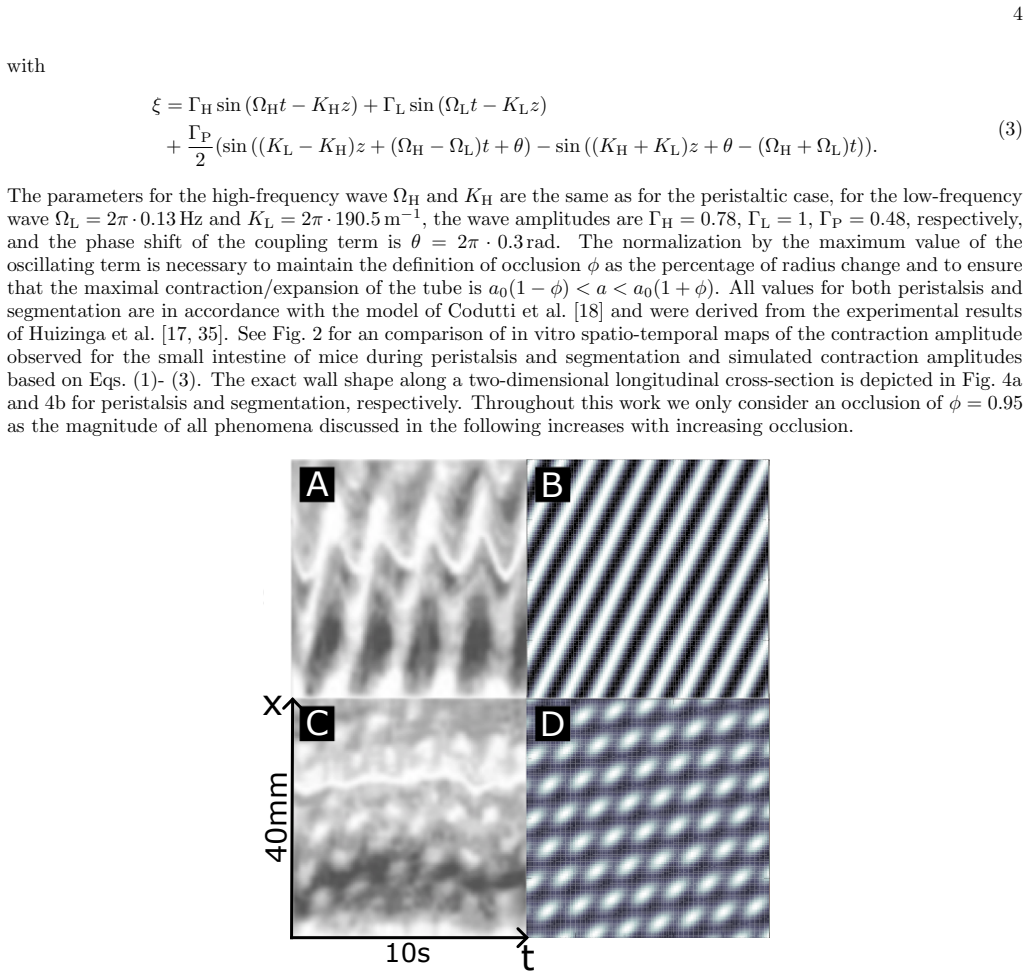
The load-bearing object is the power-law (Ostwald–de Waele) rheology $\eta = m \dot\gamma^{n-1}$ with $n = 0.252$ and $m = 0.014\ \mathrm{Pa\,s^n}$, chosen so the chyme's average viscosity equals water's, paired conceptually with the Stokes–Einstein relation $D = k_B T/(6\pi \mu r_0)$ that converts local viscosity into a particle diffusivity. On top of these sits the analytical peristalsis criterion: particles are taken up if they can diffuse across streamlines within the tube, $\langle\Delta x^2\rangle = 4Dt$, with $t = (L-x_0)/c$ set by bolus speed and initial position; the 'limit streamline' derived from this condition predicts the threshold between absorbed and flushed particles. This machinery carries the argument because it turns a rheological property, shear-thinning, into a concrete prediction about where and how much uptake occurs, and about why segmentation amplifies it while peristalsis does not.
What would settle it
Rerun the segmentation and peristalsis simulations exactly as in the paper but with the diffusion coefficient evaluated locally from the power-law viscosity, $D = k_B T/(6\pi \eta(\dot\gamma) r_0)$, instead of a fixed $D$; then compare uptake totals and spatial uptake maps against the constant-$D$ runs. If the local-$D$ runs show enhanced uptake in high-shear regions beyond the constant-$D$ runs, the paper's mechanism is supported; if the two sets agree, the reported shear-thinning benefit comes from altered flow kinematics, not from viscosity-controlled diffusivity, and the paper's explanation is not what its model shows.
Extended reading notes
Core claim
The paper's central claim is that shear-thinning chyme enhances nutrient uptake under segmentation contractions while leaving peristaltic waste clearance essentially unchanged, and that this asymmetry follows from where high shear rates occur relative to particle trajectories. In peristalsis, particles are trapped in a bolus and follow circling streamlines; uptake is localized at the wave crest where the Péclet number is low and diffusion lets particles hop across streamlines toward the wall. The authors derive a limit-streamline criterion: a particle is absorbed if its initial streamline lies within a diffusive distance $\langle\Delta x^2\rangle^{1/2} = \sqrt{4Dt}$ of the wall, with time set by the travel time through the finite tube, and simulations confirm that the maximum absorbed distance falls as viscosity rises, consistent with $D \propto \mu^{-1}$. In a shear-thinning power-law fluid, $\eta = m \dot\gamma^{n-1}$ with $n = 0.252$, the apparent viscosity drops where shear rate is high. In segmentation the highest-shear zones are also the zones particles occupy while sloshing between amplitude-matched contractions, so the local viscosity drop translates into more uptake; in peristalsis the bolus avoids the highest-shear zone, so the enhancement is marginal. The conclusion is that Non-Newtonian rheology sharpens the division of labor between contraction patterns: segmentation absorbs, peristalsis cleans.
Load-bearing premise
The load-bearing premise is that shear-thinning raises uptake by lowering the local viscosity in high-shear regions and thereby increasing the particles' diffusivity there; but the simulations prescribe a single constant diffusion coefficient $D = 0.5 \times 10^{-11}\ \mathrm{m^2/s}$ throughout, and never recompute $D$ from the simulated viscosity field, so the enhancement the paper attributes to viscosity-dependent diffusivity is not actually realized by the model as implemented.
Editorial extensions
If this is right
- Segmentation's nutrient-uptake advantage over peristalsis is amplified when the fluid is shear-thinning, so the rheology of chyme acts as a control parameter for postprandial absorption rather than a passive complication.
- In peristalsis, uptake probability falls as viscosity rises; the limit-streamline formula gives a quantitative shape to this: the furthest initial streamline from which a particle can still be absorbed scales as $\sqrt{Dt} \propto \mu^{-1/2}$ for fixed geometry and wave speed.
- Shear-thinning does not compromise peristaltic waste clearance, because particles trapped in the bolus do not visit the high-shear wall regions; the flushing function is retained even as segmentation becomes more absorptive.
- The paper identifies two uptake mechanisms in peristalsis, low-Péclet streamline hopping at the crest and shear-induced wall uptake at the wave inflection point, so spatial uptake maps can serve as a readout of where suspended particles actually experience shear.
Reading between the lines
- Because the simulations prescribe a single constant diffusion coefficient $D = 0.5 \times 10^{-11}\ \mathrm{m^2/s}$ rather than a local $D(\eta(\dot\gamma))$, the segmentation enhancement cannot, as coded, stem from the claimed viscosity–diffusivity link; it may stem instead from shear-thinning altering the velocity field, and only a local-$D$ rerun would separate these mechanisms.
- If the local-viscosity mechanism is confirmed, the same design principle could be transferred to microfluidic gut-on-chip devices: contractile walls plus a shear-thinning carrier fluid would concentrate absorption at engineered high-shear zones, a prediction testable with tracer particles and polymer solutions.
- The argument suggests a route to bacterial-overgrowth prevention: by raising uptake during segmentation, shear-thinning leaves less nutrient in the lumen for microbes; the paper names bacterial overgrowth as motivation but does not model the microbial competition.
- The peristaltic limit-streamline criterion is derived for a single wave train in a finite tube; a natural extension would replace the travel time $(L-x_0)/c$ with a residence-time distribution for wave trains or open inflow conditions.
Signed reviews
Editorial analysis
A structured set of objections, weighed in public.
Referee Report
Summary. This paper reports finite-element simulations of particle transport, diffusion, and wall uptake in an axisymmetric model of the murine small intestine driven by peristaltic and segmentation contractions. The fluid is either Newtonian (water) or a power-law shear-thinning model of chyme. The authors show that in peristalsis particles are trapped in a bolus and uptake occurs mainly near the wave crest, propose a limit-streamline criterion that predicts the maximal diffusive distance needed for uptake, and find that shear-thinning chyme enhances uptake in segmentation much more than in peristalsis. The main claim is that this enhancement arises because locally reduced viscosity in high-shear regions increases molecular diffusivity.
Significance. If the central mechanism were properly implemented and tested, this would be a valuable contribution to gastrointestinal fluid mechanics: the side-by-side comparison of peristalsis and segmentation, the use of experimentally grounded rheological parameters, and the parameter-free limit-streamline criterion are all useful and would give a falsifiable prediction for microfluidic experiments. The paper is clearly written and the flow solver is validated in Fig. 3 against lubrication theory. However, the key viscosity-diffusivity coupling is currently not described in the methods, so the primary mechanistic conclusion is not supported by the model as presented.
major comments (3)
- [Sec. II C (Methods), Table I, Eq. (4); Sec. III C] The central claim, stated in the abstract and Sec. III C, is that shear-thinning enhances uptake because a lower local viscosity increases particle diffusivity. This mechanism is not realized in the described model: the Methods and Table I specify a single constant diffusion coefficient D = 0.5 x 10^-11 m^2/s and never state that the white-noise amplitude in Eq. (4) is recomputed from the local, shear-rate-dependent viscosity eta = m gamdot^(n-1). With constant D, the enhancement in Fig. 6 cannot originate from the stated mechanism; it would have to be caused by altered flow kinematics alone, which the paper neither analyzes nor claims. Please specify exactly how eta(r,z,t) enters the particle diffusivity and the stochastic term, and confirm whether the non-Newtonian simulations actually used a locally varying D.
- [Sec. III B and Fig. 5] The 'analytical prediction' for peristaltic uptake is presented as parameter-free, but the limit streamline is read off from the simulated flow field, so the agreement in Fig. 5c is a consistency check between the particle trajectory solver and the flow field rather than an independent validation of the uptake criterion. In addition, Fig. 5d reports a comparison of predicted and simulated maximal diffused distance for different viscosities, but the text does not say whether D was varied in those simulations according to the Stokes-Einstein relation or held fixed. Without this information, the claimed inverse proportionality between uptake and viscosity is not established by the simulations.
- [Sec. II C and Fig. 3] The validation of particle motion in Fig. 3e only demonstrates that the Brownian noise produces the expected RMSD scaling in a quiescent fluid. It does not validate the particle dynamics in a strongly sheared, spatially varying flow, nor does it validate any coupling between D and the power-law viscosity field. Since the central conclusion depends on diffusion near the wall in high-shear regions, a validation of the local-diffusivity implementation, or a clear statement that D is constant, is essential.
minor comments (4)
- [Sec. II B and Eq. (4)] The symbol v is used for the radial velocity in Eqs. (6) and (7) and then again in the Peclet number definition Pe = a0 v / D in Sec. III B, which is ambiguous because v could be read as the radial component rather than the axial speed.
- [Fig. 3 caption] The panel labels in the Fig. 3 caption are inconsistent: the axial velocity profile is assigned to panels (a) and (c), and the radial velocity profile is also assigned to panels (c) and (d). Please renumber the panels and refer to them consistently in the text.
- [Sec. II A 3 and Table I] The consistency index m is said to be chosen so that the average viscosity is the same as water, but for a power-law fluid the apparent viscosity depends on the local shear rate. Please define the averaging procedure over the flow field or the reference shear rate used to set m.
- [Sec. I and Sec. III C] There is a typo in the Introduction: 'peristalitic contractions' should be 'peristaltic contractions'. Also, the phrase 'the the uptake function of segmentation is enhance' near the end of Sec. III C should be corrected.
Circularity Check
No circular derivation: the peristalsis uptake prediction is a consistency check on independently specified inputs, and the self-citations (Refs. 18, 37) trace to external experimental data.
full rationale
The paper's central claimed derivation is the analytical prediction for peristaltic uptake (Sec. III B), which combines the Stokes–Einstein diffusivity D = k_B T/(6πμr_0) with the bolus transit time (L−x_0)/c and reads the limiting streamline from the simulated flow field. No parameter of this prediction is fitted to the uptake outcome; the threshold streamline is determined by the flow geometry and the prescribed D. The comparison in Fig. 5d extracts the outermost taken-up particle's initial streamline distance and checks it against √(4Dt); this is a consistency check, not an input-output tautology. The contraction patterns are taken from Ref. [18] (a self-citation), but the text states they were derived from the experimental results of Huizinga et al. (Refs. [17,35]), so the self-citation is not the load-bearing source. The rheological parameters (n = 0.252, m = 0.014 Pa·s^n) come from literature and a stated equal-average-viscosity condition, not from the uptake data. The reader's concern that D = 0.5×10^-11 m^2/s is listed as a single constant while Sec. III C attributes shear-thinning enhancement to a viscosity-dependent diffusivity is a possible implementation gap in the manuscript, but it is not circularity: the claimed mechanism is not obtained by defining the output to equal the input. No equation reduces to another by construction, and no fitted parameter is renamed as a prediction. Therefore no circular step is identified.
Assumptions & free parameters
free parameters (4)
- Flow consistency index m =
0.014 Pa s^n
- Minimum shear rate gamma_dot_min =
1e-10 s^-1
- Occlusion phi =
0.95
- Initial particle placement =
uniform over one wavelength (3784 peristalsis, 3815 segmentation)
assumptions (6)
- domain assumption Lubrication approximation applies to intestinal flow (small Re and delta).
- domain assumption The small intestine can be modeled as a straight, smooth, axisymmetric tube with no villi, folds, or mucus layer.
- domain assumption Nutrients are passive Brownian spheres that are absorbed with 100% probability upon first wall contact.
- domain assumption Stokes-Einstein diffusivity D = kBT/(6 pi mu r0) applies with constant particle radius r0 across all fluids and shear rates.
- standard math Power-law (Ostwald-de Waele) model with n=0.252 represents chyme rheology.
- domain assumption The contraction patterns from Codutti et al. [18] faithfully reproduce murine peristalsis and segmentation.
Cite this review
Pith. "Pith review of Viscosity's impact on nutrient uptake along the gut." pith.science (2026). https://pith.science/paper/XBOQNVVO
@misc{pith2026250419235,
  author       = {Pith},
  title        = {Pith review of: Viscosity's impact on nutrient uptake along the gut},
  year         = {2026},
  howpublished = {\url{https://pith.science/paper/XBOQNVVO}},
  note         = {Machine review of arXiv:2504.19235}
}
read the original abstract
Through switching contraction patterns driving digestive flows, the small intestine balances nutrient uptake and waste removal. Complex segmentation contraction patterns are associated with higher nutrient uptake, while peristaltic contractions primarily serve to flush out unused remnants. However, the impact of the Non-Newtonian behavior of digestive fluids on the efficacy of these contraction patterns remains unclear. Here, we present finite-element simulations that model nutrient transport, diffusion, and uptake within both segmentation and peristaltic contractions along the small intestine for Newtonian and Non-Newtonian fluids. Our simulations reveal that diffusion plays a key role in uptake, with nutrient absorption directly linked to fluid viscosity, which governs molecular diffusivity. Further, we present an analytical prediction for uptake in peristalsis as a function of molecular diffusivity, which aligns closely with our simulation results. Notably, we find that shear-thinning properties of Non-Newtonian fluids enhance nutrient uptake, particularly in segmentation contractions compared to peristalsis. Our results demonstrate the fluid dynamical principles underlying intestinal digestion, showing how shear-thinning Non-Newtonian fluids promote efficient nutrient uptake without compromising the clearance of waste. This physical insight advances our understanding of digestive processes and provides a foundation for exploring the prevention of intestinal diseases such as bacterial overgrowth.
Figures


Figures from the paper (3 more)


Reference graph
Works this paper leans on
-
[1]
The stages of digestion Upon intake at the mouth, food gets pushed by peristaltic contractions through the esophagus into the stomach as shown in step 1 in Figure 1 following Ref. [31]. In the stomach food is mixed with digestive enzymes and goes through a mechanical and chemical disintegration to form a fluidized mixture referred to as chyme in step 2, b...
-
[2]
Intestine contraction patterns The small intestine is modeled as a straight, smooth tube with constant radius that obeys azimuthal symmetry, see cartoon in Figure 1. We define contraction patterns in cylindrical coordinates with the origin of the coordinate system on the symmetry axis of the tube and on its base area. The cylinder length is denoted as L =...
-
[3]
magnitude of the rate of strain tensor
Rheological model of the chyme fluid The constitutive equation of the chyme fluid, in contrast to water as our reference Newtonian fluid of constant viscosity, is described by a power-law often called the Ostwald–de Waele power-law model with the shear stress tensor τ =−η ˙γ. Here ˙γ =∇u + (∇u)⊺ corresponds to the rate of strain tensor with the velocity f...
work page 2020
-
[4]
S. Geng, L. Yang, F. Cheng, Z. Zhang, J. Li, W. Liu, Y. Li, Y. Chen, Y. Bao, L. Chen, Z. Fei, X. Li, J. Hou, Y. Lin, Z. Liu, S. Zhang, H. Wang, Q. Zhang, H. Wang, X. Wang, and J. Zhang, Frontiers in Microbiology 10, Frontiers in Microbiology (2020)
work page 2020
-
[5]
J. R. Bayrer, J. Castro, A. Venkataraman, K. K. Touhara, N. D. Rossen, R. D. Morrie, J. Maddern, A. Hendry, K. N. Braverman, S. Garcia-Caraballo, G. Schober, M. Brizuela, F. M. C. Navarro, C. Bueno-Silva, H. A. Ingraham, S. M. Brierley, and D. Julius, Nature 616, 137 (2023)
work page 2023
-
[6]
G. S. Groff JL, The digestive system: mechanism for nourishingthe body (Groff JL, Gropper SS, editors. Advanced nutrition and human metabolism. 3rd ed. Belmont (CA): Wadsworth Thomson Learning, 2000) pp. 24–52
work page 2000
-
[7]
A. H. Shapiro, M. Y. Jaffrin, and S. L. Weinberg, Journal of Fluid Mechanics 37, 799–825 (1969)
work page 1969
- [8]
Show all 44 references
-
[9]
Takabatake and K
S. Takabatake and K. Ayukawa, Journal of Fluid Mechanics 122, 439 (1982)
1982
-
[10]
Ayukawa and S
K. Ayukawa and S. Takabatake, Bulletin of JSME 25, 1061–1069 (1982)
1982
-
[11]
Takabatake, K
S. Takabatake, K. Ayukawa, and A. Mori, Journal of Fluid Mechanics 193, 267 (1988)
1988
-
[12]
Srivastava and V
L. Srivastava and V. Srivastava, Journal of Biomechanics 17, 821–829 (1984)
1984
-
[13]
L. M. Srivastava and V. P. Srivastava, Annals of Biomedical Engineering 13, 137–153 (1985)
1985
-
[14]
Subba Reddy, A
M. Subba Reddy, A. Ramachandra Rao, and S. Sreenadh, International Journal of Non-Linear Mechanics 42, 1153–1161 (2007)
2007
-
[15]
J. C. Misra and S. Maiti Arxiv (2011)
2011
-
[16]
Hayat, Y
T. Hayat, Y. Wang, K. Hutter, S. Asghar, and A. M. Siddiqui, Mathematical Problems in Engineering 2004, 347–376 (2004)
2004
-
[17]
Aboelkassem, Physics of Fluids 31, Physics of Fluids (2019)
Y. Aboelkassem, Physics of Fluids 31, Physics of Fluids (2019)
2019
-
[18]
M. D. Biviano, M. V. Paludan, A. H. Christensen, E. V. Østergaard, and K. H. Jensen, Physical Review Applied 18, Physical Review Applied (2022)
2022
-
[19]
Amselem, C
G. Amselem, C. Clanet, and M. Benzaquen, Physical Review Applied 19, 10.1103/physrevapplied.19.024017 (2023)
2023 doi
-
[20]
J. D. Huizinga, J.-H. Chen, Y. F. Zhu, A. Pawelka, R. J. McGinn, B. L. Bardakjian, S. P. Parsons, W. A. Kunze, R. Y. Wu, P. Bercik, A. Khoshdel, S. Chen, S. Yin, Q. Zhang, Y. Yu, Q. Gao, K. Li, X. Hu, N. Zarate, P. Collins, M. Pistilli, J. Ma, R. Zhang, and D. Chen, Nature Com...
2014
-
[21]
Codutti, J
A. Codutti, J. Cremer, and K. Alim, Physical Review Letters 129, Physical Review Letters (2022)
2022
-
[22]
L. A. Fullard, W. J. Lammers, and M. J. Ferrua, Journal of Food Engineering 160, 1–10 (2015)
2015
-
[23]
R. G. Lentle and P. W. M. Janssen, Journal of Comparative Physiology B 178, 673 (2008)
2008
-
[24]
Takahashi, M
T. Takahashi, M. Goto, and T. Sakata, British Journal of Nutrition 91, 867 (2004)
2004
-
[25]
A. K. Hardacre, R. G. Lentle, S.-Y. Yap, and J. A. Monro, Journal of The Royal Society Interface 15, 20180092 (2018)
2018
-
[26]
R. J. Love, R. G. Lentle, P. Asvarujanon, Y. Hemar, and K. J. Stafford, Food Digestion 4, 26 (2012)
2012
-
[28]
Fullard, W
L. Fullard, W. Lammers, G. C. Wake, and M. J. Ferrua, Food Funct. 5, 2731 (2014)
2014
-
[29]
Karthikeyan, D
J. Karthikeyan, D. Salvi, and M. V. Karwe, Journal of Food Engineering 292, 110339 (2021)
2021
-
[30]
Zhang, P
Y. Zhang, P. Wu, R. Jeantet, D. Dupont, G. Delaplace, X. D. Chen, and J. Xiao, Chemical Engineering Science 213, 115406 (2020)
2020
-
[31]
Palmada, J
N. Palmada, J. E. Cater, L. K. Cheng, and V. Suresh, Physics of Fluids 35, Physics of Fluids (2023)
2023
-
[32]
Jim´ enez-Lozano, M
J. Jim´ enez-Lozano, M. Sen, and P. F. Dunn, Physical Review E 79, Physical Review E (2009)
2009
-
[33]
C. L. Dikeman, M. R. Murphy, and G. C. Fahey, The Journal of Nutrition 136, 913–919 (2006)
2006
-
[34]
Sensoy, Current Research in Food Science 4, 308–319 (2021)
I. Sensoy, Current Research in Food Science 4, 308–319 (2021)
2021
-
[35]
Hugenholtz and W
F. Hugenholtz and W. M. de Vos, Cellular and Molecular Life Sciences 75, 149 (2017)
2017
-
[36]
A. P. de Souza, R. Sieberg, H. Li, H. R. Cahill, D. Zhao, T. C. Araujo-Jorge, H. B. Tanowitz, and L. A. Jelicks, Parasitology Research 106, 1293 (2010)
2010
-
[37]
Palmada, S
N. Palmada, S. Hosseini, R. Avci, J. E. Cater, V. Suresh, and L. K. Cheng, Applied Sciences 13, 6092 (2023)
2023
-
[38]
J. D. Huizinga, S. P. Parsons, J.-H. Chen, A. Pawelka, M. Pistilli, C. Li, Y. Yu, P. Ye, Q. Liu, M. Tong, Y. F. Zhu, and D. Wei, American Journal of Physiology-Cell Physiology 309, C403 (2015)
2015
-
[39]
H. Ji, D. Chen, C. Zhao, and G. Wu, The Journal of Physical Chemistry C 122, 1318 (2018)
2018
-
[40]
Waclawikova, A
B. Waclawikova, A. Codutti, K. Alim, and S. E. Aidy, Gut Microbes 14, Gut Microbes (2022)
2022
-
[41]
Marbach and K
S. Marbach and K. Alim, Physical Review Fluids 4, Physical Review Fluids (2019)
2019
-
[42]
Ohkubo, T
H. Ohkubo, T. Kessoku, A. Fuyuki, H. Iida, M. Inamori, T. Fujii, H. Kawamura, Y. Hata, N. Manabe, T. Chiba, T. C. Kwee, K. Haruma, N. Matsuhashi, A. Nakajima, and T. Takahara, American Journal of Gastroenterology 108, 1130–1139 (2013)
2013
-
[43]
Ishikawa, T
T. Ishikawa, T. Sato, G. Mohit, Y. Imai, and T. Yamaguchi, Journal of Theoretical Biology 279, 63–73 (2011)
2011
-
[44]
Ibanez, M
R. Ibanez, M. Shokrian, J.-H. Nam, and D. H. Kelley, Physical Review Fluids 6, Physical Review Fluids (2021)
2021
-
[45]
Cremer, I
J. Cremer, I. Segota, C.-y. Yang, M. Arnoldini, J. T. Sauls, Z. Zhang, E. Gutierrez, A. Groisman, and T. Hwa, Proceedings of the National Academy of Sciences 113, 11414–11419 (2016)
2016
Reviewed August 16, 2026 · model on record in the stance chip above.
Discussion (0). Continue with ORCID to comment.