Heavy singlet fermionic dark matter with Z₄ symmetry
Pith reviewed 2026-06-27 09:11 UTC · model grok-4.3
The pith
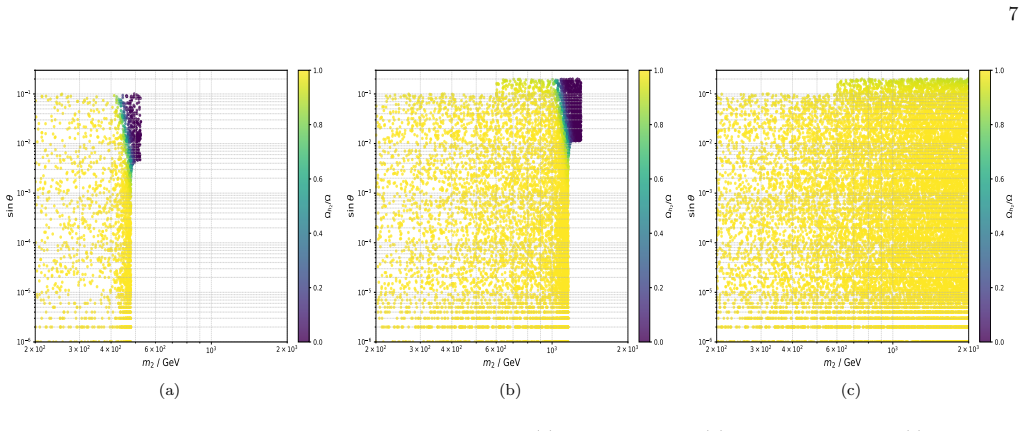
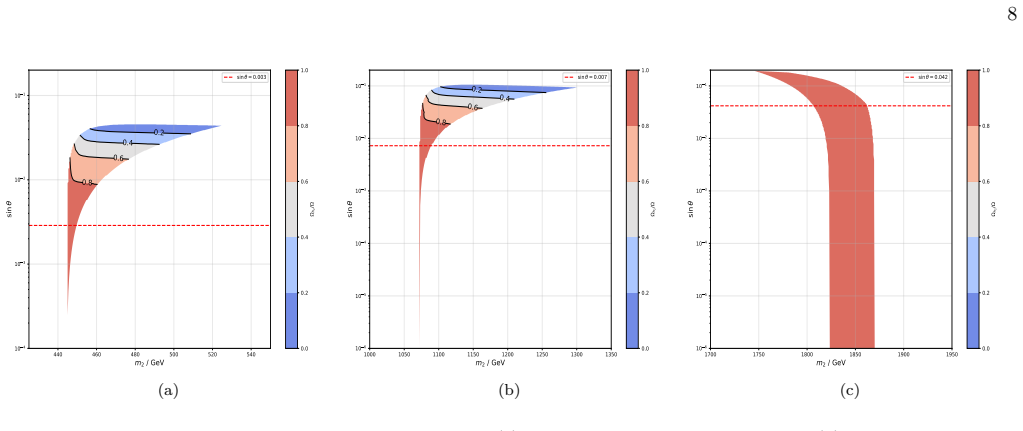
The mixing angle between the new Higgs and the SM Higgs need not be very small in the secluded region of this Z4 fermionic dark matter model.
A machine-rendered reading of the paper's core claim, the machinery that carries it, and where it could break.
Core claim
In the secluded dark matter scenario, where DM-SM interactions are negligible, the production of the Majorana fermion χ depends on the mass relation between the new Higgs h2 and χ. The mixing angle of h2 with the SM Higgs determines the viable parameter space under relic density and direct detection constraints, and analysis shows this angle does not have to be very small for heavy DM masses.
What carries the argument
The new singlet scalar S0 that acquires a vacuum expectation value, breaking the Z4 symmetry and generating both the mass of χ and the new Higgs boson h2 whose mixing controls DM production.
If this is right
- The relic density can be satisfied for heavy DM with non-negligible mixing angles.
- Direct detection constraints allow larger mixing in the secluded region.
- Future collider experiments can probe the model through the new Higgs boson.
- The mass hierarchy between h2 and χ affects how the mixing enters the relic density calculation.
Where Pith is reading between the lines
- If the mixing angle is larger, precision Higgs measurements could reveal deviations from the Standard Model.
- Similar discrete symmetries might allow comparable effects in other dark matter models.
- Collider signatures of the new Higgs could be searched for independently of direct detection results.
Load-bearing premise
DM-SM interactions remain negligible when computing the relic density in the secluded region.
What would settle it
A collider measurement showing that the mixing angle must be smaller than the values allowed by the relic density calculation in the heavy DM region would contradict the result.
Figures
read the original abstract
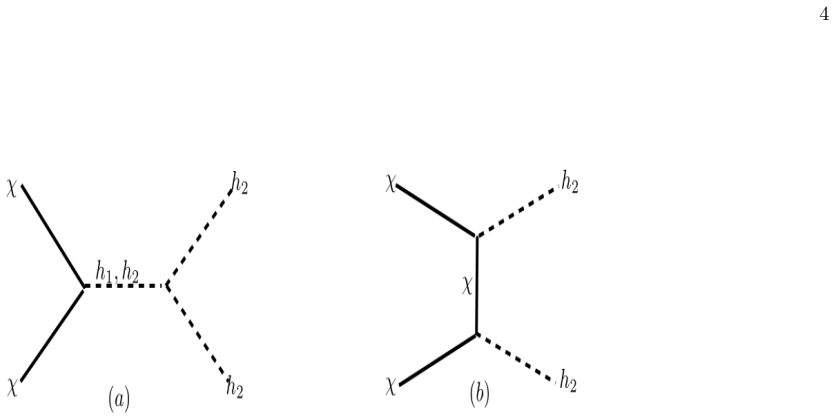
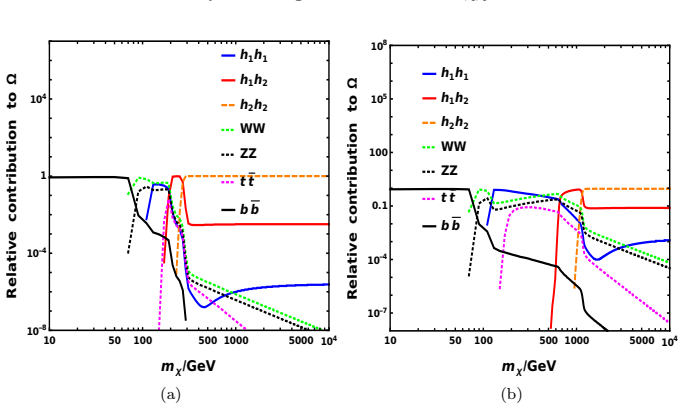
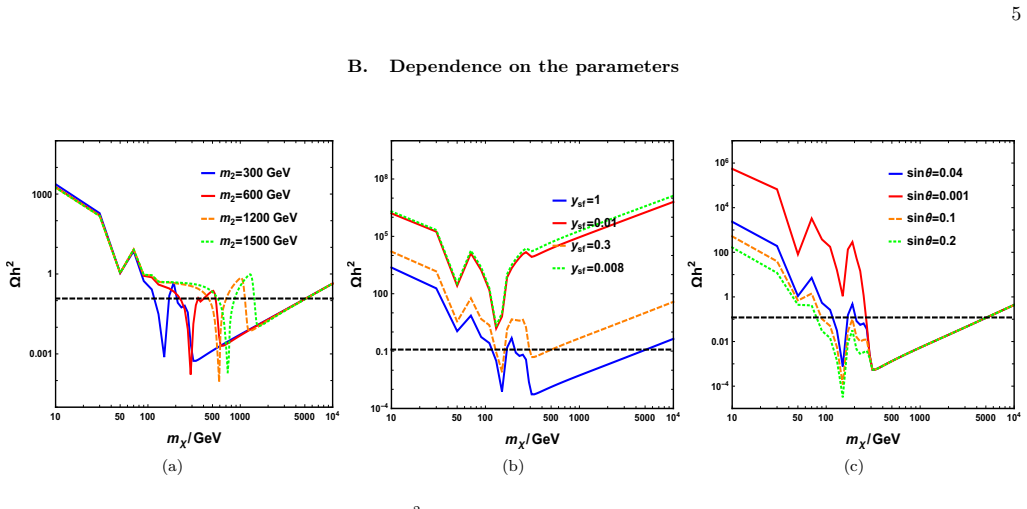
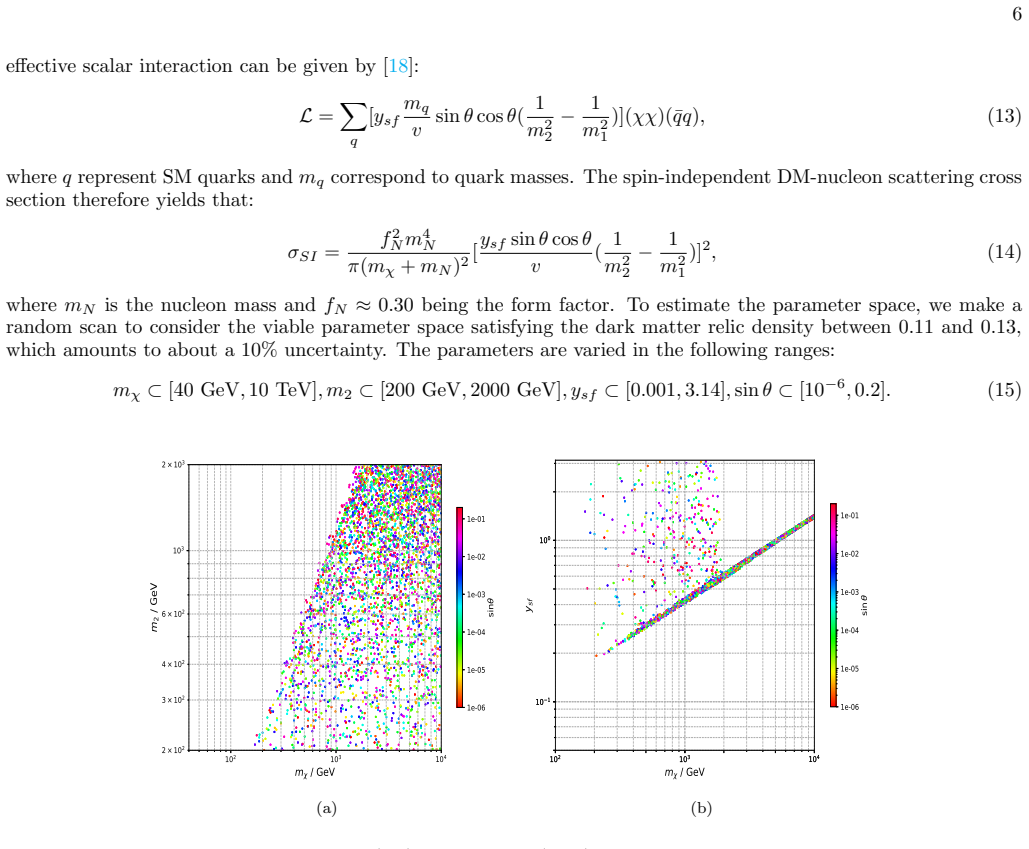
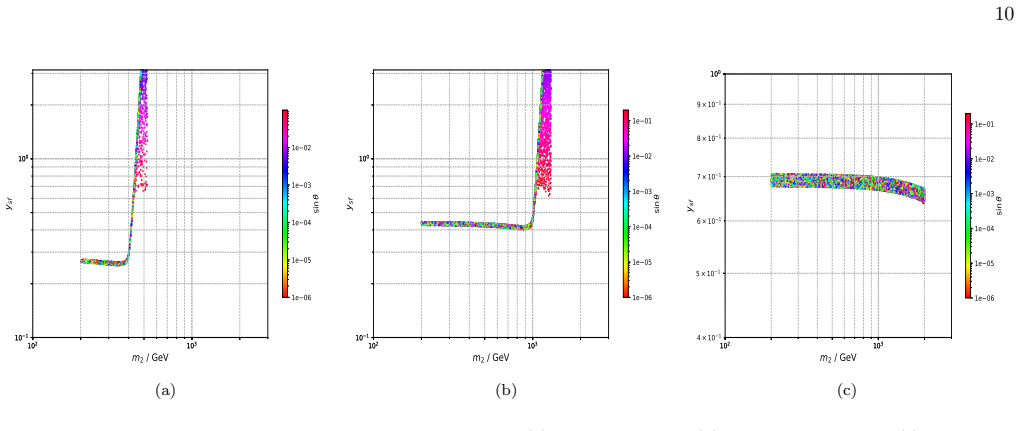
We revisited the singlet fermionic dark matter model in this work, where a Majorana fermion $\chi$ carrying $Z_4$ charge is assumed as the DM candidate. A new singlet scalar $S_0$ with a non-zero vacuum expectation value is also introduced to the SM so that $\chi$ can obtain mass after spontaneous symmetry breaking. We focus on the secluded DM region for the model, where interactions between DM and SM particles can be negligible. We have a new Higgs $h_2$ in the model, and the mixing angle of $h_2$ with the SM Higgs will play an important role in determining DM production, depending on the mass hierarchy between the new Higgs mass and the DM mass. We study DM relic density as a function of the model's four free parameters and estimate the viable parameter space under DM relic density constraint as well as direct detection constraint. We focus on the heavy DM mass region, and our analysis indicates that the mixing angle does not necessarily need to be very small in the secluded dark matter scenario, which offers potential for probing such models in future collider experiments.
Editorial analysis
A structured set of objections, weighed in public.
Referee Report
Summary. The manuscript revisits the singlet fermionic dark matter model with Z_4 symmetry, introducing a Majorana fermion χ as DM candidate and a singlet scalar S0 with VEV to generate its mass. It focuses on the secluded regime where DM-SM interactions are negligible, computes relic density as a function of four free parameters (mixing angle sinθ between h2 and SM Higgs, DM mass, new Higgs mass, and one unspecified parameter), and maps viable space under relic density plus direct detection constraints in the heavy DM region. The central result is that sinθ need not be very small, potentially allowing collider probes of h2.
Significance. If the result holds after addressing the approximation validity, the work usefully relaxes the small-mixing assumption in secluded Z4 fermionic DM models and shows that larger sinθ can remain consistent with constraints, which strengthens the case for future collider searches of the new Higgs. The explicit four-parameter counting and heavy-mass focus provide a clear mapping of viable space.
major comments (2)
- [Abstract] Abstract: the claim that viable space exists with non-small sinθ in the 'secluded' regime (where DM-SM interactions are negligible) is load-bearing for the headline result, yet a non-small sinθ induces a Higgs portal coupling ∝ sinθ that opens χχ → SM SM channels whose rate scales as sin²θ. The relic-density calculation must explicitly verify that these omitted channels remain subdominant (<10% of dominant secluded processes) throughout the reported viable region; without this check the secluded treatment is internally inconsistent precisely where the paper claims new allowed space.
- [Abstract] Abstract: relic density is expressed as a function of the four free parameters and then used to delineate viable space under the same density constraint. This is standard parameter fitting, but the manuscript must state the fourth parameter explicitly and show the numerical implementation (Boltzmann solver, mass-hierarchy handling) so that the viable-space boundaries can be reproduced.
minor comments (2)
- Notation for the new Higgs (h2) and scalar (S0) should be introduced with explicit definitions and charge assignments under Z4 at the first appearance.
- The dependence of DM production on the mass hierarchy between h2 and the DM mass should be illustrated with at least one benchmark plot or table entry.
Simulated Author's Rebuttal
We thank the referee for the careful and constructive report. The two major comments identify areas where the presentation can be strengthened for clarity and consistency. We address each point below and will revise the manuscript accordingly.
read point-by-point responses
-
Referee: [Abstract] Abstract: the claim that viable space exists with non-small sinθ in the 'secluded' regime (where DM-SM interactions are negligible) is load-bearing for the headline result, yet a non-small sinθ induces a Higgs portal coupling ∝ sinθ that opens χχ → SM SM channels whose rate scales as sin²θ. The relic-density calculation must explicitly verify that these omitted channels remain subdominant (<10% of dominant secluded processes) throughout the reported viable region; without this check the secluded treatment is internally inconsistent precisely where the paper claims new allowed space.
Authors: We agree that an explicit verification is required to confirm the internal consistency of the secluded-regime treatment when sinθ is not small. In the heavy-DM mass region the dominant annihilation channels proceed via the new scalar sector, but we will add a dedicated subsection (or appendix) that computes the relative contribution of the Higgs-portal channels χχ → SM SM. The revised manuscript will demonstrate that these channels remain below 10% of the total rate throughout the reported viable space, thereby justifying the secluded approximation. revision: yes
-
Referee: [Abstract] Abstract: relic density is expressed as a function of the four free parameters and then used to delineate viable space under the same density constraint. This is standard parameter fitting, but the manuscript must state the fourth parameter explicitly and show the numerical implementation (Boltzmann solver, mass-hierarchy handling) so that the viable-space boundaries can be reproduced.
Authors: The four free parameters are sinθ, m_χ, m_{h2}, and the Yukawa coupling y_χS that sets the strength of the χ–S0 interaction. We will list these parameters explicitly in the revised abstract and in Section 2. We will also add a short paragraph describing the numerical implementation, including the Boltzmann solver employed and the procedure used to handle mass hierarchies and resonances, so that the viable-region boundaries can be reproduced. revision: yes
Circularity Check
No significant circularity; standard parameter constraint against external relic density benchmark.
full rationale
The paper computes relic density as a function of four free parameters (m_χ, m_h2, sinθ, λ) and identifies regions satisfying the observed Ωh² ≈ 0.12 plus direct detection limits. This is ordinary model scanning against an external benchmark (Planck data), not a reduction of the output to the input by construction. No self-definitional loop, no fitted quantity renamed as prediction, and no load-bearing self-citation chain appears in the provided text. The claim that sinθ need not be very small follows from the numerical scan within the stated secluded approximation; whether that approximation remains valid for larger sinθ is a correctness question, not a circularity question. The derivation chain is self-contained.
Axiom & Free-Parameter Ledger
free parameters (4)
- mixing angle between h2 and SM Higgs
- DM mass
- new Higgs mass
- fourth free parameter (unspecified in abstract)
axioms (3)
- domain assumption Z4 symmetry is imposed on the Majorana fermion chi to ensure stability as DM candidate
- domain assumption Spontaneous symmetry breaking via S0 VEV generates chi mass
- ad hoc to paper Secluded regime where DM-SM interactions are negligible
invented entities (3)
-
Majorana fermion chi with Z4 charge
no independent evidence
-
Singlet scalar S0
no independent evidence
-
New Higgs boson h2
no independent evidence
Reference graph
Works this paper leans on
-
[1]
Freeze-out
+ cos 2θ(m2 2 −m 2 1) 4v2 0 ,(8) λsh = sin 2θ(m2 2 −m 2 1) 2vv0 Note that in the case of decoupling limit with sinθ→0,χrelic density is completely determined by the new Higgsh 2 and we come to the so-called secluded dark matter region, where SM particles make little difference in dark matter production. On the other hand, for the non-zero sinθvalue, a pai...
2000
- [2]
- [3]
-
[4]
M. Pospelov, A. Ritz, and M. B. Voloshin, Phys. Lett. B662, 53 (2008), 0711.4866
Pith/arXiv arXiv 2008
- [5]
- [6]
-
[7]
G. N. Fortes, F. S. Queiroz, C. Siqueira, and A. Viana, JCAP07, 043 (2023), 2212.05075
arXiv 2023
-
[8]
M. Pospelov and A. Ritz, Phys. Lett. B671, 391 (2009), 0810.1502
Pith/arXiv arXiv 2009
-
[9]
A. Dedes, I. Giomataris, K. Suxho, and J. D. Vergados, Nucl. Phys. B826, 148 (2010), 0907.0758
Pith/arXiv arXiv 2010
-
[10]
B. Batell, M. Pospelov, A. Ritz, and Y. Shang, Phys. Rev. D81, 075004 (2010), 0910.1567
Pith/arXiv arXiv 2010
-
[11]
B. von Harling and K. L. McDonald, JHEP08, 048 (2012), 1203.6646
Pith/arXiv arXiv 2012
-
[12]
E. C. F. S. Fortes, V. Pleitez, and F. W. Stecker, Astropart. Phys.74, 87 (2016), 1503.08220
Pith/arXiv arXiv 2016
-
[13]
S. Adri´ an-Mart´ ınez et al. (ANTARES), JCAP05, 016 (2016), 1602.07000
Pith/arXiv arXiv 2016
-
[14]
S. Okawa, M. Tanabashi, and M. Yamanaka, Phys. Rev. D95, 023006 (2017), 1607.08520
Pith/arXiv arXiv 2017
-
[15]
M. Ardid, I. Felis, A. Herrero, and J. A. Mart´ ınez-Mora, JCAP04, 010 (2017), 1701.08863
Pith/arXiv arXiv 2017
-
[16]
C. Siqueira, G. N. Fortes, A. Viana, and F. S. Queiroz, PoSICRC2021, 577 (2021), 2107.04053
arXiv 2021
-
[17]
P. Bandyopadhyay, M. Mitra, R. Padhan, A. Roy, and M. Spannowsky, JHEP05, 182 (2022), 2201.09203
arXiv 2022
- [18]
-
[19]
J. Das, S. Niyogi, and T. Srivastava, JCAP06, 018 (2026), 2601.13147
Pith/arXiv arXiv 2026
-
[20]
C. E. Yaguna and ´O. Zapata, JCAP06, 049 (2024), 2401.13101
arXiv 2024
-
[21]
B. D´ ıaz S´ aez, P. Escalona, S. Norero, and A. R. Zerwekh, JHEP10, 233 (2021), 2105.04255
arXiv 2021
-
[22]
Y. G. Kim, K. Y. Lee, and S. Shin, JHEP05, 100 (2008), 0803.2932
Pith/arXiv arXiv 2008
-
[23]
Y. G. Kim, K. Y. Lee, and S.-h. Nam (2025), 2506.20113
Pith/arXiv arXiv 2025
-
[24]
C. E. Yaguna and ´O. Zapata, Phys. Rev. D109, 015002 (2024), 2308.05249
arXiv 2024
-
[25]
D.-W. Jung, S.-H. Nam, C. Yu, Y. G. Kim, and K. Y. Lee, Eur. Phys. J. C80, 513 (2020), 2002.10075
arXiv 2020
-
[26]
Y. G. Kim, C. B. Park, and S. Shin, JHEP12, 036 (2018), 1809.01143
Pith/arXiv arXiv 2018
- [27]
-
[28]
S. Bhattacharya, I. de Medeiros Varzielas, B. Karmakar, S. F. King, and A. Sil, JHEP12, 007 (2018), 1806.00490
Pith/arXiv arXiv 2018
-
[29]
Y. G. Kim, K. Y. Lee, and S.-H. Nam, Phys. Lett. B782, 316 (2018), 1801.04074
Pith/arXiv arXiv 2018
-
[30]
M. Ettefaghi and R. Moazzemi, Eur. Phys. J. C77, 343 (2017), 1705.07571
Pith/arXiv arXiv 2017
-
[31]
Y. G. Kim, K. Y. Lee, C. B. Park, and S. Shin, Phys. Rev. D93, 075023 (????), 1601.05089
-
[32]
S. Profumo, F. S. Queiroz, J. Silk, and C. Siqueira, JCAP03, 010 (2018), 1711.03133
Pith/arXiv arXiv 2018
-
[33]
D. L´ opez-Val and T. Robens, Phys. Rev. D90, 114018 (2014), 1406.1043. 11
Pith/arXiv arXiv 2014
-
[34]
Robens, in 55th Rencontres de Moriond on QCD and High Energy Interactions (2021), 2105.07719
T. Robens, in 55th Rencontres de Moriond on QCD and High Energy Interactions (2021), 2105.07719
arXiv 2021
- [35]
-
[36]
M. J. Strassler and K. M. Zurek, Phys. Lett. B661, 263 (2008), hep-ph/0605193
Pith/arXiv arXiv 2008
-
[37]
N. Aghanim et al. (Planck), Astron. Astrophys.641, A6 (2020), 1807.06209
Pith/arXiv arXiv 2020
-
[38]
G. Alguero, G. Belanger, F. Boudjema, S. Chakraborti, A. Goudelis, S. Kraml, A. Mjallal, and A. Pukhov, Comput. Phys. Commun.299, 109133 (2024), 2312.14894
arXiv 2024
-
[39]
A. Alloul, N. D. Christensen, C. Degrande, C. Duhr, and B. Fuks, Comput. Phys. Commun.185, 2250 (2014), 1310.1921
Pith/arXiv arXiv 2014
discussion (0)
Sign in with ORCID, Apple, or X to comment. Anyone can read and Pith papers without signing in.