REVIEW 5 major objections 5 minor 23 references
Saving or Destroying the Universe with Axion-Like Particles
T0 review · 5 major / 5 minor · reviewed 2026-08-07 · deepseek-v4-flash
Pith's one-line read A light axion-like particle can either shift the electroweak vacuum toward decay or stabilize it, depending on which Standard Model field it couples to.
desk verdict Genuine new C_HH beta function and sensible application, but the direct C_WW term is simultaneously dropped and invoked, so the headline bounds are not reproducible as written. read the letter →
The pith
A machine-rendered reading of the paper's core claim, the machinery that carries it, and where it could break.
The reading
What carries the argument
The central object is the ALP-SMEFT interference: one-loop diagrams with a virtual ALP and external Standard Model particles produce UV divergences that must be absorbed into dimension-six SMEFT Wilson coefficients, adding inhomogeneous source terms $S_i$ to the SMEFT renormalization group equations between the electroweak scale and the symmetry-breaking scale $\Lambda = 4\pi f$. The argument is carried by the combined running of $\lambda$ with these source terms, by the mass-dependent ALP contributions to the $\beta$-functions of $g_s$, $g_L$, and $g_Y$, and by the newly derived $\beta$-function for the dimension-six coefficient $C_{HH}$ of the $(\partial_\mu a)(\partial^\mu a) H^\dagger H$ operator, which enters the running of the Higgs mass parameter with a $m_a^4$ suppression. This coupled system determines where $\lambda$ turns negative and how quickly the vacuum decays.
What would settle it
Compute the one-loop ALP-SMEFT interference source terms independently, in particular the operator mixings that run into $C_{HH}$ and $\lambda$, and compare the resulting vacuum-stability contours with Figures 6.2 and 6.3; a sign or size change would move the $O(1)\ \mathrm{TeV}^{-1}$ bounds.
Extended reading notes
Core claim
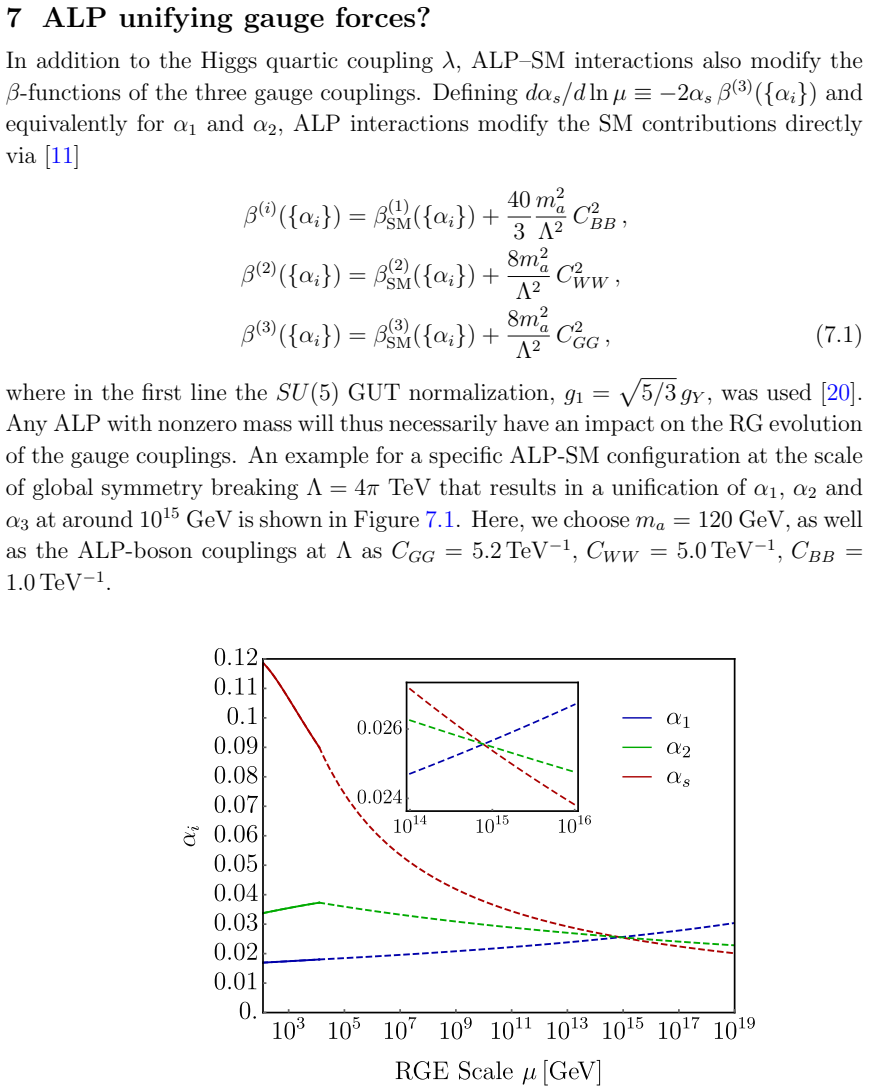
The paper's central claim is that the presence of a generic, flavor-universal ALP with $f = 1$ TeV and mass $m_a$ up to about 200 GeV alters the scale at which the Higgs potential develops a deeper true vacuum, so the measured value of the Higgs mass no longer sits in the Standard Model's near-critical metastable window. The shifts are driven by ALP-generated source terms in the one-loop SMEFT renormalization group equations, by the direct contribution $-16 g_s^2 m_H^2 C_{WW}^2/(3(4\pi f)^2)$ to the running of $\lambda$, and by mass-enhanced terms in the running of the strong coupling, the top Yukawa, and the hypercharge gauge coupling. The net effect is that $C_{WW}/f$ and $C_u/f$ of order $1\ \mathrm{TeV}^{-1}$ push the instability scale below its Standard Model value for $m_a = 100$ GeV, so they are bounded from above by the requirement that the vacuum lifetime exceeds the age of the Universe, while $C_{GG}/f$ raises the instability scale and can move the vacuum into the stable region. The same mass-dependent ALP contributions to the gauge $\beta$-functions allow the three Standard Model gauge couplings to meet near $10^{15}$ GeV when $m_a \simeq 120$ GeV and $C_{GG}/f = 5.2$, $C_{WW}/f = 5.0$, $C_{BB}/f = 1.0$ in TeV$^{-1}$.
Load-bearing premise
The whole calculation rests on the completeness of the one-loop contributions from virtual axion exchange that feed into the running of the Higgs self-coupling; if any operator mixing is missing, the derived limits on axion couplings would shift.
Editorial extensions
If this is right
- For $m_a = 100$ GeV and $\Lambda = 4\pi$ TeV, ALP couplings to W bosons and to up-type quarks are bounded near $1\ \mathrm{TeV}^{-1}$ if the electroweak vacuum must remain metastable; the precise excluded regions lie where other indirect probes already rule out the parameter space.
- An ALP-gluon coupling of similar size can raise the instability scale above its Standard Model value and, for large enough $C_{GG}/f$, can make the electroweak vacuum absolutely stable.
- These bounds are stronger when ALP effects are taken into account up to the Planck scale rather than truncated at $\Lambda$, so the quoted limits are conservative.
- Mass-dependent ALP contributions to the gauge $\beta$-functions can unify $\alpha_1$, $\alpha_2$, $\alpha_3$ near $10^{15}$ GeV without supersymmetry, for example with $m_a = 120$ GeV and the three couplings set to $(5.2, 5.0, 1.0)\ \mathrm{TeV}^{-1}$.
- A massless ALP has almost no effect on $\lambda$'s running in this framework, so the instability-based constraints are strongest when the ALP mass is in the tens to hundreds of GeV range.
Reading between the lines
- If the $C_{HH}$ $\beta$-function of Eq. (3.4) survives an independent check, the coupled running implies that heavy ALPs indirectly modify the Higgs self-coupling at low energies, which could be probed through Higgs pair production at future colliders.
- The unification example points to a non-supersymmetric UV scenario with an ALP close to the weak scale; a concrete model realizing those couplings would face proton-decay and Planck-suppressed operator constraints that this paper does not address.
- The order-one TeV$^{-1}$ bounds should be read as parametric targets: a UV completion with threshold corrections at $f$ can shift them, so an experiment that probes these couplings can discriminate between a generic ALP and specific axion models.
- One could extend the scan to include flavor non-universal couplings or to vary $\Lambda$ away from $4\pi$ TeV; the stability contours would test whether the regions not yet excluded by direct searches remain bounded.
Editorial analysis
A structured set of objections, weighed in public.
Referee Report
Summary. The paper argues that ALP couplings to SM fields modify the renormalization-group evolution of the Higgs quartic coupling through the ALP–SMEFT interference formalism, and that requiring the electroweak vacuum to remain metastable yields upper bounds on the ALP–W and ALP–up-type-quark couplings, while the ALP–gluon coupling can stabilize the vacuum. The authors also present an example in which ALP-induced modifications to the gauge-coupling beta functions lead to gauge unification around 10^15 GeV. The numerical analysis uses a modified DsixTools framework, the source terms of Ref. [11], and a new beta function for the coefficient C_HH.
Significance. If the computation is correct and reproducible, the paper introduces a genuinely new handle on ALP parameter space: vacuum stability as a probe of ALP couplings that is complementary to direct collider, flavor, and astrophysical searches. The advertised effect that a single ALP–gluon coupling can remove the electroweak instability is interesting, and the unification example, though admittedly model-dependent, is the kind of existence proof that can motivate further model building. However, the central numerical claims currently rest on an internally inconsistent treatment of the direct C_WW term and on an un-derived new anomalous dimension; these need to be addressed before the bounds can be trusted.
major comments (5)
- [Section 3, Eq. (3.2), and Section 5, C_WW bullet] The manuscript is internally inconsistent about whether the direct ALP–W contribution to the beta function of the Higgs quartic coupling is included in the numerics. In Section 3 the authors state that the term in Eq. (3.2) is 'at least two-loop power suppressed' and that they 'will therefore drop it.' Yet in Section 5 the destabilizing effect of C_WW is explained by saying that 'the square of this Wilson coefficient directly enters the RG evolution of lambda with a negative sign, see (3.2).' Since C_WW is one of the headline constrained couplings, the paper must state unambiguously whether Eq. (3.2) is implemented in the code. If it is implemented, the 'drop it' statement is wrong; if it is dropped, the explanation in Section 5 is not the mechanism that produces the plot. The bound on C_WW/f is not reproducible from the text as it stands.
- [Eq. (3.2)] Eq. (3.2) contains a gauge-coupling typo: the strong coupling g_s appears where an SU(2)_L coupling is required. Since the operator is C_WW W^I \tilde W^I, the prefactor should be proportional to g_L^2, not g_s^2. With standard values, the term as written is overestimated by roughly (g_s/g_L)^2 ~ 3-4. If this is a typo in the formula only, the reported C_WW bounds need to be recomputed; if the numerics actually use the printed expression, the implementation is wrong.
- [Section 3, Eq. (3.4)] The beta function for C_HH in Eq. (3.4) is central to the coupled evolution of m_H^2 through Eq. (3.3), but it is asserted without a derivation. The text says only that the diagrams are shown in Figure 3.1 and that the result was cross-checked with an unpublished version of Matchete. A referee cannot verify the sign, the numerical coefficients, or the flavor-universal reduction in Eq. (3.4). Given that this anomalous dimension is new to this paper and enters the advertised coupled system, the derivation (or a published reference) should be provided, and the final published version should cite the Matchete check or include it as supplementary material.
- [Section 7, Figure 7.1] The unification benchmark in Section 7 may be inconsistent with the paper's own metastability requirement. Section 6 states that for m_a = 100 GeV the bounds on C_GG/f, C_WW/f, and C_u/f are of order 1 TeV^{-1}. The Section 7 example uses C_GG = 5.2 TeV^{-1} and C_WW = 5.0 TeV^{-1} at m_a = 120 GeV, and no check is shown that this point lies in a region where the electroweak vacuum is metastable or stable. Since a large C_GG can stabilize while a large C_WW destabilizes, a combined analysis is needed; as written, the unification example may be excluded by the central phenomenological constraint of the paper.
- [Section 6, Figures 6.2 and 6.3] The bounds shown in Figures 6.2 and 6.3 are sharp curves, but no estimate of theoretical uncertainties is given. The result depends on the choice of matching scale (4πf), the truncation of the RGEs to one loop, the input values inherited from DsixTools, and the prescription for switching off ALP effects above Λ. Given the exponential sensitivity of the vacuum lifetime to λ(Λ_B), even modest scheme or scale uncertainties could move the O(1) TeV^{-1} bounds by an order of magnitude. A short discussion or an uncertainty band around at least the C_WW and C_u bounds would be needed to judge robustness.
minor comments (5)
- [Abstract] The abstract contains the typo 'non-sypersymmetric'; it should read 'non-supersymmetric'.
- [Section 2, Eq. (2.2)] The notation for the ALP–gluon coupling changes from C_GG (with a space) in the abstract and Section 2 to other forms later; please standardize the subscript formatting throughout.
- [Section 6, caption of Figure 6.2] The caption says 'one coupling turned on at the UV-scale, taken to be Λ = 4πTeV', but for m_a = 0 the ALP is massless and the statement about the ALP mass being varied between 0 and 200 GeV is clear only after reading the main text; please make the figure caption self-contained.
- [Section 7, Eq. (7.1)] The normalization convention for the beta functions is introduced by example; please define β^(i) explicitly for all three couplings before Eq. (7.1), including the sign convention for α_2 and α_3.
- [References] The paper relies heavily on the source terms from Ref. [11] and the global fit of Ref. [15], both of which are by the same collaboration; this is not problematic per se, but the text should make clear which input values are taken from those papers and where a reader should look for the definitions of the C_i used in the scan.
Circularity Check
No significant circularity: the bounds follow from external RGE inputs, and the unification example is an explicitly chosen demonstration, not a prediction.
full rationale
The derivation chain is not circular. The vacuum-instability bounds are obtained by (i) taking the one-loop ALP-SMEFT source terms S_i from Ref. [11] as inputs, (ii) solving the coupled SMEFT+ALP RGE system with lambda(M_Z) fixed at its measured value, and (iii) scanning ALP couplings at Lambda = 4*pi*f to locate the boundary where the vacuum lifetime drops below the age of the Universe. Each of these steps maps an independently specified input to a computed output; no output is fed back to fix an input, and no quantity is defined in terms of the result it is supposed to bound. The reliance on Refs. [11], [14] and [15] is normal use of prior one-loop calculations that are stated as external inputs rather than derived from the present claims; because these are parameter-free, externally checkable computations, they do not constitute circularity under the review rules. The new C_HH beta function in Eq. (3.4) is derived in this paper and cross-checked with Matchete, so it is not assumed equal to the final bound. The Section 7 unification statement is expressly an existence example ('we choose ... C_GG = 5.2 TeV^-1, C_WW = 5.0 TeV^-1, C_BB = 1.0 TeV^-1' and 'An example ... that results in a unification ... is shown'), not a prediction of those couplings; choosing inputs to produce a displayed output is a demonstration, not a fit disguised as prediction. The apparent tension between dropping Eq. (3.2) and later citing it as the C_WW destabilization mechanism is an internal-consistency or numerical-reproducibility issue, not a circularity. No circular step can be exhibited.
Assumptions & free parameters
free parameters (3)
- ALP decay constant f =
1 TeV
- ALP mass m_a =
scanned 0-200 GeV
- Unification couplings C_GG, C_WW, C_BB =
5.2, 5.0, 1.0 TeV^-1 at Lambda = 4 pi TeV, m_a = 120 GeV
assumptions (5)
- domain assumption The ALP-SMEFT interference source terms S_i from Ref. [11] are correct and complete.
- standard math One-loop SMEFT RG evolution (JMT and DsixTools) is accurate for the scale range from M_Z to Lambda.
- domain assumption The vacuum tunneling formalism of Ref. [20] (action S = 16 pi^2/(3|lambda|)) applies.
- ad hoc to paper Flavor-universal ALP-fermion couplings and one nonzero ALP coupling at a time.
- ad hoc to paper ALP effects are switched off above the scale Lambda = 4 pi f.
Cite this review
Pith. "Pith review of Saving or Destroying the Universe with Axion-Like Particles." pith.science (2026). https://pith.science/paper/XD7GJZLO
@misc{pith2026250606426,
  author       = {Pith},
  title        = {Pith review of: Saving or Destroying the Universe with Axion-Like Particles},
  year         = {2026},
  howpublished = {\url{https://pith.science/paper/XD7GJZLO}},
  note         = {Machine review of arXiv:2506.06426}
}
abstract
Light pseudoscalar resonances that couple to the Standard Model via non-renormalizable operators, such as axions and axion-like particles (ALPs), generate contributions to the renormalization group evolution equations of couplings of dimension-4 and higher-dimensional operators. In particular, they modify the $\beta$-function of the Higgs quartic coupling and of SM and SMEFT parameters entering this equation, thus having an impact on the instability scale of the electroweak vacuum. We employ this fact together with the requirement that, in the presence of axions and ALPs, the Universe remains in a meta-stable state to deduce bounds on ALP couplings to the Standard Model fields. We also show that the modification of the $\beta$-functions of the gauge couplings by the ALP can lead to a unification around the Planck scale, even in non-sypersymmetric models.
Figures


Figures from the paper (3 more)


Reference graph
Works this paper leans on
-
[11]
A. M. Galda, M. Neubert and S. Renner,ALP — SMEFT interference,JHEP06 (2021) 135, [2105.01078]
arXiv 2021
-
[1]
R. D. Peccei and H. R. Quinn,CP Conservation in the Presence of Instantons, Phys. Rev. Lett.38(1977) 1440–1443
1977
-
[2]
Weinberg,A New Light Boson?,Phys
S. Weinberg,A New Light Boson?,Phys. Rev. Lett.40(1978) 223–226
1978
-
[3]
Wilczek,Problem of StrongPandTInvariance in the Presence of Instantons, Phys
F. Wilczek,Problem of StrongPandTInvariance in the Presence of Instantons, Phys. Rev. Lett.40(1978) 279–282
1978
-
[4]
L. Calibbi, F. Goertz, D. Redigolo, R. Ziegler and J. Zupan,Minimal axion model from flavor,Phys. Rev. D95(2017) 095009, [1612.08040]
arXiv 2017
-
[5]
Y. Ema, K. Hamaguchi, T. Moroi and K. Nakayama,Flaxion: a minimal extension to solve puzzles in the standard model,JHEP01(2017) 096, [1612.05492]
arXiv 2017
- [6]
-
[7]
B. Gripaios, A. Pomarol, F. Riva and J. Serra,Beyond the Minimal Composite Higgs Model,JHEP04(2009) 070, [0902.1483]
arXiv 2009
Show all 23 references
-
[8]
Ferretti and D
G. Ferretti and D. Karateev,Fermionic UV completions of Composite Higgs models, JHEP03(2014) 077, [1312.5330]
2014 arXiv
-
[9]
P. W. Graham, D. E. Kaplan and S. Rajendran,Cosmological Relaxation of the Electroweak Scale,Phys. Rev. Lett.115(2015) 221801, [1504.07551]
2015 arXiv
-
[10]
Bellazzini, A
B. Bellazzini, A. Mariotti, D. Redigolo, F. Sala and J. Serra,R-axion at colliders, Phys. Rev. Lett.119(2017) 141804, [1702.02152]
2017 arXiv
-
[12]
Degrassi, S
G. Degrassi, S. Di Vita, J. Elias-Miro, J. R. Espinosa, G. F. Giudice, G. Isidori et al.,Higgs mass and vacuum stability in the Standard Model at NNLO,JHEP08 (2012) 098, [1205.6497]
2012 arXiv
-
[13]
Georgi, D
H. Georgi, D. B. Kaplan and L. Randall,Manifesting the Invisible Axion at Low-energies,Phys. Lett. B169(1986) 73–78
1986
-
[14]
Bauer, M
M. Bauer, M. Neubert, S. Renner, M. Schnubel and A. Thamm,The Low-Energy Effective Theory of Axions and ALPs,JHEP04(2021) 063, [2012.12272]
2021 arXiv
-
[15]
Biek¨ otter, J
A. Biek¨ otter, J. Fuentes-Mart ´ ın, A. M. Galda and M. Neubert,A global analysis of axion-like particle interactions using SMEFT fits,JHEP09(2023) 120, [2307.10372]
2023 arXiv
-
[16]
E. E. Jenkins, A. V. Manohar and M. Trott,Renormalization Group Evolution of the Standard Model Dimension Six Operators II: Yukawa Dependence,JHEP01 (2014) 035, [1310.4838]. [17]Particle Data Groupcollaboration, R. L. Workman et al.,Review of Particle Physics,PTEP2022(2022) 083C01. 14
2014 arXiv
-
[18]
E. E. Jenkins, A. V. Manohar and M. Trott,Renormalization Group Evolution of the Standard Model Dimension Six Operators I: Formalism and lambda Dependence, JHEP10(2013) 087, [1308.2627]
2013 arXiv
-
[19]
Alonso, E
R. Alonso, E. E. Jenkins, A. V. Manohar and M. Trott,Renormalization Group Evolution of the Standard Model Dimension Six Operators III: Gauge Coupling Dependence and Phenomenology,JHEP04(2014) 159, [1312.2014]
2014 arXiv
-
[20]
Buttazzo, G
D. Buttazzo, G. Degrassi, P. P. Giardino, G. F. Giudice, F. Sala, A. Salvio et al., Investigating the near-criticality of the Higgs boson,JHEP12(2013) 089, [1307.3536]
2013 arXiv
-
[21]
Celis, J
A. Celis, J. Fuentes-Martin, A. Vicente and J. Virto,DsixTools: The Standard Model Effective Field Theory Toolkit,Eur. Phys. J. C77(2017) 405, [1704.04504]
2017 arXiv
-
[22]
Fuentes-Martin, P
J. Fuentes-Martin, P. Ruiz-Femenia, A. Vicente and J. Virto,DsixTools 2.0: The Effective Field Theory Toolkit,Eur. Phys. J. C81(2021) 167, [2010.16341]
2021 arXiv
-
[23]
Fuentes-Mart ´ ın, M
J. Fuentes-Mart ´ ın, M. K¨ onig, J. Pag` es, A. E. Thomsen and F. Wilsch,A proof of concept for matchete: an automated tool for matching effective theories,Eur. Phys. J. C83(2023) 662, [2212.04510]
2023 arXiv
-
[24]
Ellis,TikZ-Feynman: Feynman diagrams with TikZ,Comput
J. Ellis,TikZ-Feynman: Feynman diagrams with TikZ,Comput. Phys. Commun. 210(2017) 103–123, [1601.05437]. 15
2017 arXiv
Reviewed August 7, 2026 · model on record in the stance chip above.
Discussion (0). Continue with ORCID to comment.