REVIEW 3 major objections 5 minor 57 references
Shape-Aware Human Pose and Shape Reconstruction Using Multi-View Images
T0 review · 3 major / 5 minor · reviewed 2026-08-14 · deepseek-v4-flash
Pith's one-line read Recovering a person's 3D body shape under loose clothing is substantially easier when the input includes several viewing angles, and physically simulated clothed bodies provide the training signal that makes shape estimates accurate.
desk verdict The multi-view fusion architecture is real and the pose numbers are credible, but the shape-under-clothing claim is supported mostly by in-distribution synthetic data and a small uncharacterized tape-measure study. read the letter →
The pith
A machine-rendered reading of the paper's core claim, the machinery that carries it, and where it could break.
The reading
What carries the argument
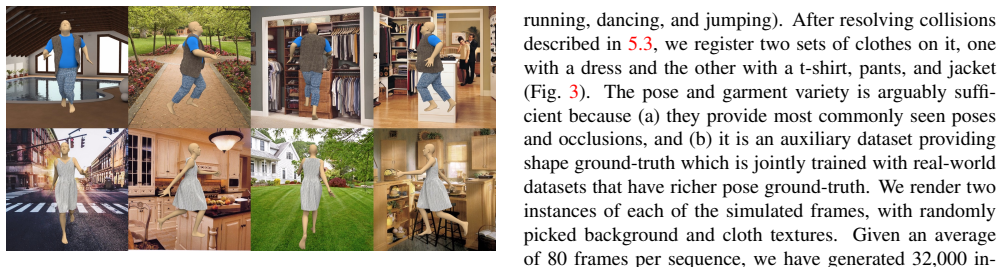
The load-bearing object is the SMPL parametric body model, a generative mesh model parameterized by joint rotations and PCA shape coefficients; the network predicts corrections to these coefficients rather than raw vertices. Around it sits a multi-view multi-stage residual scheme: image features from each view are encoded once, then a shared regression block iteratively refines the common body parameters while each view keeps its own camera parameters, and residual error-correction connections prevent gradient vanishing and allow any number of views. The supporting data machinery is a synthetic pipeline that samples uniform shape coefficients, applies motion-capture poses, resolves body-cloth interpenetration, dresses the bodies with a physical cloth simulator, and renders four views with varied backgrounds and textures.
What would settle it
A real-world benchmark with ground-truth body meshes or precise tape measurements for people of diverse body-mass indices wearing loose garments would settle it: if the variant trained with the synthetic clothed-body data does not beat the same network trained without it on those real-world shape errors, the synthetic-to-real transfer claim fails.
Extended reading notes
Core claim
The central claim is that projection ambiguity, not image resolution or feature quality, is the main obstacle to estimating a body hidden under clothing, and that multi-view input removes most of that ambiguity. The paper proposes a recurrent error-correction network that ingests any number of views, one at a time, in stages; each block predicts a correction to shared pose and shape parameters from the image feature and the current estimates, so information from all views accumulates. The same architecture, trained with a synthetic dataset of simulated clothed bodies, learns correlations between garment wrinkles and stretch and the underlying body shape, and the authors report that this shape-aware training reduces the Hausdorff distance to the ground-truth mesh while preserving pose accuracy.
Load-bearing premise
The load-bearing premise is that the synthetic clothed bodies, sampled from a limited set of shapes, poses, and two garment sets, look enough like real people in real clothes that training on them improves real-world shape estimates; the quantitative shape evaluation is done on a test set drawn from the same synthetic pipeline.
Editorial extensions
If this is right
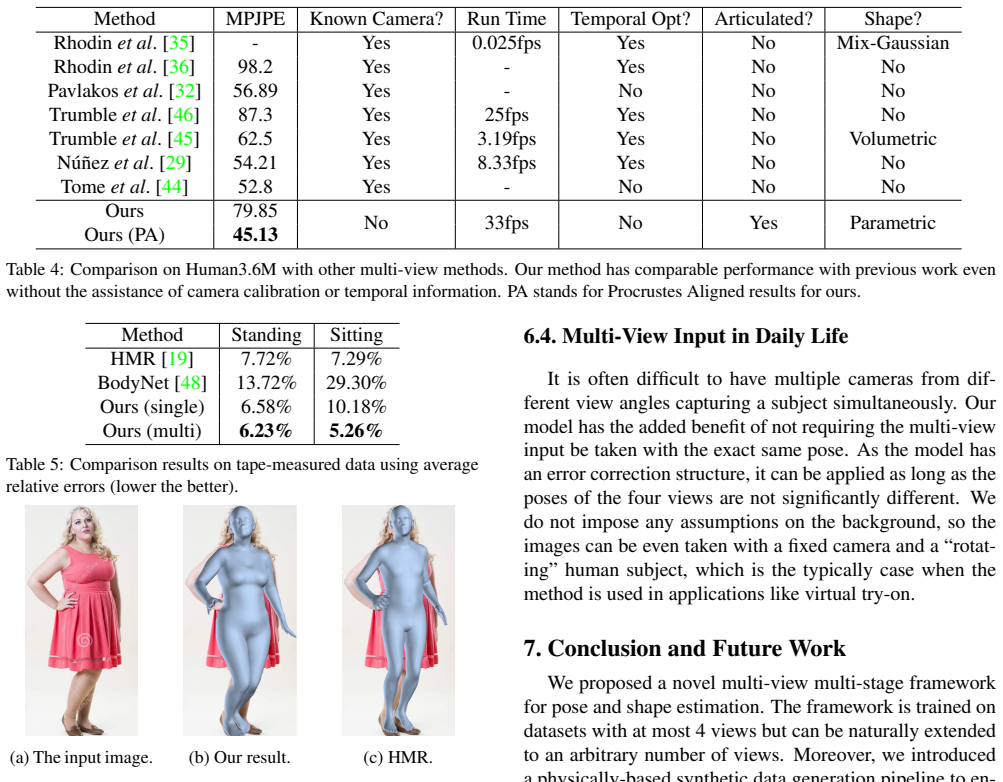
- On the standard pose benchmark, the multi-view model's mean per-joint position error drops from 58.55 mm to 45.13 mm after rigid alignment, compared with the same model given a single view.
- On the synthetic shape test, joint training with simulated clothed bodies reduces the Hausdorff distance to the ground-truth mesh from 83 mm to 53 mm for the multi-view model, and from 208 mm to 83 mm for the single-view baseline.
- The framework accepts any number of views at inference, padding or extending the recurrent chain, so it transfers from four-view training to practical one-, three-, or many-camera setups.
- The synthetic data also regularizes end-effector orientations that joint-only supervision leaves free, producing more natural limb poses without needing a learned discriminator.
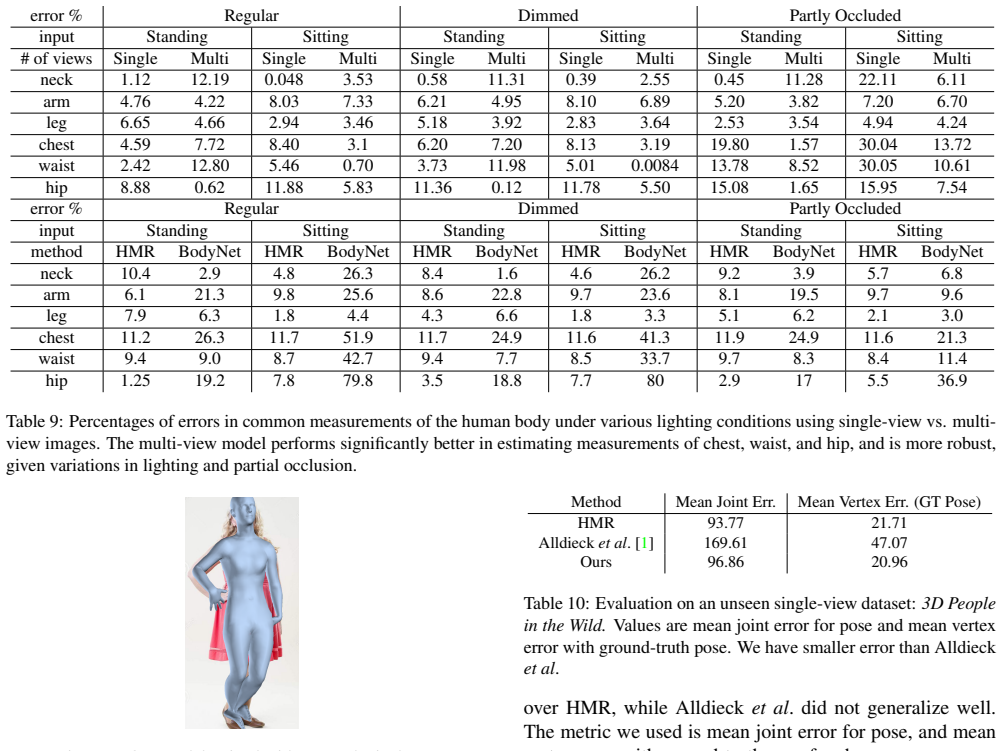
- Multi-view input is more robust to dim lighting and partial occlusion, with the largest gains on chest, waist, and hip measurements.
Reading between the lines
- One extension the authors leave implicit: the same recurrent error-correction structure could be applied to video frames of a moving subject, treating time as extra views, since the method tolerates slight pose differences between views.
- A testable extension would be to train the same network on synthetic data with progressively more realistic cloth, hair, skin, and background variation; the authors' own conclusion predicts shape error would shrink further as the synthetic-to-real gap closes.
- Because the model does not need camera calibration or synchronized capture, a practical deployment could reconstruct body shape from a person rotating in front of a single phone camera; the authors mention this use case but do not evaluate it quantitatively.
Signed reviews
Editorial analysis
A structured set of objections, weighed in public.
Referee Report
Summary. The paper proposes a multi-view multi-stage residual network that regresses SMPL pose and shape parameters from a variable number of RGB images. To provide supervision for shape under clothing, the authors build a synthetic data generation pipeline based on physically based cloth simulation with ArcSim, and jointly train on synthetic and real datasets. Experiments report that multi-view input improves pose accuracy over single-view baselines on Human3.6M and MPI-INF-3DHP, and that synthetic training improves shape reconstruction on the authors' own synthetic test set and on a small real-world tape-measure study.
Significance. The problem of recovering body shape under loose clothing from multi-view images is important and relatively under-addressed. The proposed recurrent multi-view architecture is conceptually clean, and the pipeline for generating synthetic clothed human data with ground-truth SMPL parameters is a useful resource. The pose improvements on standard benchmarks are clearly demonstrated and give credibility to the multi-view idea. However, the shape-under-clothing claim, which is the distinctive contribution, rests on a synthetic evaluation whose test set shares the training pipeline and on a real-world study with insufficient statistical support. If the authors can provide independent shape validation, the paper would be a strong candidate; in its current form, the evidence does not fully support the headline claim.
major comments (3)
- [Sec. 6.1.2 (Table 3) and Sec. 5.4] The synthetic shape test set is generated by the same pipeline as the training set, with the same two cloth templates, the same ArcSim material parameters, and the same five CMU MoCap pose sequences; only the last 10 of 100 body shapes are held out. The large Hausdorff-distance improvements after synthetic training therefore demonstrate fitting to the training distribution of garments and simulation artifacts, not necessarily generalization to arbitrary real-world clothing. This matters because the abstract's central claim is about increasing the reconstruction accuracy of the 3D human body under clothing. The authors should either extend the test protocol to include held-out garment types and varied cloth simulation/rendering parameters, or complement the synthetic evaluation with a real dataset in which ground-truth body shapes are obtained independently of the authors' own pipeline. Section 7 acknowledges a gap between synthetic and real data, but an acknowledgement does not replace the missing evidence for the central claim.
- [Sec. 6.3 and Appendix E (Table 9)] The real-world tape-measure evaluation does not report the number of subjects, per-condition variance or confidence intervals, or any significance test, so the aggregate averages in Table 5 cannot be interpreted statistically. More seriously, the detailed per-measurement errors in Table 9 show that the multi-view model is worse than the single-view model for several measurements under the regular condition (e.g., neck standing: 12.19% vs 1.12%; waist standing: 12.80% vs 2.42%; hip sitting: 5.83% vs 11.88% is fine but the first two contradict the claimed benefit). These inconsistencies are hidden by the averaging and directly undermine the statement that multi-view input provides 'significantly better' shape estimation on real-world images. The authors must either provide a fully specified study with subject counts, variances, and paired analyses for each measurement, or substantially temper the real-world shape claim to be consistent with the reported data.
- [Sec. 6.1.2, Appendix C, and Table 8] The claim that the method 'outperforms existing methods on real-world images, especially on shape estimations' is supported only by comparisons to HMR and BodyNet, both of which are known to regress near-mean body shapes. No comparison is made to contemporary shape-aware single-view methods that the authors themselves cite (e.g., Kolotouros et al. [20]) on a shape metric; Table 8 compares only pose (PA-MPJPE) with these methods, not shape. Since shape under clothing is the distinctive contribution, an evaluation against the best available shape estimators on a common benchmark is necessary before this claim can be accepted.
minor comments (5)
- [Sec. 5.4] The description of shape sampling should state explicitly that the uniform distribution is over each of the 10 SMPL shape coefficients in the range [mu - 3*sigma, mu + 3*sigma] and should define mu and sigma for the SMPL shape PCA; the current text is ambiguous.
- [Sec. 5.2, Eq. (4)] The notation g(x) and epsilon in the penetration-avoidance optimization is not fully defined; please specify what space x lives in, how the penetration depth is computed, and how the constraint is enforced in practice.
- [Appendix E, Table 9] The per-measurement error table is dense and difficult to read; a grouped presentation or a figure showing single-view vs multi-view errors by measurement and condition would make the inconsistencies easier to assess.
- [Sec. 2.1 and Table 4] There are several typographical errors in author names: 'B˘alan' should be 'Balan', 'N´u˜nez' should be 'Nunez', and 'Debra' in Table 8 should be 'Dabral'; please correct these throughout.
- [Sec. 6.1.1, Tables 1 and 2] The paper refers to 'the standard test set in Human3.6M' but does not specify which subjects and views are used for multi-view training and testing, nor how the multi-view test input is constructed; please clarify the protocol so the results are reproducible.
Circularity Check
Shape-under-clothing evaluation reuses the same synthetic pipeline that generated the training data; real-world shape evidence is not independently quantified.
-
fitted input called prediction
[Sec. 5.4 (data pipeline) and Sec. 6.1.2 (shape evaluation, Table 3)]
"We sample 100 random shapes and randomly apply them to 5 pose sequences in the CMU MoCap dataset ... we register two sets of clothes on it, one with a dress and the other with a t-shirt, pants, and jacket ... We set the first 90 shapes as the training set and the last 10 as the test set. ... we decide to use our synthetic test dataset for large-scale statistical evaluation."
The large-scale shape evaluation is performed on the output of the same generative pipeline that produced the training supervision: same ArcSim simulator, fixed cloth material parameters, and the same two garment templates; only the 10 shape identities are held out. Thus the Table 3 Hausdorff-distance numbers mostly measure fit to the authors' simulator/garment pair, not shape accuracy under general real clothing. The abstract's real-world shape claim is then carried by this in-distribution result plus a small tape-measure study with no subject count, variance, or statistical test, in which multi-view is sometimes worse (e.g., neck 12.19% vs 1.12% standing). The validation is therefore partially self-referential rather than an independent external check.
full rationale
The pose-accuracy claims are independently grounded: Human3.6M and MPI INF 3DHP are external benchmarks, and the multi-view versus single-view comparisons there are legitimate held-out evaluations. The only self-citation ([52]) is a generic claim about synthetic data in related work and is not load-bearing. The main circularity is confined to the shape-under-clothing claim. In Sec. 5.4, both training and test sets are generated by the same pipeline: 100 SMPL shapes, 5 CMU MoCap sequences, two registered garment sets, and ArcSim with fixed material parameters; only the last 10 shape identities are held out. Sec. 6.1.2 then uses this synthetic test set for the quantitative shape evaluation, and the abstract converts that into a real-world claim: 'Our method outperforms existing methods on real-world images, especially on shape estimations.' Because the garment templates and simulation parameters are shared between fit and test, the Table 3 improvements largely reflect in-distribution fitting to the authors' simulator, not accuracy under arbitrary clothing. The real-world tape measurements (Sec. 6.3 and Appendix E) have no subject count, variance, or statistical test, and several per-measurement entries show multi-view worse than single-view, so they do not independently close the loop. The authors themselves acknowledge the 'performance gap between real-world images and synthetic data' in Sec. 7. Overall, this is a partial circularity: the central shape claim is not forced by an equation, and the pose claim remains independent, but the quantitative support for real-world shape superiority is self-referential.
Assumptions & free parameters
free parameters (5)
- Loss weights λ0, λ1 =
not reported in this version
- Number of refinement stages =
3
- Shape sampling bounds for synthetic data =
[mu-3sigma, mu+3sigma]
- Synthetic dataset composition =
32,000 instances (128,000 images)
- Learning rate and epoch count =
10^-5, 20 epochs
assumptions (5)
- domain assumption The SMPL linear model spans the human body shapes and poses needed for this task.
- domain assumption Orthogonal projection approximates real-world cameras well enough for training and inference.
- domain assumption Physically simulated cloth images transfer to real loose-clothing images.
- ad hoc to paper Garment image features carry recoverable information about body shape.
- domain assumption CMU MoCap poses, restricted to five chosen sequences, provide sufficient pose diversity when combined with real pose datasets.
Cite this review
Pith. "Pith review of Shape-Aware Human Pose and Shape Reconstruction Using Multi-View Images." pith.science (2026). https://pith.science/paper/XD7NFUST
@misc{pith2026190809464,
  author       = {Pith},
  title        = {Pith review of: Shape-Aware Human Pose and Shape Reconstruction Using Multi-View Images},
  year         = {2026},
  howpublished = {\url{https://pith.science/paper/XD7NFUST}},
  note         = {Machine review of arXiv:1908.09464}
}
read the original abstract
We propose a scalable neural network framework to reconstruct the 3D mesh of a human body from multi-view images, in the subspace of the SMPL model. Use of multi-view images can significantly reduce the projection ambiguity of the problem, increasing the reconstruction accuracy of the 3D human body under clothing. Our experiments show that this method benefits from the synthetic dataset generated from our pipeline since it has good flexibility of variable control and can provide ground-truth for validation. Our method outperforms existing methods on real-world images, especially on shape estimations.
Figures


Figures from the paper (4 more)


Reference graph
Works this paper leans on
-
[20]
Convolutional mesh regression for single-image hu- man shape reconstruction
Nikos Kolotouros, Georgios Pavlakos, and Kostas Dani- ilidis. Convolutional mesh regression for single-image hu- man shape reconstruction. In Proceedings of the IEEE Con- ference on Computer Vision and Pattern Recognition, pages 4501–4510, 2019. 3, 13
work page 2019
-
[1]
Learning to re- construct people in clothing from a single rgb camera
Thiemo Alldieck, Marcus Magnor, Bharat Lal Bhatnagar, Christian Theobalt, and Gerard Pons-Moll. Learning to re- construct people in clothing from a single rgb camera. In Proceedings of the IEEE Conference on Computer Vision and Pattern Recognition, pages 1175–1186, 2019. 3, 14
work page 2019
-
[2]
The naked truth: Estimating body shape under clothing
Alexandru O B ˘alan and Michael J Black. The naked truth: Estimating body shape under clothing. In European Confer- ence on Computer Vision, pages 15–29. Springer, 2008. 2
work page 2008
-
[3]
Detailed human shape and pose from images
Alexandru O Balan, Leonid Sigal, Michael J Black, James E Davis, and Horst W Haussecker. Detailed human shape and pose from images. In Computer Vision and Pattern Recogni- tion, 2007. CVPR’07. IEEE Conference on, pages 1–8. IEEE,
work page 2007
-
[4]
Keep it smpl: Automatic estimation of 3d human pose and shape from a single image
Federica Bogo, Angjoo Kanazawa, Christoph Lassner, Peter Gehler, Javier Romero, and Michael J Black. Keep it smpl: Automatic estimation of 3d human pose and shape from a single image. In European Conference on Computer Vision, pages 561–578. Springer, 2016. 2
work page 2016
-
[5]
Synthesizing training images for boosting human 3d pose estimation
Wenzheng Chen, Huan Wang, Yangyan Li, Hao Su, Zhenhua Wang, Changhe Tu, Dani Lischinski, Daniel Cohen-Or, and Baoquan Chen. Synthesizing training images for boosting human 3d pose estimation. In 3D Vision (3DV), 2016 Fourth International Conference on, pages 479–488. IEEE, 2016. 3
work page 2016
-
[6]
Inferring 3d shapes and deformations from single views
Yu Chen, Tae-Kyun Kim, and Roberto Cipolla. Inferring 3d shapes and deformations from single views. In European Conference on Computer Vision , pages 300–313. Springer,
-
[7]
3d-r2n2: A unified approach for single and multi-view 3d object reconstruction
Christopher B Choy, Danfei Xu, JunYoung Gwak, Kevin Chen, and Silvio Savarese. 3d-r2n2: A unified approach for single and multi-view 3d object reconstruction. In European conference on computer vision , pages 628–644. Springer,
Show all 57 references
-
[8]
Carnegie-mellon mocap database
CMU. Carnegie-mellon mocap database. created with fund- ing from nsf eia- 0196217, 2003. 3, 5
2003
-
[9]
Learning 3d hu- man pose from structure and motion
Rishabh Dabral, Anurag Mundhada, Uday Kusupati, Safeer Afaque, Abhishek Sharma, and Arjun Jain. Learning 3d hu- man pose from structure and motion. In Proceedings of the European Conference on Computer Vision (ECCV) , pages 668–683, 2018. 13
2018
-
[10]
Hs-nets: Estimating human body shape from silhouettes with convolutional neural networks
Endri Dibra, Himanshu Jain, Cengiz ¨Oztireli, Remo Ziegler, and Markus Gross. Hs-nets: Estimating human body shape from silhouettes with convolutional neural networks. In 3D Vision (3DV), 2016 Fourth International Conference on, pages 108–117. IEEE, 2016. 2
2016
-
[11]
Estimating human shape and pose from a single image
Peng Guan, Alexander Weiss, Alexandru O Balan, and Michael J Black. Estimating human shape and pose from a single image. In Computer Vision, 2009 IEEE 12th Inter- national Conference on, pages 1381–1388. IEEE, 2009. 2
2009
-
[12]
Multilinear pose and body shape estimation of dressed subjects from image sets
Nils Hasler, Hanno Ackermann, Bodo Rosenhahn, Thorsten Thorm¨ahlen, and Hans-Peter Seidel. Multilinear pose and body shape estimation of dressed subjects from image sets. In Computer Vision and Pattern Recognition (CVPR), 2010 IEEE Conference on, pages 1823–1830. IEEE, 2010. 2
2010
-
[13]
Estimating body shape of dressed humans
Nils Hasler, Carsten Stoll, Bodo Rosenhahn, Thorsten Thorm¨ahlen, and Hans-Peter Seidel. Estimating body shape of dressed humans. Computers & Graphics, 33(3):211–216,
-
[14]
Girshick
Kaiming He, Georgia Gkioxari, Piotr Doll ´ar, and Ross B. Girshick. Mask R-CNN. CoRR, abs/1703.06870, 2017. 12
2017 arXiv
-
[15]
Deep residual learning for image recognition
Kaiming He, Xiangyu Zhang, Shaoqing Ren, and Jian Sun. Deep residual learning for image recognition. In Proceed- ings of the IEEE conference on computer vision and pattern recognition, pages 770–778, 2016. 3, 4
2016
-
[16]
Identity mappings in deep residual networks
Kaiming He, Xiangyu Zhang, Shaoqing Ren, and Jian Sun. Identity mappings in deep residual networks. In European conference on computer vision , pages 630–645. Springer,
-
[17]
Catalin Ionescu, Dragos Papava, Vlad Olaru, and Cristian Sminchisescu. Human3. 6m: Large scale datasets and pre- dictive methods for 3d human sensing in natural environ- ments. IEEE transactions on pattern analysis and machine intelligence, 36(7):1325–1339, 2014. 5
2014
-
[18]
Moviereshape: Tracking and reshap- ing of humans in videos
Arjun Jain, Thorsten Thorm ¨ahlen, Hans-Peter Seidel, and Christian Theobalt. Moviereshape: Tracking and reshap- ing of humans in videos. In ACM Transactions on Graphics (TOG), volume 29, page 148. ACM, 2010. 2
2010
-
[19]
Black, David W
Angjoo Kanazawa, Michael J. Black, David W. Jacobs, and Jitendra Malik. End-to-end recovery of human shape and pose. In Computer Vision and Pattern Regognition (CVPR),
-
[21]
Unite the peo- ple: Closing the loop between 3d and 2d human representa- tions
Christoph Lassner, Javier Romero, Martin Kiefel, Federica Bogo, Michael J Black, and Peter V Gehler. Unite the peo- ple: Closing the loop between 3d and 2d human representa- tions. In IEEE Conf. on Computer Vision and Pattern Recog- nition (CVPR), volume 2, page 3, 2017. 2
2017
-
[22]
Microsoft coco: Common objects in context
Tsung-Yi Lin, Michael Maire, Serge Belongie, James Hays, Pietro Perona, Deva Ramanan, Piotr Doll´ar, and C Lawrence Zitnick. Microsoft coco: Common objects in context. In European conference on computer vision , pages 740–755. Springer, 2014. 5
2014
-
[23]
Smpl: A skinned multi- person linear model
Matthew Loper, Naureen Mahmood, Javier Romero, Gerard Pons-Moll, and Michael J Black. Smpl: A skinned multi- person linear model. ACM Transactions on Graphics (TOG), 34(6):248, 2015. 1, 2, 3, 4, 5
2015
-
[24]
Monocular 3d human pose estimation in the wild using improved cnn supervision
Dushyant Mehta, Helge Rhodin, Dan Casas, Pascal Fua, Oleksandr Sotnychenko, Weipeng Xu, and Christian Theobalt. Monocular 3d human pose estimation in the wild using improved cnn supervision. In 3D Vision (3DV), 2017 Fifth International Conference on. IEEE, 2017. 5
2017
-
[25]
Monocular 3d human pose estimation in the wild using improved cnn supervision
Dushyant Mehta, Helge Rhodin, Dan Casas, Pascal Fua, Oleksandr Sotnychenko, Weipeng Xu, and Christian Theobalt. Monocular 3d human pose estimation in the wild using improved cnn supervision. In 3D Vision (3DV), 2017 International Conference on, pages 506–516. IEEE, 2017. 6, 13
2017
-
[26]
Vnect: Real-time 3d human pose estimation with a single rgb cam- era
Dushyant Mehta, Srinath Sridhar, Oleksandr Sotnychenko, Helge Rhodin, Mohammad Shafiei, Hans-Peter Seidel, Weipeng Xu, Dan Casas, and Christian Theobalt. Vnect: Real-time 3d human pose estimation with a single rgb cam- era. ACM Transactions on Graphics (TOG), 36(4):44, 2017. 2, 13
2017
-
[27]
Ganerated hands for real-time 3d hand tracking from monocular rgb
Franziska Mueller, Florian Bernard, Oleksandr Sotny- chenko, Dushyant Mehta, Srinath Sridhar, Dan Casas, and Christian Theobalt. Ganerated hands for real-time 3d hand tracking from monocular rgb. In Proceedings of the IEEE Conference on Computer Vision and Pattern Recognition ...
2018
-
[28]
Adaptive anisotropic remeshing for cloth simulation
Rahul Narain, Armin Samii, and James F O’Brien. Adaptive anisotropic remeshing for cloth simulation. ACM transac- tions on graphics (TOG), 31(6):152, 2012. 6
2012
-
[29]
Multiview 3d human pose estimation using improved least-squares and lstm net- works
Juan Carlos N ´u˜nez, Ra ´ul Cabido, Jos ´e F V ´elez, Antonio S Montemayor, and Juan Jos ´e Pantrigo. Multiview 3d human pose estimation using improved least-squares and lstm net- works. Neurocomputing, 323:335–343, 2019. 3, 8
2019
-
[30]
Neural body fitting: Unifying deep learning and model based human pose and shape es- timation
Mohamed Omran, Christoph Lassner, Gerard Pons-Moll, Pe- ter Gehler, and Bernt Schiele. Neural body fitting: Unifying deep learning and model based human pose and shape es- timation. In 2018 International Conference on 3D Vision (3DV), pages 484–494. IEEE, 2018. 3, 13
2018
-
[31]
Coarse-to-fine volumetric pre- diction for single-image 3d human pose
Georgios Pavlakos, Xiaowei Zhou, Konstantinos G Derpa- nis, and Kostas Daniilidis. Coarse-to-fine volumetric pre- diction for single-image 3d human pose. In Computer Vision and Pattern Recognition (CVPR), 2017 IEEE Conference on, pages 1263–1272. IEEE, 2017. 2, 13
2017
-
[32]
Harvesting multiple views for marker-less 3d human pose annotations
Georgios Pavlakos, Xiaowei Zhou, Konstantinos G Derpa- nis, and Kostas Daniilidis. Harvesting multiple views for marker-less 3d human pose annotations. In Proceedings of the IEEE conference on computer vision and pattern recog- nition, pages 6988–6997, 2017. 3, 8
2017
-
[33]
Learning to estimate 3d human pose and shape from a single color image
Georgios Pavlakos, Luyang Zhu, Xiaowei Zhou, and Kostas Daniilidis. Learning to estimate 3d human pose and shape from a single color image. In Proceedings of the IEEE Con- ference on Computer Vision and Pattern Recognition, pages 459–468, 2018. 3, 13
2018
-
[34]
Clothcap: Seamless 4d clothing capture and retarget- ing
Gerard Pons-Moll, Sergi Pujades, Sonny Hu, and Michael J Black. Clothcap: Seamless 4d clothing capture and retarget- ing. ACM Transactions on Graphics (TOG), 36(4):73, 2017. 2
2017
-
[35]
Gen- eral automatic human shape and motion capture using volu- metric contour cues
Helge Rhodin, Nadia Robertini, Dan Casas, Christian Richardt, Hans-Peter Seidel, and Christian Theobalt. Gen- eral automatic human shape and motion capture using volu- metric contour cues. In European conference on computer vision, pages 509–526. Springer, 2016. 8
2016
-
[36]
Unsu- pervised geometry-aware representation for 3d human pose estimation
Helge Rhodin, Mathieu Salzmann, and Pascal Fua. Unsu- pervised geometry-aware representation for 3d human pose estimation. In Proceedings of the European Conference on Computer Vision (ECCV), pages 750–767, 2018. 3, 8
2018
-
[37]
Civilian american and european surface anthropometry resource (caesar), final re- port
Kathleen M Robinette, Sherri Blackwell, Hein Daanen, Mark Boehmer, and Scott Fleming. Civilian american and european surface anthropometry resource (caesar), final re- port. volume 1. summary. Technical report, SYTRONICS INC DAYTON OH, 2002. 3
2002
-
[38]
Lcr-net: Localization-classification-regression for human pose
Gregory Rogez, Philippe Weinzaepfel, and Cordelia Schmid. Lcr-net: Localization-classification-regression for human pose. In CVPR 2017-IEEE Conference on Computer Vision & Pattern Recognition, 2017. 13
2017
-
[39]
Fashion is taking shape: Understanding clothing preference based on body shape from online sources
Hosnieh Sattar, Gerard Pons-Moll, and Mario Fritz. Fashion is taking shape: Understanding clothing preference based on body shape from online sources. In 2019 IEEE Winter Con- ference on Applications of Computer Vision (WACV), pages 968–977. IEEE, 2019. 3
2019
-
[40]
Compositional human pose regression
Xiao Sun, Jiaxiang Shang, Shuang Liang, and Yichen Wei. Compositional human pose regression. In The IEEE Inter- national Conference on Computer Vision (ICCV), volume 2, page 7, 2017. 13
2017
-
[41]
Indirect deep structured learning for 3d human body shape and pose pre- diction
J Tan, Ignas Budvytis, and Roberto Cipolla. Indirect deep structured learning for 3d human body shape and pose pre- diction. In BMVC, volume 3, page 6, 2017. 2
2017
-
[42]
Learning to fuse 2d and 3d image cues for monocular body pose estimation
Bugra Tekin, Pablo Marquez Neila, Mathieu Salzmann, and Pascal Fua. Learning to fuse 2d and 3d image cues for monocular body pose estimation. In International Con- ference on Computer Vision (ICCV), number EPFL-CONF- 230311, 2017. 2
2017
-
[43]
Lifting from the deep: Convolutional 3d pose estimation from a single image
Denis Tome, Christopher Russell, and Lourdes Agapito. Lifting from the deep: Convolutional 3d pose estimation from a single image. CVPR 2017 Proceedings, pages 2500– 2509, 2017. 2, 13
2017
-
[44]
Rethinking pose in 3d: Multi-stage refinement and recovery for markerless motion capture
Denis Tome, Matteo Toso, Lourdes Agapito, and Chris Rus- sell. Rethinking pose in 3d: Multi-stage refinement and recovery for markerless motion capture. In 2018 Inter- national Conference on 3D Vision (3DV) , pages 474–483. IEEE, 2018. 3, 8
2018
-
[45]
Deep autoencoder for combined human pose estimation and body model upscaling
Matthew Trumble, Andrew Gilbert, Adrian Hilton, and John Collomosse. Deep autoencoder for combined human pose estimation and body model upscaling. In Proceedings of the European Conference on Computer Vision (ECCV) , pages 784–800, 2018. 3, 8
2018
-
[46]
Total capture: 3d human pose estimation fusing video and inertial sensors
Matthew Trumble, Andrew Gilbert, Charles Malleson, Adrian Hilton, and John Collomosse. Total capture: 3d human pose estimation fusing video and inertial sensors. In Proceedings of 28th British Machine Vision Conference , pages 1–13, 2017. 3, 8
2017
-
[47]
Self-supervised learning of motion capture
Hsiao-Yu Tung, Hsiao-Wei Tung, Ersin Yumer, and Katerina Fragkiadaki. Self-supervised learning of motion capture. In Advances in Neural Information Processing Systems , pages 5236–5246, 2017. 2
2017
-
[48]
Bodynet: V olu- metric inference of 3d human body shapes
Gul Varol, Duygu Ceylan, Bryan Russell, Jimei Yang, Ersin Yumer, Ivan Laptev, and Cordelia Schmid. Bodynet: V olu- metric inference of 3d human body shapes. In Proceedings of the European Conference on Computer Vision (ECCV) , pages 20–36, 2018. 3, 8
2018
-
[49]
Learning from synthetic humans
G ¨ul Varol, Javier Romero, Xavier Martin, Naureen Mah- mood, Michael J Black, Ivan Laptev, and Cordelia Schmid. Learning from synthetic humans. In 2017 IEEE Conference on Computer Vision and Pattern Recognition (CVPR 2017),
2017
-
[50]
Estimation of human body shape and posture under clothing
Stefanie Wuhrer, Leonid Pishchulin, Alan Brunton, Chang Shu, and Jochen Lang. Estimation of human body shape and posture under clothing. Computer Vision and Image Under- standing, 127:31–42, 2014. 2
2014
-
[51]
Estimation of human body shape in motion with wide clothing
Jinlong Yang, Jean-S ´ebastien Franco, Franck H ´etroy- Wheeler, and Stefanie Wuhrer. Estimation of human body shape in motion with wide clothing. In European Confer- ence on Computer Vision , pages 439–454. Springer, 2016. 2
2016
-
[52]
Learning-based cloth material recovery from video
Shan Yang, Junbang Liang, and Ming C Lin. Learning-based cloth material recovery from video. In Proceedings of the IEEE Conference on Computer Vision and Pattern Recogni- tion, pages 4383–4393, 2017. 3
2017
-
[53]
Detailed, accurate, human shape estimation from clothed 3d scan sequences
Chao Zhang, Sergi Pujades, Michael Black, and Gerard Pons-Moll. Detailed, accurate, human shape estimation from clothed 3d scan sequences. In IEEE Conference on Com- puter Vision and Pattern Recognition (CVPR) , volume 2,
-
[54]
Weaklysupervised transfer for 3d human pose estimation in the wild
Xingyi Zhou, Qixing Huang, Xiao Sun, Xiangyang Xue, and Yichen Wei. Weaklysupervised transfer for 3d human pose estimation in the wild. In IEEE International Conference on Computer Vision, volume 206, page 3, 2017. 2
2017
-
[55]
Deep kinematic pose regression
Xingyi Zhou, Xiao Sun, Wei Zhang, Shuang Liang, and Yichen Wei. Deep kinematic pose regression. In European Conference on Computer Vision , pages 186–201. Springer,
-
[2016]
Extra Test Results Table 6 and 8 shows the test results before Procrustes Alignment in MPI INF 3DHP validation set and Hu- man3.6M, respectively
2, 13 Appendix A. Extra Test Results Table 6 and 8 shows the test results before Procrustes Alignment in MPI INF 3DHP validation set and Hu- man3.6M, respectively. The same conclusion about over- fitting and multi-view improvement as the main text can also be drawn from these d...
-
[2018]
2, 3, 5, 6, 7, 8, 12, 13, 14
Reviewed August 14, 2026 · model on record in the stance chip above.
Discussion (0). Continue with ORCID to comment.