REVIEW 3 major objections 4 minor 57 references
PICD: Versatile Perceptual Image Compression with Diffusion Rendering
T0 review · 3 major / 4 minor · reviewed 2026-08-15 · deepseek-v4-flash
Pith's one-line read Codec wins text accuracy and visual quality on screens and photos
desk verdict Genuinely new combination of lossless OCR text coding and diffusion rendering, with credible experiments; the 'best text accuracy' claim is inflated by a circular OCR-based metric. read the letter →
The pith
A machine-rendered reading of the paper's core claim, the machinery that carries it, and where it could break.
The reading
What carries the argument
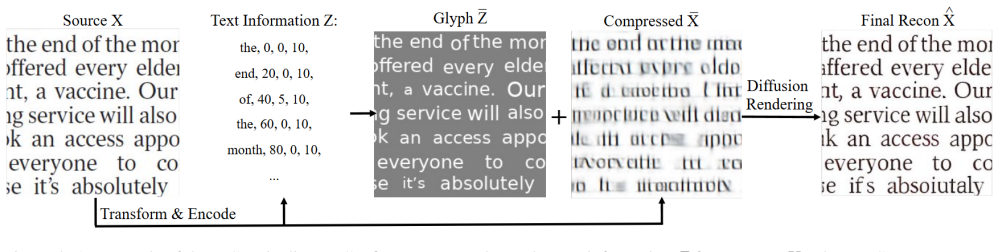
The mechanism is 'diffusion rendering,' implemented as a three-level conditioning stack on top of a pre-trained Stable Diffusion model. Domain level: the base model is fine-tuned (LoRA, rank 256) on screenshots with text-content prompts so it can generate screen layouts instead of natural-image scenes. Adaptor level: a custom adaptor feeds the decoded image and the glyph image into the UNet, using ControlNet's feature encoder for glyphs, both that encoder and Stable Diffusion's VAE encoder for the decoded image, pixel shuffle for a lossless transform, and SPADE layers for injection, because vanilla ControlNet is too weak for low-level control and StableSR alone hurts text accuracy. Instance level: at each DDPM sampling step, the paper takes the posterior mean $E[X_0 \mid X_t]$, runs a differentiable OCR (PARSeq) on crops of it and re-encodes it through the codec, then back-propagates two guidance terms so the intermediate estimate agrees with the true text and with the compressed image. Text $Z$ itself is extracted by Tesseract, compressed losslessly with cmix, and turned into a glyph image for conditioning.
What would settle it
Take a set of screenshots whose intended text strings are known independently, deliberately including glyphs a standard OCR engine tends to misread (stylized fonts, small sizes, low contrast), run PICD, and measure character-level agreement between the decoded image and the intended strings. If the decoded text matches the OCR output at encoding time but not the intended text, the 'lossless text' claim has failed at the extraction stage; the paper's own failure-case section predicts such cases exist.
Extended reading notes
Core claim
The central discovery is that text fidelity and perceptual quality do not have to compete inside one lossy codec if the text is taken out of the lossy path entirely. PICD encodes the OCR output $Z$ losslessly, compresses the image given $Z$, and then treats decoding as a conditional generation problem: sample $\hat{X} \sim p(X \mid \bar{X}, Z)$ from a diffusion model, where $\bar{X}$ is the compressed image and $Z$ is the glyph-rendered text. The paper argues this is near-optimal for text because $H(Z \mid Y)=0$ makes $H(Y \mid Z)+H(Z)=H(Y)$, so preserving text costs no extra rate, and optimal for perception because the rendered marginal distribution matches the source. Empirically, Table 2 reports BD-TEXT of 0.107 on SCI1K and BD-FID of -20.68 among perceptual codecs on screen images, and BD-FID of -74.55 on Kodak, the lowest among all compared codecs. The natural-image version removes the glyph and OCR guidance and uses BLIP captions as prompts, making the same framework a perceptual codec for ordinary photos.
Load-bearing premise
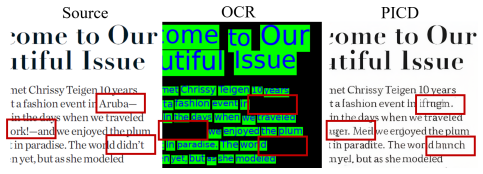
The entire text branch depends on the OCR engine reading the source image correctly at encoding time: a single misread character is stored losslessly, rendered crisply, and counted as accurate, so the reported text accuracy is bounded by OCR accuracy, not by the codec, and the paper's supplementary material concedes that text rendering fails if the OCR algorithm fails.
Editorial extensions
If this is right
- If PICD's comparisons are right, screen-content coding can use a perceptual diffusion-based codec without giving up text legibility, removing the main reason screen content needed separate, blurrier codecs.
- Because the rate argument makes text preservation cost no extra bitstream rate, further gains for screen content should come from better rendering and better image compression rather than from spending additional bits on text regions.
- The natural-image simplification means the same trained framework, with glyph and OCR guidance removed and BLIP captions as prompts, already acts as a competitive perceptual codec for ordinary photos.
- Among the text-preserving tools compared in Table 3, direct text rendering achieves slightly higher text accuracy than diffusion rendering but much worse FID and CLIP similarity, so the paper's approach is the one that keeps both metrics high simultaneously.
Reading between the lines
- A natural extension the authors do not pursue: the same side-channel idea could handle other structured screen elements—diagrams, tables, formulas, code blocks—turning the codec into a general semantic codec whenever a reliable extractor and renderer exist.
- The paper uses Tesseract for extraction and PARSeq for guidance; since the two OCR engines differ, a testable upgrade is to use one stronger neural OCR for both roles and measure whether text accuracy rises.
- The rate-optimality argument implies a falsifiable prediction the paper does not test: once the text stream is fixed, additional image bitrate should buy visual quality but almost no further text accuracy.
Signed reviews
Editorial analysis
A structured set of objections, weighed in public.
Referee Report
Summary. The paper proposes PICD, a perceptual image codec intended to work for both screen content and natural images. The encoder extracts text information Z from the source using OCR, compresses Z losslessly, and compresses the image with MLIC conditioned on Z. The decoder renders the reconstructed image and the text glyph into a final image using a Stable Diffusion model, with conditioning integrated at three levels: domain-level LoRA fine-tuning on screen images, an adaptor-level hybrid ControlNet/StableSR conditioning module, and instance-level guidance that combines OCR-based and codec-based losses during DDPM sampling. The authors report BD metrics on SCI1K, SIQAD, Kodak, and CLIC, claiming state-of-the-art text accuracy and FID among perceptual codecs on screen images and the lowest FID on natural images, together with ablations on the three conditioning levels and on alternative text-preservation tools.
Significance. If the text-accuracy results were validated against true character-level ground truth, PICD would be a notable contribution: it is one of the first systems to combine a lossless text stream with diffusion-based rendering and to demonstrate competitive perceptual quality on both screen and natural content in a single framework. The three-level conditioning design is well motivated, the ablations are informative, and the comparison set spans six codecs including both MSE-optimized and perceptual baselines. The explicit discussion of failure cases and computational complexity is a strength. However, the central claim of high text accuracy is currently threatened by a circular evaluation protocol, and the formal optimality arguments are conditional on assumptions that the paper itself acknowledges are only approximately satisfied.
major comments (3)
- [Section 3.2, Section 4.1, Eq. (3), Table 2] The text-accuracy evaluation is circular. The ground truth for the lossless text stream is Z = h(X), where h is the Tesseract OCR engine, and the reported metric is the Jaccard similarity between OCR outputs on the source and the reconstruction. The decoder and the instance-level guidance (Section A.3, using PARSeq) are explicitly optimized to make OCR output on the reconstruction match Z. Consequently, any character that Tesseract misreads on the source is encoded as ground truth, and a reconstruction that crisply reproduces that misread scores as perfectly accurate. The paper's own limitation statement in Section B.6, 'Our text rendering fails if the OCR algorithm fails,' confirms that the reported BD-TEXT values do not establish preservation of the actual characters in the image. Please re-evaluate text accuracy against ground-truth transcriptions or human reading, and report the source OCR accuracy as an upper bound on achievable performance.
- [Section 3.1, Eq. (5)-(7)] The optimality arguments are conditional on definitions rather than substantive. Eq. (5), H(Z|Y)=0, holds because Y is constructed to contain the losslessly encoded Z; the rate identity in Eq. (6) says only that losslessly transmitting Z and conditioning on it costs no more than transmitting Y alone. Eq. (7) asserts p(hat X)=p(X) by integrating p(Xbar,Z)p(X|Xbar,Z), but this requires the diffusion model to sample the exact posterior p(X|Xbar,Z). The paper itself states in Section 3.5 that the conditional distribution 'may not be perfectly trained,' which is why instance-level guidance is introduced. The claims of optimal text preservation and optimal perceptual quality should therefore be softened or supplemented with error bounds rather than presented as proven optimality.
- [Section 4.3, Table 3] The headline claim that PICD 'excels' in text accuracy is nuanced by the paper's own ablation. In Table 3, Direct Text Render achieves text accuracy 0.463 versus Diffusion Render's 0.445 at essentially the same bpp (0.016 versus 0.016). The advantage of diffusion rendering is in perceptual quality (FID 34.77 versus 52.20, CLIP 0.9059 versus 0.8785), not in text accuracy. The text in Section 4.2 should be rephrased to claim state-of-the-art text accuracy among perceptual codecs, not among all text-preservation approaches, unless the small difference in Table 3 is shown to be within noise or the comparison is made at matched operating points.
minor comments (4)
- [Section 2] The phrase 'compression mains to maintain' should be corrected to 'compression aims to maintain.'
- [Section 3.5 and Section A.3, Eq. (8)] Eq. (8) denotes the OCR model as h(.) in the guidance loss, but Section A.3 explains that Tesseract is non-differentiable and that PARSeq is used instead. Please align the notation and state explicitly in the main text that the differentiable OCR engine replaces h in the guidance term.
- [Section 4.3] The text contains a typo: 'Due to the efficient design of PCID' should read 'PICD.'
- [Section B.1] The training descriptions say '10,000 steps of gradient ascent' and '5,000 steps of gradient ascent'; these should be 'gradient descent.'
Circularity Check
Text-accuracy claims reduce to OCR self-consistency: the ground truth Z is the Tesseract output, Z is losslessly transmitted and used as test-time guidance, and the Jaccard metric scores agreement with Z; the 'optimality' proofs for text and perception are identities by construction, while natural-image FID remains independent evidence.
-
self definitional
[Section 3.1, Eqs. (3)-(6)]
"We define the reconstructed text as accurate when the OCR output for the reconstructed image, \hat{Z}=h(\hat{X}), corresponds exactly to Z: \hat{Z}=h(\hat{X})=h(g_\theta(Y))=Z. ... To comprehend why PICD achieves optimal bitrate for preserving text information, we observe that Z should be completely determined by Y as per Eq. 3. This condition implies that the entropy of Z given Y is zero, i.e., H(Z|Y)=0."
Z is defined as the output of the Tesseract OCR engine on the source, and this same Z is losslessly compressed and placed in the bitstream before the 'optimality' argument starts. With Z in Y, H(Z|Y)=0 is a coding identity, not a codec property; Eq. (6) merely applies the chain rule to a bitstream that already contains the OCR string. Thus the claimed optimal bitrate for 'preserving text information Z' reduces to 'losslessly sending the OCR output preserves the OCR output.' Since any OCR misread becomes the ground truth, the proof does not establish preservation of the actual characters, a limitation the paper concedes in B.6: 'Our text rendering fails if the OCR algorithm fails.'
-
fitted input called prediction
[Section A.3 (instance guidance) and Section 4.1 (evaluation metric)]
"PARSeq produces the logits, which is further compared with the true text content in Z (weighted by \zeta_1 in Section 3.5) as guidance for diffusion model. ... To assess text accuracy of screen content, the Jaccard similarity index is employed."
The reported BD-TEXT is the Jaccard similarity between OCR outputs on source and reconstruction, while the instance-level guidance explicitly optimizes the latent trajectory so that OCR logits match Z, the same string used as the ground truth. Therefore a high BD-TEXT largely measures whether the test-time optimizer succeeded in making OCR read back the source OCR output, not an independent property of the learned codec. The measurement procedure is coupled to the optimization target by construction; the paper's A.3 text describes comparing PARSeq logits with the true text content in Z as guidance, and Section 4.1 evaluates text accuracy with the Jaccard index.
1 more flagged steps
-
self definitional
[Section 3.1, Eq. (7)]
"PICD is Optimal for Perceptual Quality On the other hand, PICD satisfies the perfect perceptual codec constraint p(\hat{X})=p(X). More specifically, we have: p(\hat{X})=\int p(\bar{X},Z)p(X|\bar{X},Z)d\bar{X}dZ=p(X). (7) Therefore, PICD achieves optimal perceptual quality defined by Blau and Michaeli [7]."
Eq. (7) assumes the diffusion renderer produces \hat{X} by sampling exactly from the true posterior p(X|\bar{X},Z); the paper's Section 3.2 says the decoder is built 'to learn the posterior distribution p(X|\bar{X},Z).' If a conditional generative model samples from the true posterior, the marginal matching p(\hat{X})=p(X) is an identity. The 'optimal perceptual quality' conclusion is therefore the definition of the generative-decoder setup, not a derived consequence of PICD's design. The empirical FID numbers, not this equation, are the independent evidence.
full rationale
The derivation chain contains two definitional 'optimality' proofs and a text-accuracy evaluation that is coupled to the test-time guidance target. Eq. (5) is not an independent result: once Z=h(X) is compressed losslessly into Y, H(Z|Y)=0 is true by construction, and Eq. (6) is just the chain rule. Eq. (7) assumes \hat{X} is sampled from the true posterior p(X|\bar{X},Z), so the claimed perceptual optimality is the definition of a conditional generative decoder rather than a derived property. The text metric uses the same OCR output that defines and guides the text stream, and the paper concedes in B.6 that OCR failure breaks rendering. These are genuine partial circularities in the text-accuracy claim. However, the empirical comparisons on natural images (Kodak/CLIC FID, LPIPS, DISTS) are external benchmarks not determined by the OCR setup, and the architecture (lossless text side channel plus diffusion rendering) is a real engineering contribution. No load-bearing self-citation or imported uniqueness theorem was found. Overall partial circularity rather than full reduction.
Assumptions & free parameters
free parameters (3)
- Instance guidance weights zeta_1, zeta_2 =
0.25, 1e-4 (screen); 0.25, 0 (natural)
- DDPM sampling steps T =
250 (screen), 500 (natural)
- Classifier-free guidance scale omega =
0.0 (screen), 3.0 (natural)
assumptions (4)
- domain assumption The OCR engine h(.) extracts text content and its pixel location accurately enough that OCR errors do not dominate the reconstruction.
- domain assumption The trained conditional renderer p_theta(X | bar{X}, Z) is close enough to the true posterior p(X | bar{X}, Z) that the marginal condition p(hat{X}) = p(X) holds approximately.
- domain assumption Pre-trained Stable Diffusion 2.0, MLIC, ControlNet, and PARSeq behave as expected after the described fine-tuning, with no distribution shift on synthetic screen content.
- standard math Standard entropy identities (chain rule) apply to the compressed bitstreams Y and Z.
Cite this review
Pith. "Pith review of PICD: Versatile Perceptual Image Compression with Diffusion Rendering." pith.science (2026). https://pith.science/paper/XDBI2WVF
@misc{pith2026250505853,
  author       = {Pith},
  title        = {Pith review of: PICD: Versatile Perceptual Image Compression with Diffusion Rendering},
  year         = {2026},
  howpublished = {\url{https://pith.science/paper/XDBI2WVF}},
  note         = {Machine review of arXiv:2505.05853}
}
read the original abstract
Recently, perceptual image compression has achieved significant advancements, delivering high visual quality at low bitrates for natural images. However, for screen content, existing methods often produce noticeable artifacts when compressing text. To tackle this challenge, we propose versatile perceptual screen image compression with diffusion rendering (PICD), a codec that works well for both screen and natural images. More specifically, we propose a compression framework that encodes the text and image separately, and renders them into one image using diffusion model. For this diffusion rendering, we integrate conditional information into diffusion models at three distinct levels: 1). Domain level: We fine-tune the base diffusion model using text content prompts with screen content. 2). Adaptor level: We develop an efficient adaptor to control the diffusion model using compressed image and text as input. 3). Instance level: We apply instance-wise guidance to further enhance the decoding process. Empirically, our PICD surpasses existing perceptual codecs in terms of both text accuracy and perceptual quality. Additionally, without text conditions, our approach serves effectively as a perceptual codec for natural images.
Figures


Figures from the paper (12 more)




Reference graph
Works this paper leans on
-
[1]
Workshop and challenge on learned image compression (clic). 7
-
[2]
Generative adversar- ial networks for extreme learned image compression
Eirikur Agustsson, Michael Tschannen, Fabian Mentzer, Radu Timofte, and Luc Van Gool. Generative adversar- ial networks for extreme learned image compression. In Proceedings of the IEEE/CVF International Conference on Computer Vision, pages 221–231, 2019. 2
work page 2019
-
[3]
Minnen, George Toderici, and Fabian Mentzer
Eirikur Agustsson, David C. Minnen, George Toderici, and Fabian Mentzer. Multi-realism image compression with a conditional generator. ArXiv, abs/2212.13824, 2022. 2, 8
arXiv 2022
-
[4]
Scene text recognition with permuted autoregressive sequence models
Darwin Bautista and Rowel Atienza. Scene text recognition with permuted autoregressive sequence models. InEuropean Conference on Computer Vision, 2022. 9
work page 2022
-
[5]
Sutherland, Michal Arbel, and Arthur Gretton
Mikolaj Binkowski, Danica J. Sutherland, Michal Arbel, and Arthur Gretton. Demystifying mmd gans. ArXiv, abs/1801.01401, 2018. 7
arXiv 2018
-
[6]
Calculation of average psnr differences between rd-curves
Gisle Bjontegaard. Calculation of average psnr differences between rd-curves. VCEG-M33, 2001. 7
work page 2001
-
[7]
The perception-distortion tradeoff
Yochai Blau and Tomer Michaeli. The perception-distortion tradeoff. In Proceedings of the IEEE conference on computer vision and pattern recognition, pages 6228–6237, 2018. 2, 3
2018
-
[8]
Rethinking lossy com- pression: The rate-distortion-perception tradeoff
Yochai Blau and Tomer Michaeli. Rethinking lossy com- pression: The rate-distortion-perception tradeoff. In Inter- national Conference on Machine Learning , pages 675–685. PMLR, 2019. 2
work page 2019
Show all 57 references
-
[9]
Developments in international video coding standardization after avc, with an overview of versatile video coding (vvc)
Benjamin Bross, Jianle Chen, Jens-Rainer Ohm, Gary J Sul- livan, and Ye-Kui Wang. Developments in international video coding standardization after avc, with an overview of versatile video coding (vvc). Proceedings of the IEEE, 109 (9):1463–1493, 2021. 7
2021
-
[10]
Sullivan, and Jens-Rainer Ohm
Benjamin Bross, Ye-Kui Wang, Yan Ye, Shan Liu, Jianle Chen, Gary J. Sullivan, and Jens-Rainer Ohm. Overview of the versatile video coding (vvc) standard and its applica- tions. IEEE Transactions on Circuits and Systems for Video Technology, 31:3736–3764, 2021. 6, 10
2021
-
[11]
Towards image compression with per- fect realism at ultra-low bitrates
Marlene Careil, Matthew Muckley, Jakob Verbeek, and St´ephane Lathuili`ere. Towards image compression with per- fect realism at ultra-low bitrates. ArXiv, abs/2310.10325,
-
[12]
Diffusion posterior sam- pling for general noisy inverse problems
Hyungjin Chung, Jeongsol Kim, Michael T Mccann, Marc L Klasky, and Jong Chul Ye. Diffusion posterior sam- pling for general noisy inverse problems. arXiv preprint arXiv:2209.14687, 2022. 5, 8, 9
2022 arXiv
-
[13]
Elements of information theory
Thomas M Cover. Elements of information theory . John Wiley & Sons, 1999. 3
1999
-
[14]
Simoncelli
Keyan Ding, Kede Ma, Shiqi Wang, and Eero P. Simoncelli. Image quality assessment: Unifying structure and texture similarity. IEEE Transactions on Pattern Analysis and Ma- chine Intelligence, 44:2567–2581, 2020. 7
2020
-
[15]
Rashid Zamanshoar Heris and Ivan V . Baji’c. Multi-task learning for screen content image coding. 2023 IEEE Inter- national Symposium on Circuits and Systems (ISCAS), pages 1–5, 2023. 2, 7, 8
2023
-
[16]
Denoising dif- fusion probabilistic models
Jonathan Ho, Ajay Jain, and Pieter Abbeel. Denoising dif- fusion probabilistic models. Advances in neural information processing systems, 33:6840–6851, 2020. 5
2020
-
[17]
High- fidelity image compression with score-based generative models
Emiel Hoogeboom, Eirikur Agustsson, Fabian Mentzer, Luca Versari, George Toderici, and Lucas Theis. High- fidelity image compression with score-based generative models. preprint, 2023. 2, 4, 8
2023
-
[18]
Edward Hu, Yelong Shen, Phillip Wallis, Zeyuan Allen- Zhu, Yuanzhi Li, Shean Wang, and Weizhu Chen
J. Edward Hu, Yelong Shen, Phillip Wallis, Zeyuan Allen- Zhu, Yuanzhi Li, Shean Wang, and Weizhu Chen. Lora: Low-rank adaptation of large language models. ArXiv, abs/2106.09685, 2021. 4
2021 arXiv
-
[19]
Generative latent coding for ultra-low bitrate image com- pression
Zhaoyang Jia, Jiahao Li, Bin Li, Houqiang Li, and Yan Lu. Generative latent coding for ultra-low bitrate image com- pression. 2024 IEEE/CVF Conference on Computer Vision and Pattern Recognition (CVPR), pages 26088–26098, 2024. 2, 7, 8
2024
-
[20]
Mlic: Multi-reference entropy model for learned image compression
Wei Jiang, Jiayu Yang, Yongqi Zhai, Peirong Ning, Feng Gao, and Ronggang Wang. Mlic: Multi-reference entropy model for learned image compression. In Proceedings of the 31st ACM International Conference on Multimedia , pages 7618–7627, 2023. 3, 6, 7, 10
2023
-
[21]
A machine learning per- spective on predictive coding with paq8
Byron Knoll and Nando de Freitas. A machine learning per- spective on predictive coding with paq8. 2012 Data Com- pression Conference, pages 377–386, 2012. 3
2012
-
[22]
Kodak lossless true color image suite (pho- tocd pcd0992)
Eastman Kodak. Kodak lossless true color image suite (pho- tocd pcd0992). 7
-
[23]
Perco (sd): Open perceptual compression
Nikolai Korber, Eduard Kromer, Andreas Siebert, Sascha Hauke, Daniel Mueller-Gritschneder, and Bjorn Schuller. Perco (sd): Open perceptual compression. ArXiv, abs/2409.20255, 2024. 7
2024 arXiv
-
[24]
Alina Kuznetsova, Hassan Rom, Neil Gordon Alldrin, Jasper R. R. Uijlings, Ivan Krasin, Jordi Pont-Tuset, Shahab Ka- mali, Stefan Popov, Matteo Malloci, Alexander Kolesnikov, Tom Duerig, and Vittorio Ferrari. The open images dataset v4. International Journal of Computer Vision ...
1956
-
[25]
Tran, and Kazuhito Koishida
Chih-Yu Lai, Dung N. Tran, and Kazuhito Koishida. Learned image compression with text quality enhancement. ArXiv, abs/2402.08643, 2024. 2, 3, 5, 7, 8, 9
2024 arXiv
-
[26]
Neural image compres- sion with text-guided encoding for both pixel-level and per- ceptual fidelity
Hagyeong Lee, Minkyu Kim, Jun-Hyuk Kim, Seungeon Kim, Dokwan Oh, and Jaeho Lee. Neural image compres- sion with text-guided encoding for both pixel-level and per- ceptual fidelity. ArXiv, abs/2403.02944, 2024. 7, 8
2024 arXiv
-
[27]
Text + sketch: Image compression at ultra low rates
Eric Lei, Yiugit Berkay Uslu, Hamed Hassani, and Shirin Saeedi Bidokhti. Text + sketch: Image compression at ultra low rates. ArXiv, abs/2307.01944, 2023. 2, 6, 7, 8, 10
2023 arXiv
-
[28]
Junnan Li, Dongxu Li, Caiming Xiong, and Steven C. H. Hoi. Blip: Bootstrapping language-image pre-training for unified vision-language understanding and generation. In In- ternational Conference on Machine Learning, 2022. 5
2022
-
[29]
Toward extreme image compression with la- tent feature guidance and diffusion prior
Zhiyuan Li, Yanhui Zhou, Hao Wei, Chenyang Ge, and Jing- wen Jiang. Toward extreme image compression with la- tent feature guidance and diffusion prior. IEEE Transactions on Circuits and Systems for Video Technology, 35:888–899,
-
[30]
Qiao, and Chao Dong
Xin Yu Lin, Jingwen He, Zi-Yuan Chen, Zhaoyang Lyu, Ben Fei, Bo Dai, Wanli Ouyang, Y . Qiao, and Chao Dong. Diff- bir: Towards blind image restoration with generative diffu- sion prior. ArXiv, abs/2308.15070, 2023. 5
2023 arXiv
-
[31]
Correcting diffusion-based perceptual image compression with privi- leged end-to-end decoder
Yiyang Ma, Wenhan Yang, and Jiaying Liu. Correcting diffusion-based perceptual image compression with privi- leged end-to-end decoder. ArXiv, abs/2404.04916, 2024. 2, 8
2024 arXiv
-
[32]
Extreme im- age compression using fine-tuned vqgans
Qi Mao, Tinghan Yang, Yinuo Zhang, Zijian Wang, Meng Wang, Shiqi Wang, Libiao Jin, and Siwei Ma. Extreme im- age compression using fine-tuned vqgans. In 2024 Data Compression Conference (DCC) , pages 203–212. IEEE,
2024
-
[33]
High-fidelity generative image compres- sion
Fabian Mentzer, George Toderici, Michael Tschannen, and Eirikur Agustsson. High-fidelity generative image compres- sion. ArXiv, abs/2006.09965, 2020. 2, 8
2006 arXiv
-
[34]
Very low bitrate semantic compression of airplane cockpit screen content
Iulia Mitrica, Eric Mercier, Christophe Ruellan, Attilio Fian- drotti, Marco Cagnazzo, and B´eatrice Pesquet-Popescu. Very low bitrate semantic compression of airplane cockpit screen content. IEEE Transactions on Multimedia, 21:2157–2170,
-
[35]
Improving statistical fi- delity for neural image compression with implicit local like- lihood models
Matthew J Muckley, Alaaeldin El-Nouby, Karen Ullrich, Herv´e J ´egou, and Jakob Verbeek. Improving statistical fi- delity for neural image compression with implicit local like- lihood models. 2023. 2, 6, 7, 8, 10
2023
-
[36]
Improved screen content coding in vvc using soft context formation
Hannah Och, Shabhrish Reddy Uddehal, Tilo Strutz, and Andr´e Kaup. Improved screen content coding in vvc using soft context formation. ICASSP 2024 - 2024 IEEE Interna- tional Conference on Acoustics, Speech and Signal Process- ing (ICASSP), pages 3685–3689, 2023. 2, 7
2024
-
[37]
Semantic image synthesis with spatially-adaptive nor- malization
Taesung Park, Ming-Yu Liu, Ting-Chun Wang, and Jun-Yan Zhu. Semantic image synthesis with spatially-adaptive nor- malization. 2019 IEEE/CVF Conference on Computer Vision and Pattern Recognition (CVPR), pages 2332–2341, 2019. 4
2019
-
[38]
Learning transferable visual models from natural language supervision
Alec Radford, Jong Wook Kim, Chris Hallacy, Aditya Ramesh, Gabriel Goh, Sandhini Agarwal, Girish Sastry, Amanda Askell, Pamela Mishkin, Jack Clark, Gretchen Krueger, and Ilya Sutskever. Learning transferable visual models from natural language supervision. In International Con...
2021
-
[39]
Gross, and Christopher Schroers
Lucas Relic, Roberto Azevedo, Markus H. Gross, and Christopher Schroers. Lossy image compression with foun- dation diffusion models. ArXiv, abs/2404.08580, 2024. 2, 8
2024 arXiv
-
[40]
Oren Rippel and Lubomir D. Bourdev. Real-time adaptive image compression. In International Conference on Machine Learning, 2017. 2, 8
2017
-
[41]
Aitken, Rob Bishop, Daniel Rueckert, and Zehan Wang
Wenzhe Shi, Jose Caballero, Ferenc Husz ´ar, Johannes Totz, Andrew P. Aitken, Rob Bishop, Daniel Rueckert, and Zehan Wang. Real-time single image and video super-resolution us- ing an efficient sub-pixel convolutional neural network.2016 IEEE Conference on Computer Vision and ...
2016
-
[42]
Raymond W. Smith. An overview of the tesseract ocr engine. Ninth International Conference on Document Analysis and Recognition (ICDAR 2007), 2:629–633, 2007. 3, 4, 9
2007
-
[43]
Li, Xiao Wen Wu, Ruizhi Chen, Haochen Li, Guo Lu, and Limin Cheng
Tong Tang, Ling X. Li, Xiao Wen Wu, Ruizhi Chen, Haochen Li, Guo Lu, and Limin Cheng. Tsa-scc: Text semantic-aware screen content coding with ultra low bi- trate. IEEE Transactions on Image Processing , 31:2463– 2477, 2022. 2, 3, 7, 8, 9
2022
-
[44]
Deep generative models for distribution-preserving lossy compression
Michael Tschannen, Eirikur Agustsson, and Mario Lucic. Deep generative models for distribution-preserving lossy compression. Advances in neural information processing systems, 31, 2018. 2, 8
2018
-
[45]
Jianyi Wang, Zongsheng Yue, Shangchen Zhou, Kelvin C. K. Chan, and Chen Change Loy. Exploiting diffusion prior for real-world image super-resolution. ArXiv, abs/2305.07015,
-
[46]
Sinsr: Diffusion-based image super-resolution in a single step
Yufei Wang, Wenhan Yang, Xinyuan Chen, Yaohui Wang, Lanqing Guo, Lap-Pui Chau, Ziwei Liu, Yu Qiao, Alex Chichung Kot, and Bihan Wen. Sinsr: Diffusion-based image super-resolution in a single step. 2024 IEEE/CVF Conference on Computer Vision and Pattern Recognition (CVPR), page...
2024
-
[47]
Jason Wu, Siyan Wang, Siman Shen, Yi-Hao Peng, Jeffrey Nichols, and Jeffrey P. Bigham. Webui: A dataset for en- hancing visual ui understanding with web semantics. Pro- ceedings of the 2023 CHI Conference on Human Factors in Computing Systems, 2023. 4, 6
2023
-
[48]
Idempotence and percep- tual image compression
Tongda Xu, Ziran Zhu, Dailan He, Yanghao Li, Lina Guo, Yuanyuan Wang, Zhe Wang, Hongwei Qin, Yan Wang, Jingjing Liu, and Ya-Qin Zhang. Idempotence and percep- tual image compression. ArXiv, abs/2401.08920, 2024. 5, 9
2024 arXiv
-
[49]
Perceptual quality assessment of screen content images
Huan Yang, Yuming Fang, and Weisi Lin. Perceptual quality assessment of screen content images. IEEE Transactions on Image Processing, 24:4408–4421, 2015. 6
2015
-
[50]
Im- plicit transformer network for screen content image continu- ous super-resolution
Jingyu Yang, Sheng Shen, Huanjing Yue, and Kun Li. Im- plicit transformer network for screen content image continu- ous super-resolution. ArXiv, abs/2112.06174, 2021. 6
2021 arXiv
-
[51]
Guidance with spherical gaus- sian constraint for conditional diffusion
Lingxiao Yang, Shutong Ding, Yifan Cai, Jingyi Yu, Jingya Wang, and Ye Shi. Guidance with spherical gaus- sian constraint for conditional diffusion. arXiv preprint arXiv:2402.03201, 2024. 8
2024 arXiv
-
[52]
Lossy image compres- sion with conditional diffusion models
Ruihan Yang and Stephan Mandt. Lossy image compres- sion with conditional diffusion models. arXiv preprint arXiv:2209.06950, 2023. 2, 6, 7, 8, 10
2023 arXiv
-
[53]
Glyphcontrol: Glyph conditional control for visual text generation
Yukang Yang, Dongnan Gui, Yuhui Yuan, Haisong Ding, Hang-Rui Hu, and Kai Chen. Glyphcontrol: Glyph conditional control for visual text generation. ArXiv, abs/2305.18259, 2023. 3
2023 arXiv
-
[54]
Freedom: Training-free energy-guided condi- tional diffusion model
Jiwen Yu, Yinhuai Wang, Chen Zhao, Bernard Ghanem, and Jian Zhang. Freedom: Training-free energy-guided condi- tional diffusion model. In Proceedings of the IEEE/CVF In- ternational Conference on Computer Vision , pages 23174– 23184, 2023. 5
2023
-
[55]
Adding conditional control to text-to-image diffusion models
Lvmin Zhang, Anyi Rao, and Maneesh Agrawala. Adding conditional control to text-to-image diffusion models. 2023 IEEE/CVF International Conference on Computer Vision (ICCV), pages 3813–3824, 2023. 3, 4, 5, 9
2023
-
[56]
The unreasonable effectiveness of deep features as a perceptual metric
Richard Zhang, Phillip Isola, Alexei A Efros, Eli Shecht- man, and Oliver Wang. The unreasonable effectiveness of deep features as a perceptual metric. In Proceedings of the IEEE conference on computer vision and pattern recogni- tion, pages 586–595, 2018. 7
2018
-
[57]
Enhanced screen content image compression: A synergistic approach for structural fidelity and text integrity preservation
Fangtao Zhou, xiaofeng huang, Peng Zhang, Meng Wang, Zhao Wang, Yang Zhou, and Haibing YIN. Enhanced screen content image compression: A synergistic approach for structural fidelity and text integrity preservation. In ACM Multimedia 2024, 2024. 2, 7
2024
Reviewed August 15, 2026 · model on record in the stance chip above.
Discussion (0). Continue with ORCID to comment.