REVIEW 5 major objections 5 minor 29 references
Online Dynamic SLAM with Incremental Smoothing and Mapping
T0 review · 5 major / 5 minor · reviewed 2026-08-04 · deepseek-v4-flash
Pith's one-line read Dynamic SLAM can be solved online by anchoring object points in an embedded frame and solving each object's graph in parallel.
desk verdict A genuinely useful Hybrid factor-graph formulation for Dynamic SLAM with sparse Bayes trees, undercut by an abstract that overstates the accuracy of the only online variant. read the letter →
The pith
A machine-rendered reading of the paper's core claim, the machinery that carries it, and where it could break.
The reading
What carries the argument
The central object is the Hybrid factor graph: object points stored as static variables in an embedded object frame {L_e}, motions represented as world-centric transforms W_e H_k, and a ternary object smoothing factor r_{δH} written in the body frame. Its job is to make each dynamic point a leaf node so variable elimination under iSAM2 produces small Bayes-tree cliques, while still enforcing rigid-body kinematics. The Parallel-Hybrid architecture then cuts this graph along the camera–object edges, giving each dynamic object its own factor graph conditioned by a camera-pose prior, so multiple iSAM2 instances solve independently in parallel.
What would settle it
Track a sequence where the camera is stationary and a single large object moves across the field of view, then compare Parallel-Hybrid's recovered camera pose against the batch-joint Hybrid solution. If the object's motion measurably changes the camera pose estimate, the one-way conditioning assumption is violated.
Extended reading notes
Core claim
On the paper's own terms, the discovery is that Dynamic SLAM is not inherently batch-bound: its factor graph can be arranged so that incremental solvers keep small cliques. The Hybrid formulation expresses all object points in a fixed embedded frame {L_e} and all motions as relative world-frame transforms W_e H_k; each dynamic point appears once, as a leaf, and the object smoothing factor is written in the body frame to avoid distance-dependent distortion. The authors further show that the joint graph's remaining bottleneck is the camera–object connection, and that cutting it—conditioning each object graph on the static camera pose prior—lets independent iSAM2 solvers run in parallel. The re
Load-bearing premise
That feeding each dynamic-object graph only the static camera pose prior, with no feedback from object motion back into the camera estimate, gives up negligible accuracy.
Editorial extensions
If this is right
- The Hybrid formulation lets incremental solvers (iSAM2) update Dynamic SLAM graphs without the memory failures the baseline suffers on multi-object sequences.
- Parallel-Hybrid achieves 1–5 Hz optimisation and a roughly 5× speed-up over the batch world-centric baseline, making Dynamic SLAM usable for online robot operation.
- Solving the full joint problem remains more accurate than decoupling, so accuracy and speed trade off directly against each other.
- Problem structure in Dynamic SLAM depends not only on ego-motion but on each object's motion relative to the camera, since longer visible tracklets enlarge cliques.
- The embedded-frame anchor accumulates object structure over time, so object pose and velocity at every frame can be read out directly from the motion variables.
Reading between the lines
- The authors' Bayes-tree analysis suggests a natural extension: when objects are tracked continuously for long stretches, eliminating landmark variables last via Schur-complement-style updates could further cut computation—the paper flags this as future work.
- Because the accuracy gap between joint and decoupled solving is attributed to lost feedback from objects to camera, a bidirectional variant that occasionally reintroduces object-derived constraints on the camera pose could recover joint accuracy while keeping parallel speed.
- The observed dependence of clique size on object–camera relative rotation implies an active-perception strategy: a robot that keeps object faces visible and relative rotation moderate can keep its incremental updates cheap.
- The embedded-frame formulation is a natural host for class-specific motion models or learned pose priors, since the smoothing residual already lives in the body frame.
Editorial analysis
A structured set of objections, weighed in public.
Referee Report
Summary. The paper proposes a factor-graph formulation for Dynamic SLAM called Hybrid, which represents object points in an embedded object frame while estimating object motions as world-centric relative transformations. The authors argue this improves sparsity and makes the problem amenable to incremental inference with iSAM2. They also introduce Parallel-Hybrid, an architecture that decouples the static and per-object dynamic factor graphs, with unidirectional information flow from the static to the dynamic subproblems, and evaluate the approach on KITTI, Outdoor Cluster, OMD, TartanAir, and VIODE. The headline claims are that the method matches or exceeds state-of-the-art accuracy, is the first application of incremental optimisation to Dynamic SLAM, achieves a 5x speed-up, and runs online at 1-5 Hz.
Significance. If the claims held, the paper would make a useful contribution: it identifies a structural reason why naive Dynamic SLAM factor graphs are expensive under incremental solvers, proposes a representation that reduces clique sizes, and provides an extensive empirical study on multiple datasets. The Bayes-tree analysis in Section VI-C.1 is a valuable diagnostic and the authors are transparent about the failure modes of the baseline and of their own iHybrid variant. The formulation itself appears internally consistent, and the open-source implementation in DynoSAM/GTSAM is a practical asset. However, the significance is reduced by the gap between the headline accuracy/speed claims and the evidence: the only online variant, Parallel-Hybrid, is consistently less accurate than joint estimation, and the claimed 5x speed-up is measured against a baseline that fails on most sequences. The evaluation also compares only against the authors' own DynoSAM baseline, not against other published Dynamic SLAM systems.
major comments (5)
- [Abstract and Section VI-B] The abstract and introduction claim accuracy 'equal to or better than state-of-the-art' and 'minimal to no accuracy loss', but Section VI-B and Table I show that Parallel-Hybrid, the only variant that completes all sequences and runs online, performs consistently worse than the jointly solved methods, regardless of solver. For example, Table I reports Parallel-Hybrid MEr differences as large as -1.29 deg on KITTI 02 and ATE differences of -0.30 m and -0.23 m on OMD S4U and Outdoor Cluster L2. Since the online architecture explicitly discards information flow from dynamic objects back to the camera, the accuracy claims need to be either restricted to the batch/semi-batch Hybrid variant or accompanied by a clear statement that the online variant trades accuracy for speed.
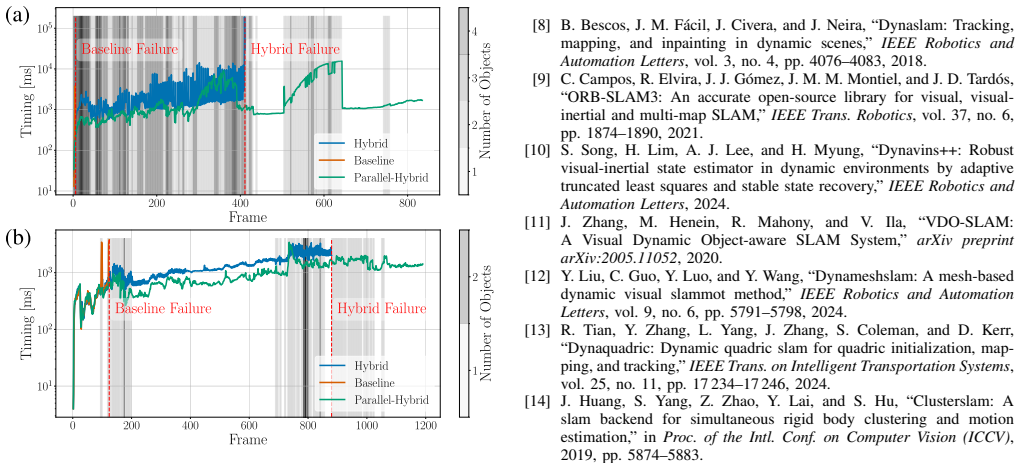
- [Section VI-C.2 and Table II] The '5x speed-up over existing methods' claim is not supported by the reported comparison. Table II shows that iBaseline fails on nearly all sequences at lambda_rs = 10 and on many sequences even at lambda_rs = 1; the 5x factor is therefore computed on a very small, non-representative subset of sequences where the baseline happens to complete. Moreover, the table shows Parallel-Hybrid is only about 2x faster than iHybrid on a number of sequences, not 5x. The paper should report per-sequence speedups and explicitly state the denominators used to compute the 5x figure, or soften the claim to 'up to 5x on sequences where the baseline completes'.
- [Section VI-C.2 and Table II] The statement that Parallel-Hybrid 'achieves an optimisation frequency of between 1 Hz to 5 Hz' is inconsistent with Table II. Many reported average update times are above 1000 ms (e.g., KITTI 00-06 at both lambda_rs settings), corresponding to less than 1 Hz. The 1-5 Hz range appears to hold for only a subset of sequences. The authors should either report the distribution of update times per sequence or revise the frequency claim to reflect the Table II data.
- [Section VI-A and Table I] The only baseline is the authors' own DynoSAM/world-centric implementation. The abstract's 'state-of-the-art' comparison is therefore not demonstrated against independent published Dynamic SLAM systems such as DynaSLAM II, VDO-SLAM, ClusterVO, or MVO. This is not a fatal flaw, because the Hybrid-vs-world-centric comparison is informative for isolating formulation effects, but the 'state-of-the-art' phrasing should be changed to 'baseline' or the authors should add comparisons to external systems.
- [Abstract and Section II-B] The claim that this is 'the first application of incremental optimisation techniques to Dynamic SLAM' is stated too strongly. Several dynamic SLAM systems use incremental back-ends (e.g., fixed-lag smoothers or iSAM2-style updates) even if they do not emphasize Bayes-tree structure. The novelty claim should be narrowed to the specific factor-graph design for incremental Dynamic SLAM, or supported by a literature review that explicitly accounts for prior incremental back-ends in dynamic SLAM.
minor comments (5)
- [Throughout] Typographical errors and wording: 'In additional to' in Section I, 'charaterise' in Section VI-C, 'homogenous' in Section III-A, and 'notated' in the Fig. 3 caption. These should be corrected.
- [Table II] The table formatting is very difficult to parse because the three method columns and the two lambda_rs values are not visually separated. Please add clear column headers and delimiters for each method and parameter setting.
- [Section VI-D] The real-world timing claim reports 'iSAM2 updates under 150 ms' but does not include frontend or tracking time. The text should clarify that this is back-end-only update time, not end-to-end online performance.
- [Section VI-C.1] The failure of iBaseline is attributed to memory exhaustion from large cliques. Reporting memory usage and the exact sequence length at failure would strengthen the scalability argument.
- [Equation (9)] The formula for W_kHe and the surrounding notation are dense and would benefit from a short derivation or a reference to the cited Chirikjian et al. work, especially because the distinction from the inverse of W_eHk is emphasized in the text.
Circularity Check
No significant circularity; the central results are empirical measurements of a proposed factor-graph design, with only minor self-citation in the baseline choice.
full rationale
The paper's core claims are empirical: the Hybrid formulation produces smaller Bayes-tree cliques, iHybrid runs faster than an incremental baseline, and Parallel-Hybrid achieves 1–5 Hz while trading away some accuracy. These are measured outcomes, not quantities derived from fitted parameters or from definitions that presuppose the conclusion. The factor-graph residuals (Eq. 7 and Eq. 11) are defined from first principles using rigid-body motion and constant-motion models; the claimed sparsity is then validated by direct Bayes-tree analysis (Section VI-C.1), not by construction. The 5× speedup is a reported timing comparison against iBaseline, not a prediction forced by a fit. The main self-citation is the use of DynoSAM [2] as the baseline, which is the authors' own prior work. This is a self-reference in the experimental comparison, but it is not load-bearing in a circular sense: the comparison still measures real algorithm behavior, and the paper's conclusions would stand or fall on those measurements regardless of who wrote the baseline. The paper also explicitly acknowledges limitations that are correctness concerns rather than circularity: Parallel-Hybrid 'performs consistently worse than the methods solved jointly' (Section VI-B) and has unidirectional information flow (Section V). These are honest trade-offs, not disguised inputs. No step in the derivation reduces to its own input by construction, so circularity is minimal.
Assumptions & free parameters
assumptions (5)
- domain assumption Dynamic objects move as rigid bodies, so all points on an object share a single SE(3) motion.
- domain assumption A constant motion model between consecutive frames is a valid prior for object motion.
- standard math The iSAM2 Bayes tree correctly and efficiently solves the linearized incremental nonlinear least squares problem.
- domain assumption The DynoSAM frontend provides reliable frame-to-frame correspondences, object segmentation, and static/dynamic classification.
- domain assumption The choice of the embedded object frame {L_e} does not affect the estimation result.
Cite this review
Pith. "Pith review of Online Dynamic SLAM with Incremental Smoothing and Mapping." pith.science (2026). https://pith.science/paper/XDDMXAVA
@misc{pith2026250908197,
  author       = {Pith},
  title        = {Pith review of: Online Dynamic SLAM with Incremental Smoothing and Mapping},
  year         = {2026},
  howpublished = {\url{https://pith.science/paper/XDDMXAVA}},
  note         = {Machine review of arXiv:2509.08197}
}
read the original abstract
Dynamic SLAM methods jointly estimate for the static and dynamic scene components, however existing approaches, while accurate, are computationally expensive and unsuitable for online applications. In this work, we present the first application of incremental optimisation techniques to Dynamic SLAM. We introduce a novel factor-graph formulation and system architecture designed to take advantage of existing incremental optimisation methods and support online estimation. On multiple datasets, we demonstrate that our method achieves equal to or better than state-of-the-art in camera pose and object motion accuracy. We further analyse the structural properties of our approach to demonstrate its scalability and provide insight regarding the challenges of solving Dynamic SLAM incrementally. Finally, we show that our formulation results in problem structure well-suited to incremental solvers, while our system architecture further enhances performance, achieving a 5x speed-up over existing methods.
Figures


Figures from the paper (5 more)


Reference graph
Works this paper leans on
-
[1]
Multimotion Visual Odometry (MVO),
K. M. Judd and J. D. Gammell, “Multimotion Visual Odometry (MVO),”Intl. J. of Robotics Research, 2024
2024
-
[2]
Dynosam: Open-source smoothing and mapping framework for dynamic slam,
J. Morris, Y . Wang, M. Kliniewski, and V . Ila, “Dynosam: Open-source smoothing and mapping framework for dynamic slam,”arXiv preprint arXiv:2501.11893, 2025
arXiv 2025
-
[3]
isam: Incremental smoothing and mapping,
M. Kaess, A. Ranganathan, and F. Dellaert, “isam: Incremental smoothing and mapping,”IEEE Transactions on Robotics, vol. 24, no. 6, pp. 1365–1378, 2008
work page 2008
-
[4]
isam2: Incremental smoothing and mapping using the bayes tree,
M. Kaess, H. Johannsson, R. Roberts, V . Ila, J. J. Leonard, and F. Dellaert, “isam2: Incremental smoothing and mapping using the bayes tree,”Intl. J. of Robotics Research, vol. 31, no. 2, pp. 216–235, 2012
work page 2012
-
[5]
Factor graphs for robot perception,
F. Dellaert, M. Kaess,et al., “Factor graphs for robot perception,” Foundations and Trends® in Robotics, vol. 6, no. 1-2, pp. 1–139, 2017
work page 2017
-
[6]
Dynaslam ii: Tightly-coupled multi-object tracking and slam,
B. Bescos, C. Campos, J. D. Tard ´os, and J. Neira, “Dynaslam ii: Tightly-coupled multi-object tracking and slam,”IEEE Robotics and Automation Letters, vol. 6, no. 3, pp. 5191–5198, 2021
2021
-
[7]
The importance of coordinate frames in dynamic slam,
J. Morris, Y . Wang, and V . Ila, “The importance of coordinate frames in dynamic slam,” inProc. of the IEEE Intl. Conf. on Robotics and Automation (ICRA), 2024
2024
-
[8]
Dynaslam: Tracking, mapping, and inpainting in dynamic scenes,
B. Bescos, J. M. F ´acil, J. Civera, and J. Neira, “Dynaslam: Tracking, mapping, and inpainting in dynamic scenes,”IEEE Robotics and Automation Letters, vol. 3, no. 4, pp. 4076–4083, 2018
work page 2018
Show all 29 references
-
[9]
ORB-SLAM3: An accurate open-source library for visual, visual- inertial and multi-map SLAM,
C. Campos, R. Elvira, J. J. G ´omez, J. M. M. Montiel, and J. D. Tard´os, “ORB-SLAM3: An accurate open-source library for visual, visual- inertial and multi-map SLAM,”IEEE Trans. Robotics, vol. 37, no. 6, pp. 1874–1890, 2021
2021
-
[10]
Dynavins++: Robust visual-inertial state estimator in dynamic environments by adaptive truncated least squares and stable state recovery,
S. Song, H. Lim, A. J. Lee, and H. Myung, “Dynavins++: Robust visual-inertial state estimator in dynamic environments by adaptive truncated least squares and stable state recovery,”IEEE Robotics and Automation Letters, 2024
2024
-
[11]
VDO-SLAM: A Visual Dynamic Object-aware SLAM System,
J. Zhang, M. Henein, R. Mahony, and V . Ila, “VDO-SLAM: A Visual Dynamic Object-aware SLAM System,”arXiv preprint arXiv:2005.11052, 2020
2005 arXiv
-
[12]
Dynameshslam: A mesh-based dynamic visual slammot method,
Y . Liu, C. Guo, Y . Luo, and Y . Wang, “Dynameshslam: A mesh-based dynamic visual slammot method,”IEEE Robotics and Automation Letters, vol. 9, no. 6, pp. 5791–5798, 2024
2024
-
[13]
Dynaquadric: Dynamic quadric slam for quadric initialization, map- ping, and tracking,
R. Tian, Y . Zhang, L. Yang, J. Zhang, S. Coleman, and D. Kerr, “Dynaquadric: Dynamic quadric slam for quadric initialization, map- ping, and tracking,”IEEE Trans. on Intelligent Transportation Systems, vol. 25, no. 11, pp. 17 234–17 246, 2024
2024
-
[14]
Clusterslam: A slam backend for simultaneous rigid body clustering and motion estimation,
J. Huang, S. Yang, Z. Zhao, Y . Lai, and S. Hu, “Clusterslam: A slam backend for simultaneous rigid body clustering and motion estimation,” inProc. of the Intl. Conf. on Computer Vision (ICCV), 2019, pp. 5874–5883
2019
-
[15]
Clustervo: Clustering moving instances and estimating visual odometry for self and sur- roundings,
J. Huang, S. Yang, T.-J. Mu, and S.-M. Hu, “Clustervo: Clustering moving instances and estimating visual odometry for self and sur- roundings,” inProc. of the IEEE/CVF Intl. Conf. Computer Vision and Pattern Recognition, 2020, pp. 2168–2177
2020
-
[16]
Dot: Dynamic object tracking for visual slam,
I. Ballester, A. Font ´an, J. Civera, K. H. Strobl, and R. Triebel, “Dot: Dynamic object tracking for visual slam,” inProc. of the IEEE Intl. Conf. on Robotics and Automation (ICRA), 2021, pp. 11 705–11 711
2021
-
[17]
Dynamic SLAM: The Need for Speed,
M. Henein, J. Zhang, R. Mahony, and V . Ila, “Dynamic SLAM: The Need for Speed,” inProc. of the IEEE Intl. Conf. on Robotics and Automation (ICRA), 2020, pp. 2123–2129
2020
-
[18]
Pose changes from a different point of view,
G. S. Chirikjian, R. Mahony, S. Ruan, and J. Trumpf, “Pose changes from a different point of view,” inProc. of the ASME Intl. Design Engineering Technical Conf. (IDETC). ASME, 2017
2017
-
[19]
Kimera: an open- source library for real-time metric-semantic localization and mapping,
A. Rosinol, M. Abate, Y . Chang, and L. Carlone, “Kimera: an open- source library for real-time metric-semantic localization and mapping,” inProc. of the IEEE Intl. Conf. on Robotics and Automation (ICRA), 2020
2020
-
[20]
Svo: Semidirect visual odometry for monocular and multicamera systems,
C. Forster, Z. Zhang, M. Gassner, M. Werlberger, and D. Scaramuzza, “Svo: Semidirect visual odometry for monocular and multicamera systems,”IEEE Trans. Robotics, vol. 33, no. 2, pp. 249–265, 2017
2017
-
[21]
Lio-sam: Tightly-coupled lidar inertial odometry via smoothing and mapping,
T. Shan, B. Englot, D. Meyers, W. Wang, C. Ratti, and D. Rus, “Lio-sam: Tightly-coupled lidar inertial odometry via smoothing and mapping,” inProc. of the IEEE/RSJ Intl. Conf. on Intelligent Robots and Systems (IROS), 2020, pp. 5135–5142
2020
-
[22]
The bayes tree: An algorithmic foundation for probabilistic robot mapping,
M. Kaess, V . Ila, R. Roberts, and F. Dellaert, “The bayes tree: An algorithmic foundation for probabilistic robot mapping,” inAlgorith- mic Foundations of Robotics IX: Selected Contributions of the Ninth International Workshop on the Algorithmic Foundations of Robotics. Sprin...
2010
-
[23]
Mr-isam2: Incremental smoothing and mapping with multi-root bayes tree for multi-robot slam,
Y . Zhang, M. Hsiao, J. Dong, J. Engel, and F. Dellaert, “Mr-isam2: Incremental smoothing and mapping with multi-root bayes tree for multi-robot slam,” inIROS. IEEE, 2021, pp. 8671–8678
2021
-
[24]
Twistslam: Constrained slam in dynamic environment,
M. Gonzalez, E. Marchand, A. Kacete, and J. Royan, “Twistslam: Constrained slam in dynamic environment,”IEEE Robotics and Au- tomation Letters, vol. 7, no. 3, pp. 6846–6853, 2022
2022
-
[25]
Vision meets robotics: The KITTI dataset,
A. Geiger, P. Lenz, C. Stiller, and R. Urtasun, “Vision meets robotics: The KITTI dataset,”Intl. J. of Robotics Research, vol. 32, no. 11, pp. 1231–1237, 2013
2013
-
[26]
The Oxford Multimotion Dataset: Multiple SE(3) Motions with Ground Truth,
K. M. Judd and J. D. Gammell, “The Oxford Multimotion Dataset: Multiple SE(3) Motions with Ground Truth,”IEEE Robotics and Automation Letters, vol. 4, no. 2, pp. 800–807, 2019
2019
-
[27]
Airdos: Dynamic slam benefits from articulated objects,
Y . Qiu, C. Wang, W. Wang, M. Henein, and S. Scherer, “Airdos: Dynamic slam benefits from articulated objects,” inProc. of the IEEE Intl. Conf. on Robotics and Automation (ICRA), 2022, pp. 8047–8053
2022
-
[28]
Viode: A simulated dataset to address the challenges of visual-inertial odometry in dynamic environments,
K. Minoda, F. Schilling, V . W¨uest, D. Floreano, and T. Yairi, “Viode: A simulated dataset to address the challenges of visual-inertial odometry in dynamic environments,”IEEE Robotics and Automation Letters, vol. 6, no. 2, pp. 1343–1350, 2021
2021
-
[29]
borglab/gtsam,
F. Dellaert and GTSAM Contributors, “borglab/gtsam,” May 2022. [Online]. Available: https://github.com/borglab/gtsam
2022
Reviewed August 4, 2026 · model on record in the stance chip above.
Discussion (0). Continue with ORCID to comment.