REVIEW 1 major objections 6 minor 70 references
CME Observations -- from Sun to Impact on Geospace
T0 review · 1 major / 6 minor · reviewed 2026-08-10 · deepseek-v4-flash
Pith's one-line read A review of CME observations argues that the structured solar wind, not the ejection itself, controls how coronal mass ejections expand, arrive, and disturb Earth's magnetosphere.
desk verdict A competent, clearly written short review by an expert; no new science, but a useful updated synthesis, needing small fixes (placeholder citation, hedged 47% statistic). read the letter →
The pith
A machine-rendered reading of the paper's core claim, the machinery that carries it, and where it could break.
The reading
What carries the argument
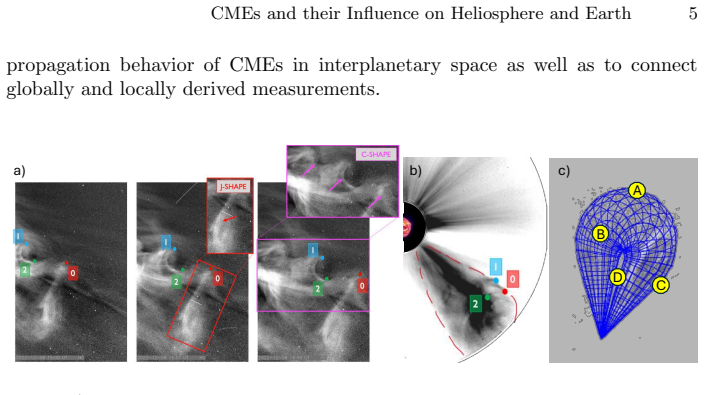
The central object is the coronal mass ejection itself, treated as an expanding magnetic plasma structure with two distinguishable parts: the shock-sheath, a high-pressure turbulent region ahead of the ejecta, and the magnetic ejecta, the flux-rope-like body whose southward magnetic field component anti-parallel to Earth's field drives magnetospheric reconnection. The argument is carried by the observational chain that links these parts across scales: EUV dimming and radio bursts mark eruption and opening field lines; white-light coronagraphs and wide-field imagers track the CME's global shape and internal small-scale structures; in-situ spacecraft sample its local plasma and field; and multi-spacecraft triangulation connects the global to the local. The 47% size-increase statistic from Larrodera and Temmer (2024) provides the quantitative backbone for claims about expansion, while the WISPR blob observations from Cappello et al. (2024) provide the interaction evidence.
What would settle it
A denser sample of CMEs beyond 1.5 AU, from missions such as Solar Orbiter and Parker Solar Probe, that failed to reproduce the ~47% size increase or showed sheath-less CMEs not doubling in size would refute the expansion narrative. Likewise, if in-situ measurements of the rear portions of CMEs found no density or field enhancements corresponding to the WISPR blobs, the interaction interpretation would collapse.
Extended reading notes
Core claim
On its own terms, the paper's central claim is a connected picture: CMEs are born from magnetic reconnection in active regions, expand and interact as they travel through stream interaction regions, high-speed streams, and other CMEs, and their impact on geospace is set by the magnetic field and plasma they deliver to Earth's magnetosphere. Within this synthesis, the review presents two concrete observational results as load-bearing. First, a statistical study of more than 2000 CMEs from 1975 to 2022 shows that CME magnetic obstacles grow roughly 47% in size from the inner heliosphere to 1 AU, with the strongest growth near 0.75 AU and no sheaths observed beyond 1.5 AU. Second, small blob-like density structures seen in WISPR images at the rear of a CME are interpreted as direct evidence of CME–solar wind interaction. The review also emphasizes that the open magnetic flux measured in situ exceeds the flux traced to solar coronal holes by about a factor of two, which points to missing polar field information as the key limitation of current background solar wind models.
Load-bearing premise
The review's synthesis depends on recent observational statistics being representative, especially the finding that CME size increases about 47% by 1 AU and the interpretation that blob-like WISPR structures reveal CME–solar wind interaction, both resting on small samples in the outer heliosphere and on visual inspection of images.
Editorial extensions
If this is right
- Space weather forecast models should treat CME expansion as a continuous process tied to distance, with the strongest growth around 0.75 AU, and should separate shock-sheath arrival from magnetic ejecta arrival to predict storm onset versus main phase.
- The systematic underestimate of open magnetic flux by a factor of two implies that operational solar wind models will keep misrepresenting background conditions until polar magnetic field observations are assimilated; solar polar orbits starting in 2026 should be used for this.
- If blob-like structures in WISPR images are genuine interaction tracers, they can be used to validate and improve Sun-to-Earth CME tracking in real time.
- The review's cascade model from magnetosphere to ionosphere to thermosphere suggests that LEO satellite drag forecasts depend on getting the CME's magnetic field orientation right, not just its arrival time.
Reading between the lines
- A testable corollary the author does not state: if the 47% size increase is real, it should appear as a systematic bias in any CME arrival-time model that assumes self-similar expansion; checking historical model errors against distance would isolate this term.
- The magnetosheath jet modulation result could be extended: jet occurrence rate may serve as an independent, in-situ early indicator of CME sheaths before the ejecta arrives, potentially improving storm warnings.
- Because the review identifies the background solar wind as the weak link, a concrete next experiment is to run the same CME ensemble through models with and without polar field corrections once Solar Orbiter data are available, and compare transit-time forecast skill.
- The blob-tracing idea invites a multi-spacecraft campaign where WISPR images from one viewpoint are matched against in-situ measurements from another spacecraft crossing the same rear CME region; a positive match would strengthen the interaction interpretation beyond visual inspection.
Editorial analysis
A structured set of objections, weighed in public.
Referee Report
Summary. This paper is a concise review by Manuela Temmer that surveys CME observations from solar origins to geospace impact. It covers source-region signatures (flares, EUV dimming, radio bursts), CME structural components (shock-sheath and magnetic ejecta), propagation and expansion through the heliosphere (including a recent statistical result that CME size increases by about 47% to 1 AU), and the resulting effects on the magnetosphere, ionosphere, and thermosphere. The review also highlights open questions and the role of PSP and Solar Orbiter.
Significance. If accurate, this is a useful and current synthesis for a broad space-weather audience, including students and researchers entering the field. The author successfully compresses a complex chain of phenomena into a short review, and the paper benefits from her expertise and from the inclusion of very recent results from PSP and SolO. The specific quantitative claims are attributed to the original literature, and the author's reliance on her own prior publications is appropriate here because those results are externally peer-reviewed and are not used to prove anything new. The main risk to the review's trustworthiness is the presentation of the ~47% size-increase statistic without uncertainty or independent confirmation, which is discussed in the major comments.
major comments (1)
- [Section 5 and Figure 3] The statement that CMEs with and without sheaths increase in size from the inner heliosphere to 1 AU by about 47% is a key quantitative anchor for the propagation narrative, but the review provides no uncertainty, per-bin sample sizes, or independent corroboration for this figure. Given that the review itself notes the outer-heliosphere sample is small, the reader cannot assess the robustness of this statistic. Please either report the confidence interval or standard error from Larrodera and Temmer (2024) or add a sentence explicitly flagging that this is a single-study estimate that awaits independent confirmation.
minor comments (6)
- [Bibliography (Bruinsma et al.)] The entry for Bruinsma et al. (2023) contains placeholder authors "Author A, Author B" and an incomplete reference; it must be completed or removed before publication.
- [Section 2 (Solar Orbiter citation)] The citation "Solar Orbiter (SolO; Müller et al, 2017)" does not match the referenced paper, which describes JHelioviewer; please cite the correct Solar Orbiter mission publication (e.g., Müller et al. 2020, A&A, 642, A1).
- [Section 4 and Bibliography (Cappello et al.)] Cappello et al. (2024) is cited in the text as "revealed" but is listed as an arXiv preprint; if it has been accepted for publication, update the reference, otherwise soften "revealed" to "suggested" or explicitly note it is a preprint.
- [Figure 3] Please consider adding error bars or sample sizes to Figure 3, or refer the reader to the original study for uncertainties, as the figure currently gives no indication of statistical scatter.
- [Section 1 and Bibliography (Temmer et al. 2023)] The text refers to the "COSPAR Space Weather Roadmap update by Temmer et al, 2023," but the bibliography entry for Temmer et al. (2023) is about CME propagation; please ensure the citation and the reference correspond to the intended work.
- [Bibliography (Koller et al. 2022)] The DOI in the Koller et al. (2022) entry appears to be a concatenation of two identifiers; please correct the DOI.
Circularity Check
No significant circularity: this review synthesizes published, externally refereed results rather than deriving claims from its own inputs; the self-cited 47% size-increase statistic is reported as external evidence, not fitted or predicted here.
full rationale
This manuscript is a review article, so it contains no derivation chain of the kind that can be circular: it does not define a quantity in terms of another quantity and then 'predict' that quantity, nor does it fit parameters to data and rename the fit as a prediction. The load-bearing quantitative statement in Section 5—that CMEs with and without sheaths increase in size by about 47% from the inner heliosphere to 1 AU—is presented as a citation to Larrodera and Temmer (2024), an externally published statistical study, with the review itself flagging the small outer-heliosphere sample ('the data sample is rather low for the outer heliosphere'). Reporting a peer-reviewed statistical result in a review is not circular; the review adds no new derivation that reduces to its inputs. Likewise, the WISPR blob interpretation in Section 4 cites Cappello et al. (2024) and is explicitly softened with 'might'; even if that work is an arXiv e-print, a pre-publication citation is a robustness concern, not a circularity. Several citations are to the author's own prior work, but none is used to forbid alternatives, to supply a uniqueness theorem, or to justify a premise solely by self-assertion; the central claims about CME behavior and geospace impact are independently supported by the cited literature. Therefore no circular steps are identified.
Assumptions & free parameters
assumptions (3)
- domain assumption CMEs are coherent, magnetized plasma structures that propagate through the heliosphere.
- domain assumption In-situ spacecraft measurements accurately sample the local solar wind and CME plasma.
- domain assumption Remote-sensing proxies (EUV dimming, type II/III radio bursts, white-light imaging) reliably identify eruptive solar activity and CME properties.
Cite this review
Pith. "Pith review of CME Observations -- from Sun to Impact on Geospace." pith.science (2026). https://pith.science/paper/XDHUW3RW
@misc{pith2026250111345,
  author       = {Pith},
  title        = {Pith review of: CME Observations -- from Sun to Impact on Geospace},
  year         = {2026},
  howpublished = {\url{https://pith.science/paper/XDHUW3RW}},
  note         = {Machine review of arXiv:2501.11345}
}
read the original abstract
Our Sun is an active star expelling dynamic phenomena known as coronal mass ejections (CMEs). The magnetic field configuration on the Sun and related solar wind structures affect the propagation behavior of CMEs, dominate its transit time and embedded magnetic field properties when impacting Earth. Since the conditions on the Sun constantly change, the impact of CMEs on the different regimes of geospace is quite variable and may differ significantly from event to event. This short review summarizes the different manifestations of CMEs on the Sun, their appearance in interplanetary space, and how CMEs trigger a cascade of reactions as they interact with Earth.
Figures


Reference graph
Works this paper leans on
-
[1]
write newline
" write newline "" before.all 'output.state := FUNCTION n.dashify 't := "" t empty not t #1 #1 substring "-" = t #1 #2 substring "--" = not "--" * t #2 global.max substring 't := t #1 #1 substring "-" = "-" * t #2 global.max substring 't := while if t #1 #1 substring * t #2 global.max substring 't := if while FUNCTION format.date year duplicate empty "emp...
-
[2]
, " * write output.state after.block = add.period write newline
ENTRY address archive author booktitle chapter doi edition editor eid eprint howpublished institution journal key month note number organization pages publisher school series title type url volume year label extra.label sort.label short.list INTEGERS output.state before.all mid.sentence after.sentence after.block FUNCTION init.state.consts #0 'before.all ...
-
[3]
write newline
" write newline "" before.all 'output.state := FUNCTION add.period duplicate empty 'skip "." * add.blank if FUNCTION if.digit duplicate "0" = swap duplicate "1" = swap duplicate "2" = swap duplicate "3" = swap duplicate "4" = swap duplicate "5" = swap duplicate "6" = swap duplicate "7" = swap duplicate "8" = swap "9" = or or or or or or or or or FUNCTION ...
-
[4]
, " * write output.state after.block = add.period write newline
ENTRY address author booktitle chapter doi edition editor eid howpublished institution journal key month note number organization pages publisher school series title type url volume year label INTEGERS output.state before.all mid.sentence after.sentence after.block FUNCTION init.state.consts #0 'before.all := #1 'mid.sentence := #2 'after.sentence := #3 '...
-
[5]
write newline
" write newline "" before.all 'output.state := FUNCTION if.digit duplicate "0" = swap duplicate "1" = swap duplicate "2" = swap duplicate "3" = swap duplicate "4" = swap duplicate "5" = swap duplicate "6" = swap duplicate "7" = swap duplicate "8" = swap "9" = or or or or or or or or or FUNCTION n.separate 't := "" #0 'numnames := t empty not t #-1 #1 subs...
-
[6]
, " * write output.state after.block = add.period write
ENTRY address author booktitle chapter edition editor eid howpublished institution journal key month note number organization pages publisher school series title type url volume year label INTEGERS output.state before.all mid.sentence after.sentence after.block FUNCTION init.state.consts #0 'before.all := #1 'mid.sentence := #2 'after.sentence := #3 'afte...
-
[7]
write newline
" write newline "" before.all 'output.state := FUNCTION n.dashify 't := "" t empty not t #1 #1 substring "-" = t #1 #2 substring "--" = not "--" * t #2 global.max substring 't := t #1 #1 substring "-" = "-" * t #2 global.max substring 't := while if t #1 #1 substring * t #2 global.max substring 't := if while FUNCTION word.in bbl.in capitalize ":" * " " *...
-
[8]
write newline
" write newline "" before.all 'output.state := FUNCTION n.dashify 't := "" t empty not t #1 #1 substring "-" = t #1 #2 substring "--" = not "--" * t #2 global.max substring 't := t #1 #1 substring "-" = "-" * t #2 global.max substring 't := while if t #1 #1 substring * t #2 global.max substring 't := if while FUNCTION word.in bbl.in capitalize ":" * " " *...
Show all 70 references
-
[9]
write newline
" write newline "" before.all 'output.state := FUNCTION fin.entry write newline FUNCTION new.block output.state before.all = 'skip after.block 'output.state := if FUNCTION stupid.colon after.authors 'output.state := FUNCTION insert.comma output.state before.all = 'skip between...
-
[10]
, " * write output.state after.block = add.period write newline
ENTRY address author booktitle chapter doi edition editor eid howpublished institution journal key month note number organization pages publisher school series title type url volume year label INTEGERS output.state before.all mid.sentence after.sentence after.block FUNCTION in...
-
[11]
write newline
" write newline "" before.all 'output.state := FUNCTION if.digit duplicate "0" = swap duplicate "1" = swap duplicate "2" = swap duplicate "3" = swap duplicate "4" = swap duplicate "5" = swap duplicate "6" = swap duplicate "7" = swap duplicate "8" = swap "9" = or or or or or or...
-
[12]
write newline
" write newline "" before.all 'output.state := FUNCTION if.digit duplicate "0" = swap duplicate "1" = swap duplicate "2" = swap duplicate "3" = swap duplicate "4" = swap duplicate "5" = swap duplicate "6" = swap duplicate "7" = swap duplicate "8" = swap "9" = or or or or or or...
-
[13]
write newline
" write newline "" before.all 'output.state := FUNCTION add.period duplicate empty 'skip "." * add.blank if FUNCTION if.digit duplicate "0" = swap duplicate "1" = swap duplicate "2" = swap duplicate "3" = swap duplicate "4" = swap duplicate "5" = swap duplicate "6" = swap dupl...
-
[14]
(2011) Impulsive Acceleration of Coronal Mass Ejections
Bein BM, Berkebile-Stoiser S, Veronig AM, et al. (2011) Impulsive Acceleration of Coronal Mass Ejections. I. Statistics and Coronal Mass Ejection Source Region Characteristics . 738(2):191, doi:10.1088/0004-637X/738/2/191, 1108.0561
2011 arXiv
-
[15]
(2009) A World-Wide Net of Solar Radio Spectrometers: e-CALLISTO
Benz AO, Monstein C, Meyer H, et al. (2009) A World-Wide Net of Solar Radio Spectrometers: e-CALLISTO . Earth Moon and Planets 104(1-4):277--285, doi:10.1007/s11038-008-9267-6
2009 doi
-
[16]
under review
Bruinsma S, Author A, Author B (2023) Cluster g: G2a summary and ti2 cluster paper - on atmospheric variability. under review
2023
-
[17]
88:563--601, doi:10.1023/A:1005107532631
Buonsanto MJ (1999) Ionospheric Storms A Review . 88:563--601, doi:10.1023/A:1005107532631
1999 doi
-
[18]
Journal of Geoph
Burlaga LF, Plunkett SP, St Cyr OC (2002) Successive CMEs and complex ejecta . Journal of Geoph. Res. (Space Physics) 107(A10):1266, doi:10.1029/2001JA000255
2002 doi
-
[19]
(2024) Internal magnetic field structures observed by PSP/WISPR in a filament related coronal mass ejection
Cappello GM, Temmer M, Vourlidas A, et al. (2024) Internal magnetic field structures observed by PSP/WISPR in a filament related coronal mass ejection . arXiv e-prints arXiv:2402.14682, doi:10.48550/arXiv.2402.14682, 2402.14682
-
[20]
A case study of the 28 October 2021 X1.0 event
Chikunova G, Podladchikova T, Dissauer K, Veronig AM, Dumbovi \'c M, Temmer M, Dickson ECM (2023) Three-dimensional relation between coronal dimming, filament eruption, and CME. A case study of the 28 October 2021 X1.0 event . 678:A166, doi:10.1051/0004-6361/202347011, 2308.09815
2023 arXiv
-
[21]
Dissauer K, Veronig AM, Temmer M, Podladchikova T, Vanninathan K (2018) Statistics of Coronal Dimmings Associated with Coronal Mass Ejections. I. Characteristic Dimming Properties and Flare Association . 863(2):169, doi:10.3847/1538-4357/aad3c6, 1807.05056
2018 arXiv
-
[22]
(2015) Geoeffectiveness of Coronal Mass Ejections in the SOHO Era
Dumbovi \'c M, Devos A, Vr s nak B, et al. (2015) Geoeffectiveness of Coronal Mass Ejections in the SOHO Era . 290(2):579--612, doi:10.1007/s11207-014-0613-8, 1410.3303
2015 arXiv
-
[23]
Journal of Geoph
Farrugia CJ, Jordanova VK, Thomsen MF, Lu G, Cowley SWH, Ogilvie KW (2006) A two-ejecta event associated with a two-step geomagnetic storm . Journal of Geoph. Res. (Space Physics) 111(A11):A11104, doi:10.1029/2006JA011893
2006 doi
-
[24]
(2016) The Solar Probe Plus Mission: Humanity's First Visit to Our Star
Fox NJ, Velli MC, Bale SD, et al. (2016) The Solar Probe Plus Mission: Humanity's First Visit to Our Star . 204(1-4):7--48, doi:10.1007/s11214-015-0211-6
2016 doi
-
[25]
Atmosphere 13(11):1781, doi:10.3390/atmos13111781, 2211.06775
Gopalswamy N (2022) The Sun and Space Weather . Atmosphere 13(11):1781, doi:10.3390/atmos13111781, 2211.06775
2022 arXiv
-
[26]
Gopalswamy N, Yashiro S, Kaiser ML, Howard RA, Bougeret JL (2001) Radio Signatures of Coronal Mass Ejection Interaction: Coronal Mass Ejection Cannibalism? 548(1):L91--L94, doi:10.1086/318939
2001 doi
-
[27]
(2008) Coronal mass ejections, type II radio bursts, and solar energetic particle events in the SOHO era
Gopalswamy N, Yashiro S, Akiyama S, et al. (2008) Coronal mass ejections, type II radio bursts, and solar energetic particle events in the SOHO era . Annales Geophysicae 26(10):3033--3047, doi:10.5194/angeo-26-3033-2008
2008 doi
-
[28]
Journal of Geoph
Gopalswamy N, M \"a kel \"a P, Xie H, Akiyama S, Yashiro S (2009) CME interactions with coronal holes and their interplanetary consequences . Journal of Geoph. Res. (Space Physics) 114(A3):A00A22, doi:10.1029/2008JA013686
2009 doi
-
[29]
96(A5):7831--7839, doi:10.1029/91JA00316
Gosling JT, McComas DJ, Phillips JL, Bame SJ (1991) Geomagnetic activity associated with earth passage of interplanetary shock disturbances and coronal mass ejections . 96(A5):7831--7839, doi:10.1029/91JA00316
1991 doi
-
[30]
214(1):46, doi:10.1007/s11214-017-0462-5, 1801.04608
Green LM, T \"o r \"o k T, Vr s nak B, Manchester W, Veronig A (2018) The Origin, Early Evolution and Predictability of Solar Eruptions . 214(1):46, doi:10.1007/s11214-017-0462-5, 1801.04608
2018 arXiv
-
[31]
(2012) An Analysis of the Origin and Propagation of the Multiple Coronal Mass Ejections of 2010 August 1
Harrison RA, Davies JA, M \"o stl C, et al. (2012) An Analysis of the Origin and Propagation of the Multiple Coronal Mass Ejections of 2010 August 1 . 750(1):45, doi:10.1088/0004-637X/750/1/45
2012 doi
-
[32]
(2024) On the Origin of the Sudden Heliospheric Open Magnetic Flux Enhancement During the 2014 Pole Reversal
Heinemann SG, Owens MJ, Temmer M, et al. (2024) On the Origin of the Sudden Heliospheric Open Magnetic Flux Enhancement During the 2014 Pole Reversal . 965(2):151, doi:10.3847/1538-4357/ad2b69, 2402.12805
2024 arXiv
-
[33]
123(3):1738--1753, doi:10.1002/2017JA024586, 1804.09579
Hofmeister SJ, Veronig A, Temmer M, Vennerstrom S, Heber B, Vr s nak B (2018) The Dependence of the Peak Velocity of High-Speed Solar Wind Streams as Measured in the Ecliptic by ACE and the STEREO satellites on the Area and Co-latitude of Their Solar Source Coronal Holes . 123...
2018 arXiv
-
[34]
(2019) Generic Magnetic Field Intensity Profiles of Interplanetary Coronal Mass Ejections at Mercury, Venus, and Earth From Superposed Epoch Analyses
Janvier M, Winslow RM, Good S, et al. (2019) Generic Magnetic Field Intensity Profiles of Interplanetary Coronal Mass Ejections at Mercury, Venus, and Earth From Superposed Epoch Analyses . Journal of Geoph. Res. (Space Physics) 124(2):812--836, doi:10.1029/2018JA025949, 1901.09921
2019 arXiv
-
[35]
14(1):5, doi:10.1007/s41116-017-0009-6
Kilpua E, Koskinen HEJ, Pulkkinen TI (2017) Coronal mass ejections and their sheath regions in interplanetary space . 14(1):5, doi:10.1007/s41116-017-0009-6
2017 doi
-
[36]
224(1-2):495, doi:10.1007/s11207-005-6393-4
Knipp DJ, Tobiska WK, Emery BA (2004) Direct and Indirect Thermospheric Heating Sources for Solar Cycles 21-23 . 224(1-2):495, doi:10.1007/s11207-005-6393-4
2004 doi
-
[37]
(2022) Magnetosheath Jet Occurrence Rate in Relation to CMEs and SIRs
Koller F, Temmer M, Preisser L, et al. (2022) Magnetosheath Jet Occurrence Rate in Relation to CMEs and SIRs . Journal of Geoph. Res. (Space Physics) 127(4):e30124, doi:10.1029/2021JA03012410.1002/essoar.10508761.2
2022
-
[38]
964(1):L5, doi:10.3847/2041-8213/ad2ddf
Koller F, Raptis S, Temmer M, Karlsson T (2024) The Effect of Fast Solar Wind on Ion Distribution Downstream of Earth's Bow Shock . 964(1):L5, doi:10.3847/2041-8213/ad2ddf
2024 doi
-
[39]
Journal of Geoph
Krauss S, Temmer M, Veronig A, Baur O, Lammer H (2015) Thermospheric and geomagnetic responses to interplanetary coronal mass ejections observed by ACE and GRACE: Statistical results . Journal of Geoph. Res. (Space Physics) 120(10):8848--8860, doi:10.1002/2015JA021702, 1510.03549
2015 arXiv
-
[40]
685:A89, doi:10.1051/0004-6361/202348641, 2402.16653
Larrodera C and Temmer M (2024) Evolution of coronal mass ejections with and without sheaths from the inner to the outer heliosphere: Statistical investigation for 1975 to 2022 . 685:A89, doi:10.1051/0004-6361/202348641, 2402.16653
2024 arXiv
-
[41]
848(1):70, doi:10.3847/1538-4357/aa8a70, 1708.02342
Linker JA, Caplan RM, Downs C, Riley P, Mikic Z, Lionello R, Henney CJ, Arge CN, Liu Y, Derosa ML, Yeates A, Owens MJ (2017) The Open Flux Problem . 848(1):70, doi:10.3847/1538-4357/aa8a70, 1708.02342
2017 arXiv
-
[42]
(2021) Coronal Hole Detection and Open Magnetic Flux
Linker JA, Heinemann SG, Temmer M, et al. (2021) Coronal Hole Detection and Open Magnetic Flux . 918(1):21, doi:10.3847/1538-4357/ac090a, 2103.05837
2021 arXiv
-
[43]
(2014) Observations of an extreme storm in interplanetary space caused by successive coronal mass ejections
Liu YD, Luhmann JG, Kajdi c P, et al. (2014) Observations of an extreme storm in interplanetary space caused by successive coronal mass ejections . Nature Communications 5:3481, doi:10.1038/ncomms4481, 1405.6088
2014 arXiv
-
[44]
Solar Physics 292(4), doi:10.1007/s11207-017-1091-6, ://dx.doi.org/10.1007/s11207-017-1091-6, 1612.02398
Lugaz N, Temmer M, Wang Y, Farrugia CJ (2017) The Interaction of Successive Coronal Mass Ejections: A Review . Solar Physics 292(4), doi:10.1007/s11207-017-1091-6, ://dx.doi.org/10.1007/s11207-017-1091-6, 1612.02398
2017 arXiv
-
[45]
295(4):61, doi:10.1007/s11207-020-01624-0
Luhmann JG, Gopalswamy N, Jian LK, Lugaz N (2020) ICME Evolution in the Inner Heliosphere . 295(4):61, doi:10.1007/s11207-020-01624-0
2020 doi
-
[46]
(2017) JHelioviewer
M \"u ller D, Nicula B, Felix S, et al. (2017) JHelioviewer. Time-dependent 3D visualisation of solar and heliospheric data . 606:A10, doi:10.1051/0004-6361/201730893, 1705.07628
2017 arXiv
-
[47]
10(1):5, doi:10.12942/lrsp-2013-5
Owens MJ, Forsyth RJ (2013) The Heliospheric Magnetic Field . 10(1):5, doi:10.12942/lrsp-2013-5
2013 doi
-
[48]
(2020) Decoding the pre-eruptive magnetic field configurations of coronal mass ejections
Patsourakos S, Vourlidas A, Török T, et al. (2020) Decoding the pre-eruptive magnetic field configurations of coronal mass ejections. Space Science Reviews 216(8):131, doi:10.1007/s11214-020-00757-9
2020 doi
-
[49]
(2018) Jets Downstream of Collisionless Shocks
Plaschke F, Hietala H, Archer M, et al. (2018) Jets Downstream of Collisionless Shocks . 214(5):81, doi:10.1007/s11214-018-0516-3
2018 doi
-
[50]
(2017) Geomagnetically induced currents: Science, engineering, and applications readiness
Pulkkinen A, Bernabeu E, Thomson A, et al. (2017) Geomagnetically induced currents: Science, engineering, and applications readiness . Space Weather 15(7):828--856, doi:10.1002/2016SW001501
2017 doi
-
[51]
175(1-4):53--92, doi:10.1007/s11214-013-9958-9, 1306.3608
Reames DV (2013) The Two Sources of Solar Energetic Particles . 175(1-4):53--92, doi:10.1007/s11214-013-9958-9, 1306.3608
2013 arXiv
-
[52]
15(2-3):205--266, doi:10.1007/BF00169321
Russell CT, McPherron RL (1973) The Magnetotail and Substorms . 15(2-3):205--266, doi:10.1007/BF00169321
1973 doi
-
[53]
50(5-6):527--534, doi:10.1016/S0032-0633(02)00031-4
Russell CT, Mulligan T (2002) On the magnetosheath thicknesses of interplanetary coronal mass ejections . 50(5-6):527--534, doi:10.1016/S0032-0633(02)00031-4
2002 doi
-
[54]
921(1):57, doi:10.3847/1538-4357/ac11f3, 2106.12076
Salman TM, Lugaz N, Winslow RM, Farrugia CJ, Jian LK, Galvin AB (2021) Categorization of Coronal Mass Ejection-driven Sheath Regions: Characteristics of STEREO Events . 921(1):57, doi:10.3847/1538-4357/ac11f3, 2106.12076
2021 arXiv
-
[55]
540(1):583--587, doi:10.1086/309303
Sammis I, Tang F, Zirin H (2000) The Dependence of Large Flare Occurrence on the Magnetic Structure of Sunspots . 540(1):583--587, doi:10.1086/309303
2000 doi
-
[56]
(2020) CME–CME Interactions as Sources of CME Geoeffectiveness: The Formation of the Complex Ejecta and Intense Geomagnetic Storm in 2017 Early September
Scolini C, Chan \' e E, Temmer M, et al. (2020) CME–CME Interactions as Sources of CME Geoeffectiveness: The Formation of the Complex Ejecta and Intense Geomagnetic Storm in 2017 Early September . The Astrophysical Journal Supplement Series 247(1):21, doi:10.3847/1538-4365/ab6...
2020 arXiv
-
[57]
113(A9):A00B07, doi:10.1029/2008JA013142
Siscoe G, Odstrcil D (2008) Ways in which ICME sheaths differ from magnetosheaths . 113(A9):A00B07, doi:10.1029/2008JA013142
2008 doi
-
[58]
18(1):4, doi:10.1007/s41116-021-00030-3, 2104.04261
Temmer M (2021) Space weather: the solar perspective . 18(1):4, doi:10.1007/s41116-021-00030-3, 2104.04261
2021 arXiv
-
[59]
673(1):L95, doi:10.1086/527414
Temmer M, Veronig AM, Vr s nak B, Ryb \'a k J, G \"o m \"o ry P, Stoiser S, Mari c i \'c D (2008) Acceleration in Fast Halo CMEs and Synchronized Flare HXR Bursts . 673(1):L95, doi:10.1086/527414
2008 doi
-
[60]
The Astrophysical Journal 835(2):1--6, doi:10.3847/1538-4357/835/2/141, ://dx.doi.org/10.3847/1538-4357/835/2/141
Temmer M, Reiss MA, Nikolic L, Hofmeister SJ, Veronig AM (2017) Preconditioning of Interplanetary Space Due to Transient CME Disturbances . The Astrophysical Journal 835(2):1--6, doi:10.3847/1538-4357/835/2/141, ://dx.doi.org/10.3847/1538-4357/835/2/141
2017 doi
-
[61]
(2023) CME Propagation Through the Heliosphere: Status and Future of Observations and Model Development
Temmer M, Scolini C, Richardson IG, et al. (2023) CME Propagation Through the Heliosphere: Status and Future of Observations and Model Development . arXiv e-prints arXiv:2308.04851, doi:10.48550/arXiv.2308.04851, 2308.04851
-
[62]
801(2):L23, doi:10.1088/2041-8205/801/2/L23, 1502.05157
Thalmann JK, Su Y, Temmer M, Veronig AM (2015) The Confined X-class Flares of Solar Active Region 2192 . 801(2):L23, doi:10.1088/2041-8205/801/2/L23, 1502.05157
2015 arXiv
-
[63]
(2004) Global dayside ionospheric uplift and enhancement associated with interplanetary electric fields
Tsurutani B, Mannucci A, Iijima B, et al. (2004) Global dayside ionospheric uplift and enhancement associated with interplanetary electric fields . Journal of Geophysical Research (Space Physics) 109(A8):A08302, doi:10.1029/2003JA010342
2004 doi
-
[64]
(2023) Space Plasma Physics: A Review
Tsurutani BT, Zank GP, Sterken VJ, et al. (2023) Space Plasma Physics: A Review . IEEE Transactions on Plasma Science 51(7):1595--1655, doi:10.1109/TPS.2022.3208906, 2209.14545
2023
-
[65]
(2012) Magnetic Topology of Active Regions and Coronal Holes: Implications for Coronal Outflows and the Solar Wind
van Driel-Gesztelyi L, Culhane JL, Baker D, et al. (2012) Magnetic Topology of Active Regions and Coronal Holes: Implications for Coronal Outflows and the Solar Wind . 281(1):237--262, doi:10.1007/s11207-012-0076-8
2012 doi
-
[66]
(2023) Quantifying errors in 3D CME parameters derived from synthetic data using white-light reconstruction techniques
Verbeke C, Mays ML, Kay K, et al. (2023) Quantifying errors in 3D CME parameters derived from synthetic data using white-light reconstruction techniques . doi:10.1016/j.asr.2022.08.056
2023 doi
-
[67]
284(1):179--201, doi:10.1007/s11207-012-0084-8, 1207.1599
Vourlidas A, Lynch BJ, Howard RA, Li Y (2013) How Many CMEs Have Flux Ropes? Deciphering the Signatures of Shocks, Flux Ropes, and Prominences in Coronagraph Observations of CMEs . 284(1):179--201, doi:10.1007/s11207-012-0084-8, 1207.1599
2013 arXiv
-
[68]
Journal of Geophysical Research: Space Physics 109, doi:10.1029/2003JA010226
Xie H, Ofman L, Lawrence G (2004) Cone model for halo CMEs: Application to space weather forecasting . Journal of Geophysical Research: Space Physics 109, doi:10.1029/2003JA010226
2004 doi
-
[69]
650(2):L143--L146, doi:10.1086/508876, astro-ph/0609197
Yashiro S, Akiyama S, Gopalswamy N, Howard RA (2006) Different Power-Law Indices in the Frequency Distributions of Flares with and without Coronal Mass Ejections . 650(2):L143--L146, doi:10.1086/508876, astro-ph/0609197
2006 arXiv
-
[70]
559(1):452--462, doi:10.1086/322405
Zhang J, Dere KP, Howard RA, Kundu MR, White SM (2001) On the Temporal Relationship between Coronal Mass Ejections and Flares . 559(1):452--462, doi:10.1086/322405
2001 doi
Reviewed August 10, 2026 · model on record in the stance chip above.
Discussion (0). Continue with ORCID to comment.