REVIEW 5 major objections 6 minor 85 references
Inverse Design of Amorphous Materials with Targeted Properties
T0 review · 5 major / 6 minor · reviewed 2026-08-04 · deepseek-v4-flash
Pith's one-line read This paper claims that a diffusion model trained on simulated amorphous structures can generate new glassy atomic configurations conditioned on target properties, and that adding Hamiltonian Monte Carlo refinement to the denoising step is w
desk verdict A serious methods paper with two genuinely new ideas—HMC-refined energy-based denoising and ghost-atom density control—but the claims are only validated within classical force-field MD, so treat the inverse-design results as proof-of-concept, not as a recipe for real glasses. read the letter →
The pith
A machine-rendered reading of the paper's core claim, the machinery that carries it, and where it could break.
The reading
What carries the argument
The central object is AMDEN's score-based diffusion process over atomic positions and element embeddings, with an equivariant graph neural network as the score function. The novel piece is the energy-based variant: instead of predicting noise directly, the network outputs a scalar 'noise energy' per atom; the score is its gradient, and Hamiltonian Monte Carlo steps on that energy are inserted between denoising iterations. This lets the generator equilibrate on the learned distribution and cross barriers that standard denoising cannot, which is what enables relaxed low-energy structures. A 'ghost atom' class controls atomic density without breaking equivariance.
What would settle it
Relax AMDEN-generated structures for a fixed composition with a quantum-mechanical (e.g., density functional theory) relaxation and compare energies and pair distribution functions to the same treatment of melt-quench reference structures; if the generated samples systematically relax to different energies or moduli, the claim that HMC denoising reaches the correct low-energy basin fails. Alternatively, train on a small atomic cluster whose ground-state structure is independently known and check whether HMC denoising finds that known minimum.
Extended reading notes
Core claim
AMDEN learns the distribution of amorphous atomistic structures from classical molecular dynamics melt-quench simulations using a score-based diffusion process with an equivariant graph neural network. It generates atomic positions and element types, and a 'ghost atom' mechanism lets it adjust density. The paper's key finding is that the standard denoising trajectory reproduces melt-like structures well but fails to produce annealed low-energy structures; a variant that predicts a scalar 'noise energy' and interleaves Hamiltonian Monte Carlo steps during denoising recovers the low-energy structures, with radial distribution functions and potential energies close to training data. On the mult
Load-bearing premise
The training data come from classical force-field melt-quench simulations, so if those potentials misrepresent the real atomic structures or elastic properties of glasses, everything AMDEN learns and validates is offset from reality.
Editorial extensions
If this is right
- AMDEN can adjust the Young's modulus of generated multi-element glasses while keeping lithium content within a few percent of the targeted value.
- Requenched compositions from AMDEN match target moduli better than the raw generated structures, indicating that structural inaccuracy is the dominant source of error.
- Standard denoising cannot generate low-energy relaxed amorphous structures; energy-based HMC refinement recovers energy and structure matching the training data for slow-cooled samples.
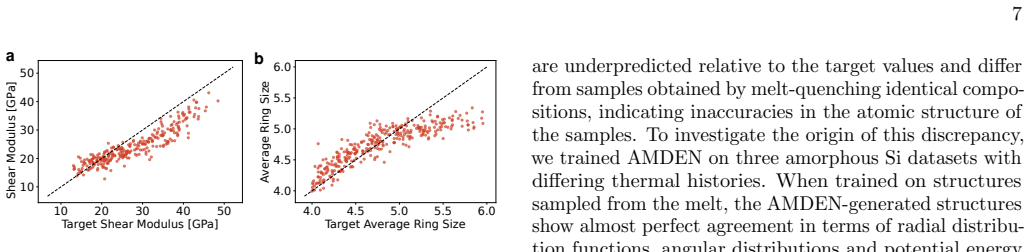
- On fixed-composition silica, conditioning on shear modulus and average ring size produces samples beyond the training range at larger cell sizes, enabling structure-only property control.
- The approach opens the route to generating 'forbidden glasses' whose structural features cannot be obtained by traditional melt-quench procedures.
Reading between the lines
- If the same HMC-refinement scheme were applied to models trained on quantum-mechanical or experimental data, it might correct some of the classical force-field bias; the paper does not test this.
- The failure of standard denoising on glassy landscapes suggests a general limitation of diffusion models on rough energy landscapes, not just a flaw of this architecture; the authors hint at this through a spin-glass analogy.
- The fixed-cell diffusion process, combined with ghost-atom density control, could be extended to variable cell volumes or open-boundary conditions to target pressure-dependent properties, though the paper does not explore that.
- Ring-size conditioning on small training cells may allow targeted generation of medium-range order features, enabling systematic study of structure-property relationships in disordered materials beyond current simulation workflows.
Signed reviews
Editorial analysis
A structured set of objections, weighed in public.
Referee Report
Summary. The paper introduces AMDEN, a diffusion-model framework for inverse design of amorphous materials. The model operates on atomic positions and element embeddings in a periodic cell, uses an equivariant graph neural network as the score backbone, and supports conditioning on macroscopic properties (Young's modulus, shear modulus) and structural features (average ring size). A 'ghost atom' mechanism is intended to control density during generation. The authors also propose an energy-based variant in which the score is obtained as the gradient of a learned noise energy E_theta, and they couple this with Hamiltonian Monte Carlo (HMC) refinement during denoising. Training and validation use three new classical-MD datasets: a multi-element glass (MEG) dataset with 11 elements, three amorphous silicon datasets with different thermal histories, and an amorphous SiO2 dataset with varied cell sizes. The paper reports that standard denoising fails to generate low-energy relaxed structures, that HMC denoising recovers energies and structures close to the training distributions, and that property-conditioned generation can adjust Young's modulus and Li content in the MEG system and shear modulus/ring size in SiO2 beyond the training range. The authors acknowledge several limitations, including the lack of high-quality training data and the reliance on classical force fields.
Significance. If the claims are substantiated, this would be a useful contribution to generative modeling of amorphous materials, an area where diffusion models are less mature than for crystals and molecules. The paper's strengths are the introduction of multiple new MD datasets, the explicit requenching validation for the composition-to-modulus mapping, the forward-noising ground-truth check for the noise-energy evaluation, and the interesting proposal to use HMC on the learned noise energy to counteract the rugged potential-energy-landscape problem. The 'structure-only' control of shear modulus and ring size, and the idea of generating 'forbidden glasses,' are conceptually valuable. However, the quantitative evidence is currently incomplete: key figures lack error bars and correlation metrics, main plots exclude a disclosed subset of samples, there is no comparison against published baselines, and the entire framework inherits the accuracy of the classical force fields with no independent DFT or experimental cross-check. The paper also does not yet provide code or trained models, so reproducibility cannot be assessed.
major comments (5)
- [§II E, Fig. 4] The main plots in Fig. 4 include only perfectly charge-balanced samples, while unbalanced samples are relegated to Supp. Fig. S3. The text reports mean absolute charge errors (0.0025 e and 0.0096 e per atom) but does not report the fraction of generated samples excluded, nor the R²/MAE for the correlations, nor error bars. Because the central claim is that AMDEN adjusts shear modulus and ring size purely through structure, this selection could bias the apparent correlation. Please report the yield of charge-balanced samples, the metrics for all generated samples, and the metrics with and without the charge-balance filter.
- [§II B, Fig. 2] The inverse-design result for the MEG dataset is described qualitatively as 'decent correlation' and 'within few percent' Li content, but no quantitative metrics (R², MAE, standard error) or error bars are given. The requenching comparison uses the same BMP potential as the training data, so it validates composition-to-modulus mapping only within that potential. Moreover, no comparison is made to existing generative models for amorphous materials, such as the diffusion model of Yang & Schwalbe-Koda (2025) or earlier GAN/VAE approaches. Please add numerical error metrics, confidence intervals, and a baseline comparison so the reader can assess whether AMDEN improves over the state of the art.
- [§II D and §IV B 4] The HMC refinement is validated against forward noising trajectories of the same model and against potential energies computed with the same Stillinger-Weber potential used for training. This is a self-consistency check, not an independent validation. More importantly, the comparison between standard denoising and HMC denoising is confounded by compute budget: standard denoising uses n=200 steps, while HMC denoising uses n=2000 steps and sets wcond=0. The reported improvement may come from the larger number of diffusion steps, the absence of CFG, or the HMC sampling itself. Please include an ablation with standard denoising at 2000 steps, and report HMC acceptance rates and wall-clock cost. A comparison to a short MD relaxation (as used in prior work) would also clarify the contribution of HMC.
- [§IV A and Discussion] The entire pipeline—training data, property labels, and validation—is based on classical force fields (BMP-shrm for MEG, Stillinger-Weber for a-Si, Tersoff-Munetoh for SiO2). The paper itself notes that universal ML force fields can be unreliable for high-energy melt-quench structures and that 'the biggest challenge' is a lack of high-quality training data, yet the title and abstract claim inverse design of amorphous materials without qualification. No DFT or experimental cross-check is provided for any generated structure, RDF, ring statistic, or elastic modulus. This is an external-correctness risk. Please either add DFT validation of a representative subset of generated samples (e.g., RDFs and elastic moduli for a few MEG and SiO2 structures) or explicitly reframe the claims as 'in silico inverse design within the accuracy of the chosen force fields.'
- [§II A and Fig. 1] The ghost atom mechanism is described as enabling density control, but the paper never quantitatively evaluates whether the target density is achieved. No results show achieved versus target density, and it is unclear how the ghost fraction interacts with property conditioning. Since density is a physically important variable, particularly for shear modulus, please report the achieved densities for the generated MEG and SiO2 samples, or state explicitly if density was not controlled in those experiments.
minor comments (6)
- [Fig. 3] The figure has panels a–f, but the text refers to panel 'e' for noise energy and panel 'd' for potential energies; the caption and in-text references should be checked for consistency. Also, the RDF panels in a and c have the same x-axis and y-axis labels but different data; consider adding legends and clarifying the line styles.
- [Eq. (21)] The learnable scale factor γ is said to balance position-based and atomic energies, but no initialization, regularization, or final value is given. Please provide these details, since the magnitude of γ directly affects the score and the HMC dynamics.
- [Eq. (24)] The Metropolis–Hastings acceptance criterion is written in terms of total energy E_tot, which includes momenta. It would be helpful to state explicitly that momenta are refreshed after each acceptance/rejection and that only positions are updated, and to clarify whether element embeddings are also updated during HMC.
- [§IV B 4] After Eq. (19), the text states 'kB × T = 1' but does not define the separate values of kB and T. Since these are arbitrary normalization constants, a single constant would be clearer and would avoid confusion with the physical Boltzmann constant.
- [Data Availability] The paper states that source code and training data 'will be made available upon final publication.' For a computational methods paper, it would be preferable to provide at least trained model checkpoints and dataset statistics in a repository or supplement during the review process, to enable independent verification of the central claims.
- [References] Several references are preprints or lack page numbers (e.g., [35], [17], [20], [33]). If final versions are available, they should be updated; otherwise, the preprint status should be explicitly noted.
Circularity Check
No significant circularity: the paper's property predictions and HMC-refinement claims are checked against independent molecular-dynamics computations (requenching, Stillinger-Weber energies, stress-tensor moduli) rather than by the model's own outputs; the two self-citations are non-load-bearing background.
full rationale
The central claims—inverse design of amorphous structures with targeted Young's modulus, shear modulus, and ring size, and the ability of HMC denoising to generate relaxed low-energy structures—are not circular because the evaluation metrics are computed independently of the trained model. Training labels are generated via classical MD melt-quench workflows (BMP for MEG, Stillinger-Weber for Si, Tersoff-Munetoh for SiO2) and properties are computed with physics-based finite-difference stress-strain calculations and ring analyses, not by the model itself. At inference, the Young's modulus of generated samples is obtained by the same stress-tensor computation, and the MEG validation requenches the entire generated composition with the original melt-quench workflow, providing an external ground truth (Fig. 2b); the correlation with targets is imperfect, which is evidence that the metric is not forced. For the Si relaxation claims, HMC-generated samples are evaluated by their Stillinger-Weber potential energies (Fig. 3d) and radial distribution functions relative to the training data—quantities not used as training targets—so the reduction in potential energy under HMC is an empirical finding, not an identity. The noise-energy comparison along forward-noising and denoising trajectories (Fig. 3e) is a self-consistency diagnostic, since E_hat is trained on forward-noised samples, but this diagnostic is not the load-bearing evidence. Self-citations (Refs [31], [41]) appear only in background and application-motivation contexts and do not ground the central claim; no uniqueness theorem from the authors is invoked. The genuine limitation is external validity: all training, conditioning, and validation data come from unvalidated classical force fields, which the paper itself flags as needing further validation and as a lack of high-quality training data. That is a correctness risk, not a circularity of the derivation chain.
Assumptions & free parameters
free parameters (8)
- sigma_X_max (position noise schedule amplitude) =
1.7 A (MEG), 1.5 A (others)
- sigma_E_max (element embedding noise scale) =
1.5
- cutoff radius r_cut =
6.5 A
- nnorm normalization factor =
40
- CFG condition weight wcond =
0.25 (MEG), 1.0 (SiO2)
- HMC timestep dt0 =
0.2 (MEG), 0.4 (Si and SiO2)
- HMC diffusion time interval [tHMC_min, tHMC_max] =
[0.0, 0.5]
- loss weight lambda =
0.5
assumptions (4)
- domain assumption Classical interatomic potentials (BMP, Stillinger-Weber, Tersoff-Munetoh) accurately represent amorphous structures and the target properties for the studied systems.
- standard math The SDE score-matching framework with VE/VP noise schedules is a valid generative model for the atomic position/element distribution.
- ad hoc to paper The learned noise energy E_theta is smooth enough and close enough to the true glass distribution that Hamiltonian Monte Carlo on it samples relaxed structures.
- domain assumption Disorder fluctuations in small amorphous silica cells (80 to 250 atoms) can be used to learn structure-property relationships that extrapolate to larger cells.
invented entities (2)
-
Ghost atoms
-
Noise energy field E_theta
Cite this review
Pith. "Pith review of Inverse Design of Amorphous Materials with Targeted Properties." pith.science (2026). https://pith.science/paper/XDIHL2LH
@misc{pith2026250913916,
  author       = {Pith},
  title        = {Pith review of: Inverse Design of Amorphous Materials with Targeted Properties},
  year         = {2026},
  howpublished = {\url{https://pith.science/paper/XDIHL2LH}},
  note         = {Machine review of arXiv:2509.13916}
}
read the original abstract
Disordered (amorphous) materials, such as glasses, are emerging as promising candidates for applications within energy storage, nonlinear optics, and catalysis. Their lack of long-range order and complex short- and medium-range orderings, which depend on composition as well as thermal and pressure history, offer a vast materials design space. To this end, relying on machine learning methods instead of trial and error is promising, and among these, inverse design has emerged as a tool for generating materials with desired properties. Although inverse design methods based on diffusion models have shown success for crystalline materials and molecules, similar methods targeting amorphous materials remain less developed, mainly because of the limited availability of large-scale datasets and the requirement for larger simulation cells. In this work, we propose and validate an inverse design method for amorphous materials, introducing AMDEN (Amorphous Material DEnoising Network), a diffusion model-based framework that generates structures of amorphous materials. These low-energy configurations are typically obtained through a thermal motion-driven random search-like process that cannot be replicated by standard denoising procedures. We therefore introduce an energy-based AMDEN variant that implements Hamiltonian Monte Carlo refinement for generating these relaxed structures. We further introduce several amorphous material datasets with diverse properties and compositions to evaluate our framework and support future development.
Figures


Figures from the paper (1 more)
Reference graph
Works this paper leans on
-
[1]
Ini- tial structures were generated from varying compositions of the glass formers SiO 2 and P 2O5, and the modifiers Al2O3 Li2O, BeO, K 2O, CaO, TiO 2, BaO and ZnO
Multi Element Glass dataset The Multi Element Glass (MEG) Dataset consists of 9,027 glass samples, containing 11 different elements. Ini- tial structures were generated from varying compositions of the glass formers SiO 2 and P 2O5, and the modifiers Al2O3 Li2O, BeO, K 2O, CaO, TiO 2, BaO and ZnO. The samples were then obtained using a simulation workflow...
-
[2]
Each of the three datasets consisted of 10,000 samples containing 256 Si atoms
Amorphous Si dataset Three amorphous silicon datasets were generated using the Stillinger-Weber potential [ 43]. Each of the three datasets consisted of 10,000 samples containing 256 Si atoms. All samples were created using the same simula- tion workflow but using a different random seed ensuring a unique atomic structure. Samples in themeltdataset were o...
-
[3]
Simulations were performed using the Tersoff potential parameterized by Munetohet al.[ 66]
Amorphous SiO 2 dataset Samples of the amorphous silica (SiO 2) dataset vary in size, with the number of atoms being uniformly dis- tributed between 80 and 250 atoms. Simulations were performed using the Tersoff potential parameterized by Munetohet al.[ 66]. Samples were initially melted at 3500 K and the immediately quenched using a local ge- ometry opti...
-
[4]
The forward diffusion process provides ground truth for noisy samples at intermediate stepsx t and noise compo- nents to supervise the score functions θ
Materials diffusion process Following the SDE framework [ 36], our materials diffu- sion process is composed of two subprocesses: a forward diffusion process and a reverse denoising diffusion process. The forward diffusion process provides ground truth for noisy samples at intermediate stepsx t and noise compo- nents to supervise the score functions θ. Th...
-
[5]
The graph G = (V,E ) provided to EGNN is a graph of the atoms in each sample x, calculated with a cutoff radius rcut = 6.5 ˚A
Equivariant graph neural network The EGNN serves as the equivariant backbone of the score function. The graph G = (V,E ) provided to EGNN is a graph of the atoms in each sample x, calculated with a cutoff radius rcut = 6.5 ˚A. The cutoff radius was chosen to ensure that all bonded and strongly interacting atoms share a direct edge connection while still k...
-
[6]
Score function The score function extended the EGNN framework to predict noise components in both positions and el- ement embeddings during the reverse denoising diffu- sion process, optionally conditioned on desired properties. The score function sθ mapped a noisy material sample xt = (C,X t,E t), diffusion step t, and desired properties yto position and...
-
[7]
The key difference between the standard score function and the energy-based variant lies in how noise components are predicted
Hamiltonian Monte Carlo refinement The energy-based score functionwas introduced to support the prediction of noise energy utilized in Sec- tion II D. The key difference between the standard score function and the energy-based variant lies in how noise components are predicted. While the standard score function directly predicted position and element nois...
-
[8]
The total system noise energy was given by, ˆEθ(x) = 1 σ(t) nX i=1 eX i +γ·e atom i ,(21) where γ is a learnable scale factor balancing the contribu- tion of atomic energies
position-based energy [ 73]: eX i = 1 2 ∥Xi −X (L) i ∥2 , derived from squared distances between original posi- tions and EGNN-output positions; and 2) atomic energy: eatom i =H (L) i , EGNN-output node features. The total system noise energy was given by, ˆEθ(x) = 1 σ(t) nX i=1 eX i +γ·e atom i ,(21) where γ is a learnable scale factor balancing the cont...
Show all 85 references
-
[9]
Initializing momenta from a Maxwell–Boltzmann distribution:p ∼ N(0, kBT M), whereMis the diagonal mass matrix chosen asM=I
-
[10]
Computing the initial energy ˆEθ and total energy Etot = ˆEθ + 1 2 ∥p∥2
-
[11]
Evolving the system using velocity Verlet integra- tion with 15 steps, X←X+p·dt+ 1 2 F·dt 2, F← −∇X ˆEθ(X), p←p+ 1 2 (F+F last)·dt; (23)
-
[12]
This accounted for the fact that ˆEθ becomes less smooth for lower σt
Computing the final energy and accepting or reject- ing the final structure according to the Metropolis– Hastings criterion with probability, α= min 1,exp −(Efinal tot −E initial tot ) kBT .(24) To ensure a consistent acceptance rate of roughly 0.5, the timestep dt was adjuste...
2000
-
[13]
S., Simine, L
Liu, Y., Madanchi, A., Anker, A. S., Simine, L. & De- ringer, V. L. The amorphous state as a frontier in compu- tational materials design.Nat. Rev. Mater.1–14 (2024)
2024
-
[14]
Inverse design in search of materials with target functionalities.Nat
Zunger, A. Inverse design in search of materials with target functionalities.Nat. Rev. Chem.2, 0121 (2018)
2018
-
[15]
Kingma, D. P. & Welling, M. Auto-encoding variational bayes. InICLR(2014)
2014
-
[16]
Goodfellow, I.et al.Generative adversarial networks. Commun. ACM63, 139–144 (2020)
2020
-
[17]
& Sch¨ utt, K
Gebauer, N., Gastegger, M. & Sch¨ utt, K. Symmetry- adapted generation of 3d point sets for the targeted dis- covery of molecules.Adv. Neural Inf. Process. Syst.32 (2019). 13
2019
-
[18]
Hoffmann, J.et al.Data-driven approach to encod- ing and decoding 3-d crystal structures.arXiv preprint arXiv:1909.00949(2019)
1909 arXiv
-
[19]
Noh, J.et al.Inverse design of solid-state materials via a continuous representation.Matter1, 1370–1384 (2019)
2019
-
[20]
J., Yildirim, B., Jain, A
Court, C. J., Yildirim, B., Jain, A. & Cole, J. M. 3- d inorganic crystal structure generation and property prediction via representation learning.J. Chem. Inf. Model.60, 4518–4535 (2020)
2020
-
[21]
Mater.7, 66 (2021)
Long, T.et al.Constrained crystals deep convolutional generative adversarial network for the inverse design of crystal structures.npj Comput. Mater.7, 66 (2021)
2021
-
[22]
& Schmidt, L
Li, J., Madry, A., Peebles, J. & Schmidt, L. On the limitations of first-order approximation in gan dynamics. InICML, 3005–3013 (PMLR, 2018)
2018
-
[23]
M., Chin-Cheong, K., Palumbo, E
Daunhawer, I., Sutter, T. M., Chin-Cheong, K., Palumbo, E. & Vogt, J. E. On the limitations of multimodal vaes. InICLR(2022)
2022
-
[24]
Lucas, J., Tucker, G., Grosse, R. B. & Norouzi, M. Don’t blame the elbo! a linear vae perspective on posterior collapse.Adv. Neural Inf. Process. Syst.32(2019)
2019
-
[25]
& Zhang, B
Xu, K., Li, C., Zhu, J. & Zhang, B. Understanding and stabilizing gans’ training dynamics using control theory. InICML, 10566–10575 (PMLR, 2020)
2020
-
[26]
& Fletcher, A
Becker, E., Pandit, P., Rangan, S. & Fletcher, A. K. Instability and local minima in gan training with kernel discriminators.Adv. Neural Inf. Process. Syst.35, 20300– 20312 (2022)
2022
-
[27]
& Abbeel, P
Ho, J., Jain, A. & Abbeel, P. Denoising diffusion proba- bilistic models. InNeurIPS, vol. 33, 6840–6851 (2020)
2020
-
[28]
& Liu, Q
Wu, L., Gong, C., Liu, X., Ye, M. & Liu, Q. Diffusion- based molecule generation with informative prior bridges. Adv. Neural Inf. Process. Syst.35, 36533–36545 (2022)
2022
-
[29]
& Jaakkola, T
Xie, T., Fu, X., Ganea, O., Barzilay, R. & Jaakkola, T. S. Crystal diffusion variational autoencoder for periodic material generation. InICLR(2022)
2022
-
[30]
Zeni, C.et al.A generative model for inorganic materials design.Nature1–3 (2025)
2025
-
[31]
Learn.: Sci
Kwon, H.et al.Spectroscopy-guided discovery of three- dimensional structures of disordered materials with dif- fusion models.Mach. Learn.: Sci. Technol.5, 045037 (2024)
2024
-
[32]
Lei, B.et al.Grand canonical generative diffusion model for crystalline phases and grain boundaries.arXiv preprint arXiv:2408.15601(2024)
2024 arXiv
-
[33]
K.et al.Accelerated data-driven materials science with the materials project.Nat
Horton, M. K.et al.Accelerated data-driven materials science with the materials project.Nat. Mater.1–11 (2025)
2025
-
[34]
G´ eoscience354, 35–77 (2022)
Liu, H.et al.Challenges and opportunities in atom- istic simulations of glasses: a review.Comptes Rendus. G´ eoscience354, 35–77 (2022)
2022
-
[35]
Batatia, I.et al.A foundation model for atomistic mate- rials chemistry.arXiv preprint arXiv:2401.00096(2023)
2023 arXiv
-
[36]
Yang, H.et al.Mattersim: A deep learning atomistic model across elements, temperatures and pressures.arXiv preprint arXiv:2405.04967(2024)
2024 arXiv
-
[37]
Mater.11, 9 (2025)
Deng, B.et al.Systematic softening in universal machine learning interatomic potentials.npj Comput. Mater.11, 9 (2025)
2025
-
[38]
& Zhang, L
Wang, Q. & Zhang, L. Inverse design of glass structure with deep graph neural networks.Nat. Commun.12, 5359 (2021)
2021
-
[39]
Merchant, A.et al.Scaling deep learning for materials discovery.Nature1–6 (2023)
2023
-
[40]
Li, H.et al.Conditional generative modeling for amorphous multi-element materials.arXiv preprint arXiv:2503.07043(2025)
2025 arXiv
-
[41]
& Yang, Y
Zhou, Z., Shang, Y., Liu, X. & Yang, Y. A generative deep learning framework for inverse design of compositionally complex bulk metallic glasses.npj Comput. Mater.9, 15 (2023)
2023
-
[42]
& Lewis, L
Comin, M. & Lewis, L. J. Deep-learning approach to the structure of amorphous silicon.Phys. Rev. B100, 094107 (2019)
2019
-
[43]
Xu, X. & Hu, J. A generative adversarial networks (gan) based efficient sampling method for inverse design of metallic glasses.J. Non-Cryst. Solids613, 122378 (2023)
2023
-
[44]
Yong, A. X. B., Su, T. & Ertekin, E. Dismai-bench: benchmarking and designing generative models using dis- ordered materials and interfaces.Digit. Discov.3, 1889– 1909 (2024)
1909
-
[45]
& Wang, B
Chen, Q., Annamareddy, A., Li, Y.-F., Morgan, D. & Wang, B. Physical regularized hierarchical generative model for metallic glass structural generation and energy prediction.arXiv preprint arXiv:2505.09977(2025)
2025
-
[46]
Y., Bengio, Y
Kilgour, M., Gastellu, N., Hui, D. Y., Bengio, Y. & Simine, L. Generating multiscale amorphous molecular structures using deep learning: a study in 2d.J. Phys. Chem. Lett. 11, 8532–8537 (2020)
2020
-
[47]
& Schwalbe-Koda, D
Yang, K. & Schwalbe-Koda, D. A generative diffu- sion model for amorphous materials.arXiv preprint arXiv:2507.05024(2025)
2025
-
[48]
Song, Y.et al.Score-based generative modeling through stochastic differential equations.arXiv preprint arXiv:2011.13456(2020)
2011 arXiv
-
[49]
Blattmann, A.et al.Stable video diffusion: Scaling latent video diffusion models to large datasets.arXiv preprint arXiv:2311.15127(2023)
2023 arXiv
-
[50]
InICLR(2024)
Podell, D.et al.SDXL: improving latent diffusion models for high-resolution image synthesis. InICLR(2024)
2024
-
[51]
Lipman, Y., Chen, R. T. Q., Ben-Hamu, H., Nickel, M. & Le, M. Flow matching for generative modeling. InICLR (2023)
2023
-
[52]
G., Hoogeboom, E
Satorras, V. G., Hoogeboom, E. & Welling, M. E(n) equivariant graph neural networks. InICML, vol. 139, 9323–9332 (2021)
2021
-
[53]
& Smedskjaer, M
Ding, J., Ji, D., Yue, Y. & Smedskjaer, M. M. Amorphous materials for lithium-ion and post-lithium-ion batteries. Small20, 2304270 (2024)
2024
-
[54]
J., Westover, A
Kalnaus, S., Dudney, N. J., Westover, A. S., Herbert, E. & Hackney, S. Solid-state batteries: The critical role of mechanics.Science381, eabg5998 (2023)
2023
-
[55]
Stillinger, F. H. & Weber, T. A. Computer simulation of local order in condensed phases of silicon.Phys. Rev. B 31, 5262 (1985)
1985
-
[56]
D., Pendleton, B
Duane, S., Kennedy, A. D., Pendleton, B. J. & Roweth, D. Hybrid monte carlo.Phys. Lett. B195, 216–222 (1987)
1987
-
[57]
Li, X.et al.Cooling rate effects in sodium silicate glasses: Bridging the gap between molecular dynamics simulations and experiments.J. Chem. Phys.147(2017)
2017
-
[58]
N.et al.Composition-structure-property relations of compressed borosilicate glasses.Phys
Svenson, M. N.et al.Composition-structure-property relations of compressed borosilicate glasses.Phys. Rev. Appl.2, 024006 (2014)
2014
-
[59]
Ring structure of the crystalline and amor- phous forms of silicon dioxide.J
Guttman, L. Ring structure of the crystalline and amor- phous forms of silicon dioxide.J. Non-Cryst. Solids116, 145–147 (1990). URL https://www.sciencedirect.com/ science/article/pii/002230939090686G. 14
1990
-
[60]
& Abrikosov, I
Raza, Z., Alling, B. & Abrikosov, I. A. Computer simula- tions of glasses: the potential energy landscape.J. Phys.: Condens. Matter27, 293201 (2015)
2015
-
[61]
& De Souza, V
Niblett, S., Biedermann, M., Wales, D. & De Souza, V. Pathways for diffusion in the potential energy landscape of the network glass former SiO2.J. Chem. Phys.147 (2017)
2017
-
[62]
& M´ ezard, M
Biroli, G., Bonnaire, T., De Bortoli, V. & M´ ezard, M. Dynamical regimes of diffusion models.Nat. Commun. 15, 9957 (2024)
2024
-
[63]
InACM Multimedia, 3568–3577 (2024)
Zeng, W.et al.Infusion: Preventing customized text- to-image diffusion from overfitting. InACM Multimedia, 3568–3577 (2024)
2024
-
[64]
& Zdeborov´ a, L
Ghio, D., Dandi, Y., Krzakala, F. & Zdeborov´ a, L. Sam- pling with flows, diffusion, and autoregressive neural net- works from a spin-glass perspective.Proc. Natl. Acad. Sci. U.S.A.121, e2311810121 (2024)
2024
-
[65]
& Krish- nan, N
Bihani, V., Manchanda, S., Sastry, S., Ranu, S. & Krish- nan, N. A. Stridernet: A graph reinforcement learning approach to optimize atomic structures on rough energy landscapes. InICML, 2431–2451 (PMLR, 2023)
2023
-
[66]
Mauro, J. C. & Loucks, R. J. Forbidden glasses and the failure of fictive temperature.J. Non-Cryst. Solids355, 676–680 (2009)
2009
-
[67]
In CVPR, 2704–2713 (2018)
Jacob, B.et al.Quantization and training of neural networks for efficient integer-arithmetic-only inference. In CVPR, 2704–2713 (2018)
2018
-
[68]
InICML(2024)
Huang, Y.et al.Symbolic music generation with non- differentiable rule guided diffusion. InICML(2024)
2024
-
[69]
& Chen, J
Yeh, P., Lee, K. & Chen, J. Training-free diffusion model alignment with sampling demons. InICLR(2025)
2025
-
[70]
Jain, A.et al.Commentary: The materials project: A materials genome approach to accelerating materials in- novation.APL Mater.1(2013)
2013
-
[71]
E., Kirklin, S., Aykol, M., Meredig, B
Saal, J. E., Kirklin, S., Aykol, M., Meredig, B. & Wolverton, C. Materials design and discovery with high- throughput density functional theory: the open quantum materials database (oqmd).JOM65, 1501–1509 (2013)
2013
-
[72]
Barroso-Luque, L.et al.Open materials 2024 (omat24) inorganic materials dataset and models.arXiv preprint arXiv:2410.12771(2024)
2024 arXiv
-
[73]
Mater.10, 295 (2024)
Zheng, H.et al.The ab initio non-crystalline structure database: empowering machine learning to decode diffu- sivity.npj Comput. Mater.10, 295 (2024)
2024
-
[74]
P.et al.LAMMPS - a flexible simulation tool for particle-based materials modeling at the atomic, meso, and continuum scales.Comp
Thompson, A. P.et al.LAMMPS - a flexible simulation tool for particle-based materials modeling at the atomic, meso, and continuum scales.Comp. Phys. Comm.271, 108171 (2022)
2022
-
[75]
H.et al.The atomic simulation environ- ment—a python library for working with atoms.J
Larsen, A. H.et al.The atomic simulation environ- ment—a python library for working with atoms.J. Phys.: Condens. Matter29, 273002 (2017)
2017
-
[76]
& Goedecker, S
Gubler, M., Krummenacher, M., Huber, H. & Goedecker, S. Efficient variable cell shape geometry optimization.J. Comput. Phys. X17, 100131 (2023)
2023
-
[77]
Bertani, M., Menziani, M. C. & Pedone, A. Improved empirical force field for multicomponent oxide glasses and crystals.Phys. Rev. Mater.5, 045602 (2021)
2021
-
[78]
& Shintani, A
Munetoh, S., Motooka, T., Moriguchi, K. & Shintani, A. Interatomic potential for si–o systems using tersoff pa- rameterization.Comput. Mater. Sci.39, 334–339 (2007)
2007
-
[79]
& Ermon, S
Song, Y. & Ermon, S. Generative modeling by estimating gradients of the data distribution. InNeurIPS, vol. 32, 11895–11907 (2019)
2019
-
[80]
& Ravan- bakhsh, S
Levy, D., Kaba, S.-O., Gonzales, C., Miret, S. & Ravan- bakhsh, S. Using multiple vector channels improves e (n)-equivariant graph neural networks.arXiv preprint arXiv:2309.03139(2023)
2023 arXiv
-
[81]
InNeurIPS, 5998–6008 (2017)
Vaswani, A.et al.Attention is all you need. InNeurIPS, 5998–6008 (2017)
2017
-
[82]
& Salimans, T
Ho, J. & Salimans, T. Classifier-free diffusion guidance. arXiv preprint arXiv:2207.12598(2022)
2022 arXiv
-
[83]
& Weber, R
Sadat, S., Kansy, M., Hilliges, O. & Weber, R. M. No training, no problem: Rethinking classifier-free guidance for diffusion models.arXiv preprint arXiv:2407.02687 (2024)
2024 arXiv
-
[84]
Kingma, D. P. & Ba, J. Adam: A method for stochastic optimization. In Bengio, Y. & LeCun, Y. (eds.)ICLR (2015)
2015
-
[85]
Salimans, T. & Ho, J. Should ebms model the energy or the score? InEnergy Based Models Workshop-ICLR 2021 (2021)
2021
Reviewed August 4, 2026 · model on record in the stance chip above.
Discussion (0). Continue with ORCID to comment.