REVIEW 2 major objections 1 minor 5 references
Credibility-Weighted Pricing of Autonomous Vehicle Liability Under Operational Design Domain Shift
T0 review · 2 major / 1 minor · reviewed 2026-06-27 · grok-4.3
Pith's one-line read Hierarchical Bayesian credibility model with learned ODD kernel pools sparse AV crash data across cities for liability pricing.
desk verdict The paper extends credibility theory with a learned ODD-similarity kernel for AV liability pooling but the four-city demonstration leaves the kernel's identifiability in doubt. read the letter →
The pith
A machine-rendered reading of the paper's core claim, the machinery that carries it, and where it could break.
The reading
What carries the argument
The learned ODD-similarity kernel, which measures similarities across cities, software versions, and territories to enable hierarchical pooling in the Bayesian credibility model.
What would settle it
Observing that the model's pooled loss predictions deviate significantly from actual losses in a held-out set of cities or new software versions would falsify the claim of effective pooling.
Extended reading notes
Core claim
The central claim is that nesting a Buhlmann-Straub credibility model inside a hierarchical Bayesian structure with an ODD-similarity kernel allows effective partial pooling of experience for AV liability ratemaking under domain shift, as shown by moderate weights and superior performance on real deployment data from four metros.
Load-bearing premise
A kernel that meaningfully captures similarities in operational design domains across cities and versions can be learned from the crash and exposure data.
Editorial extensions
If this is right
- Credibility weights indicate partial pooling is optimal rather than full or no pooling.
- The framework reduces to standard Buhlmann-Straub when the kernel is constant.
- Advantage of the learned kernel becomes detectable at approximately twelve deployed cities.
- Model handles non-stationary risk across software releases by pooling across versions.
Reading between the lines
- The power analysis suggests collecting data from additional cities would confirm the kernel's benefit.
- Insurers could implement this for more stable pricing as deployments expand.
Editorial analysis
A structured set of objections, weighed in public.
Referee Report
Summary. The paper proposes a hierarchical Bayesian credibility framework for autonomous vehicle liability pricing that pools data across cities, software versions, and territories using a learned ODD-similarity kernel, nesting the Buhlmann-Straub model as a limiting case. On 648 verified-engaged Waymo crashes from four U.S. metros matched to 116 million miles, it reports city-aggregate credibility weights of 0.12-0.46, finds partial pooling outperforms no pooling, and includes a power analysis indicating the kernel advantage becomes detectable at approximately twelve cities.
Significance. If the learned kernel can be reliably identified and produces stable pooling, the framework would provide a principled approach to ratemaking under sparse, non-stationary AV data, extending classical credibility theory to handle ODD shifts. The explicit nesting of Buhlmann-Straub and the power analysis are positive features that strengthen the contribution if the empirical claims hold.
major comments (2)
- [Abstract / Empirical demonstration] The empirical demonstration uses only four cities. With so few cross-sectional units, the ODD-similarity kernel (parameterized over city/software/territory features) has limited degrees of freedom for identifiability; estimated similarities may reflect sampling noise rather than stable ODD structure. This directly threatens the central claim that the learned kernel produces decisive outperformance over no-pooling and that its advantage is merely a power issue detectable at twelve cities (Abstract).
- [Abstract / Empirical demonstration] Moderate credibility weights (0.12-0.46) are reported, but it is unclear whether these reflect successful partial pooling via the learned kernel or the kernel collapsing toward the Buhlmann-Straub limit under data scarcity with only four units. No diagnostic is provided to distinguish these cases (Abstract).
minor comments (1)
- [Abstract] The abstract states results and comparisons but supplies no model equations, derivation steps, data processing details, or error analysis, making it impossible to verify if the data supports the claims.
Simulated Author's Rebuttal
We thank the referee for the constructive comments on the empirical demonstration and identifiability of the ODD-similarity kernel. We respond point by point below and will make the indicated revisions to strengthen the manuscript.
read point-by-point responses
-
Referee: [Abstract / Empirical demonstration] The empirical demonstration uses only four cities. With so few cross-sectional units, the ODD-similarity kernel (parameterized over city/software/territory features) has limited degrees of freedom for identifiability; estimated similarities may reflect sampling noise rather than stable ODD structure. This directly threatens the central claim that the learned kernel produces decisive outperformance over no-pooling and that its advantage is merely a power issue detectable at twelve cities (Abstract).
Authors: We agree that four cities afford limited degrees of freedom for kernel identification and that this constrains the strength of claims about outperformance. The power analysis is a simulation study showing detectability around twelve cities, which is consistent with the referee's assessment that the four-city results are preliminary. We will revise the abstract to describe the demonstration as exploratory, qualify the outperformance as consistent with but not definitive evidence of the kernel advantage, and note the power analysis as indicating the scale needed for stronger confirmation. The kernel is parameterized over software versions and territories in addition to cities, which supplies additional structure, though we acknowledge this does not eliminate the identifiability concern with the current sample. revision: yes
-
Referee: [Abstract / Empirical demonstration] Moderate credibility weights (0.12-0.46) are reported, but it is unclear whether these reflect successful partial pooling via the learned kernel or the kernel collapsing toward the Buhlmann-Straub limit under data scarcity with only four units. No diagnostic is provided to distinguish these cases (Abstract).
Authors: This observation is correct; the reported weights could arise either from informative partial pooling or from the kernel approaching the Buhlmann-Straub limit under data scarcity. We will add a diagnostic to the revised manuscript, such as posterior summaries of the kernel hyperparameters or a direct comparison of the estimated similarity matrix against the no-pooling (identity) case, to help distinguish these possibilities. The diagnostic will be presented in the results section. revision: yes
Circularity Check
No significant circularity in derivation chain
full rationale
The paper's framework nests the established Buhlmann-Straub model as an explicit limiting case and introduces a learned ODD-similarity kernel for hierarchical pooling across cities/software/territories. The central empirical claims (moderate credibility weights 0.12-0.46, outperformance of partial pooling, power analysis at ~12 cities) rest on application to 648 real crashes from four metros against 116M miles, without any quoted reduction of a 'prediction' to a fitted input by construction, self-definitional equations, or load-bearing self-citations. The derivation remains self-contained against external benchmarks and data.
Assumptions & free parameters
free parameters (2)
- ODD-similarity kernel parameters
- city-aggregate credibility weights
assumptions (2)
- domain assumption Data from different cities, versions, and territories can be hierarchically pooled via Bayesian structure
- standard math Buhlmann-Straub model as limiting case of the framework
invented entities (1)
-
learned ODD-similarity kernel
Cite this review
Pith. "Pith review of Credibility-Weighted Pricing of Autonomous Vehicle Liability Under Operational Design Domain Shift." pith.science (2026). https://pith.science/paper/XDLYETDN
@misc{pith2026260617451,
  author       = {Pith},
  title        = {Pith review of: Credibility-Weighted Pricing of Autonomous Vehicle Liability Under Operational Design Domain Shift},
  year         = {2026},
  howpublished = {\url{https://pith.science/paper/XDLYETDN}},
  note         = {Machine review of arXiv:2606.17451}
}
read the original abstract
Automated Driving System deployments create a foundational ratemaking challenge: sparse experience, shifting operational design domains, and non-stationary risk across software releases. We propose a hierarchical Bayesian credibility framework pooling across cities, software versions, and territories via a learned ODD-similarity kernel, nesting Buhlmann-Straub as a limiting case. Demonstrated on 648 verified-engaged Waymo crashes across four U.S. metros from the NHTSA Standing General Order database against 116 million matched miles, city-aggregate credibility weights are moderate (0.12-0.46), partial pooling decisively outperforms no pooling, and a power analysis shows the learned kernel's advantage becomes detectable at approximately twelve deployed cities.
Figures
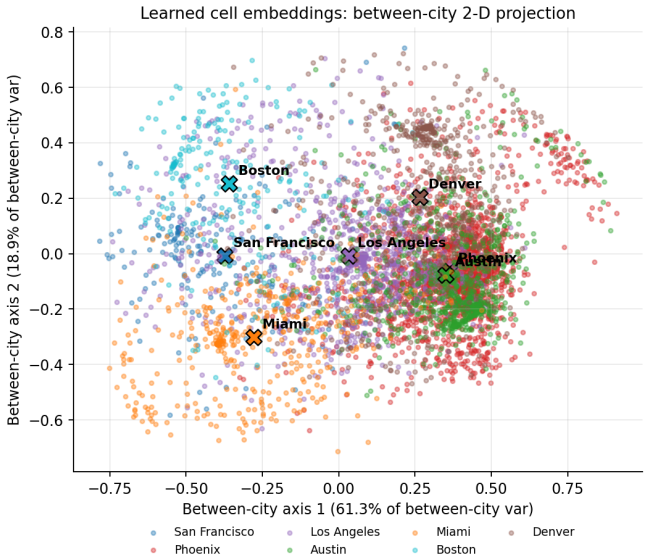


Figures from the paper (6 more)


Reference graph
Works this paper leans on
-
[1]
Betancourt, M., & Girolami, M. (2015). Hamiltonian Monte Carlo for hierarchical models. In S. K. Upadhyay, U. Singh, D. K. Dey, & A. Loganathan (Eds.), Current Trends in Bayesian Methodology with Applications. CRC Press. Bühlmann, H. (1967). Experience rating and credibility. ASTIN Bulletin, 4(3), 199–207. Bühlmann, H., & Straub, E. (1970). Glaubwürdigkei...
-
[2]
Scanlon, J
Annals of Actuarial Science, 15(2), 207–290. Scanlon, J. M., Kusano, K. D., Fraade-Blanar, L. A., McMurry, T. L., Chen, Y. H., & Victor, T. (2024a). Benchmarks for retrospective automated driving system crash rate analysis using police-reported crash data. Traffic Injury Prevention, 25(sup1), S51–S65. Scanlon, J. M., Teoh, E. R., Kidd, D. G., Kusano, K. D...
2018
-
[3]
Verified Engaged
As𝜏→ ∞,𝑍 𝑐 →1and the posterior collapses to own experience; as𝜏→0,𝑍 𝑐 →0and it collapsestothegrandmean. ThederivationdependsontheLaplaceapproximation,whichisexact forGaussianposteriorsandaccurateforPoissonposteriorswithmoderateexpectedcounts;thefull Bayesian computation in Section 6 does not rely on it. The derivation generalises to the model with covaria...
2021
-
[4]
and three canonical software versions, distributed across five quarterly periods. D.2 ADS exposure (operator disclosure) Derived from Waymo’s published mileage milestones: 170.7 million rider-only miles through December 2025 across the four metros (Waymo Safety Impact hub) and the 200-million-mile milestone in February
2025
-
[5]
These are estimates; a sensitivity range of 100–130 million total yields SGO frequencies of 4.8–6.3 per million miles
Interpolating to the SGO window and allocating by each metro’s share of Waymo’s published cumulative rider-only miles through December 2025 (San Francisco 31.4%, Phoenix 40.2%, Los Angeles 22.2%, Austin 6.3%) yields approximately 116 million four- cityrider-onlymiles(SanFrancisco36.37,Phoenix46.62,LosAngeles25.72,Austin7.29). These are estimates; a sensit...
2025
Reviewed June 27, 2026 · model on record in the stance chip above.
Discussion (0). Continue with ORCID to comment.