REVIEW 3 major objections 5 minor 24 references
Magnetic Anisotropies and Skyrmion Lattice Related to Magnetic Quadrupole Interactions of the RKKY Mechanism in Frustrated Spin-Trimer System Gd$_{3}$Ru$_{4}$Al$_{12}$ with a Breathing Kagome Structure
T0 review · 3 major / 5 minor · reviewed 2026-08-11 · deepseek-v4-flash
Pith's one-line read Magnetic quadrupole interactions explain the skyrmion lattice and mixed anisotropies of Gd3Ru4Al12.
desk verdict A plausible RKKY-based mechanism for multipole-stabilized skyrmions in Gd3Ru4Al12, but the headline Tc=5 K rests on assumed coupling constants and a fine-tuned cancellation. read the letter →
The pith
A machine-rendered reading of the paper's core claim, the machinery that carries it, and where it could break.
The reading
What carries the argument
The central object is the magnetic quadrupole moment carried by an imperfect ferromagnetic trimer: three Gd spins that are nearly parallel but canted by a small angle, so the trimer has both a net dipole moment $S_r$ and quadrupole or rotational moments $Q_{\Gamma\gamma}$ and $R_m$. The derivation machinery is the standard RKKY spin polarization $p(r) = C_p f(k_F,r) S$ with $f(k_F,r)$ linearized around the second zero $R_0$ of the oscillating function; because the next-nearest-neighbor trimer distance sits near $R_0$, the linear term generates couplings that are antisymmetric across the trimer and recombine into quadrupole-quadrupole interactions. The analysis then runs through the Hamiltonian of Eq. (50), in which quadrupole couplings act only between nearest-neighbor trimers while dipole couplings extend to third neighbors, and the thermodynamic machinery is the trimer-hexagon lattice of Fig. 23, whose four enclosed single-trimer sites keep 8 quadrupole or rotational degrees of freedom each, contributing $(1/4) k_B T \ln 8$ per trimer to the skyrmion-lattice free energy in Eq. (98).
What would settle it
Measure the entropy released between the transverse-conical and skyrmion-lattice phases at 1.25 T: the model predicts roughly $(1/4) R \ln 8$ of excess entropy per mole of trimers from the disordered single-trimer sites, appearing as the skyrmion-lattice phase is entered. If calorimetry shows no such entropy difference, or if a first-principles or measured RKKY parameter set gives $k_B^{-1}G$ couplings far from Eq. (100) and moves the sign change of Eq. (98) well away from the measured phase boundary, the central claim fails.
Extended reading notes
Core claim
On the paper's own terms, the discovery is that magnetic quadrupole moments are not an exotic addition to the RKKY picture but a necessary consequence of treating each ferromagnetic Gd trimer as an extended magnetic impurity. Because the trimer side length $D$ is much larger than the 4$f$ orbital size, the induced RKKY spin polarization from one trimer contains components that couple to the quadrupole structure of a neighboring trimer, giving quadrupole couplings proportional to $D^2$. The proposed Hamiltonian combines dipole couplings $J_1$, $J_2$, $J_3$ with quadrupole couplings $G_\Gamma$ between nearest-neighbor trimers and yields three results: the coexistence of easy-axis and easy-plane anisotropies through the inequality $0 > 4G_5 > G_6 > (4/3)G_1$; a helical-to-transverse-conical transition at $\mu_0 H_c = 1.25$ T because the conical structure has twice the $c$-axis susceptibility; and a lattice of type-A and type-P trimer hexagons that already is a skyrmion lattice with skyrmion diameter about 4.4 nm. The remaining quadrupole degrees of freedom on four disordered single trimers per repeating unit give a skyrmion-lattice free energy below that of the transverse-conical phase once temperature exceeds $T_c = 5.0$ K with the assumed couplings of Eq. (100).
Load-bearing premise
The whole quantitative conclusion rests on the assumed coupling constants of Eq. (100) and on the choice $k_F = 5$ that fixes the linearized RKKY function; these numbers are input parameters rather than values computed from the electronic structure, so the predicted $T_c = 5.0$ K is only as reliable as that input set.
Editorial extensions
If this is right
- The coexistence of easy-axis and easy-plane anisotropies follows directly from the quadrupole part of the Hamiltonian: trimers carrying different quadrupole symmetries do not interact, so frustration is eliminated and two independent ordered subgroups form.
- The helical-to-transverse-conical transition at $\mu_0 H_c = 1.25$ T is explained by the twofold larger $c$-axis susceptibility of the conical structure, with an effective anisotropic energy $k_B^{-1}\Delta = 4.04$ K extracted from the magnetization jump.
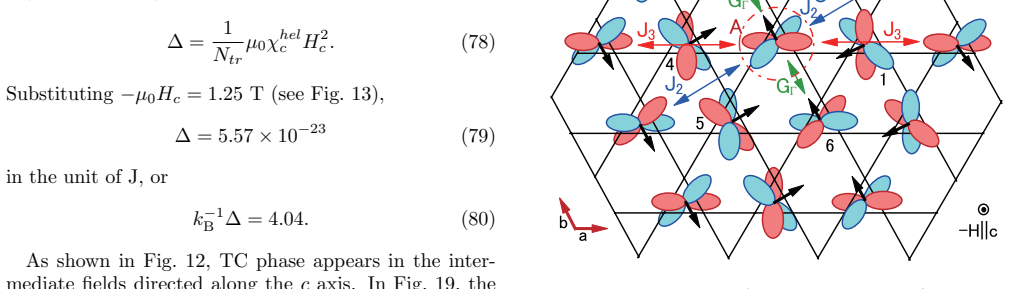
- The skyrmion lattice is a lattice of type-A and type-P trimer hexagons; the resulting spin swirl has a diameter of about 4.4 nm and a common rotation sense, so clockwise and anticlockwise chiral domains are expected in the skyrmion-lattice phase.
- Quadrupole disorder on enclosed single trimers lowers the skyrmion-lattice free energy linearly in temperature, so the skyrmion-lattice phase is stable in an intermediate temperature window below $T_c = 5.0$ K at 1.25 T.
- Because quadrupole moments do not couple directly to the applied field, their entropy is not suppressed by the field, which is why the skyrmion phase survives in an intermediate field range rather than only at zero field.
Reading between the lines
- If this mechanism is right, Gd3Ru4Al12 becomes an example of a skyrmion lattice stabilized by multipole entropy rather than by Dzyaloshinskii-Moriya interactions, giving centrosymmetric skyrmion hosts a route that does not rely on spin-orbit coupling.
- The same construction, RKKY-derived multipole couplings between extended spin clusters with imperfect ferromagnetic directivity, could apply to other trimerized or cluster magnets, where it would predict coexisting anisotropies and finite-temperature skyrmion phases whenever two quadrupole symmetries can order independently.
- A testable consequence the paper leaves implicit is that the quadrupole entropy term predicts a roughly $T \ln 2$-type contribution to the specific heat in the skyrmion-lattice phase, which field-dependent calorimetry could resolve against phonon and dipole backgrounds.
- The assumed couplings in Eq. (100) could in principle be computed from the band structure; if such a calculation reproduces the inequality $0 > 4G_5 > G_6 > (4/3)G_1$ and places $T_c$ near 5 K, the case would be much stronger.
Editorial analysis
A structured set of objections, weighed in public.
Referee Report
Summary. The paper proposes that magnetic quadrupole (MQ) interactions between imperfect ferromagnetic spin trimers in Gd3Ru4Al12, derived from the RKKY mechanism, explain the coexisting easy-axis and easy-plane magnetic anisotropies and stabilize the skyrmion lattice (SkL) at finite temperature through quadrupole entropy on disordered trimers. It constructs a low-temperature Hamiltonian (Eq. 50) that includes MQ, rotational, and dipole interactions, and it uses a free-energy comparison (Eqs. 98–100) to predict a transverse-conical (TC) to SkL transition at Tc = 5.0 K, which is stated to approximately agree with experiment. The paper also provides explicit spin structures, symmetry assignments, and a lattice of trimer hexagons that enfolds quadrupole-disordered single trimer sites.
Significance. If the mechanism is correct, the paper offers a microscopic route to multipole-entropy-stabilized skyrmions in a centrosymmetric frustrated magnet, which is of genuine interest. The symmetry analysis of imperfect FM trimers, the derivation of MQ couplings from the RKKY mechanism, and the identification of quadrupole-disordered sites as an entropy reservoir are original and valuable contributions. However, the central quantitative claim rests on a set of assumed coupling constants and an unvalidated choice of kF, as detailed in the major comments; the predictive content of the model is therefore currently limited.
major comments (3)
- [§V.B, Eq. (100)] The claimed TC–SkL transition temperature Tc = 5.0 K is computed from the coupling constants (kB^-1 G1, kB^-1 G5, kB^-1 G6, kB^-1 J3) = (-1.3, -0.25, -1.45, -0.55) K, which are introduced with the wording 'we assume ... for example.' These values are not derived from the electronic structure of Gd3Ru4Al12 and are not constrained by independent measurements; they are chosen to satisfy the anisotropy condition (Eq. 69) and to yield a positive ΔEtr that the entropy term overturns at the desired temperature. The agreement with the experimental TC–SkL boundary shown in Fig. 24 is therefore a consistency check for the chosen parameters rather than a model prediction. A sensitivity analysis is needed, and the paper should either derive the relative MQ couplings from a material-specific calculation or clearly present the calculation as an illustrative demonstration.
- [§III.A, Eq. (35) and Fig. 9] The central assumption that the nearest-neighbor trimer distance lies near the second zero R0 of f(kF, r), leading to |J1| << |J2|, |J3| in Eq. (51), is made possible by choosing kF = 5. No experimental or band-structure value of kF for Gd3Ru4Al12 is provided, and the linear-fit coefficients C1 = 27 and C2 = -21 in Eq. (37) depend on this choice. Because R0 and the sign and scale of the MQ couplings in Eq. (49) are set by kF, the entire quantitative framework rests on this unvalidated input; the paper should justify the chosen kF or demonstrate that the main conclusions are robust to its variation.
- [§V.A, Eqs. (96)–(97)] The free-energy comparison assumes that the TC-phase free energy is temperature-independent and that the only relevant entropy contribution in the SkL phase comes from the four quadrupole-disordered ST sites in the repeating unit, giving (1/4)kB ln 8 per trimer. The authors acknowledge that collective excitations are neglected but do not quantify their effect. Because the transition condition ΔFtr = 0 is determined by the competition between ΔEtr and this entropy term, a modest correction to either quantity would shift Tc appreciably; this assumption is load-bearing for the finite-temperature stabilization claim.
minor comments (5)
- [Abstract and Introduction] The word 'sentrosymmetric' in the abstract and 'cetrosymmetric' in the Introduction should be 'centrosymmetric'.
- [Fig. 12 caption] The caption refers to Ref. 9 for the red-letter phase names, but the skyrmion lattice and TC phase boundaries are reported in Ref. 8 (Hirschberger et al.); the reference citation appears to be incorrect.
- [§IV.C, Eq. (74)] The relation χ_spi(0 K) = 2 χ_hel(0 K) is stated without derivation, although it is used to obtain Δ and the transition field Hc; a brief justification would improve clarity.
- [Table VI] The entries for QΓγ are all negative; since the sign convention is not explicitly stated in the table caption, the reader must infer it from the figures and Table II, which is unnecessarily confusing.
- [Eq. (9)] The phrase 'the double sign corresponds' is awkward and should be reworded as 'the double signs in Eqs. (9)–(12) correspond to one another'.
Circularity Check
No significant circularity: the 5 K TC–SkL estimate is a conditional model result from explicitly assumed couplings, not a fitted or definitionally forced prediction.
full rationale
The derivation chain is internally consistent and does not reduce any central prediction to its own inputs by construction. The quantitative TC–SkL estimate at Tc = 5.0 K is obtained from Eq. 98, ΔFtr = ΔEtr − (1/4)kBT ln 8, using coupling constants that the paper explicitly introduces as assumptions: “we assume the set of coupling constants as ... for example” (Eq. 100). Those constants are not fitted to the TC–SkL boundary; they are chosen to satisfy the anisotropy-inequality condition of Eq. 69, which is a qualitative constraint derived from the model. The transition temperature is therefore a computed consequence of stated inputs rather than an input disguised as a prediction. Similarly, the MQ interactions are derived from the RKKY spin-polarization expression (Eqs. 33–49) and from the explicitly defined quadrupole-spin operators, not from the final free-energy comparison. The spin structures are adopted from the author's previous work, but that prior work supplies empirical data and model motivation rather than an unverified uniqueness theorem or a forced ansatz. The remaining free parameters and the illustrative character of Eq. 100 are limitations on predictive robustness, but they are not circularity. No equation was found that is equivalent to its own input by definition, and no fitted parameter is renamed as a prediction.
Assumptions & free parameters
free parameters (4)
- kF (Fermi wavevector) =
kF = 5 (Fig. 9)
- Linear-fit coefficients C1, C2 =
C1 = 27, C2 = -21
- Coupling constants G1, G5, G6, J3 =
kB^-1 (G1, G5, G6, J3) = (-1.3, -0.25, -1.45, -0.55) K
- Imperfect-trimer tilt angle xi = sin(theta) =
xi = 0.6999 (theta = 44.42 deg)
assumptions (7)
- domain assumption Classical spin description of Gd3+ with S = 7/2
- standard math RKKY spin polarization formula with free-electron contact exchange (Eq. 33 and Appendix C)
- ad hoc to paper Linearization of f(kF,r) as C1(r - R0) near the second zero point
- ad hoc to paper NN trimer distance is approximately R0 so that |J1| << |J2|, |J3| (Eq. 51)
- ad hoc to paper Imperfect FM trimer spin structures of Figs. 3 and 4 are taken from Ref. 6 with the minimal allowed tilt angle
- ad hoc to paper MQ and rotational interactions act only between NN trimers, while dipole interactions extend to 3dNN, with GR = G1 (Eq. 52)
- ad hoc to paper Type-A and type-P trimer hexagons are the relevant thermally excited states, and the TC free energy is treated as temperature independent (Eqs. 96 and 97)
invented entities (1)
-
Rotational magnetic moment Rm with vector-potential-like function FR = (xz, yz, 0)
Cite this review
Pith. "Pith review of Magnetic Anisotropies and Skyrmion Lattice Related to Magnetic Quadrupole Interactions of the RKKY Mechanism in Frustrated Spin-Trimer System Gd$_{3}$Ru$_{4}$Al$_{12}$ with a Breathing Kagome Structure." pith.science (2026). https://pith.science/paper/XDNTAMTZ
@misc{pith2026241216562,
  author       = {Pith},
  title        = {Pith review of: Magnetic Anisotropies and Skyrmion Lattice Related to Magnetic Quadrupole Interactions of the RKKY Mechanism in Frustrated Spin-Trimer System Gd$_3$Ru$_4$Al$_12$ with a Breathing Kagome Structure},
  year         = {2026},
  howpublished = {\url{https://pith.science/paper/XDNTAMTZ}},
  note         = {Machine review of arXiv:2412.16562}
}
abstract
The origin of the magnetic quadrupole (MQ) interactions in Gd$_{3}$Ru$_{4}$Al$_{12}$ which is known as a frustrated spin system and as a host material of skyrmion with a sentrosymmetric crystal structure are discussed. The MQ interactions between ferromagnetic (FM) spin trimers with imperfect FM directivity are deduced from synthesis of dipole Ruderman-Kittel-Kasuya-Yosida (RKKY) interactions. The Hamiltonian which includes both the MQ interactions and dipole interactions is proposed, and magnetic anisotropies, magnetic phase transitions and contribution of the MQ interactions to stabilize the skyrmion lattice (SkL) are discussed based on this Hamiltonian. Degrees of MQ freedom carried by the trimers contribute to stabilizing SkL which appears at finite temperatures.
Figures


Figures from the paper (24 more)




Reference graph
Works this paper leans on
-
[1]
Kasuya, Butsuri (in Japanese) 42 , 722 (1987)
T. Kasuya, Butsuri (in Japanese) 42 , 722 (1987)
work page 1987
-
[2]
For example, G. R. Stewart, Rev. Mod. Phys. 56 , 755 (1984)
work page 1984
- [3]
- [4]
-
[5]
S. Nakamura, N. Kabeya, M. Kobayashi, K. Araki, K. Katoh, and A. Ochiai, Phys. Rev. B 98 , 054410 (2018)
work page 2018
-
[6]
S. Nakamura, N. Kabeya, M. Kobayashi, K. Araki, K. Katoh, and A. Ochiai, Phys. Rev. B 107 , 014422 (2023)
work page 2023
-
[7]
T. Matsumura, Y. Ozono, S. Nakamura, N. Kabeya, and A. Ochiai, J. Phys. Soc. Jpn. 88 , 023704 (2019)
work page 2019
-
[8]
M. Hirschberger, T. Nakajima, S. Gao, L. Peng, A. Kikkawa, T. Kurumaji, M. Kriener, Y. Yamasaki, H. Sagayama, H. Nakao, K. Ohishi, K. Kakurai, Y. Taguchi, X. Yu, T. Arima, and Y. Tokura, Nat. Commun. 10 , 5831 (2019)
work page 2019
Show all 24 references
-
[9]
u hlbauer, B. Binz, F. Jonietz, C. Pfleiderer, A. Rosch, A. Neubauer, R. Georgii and P. B\
S. M\" u hlbauer, B. Binz, F. Jonietz, C. Pfleiderer, A. Rosch, A. Neubauer, R. Georgii and P. B\" o ni, Science 323 , 915 (2009)
2009
-
[10]
Everschor-Sitte, J
For review, K. Everschor-Sitte, J. Masell, R. M. Reeve, and M. Kl\" a ui, J. Appl. Phys. 124 , 240901 (2018)
2018
-
[11]
Kurumaji, T
T. Kurumaji, T. Nakajima, M. Hirschberger, A. Kikkawa, Y. Yamasaki, H. Sagayama, H. Nakao, Y. Taguchi, T. Arima, and Y. Tokura, Science 365 , 914 (2019)
2019
-
[12]
Okubo, S
T. Okubo, S. Chung, and H. Kawamura, Phys. Rev. Lett. 108 , 017206 (2012)
2012
-
[13]
Nagaosa and Y
For review, N. Nagaosa and Y. Tokura, Nat. Nanotech. 8 , 899 (2013)
2013
-
[14]
Z. Wang, Y. Su, S. Lin, and C. D. Batista, Phys. Rev. Lett. 124 , 207201 (2020)
2020
-
[15]
N. D. Khanh, T. Nakajima, X. Yu, S. Gao, K. Shibata, M. Hirschberger, Y. Yamasaki, H. Sagayama, H. Nakao, L. Peng, K. Nakajima, R. Takagi, T. Arima, Y. Tokura, and S. Seki, Nat. Nanotech. 15 , 444 (2020)
2020
-
[16]
Yambe and S
R. Yambe and S. Hayami, Sci. Rep. 11 , 11184 (2021)
2021
-
[17]
O. I. Utesov, Phys. Rev. B 103 , 064414 (2021)
2021
-
[18]
Hayami, and Y
S. Hayami, and Y. Motome, Phys. Rev. B 103 , 054422 (2021)
2021
-
[19]
J. A. M. Paddison, B. K. Rai, A. F. May, S. Calder, M. B. Stone, M. D. Frontzek, and A. D. Christianson, Phys. Rev. Lett. 129 , 137202 (2022)
2022
-
[20]
Hayami, Phys
S. Hayami, Phys. Rev. B 105 , 014408 (2022)
2022
-
[21]
Miyashita and H
S. Miyashita and H. Shiba, J. Phys. Soc. Jpn. 53 , 1145 (1984)
1984
-
[22]
For review of chirality, L. D. Barron, Chirality 24 , 879 (2012)
2012
-
[23]
Buhrandt and L
S. Buhrandt and L. Fritz, Phys. Rev. B 88 , 195137 (2013)
2013
-
[24]
Nagamiya, in Theory of Magnetism , edited by M
For example, K. Nagamiya, in Theory of Magnetism , edited by M. Yoshioka, (Yoshioka, Kyoto, 2002) p. 130
2002
Reviewed August 11, 2026 · model on record in the stance chip above.
Discussion (0). Continue with ORCID to comment.