REVIEW 3 major objections 4 minor 2 cited by
Enhanced coherence and layer-selective charge order in a trilayer cuprate superconductor
T0 review · 3 major / 4 minor · reviewed 2026-08-07 · deepseek-v4-flash
Pith's one-line read This paper claims that the trilayer cuprate Bi2223 reaches record $T_c$ because its underdoped inner CuO$_2$ plane gains quasiparticle coherence from overdoped outer planes while sharing its strong pairing with them.
desk verdict A striking experimental paper with a plausible but not proven interlayer mechanism; the tr-ARPES evidence for layer-selective charge order is the real advance, while the theoretical support is too weak to carry the full weight of the abstract's claims. read the letter →
The pith
A machine-rendered reading of the paper's core claim, the machinery that carries it, and where it could break.
The reading
What carries the argument
The central object is the trilayer block itself: three CuO$_2$ planes with deliberately imbalanced hole content (inner $p \approx 0.08$, outer $p \approx 0.25$), addressed separately by time- and angle-resolved photoemission (tr-ARPES). The analysis rides on momentum-distribution-curve fitting, where the Lorentzian width $\Gamma(\omega) = Z\, \Sigma''(\omega)$ gives the product of quasiparticle residue and imaginary self-energy while the Lorentzian area $A_L \propto Z$ isolates the residue, so pump-induced changes in $\Gamma$ and $A_L$ track layer-specific coherence in real time. The charge-order assignment is carried by the angular location of the spectral-weight crossover ($\pm 6^\circ$ around the node, matching backfolding by $Q \simeq \pm 0.33$ r.l.u.) and by RXS peaks at that wavevector with correlation length $\xi_{\mathrm{CO}} \sim 20$–$30$ Å. On the theory side, a three-layer single-band Hubbard model with different on-site energies per layer, solved by the cluster rotationally-invariant slave-boson method, supplies the layer-resolved quasiparticle weights and d-wave gaps that the mechanism requires.
What would settle it
Measure the charge-order reflection with layer sensitivity — for example by resonant scattering tuned to the inner-plane environment — while repeating the pump-probe coherence measurement; if the $Q \simeq 0.33$ r.l.u. signal survives at electronic temperatures where the inner-plane coherence has already risen, or vanishes while the coherence gain remains, the proposed mechanism fails. A simpler first check is a temperature sweep of the RXS intensity through the same electronic temperatures used in the time-resolved experiment, which would show whether charge-order melting actually tracks the coherence enhancement.
Extended reading notes
Core claim
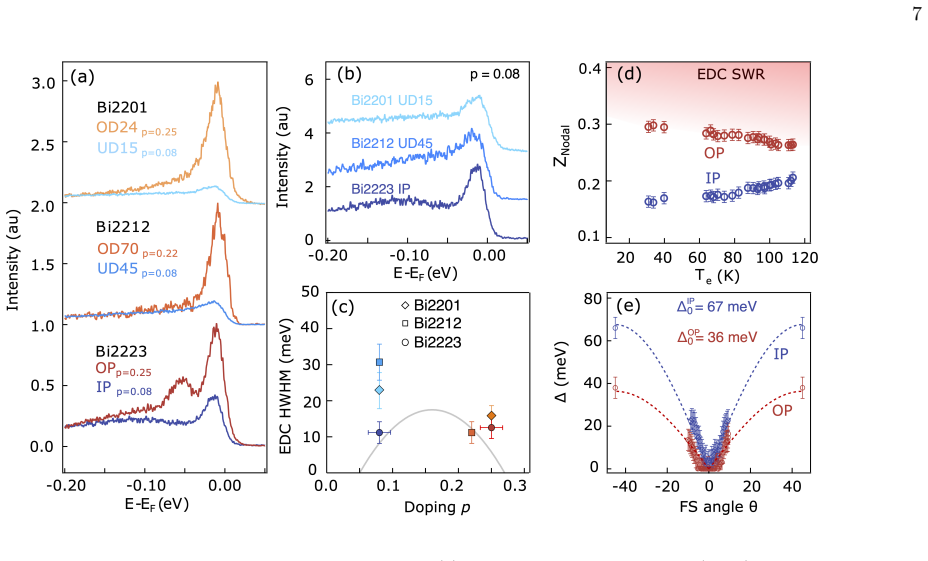
On its own terms, the paper establishes that the inner and outer CuO$_2$ planes of Bi2223 do not behave like independent copies of the cuprate phase diagram. The inner plane carries a small Fermi surface ($p = 0.08 \pm 0.02$), a superconducting gap of $\Delta^{\mathrm{IP}}_0 \approx 67$ meV, and — as shown by a sign change in the pump-induced spectral-weight response at Fermi-surface angles beyond $\pm 6^\circ$ from the node — short-range charge order at $Q \simeq 0.33$ r.l.u. that is confirmed by resonant X-ray scattering. Despite being underdoped, this plane has a quasiparticle residue and scattering rate comparable to the overdoped outer planes, and suppressing the charge-order fluctuations with the pump raises its coherence further toward the outer-plane value. The paper interprets these observations as evidence for an interlayer mechanism: the overdoped outer planes ($p=0.25 \pm 0.02$, $\Delta^{\mathrm{OP}}_0 \approx 36$ meV) gain pairing strength from the strongly paired inner plane, while the inner plane gains coherence from its proximity to the metallic, overdoped layers. Three-layer Hubbard calculations with layer-resolved dopings reproduce the qualitative pattern — inner-plane gap larger, outer-plane gap slightly enhanced over a single layer at the same doping — and the paper concludes that this proximity effect underlies the record $T_c$ of Bi2223.
Load-bearing premise
The entire layer-selective story depends on the premise that the momentum-dependent spectral-weight change seen by time-resolved photoemission is caused by short-range charge order living specifically on the inner plane, because the X-ray scattering data that confirm the charge-order wavevector are not layer-resolved and no temperature-dependent charge-order measurement is shown.
Editorial extensions
If this is right
- The underdoped inner plane should not be modeled as an incoherent bad metal: its sharp quasiparticle peak is presented as a genuine, proximity-induced property rather than a violation of underdoped physics.
- The outer-plane gap of about 36 meV, larger than in comparably doped Bi2212, is taken as evidence that strong pairing leaks from the inner plane outward, so a microscopic theory of Bi2223 must reproduce this overshoot.
- The pump-induced increase of nodal spectral weight, opposite to the ubiquitous suppression in single- and bilayer cuprates, marks short-range charge order as a coherence-suppressing fluctuation whose melting can be followed in real time.
- Optimizing $T_c$ in cuprates may require engineering an intralayer-unit-cell doping imbalance rather than tuning one uniform doping, consistent with the empirical record of multilayers.
Reading between the lines
- Editorial inference: the mechanism is directly testable by a temperature-dependent RXS sweep over the same electronic temperatures used in the tr-ARPES; if the $Q \simeq 0.33$ r.l.u. signal does not melt as inner-plane coherence rises, the charge-order attribution would need revision.
- Editorial inference: reading the paper as a design rule suggests that alternating strongly and weakly correlated layers in other oxide heterostructures should raise $T_c$, with the testable prediction that adding more underdoped inner layers increases the gain.
- Editorial inference: because the paper treats charge-order fluctuations as a competitor to the proximity-enhanced coherence, weakening the order — by strain, disorder, or magnetic field — should further increase the inner-plane quasiparticle weight at low temperature, a control not included in the current dataset.
Signed reviews
Editorial analysis
A structured set of objections, weighed in public.
Referee Report
Summary. This manuscript presents tr-ARPES and RXS measurements on trilayer Bi2223 and argues that the inner CuO2 plane (IP), at estimated doping p≈0.08, hosts short-range charge order at Q≈0.33 r.l.u., an underdoped-like d-wave gap (Δ0≈67 meV), and yet anomalously high quasiparticle coherence comparable to the overdoped outer planes (OP, p≈0.25). The pump-induced spectral-weight dynamics show a nodal increase and off-nodal decrease for the IP, interpreted as melting of CO, while the OP response is different. Complementary three-layer Hubbard calculations using CRISB reproduce the layer-resolved Fermi-surface and gap hierarchy and find a small interlayer enhancement of IP coherence and OP pairing. The authors conclude that interlayer proximity between underdoped and overdoped planes simultaneously optimizes pairing strength and phase coherence, providing a microscopic explanation for the record Tc of Bi2223.
Significance. If the layer-selective CO and interlayer-coherence mechanism are correct, the paper provides a new experimental window into why trilayer cuprates have the highest Tc: it would reconcile a strongly paired underdoped inner plane with a phase-coherent, overdoped outer plane. The strengths are the combination of layer-resolved tr-ARPES with RXS confirmation of a CO-like wavevector, the systematic extraction of quasiparticle weight and scattering rates, and the transparent theoretical comparison. The CRISB calculation is not fitted to the measured Z or gap values, so the comparison is not circular; it independently yields the correct layer-resolved Fermi-surface and gap hierarchy, and it openly states its quantitative limitations. The main value of the paper is the formulation of a precise, falsifiable scenario rather than a completed quantitative proof of the mechanism.
major comments (3)
- [Layer-resolved correlations and superconductivity: theoretical perspective] The central mechanistic claim—interlayer proximity increases IP coherence and OP pairing—rests on the CRISB results in Fig. 5, but the quantitative support is acknowledged to be small: the IP Z enhancement is "small (a few percent)", the OP gap enhancement is "quantitatively small", and the Methods state that the model "does not aim at a quantitative description of the experimental results". The experimental anomaly is large: the IP and OP HWHM are equivalent in Fig. 4(c), and the IP Z rises toward the OP value with temperature in Fig. 4(d). A few-percent effect in a model that explicitly disclaims quantitative accuracy does not demonstrate that interlayer coupling is the origin of the observed exceptional IP coherence. The authors need either a calculation capable of producing a larger effect (for example, including interlayer correlations beyond the present static embedding) or a quantitative bound on the enhancement from interlayer coupling, and the abstract and Discussion must be moderated to the level of the presented evidence.
- [Layer-dependent quasiparticle weight and pairing gap] The comparison in Fig. 4(a–c) of the Bi2223 IP with underdoped Bi2201 and Bi2212 is not a controlled test of interlayer proximity. As the paper notes in the introduction, the IP is "screened from inhomogeneities in the spacer layers", while the Fermi-surface sheets measured in Bi2201 and Bi2212 are associated with CuO2 planes in direct contact with the (BiO)2 spacer layers. Spacer-layer disorder is a known source of quasiparticle broadening and incoherence in underdoped cuprates, so the higher coherence of the Bi2223 IP could reflect reduced structural disorder rather than proximity to the overdoped OP. This alternative is not addressed or excluded in the manuscript. The central claim that "it is the proximity of the IP to the OP that is responsible for its sharp spectral features" therefore needs either a control experiment or a quantitative disorder model before it can be regarded as established.
- [Observation of layer-selective charge order by tr-ARPES and RXS] The layer attribution of the charge order is underdetermined. The RXS signal at Q≈0.33 r.l.u. in Fig. 3(c) is not layer-resolved; it demonstrates that the sample contains short-range CO with that wavevector, but it cannot show that the order resides on the IP. The assignment rests on the interpretation of the momentum-dependent tr-ARPES spectral-weight crossover around the node as the signature of a reconstructed IP Fermi surface (Fig. 3(b)), an interpretation that is plausible but not directly verified. Moreover, no temperature-dependent CO measurement is shown; the claim that the pump-induced Z increase is due to CO melting would be strongly supported by temperature-dependent RXS (for example, peak intensity versus T) or by a pump-probe RXS experiment. Without such evidence, the "layer-selective" charge-order narrative and the inference that CO fluctuations suppress IP coherence are not uniquely established.
minor comments (4)
- [Layer-dependent quasiparticle weight and pairing gap] The normalization of the EDCs in Fig. 4(a,b) is not fully transparent: the overdoped spectra are scaled to the QP peak height and the underdoped backgrounds are "scaled to match". This procedure can exaggerate or suppress apparent linewidth differences; the raw spectra, or an explicit statement of the scaling factors, should be provided.
- [Layer-dependent quasiparticle weight and pairing gap] The definition Z=∫_{−0.025}^{∞} I(k_F,ω)dω / ∫_{−∞}^{∞}I(k_F,ω)dω in Fig. 4(d) depends on the choice of integration window lower bound; the sensitivity of the extracted Z values and of the temperature trend to this bound should be reported or cited from the Supplementary Material.
- [Layer-resolved correlations and superconductivity: theoretical perspective] There is a typo in the text: "upong including" should read "upon including".
- [Layer-dependent quasiparticle weight and pairing gap] The doping values p=0.08±0.02 and p=0.25±0.02 and the gap amplitudes Δ0=67 meV and 36 meV are quoted in the main text without specifying the extraction procedure; a short pointer to the relevant Supplementary Material sections for each quantity would improve reproducibility.
Circularity Check
No circular reduction: the interlayer mechanism is an independent model output; only minor, non-load-bearing self-citations appear.
full rationale
I find no step where a 'prediction' or 'first-principles result' is equivalent to an input by construction. The inner-plane/outer-plane doping assignment rests on direct Fermi-surface volume measurements, the larger inner-plane gap is measured independently, and the charge-order signal is observed in RXS at Q≈0.33 r.l.u. The CRISB calculation uses a fixed three-layer Hubbard Hamiltonian (t, t′=−0.35t, t⊥=−0.1t, U=11.1t, ε_IP=−1.2t) and outputs layer-resolved quasiparticle weights and d-wave gaps; the interlayer enhancement of IP coherence and OP pairing is a model result, not a parameter fitted to the measured Z or gap values. The authors even state the calculated enhancement is 'small (a few percent)' and that the approach 'does not aim at a quantitative description of the experimental results,' which is a quantitative limitation rather than a circularity. The layer-selective CO interpretation is weakened because the RXS is not layer-resolved and no temperature-dependent CO measurement is shown, but this is an empirical-interpretation gap, not a self-referential reduction. The self-citations that do appear—the Z-extraction procedure of Ref. 4, the CRISB formalism of Refs. 35–36, the tr-ARPES review [12], and prior CO work [32]—are methodological or comparative and do not assume the paper's conclusions. Score 2 reflects only the presence of minor, non-load-bearing self-citations; the central claim retains independent experimental and theoretical content.
Assumptions & free parameters
free parameters (5)
- epsilon_IP (inner-plane on-site energy) =
-1.2t
- t_perp (interlayer hopping) =
-0.1t
- U (on-site Coulomb repulsion) =
11.1t
- t' (next-nearest-neighbor hopping) =
-0.35t
- Z-integration window lower bound =
-25 meV
assumptions (6)
- standard math The ARPES intensity is proportional to the single-particle spectral function, and MDC width is proportional to Z_k times the imaginary part of the self-energy.
- domain assumption The pump-induced changes in spectral weight can be mapped to an effective electronic temperature T_e.
- domain assumption Charge-order fluctuations enter the incoherent part of the spectral function and suppress the quasiparticle residue Z.
- domain assumption The RXS signal at Q≈0.33 r.l.u. originates from the same charge order that affects the inner plane in ARPES.
- domain assumption The measured Fermi surface areas correspond to inner-plane doping p=0.08 and outer-plane doping p=0.25.
- domain assumption The three-layer single-band Hubbard model with CRISB is a valid representation of the layer-resolved correlations in Bi2223.
Cite this review
Pith. "Pith review of Enhanced coherence and layer-selective charge order in a trilayer cuprate superconductor." pith.science (2026). https://pith.science/paper/XDVCP625
@misc{pith2026250601448,
  author       = {Pith},
  title        = {Pith review of: Enhanced coherence and layer-selective charge order in a trilayer cuprate superconductor},
  year         = {2026},
  howpublished = {\url{https://pith.science/paper/XDVCP625}},
  note         = {Machine review of arXiv:2506.01448}
}
abstract
Trilayer cuprates hold the record for the highest superconducting critical temperatures ($T_{\text{c}}$), yet the underlying mechanism remains elusive. Using time- and angle-resolved photoemission spectroscopy (tr-ARPES), we uncover a striking interplay between charge order, superconducting gap magnitude, and quasiparticle coherence in Bi$_2$Sr$_2$Ca$_2$Cu$_3$O$_{10+\delta}$ (Bi2223). This constitutes ARPES-based evidence of charge order on the inner CuO$_2$ plane, as confirmed via resonant x-ray scattering (RXS); in addition, the same inner plane hosts a superconducting gap significantly larger than that of the overdoped outer planes, firmly establishing it as underdoped. Unexpectedly, despite its underdoped nature, the inner plane also exhibits an exceptional degree of quasiparticle coherence; suppressing charge-order fluctuations further enhances this, making it comparable to that of the overdoped outer planes at elevated electronic temperatures. These findings, supported by complementary three-layer single-band Hubbard calculations, reveal a unique interlayer mechanism in which both pairing strength and phase coherence are optimized when interfacing planes with distinct hole concentrations, providing new microscopic insight into the record $T_{\text{c}}$ of Bi2223.
Figures


Figures from the paper (2 more)

Forward citations
Cited by 2 Pith papers
-
Ghost-RISB for Correlated Electron-Phonon Systems: Application to the Hubbard-Holstein Model
Ghost-RISB is generalized to electron-phonon systems and reproduces DMFT benchmarks on the Hubbard-Holstein model, showing that superconducting order is suppressed by a phonon-overlap (Franck-Condon) factor in the bip...
-
Direct minimization versus iterative embedding in the ghost-Gutzwiller method: a comparative study of magnetism in Mott insulators
Iterative ghost-Gutzwiller embedding fails for symmetry-invariant Mott insulators under Zeeman field, while direct minimization of the variational functional yields a stable partially polarized paramagnet.
Reference graph
Works this paper leans on
- [1]
-
[2]
M. Hashimoto, I. M. Vishik, R. H. He, T. P. Devereaux, and Z. X. Shen, Energy gaps in high-transition-temperature cuprate superconductors,Nat. Phys.10, 483 (2014)
work page 2014
-
[3]
D. L. Feng, D. H. Lu, K. M. Shen, C. Kim, H. Eisaki, A. Damascelli, R. Yoshizaki, J. I. Shimoyama, K. Kishio, G. D. Gu, S. Oh, A. Andrus, J. O’Donnell, J. N. Eckstein, and Z. X. Shen, Signature of superfluid density in the single-particle excitation spectrum of Bi 2Sr2CaCu2O(8+δ),Science289, 277 (2000)
work page 2000
-
[4]
D. Fournier, G. Levy, Y. Pennec, J. L. McChesney, A. Bostwick, E. Rotenberg, R. Liang, W. N. Hardy, D. A. Bonn, I. S. Elfimov, and A. Damascelli, Loss of nodal quasiparticle integrity in underdoped YBa 2Cu3O6+x,Nat. Phys.6, 905 (2010)
work page 2010
-
[5]
V. J. Emery and S. A. Kivelson, Importance of phase fluctuations in superconductors with small superfluid density,Nature 374, 434 (1995)
work page 1995
-
[6]
A. Trokiner, L. Le Noc, J. Schneck, A. M. Pougnet, R. Mellet, J. Primot, H. Savary, Y. M. Gao, and S. Aubry, 17O nuclear- magnetic-resonance evidence for distinct carrier densities in the two types of CuO 2 planes of (Bi,Pb)2Sr2Ca2Cu3Oy,Phys. Rev. B44, 2426 (1991)
work page 1991
-
[7]
H. Kotegawa, Y. Tokunaga, K. Ishida, G. Q. Zheng, Y. Kitaoka, K. Asayama, H. Kito, A. Iyo, H. Ihara, K. Tanaka, K. Tokiwa, and T. Watanabe, NMR study of carrier distribution and superconductivity in multilayered high-Tc cuprates, J. Phys. Chem. Solids62, 171 (2001)
work page 2001
-
[8]
Kivelson, Making high T C higher: a theoretical proposal,Phys
S. Kivelson, Making high T C higher: a theoretical proposal,Phys. B Condens. Matter318, 61 (2002)
work page 2002
Show all 44 references
-
[9]
E. Berg, D. Orgad, and S. A. Kivelson, Route to high-temperature superconductivity in composite systems,Phys. Rev. B 78, 1 (2008)
2008
-
[10]
Oliviero, S
V. Oliviero, S. Benhabib, I. Gilmutdinov, B. Vignolle, L. Drigo, M. Massoudzadegan, M. Leroux, G. L. Rikken, A. Forget, 11 D. Colson, D. Vignolles, and C. Proust, Magnetotransport signatures of antiferromagnetism coexisting with charge order in the trilayer cuprate HgBa 2Ca2Cu...
2022
-
[11]
Kunisada, S
S. Kunisada, S. Isono, Y. Kohama, S. Sakai, C. Bareille, S. Sakuragi, R. Noguchi, K. Kurokawa, K. Kuroda, Y. Ishida, S. Adachi, R. Sekine, T. K. Kim, C. Cacho, S. Shin, T. Tohyama, K. Tokiwa, and T. Kondo, Observation of small Fermi pockets protected by clean CuO 2 sheets of a...
2020
-
[12]
Boschini, M
F. Boschini, M. Zonno, and A. Damascelli, Time-resolved ARPES studies of quantum materials,Rev. Mod. Phys.96, 015003 (2024)
2024
-
[13]
Comin and A
R. Comin and A. Damascelli, Resonant X-Ray Scattering Studies of Charge Order in Cuprates, Annu. Rev. Condens. Matter Phys.7, 369 (2016)
2016
-
[14]
Frano, S
A. Frano, S. Blanco-Canosa, B. Keimer, and R. J. Birgeneau, Charge ordering in superconducting copper oxides,J. Phys. Condens. Matter32(2020)
2020
-
[15]
D. L. Feng, A. Damascelli, K. M. Shen, N. Motoyama, D. H. Lu, H. Eisaki, K. Shimizu, J.-I. Shimoyama, K. Kishio, N. Kaneko, M. Greven, G. D. Gu, X. J. Zhou, C. Kim, F. Ronning, N. P. Armitage, and Z.-X. Shen, Electronic Structure of the Trilayer Cuprate Superconductor Bi 2Sr2C...
2002
-
[16]
T. Sato, H. Matsui, S. Nishina, T. Takahashi, T. Fujii, T. Watanabe, and A. Matsuda, Low Energy Excitation and Scaling in Bi2Sr2Can−1CunO2n+4: Angle-Resolved Photoemission Spectroscopy,Phys. Rev. Lett.89, 067005 (2002)
2002
-
[17]
M¨ uller, C
R. M¨ uller, C. Janowitz, M. Schneider, R.-S. Unger, A. Krapf, H. Dwelk, A. M¨ uller, L. Dudy, R. Manzke, C. Ast, and H. H¨ ochst, Fermi Surface and Superconducting Gap of Triple-Layered Bi2Sr2Ca2Cu3O10+δ,J. Supercond.15, 147 (2002)
2002
-
[18]
Ideta, K
S. Ideta, K. Takashima, M. Hashimoto, T. Yoshida, A. Fujimori, H. Anzai, T. Fujita, Y. Nakashima, A. Ino, M. Arita, H. Namatame, M. Taniguchi, K. Ono, M. Kubota, D. H. Lu, Z. X. Shen, K. M. Kojima, and S. Uchida, Enhanced superconducting gaps in the trilayer high-temperature B...
2010
-
[19]
Ideta, T
S. Ideta, T. Yoshida, M. Hashimoto, A. Fujimori, H. Anzai, A. Ino, M. Arita, H. Namatame, M. Taniguchi, K. Takashima, K. M. Kojima, and S. Uchida, Effect of electron-phonon coupling in the ARPES spectra of the tri-layer cuprate Bi2Sr2Ca2Cu3O10+δ,J. Phys. Conf. Ser.428(2013)
2013
-
[20]
X. Luo, H. Chen, Y. Li, Q. Gao, C. Yin, H. Yan, T. Miao, H. Luo, Y. Shu, Y. Chen, C. Lin, S. Zhang, Z. Wang, F. Zhang, F. Yang, Q. Peng, G. Liu, L. Zhao, Z. Xu, T. Xiang, and X. J. Zhou, Electronic origin of high superconducting critical temperature in trilayer cuprates,Nat. P...
2023
-
[21]
Kunisada, S
S. Kunisada, S. Adachi, S. Sakai, N. Sasaki, M. Nakayama, S. Akebi, K. Kuroda, T. Sasagawa, T. Watanabe, S. Shin, and T. Kondo, Observation of Bogoliubov Band Hybridization in the Optimally Doped Trilayer Bi 2Sr2Ca2Cu3O10+δ,Phys. Rev. Lett.119, 217001 (2017)
2017
-
[22]
Damascelli, Z
A. Damascelli, Z. Hussain, and Z.-X. Shen, Angle-resolved photoemission studies of the cuprate superconductors,Rev. Mod. Phys.75, 473 (2003)
2003
-
[23]
Damascelli, Probing the Electronic Structure of Complex Systems by ARPES, Phys
A. Damascelli, Probing the Electronic Structure of Complex Systems by ARPES, Phys. Scr.T109, 61 (2004)
2004
-
[24]
J. A. Sobota, Y. He, and Z.-X. Shen, Angle-resolved photoemission studies of quantum materials,Rev. Mod. Phys.93, 025006 (2021)
2021
-
[25]
S. K. Y. Dufresne, S. Zhdanovich, M. Michiardi, B. G. Guislain, M. Zonno, V. Mazzotti, L. O’Brien, S. Kung, G. Levy, A. K. Mills, F. Boschini, D. J. Jones, and A. Damascelli, A versatile laser-based apparatus for time-resolved ARPES with micro-scale spatial resolution,Rev. Sci...
2024
-
[26]
S. Smit, E. Mauri, L. Bawden, F. Heringa, F. Gerritsen, E. van Heumen, Y. K. Huang, T. Kondo, T. Takeuchi, N. E. Hussey, M. Allan, T. K. Kim, C. Cacho, A. Krikun, K. Schalm, H. Stoof, and M. S. Golden, Momentum-dependent scaling exponents of nodal self-energies measured in str...
2024
-
[27]
Zonno, F
M. Zonno, F. Boschini, and A. Damascelli, Time-resolved ARPES on cuprates: Tracking the low-energy electrodynamics in the time domain,J. Electron Spectros. Relat. Phenomena251, 147091 (2021)
2021
-
[28]
Zonno, F
M. Zonno, F. Boschini, E. Razzoli, S. K. Dufresne, M. Michiardi, M. X. Na, T. M. Pedersen, S. Gorovikov, S. Gonzalez, G. Di Santo, L. Petaccia, M. Schneider, D. Wong, P. Dosanjh, Y. Yoshida, H. Eisaki, R. D. Zhong, J. A. Schneeloch, G. D. Gu, A. K. Mills, S. Zhdanovich, G. Lev...
2021
-
[29]
J. Graf, C. Jozwiak, C. L. Smallwood, H. Eisaki, R. A. Kaindl, D. H. Lee, and A. Lanzara, Nodal quasiparticle meltdown in ultrahigh-resolution pump-probe angle-resolved photoemission, Nat. Phys.7, 805 (2011)
2011
-
[30]
Hunter, S
A. Hunter, S. Beck, E. Cappelli, F. Margot, M. Straub, Y. Alexanian, G. Gatti, M. D. Watson, T. K. Kim, C. Cacho, N. C. Plumb, M. Shi, M. Radovi´ c, D. A. Sokolov, A. P. Mackenzie, M. Zingl, J. Mravlje, A. Georges, F. Baumberger, and A. Tamai, Fate of Quasiparticles at High Te...
2023
-
[31]
ˇSkrlec and R
A. ˇSkrlec and R. Hlubina, Temperature dependence of the quasiparticle weight in metals with local self-energy, Phys. Rev. B110, 1 (2024)
2024
-
[32]
Comin, A
R. Comin, A. Frano, M. M. Yee, Y. Yoshida, H. Eisaki, E. Schierle, E. Weschke, R. Sutarto, F. He, A. Soumyanarayanan, Y. He, M. Le Tacon, I. S. Elfimov, J. E. Hoffman, G. A. Sawatzky, B. Keimer, and A. Damascelli, Charge Order Driven by Fermi-Arc Instability in Bi 2Sr2−xLaxCuO...
2014
-
[33]
J. He, C. R. Rotundu, M. S. Scheurer, Y. He, M. Hashimoto, K. J. Xu, Y. Wang, E. W. Huang, T. Jia, S. Chen, B. Moritz, D. Lu, Y. S. Lee, T. P. Devereaux, and Z.-X. Shen, Fermi surface reconstruction in electron-doped cuprates without antiferromagnetic long-range order,Proc. Na...
2019
-
[34]
Boschini, M
F. Boschini, M. Minola, R. Sutarto, E. Schierle, M. Bluschke, S. Das, Y. Yang, M. Michiardi, Y. C. Shao, X. Feng, S. Ono, R. D. Zhong, J. A. Schneeloch, G. D. Gu, E. Weschke, F. He, Y. D. Chuang, B. Keimer, A. Damascelli, A. Frano, and E. H. da Silva Neto, Dynamic electron cor...
2021
-
[35]
Lechermann, A
F. Lechermann, A. Georges, G. Kotliar, and O. Parcollet, Rotationally invariant slave-boson formalism and momentum dependence of the quasiparticle weight, Phys. Rev. B76, 155102 (2007)
2007
-
[36]
Isidori and M
A. Isidori and M. Capone, Rotationally invariant slave bosons for strongly correlated superconductors, Phys. Rev. B80, 115120 (2009)
2009
-
[37]
Kurokawa, S
K. Kurokawa, S. Isono, Y. Kohama, S. Kunisada, S. Sakai, R. Sekine, M. Okubo, M. D. Watson, T. K. Kim, C. Cacho, S. Shin, T. Tohyama, K. Tokiwa, and T. Kondo, Unveiling phase diagram of the lightly doped high-tc cuprate supercon- ductors with disorder removed, Nature Communica...
2023
-
[38]
S.-D. Chen, M. Hashimoto, Y. He, D. Song, K.-J. Xu, J.-F. He, T. P. Devereaux, H. Eisaki, D.-H. Lu, J. Zaanen, and Z.-X. Shen, Incoherent strange metal sharply bounded by a critical doping in Bi2212.,Science366, 1099 (2019)
2019
-
[39]
Berben, S
M. Berben, S. Smit, C. Duffy, Y.-T. Hsu, L. Bawden, F. Heringa, F. Gerritsen, S. Cassanelli, X. Feng, S. Bron, E. van Heumen, Y. Huang, F. Bertran, T. K. Kim, C. Cacho, A. Carrington, M. S. Golden, and N. E. Hussey, Superconducting dome and pseudogap endpoint in Bi2201,Phys. R...
2022
-
[40]
T. J. Reber, X. Zhou, N. C. Plumb, S. Parham, J. A. Waugh, Y. Cao, Z. Sun, H. Li, Q. Wang, J. S. Wen, Z. J. Xu, G. Gu, Y. Yoshida, H. Eisaki, G. B. Arnold, and D. S. Dessau, A unified form of low-energy nodal electronic interactions in hole-doped cuprate superconductors,Nat. C...
2019
-
[41]
Boschini, E
F. Boschini, E. H. Da Silva Neto, E. Razzoli, M. Zonno, S. Peli, R. P. Day, M. Michiardi, M. Schneider, B. Zwartsenberg, P. Nigge, R. D. Zhong, J. Schneeloch, G. D. Gu, S. Zhdanovich, A. K. Mills, G. Levy, D. J. Jones, C. Giannetti, and A. Damascelli, Collapse of superconducti...
2018
-
[42]
de’ Medici, G
L. de’ Medici, G. Giovannetti, and M. Capone, Selective mott physics as a key to iron superconductors, Phys. Rev. Lett. 13 112, 177001 (2014)
2014
-
[43]
Mazza, A
G. Mazza, A. Amaricci, and M. Capone, Interface and bulk superconductivity in superconducting heterostructures with enhanced critical temperatures, Phys. Rev. B103, 094514 (2021)
2021
-
[44]
C.-t. Kuo, M. Hashimoto, H. Lee, T. T. Huynh, A. Maciel, Z. Zhang, D. Zhang, B. Edwards, F. Kazemifar, C.-C. Kao, D. Lu, and J.-s. Lee, Introducing new resonant soft x-ray scattering capability in SSRL, ArXiv:2501.05526 (2025), 2501.05526. Methods ARPES Equilibrium ARPES measu...
2025
Reviewed August 7, 2026 · model on record in the stance chip above.
Discussion (0). Continue with ORCID to comment.