REVIEW 3 major objections 5 minor 46 references
Disentangling axion-like particle couplings to nucleons via a delayed signal in Super-Kamiokande from a future supernova
T0 review · 3 major / 5 minor · reviewed 2026-08-10 · deepseek-v4-flash
Pith's one-line read Axion-like particles from a future galactic supernova would scatter off protons in water and produce a delayed, easily identifiable photon signal near 30 MeV in Super-Kamiokande.
desk verdict A promising delayed ALP signal in SK with a real low-mass problem: the claimed reach below ~10^-3 MeV is built on a quiescent background that does not apply during the SN neutrino burst. read the letter →
The pith
A machine-rendered reading of the paper's core claim, the machinery that carries it, and where it could break.
The reading
What carries the argument
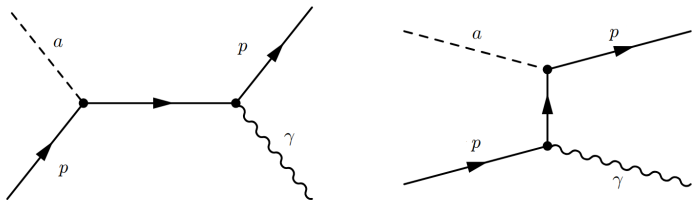
The load-bearing object is the scattering process $a\,p\to p\,\gamma$ and its differential cross section, Eq. (4), which converts an incoming ALP into a photon of energy $E_\gamma\sim E_a$ through proton intermediate states. The kinematics of this two-body process fix the photon energy for a given ALP energy, and the ALP's nonzero mass makes its time of flight energy-dependent, so the whole ALP package arrives in a delayed window $\Delta t_a$ proportional to $(d_{\rm SN}/1\,{\rm kpc})(m_a/0.1\,{\rm MeV})^2$. That time window, combined with the low background in the reconstructed-energy region 16--78 MeV, sets the sensitivity through the significance condition $N_\gamma \ge \max\left(2,\,2\sqrt{\bar{n}_{\rm bkg}\Delta t_a}\right)$. The second object is the oxygen de-excitation channel at ~7 MeV, which depends on both proton and neutron couplings and provides the complementary handle for disentangling the two couplings.
What would settle it
A first-principles or measured value of the $a\,p\to p\,\gamma$ cross section at ALP energies of tens of MeV that differs substantially from Eq. (4) — for example because nuclear binding in oxygen or proton form factors change the amplitude — would shift the predicted photon rates and the probed coupling region by the same factor; a concrete check is to recompute the cross section including the proton's electromagnetic form factors and in-medium corrections for protons in water, and then compare the resulting event spectrum in the 16--78 MeV window with the paper's predictions.
Extended reading notes
Core claim
The central claim is that a future galactic supernova would act as an ALP factory whose ALPs, after a delayed flight, would be detected through $a\,p\to p\,\gamma$ scattering on free protons in water, with a photon spectrum peaking around 30 MeV where the Super-Kamiokande background is very small. The authors compute the ALP flux from an 18 solar-mass progenitor using production via nucleon-nucleon bremsstrahlung and pion-ALP conversion, including trapping and absorption in the proto-neutron star, and convolve it with the proton scattering cross section. They find that a supernova at 1 kpc would let Super-Kamiokande and Hyper-Kamiokande probe the previously unexcluded region between SN 1987A cooling and event bounds, SNO solar-axion limits, and the diffuse galactic ALP flux; at 10 kpc the probed region shrinks but remains substantial, and the most distant observable supernova would be around 100 kpc. They also show the SN 1987A signal in this channel would have been too weak to constrain.
Load-bearing premise
The prediction assumes that the $a\,p\to p\,\gamma$ squared amplitude taken from the companion paper correctly describes ALP scattering on free protons in water at these energies; the paper does not re-derive that amplitude, and every event-rate and sensitivity result scales with it.
Editorial extensions
If this is right
- A galactic supernova at 1 kpc would allow Super-Kamiokande to probe ALP masses from $10^{-4}$ MeV to 1 MeV and couplings from $3\times 10^{-6}$ to $4\times 10^{-5}$, filling the gap between existing SN 1987A, SNO, and diffuse-flux bounds.
- Hyper-Kamiokande, with roughly eight times the fiducial mass, extends the reach toward smaller couplings.
- The $a\,p\to p\,\gamma$ channel is purely proton-coupled, so a detected ~30 MeV peak would establish that ALPs couple to protons.
- Combining the ~30 MeV peak with the ~7 MeV oxygen de-excitation peak, whose rate depends on both couplings, would let the two couplings be extracted separately.
- The SN 1987A data would not have seen this signal: even in the most favorable case the significance would have been only $Z\simeq 0.5$.
Reading between the lines
- Because the delay scales as $m_a^2$ and can reach years for the lightest masses at kiloparsec distances, the observable mass range depends on the experiment's lifetime; a detector that starts taking data only after the neutrino burst would still capture most of the ALP package, while one decommissioned before the package arrives would miss it entirely.
- The same time-of-flight delay could confirm an ALP interpretation independently of the overall rate: the photon arrival times should track $E_a^{-2}$ with a single mass parameter, a correlation that is testable event by event.
- If a future supernova produces both peaks, the ratio of the 30 MeV to 7 MeV photon rates would directly measure $g_{ap}^2$ relative to the combination of $g_{ap}$ and $g_{an}$ entering oxygen excitation, turning a single event into a coupling-ratio measurement.
Editorial analysis
A structured set of objections, weighed in public.
Referee Report
Summary. The paper proposes a new search channel for sub-MeV axion-like particles (ALPs) from a future galactic core-collapse supernova in water Cherenkov detectors, via the process a p -> p gamma on free protons. It computes the ALP flux from an 18 solar-mass proto-neutron-star model at 1 s post-bounce, convolves it with the cross section imported from the authors' companion paper, and estimates photon event rates in Super-Kamiokande and Hyper-Kamiokande in a reconstructed-energy window E_rec = [16, 78] MeV. The paper claims that a SN within about 100 kpc would allow probing ALP masses between 10^-4 MeV and 1 MeV and ALP-proton couplings between 3 x 10^-6 and 4 x 10^-5, and that combining this proton-only signal with the oxygen de-excitation signal around 7 MeV would disentangle the ALP-proton and ALP-neutron couplings.
Significance. If the calculation holds, this is a valuable phenomenological forecast: the delayed, roughly 30 MeV photon signal sits in a low-background window, and its exclusive dependence on the proton coupling is a genuinely useful complement to the oxygen channel. The paper is explicit about its modeling choices and identifies a concrete region of parameter space between existing bounds, so it gives falsifiable predictions for SK and HK observing strategies. The main quantitative claims are not yet established, however, because of the validity of the background assumption at low masses, the unvalidated central amplitude, and the only qualitative treatment of the coupling-disentangling procedure.
major comments (3)
- [§III.1, Eqs. (7)–(11), Fig. 4] Section III.1, Eqs. (7)–(11) and Fig. 4: the claimed probed region extends down to m_a = 10^-4 MeV, but the detection criterion in Eq. (10) is not valid there. Using Eq. (7) with E_high = 78 MeV and d_SN = 1 kpc gives a first-ALP arrival time t0_a ≈ 0.08 s for m_a = 10^-4 MeV, and Eq. (11) gives Δt_a ≈ 1.9 s; for m_a = 10^-3 MeV the corresponding numbers are ≈ 8 s and ≈ 190 s. Both windows overlap with the ~10–20 s burst of SN neutrinos that a galactic supernova will produce, during which Super-Kamiokande will record a large number of inverse-beta-decay and other events in E_rec ∈ [16, 78] MeV. The background rate nbar_bkg = 9.38 × 10^-7 s^-1 is the quiescent DSNB-search rate from Ref. [30] and does not include burst events. Hence Eq. (10) is not a valid 95% C.L. condition for m_a ≲ 10^-3 MeV, and the low-mass portion of the SK/HK regions in Fig. 4 is unsupported; the same caveat applies to the oxygen-channel curves in Fig. 6 via Eq. (12). The analysis should either restrict to masses whose entire arrival window starts after the neutrino burst or include a time-dependent burst-background model.
- [§III, Eq. (4)] Section III, Eq. (4): the whole event-rate calculation is proportional to the squared amplitude for a p → p γ that is imported from the authors' companion paper [29]. The manuscript does not re-derive this amplitude, provide an independent numerical check, or estimate the effect of nuclear binding on protons in water at the energies of interest (E_a ≈ 10–100 MeV). Since any multiplicative error in Eq. (4) directly rescales all predictions in Eqs. (6)–(10) and all contours in Figs. 4 and 6, the derivation or a cross-check of the amplitude should be included, and the free-proton approximation should be justified.
- [§III.2, Fig. 6] Section III.2, Fig. 6: the claimed ability to disentangle g_ap and g_an is only sketched qualitatively. The oxygen-channel sensitivity is obtained by extrapolating Ref. [28] to a fixed ALP energy window [E_low, E_high] = [9.55, 28] MeV, but the paper does not report the oxygen event-rate formula or the systematic uncertainties in the nuclear matrix elements, and Fig. 5 is schematic. To turn the claim into a demonstrated capability, the authors should define a two-coupling likelihood and show, for a representative SN distance and ALP parameters, the expected joint confidence regions or the precision with which each coupling could be extracted.
minor comments (5)
- [Eq. (7)] Eq. (7): the algebraic expression t_a ≃ d_SN m_a^2/(2 E_a) is dimensionally inconsistent; the correct relation is t_a ≃ d_SN m_a^2/(2 E_a^2), which is what the numerical prefactor implements. Please fix the equation.
- [§III.1] Section III.1: the sentence 'we consider E_low_a = 16 MeV and E_low_a = 78 MeV' should read E_low_a = 16 MeV and E_high_a = 78 MeV.
- [§III.1, Eq. (10)] Section III.1, Eq. (10): the criterion Nγ ≥ max[2, 2√(nbar_bkg Δt_a)] is a Gaussian approximation for a Poisson process with small counts; the 95% C.L. boundary should be checked with a Poisson or profile-likelihood treatment wherever Nγ is of order 2.
- [Fig. 5] Fig. 5: because the ordinate is in arbitrary units, the claimed relative size of the oxygen and a p → p γ peaks cannot be verified; a quantitative version with a common scale, or with the ratio stated in the caption, would be more informative.
- [§II] Section II: the forecast is based entirely on a single 18 M_sun profile evaluated at 1 s post-bounce and integrated over 0.5–2 s. A brief statement of how the sensitivity contours would change with a different progenitor mass or a later emission time would materially strengthen the robustness of the claimed reach.
Circularity Check
No circularity: the sensitivity projection is a forward calculation over (m_a, g_ap), and the only inherited ingredient (the a p -> p gamma amplitude from the authors' companion paper) is a derived input rather than the target claim.
full rationale
The derivation chain is: SN ALP flux (Eq. 2) -> differential a p -> p gamma cross section (Eqs. 3-4) -> photon spectrum (Eq. 6) -> event counts -> significance criterion (Eqs. 9-10). Each step is a forward computation. The scan over ALP mass and coupling is an unconstrained grid; no parameter is fitted to the claimed observable region, so the sensitivity contours are genuine predictions rather than restatements of inputs. The most load-bearing imported element is the averaged squared amplitude |M|^2_ap in Eq. (4), which is taken from the same authors' companion paper [29] ('For further details, see Ref. [29]'). This is a real inheritance risk: the present paper does not re-derive or validate the amplitude, and every event rate is proportional to it. But this is a robustness/correctness caveat, not circularity, because the amplitude is an independently stated QFT input and the paper's claim (a delayed ~30 MeV signal observable by SK/HK) is not defined in terms of itself. Similarly, the oxygen de-excitation comparison is imported from Refs. [20,28,32], and the disentangling strategy is a two-channel inversion, not a tautology. The separate concern that for m_a less than about 10^-3 MeV the ALP package overlaps the SN neutrino burst and invalidates the quiescent background rate n_bkg used in Eqs. (9)-(10) is a validity issue about the low-mass reach, not a circularity of the derivation. No circular step can be exhibited from the paper's own equations.
Assumptions & free parameters
free parameters (2)
- SN integration time window (tmin=0.5 s, tmax=2 s) =
0.5-2 s after bounce
- Reconstructed-energy signal window [16,78] MeV =
16-78 MeV
assumptions (6)
- domain assumption Nucleon-nucleon bremsstrahlung and pion-ALP conversion production rates from Refs [11-13,15-17,28] are correct.
- domain assumption The optical depth and gravitational redshift treatment of ALP transport from Refs [21,28] accurately describes ALP escape from the proto-neutron star.
- domain assumption The a p -> p gamma squared amplitude in Eq. (4), taken from the authors' companion paper [29], correctly describes ALP scattering on free protons in water.
- domain assumption The 18 solar mass AGILE-BOLTZTRAN PNS profiles evaluated at 1 s post-bounce are representative of a future galactic core-collapse SN.
- domain assumption SK and HK background rates in the relevant energy windows, from Refs [30,46], and the oxygen de-excitation cross sections from Ref [28], apply to the forecast.
- domain assumption The quantitative sensitivity is computed for a KSVZ-like benchmark with Can=0.
Cite this review
Pith. "Pith review of Disentangling axion-like particle couplings to nucleons via a delayed signal in Super-Kamiokande from a future supernova." pith.science (2026). https://pith.science/paper/XDWQ3HQF
@misc{pith2026241219890,
  author       = {Pith},
  title        = {Pith review of: Disentangling axion-like particle couplings to nucleons via a delayed signal in Super-Kamiokande from a future supernova},
  year         = {2026},
  howpublished = {\url{https://pith.science/paper/XDWQ3HQF}},
  note         = {Machine review of arXiv:2412.19890}
}
abstract
In this work, we show that, if axion-like particles (ALPs) from core-collapse supernovae (SNe) couple to protons, they would produce very characteristic signatures in neutrino water Cherenkov detectors through their scattering off free protons via $a \, p \rightarrow p \, \gamma$ interactions. Specifically, sub-MeV ALPs would generate photons with energies $\sim 30$ MeV, which could be observed by Super-Kamiokande and Hyper-Kamiokande as a delayed signal after a future detection of SN neutrinos. We apply this to a hypothetical neighbouring SN (at a maximum distance of 100 kpc) and demonstrate that the region in the parameter space with ALP masses between $10^{-4}$ MeV and $1$ MeV and ALP-proton couplings in the range $3 \times 10^{-6}-4 \times 10^{-5}$ could be probed. We argue that this new signature, combined with the one expected at $\sim 7$ MeV from oxygen de-excitation, would allow us to disentangle ALP-neutron and ALP-proton couplings.
Figures


Figures from the paper (3 more)


Reference graph
Works this paper leans on
-
[28]
Cross section for supernova axion observation in neutrino water Cherenkov detectors
P. Carenza, G. Co, M. Giannotti, A. Lella, G. Lucente, A. Mirizzi et al.,Cross section for supernova axion observation in neutrino water Čherenkov detectors, Phys. Rev. C109 (2024) 015501 [2306.17055]
work page Pith review arXiv 2024
-
[30]
Super-Kamiokande collaboration, Diffuse supernova neutrino background search at Super-Kamiokande, Phys. Rev. D104 (2021) 122002 [2109.11174]
arXiv 2021
-
[29]
D. Alonso-González, D. Cerdeño, M. Cermeño and A.D. Perez,Probing a diffuse flux of axion-like particles from galactic supernovae with neutrino water Cherenkov detectors, 2412.09595
-
[1]
P. Svrcek and E. Witten,Axions In String Theory, JHEP 06 (2006) 051 [hep-th/0605206]
arXiv 2006
-
[2]
G.B. Gelmini and M. Roncadelli,Left-Handed Neutrino Mass Scale and Spontaneously Broken Lepton Number, Phys. Lett. B99 (1981) 411
work page 1981
-
[3]
A. Davidson and K.C. Wali,Minimal flavor unification via multigenerational peccei-quinn symmetry, Phys. Rev. Lett.48 (1982) 11
work page 1982
-
[4]
Wilczek,Axions and Family Symmetry Breaking, Phys
F. Wilczek,Axions and Family Symmetry Breaking, Phys. Rev. Lett.49 (1982) 1549
work page 1982
- [5]
Show all 46 references
-
[6]
Halverson, C
J. Halverson, C. Long, B. Nelson and G. Salinas,Axion reheating in the string landscape, Phys. Rev. D99 (2019) 086014 [1903.04495]
2019 arXiv
-
[7]
Peccei and H.R
R.D. Peccei and H.R. Quinn,CP conservation in the presence of pseudoparticles, Phys. Rev. Lett. 38 (1977) 1440
1977
-
[8]
Peccei and H.R
R.D. Peccei and H.R. Quinn,Constraints imposed byCP conservation in the presence of pseudoparticles, Phys. Rev. D16 (1977) 1791
1977
-
[9]
Weinberg,A New Light Boson?, Phys
S. Weinberg,A New Light Boson?, Phys. Rev. Lett.40 (1978) 223
1978
-
[10]
Wilczek,Problem of StrongP and T Invariance in the Presence of Instantons, Phys
F. Wilczek,Problem of StrongP and T Invariance in the Presence of Instantons, Phys. Rev. Lett. 40 (1978) 279
1978
-
[11]
Raffelt,Astrophysical methods to constrain axions and other novel particle phenomena, Physics Reports 198 (1990) 1
G.G. Raffelt,Astrophysical methods to constrain axions and other novel particle phenomena, Physics Reports 198 (1990) 1
1990
-
[12]
Raffelt and D
G. Raffelt and D. Seckel,A selfconsistent approach to neutral current processes in supernova cores, Phys. Rev. D52 (1995) 1780 [astro-ph/9312019]
1995 arXiv
-
[13]
Raffelt,Stars as laboratories for fundamental physics: The astrophysics of neutrinos, axions, and other weakly interacting particles(5, 1996)
G.G. Raffelt,Stars as laboratories for fundamental physics: The astrophysics of neutrinos, axions, and other weakly interacting particles(5, 1996)
1996
-
[14]
Fischer, S
T. Fischer, S. Chakraborty, M. Giannotti, A. Mirizzi, A. Payez and A. Ringwald,Probing axions with the neutrino signal from the next galactic supernova, Phys. Rev. D94 (2016) 085012 [1605.08780]
2016 arXiv
-
[15]
Carenza, T
P. Carenza, T. Fischer, M. Giannotti, G. Guo, G. Martínez-Pinedo and A. Mirizzi,Improved axion emissivity from a supernova via nucleon-nucleon bremsstrahlung, JCAP 10 (2019) 016 [1906.11844]
2019 arXiv
-
[16]
Carenza, B
P. Carenza, B. Fore, M. Giannotti, A. Mirizzi and S. Reddy,Enhanced Supernova Axion Emission and its Implications, Phys. Rev. Lett.126 (2021) 071102 [2010.02943]
2021 arXiv
-
[17]
Fischer, P
T. Fischer, P. Carenza, B. Fore, M. Giannotti, A. Mirizzi and S. Reddy,Observable signatures of enhanced axion emission from protoneutron stars, Phys. Rev. D104 (2021) 103012 [2108.13726]
2021 arXiv
-
[18]
Lella, P
A. Lella, P. Carenza, G. Lucente, M. Giannotti and A. Mirizzi,Protoneutron stars as cosmic factories for massive axionlike particles, Phys. Rev. D107 (2023) 103017 [2211.13760]
2023 arXiv
-
[19]
Lucente, L
G. Lucente, L. Mastrototaro, P. Carenza, L. Di Luzio, M. Giannotti and A. Mirizzi,Axion signatures from supernova explosions through the nucleon electric-dipole portal, Phys. Rev. D 105 (2022) 123020 [2203.15812]
2022 arXiv
-
[20]
Lella, P
A. Lella, P. Carenza, G. Co’, G. Lucente, M. Giannotti, A. Mirizzi et al.,Getting the most on supernova axions, Phys. Rev. D109 (2024) 023001 [2306.01048]
2024 arXiv
-
[21]
Carenza,Axion emission from supernovae: a cheatsheet, Eur
P. Carenza,Axion emission from supernovae: a cheatsheet, Eur. Phys. J. Plus138 (2023) 836 [2309.14798]
2023 arXiv
-
[22]
Chakraborty, A
S. Chakraborty, A. Gupta and M. Vanvlasselaer,Photoproduction of heavy QCD axions in supernovae, Phys. Rev. D110 (2024) 063032 [2403.12169]
2024 arXiv
-
[23]
Lella, E
A. Lella, E. Ravensburg, P. Carenza and M.C.D. Marsh,Supernova limits on QCD axionlike particles, Phys. Rev. D110 (2024) 043019 [2405.00153]
2024 arXiv
-
[24]
Burrows, M.S
A. Burrows, M.S. Turner and R.P. Brinkmann,Axions and sn 1987a, Phys. Rev. D39 (1989) 1020
1989
-
[25]
Turner,Axions from sn1987a, Phys
M.S. Turner,Axions from sn1987a, Phys. Rev. Lett.60 (1988) 1797
1988
-
[26]
Raffelt and D
G. Raffelt and D. Seckel,Bounds on exotic-particle interactions from sn1987a, Phys. Rev. Lett. 60 (1988) 1793
1988
-
[27]
Burrows, M.T
A. Burrows, M.T. Ressell and M.S. Turner,Axions and sn 1987a: Axion trapping, Phys. Rev. D 42 (1990) 3297. 11
1990
-
[31]
Hyper-Kamiokande collaboration, Hyper-Kamiokande Design Report, 1805.04163
-
[32]
Engel, D
J. Engel, D. Seckel and A.C. Hayes,Emission and detectability of hadronic axions from SN1987A, Phys. Rev. Lett.65 (1990) 960
1990
-
[33]
Fischer, G
T. Fischer, G. Martínez-Pinedo, M. Hempel and M. Liebendörfer,Neutrino spectra evolution during protoneutron star deleptonization, Phys. Rev. D85 (2012) 083003
2012
-
[34]
Carena and R.D
M. Carena and R.D. Peccei,Effective lagrangian for axion emission from sn 1987a, Phys. Rev. D 40 (1989) 652
1989
-
[35]
Di Luzio, M
L. Di Luzio, M. Giannotti, E. Nardi and L. Visinelli,The landscape of QCD axion models, Phys. Rept. 870 (2020) 1 [2003.01100]
2020 arXiv
-
[36]
Chang and K
S. Chang and K. Choi,Hadronic axion window and the big bang nucleosynthesis, Phys. Lett. B 316 (1993) 51 [hep-ph/9306216]
1993 arXiv
-
[37]
Giannotti and F
M. Giannotti and F. Nesti,Nucleon-nucleon Bremsstrahlung emission of massive axions, Phys. Rev. D72 (2005) 063005 [hep-ph/0505090]
2005 arXiv
-
[38]
Choi, H.J
K. Choi, H.J. Kim, H. Seong and C.S. Shin,Axion emission from supernova with axion-pion-nucleon contact interaction, JHEP 02 (2022) 143 [2110.01972]
2022 arXiv
-
[39]
Collaboration,Review of Particle Physics, PTEP 2022 (2022) 083C01
P.D.G. Collaboration,Review of Particle Physics, PTEP 2022 (2022) 083C01
2022
-
[40]
Kim,Weak Interaction Singlet and Strong CP Invariance, Phys
J.E. Kim,Weak Interaction Singlet and Strong CP Invariance, Phys. Rev. Lett.43 (1979) 103
1979
-
[41]
Shifman, A.I
M.A. Shifman, A.I. Vainshtein and V.I. Zakharov,Can Confinement Ensure Natural CP Invariance of Strong Interactions?, Nucl. Phys. B 166 (1980) 493
1980
-
[42]
Mezzacappa and S.W
A. Mezzacappa and S.W. Bruenn,A Numerical Method for Solving the Neutrino Boltzmann Equation Coupled to Spherically Symmetric Stellar Core Collapse, Astrophys. J. 405 (1993) 669
1993
-
[43]
Liebendoerfer, O.E.B
M. Liebendoerfer, O.E.B. Messer, A. Mezzacappa, S.W. Bruenn, C.Y. Cardall and F.K. Thielemann,A Finite difference representation of neutrino radiation hydrodynamics for spherically symmetric general relativistic supernova simulations, Astrophys. J. Suppl.150 (2004) 263 [astro-...
2004 arXiv
-
[44]
Bhusal, N
A. Bhusal, N. Houston and T. Li,Searching for Solar Axions Using Data from the Sudbury Neutrino Observatory, Phys. Rev. Lett.126 (2021) 091601 [2004.02733]
2021 arXiv
-
[45]
Carenza,Axion Emission And Detection From A Galactic Supernova, Ph.D
P. Carenza,Axion Emission And Detection From A Galactic Supernova, Ph.D. thesis, Bari U., 2018
2018
-
[46]
Super-Kamiokande collaboration, Solar Neutrino Measurements in Super-Kamiokande-IV, Phys. Rev. D94 (2016) 052010 [1606.07538]. 12
2016
Reviewed August 10, 2026 · model on record in the stance chip above.
Discussion (0). Continue with ORCID to comment.