REVIEW 3 major objections 5 minor 54 references
DASH: 4D Hash Encoding with Self-Supervised Decomposition for Real-Time Dynamic Scene Rendering
T0 review · 3 major / 5 minor · reviewed 2026-08-15 · deepseek-v4-flash
Pith's one-line read Self-supervised split lets 4D hash render dynamic scenes at 264 FPS.
desk verdict A well-engineered combination of known pieces with state-of-the-art benchmark numbers on two real-world dynamic datasets; the decomposition threshold is under-specified but not a load-bearing flaw, and the paper deserves serious peer review. read the letter →
The pith
A machine-rendered reading of the paper's core claim, the machinery that carries it, and where it could break.
The reading
What carries the argument
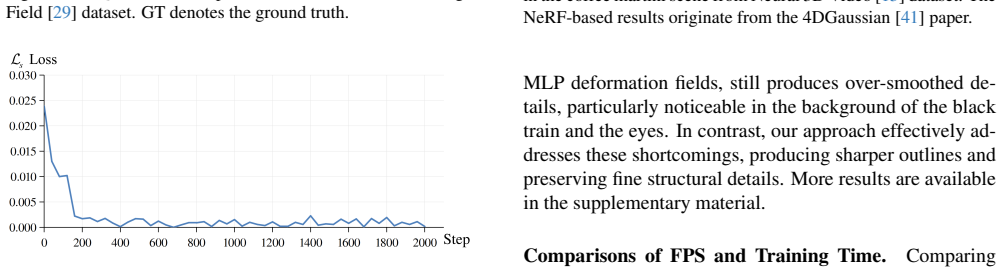
The load-bearing object is the multiresolution 4D hash encoder, a hash grid that maps a 4D coordinate $(p,t)$ to a feature vector through hashing and quadrilinear interpolation, with geometric progression of resolutions and per-dimension prime factors. Its enabling partner is the self-supervised decomposition: a linear motion model $p(t)=p+t\Delta p$ whose predicted displacement magnitude $\|\Delta p\|$ is thresholded at the top $k$ percent to label Gaussians dynamic or static, plus the static constraint $L_s=\frac{1}{N_s}\sum_{p\in G_s}\|\Delta p\|$ that pushes static displacements to zero. The third piece is the spatio-temporal smoothness regularization, which penalizes feature differences under small coordinate perturbations so the explicit hash representation does not produce erratic deformations.
What would settle it
Use a synthetic dynamic scene with a known ground-truth mask of which Gaussians truly move. If any Gaussian with nonzero true velocity has $\|\Delta p\|$ below the chosen top-$k$ threshold throughout training, DASH will classify it static and render it frozen, producing a measurable error at that region; observing such misclassification directly disproves the decomposition's reliability.
Extended reading notes
Core claim
The central discovery is that a dynamic scene can be decomposed into static and dynamic Gaussians without any annotation, by reading each Gaussian's predicted per-unit-time displacement $\Delta p$ from a 3D hash encoder plus a small MLP, and thresholding at the top $k$ percent of displacement magnitudes. Static Gaussians are then frozen and rendered by standard 3D Gaussian splatting, while dynamic Gaussians are deformed by a 4D multiresolution hash encoder that avoids both the low-rank assumption of plane-based methods and the feature overlap of grid-decomposed variants. The method reports that this split, together with decoupled density control and a feature-space smoothness regularization $L_r = \|G_{4D}(x) - G_{4D}(x+\epsilon_x)\|_2^2$, yields state-of-the-art rendering quality and 264 FPS at $1352\times 1014$ resolution on a single 4090 GPU.
Load-bearing premise
The method assumes that the magnitude of the deformation predicted during optimization is a trustworthy measure of true motion, and that one fixed percentile threshold cleanly separates static from dynamic Gaussians; if a moving region is under-predicted at the start, it is frozen as static and never gets the 4D encoding that could fix it.
Editorial extensions
If this is right
- DASH's results imply that explicit 4D hash encoding is a workable alternative to plane-based factorization for dynamic Gaussian splatting, removing the need for the low-rank assumption that causes feature overlap.
- Because only dynamic Gaussians consume 4D hash capacity, scenes with large static backgrounds need far fewer hash entries and suffer fewer collisions, which is why the full model runs faster than plane-based baselines while storing 146 MB.
- The self-supervised decomposition is a portable component: inserting it into a grid-decomposed 4D encoder (Grid4D+dec) raises that model's PSNR on both datasets, suggesting the static/dynamic split itself, not just the encoder, drives part of the gain.
- Real-time 264 FPS rendering at 1352×1014 with about 106.6k Gaussians indicates that dynamic-view synthesis can be fast enough for interactive applications such as VR and film previz.
Reading between the lines
- A stress test the paper does not run: scenes dominated by fast, large-displacement motion, where the top-$k$ threshold could lock slow-moving content into the static set at initialization, after which it never receives 4D encoding and stays frozen; quality would drop most on exactly the regions that matter.
- The linear-motion descriptor $\Delta p$ is only a first-order average speed, so trajectories with reversals or high curvature may be under-modeled; extending the model with a second-order term or per-Gaussian confidence would be a natural test.
- The decomposition also reads as a compression principle: if static Gaussians require no per-frame deformation state, mostly-static scenes should compress well below the reported storage, and the same split could be reused for editing or animation by moving only the dynamic subgraph.
- One could test the decomposition's necessity by measuring the hash-collision rate with and without the split; the paper argues collisions drop because the 4D table covers fewer Gaussians, and that is checkable directly from table statistics.
Signed reviews
Editorial analysis
A structured set of objections, weighed in public.
Referee Report
Summary. This paper proposes DASH, a dynamic scene rendering method based on 3D Gaussian Splatting. The main novelty is a self-supervised static/dynamic decomposition: during optimization, each Gaussian is assigned to the dynamic set if its predicted linear deformation magnitude ||Δp|| exceeds a top-k-percentile threshold τ, and static Gaussians are constrained to have zero deformation. Dynamics are then encoded by a multiresolution 4D hash encoder followed by a multi-head deformation decoder, and a feature-space smoothness regularizer is added to stabilize deformation. Experiments on Neural 3D Video and Technicolor Light Field report state-of-the-art PSNR/SSIM/LPIPS (32.22 dB mean PSNR on Neural 3D Video, 33.94 dB on Technicolor) and real-time rendering at 264 FPS on an RTX 4090. The paper also applies the decomposition to Grid4D (Grid4D+dec) and includes ablations of decomposition, density control, and smoothness regularization.
Significance. If the reported results are reproducible, DASH would be a meaningful advance in real-time dynamic scene rendering: it offers a simple remedy to the feature-overlap and low-rank limitations of plane- and grid-based deformation encoders, and it demonstrates a credible speed/quality tradeoff against recent Gaussian baselines on two standard real-world benchmarks. Strengths include ablations that support the contribution of each component, the transfer of the decomposition idea to Grid4D as an external sanity check, comparison with official codes of baseline methods, and a public code release. However, the central decomposition mechanism is under-specified and the empirical margins over the strongest baselines are small and reported without variance, so the state-of-the-art claim should be treated as conditional until these points are addressed.
major comments (3)
- [Section 4.1, Fig. 3, Table 4] The decomposition threshold τ (the top k% percentile of ||Δp||) is a load-bearing free parameter, but the value of k is never reported and the text does not state when the percentile is computed or whether it is recomputed during optimization. Since the entire accuracy argument depends on which Gaussians are assigned to the 4D hash encoder, the method as described is not fully reproducible. Please report k (and any update schedule), the values of λs and λr, and add a sensitivity study over k (e.g., PSNR versus k, and the resulting fraction of dynamic Gaussians) for at least one scene.
- [Section 4.1, Fig. 6, Fig. 7] The decomposition's correctness is not quantitatively established. The only evidence is the convergence curve of Ls and two qualitative visualizations. Because thresholding uses the model's own deformation predictions, a Gaussian whose motion is underestimated early in training is permanently assigned to the static set and excluded from the 4D hash encoder; this could break on scenes with complex or slow motion. Please add a quantitative robustness study: vary k over a range and report PSNR and the fraction of dynamic Gaussians, and evaluate on a scene (real or synthetic) with known motion or ground-truth masks to measure assignment accuracy.
- [Section 5.2, Tables 1, 2, and 4] The headline gains are small relative to the closest baselines (e.g., 32.22 vs. 31.74 dB on Neural 3D Video; 33.94 vs. 33.04 dB on Technicolor Light Field) and all metrics are single-run, with no standard deviations or repeated training runs. Without variance estimates, it is unclear whether the reported margins exceed optimization noise. Please provide mean ± std over at least three seeds or initializations for the main tables and the ablation, or justify why single runs are sufficient for the state-of-the-art claim.
minor comments (5)
- [Table 1] The last column header reads 'Ours [13]'; the citation [13] belongs to Grid4D and should be removed so the column is simply 'Ours'.
- [Section 5.1] The sentence 'our use COLMAP point clouds from the first frame for initialization' contains a grammatical error; it should be 'we use COLMAP point clouds from the first frame for initialization'.
- [Equation (8)] The bit-wise XOR operator is not defined, and the symbol L is reused for the number of resolution levels and for the total loss; please disambiguate the notation.
- [Figure 2 caption] The caption contains a duplicated word: 'and and the horizontal axis' should be 'and the horizontal axis'.
- [Section 5.1, Implementation Details] The implementation details do not report the hash table sizes T_l, the number of levels L, the feature dimension F, the perturbation scale ε, or the values of λc, λs, and λr; these should be listed in the paper or the supplementary material for reproducibility.
Circularity Check
Benchmark claims are externally validated, but the decomposition's validation is self-referential because the static/dynamic split and the loss Ls both use the model's own predicted ||Delta p||.
-
self definitional
[Section 4.1 (Self-Supervised Dynamic-Static Decomposition) and Section 5.2, Fig. 6 and surrounding text]
"We compute motion magnitudes ||∆p|| for all Gaussians and set a threshold τ at the top k% percentile of these values. Gaussians with ||∆p|| > τ are classified as dynamic Gaussians Gd, while the rest are classified as static Gaussians Gs. ... As shown in Fig. 6, Ls converges rapidly, ensuring stable optimization and accurate identification of static components."
The static/dynamic labels are defined by thresholding the model's own predicted deformation magnitude ||Δp||, and Eq. (5) defines Ls as the average of that same quantity over the static subset. Therefore, Fig. 6's convergence of Ls is not independent evidence of correct decomposition; it only shows that the optimized quantity used to create the labels decreases. The paper presents this convergence as confirmation of 'accurate identification of static components' without external masks, without reporting k, and without any ground-truth motion labels. This is a mild self-referential validation of the decomposition mechanism, though it does not affect the external quality benchmarks.
full rationale
The paper's central claim is state-of-the-art rendering quality and speed on two public benchmarks, evaluated with official baseline code and external datasets, so the headline result is not circular. No fitted parameter is renamed as a prediction, and no uniqueness theorem or load-bearing self-citation forces the method's choice: the only self-citation (Ref. [52]) appears in a survey-style related-work list and is not load-bearing. The one genuinely self-referential element is the self-supervised decomposition: the static/dynamic partition is defined by thresholding the model's own ||Δp||, and the monitor loss Ls is the average of that same quantity, so Fig. 6's convergence cannot by itself validate the decomposition's accuracy. This does not invalidate the benchmark comparisons, which are external, but it does make the decomposition's internal evidence partly tautological. Accordingly, the circularity score is 2 rather than 0.
Assumptions & free parameters
free parameters (6)
- Threshold k for static/dynamic split
- Static constraint weight lambda_s
- Smooth regularization weight lambda_r
- Color loss weight lambda_c
- Hash grid parameters (L, N_min, N_max, T_l, F)
- Perturbation scale epsilon for smoothness regularization
assumptions (5)
- domain assumption Most real dynamic scenes contain large static regions that can be safely removed from the 4D hash table.
- domain assumption The deformation magnitude ||delta_p|| predicted by a 3D hash encoder is a reliable proxy for actual motion.
- ad hoc to paper A linear motion model p(t) = p + t * delta_p is sufficient for decomposition even though real motion is nonlinear.
- domain assumption 3D Gaussian Splatting provides a correct static rendering backbone and its training configuration transfers to dynamic Gaussians.
- domain assumption Spatio-temporal smoothness of encoded features is beneficial and can be imposed by random-perturbation consistency.
Cite this review
Pith. "Pith review of DASH: 4D Hash Encoding with Self-Supervised Decomposition for Real-Time Dynamic Scene Rendering." pith.science (2026). https://pith.science/paper/XDX7BQSD
@misc{pith2026250719141,
  author       = {Pith},
  title        = {Pith review of: DASH: 4D Hash Encoding with Self-Supervised Decomposition for Real-Time Dynamic Scene Rendering},
  year         = {2026},
  howpublished = {\url{https://pith.science/paper/XDX7BQSD}},
  note         = {Machine review of arXiv:2507.19141}
}
read the original abstract
Dynamic scene reconstruction is a long-term challenge in 3D vision. Existing plane-based methods in dynamic Gaussian splatting suffer from an unsuitable low-rank assumption, causing feature overlap and poor rendering quality. Although 4D hash encoding provides an explicit representation without low-rank constraints, directly applying it to the entire dynamic scene leads to substantial hash collisions and redundancy. To address these challenges, we present DASH, a real-time dynamic scene rendering framework that employs 4D hash encoding coupled with self-supervised decomposition. Our approach begins with a self-supervised decomposition mechanism that separates dynamic and static components without manual annotations or precomputed masks. Next, we introduce a multiresolution 4D hash encoder for dynamic elements, providing an explicit representation that avoids the low-rank assumption. Finally, we present a spatio-temporal smoothness regularization strategy to mitigate unstable deformation artifacts. Experiments on real-world datasets demonstrate that DASH achieves state-of-the-art dynamic rendering performance, exhibiting enhanced visual quality at real-time speeds of 264 FPS on a single 4090 GPU. Code: https://github.com/chenj02/DASH.
Figures


Figures from the paper (5 more)




Reference graph
Works this paper leans on
-
[1]
Hyperreel: High-fidelity 6-dof video with ray- conditioned sampling
Benjamin Attal, Jia-Bin Huang, Christian Richardt, Michael Zollhoefer, Johannes Kopf, Matthew O’Toole, and Changil Kim. Hyperreel: High-fidelity 6-dof video with ray- conditioned sampling. In Proceedings of the IEEE/CVF Conference on Computer Vision and Pattern Recognition , pages 16610–16620, 2023. 2, 5, 6, 7
work page 2023
-
[2]
Per-gaussian embedding- based deformation for deformable 3d gaussian splatting
Jeongmin Bae, Seoha Kim, Youngsik Yun, Hahyun Lee, Gun Bang, and Youngjung Uh. Per-gaussian embedding- based deformation for deformable 3d gaussian splatting. In European Conference on Computer Vision , pages 321–335. Springer, 2024. 2, 3, 6, 7
work page 2024
-
[3]
Neural surface reconstruction of dynamic scenes with monocular RGB-D camera
Hongrui Cai, Wanquan Feng, Xuetao Feng, Yan Wang, and Juyong Zhang. Neural surface reconstruction of dynamic scenes with monocular RGB-D camera. Advances in Neural Information Processing Systems, 35:967–981, 2022. 2
work page 2022
-
[4]
HexPlane: A fast representa- tion for dynamic scenes
Ang Cao and Justin Johnson. HexPlane: A fast representa- tion for dynamic scenes. In Proceedings of the IEEE/CVF Conference on Computer Vision and Pattern Recognition , pages 130–141, 2023. 2, 3
work page 2023
-
[5]
Chan, Connor Z
Eric R. Chan, Connor Z. Lin, Matthew A. Chan, Koki Nagano, Boxiao Pan, Shalini De Mello, Orazio Gallo, Leonidas Guibas, Jonathan Tremblay, Sameh Khamis, Tero Karras, and Gordon Wetzstein. Efficient geometry-aware 3D generative adversarial networks. In arXiv, 2021. 2, 3
2021
-
[6]
Spacetime surface regularization for neural dynamic scene reconstruction
Jaesung Choe, Christopher Choy, Jaesik Park, In So Kweon, and Anima Anandkumar. Spacetime surface regularization for neural dynamic scene reconstruction. In Proceedings of the IEEE/CVF International Conference on Computer Vi- sion, pages 17871–17881, 2023. 2
work page 2023
-
[7]
Neural radiance flow for 4D view synthesis and video processing
Yilun Du, Yinan Zhang, Hong-Xing Yu, Joshua B Tenen- baum, and Jiajun Wu. Neural radiance flow for 4D view synthesis and video processing. In 2021 IEEE/CVF In- ternational Conference on Computer Vision (ICCV) , pages 14304–14314. IEEE Computer Society, 2021. 2
work page 2021
-
[8]
Fast dynamic radiance fields with time-aware neural vox- els
Jiemin Fang, Taoran Yi, Xinggang Wang, Lingxi Xie, Xi- aopeng Zhang, Wenyu Liu, Matthias Nießner, and Qi Tian. Fast dynamic radiance fields with time-aware neural vox- els. In SIGGRAPH Asia 2022 Conference Papers, pages 1–9,
2022
Show all 54 references
-
[9]
K- Planes: Explicit radiance fields in space, time, and appear- ance
Sara Fridovich-Keil, Giacomo Meanti, Frederik Rahbæk Warburg, Benjamin Recht, and Angjoo Kanazawa. K- Planes: Explicit radiance fields in space, time, and appear- ance. In Proceedings of the IEEE/CVF Conference on Com- puter Vision and Pattern Recognition , pages 12479–12488,
-
[10]
Dynamic view synthesis from dynamic monocular video
Chen Gao, Ayush Saraf, Johannes Kopf, and Jia-Bin Huang. Dynamic view synthesis from dynamic monocular video. In Proceedings of the IEEE/CVF International Conference on Computer Vision, pages 5712–5721, 2021. 2
2021
-
[11]
Forward flow for novel view synthesis of dynamic scenes
Xiang Guo, Jiadai Sun, Yuchao Dai, Guanying Chen, Xiao- qing Ye, Xiao Tan, Errui Ding, Yumeng Zhang, and Jingdong Wang. Forward flow for novel view synthesis of dynamic scenes. In Proceedings of the IEEE/CVF International Con- ference on Computer Vision , pages 16022–16033, 2023. 2, 3
2023
-
[12]
Sc-gs: Sparse-controlled gaussian splatting for editable dynamic scenes
Yi-Hua Huang, Yang-Tian Sun, Ziyi Yang, Xiaoyang Lyu, Yan-Pei Cao, and Xiaojuan Qi. Sc-gs: Sparse-controlled gaussian splatting for editable dynamic scenes. In Proceed- ings of the IEEE/CVF Conference on Computer Vision and Pattern Recognition, pages 4220–4230, 2024. 3
2024
-
[13]
Grid4D: 4D decomposed hash encoding for high-fidelity dynamic scene rendering
Xu Jiawei, Fan Zexin, Yang Jian, and Xie Jin. Grid4D: 4D decomposed hash encoding for high-fidelity dynamic scene rendering. The Thirty-eighth Annual Conference on Neural Information Processing Systems, 2024. 1, 2, 3, 4, 5, 6, 7
2024
-
[14]
3D Gaussian splatting for real-time radiance field rendering
Bernhard Kerbl, Georgios Kopanas, Thomas Leimk ¨uhler, and George Drettakis. 3D Gaussian splatting for real-time radiance field rendering. ACM Transactions on Graphics, 42 (4), 2023. 2, 3, 4, 5, 6, 8
2023
-
[15]
Neural 3D video synthesis from multi-view video
Tianye Li, Mira Slavcheva, Michael Zollhoefer, Simon Green, Christoph Lassner, Changil Kim, Tanner Schmidt, Steven Lovegrove, Michael Goesele, Richard Newcombe, et al. Neural 3D video synthesis from multi-view video. In Proceedings of the IEEE/CVF Conference on Computer Vi- si...
2022
-
[16]
Neural scene flow fields for space-time view synthesis of dy- namic scenes
Zhengqi Li, Simon Niklaus, Noah Snavely, and Oliver Wang. Neural scene flow fields for space-time view synthesis of dy- namic scenes. In Proceedings of the IEEE/CVF Conference on Computer Vision and Pattern Recognition , pages 6498– 6508, 2021
2021
-
[17]
DynIBaR: Neural dynamic image-based rendering
Zhengqi Li, Qianqian Wang, Forrester Cole, Richard Tucker, and Noah Snavely. DynIBaR: Neural dynamic image-based rendering. In Proceedings of the IEEE/CVF Conference on Computer Vision and Pattern Recognition , pages 4273– 4284, 2023. 2
2023
-
[18]
Spacetime gaus- sian feature splatting for real-time dynamic view synthesis
Zhan Li, Zhang Chen, Zhong Li, and Yi Xu. Spacetime gaus- sian feature splatting for real-time dynamic view synthesis. In Proceedings of the IEEE/CVF Conference on Computer Vision and Pattern Recognition, pages 8508–8520, 2024. 2, 3
2024
-
[19]
Semantic attention flow fields for monocular dynamic scene decomposition
Yiqing Liang, Eliot Laidlaw, Alexander Meyerowitz, Srinath Sridhar, and James Tompkin. Semantic attention flow fields for monocular dynamic scene decomposition. In Proceed- ings of the IEEE/CVF International Conference on Com- puter Vision, pages 21797–21806, 2023. 2
2023
-
[20]
Robust dynamic radiance fields
Yu-Lun Liu, Chen Gao, Andreas Meuleman, Hung-Yu Tseng, Ayush Saraf, Changil Kim, Yung-Yu Chuang, Jo- hannes Kopf, and Jia-Bin Huang. Robust dynamic radiance fields. In Proceedings of the IEEE/CVF Conference on Com- puter Vision and Pattern Recognition, pages 13–23, 2023. 2
2023
-
[21]
Dn-4dgs: Denoised de- formable network with temporal-spatial aggregation for dy- namic scene rendering
Jiahao Lu, Jiacheng Deng, Ruijie Zhu, Yanzhe Liang, Wenfei Yang, Tianzhu Zhang, and Xu Zhou. Dn-4dgs: Denoised de- formable network with temporal-spatial aggregation for dy- namic scene rendering. arXiv preprint arXiv:2410.13607 ,
-
[22]
3d geometry-aware deformable gaussian splatting for dynamic view synthesis
Zhicheng Lu, Xiang Guo, Le Hui, Tianrui Chen, Min Yang, Xiao Tang, Feng Zhu, and Yuchao Dai. 3d geometry-aware deformable gaussian splatting for dynamic view synthesis. In Proceedings of the IEEE/CVF Conference on Computer Vision and Pattern Recognition, pages 8900–8910, 2024
2024
-
[23]
Dynamic 3d gaussians: Tracking by per- sistent dynamic view synthesis
Jonathon Luiten, Georgios Kopanas, Bastian Leibe, and Deva Ramanan. Dynamic 3d gaussians: Tracking by per- sistent dynamic view synthesis. In 2024 International Con- ference on 3D Vision (3DV), pages 800–809. IEEE, 2024. 3
2024
-
[24]
Nerf: Representing scenes as neural radiance fields for view syn- thesis
Ben Mildenhall, Pratul P Srinivasan, Matthew Tancik, Jonathan T Barron, Ravi Ramamoorthi, and Ren Ng. Nerf: Representing scenes as neural radiance fields for view syn- thesis. Communications of the ACM , 65(1):99–106, 2021. 2
2021
-
[25]
Instant neural graphics primitives with a mul- tiresolution hash encoding
Thomas M ¨uller, Alex Evans, Christoph Schied, and Alexan- der Keller. Instant neural graphics primitives with a mul- tiresolution hash encoding. ACM Transactions on Graphics (ToG), 41(4):1–15, 2022. 2, 3, 4, 5
2022
-
[26]
HyperNeRF: A higher- dimensional representation for topologically varying neural radiance fields
Keunhong Park, Utkarsh Sinha, Peter Hedman, Jonathan T Barron, Sofien Bouaziz, Dan B Goldman, Ricardo Martin- Brualla, and Steven M Seitz. HyperNeRF: A higher- dimensional representation for topologically varying neural radiance fields. arXiv preprint arXiv:2106.13228, 2021. 2, 3
2021 arXiv
-
[27]
Pytorch: An im- perative style, high-performance deep learning library
Adam Paszke, Sam Gross, Francisco Massa, Adam Lerer, James Bradbury, Gregory Chanan, Trevor Killeen, Zeming Lin, Natalia Gimelshein, Luca Antiga, et al. Pytorch: An im- perative style, high-performance deep learning library. Ad- vances in neural information processing systems ...
2019
-
[28]
D-nerf: Neural radiance fields for dynamic scenes
Albert Pumarola, Enric Corona, Gerard Pons-Moll, and Francesc Moreno-Noguer. D-nerf: Neural radiance fields for dynamic scenes. In Proceedings of the IEEE/CVF Con- ference on Computer Vision and Pattern Recognition , pages 10318–10327, 2021. 2, 3
2021
-
[29]
Dataset and pipeline for multi-view light-field video
Neus Sabater, Guillaume Boisson, Benoit Vandame, Paul Kerbiriou, Frederic Babon, Matthieu Hog, Remy Gendrot, Tristan Langlois, Olivier Bureller, Arno Schubert, et al. Dataset and pipeline for multi-view light-field video. In Pro- ceedings of the IEEE conference on computer vis...
2017
-
[30]
Structure- from-Motion revisited
Johannes L Schonberger and Jan-Michael Frahm. Structure- from-Motion revisited. In Proceedings of the IEEE con- ference on computer vision and pattern recognition , pages 4104–4113, 2016. 5
2016
-
[31]
Tensor4D: Efficient neural 4D decomposition for high-fidelity dynamic reconstruction and rendering
Ruizhi Shao, Zerong Zheng, Hanzhang Tu, Boning Liu, Hongwen Zhang, and Yebin Liu. Tensor4D: Efficient neural 4D decomposition for high-fidelity dynamic reconstruction and rendering. In Proceedings of the IEEE/CVF Conference on Computer Vision and Pattern Recognition , pages 16...
2023
-
[32]
Swings: sliding windows for dynamic 3d gaussian splatting
Richard Shaw, Michal Nazarczuk, Jifei Song, Arthur Moreau, Sibi Catley-Chandar, Helisa Dhamo, and Eduardo P´erez-Pellitero. Swings: sliding windows for dynamic 3d gaussian splatting. In European Conference on Computer Vision, pages 37–54. Springer, 2024. 3
2024
-
[33]
Factorized motion fields for fast sparse input dynamic view synthesis
Nagabhushan Somraj, Kapil Choudhary, Sai Harsha Mup- paraju, and Rajiv Soundararajan. Factorized motion fields for fast sparse input dynamic view synthesis. arXiv preprint arXiv:2404.11669, 2024. 2
2024 arXiv
-
[34]
Nerf- player: A streamable dynamic scene representation with de- composed neural radiance fields.IEEE Transactions on Visu- alization and Computer Graphics , 29(5):2732–2742, 2023
Liangchen Song, Anpei Chen, Zhong Li, Zhang Chen, Lele Chen, Junsong Yuan, Yi Xu, and Andreas Geiger. Nerf- player: A streamable dynamic scene representation with de- composed neural radiance fields.IEEE Transactions on Visu- alization and Computer Graphics , 29(5):2732–2742, ...
2023
-
[35]
3dgstream: On-the-fly training of 3d gaussians for efficient streaming of photo-realistic free- viewpoint videos
Jiakai Sun, Han Jiao, Guangyuan Li, Zhanjie Zhang, Lei Zhao, and Wei Xing. 3dgstream: On-the-fly training of 3d gaussians for efficient streaming of photo-realistic free- viewpoint videos. In Proceedings of the IEEE/CVF Con- ference on Computer Vision and Pattern Recognition ,...
2024
-
[36]
Non- Rigid Neural Radiance Fields: Reconstruction and novel view synthesis of a dynamic scene from monocular video
Edgar Tretschk, Ayush Tewari, Vladislav Golyanik, Michael Zollh¨ofer, Christoph Lassner, and Christian Theobalt. Non- Rigid Neural Radiance Fields: Reconstruction and novel view synthesis of a dynamic scene from monocular video. In Proceedings of the IEEE/CVF International Con...
2021
-
[37]
Flow supervision for deformable NeRF
Chaoyang Wang, Lachlan Ewen MacDonald, Laszlo A Jeni, and Simon Lucey. Flow supervision for deformable NeRF. In Proceedings of the IEEE/CVF Conference on Computer Vision and Pattern Recognition , pages 21128–21137, 2023. 2
2023
-
[38]
Masked space-time hash encoding for efficient dynamic scene reconstruction
Feng Wang, Zilong Chen, Guokang Wang, Yafei Song, and Huaping Liu. Masked space-time hash encoding for efficient dynamic scene reconstruction. Advances in Neural Informa- tion Processing Systems, 2023. 2, 3, 5
2023
-
[39]
Mixed neural voxels for fast multi- view video synthesis
Feng Wang, Sinan Tan, Xinghang Li, Zeyue Tian, Yafei Song, and Huaping Liu. Mixed neural voxels for fast multi- view video synthesis. In Proceedings of the IEEE/CVF In- ternational Conference on Computer Vision , pages 19706– 19716, 2023. 3, 6, 7
2023
-
[40]
Image quality assessment: from error visibility to structural similarity
Zhou Wang, Alan C Bovik, Hamid R Sheikh, and Eero P Si- moncelli. Image quality assessment: from error visibility to structural similarity. IEEE transactions on image processing, 13(4):600–612, 2004. 6
2004
-
[41]
4d gaussian splatting for real-time dynamic scene rendering
Guanjun Wu, Taoran Yi, Jiemin Fang, Lingxi Xie, Xiaopeng Zhang, Wei Wei, Wenyu Liu, Qi Tian, and Xinggang Wang. 4d gaussian splatting for real-time dynamic scene rendering. In Proceedings of the IEEE/CVF conference on computer vi- sion and pattern recognition , pages 20310–203...
2024
-
[42]
Swift4d: Adaptive divide-and-conquer gaussian splatting for compact and efficient reconstruction of dynamic scene.arXiv preprint arXiv:2503.12307, 2025
Jiahao Wu, Rui Peng, Zhiyan Wang, Lu Xiao, Luyang Tang, Jinbo Yan, Kaiqiang Xiong, and Ronggang Wang. Swift4d: Adaptive divide-and-conquer gaussian splatting for compact and efficient reconstruction of dynamic scene.arXiv preprint arXiv:2503.12307, 2025. 3
2025 arXiv
-
[43]
S-NeRF: Neural radiance fields for street views
Ziyang Xie, Junge Zhang, Wenye Li, Feihu Zhang, and Li Zhang. S-NeRF: Neural radiance fields for street views. arXiv preprint arXiv:2303.00749, 2023. 2
2023 arXiv
-
[44]
4K4D: Real-time 4D view synthesis at 4K resolution
Zhen Xu, Sida Peng, Haotong Lin, Guangzhao He, Jiaming Sun, Yujun Shen, Hujun Bao, and Xiaowei Zhou. 4K4D: Real-time 4D view synthesis at 4K resolution. In Proceed- ings of the IEEE/CVF Conference on Computer Vision and Pattern Recognition, pages 20029–20040, 2024. 2, 3 10
2024
-
[45]
4d gaussian splatting with scale-aware residual field and adap- tive optimization for real-time rendering of temporally com- plex dynamic scenes
Jinbo Yan, Rui Peng, Luyang Tang, and Ronggang Wang. 4d gaussian splatting with scale-aware residual field and adap- tive optimization for real-time rendering of temporally com- plex dynamic scenes. In Proceedings of the 32nd ACM In- ternational Conference on Multimedia , page...
-
[46]
NeRF-DS: Neural radiance fields for dynamic specular objects
Zhiwen Yan, Chen Li, and Gim Hee Lee. NeRF-DS: Neural radiance fields for dynamic specular objects. In Proceedings of the IEEE/CVF Conference on Computer Vision and Pat- tern Recognition, pages 8285–8295, 2023. 2
2023
-
[47]
BANMo: Build- ing animatable 3D neural models from many casual videos
Gengshan Yang, Minh V o, Natalia Neverova, Deva Ra- manan, Andrea Vedaldi, and Hanbyul Joo. BANMo: Build- ing animatable 3D neural models from many casual videos. In Proceedings of the IEEE/CVF Conference on Computer Vision and Pattern Recognition, pages 2863–2873, 2022. 2
2022
-
[48]
Deformable 3D Gaussians for high-fidelity monocular dynamic scene reconstruction.arXiv preprint arXiv:2309.13101, 2023
Ziyi Yang, Xinyu Gao, Wen Zhou, Shaohui Jiao, Yuqing Zhang, and Xiaogang Jin. Deformable 3D Gaussians for high-fidelity monocular dynamic scene reconstruction.arXiv preprint arXiv:2309.13101, 2023. 2, 3
2023 arXiv
-
[49]
Real-time photorealistic dynamic scene represen- tation and rendering with 4D Gaussian splatting
Zeyu Yang, Hongye Yang, Zijie Pan, Xiatian Zhu, and Li Zhang. Real-time photorealistic dynamic scene represen- tation and rendering with 4D Gaussian splatting. arXiv preprint arXiv:2310.10642, 2023
2023 arXiv
-
[50]
Cogs: Controllable gaussian splatting
Heng Yu, Joel Julin, Zolt ´an ´A Milacski, Koichiro Niinuma, and L ´aszl´o A Jeni. Cogs: Controllable gaussian splatting. In Proceedings of the IEEE/CVF Conference on Computer Vision and Pattern Recognition , pages 21624–21633, 2024. 3
2024
-
[51]
STaR: Self-supervised tracking and reconstruc- tion of rigid objects in motion with neural rendering
Wentao Yuan, Zhaoyang Lv, Tanner Schmidt, and Steven Lovegrove. STaR: Self-supervised tracking and reconstruc- tion of rigid objects in motion with neural rendering. In Pro- ceedings of the IEEE/CVF Conference on Computer Vision and Pattern Recognition, pages 13144–13152, 2021. 2
2021
-
[52]
NDF: Neural deformable fields for dynamic human modelling
Ruiqi Zhang and Jie Chen. NDF: Neural deformable fields for dynamic human modelling. In European Conference on Computer Vision, pages 37–52. Springer, 2022. 2
2022
-
[53]
The unreasonable effectiveness of deep features as a perceptual metric
Richard Zhang, Phillip Isola, Alexei A Efros, Eli Shecht- man, and Oliver Wang. The unreasonable effectiveness of deep features as a perceptual metric. In Proceedings of the IEEE conference on computer vision and pattern recogni- tion, pages 586–595, 2018. 6
2018
-
[54]
Motiongs: Exploring explicit motion guidance for deformable 3d gaussian splatting
Ruijie Zhu, Yanzhe Liang, Hanzhi Chang, Jiacheng Deng, Jiahao Lu, Wenfei Yang, Tianzhu Zhang, and Yongdong Zhang. Motiongs: Exploring explicit motion guidance for deformable 3d gaussian splatting. Advances in Neural In- formation Processing Systems, 37:101790–101817, 2025. 2, 3 11
2025
Reviewed August 15, 2026 · model on record in the stance chip above.
Discussion (0). Continue with ORCID to comment.