REVIEW 4 major objections 4 minor 94 references
Accelerating Learned Image Compression Through Modeling Neural Training Dynamics
T0 review · 4 major / 4 minor · reviewed 2026-08-07 · deepseek-v4-flash
Pith's one-line read Training a learned image codec can run in about 62% of the usual wall-clock time, with the same final rate–distortion quality, when most weights are locked as affine copies of a few reference weights.
desk verdict Real training-time savings, but the paper's own mechanism is undercut by a missing SMA-only control at the same epoch budget. read the letter →
The pith
A machine-rendered reading of the paper's core claim, the machinery that carries it, and where it could break.
The reading
What carries the argument
The load-bearing mechanism is Correlation Mode Decomposition (CMD), which expresses each non-reference weight as an affine function of a mode reference weight, $w_i(t)\approx k_i w_m(t)+d_i$, after clustering parameter trajectories into a few correlated modes. The method first performs CMD after $F=20$ epochs of normal training, then progressively 'true-embeds' the least-sensitive 1% of parameters per epoch once their affine coefficients have stabilized, while a small dummy-embedding step reinitializes a few extra parameters to their embedded values. A companion Sampling-then-Moving-Average (SMA) step interpolates periodically sampled SGD states and copies the moving average back into the optimizer, keeping temporal behavior smooth enough for the affine model to remain valid. Together these mechanisms shrink the training-space dimension toward the number of modes, which is as few as 50–120 in practice.
What would settle it
Pick a new LIC architecture not reported in the paper, run the method with F=20, and record the maximum relative drift of the fixed coefficients (k_i, d_i) between epoch 20 and the final epoch alongside the final BD-Rate against an SGD-trained anchor. If a large fraction of coefficients drift by more than a few percent after embedding, or if freezing them at epoch 20 costs more than roughly a 1% BD-Rate penalty, the central assumption would be contradicted.
Extended reading notes
Core claim
The central discovery is that LIC training dynamics are highly compressible: after a short warm-up, the trajectory of each weight $w_i(t)$ is well approximated by $w_i(t) \approx k_i w_m(t) + d_i$, where $w_m(t)$ is a reference trajectory from the same correlation mode. This linear representation, obtained by Correlation Mode Decomposition, lets the authors freeze the affine coefficients $(k_i, d_i)$ and 'embed' the corresponding weights so they are no longer optimized directly; they evolve through the reference parameter instead. The paper further shows that only about 25% of parameters are sensitive to being frozen this way, and that a Sampling-then-Moving-Average (SMA) schedule is needed to keep trajectories smooth enough for the approximation to hold. In experiments, the method reaches final R-D performance comparable to SGD in roughly 62% of the training time, and on a noisy quadratic model it provably attains lower steady-state variance than SGD.
Load-bearing premise
After roughly the first 20 epochs, each non-reference weight can be represented by a fixed affine function of its mode's reference weight whose coefficients do not drift meaningfully for the rest of training.
Editorial extensions
If this is right
- Across the three benchmark codecs ELIC, TCM-S, and FLIC, the method reaches the final R-D point in roughly 62% of the SGD wall-clock time, with slightly negative BD-Rate on Kodak (about -0.7%).
- The number of trainable parameters at the final epoch is roughly halved (e.g., FLIC drops from 70.96M to 41.39M), and the total parameter-epochs across all rate points fall to about 51% of the SGD total.
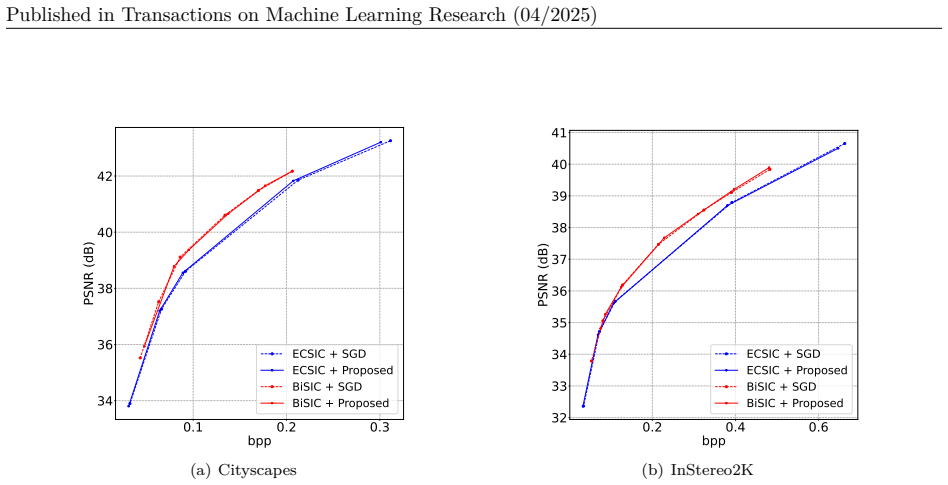
- The same affine-embedding recipe transfers to stereo, remote-sensing, screen-content, and raw-image codecs, each trained in about 60–64% of the corresponding SGD time with comparable or better BD-Rate.
- On a noisy quadratic model the proposed update rule provably has lower steady-state training variance than standard SGD at the same learning rate, which the paper identifies as the stabilizing mechanism for the embedding.
- The method beats the low-dimensional baselines P-SGD, P-BFGS, and TWA (which diverge on LIC) and the sparsity baselines RigL and SRigL (which do not reduce training time), so the combination of mode embedding with moving-average smoothing is claimed to be the key.
Reading between the lines
- If the affine-coefficient stability measured at epoch 20 fails on architectures with very different layer dynamics (for instance, long-range transformer blocks), periodic re-estimation of the coefficients, or a slower embedding schedule, would likely be needed to preserve the time savings outside the paper's model set.
- Combining the frozen parameters with sparse backpropagation that skips gradient computation for embedded weights could cut per-epoch cost as well as epoch count; the paper itself flags this as a non-trivial open implementation step.
- The same trajectory-compression idea could be applied to the intra-frame coder of learned video compression, since that coder is itself an LIC; the motion-estimation modules would require separate treatment.
- The strong correlation between 'CMD instant performance' and final BD-Rate suggests a cheap single-forward-pass diagnostic for how many effective dimensions any codec architecture needs, which may generalize beyond compression.
Signed reviews
Editorial analysis
A structured set of objections, weighed in public.
Referee Report
Summary. The paper proposes two mechanisms to accelerate the training of learned image compression (LIC) models: STDET, which clusters parameter trajectories into modes, expresses non-reference parameters as affine functions of reference parameters, and progressively freezes ('embeds') parameters with stable affine coefficients; and SMA, which periodically averages sampled SGD iterates and synchronizes them back into training. The authors report that their method reaches the same or slightly better rate-distortion performance as standard SGD in roughly 62% of the wall-clock training time across ELIC, TCM-S, and FLIC, with additional experiments on stereo, remote sensing, screen content, and raw-image codecs. They also provide a noisy-quadratic-model analysis intended to show that the method reduces steady-state training variance relative to SGD.
Significance. Speeding up LIC training is a practically important goal, and the paper demonstrates a large reduction in wall-clock time on several modern codecs with essentially unchanged rate-distortion performance. The experimental scope is broad, the implementations of the compared codecs are publicly available, and the paper reports detailed ablations of the main hyperparameters. The variance analysis is derived from the algorithm's update rules rather than fitted to the measurements, and the paper includes a useful comparison with low-dimensional and sparsity-based training methods. The main weakness is that the reported wall-clock acceleration is not cleanly attributed to the proposed parameter-embedding mechanism, because the SMA-only control at the reduced epoch budget is missing and the paper admits that embedding does not reduce per-epoch gradient time in current frameworks.
major comments (4)
- [Appendix A.3 / Fig. 15] The decisive control experiment is missing. Appendix A.3 reports that 'ELIC + SMA' reaches the same final R-D loss (0.3442) as the full method, but the text states that this SMA-only run uses the same 120-epoch budget as standard SGD. Since Fig. 15 shows the full proposed method reaching the same loss by epoch 70, and since Appendix A.5 states that embedded parameters do not reduce per-epoch gradient time on current frameworks, the entire reported wall-clock saving comes from training for fewer epochs. The paper must report an SMA-only run at the proposed method's reduced budget (70 epochs for lambda=0.0018, 50 epochs for fine-tuning). If that run also reaches approximately 0.3442, the acceleration is attributable to the moving-average mechanism rather than to the dimension/parameter reduction that the title and abstract emphasize; if it does not, the result would support the claimed role of STDET.
- [Section 4.3 / Appendix A.5] The complexity analysis does not establish that reducing the number of trainable parameters reduces training time. Table 1 reports 'Total trainable params' and 'Final trainable params', but Section A.5 explicitly acknowledges that setting requires_grad=False does not prevent the embedded parameters from being computed in the chain rule, so per-epoch wall-clock time is essentially unchanged. Under this admission, the total-parameter reduction is an accounting metric, not a computational saving. The paper should report per-epoch wall-clock time as a function of the fraction of embedded parameters, or implement sparse backward computation that actually skips embedded parameters, before claiming that dimension reduction accelerates convergence.
- [Section 4.4, Tables 3-5] The hyperparameters F, M, S, P, L, alpha, and l appear to be selected using final BD-Rate on the same evaluation benchmarks that are later used to report the headline results. The ablation tables in Section 4.4 report BD-Rate without specifying a separate validation set, and the chosen configuration in each column ('0%' anchor) is the one used in Table 1. To avoid selection-on-test circularity, the hyperparameters should be chosen on a held-out validation split or on a subset of the training data, and the test-set results in Table 1 should be reported only for the final selected configuration.
- [Appendix A.6, Eq. (14)] The theoretical variance comparison rests on assumptions that are not verified in the paper. The inequality V*_Proposed <= V*_SGD requires both alpha in (0,1) and E[k_i^2] <= 1, and the proof also uses E[d_i] -> 0. The paper states only that E[d_i] -> 0 'empirically' and provides no evidence for E[k_i^2] <= 1. The authors should report the empirical distribution of k_i (and d_i) from the models in Section 4; if E[k_i^2] exceeds 1 for some modes, the stated inequality no longer follows. In addition, the variance of embedded parameters is written as E[k_i^2] V*_SMA, which omits a possible contribution from Var(d_i) unless d_i is treated as a deterministic offset.
minor comments (4)
- [Appendix A.2] The sentence 'following standard practie' contains a typo: 'practie' should be 'practice'.
- [Appendix A.4 / Fig. 16] Two subfigures are both labeled '(c) Proposed SMA', one for l=1 and one for l=2; the labels should be (c) and (d).
- [Table 1] The heading 'Total trainable params' is ambiguous because the reported values are parameter-epoch products (e.g., 35.42M x 520 epochs = 18,418M), not the number of parameters at any single time. The caption or column header should state this explicitly.
- [Section 3.3.2] The connection of SMA to the Lookahead optimizer is stated only briefly; a short formal comparison or a citation to the Lookahead update when l>1 would help readers understand the exact relationship.
Circularity Check
No circular derivation: the acceleration claim is an empirical comparison, though the paper's own A.3/A.5 expose an attribution gap that is a soundness concern rather than a circularity.
full rationale
The paper's derivation chain is constructive and self-contained: CMD affine embedding (Eq. 3), coefficient updates (Eq. 6), stability-based embedding (Eq. 7), and SMA interpolation (Eqs. 8-9) define an algorithm whose outputs (final R-D loss, BD-Rate, training time) are measured against an independent SGD baseline rather than read off from its inputs. The variance analysis in Appendix A.6 is derived from the algorithm's own update rules and standard noisy-quadratic recurrences, not fitted to the experimental results; the unproven condition E[k_i^2] ≤ 1 in Eq. 14 is an unsupported-assumption/correctness risk, not a presupposition of the conclusion. Hyperparameters F, M, S, P, L, α, l are selected through ablations scored on the same benchmark sets used for the final BD-Rate, which is test-set selection (an overfitting/soundness concern), not a quantity equivalent by construction to the selection criterion. Self-citations (e.g., Zhang et al. 2024b,c; 2025) are background LIC references and are not load-bearing for the acceleration claim; CMD is imported from Brokman et al. (2024) with its affine assumption stated explicitly rather than smuggled. The genuine weakness is empirical attribution: A.5 admits embedded parameters do not reduce per-epoch gradient time in current frameworks, and A.3 shows SMA alone reaches the same final loss at the SGD epoch budget while no SMA-only run at the proposed 70-epoch budget is reported, so the conclusion that dimension reduction causes the speedup is not established. That is a missing-control problem, not a circular definition or a fitted-input-called-prediction reduction.
Assumptions & free parameters
free parameters (10)
- F (head-stage epochs) =
20 for lambda=0.0018, 10 for fine-tuning
- M (number of modes) =
50 (ELIC), 70 (TCM-S), 100 (FLIC)
- S (sampled trajectories) =
200 x M (e.g., 10k, 14k, 20k)
- P (embedding percentage per epoch) =
1%
- L (embedding period) =
1
- alpha (SMA moving average factor) =
0.8
- l (SMA sampling interval) =
5
- Sensitivity threshold and layer split =
25% sensitive, top 50% layers, half-half split
- Dummy embedding schedule =
min(tP/2%, 25%)
- Perturbation scale sigma =
fraction of max parameter value in layer
assumptions (5)
- domain assumption LIC parameter trajectories can be approximated as affine transformations of a reference within a mode (Eq. 3)
- domain assumption Affine coefficients stabilize after the head-stage (F epochs)
- domain assumption About 75% of parameters are insensitive to being fixed/pruned
- ad hoc to paper E[k_i^2] <= 1 and E[d_i] -> 0 in the noisy quadratic analysis
- standard math Standard contraction mapping / Banach fixed point theorem for the expectation recursion
Cite this review
Pith. "Pith review of Accelerating Learned Image Compression Through Modeling Neural Training Dynamics." pith.science (2026). https://pith.science/paper/XE54XNL6
@misc{pith2026250518107,
  author       = {Pith},
  title        = {Pith review of: Accelerating Learned Image Compression Through Modeling Neural Training Dynamics},
  year         = {2026},
  howpublished = {\url{https://pith.science/paper/XE54XNL6}},
  note         = {Machine review of arXiv:2505.18107}
}
read the original abstract
As learned image compression (LIC) methods become increasingly computationally demanding, enhancing their training efficiency is crucial. This paper takes a step forward in accelerating the training of LIC methods by modeling the neural training dynamics. We first propose a Sensitivity-aware True and Dummy Embedding Training mechanism (STDET) that clusters LIC model parameters into few separate modes where parameters are expressed as affine transformations of reference parameters within the same mode. By further utilizing the stable intra-mode correlations throughout training and parameter sensitivities, we gradually embed non-reference parameters, reducing the number of trainable parameters. Additionally, we incorporate a Sampling-then-Moving Average (SMA) technique, interpolating sampled weights from stochastic gradient descent (SGD) training to obtain the moving average weights, ensuring smooth temporal behavior and minimizing training state variances. Overall, our method significantly reduces training space dimensions and the number of trainable parameters without sacrificing model performance, thus accelerating model convergence. We also provide a theoretical analysis on the Noisy quadratic model, showing that the proposed method achieves a lower training variance than standard SGD. Our approach offers valuable insights for further developing efficient training methods for LICs.
Figures


Figures from the paper (13 more)




Reference graph
Works this paper leans on
-
[1]
Intrinsic dimensionality explains the effectiveness of language model fine-tuning
Armen Aghajanyan, Sonal Gupta, and Luke Zettlemoyer. Intrinsic dimensionality explains the effectiveness of language model fine-tuning. Proceedings of the 59th Annual Meeting of the Association for Computational Linguistics and the 11th International Joint Conference on Natural Language Processing, pp.\ 7319--7328, August 2021
2021
-
[2]
Towards efficient image compression without autoregressive models
Muhammad Salman Ali, Yeongwoong Kim, Maryam Qamar, Sung-Chang Lim, Donghyun Kim, Chaoning Zhang, Sung-Ho Bae, and Hui Yong Kim. Towards efficient image compression without autoregressive models. Advances in Neural Information Processing Systems, 36: 0 7392--7404, 2023
2023
-
[3]
Nonlinear transform coding
Johannes Ball \'e , Philip A Chou, David Minnen, Saurabh Singh, Nick Johnston, Eirikur Agustsson, Sung Jin Hwang, and George Toderici. Nonlinear transform coding. IEEE Journal of Selected Topics in Signal Processing, 15 0 (2): 0 339--353, 2020
2020
-
[4]
Variational image compression with a scale hyperprior
Johannes Ballé, David Minnen, Saurabh Singh, Sung Jin Hwang, and Nick Johnston. Variational image compression with a scale hyperprior. International Conference on Learning Representations, 2018
2018
-
[5]
Instereo2k: a large real dataset for stereo matching in indoor scenes
Wei Bao, Wei Wang, Yuhua Xu, Yulan Guo, Siyu Hong, and Xiaohu Zhang. Instereo2k: a large real dataset for stereo matching in indoor scenes. Science China Information Sciences, 63: 0 1--11, 2020
2020
-
[6]
Image reconstruction via deep image prior subspaces
Riccardo Barbano, Javier Antoran, Johannes Leuschner, Jos \'e Miguel Hern \'a ndez-Lobato, Bangti Jin, and Zeljko Kereta. Image reconstruction via deep image prior subspaces. Transactions on Machine Learning Research, 2024
2024
-
[7]
Compressai: a pytorch library and evaluation platform for end-to-end compression research, 2020
Jean B \'e gaint, Fabien Racap \'e , Simon Feltman, and Akshay Pushparaja. Compressai: a pytorch library and evaluation platform for end-to-end compression research, 2020
2020
-
[8]
Bj ntegaard
G. Bj ntegaard. Calculation of average PSNR differences between rd-curves. ITU-T SG 16/Q6, 13th VCEG Meeting, April 2001
2001
Show all 94 references
-
[9]
Enhancing neural training via a correlated dynamics model
Jonathan Brokman, Roy Betser, Rotem Turjeman, Tom Berkov, Ido Cohen, and Guy Gilboa. Enhancing neural training via a correlated dynamics model. The Twelfth International Conference on Learning Representations, 2024
2024
-
[10]
Brunton, Marko Budi s i\' c , Eurika Kaiser, and J
Steven L. Brunton, Marko Budi s i\' c , Eurika Kaiser, and J. Nathan Kutz. Modern koopman theory for dynamical systems. SIAM Review, 64 0 (2): 0 229--340, 2022
2022
-
[11]
Robust overfitting may be mitigated by properly learned smoothening
Tianlong Chen, Zhenyu Zhang, Sijia Liu, Shiyu Chang, and Zhangyang Wang. Robust overfitting may be mitigated by properly learned smoothening. International Conference on Learning Representations, 2021
2021
-
[12]
Illuminant estimation for color constancy: why spatial-domain methods work and the role of the color distribution
Dongliang Cheng, Dilip K Prasad, and Michael S Brown. Illuminant estimation for color constancy: why spatial-domain methods work and the role of the color distribution. Journal of the Optical Society of America A, 31 0 (5): 0 1049--1058, 2014
2014
-
[13]
The cityscapes dataset for semantic urban scene understanding
Marius Cordts, Mohamed Omran, Sebastian Ramos, Timo Rehfeld, Markus Enzweiler, Rodrigo Benenson, Uwe Franke, Stefan Roth, and Bernt Schiele. The cityscapes dataset for semantic urban scene understanding. Proceedings of the IEEE/CVF Conference on Computer Vision and Pattern Rec...
2016
-
[14]
Parameter-efficient fine-tuning of large-scale pre-trained language models
Ning Ding, Yujia Qin, Guang Yang, Fuchao Wei, Zonghan Yang, Yusheng Su, Shengding Hu, Yulin Chen, Chi-Min Chan, Weize Chen, et al. Parameter-efficient fine-tuning of large-scale pre-trained language models. Nature Machine Intelligence, 5 0 (3): 0 220--235, 2023
2023
-
[15]
Optimizing neural networks via koopman operator theory
Akshunna S Dogra and William Redman. Optimizing neural networks via koopman operator theory. Advances in Neural Information Processing Systems, 33: 0 2087--2097, 2020
2020
-
[16]
Qarv: Quantization-aware resnet vae for lossy image compression
Zhihao Duan, Ming Lu, Jack Ma, Yuning Huang, Zhan Ma, and Fengqing Zhu. Qarv: Quantization-aware resnet vae for lossy image compression. IEEE Transactions on Pattern Analysis and Machine Intelligence, 2023
2023
-
[17]
Asymmetric numeral systems, 2009
Jarek Duda. Asymmetric numeral systems, 2009
2009
-
[18]
Rigging the lottery: Making all tickets winners
Utku Evci, Trevor Gale, Jacob Menick, Pablo Samuel Castro, and Erich Elsen. Rigging the lottery: Making all tickets winners. Proceedings of the International Conference on Machine Learning, pp.\ 2943--2952, 2020
2020
-
[19]
Understanding the difficulty of training deep feedforward neural networks
Xavier Glorot and Yoshua Bengio. Understanding the difficulty of training deep feedforward neural networks. Proceedings of the International Conference on Artificial Intelligence and Statistics, pp.\ 249--256, 2010
2010
-
[20]
Improving neural network training in low dimensional random bases
Frithjof Gressmann, Zach Eaton-Rosen, and Carlo Luschi. Improving neural network training in low dimensional random bases. Advances in Neural Information Processing Systems, 33: 0 12140--12150, 2020
2020
-
[21]
EVC : Towards real-time neural image compression with mask decay
Wang Guo-Hua, Jiahao Li, Bin Li, and Yan Lu. EVC : Towards real-time neural image compression with mask decay. The Eleventh International Conference on Learning Representations, 2023
2023
-
[22]
Checkerboard context model for efficient learned image compression
Dailan He, Yaoyan Zheng, Baocheng Sun, Yan Wang, and Hongwei Qin. Checkerboard context model for efficient learned image compression. Proceedings of the IEEE/CVF Conference on Computer Vision and Pattern Recognition, pp.\ 14771--14780, 2021
2021
-
[23]
E LIC : Efficient learned image compression with unevenly grouped space-channel contextual adaptive coding
Dailan He, Ziming Yang, Weikun Peng, Rui Ma, Hongwei Qin, and Yan Wang. E LIC : Efficient learned image compression with unevenly grouped space-channel contextual adaptive coding. Proceedings of the IEEE/CVF Conference on Computer Vision and Pattern Recognition, pp.\ 5718--572...
2022
-
[24]
Asymmetric valleys: Beyond sharp and flat local minima
Haowei He, Gao Huang, and Yang Yuan. Asymmetric valleys: Beyond sharp and flat local minima. Advances in Neural Information Processing Systems, 32, 2019
2019
-
[25]
Delving deep into rectifiers: Surpassing human-level performance on imagenet classification
Kaiming He, Xiangyu Zhang, Shaoqing Ren, and Jian Sun. Delving deep into rectifiers: Surpassing human-level performance on imagenet classification. Proceedings of the IEEE/CVF International Conference on Computer Vision, pp.\ 1026--1034, 2015
2015
-
[26]
Momentum contrast for unsupervised visual representation learning
Kaiming He, Haoqi Fan, Yuxin Wu, Saining Xie, and Ross Girshick. Momentum contrast for unsupervised visual representation learning. Proceedings of the IEEE/CVF Conference on Computer Vision and Pattern Recognition, pp.\ 9729--9738, 2020
2020
-
[27]
Lo RA : Low-rank adaptation of large language models
Edward J Hu, yelong shen, Phillip Wallis, Zeyuan Allen-Zhu, Yuanzhi Li, Shean Wang, Lu Wang, and Weizhu Chen. Lo RA : Low-rank adaptation of large language models. International Conference on Learning Representations, 2022
2022
-
[28]
JPEG AI Common Training & Test Conditions v8.0
ISO/IEC JTC 1/SC29/WG1 . JPEG AI Common Training & Test Conditions v8.0 . CPM, 100th Meeting, Covilh \ a , Portugal, July 2023. Document number: N100600
2023
-
[29]
Garipov, Dmitry P
Pavel Izmailov, Dmitrii Podoprikhin, T. Garipov, Dmitry P. Vetrov, and Andrew Gordon Wilson. Averaging weights leads to wider optima and better generalization. Conference on Uncertainty in Artificial Intelligence, 2018
2018
-
[30]
Visual prompt tuning
Menglin Jia, Luming Tang, Bor-Chun Chen, Claire Cardie, Serge Belongie, Bharath Hariharan, and Ser-Nam Lim. Visual prompt tuning. European Conference on Computer Vision, pp.\ 709--727, 2022
2022
-
[31]
Towards practical real-time neural video compression, 2025
Zhaoyang Jia, Bin Li, Jiahao Li, Wenxuan Xie, Linfeng Qi, Houqiang Li, and Yan Lu. Towards practical real-time neural video compression, 2025. URL https://arxiv.org/abs/2502.20762
2025 arXiv
-
[32]
Variable-rate learned image compression with multi-objective optimization and quantization-reconstruction offsets
Fatih Kamisli, Fabien Racap \'e , and Hyomin Choi. Variable-rate learned image compression with multi-objective optimization and quantization-reconstruction offsets. Proceedings of the Data Compression Conference, 2024
2024
-
[33]
Multi-layer random perturbation training for improving model generalization efficiently
Lis Kanashiro Pereira, Yuki Taya, and Ichiro Kobayashi. Multi-layer random perturbation training for improving model generalization efficiently. Proceedings of the Fourth BlackboxNLP Workshop on Analyzing and Interpreting Neural Networks for NLP, pp.\ 303--310, November 2021
2021
-
[34]
A software platform for manipulating the camera imaging pipeline
Hakki Can Karaimer and Michael S Brown. A software platform for manipulating the camera imaging pipeline. Computer Vision--ECCV 2016: 14th European Conference, Amsterdam, The Netherlands, October 11--14, 2016, Proceedings, Part I 14, pp.\ 429--444, 2016
2016
-
[35]
Understanding black-box predictions via influence functions
Pang Wei Koh and Percy Liang. Understanding black-box predictions via influence functions. Proceedings of the 34th International Conference on Machine Learning, 70: 0 1885--1894, 2017
2017
-
[36]
Dynamic sparse training with structured sparsity
Mike Lasby, Anna Golubeva, Utku Evci, Mihai Nica, and Yani Ioannou. Dynamic sparse training with structured sparsity. Proceedings of the International Conference on Learning Representations, 2024
2024
-
[37]
Measuring the intrinsic dimension of objective landscapes
Chunyuan Li, Heerad Farkhoor, Rosanne Liu, and Jason Yosinski. Measuring the intrinsic dimension of objective landscapes. International Conference on Learning Representations, 2018
2018
-
[38]
Frequency-aware transformer for learned image compression
Han Li, Shaohui Li, Wenrui Dai, Chenglin Li, Junni Zou, and Hongkai Xiong. Frequency-aware transformer for learned image compression. The Twelfth International Conference on Learning Representations, 2024 a
2024
-
[39]
Deep contextual video compression
Jiahao Li, Bin Li, and Yan Lu. Deep contextual video compression. Proceedings of the Advances in Neural Information Processing Systems, 34: 0 18114--18125, 2021
2021
-
[40]
Hybrid spatial-temporal entropy modelling for neural video compression
Jiahao Li, Bin Li, and Yan Lu. Hybrid spatial-temporal entropy modelling for neural video compression. Proceedings of the ACM International Conference on Multimedia, pp.\ 1503--1511, 2022 a
2022
-
[41]
Neural video compression with diverse contexts
Jiahao Li, Bin Li, and Yan Lu. Neural video compression with diverse contexts. Proceedings of the IEEE/CVF Conference on Computer Vision and Pattern Recognition, pp.\ 22616--22626, 2023 a
2023
-
[42]
Neural video compression with feature modulation
Jiahao Li, Bin Li, and Yan Lu. Neural video compression with feature modulation. Proceedings of the IEEE/CVF Conference on Computer Vision and Pattern Recognition, pp.\ 26099--26108, 2024 b
2024
-
[43]
Low dimensional trajectory hypothesis is true: Dnns can be trained in tiny subspaces
Tao Li, Lei Tan, Zhehao Huang, Qinghua Tao, Yipeng Liu, and Xiaolin Huang. Low dimensional trajectory hypothesis is true: Dnns can be trained in tiny subspaces. IEEE Transactions on Pattern Analysis and Machine Intelligence, 45 0 (3): 0 3411--3420, 2022 b
2022
-
[44]
Subspace adversarial training
Tao Li, Yingwen Wu, Sizhe Chen, Kun Fang, and Xiaolin Huang. Subspace adversarial training. Proceedings of the IEEE/CVF Conference on Computer Vision and Pattern Recognition, pp.\ 13409--13418, 2022 c
2022
-
[45]
Trainable weight averaging: Efficient training by optimizing historical solutions
Tao Li, Zhehao Huang, Qinghua Tao, Yingwen Wu, and Xiaolin Huang. Trainable weight averaging: Efficient training by optimizing historical solutions. The Eleventh International Conference on Learning Representations, 2023 b
2023
-
[46]
Revisiting random weight perturbation for efficiently improving generalization
Tao Li, Qinghua Tao, Weihao Yan, Yingwen Wu, Zehao Lei, Kun Fang, Mingzhen He, and Xiaolin Huang. Revisiting random weight perturbation for efficiently improving generalization. Transactions on Machine Learning Research, 2024 c
2024
-
[47]
Deep model fusion: A survey, 2023 c
Weishi Li, Yong Peng, Miao Zhang, Liang Ding, Han Hu, and Li Shen. Deep model fusion: A survey, 2023 c
2023
-
[48]
Microsoft COCO : Common O bjects in C ontext
Tsung-Yi Lin, Michael Maire, Serge Belongie, James Hays, Pietro Perona, Deva Ramanan, Piotr Doll \'a r, and C Lawrence Zitnick. Microsoft COCO : Common O bjects in C ontext. European Conference on Computer Vision, pp.\ 740--755, 2014
2014
-
[49]
Learned image compression with mixed transformer-cnn architectures
Jinming Liu, Heming Sun, and Jiro Katto. Learned image compression with mixed transformer-cnn architectures. Proceedings of the IEEE/CVF Conference on Computer Vision and Pattern Recognition, pp.\ 14388--14397, June 2023
2023
-
[50]
Bidirectional stereo image compression with cross-dimensional entropy model
Zhening Liu, Xinjie Zhang, Jiawei Shao, Zehong Lin, and Jun Zhang. Bidirectional stereo image compression with cross-dimensional entropy model. Proceedings of the European Conference on Computer Vision, pp.\ 480--496, 2024
2024
-
[51]
Deep learning for universal linear embeddings of nonlinear dynamics
Bethany Lusch, J Nathan Kutz, and Steven L Brunton. Deep learning for universal linear embeddings of nonlinear dynamics. Nature communications, 9 0 (1): 0 4950, 2018
2018
-
[52]
New insights and perspectives on the natural gradient method
James Martens. New insights and perspectives on the natural gradient method. Journal of Machine Learning Research, 21 0 (146): 0 1--76, 2020
2020
-
[53]
Advancing the rate-distortion-computation frontier for neural image compression
David Minnen and Nick Johnston. Advancing the rate-distortion-computation frontier for neural image compression. 2023 IEEE International Conference on Image Processing, pp.\ 2940--2944, 2023
2023
-
[54]
Channel-wise autoregressive entropy models for learned image compression
David Minnen and Saurabh Singh. Channel-wise autoregressive entropy models for learned image compression. 2020 IEEE International Conference on Image Processing, pp.\ 3339--3343, 2020
2020
-
[55]
Importance estimation for neural network pruning
Pavlo Molchanov, Arun Mallya, Stephen Tyree, Iuri Frosio, and Jan Kautz. Importance estimation for neural network pruning. Proceedings of the IEEE/CVF Conference on Computer Vision and Pattern Recognition, pp.\ 11264--11272, 2019
2019
-
[56]
Exponential moving average of weights in deep learning: Dynamics and benefits
Daniel Morales-Brotons, Thijs Vogels, and Hadrien Hendrikx. Exponential moving average of weights in deep learning: Dynamics and benefits. Transactions on Machine Learning Research, 2024
2024
-
[57]
Decomposed linear dynamical systems (dlds) for learning the latent components of neural dynamics
Noga Mudrik, Yenho Chen, Eva Yezerets, Christopher J Rozell, and Adam S Charles. Decomposed linear dynamical systems (dlds) for learning the latent components of neural dynamics. Journal of Machine Learning Research, 25 0 (59): 0 1--44, 2024
2024
-
[58]
Modern hierarchical, agglomerative clustering algorithms, 2011
Daniel M \"u llner. Modern hierarchical, agglomerative clustering algorithms, 2011
2011
-
[59]
Learning srgb-to-raw-rgb de-rendering with content-aware metadata
Seonghyeon Nam, Abhijith Punnappurath, Marcus A Brubaker, and Michael S Brown. Learning srgb-to-raw-rgb de-rendering with content-aware metadata. Proceedings of the IEEE/CVF Conference on Computer Vision and Pattern Recognition, pp.\ 17704--17713, 2022
2022
-
[60]
A review on weight initialization strategies for neural networks
Meenal V Narkhede, Prashant P Bartakke, and Mukul S Sutaone. A review on weight initialization strategies for neural networks. Artificial intelligence review, 55 0 (1): 0 291--322, 2022
2022
-
[61]
Scid: A database for screen content images quality assessment
Zhangkai Ni, Lin Ma, Huanqiang Zeng, Ying Fu, Lu Xing, and Kai-Kuang Ma. Scid: A database for screen content images quality assessment. Proceedings of International Symposium on Intelligent Signal Processing and Communication Systems, pp.\ 774--779, 2017
2017
-
[62]
Abolafia, Jeffrey Pennington, and Jascha Sohl-Dickstein
Roman Novak, Yasaman Bahri, Daniel A. Abolafia, Jeffrey Pennington, and Jascha Sohl-Dickstein. Sensitivity and generalization in neural networks: an empirical study. International Conference on Learning Representations, 2018
2018
-
[63]
Banach's fixed point theorem for partial metric spaces, 2004
Sandra Oltra and Oscar Valero. Banach's fixed point theorem for partial metric spaces, 2004
2004
-
[64]
Acceleration of stochastic approximation by averaging
Boris T Polyak and Anatoli B Juditsky. Acceleration of stochastic approximation by averaging. SIAM Journal on Control and Optimization, 30 0 (4): 0 838--855, 1992
1992
-
[65]
Your transformer is secretly linear, 2024
Anton Razzhigaev, Matvey Mikhalchuk, Elizaveta Goncharova, Nikolai Gerasimenko, Ivan Oseledets, Denis Dimitrov, and Andrey Kuznetsov. Your transformer is secretly linear, 2024
2024
-
[66]
Exact solutions to the nonlinear dynamics of learning in deep linear neural networks, 2013
Andrew M Saxe, James L McClelland, and Surya Ganguli. Exact solutions to the nonlinear dynamics of learning in deep linear neural networks, 2013
2013
-
[67]
No more pesky learning rates
Tom Schaul, Sixin Zhang, and Yann LeCun. No more pesky learning rates. Proceedings of the 30th International Conference on Machine Learning, 28 0 (3): 0 343--351, 2013
2013
-
[68]
Dynamic mode decomposition of numerical and experimental data
Peter J Schmid. Dynamic mode decomposition of numerical and experimental data. Journal of Fluid Mechanics, 656: 0 5--28, 2010
2010
-
[69]
Dynamic mode decomposition and its variants
Peter J Schmid. Dynamic mode decomposition and its variants. Annual Review of Fluid Mechanics, 54 0 (1): 0 225--254, 2022
2022
-
[70]
Temporal context mining for learned video compression
Xihua Sheng, Jiahao Li, Bin Li, Li Li, Dong Liu, and Yan Lu. Temporal context mining for learned video compression. IEEE Transactions on Multimedia, 25: 0 7311--7322, 2022
2022
-
[71]
Consistency models
Yang Song, Prafulla Dhariwal, Mark Chen, and Ilya Sutskever. Consistency models. Proceedings of the International Conference on Machine Learning, 202: 0 32211--32252, 2023
2023
-
[72]
Rethinking the inception architecture for computer vision
Christian Szegedy, Vincent Vanhoucke, Sergey Ioffe, Jon Shlens, and Zbigniew Wojna. Rethinking the inception architecture for computer vision. Proceedings of the IEEE/CVF Conference on Computer Vision and Pattern Recognition, pp.\ 2818--2826, 2016
2016
-
[73]
Adanic: Towards practical neural image compression via dynamic transform routing
Lvfang Tao, Wei Gao, Ge Li, and Chenhao Zhang. Adanic: Towards practical neural image compression via dynamic transform routing. Proceedings of the IEEE/CVF International Conference on Computer Vision, pp.\ 16879--16888, October 2023
2023
-
[74]
Beyond learned metadata-based raw image reconstruction
Yufei Wang, Yi Yu, Wenhan Yang, Lanqing Guo, Lap-Pui Chau, Alex C Kot, and Bihan Wen. Beyond learned metadata-based raw image reconstruction. International Journal of Computer Vision, 132 0 (12): 0 5514--5533, 2024
2024
-
[75]
Towards certificated model robustness against weight perturbations
Tsui-Wei Weng, Pu Zhao, Sijia Liu, Pin-Yu Chen, Xue Lin, and Luca Daniel. Towards certificated model robustness against weight perturbations. Proceedings of the AAAI Conference on Artificial Intelligence, 34 0 (04): 0 6356--6363, 2020
2020
-
[76]
Ecsic: Epipolar cross attention for stereo image compression
Matthias W \"o dlinger, Jan Kotera, Manuel Keglevic, Jan Xu, and Robert Sablatnig. Ecsic: Epipolar cross attention for stereo image compression. Proceedings of the IEEE/CVF Winter Conference on Applications of Computer Vision, pp.\ 3436--3445, 2024
2024
-
[77]
Understanding short-horizon bias in stochastic meta-optimization
Yuhuai Wu, Mengye Ren, Renjie Liao, and Roger Grosse. Understanding short-horizon bias in stochastic meta-optimization. International Conference on Learning Representations, 2018
2018
-
[78]
Remote sensing image compression based on high-frequency and low-frequency components
Shao Xiang and Qiaokang Liang. Remote sensing image compression based on high-frequency and low-frequency components. IEEE Transactions on Geoscience and Remote Sensing, 2024
2024
-
[79]
Perceptual quality assessment of screen content images
Huan Yang, Yuming Fang, and Weisi Lin. Perceptual quality assessment of screen content images. IEEE Transactions on Image Processing, 24 0 (11): 0 4408--4421, 2015
2015
-
[80]
Deep neural network pruning method based on sensitive layers and reinforcement learning
Wenchuan Yang, Haoran Yu, Baojiang Cui, Runqi Sui, and Tianyu Gu. Deep neural network pruning method based on sensitive layers and reinforcement learning. Artificial Intelligence Review, 56 0 (Suppl 2): 0 1897--1917, 2023
1917
-
[81]
Computationally-efficient neural image compression with shallow decoders
Yibo Yang and Stephan Mandt. Computationally-efficient neural image compression with shallow decoders. Proceedings of the IEEE/CVF International Conference on Computer Vision, pp.\ 530--540, 2023
2023
-
[82]
Safer: Layer-level sensitivity assessment for efficient and robust neural network inference, 2023
Edouard Yvinec, Arnaud Dapogny, and Kevin Bailly. Safer: Layer-level sensitivity assessment for efficient and robust neural network inference, 2023
2023
-
[83]
Are all layers created equal? Journal of Machine Learning Research, 23 0 (67): 0 1--28, 2022
Chiyuan Zhang, Samy Bengio, and Yoram Singer. Are all layers created equal? Journal of Machine Learning Research, 23 0 (67): 0 1--28, 2022
2022
-
[84]
Which algorithmic choices matter at which batch sizes? insights from a noisy quadratic model
Guodong Zhang, Lala Li, Zachary Nado, James Martens, Sushant Sachdeva, George E Dahl, Christopher J Shallue, and Roger Grosse. Which algorithmic choices matter at which batch sizes? insights from a noisy quadratic model. Advances in Neural Information Processing Systems, 2019 a
2019
-
[85]
Lookaround optimizer: k steps around, 1 step average
Jiangtao Zhang, Shunyu Liu, Jie Song, Tongtian Zhu, Zhengqi Xu, and Mingli Song. Lookaround optimizer: k steps around, 1 step average. Thirty-seventh Conference on Neural Information Processing Systems, 2023
2023
-
[86]
Lookahead optimizer: k steps forward, 1 step back
Michael Zhang, James Lucas, Jimmy Ba, and Geoffrey E Hinton. Lookahead optimizer: k steps forward, 1 step back. Advances in Neural Information Processing Systems, 32, 2019 b
2019
-
[87]
Theoretical bound-guided hierarchical vae for neural image codecs
Yichi Zhang, Zhihao Duan, Yuning Huang, and Fengqing Zhu. Theoretical bound-guided hierarchical vae for neural image codecs. 2024 IEEE International Conference on Multimedia and Expo (ICME), pp.\ 1--6, 2024 a
2024
-
[88]
Another way to the top: Exploit contextual clustering in learned image coding
Yichi Zhang, Zhihao Duan, Ming Lu, Dandan Ding, Fengqing Zhu, and Zhan Ma. Another way to the top: Exploit contextual clustering in learned image coding. Proceedings of the AAAI Conference on Artificial Intelligence, 38 0 (8): 0 9377--9386, 2024 b
2024
-
[89]
On efficient neural network architectures for image compression
Yichi Zhang, Zhihao Duan, and Fengqing Zhu. On efficient neural network architectures for image compression. 2024 IEEE International Conference on Image Processing, 2024 c
2024
-
[90]
Balanced rate-distortion optimization in learned image compression
Yichi Zhang, Zhihao Duan, Yuning Huang, and Fengqing Zhu. Balanced rate-distortion optimization in learned image compression. arXiv preprint arXiv:2502.20161, 2025
2025 arXiv
-
[91]
Enhanced screen content image compression: A synergistic approach for structural fidelity and text integrity preservation
Fangtao Zhou, Xiaofeng Huang, Peng Zhang, Meng Wang, Zhao Wang, Yang Zhou, and Haibing Yin. Enhanced screen content image compression: A synergistic approach for structural fidelity and text integrity preservation. Proceedings of the ACM International Conference on Multimedia,...
2024
-
[92]
Towards understanding why lookahead generalizes better than sgd and beyond
Pan Zhou, Hanshu Yan, Xiaotong Yuan, Jiashi Feng, and Shuicheng Yan. Towards understanding why lookahead generalizes better than sgd and beyond. Advances in Neural Information Processing Systems, 34: 0 27290--27304, 2021 a
2021
-
[93]
Efficient neural network training via forward and backward propagation sparsification
Xiao Zhou, Weizhong Zhang, Zonghao Chen, Shizhe Diao, and Tong Zhang. Efficient neural network training via forward and backward propagation sparsification. Advances in Neural Information Processing Systems, 34: 0 15216--15229, 2021 b
2021
-
[94]
write newline
" write newline "" before.all 'output.state := FUNCTION n.dashify 't := "" t empty not t #1 #1 substring "-" = t #1 #2 substring "--" = not "--" * t #2 global.max substring 't := t #1 #1 substring "-" = "-" * t #2 global.max substring 't := while if t #1 #1 substring * t #2 gl...
Reviewed August 7, 2026 · model on record in the stance chip above.
Discussion (0). Continue with ORCID to comment.