REVIEW 3 major objections 6 minor 86 references
Computational study of active polar polymer melts: from active reptation to activity induced local alignment
T0 review · 3 major / 6 minor · reviewed 2026-08-12 · deepseek-v4-flash
Pith's one-line read Tangent polar activity gives entangled polymer melts a low-activity regime that matches active reptation theory and a high-activity regime where diffusion becomes independent of molecular weight, tube segments stretch and align, and local…
desk verdict A solid simulation test of active reptation in all-active melts that is worth refereeing despite an unchecked high-activity extrapolation and some internal numerical inconsistencies. read the letter →
The pith
A machine-rendered reading of the paper's core claim, the machinery that carries it, and where it could break.
The reading
What carries the argument
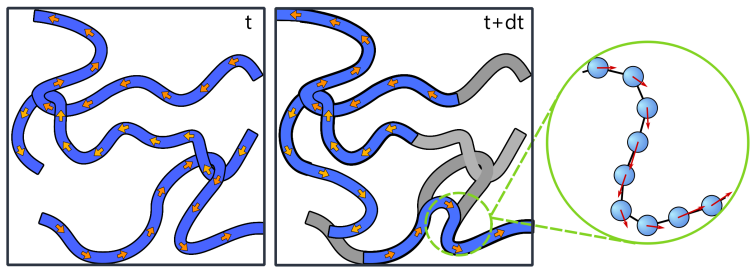
The central mechanism is a coarse-grained bead-spring melt in which each monomer feels a tangent self-propulsion force $\mathbf{f}^a_i = f_c(\mathbf{r}_{i+1}-\mathbf{r}_{i-1})/b$, with the dimensionless activity $Pe_m = f_c b / k_BT$ and a global activity $Pe_g = N Pe_m$. The load-bearing identity is a force balance between the accumulated active tension $N f_c$ and the entropic elasticity of the chain inside its tube, giving the relative primitive-path stretch $(L_{PP}-L^0_{PP})/L^0_{PP} = \alpha Pe_g[1-(L_{PP}/1.5 L^0_{PP})^2]$, which says that tube stretching is controlled only by the global activity. The diagnostics that carry the argument are primitive path analysis for the tube length, the tube tangent correlation and tube survival functions for distinguishing passive reptation from active drift, and the local order parameter $p_2$ for nematic bond alignment.
What would settle it
Repeat the high-activity simulations with a stiffer spring potential or an explicit no-crossing constraint while tracking chain crossings; if the tube stretching, the superdiffusion peak, or the alignment peak near $Pe_m \approx 2$ disappear when crossings are suppressed, the claimed high-activity regimes were artifacts of bond deformation.
Extended reading notes
Core claim
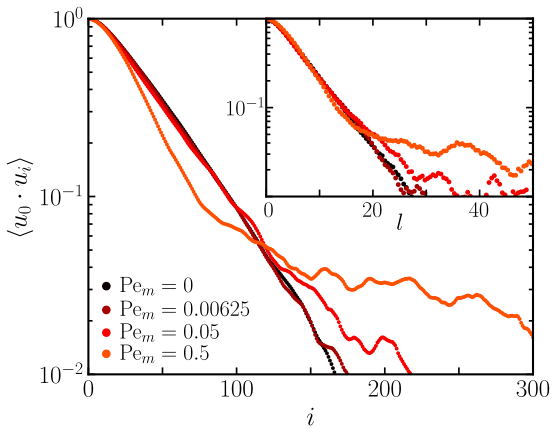
On the paper's own terms, the discovery is that an entangled melt of chains that each push tangentially along their own contour has a low-activity regime that matches the active reptation theory: diffusion $D_G$ is proportional to $Pe_m$ and independent of molecular weight, the center-of-mass mean-square displacement is superdiffusive before the terminal Fickian regime, and the end-to-end relaxation time scales as $\tau_\phi \propto N/Pe_m$. Above roughly $Pe_m \approx 0.05$ the assumptions of the theory break down: tube segments acquire orientational correlations beyond the entanglement length, the primitive path stretches while the coil stretches only mildly, and the head-tail symmetry of the chain is broken in both conformation and dynamics, with the head monomer becoming the slowest. At the highest activities local bond alignment appears, peaking near $Pe_m = 2$ and forming transient clusters of aligned segments, and the whole set of regimes is summarized in an eight-region diagram as a function of molecular weight and activity.
Load-bearing premise
The high-activity conclusions rest on the assumption that a 10 percent stretch of the inter-monomer springs does not make chains able to pass through each other; if that assumption fails, the tube stretching, local alignment, and the high-activity regions of the phase diagram would be artifacts of the model rather than entanglement physics.
Editorial extensions
If this is right
- Once activity dominates, the diffusion coefficient becomes independent of molecular weight and grows linearly with $Pe_m$ in the active-reptation regime, so chain length ceases to set the transport rate.
- The center-of-mass mean-square displacement shows a superdiffusive regime that can persist for over a decade in logarithmic time before becoming Fickian, with the same functional form as the mean-square displacement of a single self-propelled particle.
- The end-to-end relaxation time scales as $\tau_\phi \propto N/Pe_m$ in the activity-dominated regime, so longer chains relax faster relative to their passive disengagement time.
- The primitive path can stretch up to about 50 percent while the overall coil stretches only about 10 percent, revealing an inward-folded chain structure whose tube stretch is a universal function of the global activity $Pe_g$.
- The eight-region phase diagram organizes unentangled and entangled chains, passive and active reptation, anisotropic active motion, tube stretching, and nematic bond alignment into a single map spanned by $N$ and $Pe_m$.
Reading between the lines
- If the alignment-induced reduction of effective monomer friction is real, the peak in diffusion near $Pe_m \approx 2$ should come with a measurable drop in the effective friction inferred from the chain's internal relaxation modes; the paper does not report that check.
- The collapse of tube stretch onto the global activity $Pe_g$ suggests a universality that could be tested in other bead-spring models: a model with different bond stiffness might shift the coefficient $\alpha$ in the tube-stretch identity but keep the same functional form.
- By analogy with shear-oriented melts, the tube-tangent halo at high activity implies an anisotropic stress relaxation mechanism; computing the stress relaxation function would give a rheological consequence that the paper does not extract.
- If the melt result transfers to motor-driven filament networks, transport in such active entangled fluids should become insensitive to filament length at high motor activity, a testable in-vitro prediction.
Signed reviews
Editorial analysis
A structured set of objections, weighed in public.
Referee Report
Summary. This paper reports Langevin molecular dynamics simulations of entangled Kremer-Grest polymer melts in which every monomer is subjected to a tangent polar active force (Eq. 3), with monomeric Péclet numbers spanning four orders of magnitude and chain lengths N=50–800. The authors characterize coil size and segmental deformation, primitive-path tube length and orientation correlations, local bond alignment and cluster statistics, center-of-mass and monomeric MSDs, end-to-end relaxation, and tube-tangent/survival functions. They conclude that at low activities the data confirm the earlier active reptation theory—molecular-weight-independent diffusion coefficient proportional to Pem, transient superdiffusion, and end-to-end relaxation time scaling as N/Pem—while at high activities new phenomena appear: progressive head-tail stretching asymmetry, tube stretching, local nematic-like bond alignment, and an eight-region phase diagram. Additional simulations with higher friction are used to assess inertia effects.
Significance. The low-activity part of the paper is a valuable, largely parameter-free test of active reptation theory in fully active melts: the predicted N-independent D, D∝Pem, and superdiffusive MSD are compared with simulation without fitting the theory to these data, and the agreement supports the theory's robustness when constraint release is present. The high-activity findings—tube stretching, alignment, and the phase diagram—are novel and interesting, but they currently rest on an unverified assumption about chain uncrossability under ~10% FENE bond stretch. If that assumption survives a direct test, the paper will provide a useful map of active entangled polymer behavior and a benchmark for future theory; even if it fails, the low-activity conclusions stand. The manuscript is generally well organized and includes reproducible simulation protocols and comparisons to prior work.
major comments (3)
- [§3.3 and Fig. S5] The central high-activity claims—tube stretching (Fig. 4), local bond alignment (Fig. 6), the high-activity tube-tangent correlations (Fig. 11), and phase-diagram regions V, VII, and VIII—are made for Pem ≥ 1 at ζ=0.5, where the authors find ~10% FENE bond stretch. The text acknowledges that 'the uncrossability of the chains might be compromised,' but the assertion that 10% stretching 'remains limited enough to preserve the validity of our results' is not supported by any test. Because all tube-based observables presuppose that chains cannot pass through each other, please supply a direct test (e.g., a bond–bond crossing census as a function of Pem, or a repeat of key high-Pem runs with stiffer FENE springs) and show that the PPA results and phase diagram are unchanged. This is required before the high-activity regimes can be accepted as entanglement physics rather than model artifacts.
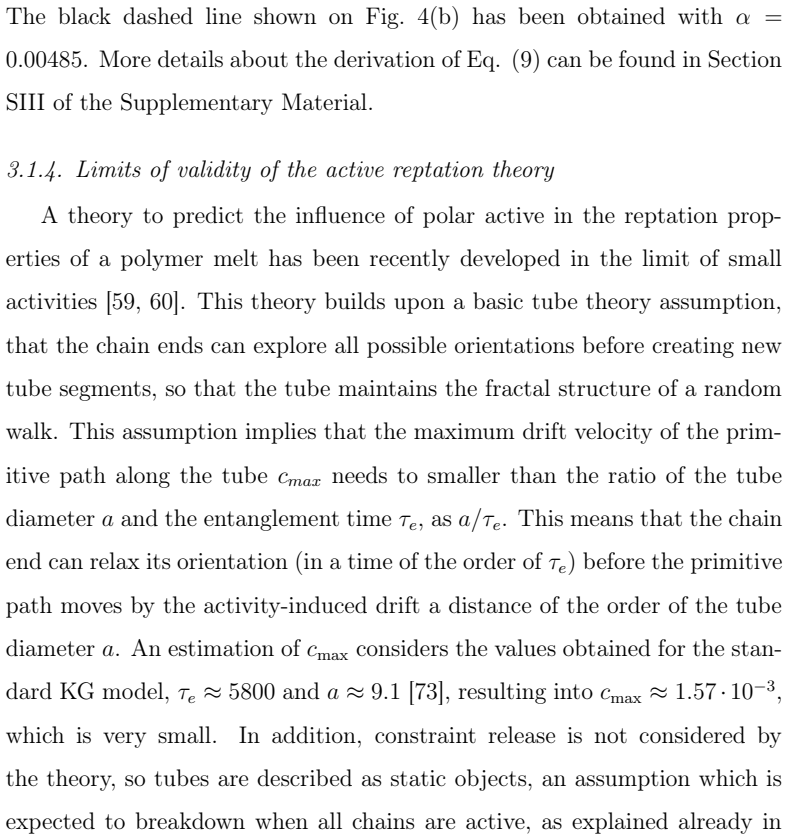
- [§3.1.4, §3.2.2, §3.2.4, Conclusions] The manuscript uses incompatible thresholds for the validity of the active reptation theory. Section 3.1.4 reports that orientation correlations of tube segments deviate from equilibrium for Pem ≥ 0.05 and that the theory's key assumption fails above this value; §3.2.2 similarly states that the t^{1/4} tube-constrained regime disappears for Pem ≥ 0.05. The Conclusions and the final bullet list, however, say the theory is valid only up to Pem = 0.0125. Please reconcile these numbers and state explicitly, for each quantitative comparison to theory in Figs. 7, 9, 10, and 12, which threshold applies. As written, it is unclear whether the regime called 'low activity' is Pem ≤ 0.0125 or Pem ≤ 0.05.
- [§3.4 and Eq. (9)] The phase-diagram boundary separating active anisotropic reptation from the active stretched tube is set by a 10% tube elongation, stated to correspond to Peg ≈ 100. Using the paper's own Eq. (9) with α = 0.00485, the relative tube elongation in the linear regime is (LPP − L0PP)/L0PP ≈ αPeg = 0.00485 Peg, so a 10% elongation is reached at Peg ≈ 21; including the saturation factor (1 − (LPP/1.5L0PP)^2) gives Peg ≈ 21.5, not Peg ≈ 100. Please correct the threshold or the reported α and redraw the corresponding boundary; the current V–VII line is quantitatively inconsistent with Fig. 4(b).
minor comments (6)
- [Abstract and §3.2.3] The abstract states that the end-to-end relaxation time is inversely proportional to the molecular weight, but the body and the conclusions state τϕ ∼ N/Pem, i.e., proportional to N and inversely proportional to Pem. Please correct the abstract to match the results.
- [§3.1.1 and §3.1.3] The maximum chain elongation is reported as 14% in Section 3.1.1 and as 10% in Section 3.1.3; please make these values consistent.
- [Fig. 2 caption] The second panel is also labeled (a); it should be (b).
- [§3.2.3, Eq. (11)] For β > 1 the function in Eq. (11) is a compressed exponential, not a stretched exponential; please adjust the terminology.
- [§3.4] The sentence 'unentangled chains also experience elongation (region IV)' appears to mislabel the region; region IV is the entangled active-reptation region, and the intended region is likely VI. Please check all region labels in the bullet list against Fig. 14.
- [§3.1.5] The cluster analysis uses p2^th = 0.25 and d = 2.0σ; a brief statement of sensitivity to these cutoffs would strengthen the phase-diagram boundary in region VIII.
Circularity Check
Central active-reptation test is independent; minor circularity burden from the fitted tube-stretch law used to place one phase-diagram boundary.
-
fitted input called prediction
[Section 3.1.3, Eq. (9) and Fig. 4(b); Section 3.4 phase-diagram boundary V/VII]
"The black dashed line shown on Fig. 4(b) has been obtained with α = 0.00485. ... The line separating active anisotropic reptation (V) from the active stretched tube (VII) can be derived from Fig. 4 by establishing a threshold elongation of the tube at 10%. The global Péclet number corresponding to this relative elongation of the tube is Peg ≈ 100."
Equation (9) is calibrated to the same LPP(Peg) data it is then said to describe: the dashed line in Fig. 4(b) is a one-parameter fit, not a parameter-free prediction. The V/VII phase boundary is then 'derived from Fig. 4' by reading the 10% tube-elongation threshold off this fitted curve, so the resulting boundary (Peg ≈ 100, hence Pem ∝ 100/N ∝ 1/Z) is a re-description of the fit rather than an independent test. The paper's central dynamical claims (D ∝ Pem, N-independent D, superdiffusion, tube-survival asymmetry) are instead compared with the analytical active-reptation theory and are not affected by this in-sample fitting.
full rationale
The paper's main derivation chain is not circular. The active-reptation theory predictions tested here (D ∝ Pem, molecular-weight-independent D, transient superdiffusion, asymmetric tube survival) are parameter-free analytical scalings from the authors' earlier theory, and the present simulations are new multi-chain data with all chains active; the predictions are not fit to these simulations. The self-citations [59,60] provide the analytical benchmark, and the paper actively tests the theory's stated assumption (isotropic tube-segment creation) via orientation correlations rather than assuming it. The only notable in-sample element is Eq. (9), where the tube-stretch law is fitted to the same primitive-path data it describes and later used to place the V/VII boundary in the phase diagram; this is a minor circularity burden but does not support the paper's headline dynamical results. The acknowledged 10% FENE bond stretch at high Pem is a model-robustness concern about chain uncrossability, not a circularity of the derivation chain. Overall, the central claims have independent empirical content, so a low score is appropriate.
Assumptions & free parameters
free parameters (5)
- alpha_tube =
0.00485
- alpha_coil =
0.035
- cluster_size_exponent_nu =
-1.7
- phase_diagram_thresholds =
various (10% tube elongation, 1.5x diffusion increase, Pem ≈ 0.2, Pem ≈ 1)
- cluster_definition_cutoffs =
p_th=0.25, d=2.0σ
assumptions (7)
- domain assumption The Kremer-Grest model and the tube/reptation framework describe entangled polymer dynamics.
- domain assumption Chain ends explore all orientations before creating new tube segments (c ≤ a/τe), a key assumption of the active reptation theory.
- domain assumption Primitive path analysis (PPA) yields meaningful tube lengths and tangent correlations in non-equilibrium active steady states.
- domain assumption Hydrodynamic interactions are negligible at the monomer density considered.
- ad hoc to paper The tangent active force in Eq. (3), f_i^a = f_c b (r_{i+1} - r_{i-1}), is a valid discretization of polar activity.
- domain assumption At high activity, 10% FENE bond stretching does not compromise chain uncrossability.
- standard math The Langevin thermostat with constant friction ζ and Gaussian white noise obeying the fluctuation-dissipation relation describes the thermal bath.
Cite this review
Pith. "Pith review of Computational study of active polar polymer melts: from active reptation to activity induced local alignment." pith.science (2026). https://pith.science/paper/XEJNWES5
@misc{pith2026241111472,
  author       = {Pith},
  title        = {Pith review of: Computational study of active polar polymer melts: from active reptation to activity induced local alignment},
  year         = {2026},
  howpublished = {\url{https://pith.science/paper/XEJNWES5}},
  note         = {Machine review of arXiv:2411.11472}
}
read the original abstract
This work investigates the effects of tangent polar activity on the conformational and dynamic properties of entangled polymer melts through Langevin molecular dynamics simulations. We examine systems composed of all self-propelled, monodisperse linear chains, so that constraint release is considered. The range of activities explored here includes values where the active reptation theory is applicable, as well as higher activities that challenge the validity of the theory. Chain conformations exhibit a moderate increase in coil size increase, which becomes more pronounced at higher activity levels. Under these conditions, a local bond alignment along the chain contour appears together with a non-homogeneous segmental stretching, and orientation and stretching of the tube. Dynamically, polar activity induces a molecular-weight-independent diffusion coefficient, a transient superdiffusive behavior, and an end-to-end relaxation time inversely proportional to the molecular weight. Finally, our results are summarized in a diagram that classifies the various regimes of behavior observed in the simulations. Overall, these findings provide valuable insights into the complex interplay between activity and entanglements, advancing our understanding of active polymer systems and their potential applications across various fields.
Figures


Figures from the paper (12 more)



Reference graph
Works this paper leans on
-
[1]
Bechinger, R
C. Bechinger, R. Di Leonardo, H. Löwen, C. Reichhardt, G. Volpe, G. Volpe, Active particles in complex and crowded environments, Rev. Mod. Phys. 88 (4) (2016) 045006
2016
-
[2]
Gompper, R
G. Gompper, R. G. Winkler, T. Speck, A. Solon, C. Nardini, F. Peruani, H. Löwen, R. Golestanian, U. B. Kaupp, L. Alvarez, et al., The 2020 47 motile active matter roadmap, Journal of Physics: Condensed Matter 32 (19) (2020) 193001
2020
-
[3]
S. Roca-Bonet, M. Wagner, M. Ripoll, Clustering of self-thermophilic asymmetricdimers: therelevanceofhydrodynamics, SoftMatter(2022). doi:https://doi.org/10.1039/D2SM00523A
-
[4]
Zöttl, H
A. Zöttl, H. Stark, Emergent behavior in active colloids, Journal of Physics: Condensed Matter 28 (25) (2016) 253001
2016
-
[5]
R. S. Negi, R. G. Winkler, G. Gompper, Emergent collective behavior of active brownian particles with visual perception, Soft Matter 18 (33) (2022) 6167–6178
2022
-
[6]
M. F. Hagan, A. Baskaran, Emergent self-organization in active mate- rials, Current opinion in cell biology 38 (2016) 74–80
2016
-
[7]
T. Vicsek, A. Zafeiris, Collective motion, Physics Reports 517 (3-4) (2012) 71–140. doi:10.1016/j.physrep.2012.03.004. URL https://doi.org/10.1016%2Fj.physrep.2012.03.004
-
[8]
Yildiz, M
A. Yildiz, M. Tomishige, R. D. Vale, P. R. Selvin, Kinesin walks hand- over-hand, Science 303 (5658) (2004) 676–678
2004
Show all 86 references
-
[9]
Molloy, Myosin motors drive long range alignment of actin filaments 2, Journal of Biological Chemistry 285 (7) (2010) 4964–4974
T.Butt, T.Mufti, A.Humayun, P.B.Rosenthal, S.Khan, S.Khan, J.E. Molloy, Myosin motors drive long range alignment of actin filaments 2, Journal of Biological Chemistry 285 (7) (2010) 4964–4974
2010
-
[10]
P. Xu, S. Duan, Z. Xiao, Z. Yang, W. Wang, Light-powered active colloids from monodisperse and highly tunable microspheres with a 48 thin TiO2 shell, Soft Matter 16 (26) (2020) 6082–6090.doi:10.1039/ d0sm00719f. URL https://doi.org/10.1039%2Fd0sm00719f
2020
-
[11]
Ghosh, P
A. Ghosh, P. Fischer, Controlled Propulsion of Artificial Magnetic Nanostructured Propellers, Nano Lett. 9 (6) (2009) 2243–2245. doi: 10.1021/nl900186w
2009 doi
-
[12]
Jiang, N
H.-R. Jiang, N. Yoshinaga, M. Sano, Active Motion of a Janus Particle by Self-Thermophoresis in a Defocused Laser Beam, Phys. Rev. Lett. 105 (26) (2010) 268302.doi:10.1103/PhysRevLett.105.268302
2010 doi
-
[13]
R. G. Winkler, G. Gompper, The physics of active polymers and fila- ments, The Journal of Chemical Physics 153 (4) (2020) 040901
2020
-
[14]
Nishiguchi, J
D. Nishiguchi, J. Iwasawa, H.-R. Jiang, M. Sano, Flagellar dynamics of chains of active Janus particles fueled by an AC electric field, New J. Phys. 20 (1) (2018) 015002.doi:10.1088/1367-2630/aa9b48
2018 doi
-
[15]
Duclos, R
G. Duclos, R. Adkins, D. Banerjee, M. S. E. Peterson, M. Varghese, I. Kolvin, A. Baskaran, R. A. Pelcovits, T. R. Powers, A. Baskaran, F.Toschi, M.F. Hagan, S.J. Streichan, V.Vitelli, D. A.Beller, Z. Dogic, Topological structure and dynamics of three-dimensional active nemat- ...
2020 doi
-
[16]
G. A. Vliegenthart, A. Ravichandran, M. Ripoll, T. Auth, G. Gompper, Filamentous active matter: Band formation, bending, buckling, and de- fects, Science advances 6 (30) (2020) eaaw9975.doi:10.1126/sciadv. aaw997. 49
2020 doi
-
[17]
Martinez-Pedrero, A
F. Martinez-Pedrero, A. Ortiz-Ambriz, I. Pagonabarraga, P. Tierno, Colloidal Microworms Propelling via a Cooperative Hydrodynamic Con- veyor Belt, Phys. Rev. Lett. 115 (13) (2015) 138301. doi:10.1103/ PhysRevLett.115.138301
2015
-
[18]
Jaiswal, M
S. Jaiswal, M. Ripoll, S. Thakur, Diffusiophoretic Brownian Dynam- ics: Characterization of Hydrodynamic Effects for an Active Chemoat- tractive Polymer, Macromolecules 57 (15) (2024) 6968–6978. doi: 10.1021/acs.macromol.4c00720
2024 doi
-
[19]
F. J. Nédélec, T. Surrey, A. C. Maggs, S. Leibler, Self-organization of microtubules and motors, Nature 389 (6648) (1997) 305–308.doi:10. 1038/38532
1997
-
[20]
Hirokawa, Y
N. Hirokawa, Y. Noda, Y. Tanaka, S. Niwa, Kinesin superfamily mo- tor proteins and intracellular transport, Nature reviews Molecular cell biology 10 (10) (2009) 682–696
2009
-
[21]
Schaller, C
V. Schaller, C. Weber, C. Semmrich, E. Frey, A. R. Bausch, Polar pat- terns of driven filaments, Nature 467 (7311) (2010) 73–77
2010
-
[22]
C. A. Philipps, G. Gompper, R. G. Winkler, Tangentially driven ac- tive polar linear polymers-an analytical study, The Journal of Chemical Physics (2022)
2022
-
[23]
Brahmachari, T
S. Brahmachari, T. Markovich, F. C. MacKintosh, J. N. Onuchic, Temporally Correlated Active Forces Drive Segregation and Enhanced Dynamics in Chromosome Polymers, PRX Life 2 (3) (2024) 033003. doi:10.1103/PRXLife.2.033003. 50
2024 doi
-
[24]
Goychuk, D
A. Goychuk, D. Kannan, A. K. Chakraborty, M. Kardar, Polymer folding through active processes recreates features of genome organiza- tion, Proceedings of the National Academy of Sciences 120 (20) (2023) e2221726120. doi:10.1073/pnas.2221726120
2023 doi
-
[25]
S. K. Anand, S. P. Singh, Conformation and dynamics of a self-avoiding active flexible polymer, Physical Review E 101 (3) (2020) 030501
2020
-
[26]
A. R. Tejedor, J. Ramírez, M. Ripoll, Progressive polymer deforma- tion induced by polar activity and the influence of inertia, Phys. Rev. Research 6 (3) (2024) L032002. doi:10.1103/PhysRevResearch.6. L032002
2024 doi
-
[27]
Martín-Gómez, D
A. Martín-Gómez, D. Levis, A. Díaz-Guilera, I. Pagonabarraga, Col- lective motion of active Brownian particles with polar alignment, Soft Matter 14 (14) (2018) 2610–2618.doi:10.1039/C8SM00020D
2018 doi
-
[28]
Bianco, E
V. Bianco, E. Locatelli, P. Malgaretti, Globulelike conformation and enhanced diffusion of active polymers, Physical Review Letters 121 (21) (2018)
2018
-
[29]
S. K. Anand, S. P. Singh, Structure and dynamics of a self-propelled semiflexible filament, Physical Review E 98 (4) (2018) 042501
2018
-
[31]
Lamura, Excluded volume effects on tangentially driven active ring polymers, Phys
A. Lamura, Excluded volume effects on tangentially driven active ring polymers, Phys. Rev.E 109 (5) (2024) 054611.doi:10.1103/PhysRevE. 109.054611
2024 doi
-
[32]
C. A. Philipps, G. Gompper, R. G. Winkler, Dynamics of active polar ring polymers, Physical Review E 105 (6) (2022) L062501
2022
- [33]
-
[34]
Martín-Gómez, G
A. Martín-Gómez, G. Gompper, R. G. Winkler, Active brownian fila- mentous polymers under shear flow, Polymers 10 (8) (2018) 837
2018
-
[35]
Vatin, S
M. Vatin, S. Kundu, E. Locatelli, Conformation and dynamics of par- tially active linear polymers, Soft Matter 20 (8) (2024) 1892–1904. doi:10.1039/D3SM01162C
2024 doi
-
[36]
Fazelzadeh, E
M. Fazelzadeh, E. Irani, Z. Mokhtari, S. Jabbari-Farouji, Effects of iner- tiaonconformationanddynamicsoftangentiallydrivenactivefilaments, Physical Review E 108 (2) (2023) 024606
2023
-
[37]
M. S. E. Peterson, M. F. Hagan, A. Baskaran, Statistical properties of a tangentially driven active filament, J. Stat. Mech. 2020 (1) (2020) 013216. doi:10.1088/1742-5468/ab6097
2020 doi
-
[38]
J. R. Howse, R. A. Jones, A. J. Ryan, T. Gough, R. Vafabakhsh, R. Golestanian, Self-motile colloidal particles: from directed propulsion to random walk, Physical review letters 99 (4) (2007) 048102. 52
2007
-
[39]
R. E. Isele-Holder, J. Elgeti, G. Gompper, Self-propelled worm-like fil- aments: spontaneous spiral formation, structure, and dynamics, Soft matter 11 (36) (2015) 7181–7190
2015
-
[40]
Duman, R
Ö. Duman, R. E. Isele-Holder, J. Elgeti, G. Gompper, Collective dynam- ics of self-propelled semiflexible filaments, Soft matter 14 (22) (2018) 4483–4494
2018
-
[41]
M. A. Ubertini, E. Locatelli, A. Rosa, Universal Time and Length Scales of Polar Active Polymer Melts, ACS Macro Lett. (2024) 1204–1210doi: 10.1021/acsmacrolett.4c00423
2024 doi
-
[42]
J. P. Miranda, E. Locatelli, C. Valeriani, Self-Organized States from Solutions of Active Ring Polymers in Bulk and under Confinement, J. Chem. Theory Comput. 20 (4) (2024) 1636–1645. doi:10.1021/acs. jctc.3c00818
2024 doi
-
[43]
S. F. Edwards, Statistical mechanics with topological constraints: I, Proceedings of the Physical Society 91 (3) (1967) 513
1967
-
[44]
Watanabe, Viscoelasticity and dynamics of entangled polymers, Progress in Polymer Science 24 (9) (1999) 1253–1403
H. Watanabe, Viscoelasticity and dynamics of entangled polymers, Progress in Polymer Science 24 (9) (1999) 1253–1403
1999
-
[45]
McLeish, Tube theory of entangled polymer dynamics, Advances in physics 51 (6) (2002) 1379–1527
T. McLeish, Tube theory of entangled polymer dynamics, Advances in physics 51 (6) (2002) 1379–1527
2002
-
[46]
Rubinstein, R
M. Rubinstein, R. H. Colby, Polymer Physics, Oxford University Press, Oxford, New York, 2003. 53
2003
-
[47]
M. Doi, S. F. Edwards, S. F. Edwards, The theory of polymer dynamics, Vol. 73, oxford university press, 1988
1988
-
[48]
Doi, Explanation for the 3.4-power law for viscosity of polymeric liquids on the basis of the tube model, Journal of Polymer Science: Polymer Physics Edition 21 (5) (1983) 667–684
M. Doi, Explanation for the 3.4-power law for viscosity of polymeric liquids on the basis of the tube model, Journal of Polymer Science: Polymer Physics Edition 21 (5) (1983) 667–684
1983
-
[49]
S. T. Milner, T. McLeish, Reptation and Contour-Length Fluctuations in Melts of Linear Polymers, Physical Review Letters 81 (3) (1998) 725–
1998
-
[50]
Rubinstein, R
M. Rubinstein, R. H. Colby, Self-consistent theory of polydisperse en- tangled polymers: Linear viscoelasticity of binary blends, The Journal of chemical physics 89 (8) (1988) 5291–5306
1988
-
[51]
S. T. Milner, T. C. B. McLeish, A. E. Likhtman, Microscopic theory of convective constraint release, Journal of Rheology 45 (2) (2001) 539
2001
-
[52]
Marrucci, Relaxation by reptation and tube enlargement: A model for polydisperse polymers, J
G. Marrucci, Relaxation by reptation and tube enlargement: A model for polydisperse polymers, J. Polym. Sci. Polym. Phys. Ed. 23 (1) (1985) 159–177. doi:10.1002/pol.1985.180230115
1985
-
[53]
S. T. Milner, T. C. B. McLeish, Parameter-Free Theory for Stress Relax- ation in Star Polymer Melts, Macromolecules 30 (7) (1997) 2159–2166. doi:10.1021/ma961559f
1997 doi
-
[54]
A. E. Likhtman, T. C. McLeish, Quantitative theory for linear dynamics of linear entangled polymers, Macromolecules 35 (16) (2002) 6332–6343. 54
2002
-
[55]
Watanabe, S
H. Watanabe, S. Ishida, Y. Matsumiya, T. Inoue, Viscoelastic and Di- electric Behavior of Entangled Blends of Linear Polyisoprenes Having Widely Separated Molecular Weights: Test of Tube Dilation Picture, Macromolecules 37 (5) (2004) 1937–1951.doi:10.1021/ma030443y
2004 doi
-
[56]
Watanabe, Y
H. Watanabe, Y. Matsumiya, T. Inoue, Dielectric and Viscoelastic Relaxation of Highly Entangled Star Polyisoprene: Quantitative Test of Tube Dilation Model, Macromolecules 35 (6) (2002) 2339–2357. doi:10.1021/ma011782z
2002 doi
-
[57]
Zamponi, A
M. Zamponi, A. Wischnewski, M. Monkenbusch, L. Willner, D. Richter, A. E. Likhtman, G. Kali, B. Farago, Molecular Observation of Con- straintReleaseinPolymerMelts, Phys.Rev.Lett.96(23)(2006)238302. doi:10.1103/PhysRevLett.96.238302
2006 doi
-
[58]
D. Auhl, J. Ramirez, A. E. Likhtman, P. Chambon, C. Fernyhough, Linear and nonlinear shear flow behavior of monodisperse polyisoprene melts with a large range of molecular weights, Journal of Rheology 52 (3) (2008) 801–835. doi:10.1122/1.2890780
2008 doi
-
[59]
A. R. Tejedor, J. Ramírez, Reptation of active entangled polymers, Macromolecules 52 (22) (2019) 8788–8792
2019
-
[60]
A. R. Tejedor, J. Ramírez, Dynamics of entangled polymers subjected to reptation and drift, Soft matter 16 (12) (2020) 3154–3168
2020
-
[61]
A. R. Tejedor, R. Carracedo, J. Ramírez, Molecular dynamics simula- tions of active entangled polymers reptating through a passive mesh, Polymer 268 (2023) 125677.doi:10.1016/j.polymer.2023.125677. 55
2023
-
[62]
Z. Wang, R. G. Larson, Constraint release in entangled binary blends of linear polymers: A molecular dynamics study, Macromolecules 41 (13) (2008) 4945–4960
2008
-
[63]
Kremer, G
K. Kremer, G. S. Grest, Dynamics of entangled linear polymer melts: A molecular-dynamics simulation, The Journal of Chemical Physics 92 (8) (1990) 5057–5086
1990
-
[64]
J. D. Weeks, D. Chandler, H. C. Andersen, Role of repulsive forces in determining the equilibrium structure of simple liquids, The Journal of chemical physics 54 (12) (1971) 5237–5247
1971
-
[65]
R. B. Bird, C. F. Curtiss, R. C. Armstrong, O. Hassager, Dynamics of polymeric liquids, volume 2: Kinetic theory, Wiley, 1987
1987
-
[66]
H. C. Öttinger, Stochastic Processes in Polymeric Fluids: Tools and Examples for Developing Simulation Algorithms, Springer Berlin Hei- delberg, Berlin, Heidelberg, 1996
1996
-
[67]
N. G. Van Kampen, Stochastic processes in physics and chemistry, Vol. 1, Elsevier, 1992
1992
-
[68]
A. P. Thompson, H. M. Aktulga, R. Berger, D. S. Bolintineanu, W. M. Brown, P. S. Crozier, P. J. in ’t Veld, A. Kohlmeyer, S. G. Moore, T. D. Nguyen, R. Shan, M. J. Stevens, J. Tranchida, C. Trott, S. J. Plimpton, LAMMPS - a flexible simulation tool for particle-based materials...
2022
-
[69]
Y. R. Sliozberg, J. W. Andzelm, Fast protocol for equilibration of entan- gled and branched polymer chains, Chemical Physics Letters 523 (2012) 139–143
2012
-
[70]
S. K. Sukumaran, G. S. Grest, K. Kremer, R. Everaers, Identifying the primitive path mesh in entangled polymer liquids, Journal of Polymer Science Part B: Polymer Physics 43 (8) (2005) 917–933
2005
-
[71]
Everaers, S
R. Everaers, S. K. Sukumaran, G. S. Grest, C. Svaneborg, A. Sivasub- ramanian, K. Kremer, Rheology and microscopic topology of entangled polymeric liquids, Science 303 (5659) (2004) 823–826
2004
-
[72]
Hagita, T
K. Hagita, T. Murashima, Effect of chain-penetration on ring shape for mixtures of rings and linear polymers, Polymer 218 (2021) 123493. doi:10.1016/j.polymer.2021.123493
2021
-
[73]
A. E. Likhtman, S. K. Sukumaran, J. Ramirez, Linear viscoelastic- ity from molecular dynamics simulation of entangled polymers, Macro- molecules 40 (18) (2007) 6748–6757
2007
-
[74]
R. S. Graham, A. E. Likhtman, T. C. B. McLeish, S. T. Milner, Micro- scopic theory of linear, entangled polymer chains under rapid deforma- tion including chain stretch and convective constraint release, Journal of Rheology 47 (5) (2003) 1171–1200.doi:10.1122/1.1595099
2003 doi
-
[75]
I. C. Gârlea, O. Dammone, J. Alvarado, V. Notenboom, Y. Jia, G. H. Koenderink, D. G. A. L. Aarts, M. P. Lettinga, B. M. Mulder, Colloidal liquid crystals confined to synthetic tactoids. 57 https://doi.org/10.1038/s41598-019-56729-9, Sci. Rep. 9 (2019) 20391. doi:https://doi.or...
2019 doi
-
[76]
Kuhnhold, P
A. Kuhnhold, P. van der Schoot, Structure of nematic tactoids of hard rods, J. Chem. Phys. 156 (2022) 104501. doi:https://doi.org/10. 1063/5.0078056
2022
-
[77]
Huepe, M
C. Huepe, M. Aldana, Intermittency and Clustering in a System of Self- Driven Particles, Phys. Rev. Lett. 92 (16) (2004) 168701.doi:10.1103/ PhysRevLett.92.168701
2004
-
[78]
Levis, L
D. Levis, L. Berthier, Clustering and heterogeneous dynamics in a ki- neticMonteCarlomodelofself-propelledharddisks, Phys.Rev.E89(6) (2014) 062301. doi:10.1103/PhysRevE.89.062301
2014 doi
-
[79]
Peruani, A
F. Peruani, A. Deutsch, M. Bär, Nonequilibrium clustering of self- propelled rods, Phys. Rev. E 74 (3) (2006) 030904. doi:10.1103/ PhysRevE.74.030904
2006
-
[80]
Ramírez, S
J. Ramírez, S. K. Sukumaran, B. Vorselaars, A. E. Likhtman, Efficient on the fly calculation of time correlation functions in computer simula- tions, The Journal of chemical physics 133 (15) (2010) 154103
2010
-
[81]
W. Li, P. K. Jana, A. F. Behbahani, G. Kritikos, L. Schneider, P. Polińska, C. Burkhart, V. A. Harmandaris, M. Müller, M. Doxas- takis, Dynamics of Long Entangled Polyisoprene Meltsvia Multiscale Modeling, Macromolecules 54 (18) (2021) 8693–8713. doi:10.1021/ acs.macromol.1c01376. 58
2021
-
[82]
C. B. Gell, W. W. Graessley, L. J. Fetters, Viscoelasticity and self-diffusion in melts of entangled linear polymers, J. Polym. Sci. B Polym. Phys. 35 (12) (1997) 1933–1942. doi:10.1002/(SICI) 1099-0488(19970915)35:12<1933::AID-POLB8>3.0.CO;2-Q
1997 doi
-
[83]
Van Ruymbeke, Y
E. Van Ruymbeke, Y. Masubuchi, H. Watanabe, Effective Value of the Dynamic Dilution Exponent in Bidisperse Linear Polymers: From 1 to 4/3, Macromolecules 45 (4) (2012) 2085–2098. doi:10.1021/ ma202167q
2012
-
[84]
Watanabe, O
H. Watanabe, O. Urakawa, T. Kotaka, Slow dielectric relaxation of en- tangled linear cis-polyisoprenes with asymmetrically inverted dipoles. 2. behavior in a short matrix, Macromolecules 27 (13) (1994) 3525–3536
1994
-
[85]
Watanabe, Y
H. Watanabe, Y. Matsumiya, T. Inoue, Dielectric and viscoelastic study of entanglement dynamics: A review of recent findings, Macromolecular Symposia 228 (1) (2005) 51–70
2005
-
[86]
J. S. Centre, Journal of large-scale research facilities 7 (2018) A182. doi:10.17815/jlsrf-7-182. 59
2018 doi
-
[728]
doi:10.1103/physrevlett.81.725
Reviewed August 12, 2026 · model on record in the stance chip above.
Discussion (0). Continue with ORCID to comment.