Governance Gaps in Agent Interoperability Protocols: What MCP, A2A, and ACP Cannot Express
Pith reviewed 2026-07-01 03:11 UTC · model grok-4.3
The pith
Agent interoperability protocols lack voting, dissent preservation, and other primitives needed for governed communities.
A machine-rendered reading of the paper's core claim, the machinery that carries it, and where it could break.
Core claim
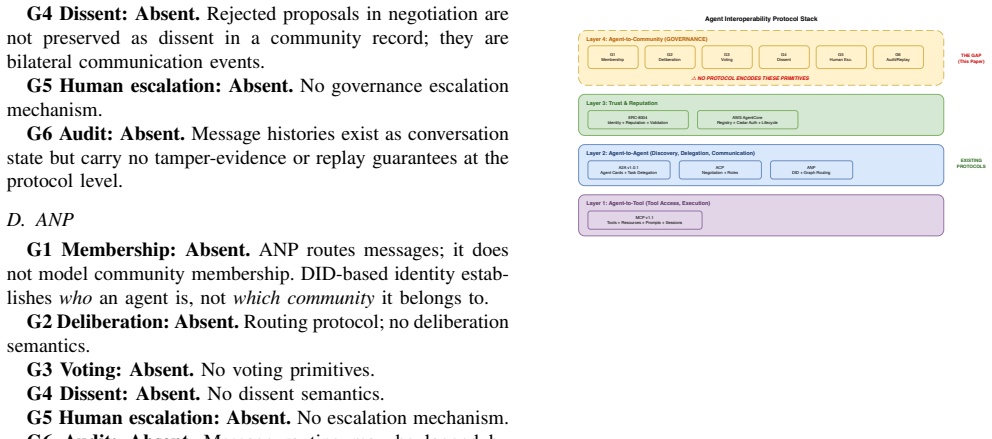
Mapping each protocol against the taxonomy produces a gap matrix showing voting and dissent preservation absent across MCP, A2A, ACP, ANP, and ERC-8004, deliberation absent or at most partial, and no protocol encoding the full set of primitives required for governed agent communities. The work distinguishes extensible gaps from structural gaps and concludes that agent community governance constitutes a missing architectural layer above current interoperability standards, not a missing feature within them.
What carries the argument
The six-dimension governance requirements taxonomy (membership, deliberation, voting, dissent preservation, human escalation, and audit/replay) used to classify each protocol's capabilities as Supported, Partial, or Absent.
If this is right
- Voting is absent across all five protocols.
- Dissent preservation is absent across all five protocols.
- Deliberation is absent or at most partial in the protocols.
- No protocol encodes the full set of primitives for governed agent communities.
- Agent community governance requires a missing architectural layer above the standards rather than extensions inside them.
Where Pith is reading between the lines
- Enterprises may need to add custom governance mechanisms outside the interoperability protocols when deploying agent fleets.
- Protocol evolution could close some gaps through extensions but would leave structural gaps untouched.
- A separate governance protocol or layer may develop as its own standard to sit above existing interoperability work.
- The same taxonomy could be applied to other agent communication frameworks to check for similar gaps.
Load-bearing premise
The six governance dimensions drawn from organizational theory, multi-agent systems literature, and enterprise standards are both necessary and sufficient to determine whether a protocol can support governed agent communities.
What would settle it
An updated specification or running implementation of one of the five protocols that adds explicit voting procedures and dissent preservation mechanisms, enabling a governed agent community to operate without any additional layer, would test the universal absence and structural gap claims.
Figures
read the original abstract
Agent interoperability protocols (MCP, A2A, ACP, ANP, and ERC-8004) have rapidly matured to enable identity, capability discovery, tool access, and message exchange between autonomous agents. However, as enterprises deploy heterogeneous agent fleets that must make collective decisions under governance constraints, a question arises: can these protocols support governed agent communities, or only task-oriented coordination? We present a systematic gap analysis applying a six-dimension governance requirements taxonomy (membership, deliberation, voting, dissent preservation, human escalation, and audit/replay) derived from organizational theory, multi-agent systems literature, and enterprise governance standards. We analyze each protocol's specification against this taxonomy, classifying capabilities as Supported, Partial, or Absent. The resulting gap matrix reveals that voting and dissent preservation are universally absent across all five protocols, deliberation is absent or at most partial, and no protocol encodes the full set of primitives required for governed agent communities. We distinguish extensible gaps (addressable through protocol extension mechanisms) from structural gaps (requiring a new architectural layer) and assess time-sensitivity based on observed protocol evolution velocity. The analysis establishes that agent community governance constitutes a missing architectural layer above current interoperability standards, not a missing feature within them.
Editorial analysis
A structured set of objections, weighed in public.
Referee Report
Summary. The paper claims that five agent interoperability protocols (MCP, A2A, ACP, ANP, ERC-8004) cannot support governed agent communities. It applies a six-dimension taxonomy (membership, deliberation, voting, dissent preservation, human escalation, audit/replay) derived from organizational theory, MAS literature, and enterprise standards; classifies each protocol's capabilities as Supported/Partial/Absent; finds voting and dissent preservation absent in all protocols, deliberation absent or partial, and no protocol encoding the full primitive set; distinguishes extensible from structural gaps; and concludes that agent community governance is a missing architectural layer above current standards rather than a missing feature within them.
Significance. If the taxonomy is adequate, the universal absences in voting and dissent preservation, combined with the extensible-vs-structural gap distinction, would usefully highlight that current interoperability standards are insufficient for enterprise agent fleets requiring collective decisions under governance constraints. The systematic classification approach provides a concrete basis for future protocol design and standards work.
major comments (1)
- [Abstract and taxonomy derivation section] The manuscript derives the six-dimension taxonomy from prior literature but does not demonstrate that these dimensions are sufficient (as opposed to merely necessary) to determine whether a protocol can support governed agent communities. The central claim that governance is a missing architectural layer (rather than addressable via composition with external services, implicit mechanisms, or application-layer enforcement) depends on exhaustiveness of the taxonomy; this argument is absent.
minor comments (1)
- [Title] The title references only MCP, A2A, and ACP while the abstract and analysis cover five protocols including ANP and ERC-8004; this mismatch should be corrected for clarity.
Simulated Author's Rebuttal
We thank the referee for the constructive comment on the taxonomy derivation. We respond point-by-point below.
read point-by-point responses
-
Referee: [Abstract and taxonomy derivation section] The manuscript derives the six-dimension taxonomy from prior literature but does not demonstrate that these dimensions are sufficient (as opposed to merely necessary) to determine whether a protocol can support governed agent communities. The central claim that governance is a missing architectural layer (rather than addressable via composition with external services, implicit mechanisms, or application-layer enforcement) depends on exhaustiveness of the taxonomy; this argument is absent.
Authors: We agree that the manuscript did not include an explicit argument establishing sufficiency of the six dimensions. The taxonomy was constructed by extracting the minimal set of primitives required for collective decision-making under governance constraints, as identified in the cited organizational theory, MAS literature on agent societies, and enterprise standards. We will revise the taxonomy derivation section to add a concise justification of sufficiency: these dimensions jointly cover all core functions needed for a governed agent community (defining participants, enabling discussion, reaching binding outcomes, preserving minority positions, incorporating external oversight, and ensuring verifiability), such that the absence of any one prevents full governance. This supports the architectural-layer claim because the protocols' structural omissions (as opposed to merely missing optional features) cannot be remedied by composition with external services or application-layer enforcement without the underlying interoperability layer providing the primitives. The existing extensible-vs-structural distinction in the paper will be cross-referenced to reinforce this point. revision: yes
Circularity Check
No significant circularity; taxonomy from external literature
full rationale
The paper states its six-dimension governance requirements taxonomy is derived from organizational theory, multi-agent systems literature, and enterprise governance standards. Gap classifications are presented as direct comparisons to published protocol specifications (Supported/Partial/Absent). No self-citations are invoked as load-bearing premises, no fitted inputs are renamed as predictions, and no derivation step reduces by construction to the paper's own inputs or definitions. The central claim follows from applying an externally sourced framework, rendering the analysis self-contained against external benchmarks.
Axiom & Free-Parameter Ledger
axioms (1)
- domain assumption The six-dimension governance requirements taxonomy derived from organizational theory, multi-agent systems literature, and enterprise governance standards is appropriate and complete for evaluating governed agent communities.
Reference graph
Works this paper leans on
-
[1]
Model context protocol specification,
Anthropic, “Model context protocol specification,” 2024, schema version 2025-11-25; latest protocol version 2025-06-18. [Online]. Available: https://modelcontextprotocol.io/specification
2024
-
[2]
Agent2agent protocol,
Google and Linux Foundation, “Agent2agent protocol,” 2026, version 1.0.1, May 2026. [Online]. Available: https://a2a-protocol.org/
2026
-
[3]
Agent communication protocol,
IBM Research, “Agent communication protocol,” 2025, open-source agent communication framework. [Online]. Available: https://github. com/ibm/agent-communication-protocol
2025
-
[4]
Agent network protocol,
ANP Community, “Agent network protocol,” 2025, dID-based agent routing protocol. [Online]. Available: https://github.com/ agent-network-protocol/
2025
-
[5]
Erc-8004: Trustless agents,
Ethereum Community, “Erc-8004: Trustless agents,” 2025, draft, created 2025-08-13. Defines Identity, Reputation, and Validation registries. [Online]. Available: https://eips.ethereum.org/EIPS/eip-8004
2025
-
[6]
Amazon bedrock agentcore,
Amazon Web Services, “Amazon bedrock agentcore,” 2026, gA, 15 regions. Agent registry, runtime, gateway, evaluations. [Online]. Available: https://aws.amazon.com/bedrock/agentcore/
2026
-
[7]
A2a protocol extensions,
Linux Foundation, “A2a protocol extensions,” 2026, extension framework documentation, accessed June 2026. [Online]. Available: https://a2a-protocol.org/latest/topics/extensions/
2026
-
[8]
Habermas,Between Facts and Norms: Contributions to a Discourse Theory of Law and Democracy
J. Habermas,Between Facts and Norms: Contributions to a Discourse Theory of Law and Democracy. MIT Press, 1996
1996
-
[9]
H. M. Robertet al.,Robert’s Rules of Order Newly Revised, 12th ed. PublicAffairs, 2020
2020
-
[10]
Ostrom,Governing the Commons: The Evolution of Institutions for Collective Action
E. Ostrom,Governing the Commons: The Evolution of Institutions for Collective Action. Cambridge University Press, 1990
1990
-
[11]
A framework for argumentation-based negotiation,
C. Sierra, N. R. Jennings, P. Noriega, and S. Parsons, “A framework for argumentation-based negotiation,” inArgumentation in Multi-Agent Systems. Springer, 2004
2004
-
[12]
Governance by Design: A Parsonian Institutional Architecture for Internet-Wide Agent Societies
Y . Ruan, “Governance by design: A parsonian institutional architecture for internet-wide agent societies,”arXiv preprint arXiv:2604.11337, 2026
work page internal anchor Pith review Pith/arXiv arXiv 2026
-
[13]
Institutional ai: Governing llm collusion via public governance graphs,
A. Bracale Syrnikovet al., “Institutional ai: Governing llm collusion via public governance graphs,”arXiv preprint arXiv:2601.11369, 2026
-
[14]
Supervisory guidance on model risk management (sr 11-7),
Office of the Comptroller of the Currency, “Supervisory guidance on model risk management (sr 11-7),” 2011, oCC Bulletin 2011-12
2011
-
[15]
Iso/iec 42001:2023 ar- tificial intelligence management system,
International Organization for Standardization, “Iso/iec 42001:2023 ar- tificial intelligence management system,” 2023
2023
-
[16]
Regulation (eu) 2024/1689 (artificial intelligence act),
European Parliament and Council, “Regulation (eu) 2024/1689 (artificial intelligence act),” 2024
2024
-
[17]
A protocol trust taxonomy for agent interoper- ability,
Y . Hu and W. Rong, “A protocol trust taxonomy for agent interoper- ability,”arXiv preprint arXiv:2511.03434, 2025, aAAI 2026 TrustAgent Workshop
-
[18]
A survey of agent communication protocols,
A. Ehteshamet al., “A survey of agent communication protocols,”arXiv preprint arXiv:2505.02279, 2025
-
[19]
Agentrfc: A reference framework for agent inter- operability,
AgentRFC Authors, “Agentrfc: A reference framework for agent inter- operability,”arXiv preprint arXiv:2603.23801, 2026
-
[20]
Llm constitutional multi-agent governance,
J. de Curtoet al., “Llm constitutional multi-agent governance,”arXiv preprint arXiv:2603.13189, 2026
-
[21]
From Debate to Decision: Conformal Social Choice for Safe Multi-Agent Deliberation
X. Wanget al., “From debate to decision: Conformal social choice for safe multi-agent deliberation,”arXiv preprint arXiv:2604.07667, 2026
work page internal anchor Pith review Pith/arXiv arXiv 2026
-
[22]
The role of social learning and collective norm formation in llm multi-agent systems,
S. Guptaet al., “The role of social learning and collective norm formation in llm multi-agent systems,” inProceedings of AAMAS 2025, 2025
2025
discussion (0)
Sign in with ORCID, Apple, or X to comment. Anyone can read and Pith papers without signing in.