REVIEW 3 major objections 1 minor 32 references
Temporal Coarse-Graining of Latent Default-Probability Paths Generates Effective Default Correlation
T0 review · 3 major / 1 minor · reviewed 2026-07-01 · grok-4.3
Pith's one-line read Persistent dynamics in a latent default-probability path generate effective default correlation when monthly values are aggregated over longer horizons.
desk verdict Coarse-graining monthly OU latent default paths induces effective long-horizon correlation under conditional independence and improves predictive density when residual params are fit after aggregation. read the letter →
The pith
A machine-rendered reading of the paper's core claim, the machinery that carries it, and where it could break.
The reading
What carries the argument
The OU-Binomial baseline whose latent default-probability path is temporally coarse-grained before aggregation, thereby generating an effective mixing distribution at each longer scale.
What would settle it
Simulate default counts from the coarse-grained OU-Binomial model at multiple horizons without extra residual-covariance terms and compare the resulting overdispersion and autocorrelation statistics directly to the empirical corporate default counts; systematic mismatch at long horizons would falsify the claim.
Extended reading notes
Core claim
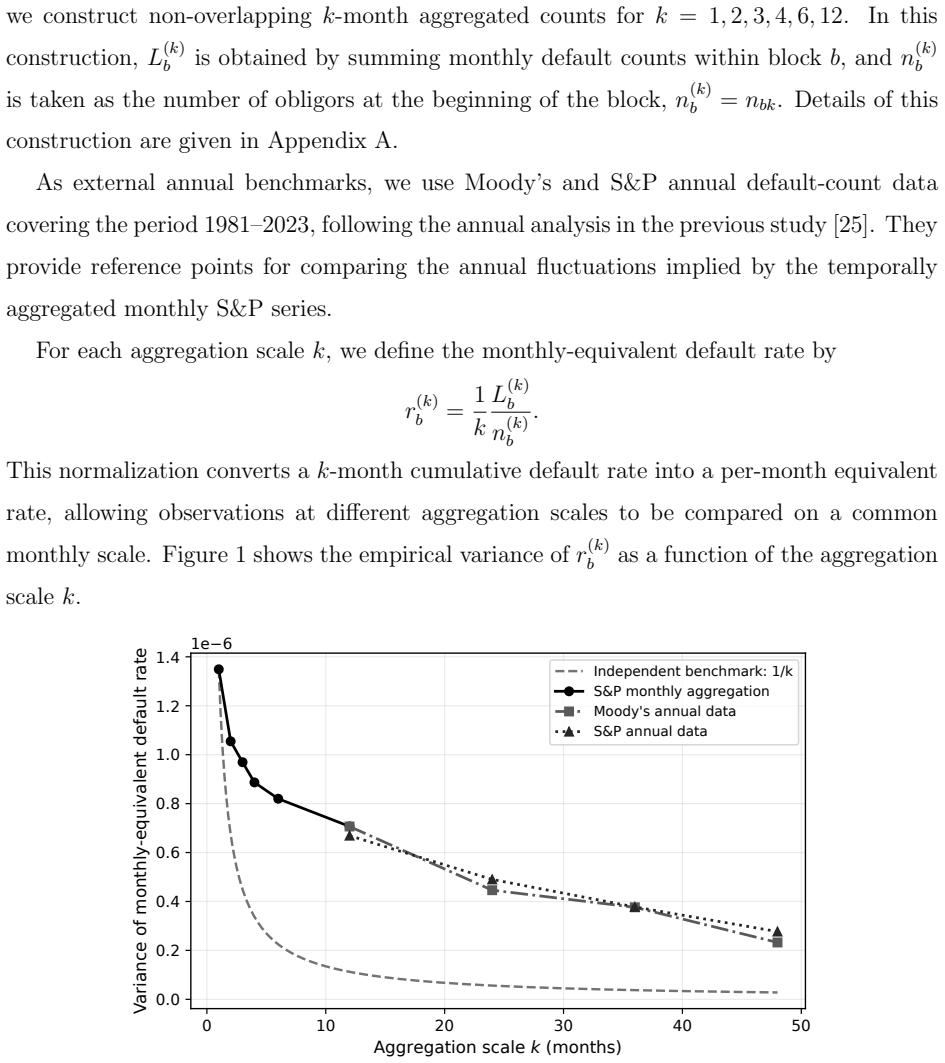
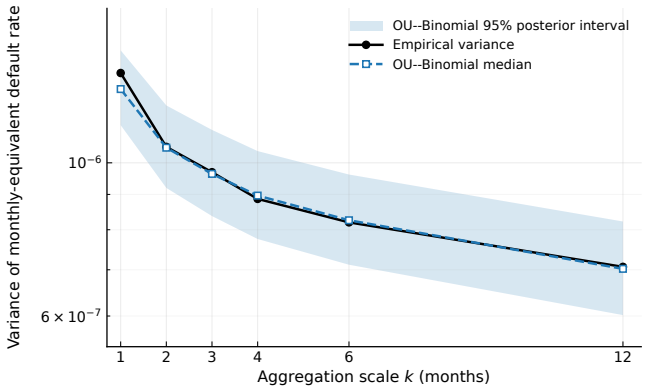
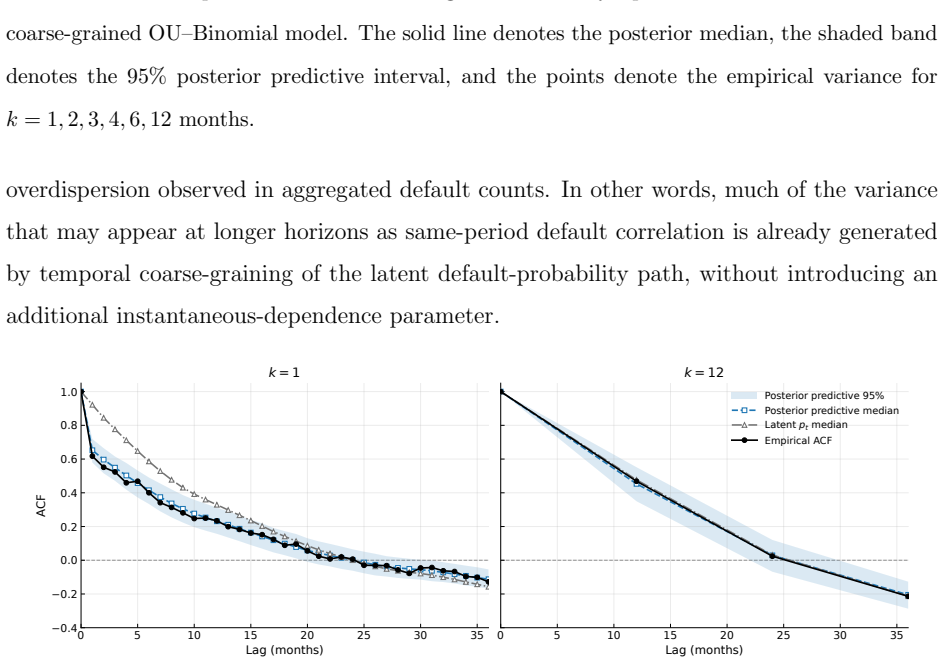
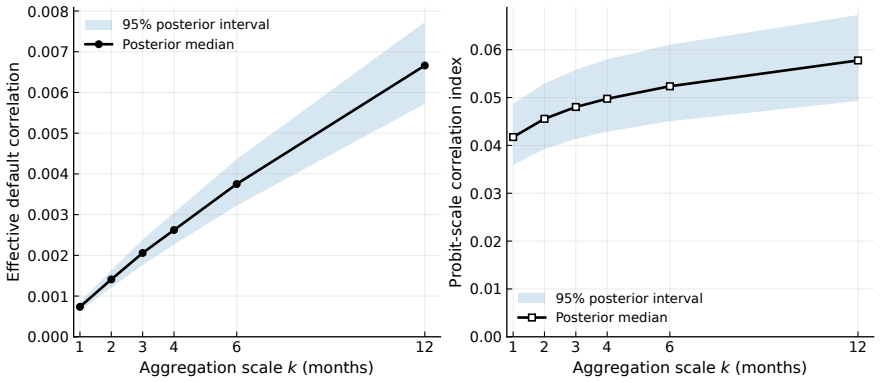
In the OU-Binomial baseline, monthly defaults are conditionally independent given the latent path, but aggregating monthly default probabilities into long-horizon probabilities induces a scale-dependent effective mixing distribution for aggregated default counts. Applied to corporate default-count data, this mechanism explains long-horizon overdispersion, autocorrelation, and the emergence of effective default correlation. When monthly posterior latent paths are first coarse-grained and residual-dependence parameters are estimated conditional on these paths, the residual covariance contributions remain small while the predictive density improves.
Load-bearing premise
Monthly defaults are conditionally independent given the latent path, so any observed dependence at longer horizons must come only from the path's persistence and the aggregation step.
Editorial extensions
If this is right
- Long-horizon overdispersion in default counts is produced by the aggregation step alone.
- Autocorrelation in default counts emerges from the persistent latent dynamics under coarse-graining.
- Residual covariance contributions stay small when parameters are estimated after coarse-graining the monthly paths.
- Per-block expected log predictive density improves relative to direct fitting at each scale.
- Long-horizon fluctuations are not over-allocated to contagion or common-factor parameters.
Reading between the lines
- Many reported default correlations at multi-year horizons may be largely artifacts of temporal aggregation rather than simultaneous dependence.
- The same aggregation-induced mixing could appear in other persistent latent-count processes, such as failure counts in reliability data.
- The approach supplies a natural null model for testing whether additional dependence terms are required once scale-consistent baselines are subtracted.
Signed reviews
Editorial analysis
A structured set of objections, weighed in public.
Referee Report
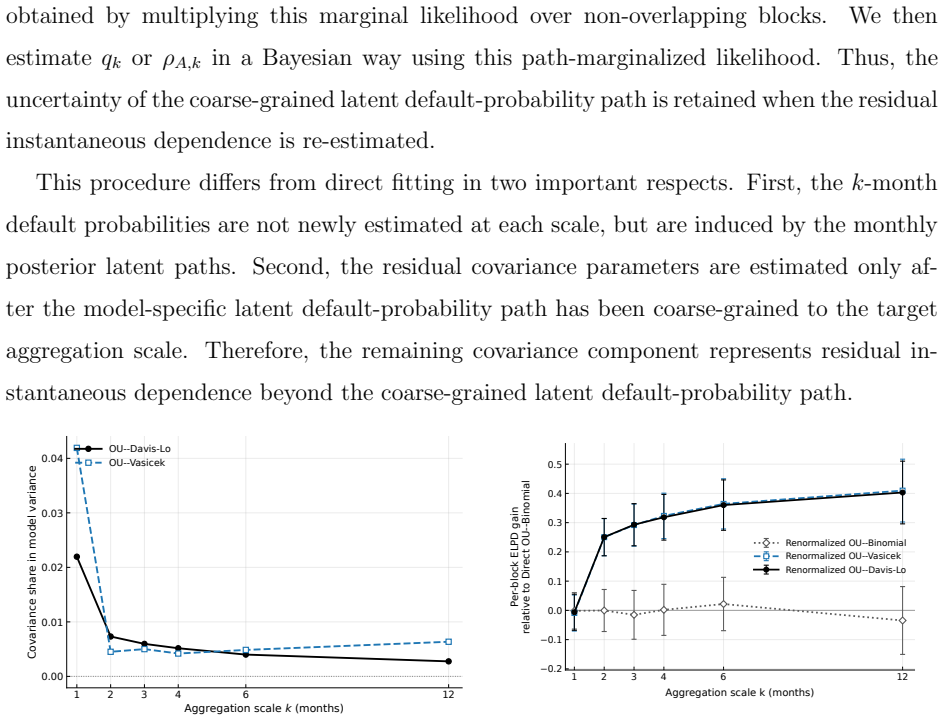
Summary. The manuscript claims that persistent dynamics of a latent default-probability path (Ornstein-Uhlenbeck process) in an OU-Binomial baseline, where monthly defaults are conditionally independent given the path, generate effective default correlation at longer horizons solely through temporal coarse-graining. This aggregation induces a scale-dependent mixing distribution explaining overdispersion, autocorrelation, and correlation in corporate default-count data. Direct fitting at each scale increases residual covariance shares in Davis-Lo contagion and Vasicek extensions and worsens predictive density, whereas coarse-graining monthly posterior paths first before fitting residuals keeps residual covariance small and improves per-block expected log predictive density.
Significance. If the central mechanism holds, the result supplies a parsimonious, scale-consistent baseline for long-horizon default dependence arising from short-horizon conditional independence plus persistent latent dynamics, rather than instantaneous contagion or common factors. The explicit comparison of fitting procedures and emphasis on predictive density offer a practical regularization strategy that could improve identifiability in multi-scale credit-risk models.
major comments (3)
- [Abstract] Abstract (OU-Binomial baseline): The claim that long-horizon dependence arises solely from temporal coarse-graining rests on the untested assumption that monthly defaults are conditionally independent given the latent path. No validation against models permitting instantaneous dependence at the monthly scale is described, which is load-bearing because violation would mean the reported superiority of coarse-graining could be an artifact of the baseline rather than a general property.
- [Abstract] Abstract (fitting procedure): Residual-dependence parameters are estimated conditional on coarse-grained posterior latent paths that were themselves estimated from the same data. This procedure risks circularity in separating latent-path variance from residual covariance, undermining the attribution that residual contributions remain small under coarse-graining.
- [Abstract] Abstract: The reported improvement in predictive density and reduction in residual covariance when coarse-graining is applied first are stated without quantitative values, error bars, explicit derivation of the induced mixing distribution, data sample periods, or exclusion rules, preventing assessment of the magnitude and robustness of the central empirical claim.
minor comments (1)
- [Abstract] The abstract introduces 'per-block expected log predictive density' and 'effective mixing distribution' without defining block structure or providing the explicit functional form or derivation.
Simulated Author's Rebuttal
We thank the referee for the constructive comments on the abstract. We address each point below, clarifying the scope of the baseline model and proposing targeted revisions to improve transparency without altering the core claims.
read point-by-point responses
-
Referee: [Abstract] Abstract (OU-Binomial baseline): The claim that long-horizon dependence arises solely from temporal coarse-graining rests on the untested assumption that monthly defaults are conditionally independent given the latent path. No validation against models permitting instantaneous dependence at the monthly scale is described, which is load-bearing because violation would mean the reported superiority of coarse-graining could be an artifact of the baseline rather than a general property.
Authors: The OU-Binomial is introduced explicitly as a baseline that assumes conditional independence of monthly defaults given the latent path; this isolates the contribution of temporal aggregation to effective long-horizon correlation. The manuscript's central demonstration is that this baseline alone reproduces the observed scale-dependent overdispersion and correlation. Comparisons are made to Davis-Lo and Vasicek extensions that add instantaneous dependence at the fitting horizon; those extensions receive larger residual shares when fitted directly at long horizons. The reported advantage of coarse-graining is therefore shown relative to models that already permit instantaneous dependence, rather than claimed as a universal property. We will add a clarifying sentence on the baseline scope in the revised abstract and introduction. revision: no
-
Referee: [Abstract] Abstract (fitting procedure): Residual-dependence parameters are estimated conditional on coarse-grained posterior latent paths that were themselves estimated from the same data. This procedure risks circularity in separating latent-path variance from residual covariance, undermining the attribution that residual contributions remain small under coarse-graining.
Authors: Latent paths are first estimated at the monthly scale using only the monthly counts. These paths are then coarse-grained to the target horizon before any residual parameters are fitted to the aggregated counts. The two-step sequence attributes variation to the latent dynamics at the native scale before examining residuals at the aggregated scale. While the underlying observations are the same, the temporal separation reduces direct circularity. We will expand the methods description to make this estimation order explicit and discuss its implications for identifiability. revision: partial
-
Referee: [Abstract] Abstract: The reported improvement in predictive density and reduction in residual covariance when coarse-graining is applied first are stated without quantitative values, error bars, explicit derivation of the induced mixing distribution, data sample periods, or exclusion rules, preventing assessment of the magnitude and robustness of the central empirical claim.
Authors: The abstract summarizes results whose details appear in the main text: the derivation of the scale-dependent mixing distribution is given in Section 2, data periods and exclusion criteria are stated in Section 3, and numerical values for predictive-density gains together with covariance shares (including uncertainty) are reported in Section 4. We will revise the abstract to incorporate the key quantitative magnitudes, sample information, and a brief reference to the mixing-distribution derivation so that the central claims are self-contained. revision: yes
Circularity Check
No circularity; central derivation follows from explicit model assumptions and aggregation mathematics
full rationale
The paper states the OU-Binomial baseline assumption of conditional independence of monthly defaults given the latent path, then shows mathematically that temporal aggregation of probabilities induces a scale-dependent mixing distribution and thus effective correlation. This follows directly from the model's probability structure without any reduction to fitted parameters being renamed as predictions or self-citations. Empirical sections compare predictive densities across fitting procedures, which is standard model evaluation rather than a definitional equivalence. No self-definitional steps, load-bearing self-citations, or smuggled ansatzes appear; the conditional-independence assumption is explicit and the results are presented as consequences of that assumption plus aggregation.
Assumptions & free parameters
free parameters (2)
- OU mean-reversion speed and volatility
- residual covariance parameters
assumptions (1)
- domain assumption Monthly defaults are conditionally independent given the latent path
Cite this review
Pith. "Pith review of Temporal Coarse-Graining of Latent Default-Probability Paths Generates Effective Default Correlation." pith.science (2026). https://pith.science/paper/XF4AMBEM
@misc{pith2026260612446,
  author       = {Pith},
  title        = {Pith review of: Temporal Coarse-Graining of Latent Default-Probability Paths Generates Effective Default Correlation},
  year         = {2026},
  howpublished = {\url{https://pith.science/paper/XF4AMBEM}},
  note         = {Machine review of arXiv:2606.12446}
}
read the original abstract
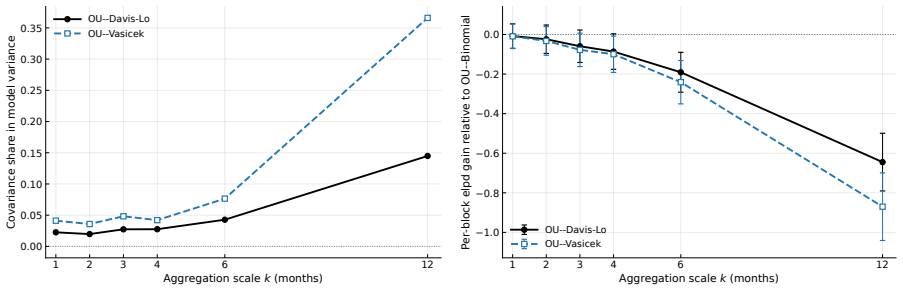
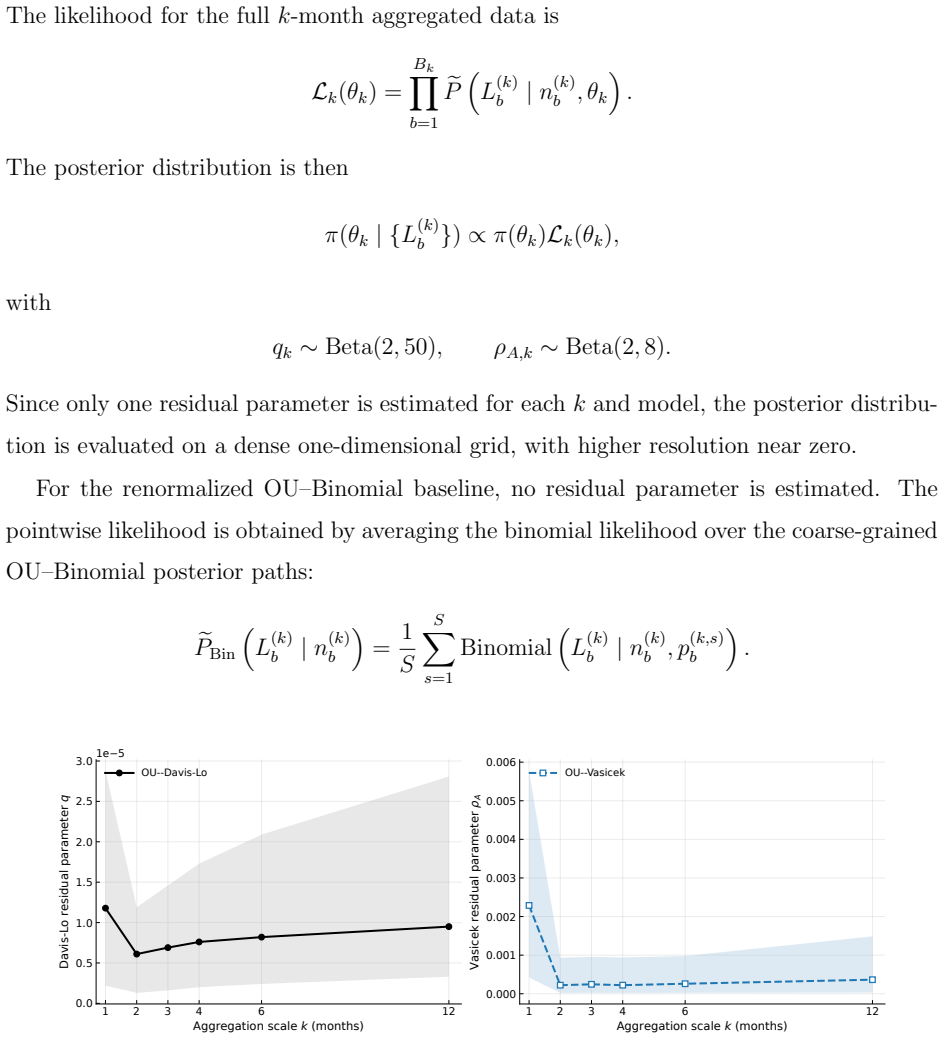
We show that persistent dynamics of a latent default-probability path can generate effective default correlation through temporal coarse-graining. In the OU--Binomial baseline, monthly defaults are conditionally independent given this latent path, but aggregating monthly default probabilities into long-horizon probabilities induces a scale-dependent effective mixing distribution for aggregated default counts. Applied to corporate default-count data, this mechanism explains long-horizon overdispersion, autocorrelation, and the emergence of effective default correlation. We then examine Davis--Lo-type contagion and Vasicek-type common-factor extensions. Direct fitting at each aggregation scale assigns increasing residual covariance shares to instantaneous dependence, but worsens the per-block expected log predictive density. In contrast, when monthly posterior latent paths are first coarse-grained and residual-dependence parameters are estimated conditional on these paths, the residual covariance contributions remain small while the predictive density improves. Thus, temporal coarse-graining provides a scale-consistent baseline that regularizes the attribution of variance and improves identifiability by suppressing the over-allocation of long-horizon fluctuations to contagion or asset-correlation parameters.
Figures
Figures from the paper (17 more)








Reference graph
Works this paper leans on
-
[1]
Vasicek default-count distribution In the Vasicek specification, default dependence is generated by a common Gaussian factor. The baseline default probabilityp t is inherited from the latent default-probability path of the OU–Binomial state-space model. As in the main text, we write yt = Φ−1(pt), p t = Φ(yt), where Φ denotes the standard normal cumulative...
-
[2]
Davis–Lo default-count distribution In the Davis–Lo specification, default dependence is generated by a cumulative conta- gion mechanism. As in the main text, the baseline probabilityp t is generated by the latent default-probability path of the OU–Binomial state-space model. LetX it denote the idiosyn- cratic default indicator of obligoriin periodt, with...
-
[3]
k+ 2 k−1X h=1 (k−h)ϕ h # , we obtain Var(p(k))≈φ(µ) 2{1−Φ(µ)} 2(k−1)σ2 y
Coarse-grained mixing distribution of the OU–Binomial baseline The preceding subsections defined the one-period default-count distributions used as residual instantaneous-dependence extensions. We now give an analytical characterization of the effective mixing distribution induced by temporal coarse-graining of the OU–Binomial baseline. This characterizat...
-
[4]
Bayesian estimation of the monthly OU–Binomial model The monthly OU–Binomial model was estimated by Bayesian inference using the monthly S&P default-count series from January 1981 to September 2021 (T= 489). The observation equation is Lt |p t, nt ∼Binomial(n t, pt), and the latent default probability is represented on the probit scale as yt = Φ−1(pt), p ...
work page 1981
-
[5]
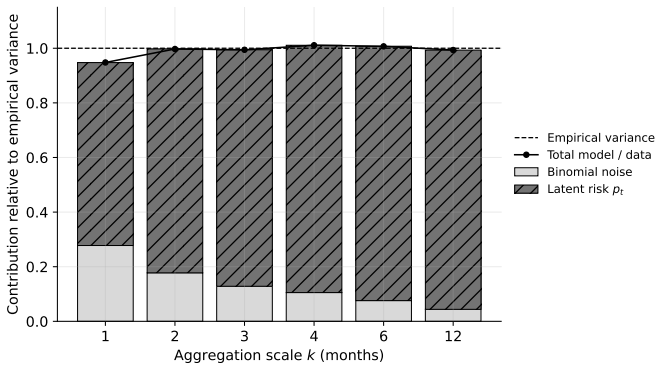
Variance decomposition of the coarse-grained OU–Binomial model We first examine how the variance of the coarse-grained OU–Binomial model is decom- posed into conditional binomial noise and fluctuations of the latent default-probability path. For each aggregation scalek, we decompose the posterior predictive variance of the monthly- equivalent default rate...
-
[6]
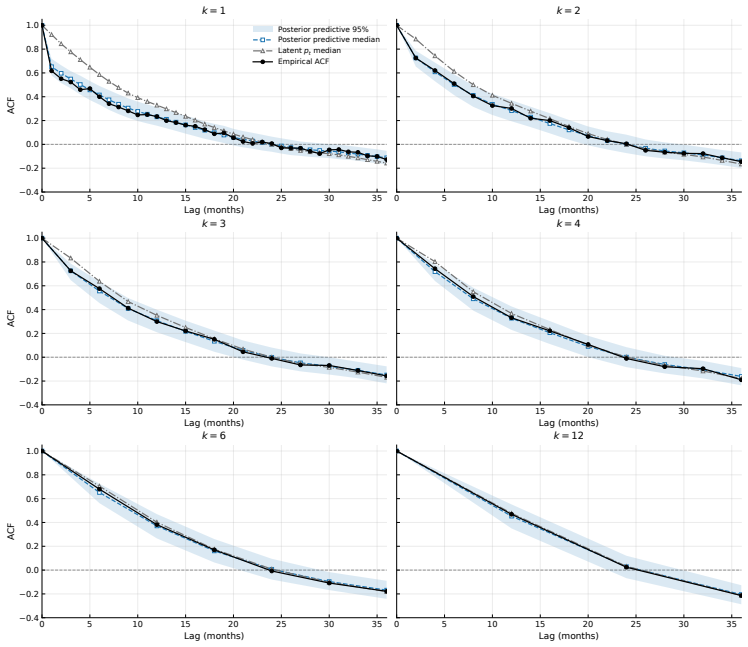
Autocorrelation diagnostics Figure 8 shows that the coarse-grained OU–Binomial posterior paths reproduce the em- pirical ACF over all aggregation scalesk= 1,2,3,4,6,12, confirming that the variance scaling is accompanied by a consistent representation of temporal persistence in the latent default-probability path. 31 0 5 10 15 20 25 30 35 Lag (months) −0....
-
[7]
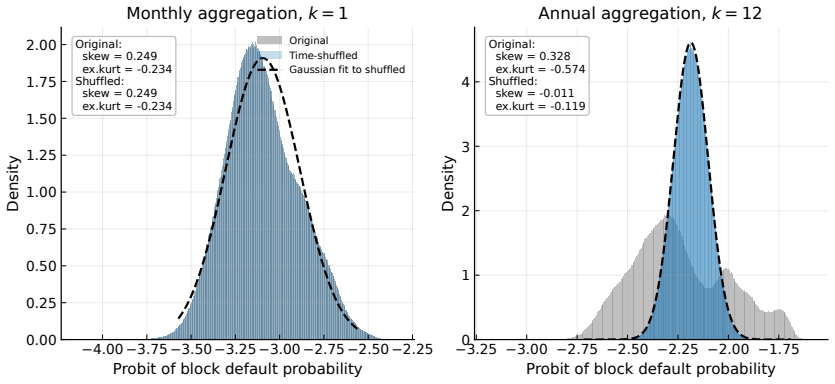
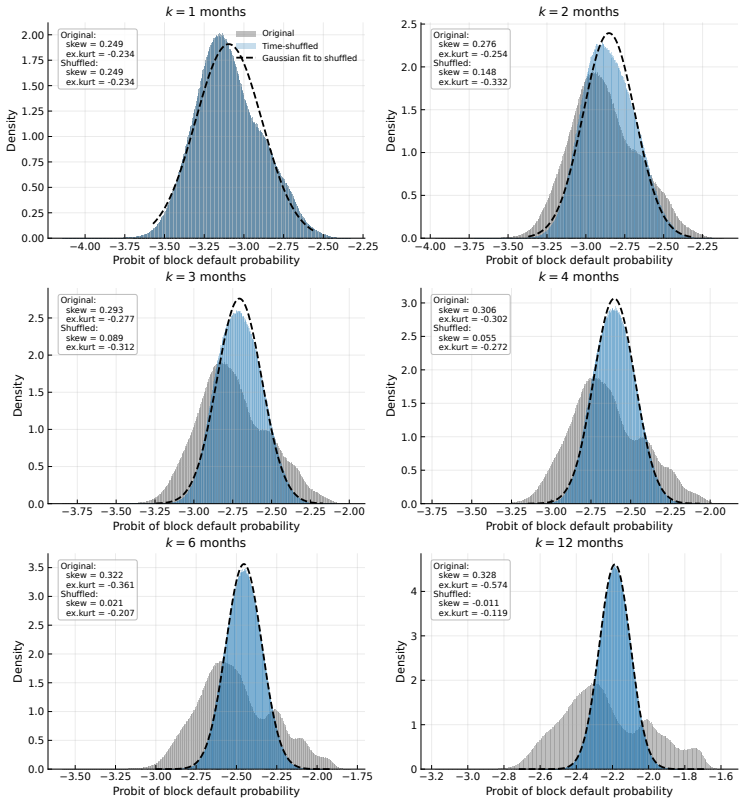
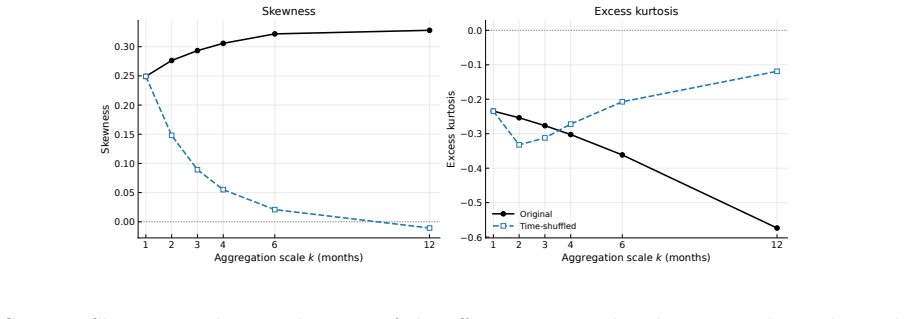
Effective mixing distributions Figures 9 and 10 provide additional diagnostics of the effective mixing distribution. The original posterior paths and the time-shuffled benchmark differ increasingly with the aggre- gation scale, indicating that the long-horizon distribution is shaped by the temporal ordering and persistence of the monthly latent default-pr...
-
[8]
R. N. Mantegna and H. E. Stanley,An Introduction to Econophysics: Correlations and Com- plexity in Finance(Cambridge University Press, 1999). 43
work page 1999
Show all 32 references
-
[9]
Galam, Int
S. Galam, Int. J. Mod. Phys. C19, 409 (2008)
2008
-
[10]
Lux, Econ
T. Lux, Econ. J.105, 881 (1995)
1995
-
[11]
Lux and M
T. Lux and M. Marchesi, Nature397, 498 (1999)
1999
-
[12]
Alfarano, T
S. Alfarano, T. Lux, and F. Wagner, Comput. Econ.26, 19 (2005)
2005
-
[13]
Bouchaud, M
J.-P. Bouchaud, M. M´ ezard, and M. Potters, Quant. Finance2, 251 (2002)
2002
-
[14]
Fernandez-Gracia, K
J. Fernandez-Gracia, K. Suchecki, J. J. Ramasco, M. SanMiguel, and V. M. Egu´ ıluz, Phys. Rev. Lett.112, 158701 (2014)
2014
-
[15]
S. Mori, M. Hisakado, and T. Takahashi, Phys. Rev. E86, 026109 (2012)
2012
-
[16]
S. Mori, K. Nakayama, and M. Hisakado, Phys. Rev. E99, 052307 (2019)
2019
-
[17]
Smolyak and S
A. Smolyak and S. Havlin, Entropy24, 271 (2022)
2022
-
[18]
P. J. Sch¨ onbucher,Credit Derivatives Pricing Models: Models, Pricing and Implementation (John Wiley & Sons, 2003)
2003
-
[19]
M. H. A. Davis and V. Lo, Quant. Finance1, 382 (2001)
2001
-
[20]
O. A. Vasicek, KMV Corporation (1991), working paper
1991
-
[21]
O. A. Vasicek, Risk15, 160 (2002)
2002
-
[22]
S. R. Das, D. Duffie, N. Kapadia, and L. Saita, J. Finance62, 93 (2007)
2007
-
[23]
Duffie, A
D. Duffie, A. Eckner, G. Horel, and L. Saita, J. Finance64, 2089 (2009)
-
[24]
Azizpour, K
S. Azizpour, K. Giesecke, and G. Schwenkler, J. Financ. Econ.129, 154 (2018)
2018
-
[25]
Sakata, M
A. Sakata, M. Hisakado, and S. Mori, J. Phys. Soc. Jpn.76, 054801 (2007)
2007
-
[26]
Torri, R
G. Torri, R. Giacometti, and G. Farina, Commun. Nonlinear Sci. Numer. Simul.159, 109886 (2026)
2026
-
[27]
Hisakado and S
M. Hisakado and S. Mori, Physica A: Statistical Mechanics and its Applications563, 125435 (2021)
2021
-
[28]
A. G. Hawkes, Biometrika58, 83 (1971)
1971
-
[29]
Errais, K
E. Errais, K. Giesecke, and L. R. Goldberg, SIAM J. Financial Math.1, 642 (2010)
2010
-
[30]
Kirchner, Quant
M. Kirchner, Quant. Finance17, 571 (2017)
2017
-
[31]
Hisakado, K
M. Hisakado, K. Hattori, and S. Mori, Phys. Rev. E106, 034106 (2022)
2022
-
[32]
Mori, Contagion or macroeconomic fluctuations? identifiability in aggregated default data (2026), arXiv preprint arXiv:2604.18118, arXiv:2604.18118 [q-fin.RM]
S. Mori, Contagion or macroeconomic fluctuations? identifiability in aggregated default data (2026), arXiv preprint arXiv:2604.18118, arXiv:2604.18118 [q-fin.RM]. 44
2026 arXiv
Reviewed July 1, 2026 · model on record in the stance chip above.
Discussion (0). Continue with ORCID to comment.