REVIEW 3 major objections 5 minor 3 cited by
Balancing Preservation and Modification: A Region and Semantic Aware Metric for Instruction-Based Image Editing
T0 review · 3 major / 5 minor · reviewed 2026-08-07 · deepseek-v4-flash
Pith's one-line read This paper introduces BPM, a metric for instruction-based image editing that explicitly separates editing-relevant from editing-irrelevant regions, and claims it achieves the highest agreement with human evaluation among existing…
desk verdict A sensible two-tier metric for instruction-based editing, but the headline number is undercut by an undefined Smodify for add/remove instructions and alpha tuning on the evaluation set. read the letter →
The pith
A machine-rendered reading of the paper's core claim, the machinery that carries it, and where it could break.
The reading
What carries the argument
The key machinery is the explicit disentanglement of the image into editing-relevant and editing-irrelevant regions, driven by a three-step pipeline: LLM instruction parsing, detector/segmentor localization, and two rule-based plus two embedding-based judges. The load-bearing identity is the directional CLIP similarity computed on cropped bounding-box regions, cos_sim(CLIP_I(A_edit)-CLIP_I(A_origin), CLIP_T(o2)-CLIP_T(o1)), which measures whether the change in image features moves in the same direction as the change in text features. This identity lets the metric assess modification against the instruction while implicitly checking that unrelated attributes are retained, and the preservation score uses an L2 distance on the complement of the union of the original and edited masks to enforce that untouched regions are unchanged.
What would settle it
Take an edit where the detector misses the edited object (for instance, an instruction that adds a small object that the detector does not recognize, or an edit that changes an object beyond recognizability), and check BPM's score against human ratings; a single systematic failure of localization that flips the relative ranking of two clearly good and clearly bad edits would refute the metric's reliability without a fallback.
Extended reading notes
Core claim
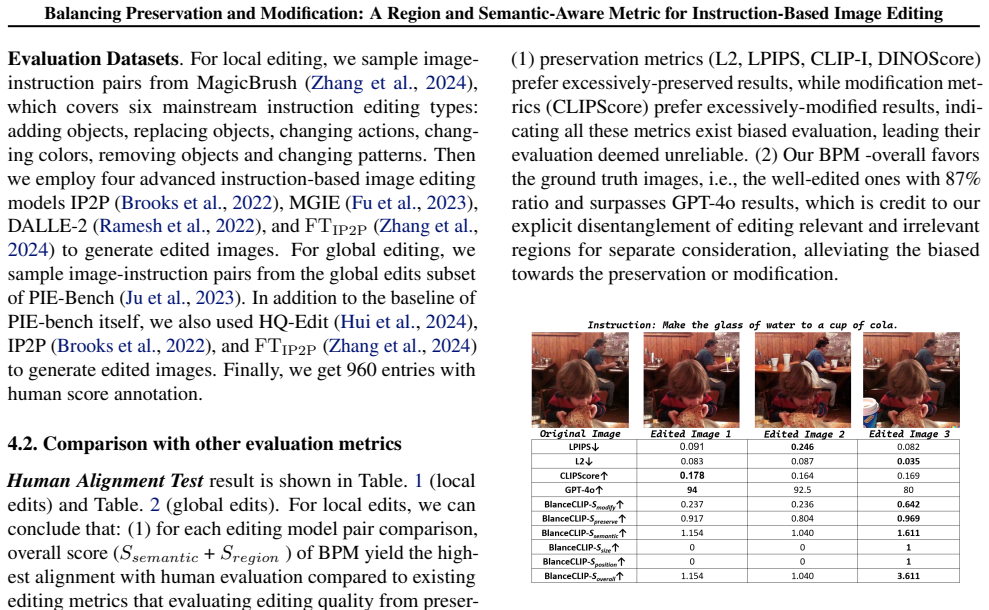
The paper claims that the central failure of existing editing metrics is that they evaluate the whole image as one unit, even though a good edit requires opposite treatments for different regions: the editing-relevant region must change according to the instruction, while everything else must stay intact. BPM addresses this by first parsing the instruction with an LLM to identify the source and target objects and any required size or position changes, then using a detector and segmentor to locate those objects in both the original and edited images. A Region-Aware Judge scores whether the edited region's position and size match the instruction, and a Semantic-Aware Judge uses directional CLIP similarity on the cropped edited regions plus an L2 distance on the preserved regions to score content compliance and preservation. The final BPM score is a weighted combination (0.7*S_semantic + 0.3*S_region), and experiments report that this score has the highest alignment with human preference rankings among all compared metrics on both local edits and global edits.
Load-bearing premise
The metric assumes that the LLM parsing and the detector and segmentor reliably locate every region that the editing process touches in both the original and edited images, so that the right pixels are scored.
Editorial extensions
If this is right
- If BPM's human-alignment results hold, it provides a cheap and interpretable alternative to human evaluation for benchmarking instruction-based editing models at scale, with speed around 1.5 seconds per image versus about 11.4 seconds for GPT-4o according to the paper's comparison.
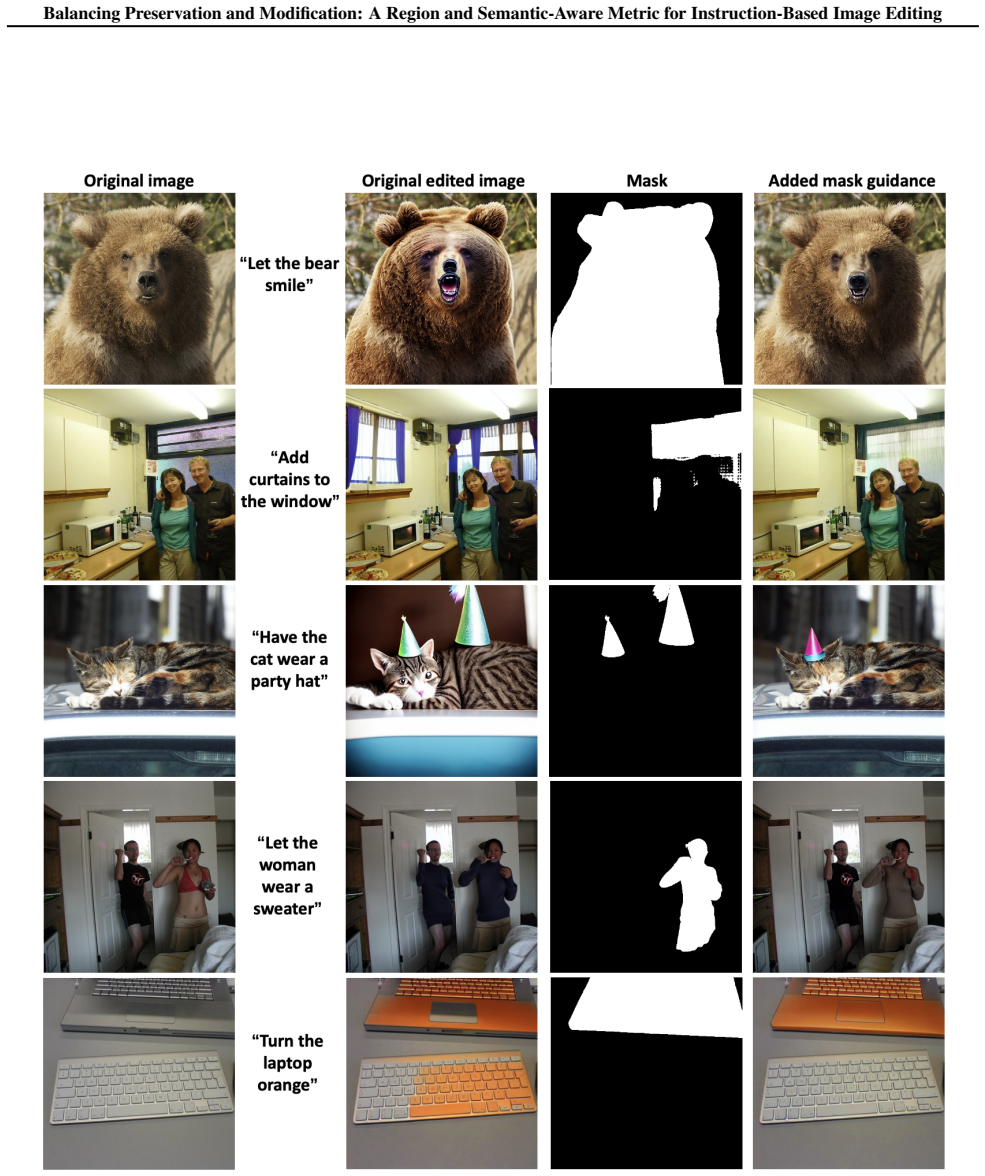
- The region-localization step can be reused as training-free guidance: applying classifier-free guidance only inside the detected editing regions improved preservation and modification scores for IP2P, FTIP2P, and MGIE in the paper's experiments, and 91% of user-preference samples rated the guided output as better or equal.
- Because the metric returns separate scores for position, size, modification, and preservation, it can diagnose which aspect of an editing model fails, rather than giving a single opaque number.
- The metric could be applied to other instruction-following visual tasks where a subset of pixels must change and the rest must stay fixed, such as object removal, inpainting, or attribute-sensitive generation.
Reading between the lines
- A natural extension the paper does not pursue is using the BPM sub-scores as training rewards or loss components for editing models, since the component structure gives dense, differentiable-style feedback on exactly which criterion failed.
- The metric's reliance on open-set detection and segmentation means its practical ceiling is set by those tools; as better open-vocabulary segmentors arrive, the same scoring scheme should improve without any change to the BPM formulas.
- The paper's 97% localization accuracy on 100 samples suggests the main risk is not typical parsing errors but instructions that refer to objects indirectly (e.g., 'it' when the referent is not named), which the paper itself notes as the failure mode in its object-identification errors.
- One implicit claim worth testing is whether the directional CLIP similarity stays reliable when the edited object changes class (e.g., clock to street sign) versus when it only changes appearance; the paper evaluates both types but does not break down performance by edit type.
Editorial analysis
A structured set of objections, weighed in public.
Referee Report
Summary. This paper proposes BPM, an automatic metric for instruction-based image editing. The metric first uses an LLM to parse the instruction into source/target objects and required size/position changes, then uses a detector and segmentor to localize those objects in the original and edited images. A region-aware judge checks size and position alignment, while a semantic-aware judge computes a directional CLIP similarity on the edited region and an L2-based preservation score on the complementary region. The two scores are combined with weight alpha. The authors report human-alignment experiments on local edits from MagicBrush and global edits from PIE-Bench, a ground-truth test, component ablations, and a mask-guidance application for improving editing models. The central claim is that BPM achieves the highest alignment with human evaluation among the compared metrics.
Significance. If the central claim holds, BPM would be a useful automated evaluator for instruction-based image editing, because it explicitly separates modification and preservation regions and provides interpretable component scores. The paper has several strengths: a concrete algorithmic pipeline, a human study with 960 responses, validation of parsing and mask quality, component-level ablations, and a released project page. The main caveats are that the S_modify definition is incomplete for add/remove instructions and that the balance weight alpha is tuned on a subset of the evaluation data. These issues are fixable but must be addressed before the headline alignment result can be taken at face value.
major comments (3)
- [§3.2 and Alg. 2 (line 10)] For add/remove instructions, §3.2 sets o1 or o2 to 'None' and initializes masks and boxes to the counterpart. Algorithm 2 line 10 then computes S_modify as the cosine similarity between CLIP image-difference vectors and CLIPT(o2) - CLIPT(o1), but CLIPT('None') is undefined. No fallback is documented: Appendix A.4 covers f_size and f_position only, not S_modify. Because the MagicBrush sample explicitly covers 'adding objects' and 'removing objects', the reported Alignment Score of 0.799 in Table 1 must either have been computed on a subset that excludes those instructions or using an undocumented special case. Please specify the exact fallback, for example by defining S_modify for the single-object case, or exclude such samples and report a per-instruction-type breakdown.
- [Appendix B.1 / Table 9 / §4.1] The balance weight alpha is set to 0.7 because it achieves the highest human-alignment score on a 100-entry subset of the same evaluation data (Table 9). Since BPM is defined by the weighted sum in Alg. 1 line 12, and since the headline comparison in Table 1 uses this tuned value, the comparison is partially circular: the metric itself has effectively been fit to the evaluation target. Please either fix alpha as a predetermined constant, tune it on a disjoint validation set, or report the sensitivity of all pairwise alignment scores over the full range of alpha.
- [§3.3 and §3.2 (thresholds and localization failure)] The region-aware judge depends on an IOU threshold and an area-ratio threshold that are never specified in the main text or appendix; without these values, f_size and f_position are not reproducible, and their binary 0/1 outputs are sensitive to the chosen thresholds. Additionally, the pipeline has no specified behavior when the detector or segmentor returns no detection, multiple detections, or an incorrect segmentation for o1 or o2. The only evidence of localization quality is the 100-sample validation in §4.3 and Table 13, and Appendix B.4 notes the LLM can misparse instructions containing 'it' because it cannot see the image. Since S_region and S_semantic are computed exactly on the localized masks, such failures can change the score for affected samples and therefore the reported alignment. Please report the thresholds, define the failure fallback, and quantify the alignment after excluding or flagging failure cases.
minor comments (5)
- [Alg. 2 line 12 and §3.4] The min-max normalization Norm is not defined over its support; S_modify and S_preserve are scalars per sample, so please specify whether normalization is performed per sample, per batch, or over the whole evaluation set.
- [§4.1] The alignment formula uses strict inequalities 1_{H1>H2} and 1_{M1>M2}, but ties in either human or metric scores are not addressed; please state how ties are counted.
- [Table 3] The reported inference speed lacks hardware and batch-size information; please add the experimental setting so the speed comparison is meaningful.
- [§3.1] There is a typo in the phrase 'fpsosition(·)', which should read 'f_position(·)'.
- [§4.4 / Table 8] Evaluating the mask-guidance enhancement with the BPM component scores themselves may favor the method by construction; please also report improvement using the independent user-study percentages from Table 15 and, if possible, an external metric.
Circularity Check
BPM has independent human-alignment grounding, but alpha is tuned on the evaluation target and the mask-guided enhancement is partly self-scored with its own mask-defined components.
-
fitted input called prediction
[Appendix B.1 and Sec. 4.1 (Implementation Details), with reported results in Tables 1-2]
"We conduct experiments with different weight factor α between Ssemantic and Sregion, i.e., BP M= α ∗ Ssemantic + (1 − α) ∗ Sregion, the results are shown in Table. 9. Among all combinations, α = 0.7 reaches the best human evaluation alignment. ... For scaling weight α for Ssemantic, we set it to 0.7 (i.e. BPM = 0.7 ∗ Ssemantic + 0.3 ∗ Sregion)."
The scalar α is selected by maximizing human-alignment on a 100-entry subset, and the appendix does not state that this subset is held out from the human-alignment evaluation reported in Tables 1-2. Because the reported local-edit alignment is the same target used to select the weighting parameter, that portion of the headline result is an in-sample optimum rather than an independent prediction. The global-edit results and separate user studies provide independent support, so this is partial rather than complete circularity.
-
self definitional
[Sec. 3.4 Eqs. (2)-(3), Sec. 3.5 Eq. (4), and Table 8]
"Ap_origin = [1− Morigin ∪ Medit] ⊙ Iorigin; Ap_edit = [1− Morigin ∪ Medit] ⊙ Iedit ... sT ∗ (ϵθ(zt, t, Iorigin, Tedit) − ϵθ(zt, t, Iorigin, ∅)) ⊙ Mall ... Mall = Morigin ∪ Medit."
The enhancement uses Mall = Morigin ∪ Medit to restrict instruction guidance to exactly the pixels that the preservation score excludes from its L2 comparison. Thus any method that suppresses changes outside Mall will mechanically raise Spreserve, making the 'Preservation' gains in Table 8 partly self-confirming rather than independent evidence of quality improvement. The paper mitigates this with a separate user study, but the tabulated component-score comparison is constructed from the same mask-defined regions that the guidance is designed to protect.
full rationale
The core metric is benchmarked externally against human ratings, so the central claim is not simply defined into existence. The CLIP directional similarity and masked L2 components are computed from stated image/text inputs and masks, with no load-bearing self-citation or imported uniqueness theorem. The main circularity-related concerns are (1) the balance factor α is tuned on the human-alignment target and then reported as part of the headline alignment, and (2) the mask-guided enhancement is partly evaluated with BPM's own mask-defined preservation score, so Table 8's improvements are partially enforced by construction. The global-edit comparison and independent user studies keep the central claim substantially supported, so the score is moderate rather than severe. The reviewer-flagged undefined Smodify for add/remove instructions is a specification gap and reproducibility risk, but it is not itself a circularity: no equation in the paper reduces that result to its own input by definition.
Assumptions & free parameters
free parameters (3)
- balance weight alpha =
0.7
- position saliency IOU threshold =
not specified
- size saliency area ratio threshold =
not specified
assumptions (6)
- domain assumption CLIP encoders provide a semantically consistent space for measuring image and text edit directions.
- domain assumption The union of Morigin and Medit masks covers all pixels affected by the edit.
- domain assumption Grounding DINO and Grounded SAM localize source and target objects accurately in both images.
- domain assumption LLM parsing reliably extracts object names and size and position states from instructions.
- domain assumption Human ratings are an appropriate ground truth for editing quality.
- domain assumption Pixel L2 distance is a valid measure of content preservation in irrelevant regions.
Cite this review
Pith. "Pith review of Balancing Preservation and Modification: A Region and Semantic Aware Metric for Instruction-Based Image Editing." pith.science (2026). https://pith.science/paper/XFCZWCAD
@misc{pith2026250613827,
  author       = {Pith},
  title        = {Pith review of: Balancing Preservation and Modification: A Region and Semantic Aware Metric for Instruction-Based Image Editing},
  year         = {2026},
  howpublished = {\url{https://pith.science/paper/XFCZWCAD}},
  note         = {Machine review of arXiv:2506.13827}
}
read the original abstract
Instruction-based image editing, which aims to modify the image faithfully according to the instruction while preserving irrelevant content unchanged, has made significant progress. However, there still lacks a comprehensive metric for assessing the editing quality. Existing metrics either require high human evaluation costs, which hinder large-scale evaluation, or are adapted from other tasks and lose task-specific concerns, failing to comprehensively evaluate both instruction-based modification and preservation of irrelevant regions, resulting in biased evaluation. To tackle this, we introduce a new metric called Balancing Preservation and Modification (BPM), tailored for instruction-based image editing by explicitly disentangling the image into editing-relevant and irrelevant regions for specific consideration. We first identify and locate editing-relevant regions, followed by a two-tier process to assess editing quality: Region-Aware Judge evaluates whether the position and size of the edited region align with the instruction, and Semantic-Aware Judge further assesses the instruction content compliance within editing-relevant regions as well as content preservation within irrelevant regions, yielding comprehensive and interpretable quality assessment. Moreover, the editing-relevant region localization in BPM can be integrated into image editing approaches to improve editing quality, demonstrating its broad applicability. We verify the effectiveness of the BPM metric on comprehensive instruction-editing data, and the results show the highest alignment with human evaluation compared to existing metrics, indicating its efficacy. Code is available at: https://joyli-x.github.io/BPM/
Figures


Figures from the paper (11 more)


Forward citations
Cited by 3 Pith papers
-
Tunable Polariton Canalization in Natural van der Waals Oxide
Untreated alpha-V2O5 exhibits frequency-tunable in-plane polariton canalization with unidirectional Poynting-vector flow, mapped by infrared nano-imaging and a permittivity phase diagram.
-
Exposing Blindspots: Cultural Bias Evaluation in Generative Image Models
When countries are not named, image models default to US-like modern styles, and iterative image editing erodes cultural fidelity that CLIPScore misses but human raters and a culture-aware VQA metric catch.
-
Identity-Preserving Text-to-Video Generation via Training-Free Prompt, Image, and Guidance Enhancement
A training-free prompt, image, and guidance enhancement framework improves face consistency and video quality for identity-preserving text-to-video generation, winning the ACM Multimedia 2025 IPVG challenge.
Reference graph
Works this paper leans on
-
[1]
M., Mas- siceti, D., Sanjabi, M., Hu, S
Basu, S., Saberi, M., Bhardwaj, S., Chegini, A. M., Mas- siceti, D., Sanjabi, M., Hu, S. X., and Feizi, S. Editval: Benchmarking diffusion based text-guided image editing methods. arXiv preprint arXiv:2310.02426,
-
[4]
Fu, T.-J., Hu, W., Du, X., Wang, W. Y ., Yang, Y ., and Gan, Z. Guiding instruction-based image editing via multimodal large language models. arXiv preprint arXiv:2309.17102,
-
[5]
Stylegan-nada: Clip-guided domain adaptation of image generators
Gal, R., Patashnik, O., Maron, H., Chechik, G., and Cohen- Or, D. Stylegan-nada: Clip-guided domain adaptation of image generators. arXiv preprint arXiv:2108.00946,
-
[6]
Ace: All-round creator and editor following instructions via diffusion transformer
Han, Z., Jiang, Z., Pan, Y ., Zhang, J., Mao, C., Xie, C., Liu, Y ., and Zhou, J. Ace: All-round creator and editor following instructions via diffusion transformer. arXiv preprint arXiv:2410.00086,
-
[8]
Hessel, J., Holtzman, A., Forbes, M., Bras, R. L., and Choi, Y . Clipscore: A reference-free evaluation metric for im- age captioning. arXiv preprint arXiv:2104.08718,
-
[9]
Hui, M., Yang, S., Zhao, B., Shi, Y ., Wang, H., Wang, P., Zhou, Y ., and Xie, C
URL https://arxiv.org/abs/ 2207.12598. Hui, M., Yang, S., Zhao, B., Shi, Y ., Wang, H., Wang, P., Zhou, Y ., and Xie, C. Hq-edit: A high-quality dataset for instruction-based image editing,
-
[10]
Johnson, J., Alahi, A., and Fei-Fei, L
URL https: //arxiv.org/abs/2404.09990. Johnson, J., Alahi, A., and Fei-Fei, L. Perceptual losses for real-time style transfer and super-resolution. In ECCV,
-
[11]
From the result we can conclude that for the task of parsing instructions, current advanced LLM show similar alignment performance between metric and human evaluation. Specifically, Gemma-9B can achieve performance on par with GPT-4o. 13 Balancing Preservation and Modification: A Region and Semantic-Aware Metric for Instruction-Based Image Editing Figure ...
work page 2022
Show all 22 references
-
[12]
Imagic: Text-based real image editing with diffusion models
Kawar, B., Zada, S., Lang, O., Tov, O., Chang, H., Dekel, T., Mosseri, I., and Irani, M. Imagic: Text-based real image editing with diffusion models. arXiv preprint arXiv:2210.09276,
-
[13]
and Ye, J
Kim, G. and Ye, J. C. Diffusionclip: Text-guided image manipulation using diffusion models. arXiv preprint arXiv:2110.02711,
-
[14]
Li, J., Li, H., Erfani, S., Feng, L., Bailey, J., and Liu, F
URL https://arxiv.org/ abs/2312.14867. Li, J., Li, H., Erfani, S., Feng, L., Bailey, J., and Liu, F. Visual-text cross alignment: Refining the similar- ity score in vision-language models. arXiv preprint arXiv:2406.02915,
-
[15]
Grounding dino: Marrying dino with grounded pre-training for open-set object detection
Liu, S., Zeng, Z., Ren, T., Li, F., Zhang, H., Yang, J., Li, C., Yang, J., Su, H., Zhu, J., et al. Grounding dino: Marrying dino with grounded pre-training for open-set object detection. arXiv preprint arXiv:2303.05499,
-
[16]
https://cdn.openai.com/papers/GPTV_ System_Card.pdf/ [Accessed: 22-09-2024]. OpenAI. Introducing gpt-4o: our fastest and most afford- able flagship model,
2024
-
[17]
Radford, A., Kim, J
https://openai.com/ index/hello-gpt-4o/ [Accessed: 22-09-2024]. Radford, A., Kim, J. W., Hallacy, C., Ramesh, A., Goh, G., Agarwal, S., Sastry, G., Askell, A., Mishkin, P., Clark, J., et al. Learning transferable visual models from natural language supervision. arXiv preprint ...
2024 arXiv
-
[19]
Our prompts include three parts, separately targets for object identify, size state and position state judgement. A.2. User Study for Human Alignment Test In this part, we provide details about the user study regarding the degree to which the metrics align with human ratings. ...
2024
-
[20]
A.3. User Study for Mask Guided Enhancement Quality To analyze whether the editing performance have improved after adding mask guidance, we conducted preference tests with three human evaluators comparing images produced by the original models and those generated by models wit...
2022
-
[22]
Ours” denotes edited image under our mask guidance is preferred by user, “Equal
and DiffEdit(Couairon et al., 2022). For GPT-4o, we prompt it to output the bounding box coordinates of editing region; for DiffEdit, we visualize the attention map that serves as their mask guidance during editing process. 18 Balancing Preservation and Modification: A Region ...
2022
-
[2016]
Direct inversion: Boosting diffusion-based editing with 3 lines of code
Ju, X., Zeng, A., Bian, Y ., Liu, S., and Xu, Q. Direct inversion: Boosting diffusion-based editing with 3 lines of code. arXiv preprint arXiv:2310.01506,
-
[2021]
Hierarchical text-conditional image generation with clip latents
Ramesh, A., Dhariwal, P., Nichol, A., Chu, C., and Chen, M. Hierarchical text-conditional image generation with clip latents. arXiv preprint arXiv:2204.06125,
-
[2022]
Diffedit: Diffusion-based semantic image editing with mask guidance
Couairon, G., Verbeek, J., Schwenk, H., and Cord, M. Diffedit: Diffusion-based semantic image editing with mask guidance. arXiv preprint arXiv:2210.11427,
-
[2023]
Brooks, T., Holynski, A., and Efros, A. A. Instructpix2pix: Learning to follow image editing instructions. arXiv preprint arXiv:2211.09800,
-
[2024]
Prompt-to-prompt im- age editing with cross attention control
Hertz, A., Mokady, R., Tenenbaum, J., Aberman, K., Pritch, Y ., and Cohen-Or, D. Prompt-to-prompt im- age editing with cross attention control. arXiv preprint arXiv:2208.01626,
Reviewed August 7, 2026 · model on record in the stance chip above.
Discussion (0). Sign in to comment.