Predicting Defect States: A Quick Screening Protocol for Substitutional Point Defect Engineering
Pith reviewed 2026-06-27 15:31 UTC · model grok-4.3
The pith
A tight-binding protocol predicts the number and character of defect in-gap states by altering only on-site energies in the host Hamiltonian.
A machine-rendered reading of the paper's core claim, the machinery that carries it, and where it could break.
Core claim
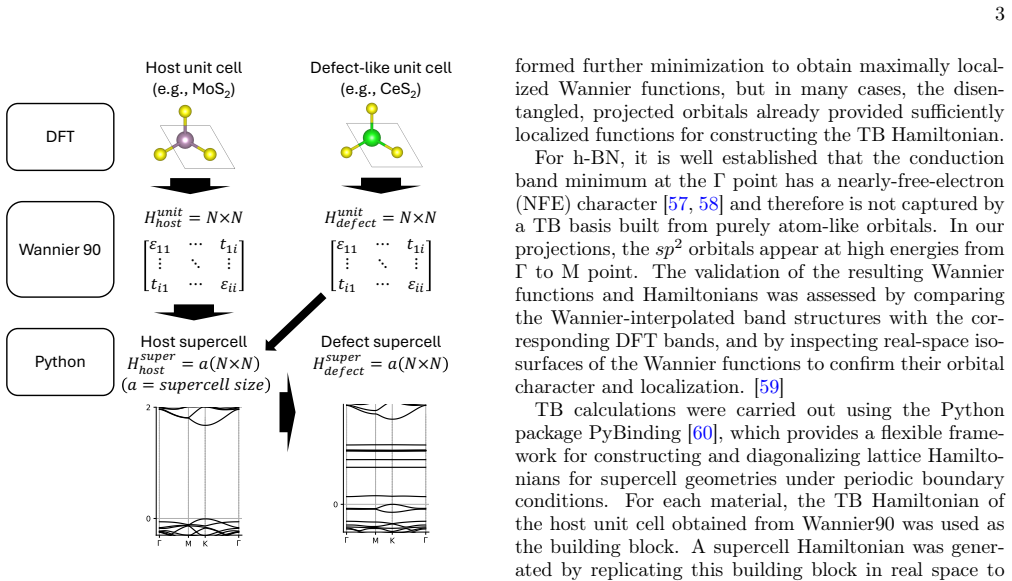
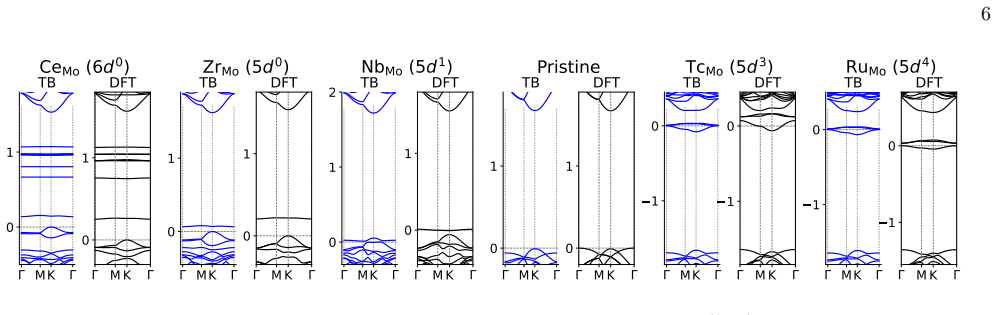
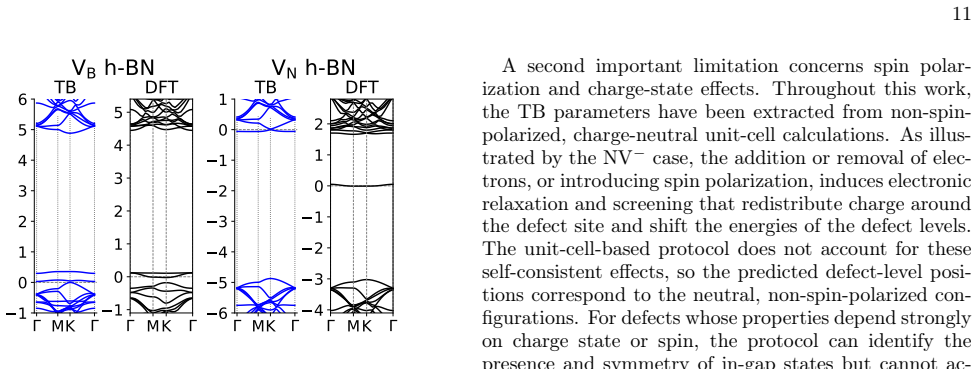
The protocol extracts Wannier tight-binding Hamiltonians from small, fully relaxed unit cells of the host and defect-like systems, replicates the host Hamiltonian to construct a supercell model, and introduces the defect by modifying only the on-site energies at the substitution site while leaving the hopping parameters unchanged. This captures the number of in-gap states, their degeneracies, and their shallow or deep character relative to host band edges in three systems despite quantitative deviations in absolute energies.
What carries the argument
The on-site-energy-only modification inside a replicated host tight-binding Hamiltonian extracted from unit-cell Wannier functions.
If this is right
- The method enables rapid pre-screening of many substitutional configurations in both 2D and 3D hosts without repeated large-cell relaxations.
- It identifies the correct degeneracy and relative positioning of defect levels for simple substitutions and for substitution-vacancy complexes.
- The protocol fails to capture charge redistribution effects that occur for vacancies of highly electronegative atoms or for spin-polarized charge states.
- Quantitative energy positions may deviate from full calculations while the count and character of states remain reliable.
Where Pith is reading between the lines
- The same on-site shift could be calibrated once per element pair and then reused across many host lattices to map defect trends quickly.
- Extending the protocol to include a few adjusted hopping terms near the defect site might improve absolute energy accuracy without losing speed.
- The approach could be combined with high-throughput databases to flag promising defect candidates before any supercell DFT is run.
Load-bearing premise
A substitutional defect can be approximated by changing only the on-site energy at the defect site while leaving all hopping parameters identical to those of the pristine host.
What would settle it
A full supercell calculation on one of the three tested systems that yields a different number of in-gap states or a different shallow-versus-deep assignment than the protocol predicts.
Figures
read the original abstract
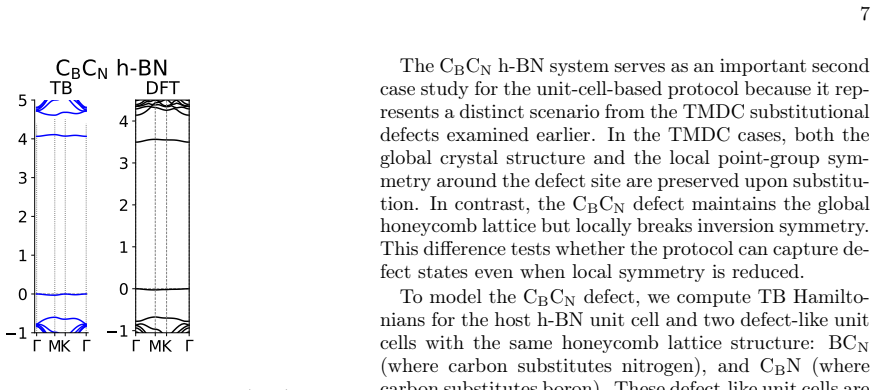
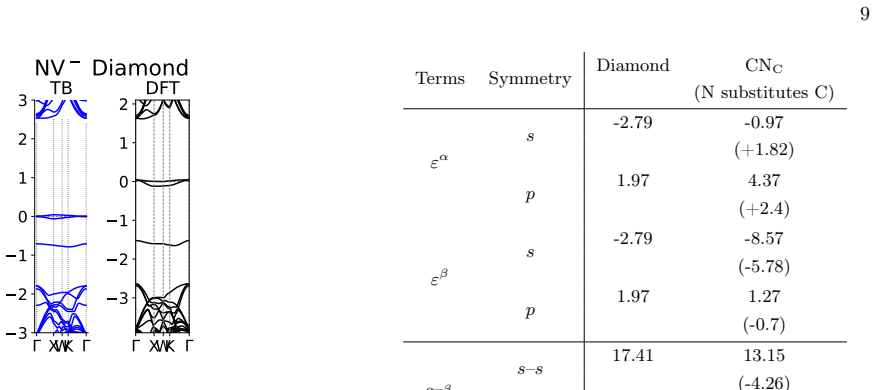
Point defects in crystalline materials play a central role in determining electronic, optical, and magnetic properties. However, systematic exploration of defect configurations remains computationally expensive because large supercell calculations are required to approximate isolated defects under periodic boundary conditions. We present a unit-cell-based tight-binding protocol that enables rapid pre-screening of substitutional defects. The protocol extracts Wannier tight-binding Hamiltonians from small, fully relaxed unit cells of the host and defect-like systems, replicates the host Hamiltonian to construct a supercell model, and introduces the defect by modifying only the on-site energies at the substitution site while leaving the hopping parameters unchanged. We validate the protocol across three diverse systems: isostructural substitutional defects in transition-metal dichalcogenides (M$_\mathrm{Mo}$ MoS$_2$, M = Ce, Zr, Nb, Tc, and Ru), symmetry-breaking carbon substitutions in hexagonal boron nitride (C$_\mathrm{B}$C$_\mathrm{N}$ h-BN), and nitrogen-vacancy (NV$^-$) centers in diamond. These case studies span two-dimensional and three-dimensional hosts, simple substitutions, and substitution-vacancy complexes. In all cases, the protocol successfully captures the number of in-gap states, their degeneracies, and their shallow or deep character relative to host band edges, despite some quantitative deviations in absolute energy positions. We further identify limitations for vacancies of highly electronegative atoms and for charge-state or spin-polarization effects, both of which involve self-consistent charge redistribution not captured by the protocol.
Editorial analysis
A structured set of objections, weighed in public.
Referee Report
Summary. The manuscript presents a unit-cell-based tight-binding protocol for rapid pre-screening of substitutional point defects. Wannier Hamiltonians are extracted from small relaxed unit cells of the host and a defect-like system; the host Hamiltonian is tiled into a supercell, and the defect is introduced by altering only the on-site energy at the substitution site while leaving all hopping parameters unchanged. Validation on three systems—isostructural substitutions in TMDs (M_Mo MoS2 for M=Ce,Zr,Nb,Tc,Ru), symmetry-breaking C substitutions in h-BN, and NV- centers in diamond—shows that the protocol reproduces the number, degeneracies, and shallow/deep character of in-gap states relative to host band edges, despite quantitative deviations in absolute energies. Limitations are explicitly noted for vacancies of highly electronegative atoms and for charge-redistribution or spin-polarization effects.
Significance. If the central approximation holds, the protocol offers an efficient computational pre-screening tool that reduces the need for large supercell DFT calculations in defect engineering across 2D and 3D materials. The work is strengthened by its explicit identification of failure modes and by testing across chemically and structurally diverse cases. Reproducibility is aided by reliance on standard Wannier-function tools.
major comments (1)
- [Abstract and protocol description] Abstract and protocol description (paragraph introducing the modeling choice): The assumption that hopping parameters remain identical to the pristine host when a substitutional defect is introduced solely by shifting on-site energies is introduced as an approximation without derivation from the paper's equations or independent verification (e.g., direct comparison of hopping integrals extracted from host versus defect-like unit cells). This assumption is load-bearing for the central claim of qualitative accuracy on state counts and character, particularly for the TMD and h-BN cases where the substituting atoms differ substantially in size, valence, and electronegativity from the host atoms.
Simulated Author's Rebuttal
We thank the referee for their thoughtful review and constructive criticism of our manuscript. We provide a point-by-point response to the major comment below and outline the revisions we will make.
read point-by-point responses
-
Referee: [Abstract and protocol description] Abstract and protocol description (paragraph introducing the modeling choice): The assumption that hopping parameters remain identical to the pristine host when a substitutional defect is introduced solely by shifting on-site energies is introduced as an approximation without derivation from the paper's equations or independent verification (e.g., direct comparison of hopping integrals extracted from host versus defect-like unit cells). This assumption is load-bearing for the central claim of qualitative accuracy on state counts and character, particularly for the TMD and h-BN cases where the substituting atoms differ substantially in size, valence, and electronegativity from the host atoms.
Authors: The referee correctly identifies that the protocol relies on the approximation of unchanged hopping parameters, which is introduced to enable the use of small unit-cell calculations for pre-screening without requiring large supercells. This choice is motivated by the desire to isolate the effect of the on-site perturbation while preserving the host's band structure connectivity. Although the manuscript does not derive this from first principles equations, it is presented as a practical approximation whose validity is tested through the case studies. We agree that providing a direct comparison of the hopping integrals would enhance the justification. In the revised version, we will include such a comparison (extracted from the defect-like unit cells versus the host) in a new supplementary section or appendix, focusing on the TMD and h-BN systems to quantify the changes in hopping parameters and discuss their impact on the in-gap states. revision: yes
Circularity Check
No significant circularity; protocol is an explicit approximation validated externally
full rationale
The paper defines its screening protocol explicitly as an approximation (extract Wannier Hamiltonians from host and defect-like cells, tile host supercell, modify only on-site energies at substitution site while leaving hoppings unchanged). This modeling choice is stated upfront rather than derived from the paper's own equations. Validation proceeds by direct comparison to expected in-gap state counts, degeneracies, and characters in three independent systems, with acknowledged quantitative deviations and limitations. No self-citation chains, fitted inputs renamed as predictions, or self-definitional reductions appear in the derivation; the central claim rests on the external match to known defect physics rather than reducing to its inputs by construction.
Axiom & Free-Parameter Ledger
axioms (1)
- ad hoc to paper Hopping parameters remain unchanged when a substitutional defect is introduced by modifying only on-site energies
Reference graph
Works this paper leans on
-
[1]
Defects in semiconductors and their effects on devices.Acta Mater.2000,48, 137–149
Mahajan, S. Defects in semiconductors and their effects on devices.Acta Mater.2000,48, 137–149
2000
-
[2]
E.; Janotti, A.; Lyons, J
Dreyer, C. E.; Janotti, A.; Lyons, J. L.; Wickrama- ratne,D.Defectsinsemiconductors.J. Appl. Phys.2024, 136, 190401
2024
-
[3]
F.; Seo, H.; Galli, G.; Awschalom, D
Koehl, W. F.; Seo, H.; Galli, G.; Awschalom, D. D. De- signing Defect Spins for Wafer-Scale Quantum Technolo- gies.MRS Bull.2015,40, 1146–1153
2015
-
[4]
C.; Zakaria, N
Loredo, J. C.; Zakaria, N. A.; Somaschi, N.; Anton, C.; de Santis, L.; Giesz, V.; Grange, T.; Broome, M. A.; Gazzano, O.; Coppola, G. et al. Scalable Performance in Solid-State Single-Photon Sources.Optica2016,3, 433– 440
-
[5]
Somaschi, N.; Giesz, V.; De Santis, L.; Loredo, J.; Almeida, M.; Hornecker, G.; Portalupi, S.; Grange, T.; Antón, C.; Demory, J. et al. Near-Optimal Single-Photon Sources in the Solid State.Nat. Photon.2016,10, 340– 345
2016
-
[6]
Ding, X.; He, Y.; Duan, Z.-C.; Gregersen, N.; Chen, M.- C.; Unsleber, S.; Maier, S.; Schneider, C.; Kamp, M.; Höfling, S. et al. On-Demand Single Photons with High Extraction Efficiency and Near-Unity Indistinguishabil- ityfromaResonantlyDrivenQuantumDotinaMicropil- lar.Phys. Rev. Lett.2016,116, 020401
2016
-
[7]
Kane, B. E. A Silicon-Based Nuclear Spin Quantum Computer.Nature1998,393, 133–137
-
[8]
Quantum Computing with De- fects.PNAS2010,107, 8513–8518
Weber, J.; Koehl, W.; Varley, J.; Janotti, A.; Buckley, B.; Walle, C.; Awschalom, D. Quantum Computing with De- fects.PNAS2010,107, 8513–8518
-
[9]
A.; Su, C.- H.; Greentree, A
Aharonovich, I.; Castelletto, S.; Simpson, D. A.; Su, C.- H.; Greentree, A. D.; Prawer, S. Diamond-Based Single- Photon Emitters.Rep. Prog. Phys.2011,74, 076501
2011
-
[10]
P.; Lim, W.; Morton, J.; Jamieson, D.; Dzurak, A.; Morello, A
Pla, J.; Tan, K.; Dehollain, J. P.; Lim, W.; Morton, J.; Jamieson, D.; Dzurak, A.; Morello, A. A single-Atom Electron Spin Qubit in Silicon.Nature2012,489, 541– 545
-
[11]
A pro- grammable Two-Qubit Solid-State Quantum Processor under Ambient Conditions.Npj Quantum Inf.2019,5, 9
Wu, Y.; Wang, Y.; Qin, X.; Rong, X.; Du, J. A pro- grammable Two-Qubit Solid-State Quantum Processor under Ambient Conditions.Npj Quantum Inf.2019,5, 9
2019
-
[12]
Influ- ence of Point Defects on the Electronic and Topological Properties of MonolayerWTe2.Phys
Muechler, L.; Hu, W.; Lin, L.; Yang, C.; Car, R. Influ- ence of Point Defects on the Electronic and Topological Properties of MonolayerWTe2.Phys. Rev. B2020,102, 041103
-
[13]
Diamond Nanophotonics.Adv
Aharonovich, I.; Neu, E. Diamond Nanophotonics.Adv. Opt. Mater.2014,2, 911–928
2014
-
[14]
B.; Awschalom, D
Alkauskas, A.; Buckley, B. B.; Awschalom, D. D.; de Walle, C. G. V. First-Principles Theory of the Lumi- nescenceLineshapefortheTripletTransitioninDiamond NV Centres.New J. Phys.2014,16, 073026
2014
-
[15]
Observation of Coherent Oscillations in a Single Electron Spin.Phys
Jelezko, F.; Gaebel, T.; Popa, I.; Gruber, A.; Wrachtrup, J. Observation of Coherent Oscillations in a Single Electron Spin.Phys. Rev. Lett.2004,92, 076401
2004
-
[16]
Observation of Coherent Oscil- lation of a Single Nuclear Spin and Realization of a Two-Qubit Conditional Quantum Gate.Phys
Jelezko, F.; Gaebel, T.; Popa, I.; Domhan, M.; Gru- ber, A.; Wrachtrup, J. Observation of Coherent Oscil- lation of a Single Nuclear Spin and Realization of a Two-Qubit Conditional Quantum Gate.Phys. Rev. Lett. 2004,93, 130501
2004
-
[17]
Balasubramanian, G.; Neumann, P.; Twitchen, D.; Markham, M.; Kolesov, R.; Mizuochi, N.; Isoya, J.; Achard, J.; Beck, J.; Tissler, J. et al. Ultralong spin coherence time in isotopically engineered diamond.Nat. Mater.2009,8, 383–387
2009
-
[18]
W.; Manson, N
Doherty, M. W.; Manson, N. B.; Delaney, P.; Hollen- berg, L. C. L. The negatively charged nitrogen-vacancy centre in diamond: the electronic solution.New J. Phys. 2011,13, 025019
2011
-
[19]
R.; Gali, A.; Togan, E.; Chu, Y.; Trifonov, A.; Kaxiras, E.; Lukin, M
Maze, J. R.; Gali, A.; Togan, E.; Chu, Y.; Trifonov, A.; Kaxiras, E.; Lukin, M. D. Properties of nitrogen-vacancy centers in diamond: the group theoretic approach.New J. Phys.2011,13, 025025
2011
-
[20]
W.; Ritika, R.; Tamtaji, M.; Liu, H.; Hu, Y.; Liu, Z.; Galligan, P
Tang, T. W.; Ritika, R.; Tamtaji, M.; Liu, H.; Hu, Y.; Liu, Z.; Galligan, P. R.; Xu, M.; Shen, J.; Wang, J. et al. Structured-Defect Engineering of Hexagonal Boron Ni- tride for Identified Visible Single-Photon Emitters.ACS Nano2025,19, 8509–8519
-
[21]
The hBN Defects Database: A Theoretical Compilation of Color Centers in Hexagonal Boron Nitride.J
Cholsuk, C.; Zand, A.; Çakan, A.; Vogl, T. The hBN Defects Database: A Theoretical Compilation of Color Centers in Hexagonal Boron Nitride.J. Phys. Chem. C 2024,128, 12716–12725
2024
-
[22]
Carbon defects engineering in hexagonal boron 13 nitride for single photon emission and spin qubits.APL Quantum2025,2, 026127
Du, T.; Yang, X.; Pei, W.; Han, P.; Feng, Y.; Zhao, J.; Zhou, S. Carbon defects engineering in hexagonal boron 13 nitride for single photon emission and spin qubits.APL Quantum2025,2, 026127
-
[23]
Fast luminescence from carbon-related defects of hexagonal boron nitride.J
Era, K.; Minami, F.; Kuzuba, T. Fast luminescence from carbon-related defects of hexagonal boron nitride.J. Lu- min.1981,24-25, 71–74
1981
-
[24]
Z.; Li, J.; Lin, J
Du, X. Z.; Li, J.; Lin, J. Y.; Jiang, H. X. The origin of deep-level impurity transitions in hexagonal boron ni- tride.Appl. Phys. Lett.2015,106, 021110
2015
-
[25]
G.; Alkauskas, A
Mackoit-Sinkevičien˙ e, M.; Maciaszek, M.; Van de Walle, C. G.; Alkauskas, A. Carbon dimer defect as a source of the 4.1 eV luminescence in hexagonal boron ni- tride.Appl. Phys. Lett.2019,115, 212101
2019
-
[26]
Jara, C.; Rauch, T.; Botti, S.; Marques, M. A. L.; Norambuena, A.; Coto, R.; Castellanos-Águila, J. E.; Maze, J. R.; Munoz, F. First-Principles Identification of Single Photon Emitters Based on Carbon Clusters in Hexagonal Boron Nitride.J. Phys. Chem. A2021,125, 1325–1335
-
[27]
Coupling Quantum Emitters in 2D Mate- rials with Tapered Fibers.ACS Photonics2017,4, 761– 767
Schell, A.; Takashima, H.; Tran, T.; Aharonovich, I.; Takeuchi, S. Coupling Quantum Emitters in 2D Mate- rials with Tapered Fibers.ACS Photonics2017,4, 761– 767
-
[28]
A.; Castellanos-Gomez, A.; van der Zant, H
Tonndorf, P.; Schmidt, R.; Schneider, R.; Kern, J.; Buscema, M.; Steele, G. A.; Castellanos-Gomez, A.; van der Zant, H. S. J.; de Vasconcellos, S. M.; Brats- chitsch, R. Single-photon emission from localized exci- tons in an atomically thin semiconductor.Optica2015, 2, 347–352
-
[29]
E.; Zhang, X.; Choudhury, T
Wu,W.; Dass,C.K.; Hendrickson,J.R.; Montaño,R.D.; Fischer, R. E.; Zhang, X.; Choudhury, T. H.; Red- wing, J. M.; Wang, Y.; Pettes, M. T. Locally defined quantum emission from epitaxial few-layer tungsten dis- elenide.Appl. Phys. Lett.2019,114, 213102
2019
-
[30]
He, Y.-M.; Clark, G.; Schaibley, J.; He, Y.; Chen, M.-c.; Wei, Y.-J.; Ding, X.; Zhang, Q.; Yao, W.; Xu, X. et al. Single Quantum Emitters in Monolayer Semiconductors. Nat. Nanotechnol.2014,10, 497–502
2014
-
[31]
Ouma, C. N. M.; Singh, S.; Obodo, K. O.; Amolo, G. O.; Romero, A. H. Controlling the magnetic and optical responses of aMoS 2 monolayer by lanthanide substi- tutional doping: a first-principles study.Phys. Chem. Chem. Phys.2017,19, 25555–25563
2017
-
[32]
Ab-initio investigation ofEr3+ de- fects in tungsten disulfide.Comput
López-Morales, G.; Hampel, A.; López, G.; Menon, V.; Flick, J.; Meriles, C. Ab-initio investigation ofEr3+ de- fects in tungsten disulfide.Comput. Mater. Sci.2022, 210, 111041
2022
-
[33]
K.; Siadati, M
Maleki-Ghaleh, H.; Moradpur-Tari, E.; Shakiba, M.; Paczesny, J.; Hurley, P. K.; Siadati, M. H.; Ansari, L.; Gity, F. Electronic structure of rare-earth erbium-doped platinum diselenide: A density functional theory study. J. Phys. Chem. Solids2024,190, 112004
-
[34]
Electronic and opti- cal properties of lanthanide-dopedMoS2: Impact of ionic size and orbital configuration mismatch.Phys
Kang, H.; Queiroz, R.; Muechler, L. Electronic and opti- cal properties of lanthanide-dopedMoS2: Impact of ionic size and orbital configuration mismatch.Phys. Rev. B 2025,112, 174107
2025
-
[35]
E.; Alkauskas, A.; Lyons, J
Dreyer, C. E.; Alkauskas, A.; Lyons, J. L.; Janotti, A.; VandeWalle,C.G.First-PrinciplesCalculationsofPoint Defects for Quantum Technologies.Annu. Rev. Mater. Res.2018,48, 1–26
2018
-
[36]
Freysoldt, C.; Grabowski, B.; Hickel, T.; Neugebauer, J.; Kresse, G.; Janotti, A.; Van de Walle, C. G. First- principles calculations for point defects in solids.Rev. Mod. Phys.2014,86, 253–305
2014
-
[37]
G.; Neugebauer, J
Van de Walle, C. G.; Neugebauer, J. First-principles cal- culations for defects and impurities: Applications to III- nitrides.J. Appl. Phys.2004,95, 3851–3879
2004
-
[38]
W.-z.; Jin, Y.; Govoni, M.; Galli, G
Chen, S.; Yu, V. W.-z.; Jin, Y.; Govoni, M.; Galli, G. Ad- vances in Quantum Defect Embedding Theory.J. Chem. Theory Comput.2025,21, 7797–7812
2025
-
[39]
Sun, Q.; Chan, G. K.-L. Quantum Embedding Theories. Acc. Chem. Res.2016,49, 2705–2712
2016
-
[40]
Green’s Function Formulation of Quantum Defect Embedding Theory.J
Sheng, N.; Vorwerk, C.; Govoni, M.; Galli, G. Green’s Function Formulation of Quantum Defect Embedding Theory.J. Chem. Theory Comput.2022,18, 3512–3522
2022
-
[41]
I.; Hampel, A.; Cano, J.; Rösner, M.; Dreyer, C
Muechler, L.; Badrtdinov, D. I.; Hampel, A.; Cano, J.; Rösner, M.; Dreyer, C. E. Quantum embedding methods for correlated excited states of point defects: Case studies and challenges.Phys. Rev. B2022,105, 235104
-
[42]
Parameterization of tight-binding models from density functional theory calculations.Phys
Urban,A.; Reese,M.; Mrovec,M.; Elsässer,C.; Meyer,B. Parameterization of tight-binding models from density functional theory calculations.Phys. Rev. B2011,84, 155119
-
[43]
A.; Lindefelt, U.; Zunger, A
Singh, V. A.; Lindefelt, U.; Zunger, A. Evaluation of tight-binding models for deep defect levels in semicon- ductors.Phys. Rev. B1982,25, 2781–2785
-
[44]
M.Electronic Structure: Basic Theory and Practical Methods; Cambridge University Press: Cam- bridge, 2012
Martin, R. M.Electronic Structure: Basic Theory and Practical Methods; Cambridge University Press: Cam- bridge, 2012
2012
-
[45]
Calculations of molecules, clusters, and solids with a simplified LCAO- DFT-LDA scheme.Int
Seifert, G.; Porezag, D.; Frauenheim, T. Calculations of molecules, clusters, and solids with a simplified LCAO- DFT-LDA scheme.Int. J. Quantum Chem.1996,58, 185–192
1996
-
[46]
A machine learning approach to predict tight-binding pa- rameters for point defects via the projected density of states.npj Comput
Fried, H.; Barragan-Yani, D.; Libisch, F.; Wirtz, L. A machine learning approach to predict tight-binding pa- rameters for point defects via the projected density of states.npj Comput. Mater.2025,11
2025
-
[47]
Machine learning method for tight-binding Hamiltonian parameterization from ab-initio band struc- ture.npj Comput
Wang, Z.; Shizhuo, Y.; Wang, H.; He, J.; Huang, Q.; Chang, S. Machine learning method for tight-binding Hamiltonian parameterization from ab-initio band struc- ture.npj Comput. Mater.2021,7
2021
-
[48]
A.; Peeters, F
Nakhaee, M.; Ketabi, S. A.; Peeters, F. M. Machine learning approach to constructing tight binding mod- els for solids with application to BiTeCl.J. Appl. Phys. 2020,128, 215107
2020
-
[49]
Machine learned environment- dependent corrections for aspds∗ empirical tight-binding basis.Mach
Soccodato, D.; Penazzi, G.; Pecchia, A.; Phan, A.- L.; Auf der Maur, M. Machine learned environment- dependent corrections for aspds∗ empirical tight-binding basis.Mach. Learn.: Sci. Technol.2024,5
2024
-
[50]
K.; Zhang, P.; Zhang, L.; E, W
Gu, Q.; Zhou, A.; Pandey, S. K.; Zhang, P.; Zhang, L.; E, W. Deep learning tight-binding approach for large- scale electronic simulations at finite temperatures with ab initio accuracy.Nat. Commun.2024,15
2024
-
[51]
Efficiency of ab-initio total energy calculations for metals and semiconductors using a plane-wave basis set.Comput
Kresse, G.; Furthmüller, J. Efficiency of ab-initio total energy calculations for metals and semiconductors using a plane-wave basis set.Comput. Mater. Sci.1996,6, 15– 50
1996
-
[52]
P.; Burke, K.; Ernzerhof, M
Perdew, J. P.; Burke, K.; Ernzerhof, M. Generalized Gradient Approximation Made Simple.Phys. Rev. Lett. 1996,77, 3865–3868
1996
-
[53]
P.; Burke, K.; Ernzerhof, M
Perdew, J. P.; Burke, K.; Ernzerhof, M. Perdew, Burke, and Ernzerhof Reply:.Phys. Rev. Lett.1998,80, 891– 891
1998
-
[54]
Efficient iterative schemes for ab initio total-energy calculations using a plane-wave ba- sis set.Phys
Kresse, G.; Furthmüller, J. Efficient iterative schemes for ab initio total-energy calculations using a plane-wave ba- sis set.Phys. Rev. B1996,54, 11169–11186
-
[55]
Ab Initio Pseudopotentials for Electronic Structure Calculations of Poly-Atomic Sys- tems Using Density-Functional Theory.Comput
Fuchs, M.; Scheffler, M. Ab Initio Pseudopotentials for Electronic Structure Calculations of Poly-Atomic Sys- tems Using Density-Functional Theory.Comput. Phys. 14 Commun.1999,119, 67–98
1999
-
[56]
A.; Yates, J
Mostofi, A. A.; Yates, J. R.; Lee, Y.-S.; Souza, I.; Van- derbilt, D.; Marzari, N. wannier90: A Tool for Obtaining Maximally Localised Wannier Functions.Comput. Phys. Commun2008,178, 685–699
-
[57]
Defect and impurity properties of hexagonal boron nitride: A first-principles calculation
Huang, B.; Lee, H. Defect and impurity properties of hexagonal boron nitride: A first-principles calculation. Phys. Rev. B2012,86, 245406
-
[58]
J.; Monserrat, B.; Zólyomi, V.; Drum- mond, N
Hunt, R. J.; Monserrat, B.; Zólyomi, V.; Drum- mond, N. D. Diffusion quantum Monte Carlo andGW study of the electronic properties of monolayer and bulk hexagonal boron nitride.Phys. Rev. B2020,101, 205115
-
[59]
A.; Yates, J
Marzari, N.; Mostofi, A. A.; Yates, J. R.; Souza, I.; Van- derbilt, D. Maximally localized Wannier functions: The- ory and applications.Rev. Mod. Phys.2012,84, 1419– 1475
2012
-
[60]
P., Miša Anđelković Pybinding v0.9.5: A Python package for tight-binding calculations
Dean Moldovan, F. P., Miša Anđelković Pybinding v0.9.5: A Python package for tight-binding calculations. Zenodo2020,
-
[61]
InScientific Modeling and Simulations; Yip, S., de la Rubia, Diaz, T., Eds.; Springer Nether- lands: Dordrecht, 2009; pp 81–95
Wang, C.-Z.; Lu, W.-C.; Yao, Y.-X.; Li, J.; Yip, S.; Ho, K.-M. InScientific Modeling and Simulations; Yip, S., de la Rubia, Diaz, T., Eds.; Springer Nether- lands: Dordrecht, 2009; pp 81–95
2009
-
[62]
N.; Lieu, S.; Trit- saris, G
Fang, S.; Kuate Defo, R.; Shirodkar, S. N.; Lieu, S.; Trit- saris, G. A.; Kaxiras, E. Ab initio tight-binding Hamilto- nian for transition metal dichalcogenides.Phys. Rev. B 2015,92, 205108
2015
-
[63]
Single atom doping in 2D layeredMoS2fromaperiodictableperspective.Surf
Sovizi, S.; Szoszkiewicz, R. Single atom doping in 2D layeredMoS2fromaperiodictableperspective.Surf. Sci. Rep.2022,77, 100567
2022
-
[64]
Jones, L. A. H.; Xing, Z.; Swallow, J. E. N.; Shiel, H.; Featherstone, T. J.; Smiles, M. J.; Fleck, N.; Thakur, P. K.; Lee, T.-L.; Hardwick, L. J. et al. Band Alignments, Electronic Structure, and Core-Level Spec- tra of Bulk Molybdenum Dichalcogenides (MoS2, MoSe2, and MoTe2).J. Phys. Chem. C2022,126, 21022–21033. 15 Appendix A: TB background and physica...
discussion (0)
Sign in with ORCID, Apple, or X to comment. Anyone can read and Pith papers without signing in.