REVIEW 4 major objections 8 minor 57 references
MapExplorer: New Content Generation from Low-Dimensional Visualizations
T0 review · 4 major / 8 minor · reviewed 2026-08-11 · deepseek-v4-flash
Pith's one-line read Given any empty coordinate on a projection map of a text corpus, MapExplorer generates a new text entry that fits the local semantic neighborhood.
desk verdict New task, thin evidence: MapExplorer's offline evaluation can't distinguish genuine generation from copying the nearest neighbor, so the headline claim rests on an unvalidated metric. read the letter →
The pith
A machine-rendered reading of the paper's core claim, the machinery that carries it, and where it could break.
The reading
What carries the argument
The load-bearing object is the projection map itself, treated as a spatial semantic scaffold: the paper assumes that proximity on the map reflects semantic similarity, so a query location's neighborhood can stand in for a prompt. On the generation side, the central machinery is retrieval-augmented prompting, in which the nearest neighbors of a query point are retrieved and fed to an LLM (optionally with few-shot examples or chain-of-thought), plus two alternative routes: fine-tuning a language model to map raw coordinates directly to text, and inverting an interpolated high-dimensional embedding back into text with a pre-trained embedding-inversion model. The evaluation machinery is Atometric, an LLM-based metric that decomposes both generated and reference texts into atomic statements and, at three hand-defined strictness levels (loose, moderate, strict), checks whether each statement is entailed by the other text, producing precision, recall, and F1. Atometric's role is to decide whether a generated text is both correct and complete relative to a held-out reference.
What would settle it
Run a human study on the persona and research-context maps in which annotators rate how well each generated text matches its held-out reference, then compute the rank correlation between those ratings and Atometric-F1; if the correlation is near zero—or if texts humans consider off-topic score as high as on-topic ones—the metric and the quantitative evidence for MapExplorer's central claim fail.
Extended reading notes
Core claim
The paper's central proposal is to treat a final projection map $V = \{(\mathbf{x}_i, s_i)\}$, built by any visualization recipe such as embedding-based dimension reduction or a citation-network layout, as a generative interface. Given a query position $\mathbf{x}_q$ not occupied by any existing entry, a MapExplorer model must produce text $\hat{s}$ that would have been mapped to $\mathbf{x}_q$, aligned with the semantic content of nearby texts. The task is defined as visualization-agnostic: the model works only with the final map and cannot see or recompute the embedding or layout recipe. To make the task measurable, the paper proposes Atometric, which generalizes ROUGE by replacing n-gram overlap with atomic-statement entailment, yielding precision, recall, and F1 at loose, moderate, and strict levels. Using held-out references as proxies for correct answers, the paper demonstrates that even simple baselines produce plausible outputs on five maps spanning personas, LLM red-teaming dialogues, and computer-science research contexts and ideas.
Load-bearing premise
The claim that generated text is truly aligned with its map position rests on Atometric, an LLM-produced measure of statement entailment, and the paper reports no human study showing that Atometric matches human judgments of alignment.
Editorial extensions
If this is right
- Any existing visualization map of a text corpus—including maps built from citation networks rather than embeddings—becomes a tool for generating new, on-topic content at unoccupied positions.
- New synthetic personas, LLM red-teaming strategies, and research ideas or contexts can be produced by navigating to underexplored regions of the corresponding maps, without retraining the generator for each map.
- Atometric gives an offline, scalable way to benchmark such generation, reporting both correctness (precision) and completeness (recall) at multiple strictness levels instead of a single similarity score.
- The difficulty of the task depends on map density and construction: on densely packed maps like the red-teaming corpus, simple nearest-neighbor echoing is already hard to beat, while sparse research maps reward methods that draw on global structure.
- A human baseline outperforms all tested AI methods on the persona map, indicating room for methods that use the map's global layout rather than only local neighborhoods.
Reading between the lines
- A natural extension the paper does not develop: the same coordinate-to-content inversion should work for any modality whose items can be embedded and projected, such as images, molecules, or database records, whenever the map preserves local semantic structure.
- Because the paper validates Atometric only against conventional similarity metrics, not human judgment, its quantitative scores may partly reflect agreement between the generating and evaluating language models; a human correlation study would settle how much of the reported alignment is real.
- The paper's failure of every generation method to beat EchoNearest on the red-teaming map implies a density-dependent regime: on locally dense maps, nearest-neighbor echoing already encodes most of the answer, so improvements would have to come from explicitly adding novelty rather than from better local alignment.
- A concrete testable extension suggested by the paper's own discussion is novelty-aware generation: require a generated research idea to be atomically distant from its k nearest map neighbors while still topically aligned, and measure whether such generations are rated as more useful by domain experts.
Editorial analysis
A structured set of objections, weighed in public.
Referee Report
Summary. The paper introduces MapExplorer, a task in which a text is generated for an arbitrary 2D coordinate on a projection map of a text corpus, and Atometric, an LLM-based metric that decomposes generated and reference texts into atomic statements and scores precision, recall, and F1 at three strictness levels. The authors evaluate several simple methods (retrieval-augmented prompting, fine-tuned Llama, embedding inversion) on four datasets spanning personas, red-teaming strategies, and research ideas/contexts, and also report a human baseline and a nearest-neighbor copy baseline. The central claim is that these methods can produce text that aligns with the local semantic structure of the map, enabling exploration of unoccupied regions.
Significance. If the task and metric are valid, MapExplorer is a genuinely novel bridge between visualization and conditional text generation, with potential applications in scientific discovery, persona synthesis, and LLM red teaming. The strengths of the paper are its clear task formulation, the reproducible code repositories, the inclusion of multiple visualization recipes (embedding-based and network-based), and the honest discussion of limitations. The Atometric idea—fine-grained, entailment-based evaluation at multiple strictness levels—is conceptually attractive and could be useful beyond this specific task. However, the significance is substantially tempered by evaluation gaps: the metric is not validated against human judgments, novelty is not measured, and the strongest baselines often match or outperform the proposed methods. The present evidence is therefore suggestive rather than conclusive.
major comments (4)
- [§3.1] The argument that generated text aligning with a novel held-out reference must itself be novel is invalid. A method that simply copies a nearby training text can score highly against a novel reference whenever the map is locally dense, because the reference will resemble its neighbors. The EchoNearest baseline in Table 3 (e.g., 0.884/0.556/0.268 on Persona and 0.783/0.586/0.282 on Red Teaming) demonstrates exactly this behavior, and the paper never measures lexical or semantic distinctness of outputs from the training corpus. Since the task is defined as generating text that 'would have been mapped to x_q' and the abstract claims 'new content generation,' the offline evaluation does not establish the core claim.
- [§3.3, Appendix C] Atometric is never validated against human judgments. Both decomposition and verification use gpt-4o, and several of the strongest candidate methods also use gpt-4o (Table 4), so the reported scores may reflect model self-agreement rather than true coherence or alignment. The human baseline in §4.4 is not used to compute a correlation with Atometric; the observation that humans score higher on Atometric but lower on lexical metrics is not a validation. Without a human-correlation study, or at least a demonstration that scores are stable across different evaluator models, the quantitative evidence for the central claim rests on an unvalidated metric.
- [§4.5, Table 4] Error bars are reported for only one method (CoT-RAG(1)), and no significance tests are provided anywhere. On Red Teaming, no candidate method surpasses EchoNearest at any Atometric level, and on Research Idea the best method beats EchoNearest by only 0.220 vs. 0.191 F1-M. Given the variance visible in the few reported standard errors (e.g., 0.019 on Persona F1-M), these differences may not be statistically reliable. The paper's claims of 'clear improvements' and 'competitive performance' are not supported without significance testing or complete error bars.
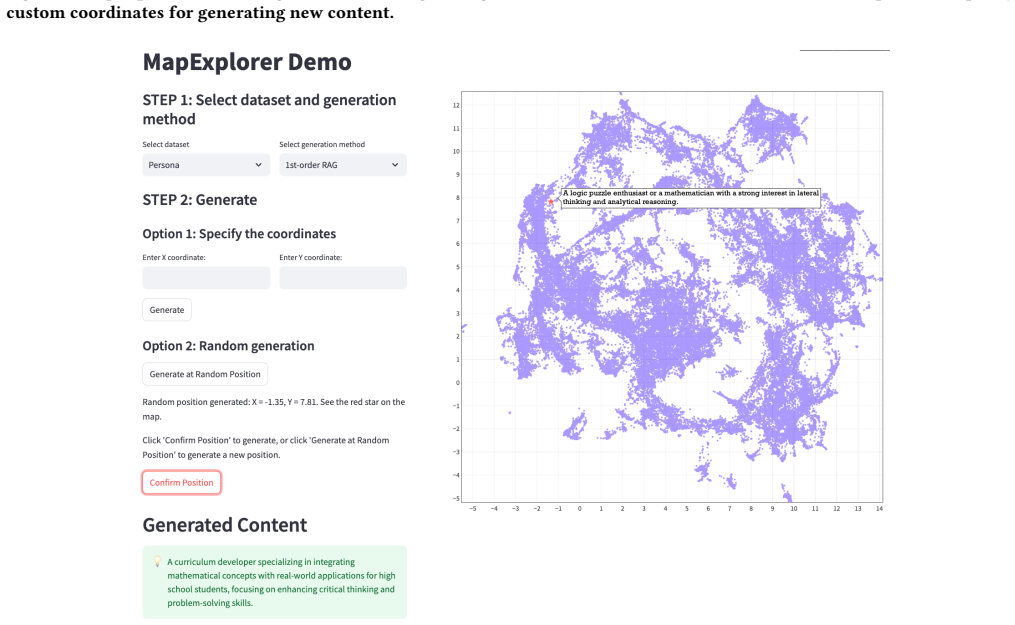
- [§6.1] The paper explicitly concedes that the offline framework only queries positions with known references, not the unoccupied positions that are central to the MapExplorer task. This is not a peripheral limitation: the task definition in §2.1 specifies a query position 'not previously occupied by an existing text entry,' and the offline setup evaluates a different, easier problem (given a held-out point, predict its text). The only evidence for the actual task is the interactive demo (§4.6), which is anecdotal. The authors acknowledge this, but the admission means the paper does not currently evaluate the problem it defines.
minor comments (8)
- [Table 3] The table header appears malformed: it repeats 'Persona (Text)' and places 'Human' and 'EchoNearest' in a way that suggests a shared column structure, but the dataset names for the remaining columns are not aligned with the methods. Please restructure the table so each dataset-method pair has its own column.
- [Table 5] The 'Atometric Recall (moderate)' row for the Persona dataset lists a value of '-0.671' for Embedding Inversion, which is presumably a typo for '0.671'. Please correct it.
- [Appendix B.1] The sentence 'The results are shown in Table 5, 6, and ??.' contains a missing table reference (likely Table 6 or another supplementary table). Please fill in the citation.
- [Appendix E] The sentence 'Figure ?? provides an example of prompts...' has a missing figure reference. Please insert the correct figure number.
- [References] There are duplicated references: [4] and [5] are both Bowman et al. 2015, and [37] appears to be repeated. Please deduplicate the bibliography.
- [§4.4 vs. Table 6] The nearest-neighbor dummy baseline is called 'EchoNearest' in the main text and Table 3, but Table 6 labels it 'CopyNearest'. Please use a consistent name throughout.
- [§4.2, Table 2, Table 5/6] The dataset is referred to as 'Research Context (Network)' in Table 2 and §4.2, but as 'Research Context Citation (Network)' in Tables 5 and 6. Please unify the naming.
- [Appendix B.2] The human baseline was collected from only two annotators with no reported inter-annotator agreement or instruction fidelity checks. This limits the interpretability of the human comparison, and the paper should at least note the small scale.
Circularity Check
No significant circularity: the core derivation is self-contained; the main weaknesses are an unmeasured novelty dimension and a self-referential LLM evaluation, not equation-level circularity.
full rationale
The paper's claimed chain is: define MapExplorer (Sec 2.1) as generating text that would map to a query coordinate; propose candidate methods (Sec 2.2 and 4.1); evaluate offline by comparing generated text to the held-out reference that actually occupies that coordinate (Sec 3.1); and score with Atometric (Sec 3.3 and 4). No step equates an output to an input by construction. The held-out reference is the gold standard by definition of the task, so measuring alignment to it is the task itself, not a circular shortcut. No parameter is fitted to Atometric and then re-reported as a prediction; the candidate methods are trained with standard LM objectives or are retrieval/prompting baselines, and Atometric is not used as a training objective. The paper does not rely on a uniqueness theorem or load-bearing self-citation; the only same-author citation (MASSW, [51]) is for dataset construction and does not forbid alternative methods. The main concerns are validity rather than circularity: Atometric's verifier is gpt-4o-2024-05-13 and the strongest candidate methods also use gpt-4o, so scores may partially reflect model self-agreement rather than true alignment; Section 3.1's inference that generated text aligned with a novel reference is itself novel is logically invalid because EchoNearest can copy a nearby training text and still align with a novel held-out reference, and its high scores in Table 3 are consistent with this; Section 6.1 explicitly concedes that the framework 'does not explicitly assess aspects such as novelty or broader utility' and that offline evaluation is limited to querying known positions with existing references rather than entirely unexplored locations. These are acknowledged scope and correctness limitations, not cases where a prediction reduces to its inputs by definition. Therefore no specific circular step can be exhibited, and the result is not forced by self-citation or by construction.
Assumptions & free parameters
assumptions (4)
- domain assumption Projection maps preserve semantic locality: semantically similar texts are positioned close together (Section 1, principle 1).
- domain assumption Held-out gold-standard references are novel with respect to the training set, so text aligning with them is novel (Section 3.1).
- domain assumption An LLM's entailment judgment is a valid, unbiased measure of logical coherence and alignment (Section 3.3, Appendix C).
- domain assumption The 2D coordinates alone are a sufficient conditioning signal for text generation even though the map is provided without the original visualization pipeline (Section 2.1).
Cite this review
Pith. "Pith review of MapExplorer: New Content Generation from Low-Dimensional Visualizations." pith.science (2026). https://pith.science/paper/XFOCA4KE
@misc{pith2026241218673,
  author       = {Pith},
  title        = {Pith review of: MapExplorer: New Content Generation from Low-Dimensional Visualizations},
  year         = {2026},
  howpublished = {\url{https://pith.science/paper/XFOCA4KE}},
  note         = {Machine review of arXiv:2412.18673}
}
read the original abstract
Low-dimensional visualizations, or "projection maps," are widely used in scientific and creative domains to interpret large-scale and complex datasets. These visualizations not only aid in understanding existing knowledge spaces but also implicitly guide exploration into unknown areas. Although techniques such as t-SNE and UMAP can generate these maps, there exists no systematic method for leveraging them to generate new content. To address this, we introduce MapExplorer, a novel knowledge discovery task that translates coordinates within any projection map into coherent, contextually aligned textual content. This allows users to interactively explore and uncover insights embedded in the maps. To evaluate the performance of MapExplorer methods, we propose Atometric, a fine-grained metric inspired by ROUGE that quantifies logical coherence and alignment between generated and reference text. Experiments on diverse datasets demonstrate the versatility of MapExplorer in generating scientific hypotheses, crafting synthetic personas, and devising strategies for attacking large language models-even with simple baseline methods. By bridging visualization and generation, our work highlights the potential of MapExplorer to enable intuitive human-AI collaboration in large-scale data exploration.
Figures


Figures from the paper (8 more)


Reference graph
Works this paper leans on
-
[1]
Ali Amin-Nejad, Julia Ive, and Sumithra Velupillai. 2020. Exploring Transformer Text Generation for Medical Dataset Augmentation. In International Conference on Language Resources and Evaluation. https://api.semanticscholar.org/CorpusID: 218974353
work page 2020
-
[2]
Mathieu Bastian, Sebastien Heymann, and Mathieu Jacomy. 2009. Gephi: An Open Source Software for Exploring and Manipulating Networks. http://www. aaai.org/ocs/index.php/ICWSM/09/paper/view/154
work page 2009
-
[3]
Anna Bohman, Tina-Simone Neset, Tomasz Opach, and Jan Ketil Rød. 2015. Decision support for adaptive action–assessing the potential of geographic vi- sualization. Journal of Environmental Planning and Management 58, 12 (2015), 2193–2211
work page 2015
-
[4]
Samuel R Bowman, Gabor Angeli, Christopher Potts, and Christopher D Manning
-
[5]
Bowman, Gabor Angeli, Christopher Potts, and Christopher D
Samuel R. Bowman, Gabor Angeli, Christopher Potts, and Christopher D. Man- ning. 2015. A large annotated corpus for learning natural language inference. arXiv:1508.05326 [cs.CL] https://arxiv.org/abs/1508.05326
arXiv 2015
-
[6]
Xin Chan, Xiaoyang Wang, Dian Yu, Haitao Mi, and Dong Yu. 2024. Scaling syn- thetic data creation with 1,000,000,000 personas. arXiv preprint arXiv:2406.20094 (2024)
arXiv 2024
-
[7]
William N Dilla and Robyn L Raschke. 2015. Data visualization for fraud detection: Practice implications and a call for future research. International Journal of Accounting Information Systems 16 (2015), 1–22
work page 2015
-
[8]
Abhimanyu Dubey, Abhinav Jauhri, Abhinav Pandey, Abhishek Kadian, Ahmad Al-Dahle, Aiesha Letman, Akhil Mathur, Alan Schelten, Amy Yang, Angela Fan, et al. 2024. The llama 3 herd of models. arXiv preprint arXiv:2407.21783 (2024)
arXiv 2024
Show all 57 references
-
[9]
Deep Ganguli, Liane Lovitt, Jackson Kernion, Amanda Askell, Yuntao Bai, Saurav Kadavath, Ben Mann, Ethan Perez, Nicholas Schiefer, Kamal Ndousse, et al. 2022. Red teaming language models to reduce harms: Methods, scaling behaviors, and lessons learned. arXiv preprint arXiv:220...
2022 arXiv
-
[10]
Tanya Goyal, Junyi Jessy Li, and Greg Durrett. 2022. News summarization and evaluation in the era of gpt-3. arXiv preprint arXiv:2209.12356 (2022)
2022 arXiv
-
[11]
Xuemei Gu and Mario Krenn. 2024. Generation and human-expert evaluation of interesting research ideas using knowledge graphs and large language models. arXiv [cs.AI] (May 2024)
2024
-
[12]
Zhiting Hu, Zichao Yang, Xiaodan Liang, Ruslan Salakhutdinov, and Eric P Xing
-
[13]
Muhammad Khalifa, Hady Elsahar, and Marc Dymetman. 2020. A distributional approach to controlled text generation. arXiv preprint arXiv:2012.11635 (2020)
2020 arXiv
-
[14]
Tumaini Kilimba, Gideon Nimako, and Kobus Herbst. 2015. Data everywhere: an integrated longitudinal data visualization platform for health and demographic surveillance sites. In Proceedings of the 6th ACM Conference on Bioinformatics, Computational Biology and Health Informati...
2015
-
[15]
Omesh Kumar and Abhishek Goyal. 2016. Visualization: a novel approach for big data analytics. In 2016 Second International Conference on Computational Intelligence & Communication Technology (CICT) . IEEE, 121–124
2016
-
[16]
Alon Lavie and Abhaya Agarwal. 2007. METEOR: An Automatic Metric for MT Evaluation with High Levels of Correlation with Human Judgments. In WMT@ACL. https://api.semanticscholar.org/CorpusID:16289845
2007
-
[17]
Zehan Li, Xin Zhang, Yanzhao Zhang, Dingkun Long, Pengjun Xie, and Meishan Zhang. 2023. Towards general text embeddings with multi-stage contrastive learning. arXiv preprint arXiv:2308.03281 (2023)
2023 arXiv
-
[18]
Chin-Yew Lin. 2004. Rouge: A package for automatic evaluation of summaries. In Text summarization branches out. 74–81
2004
-
[19]
Ruibo Liu, Guangxuan Xu, Chenyan Jia, Weicheng Ma, Lili Wang, and Soroush Vosoughi. 2020. Data boost: Text data augmentation through reinforcement learning guided conditional generation. arXiv preprint arXiv:2012.02952 (2020)
2020 arXiv
-
[20]
Daniel M Low, Laurie Rumker, Tanya Talkar, John Torous, Guillermo Cecchi, and Satrajit S Ghosh. 2020. Natural language processing reveals vulnerable mental health support groups and heightened health anxiety on Reddit during COVID-19: Observational study. J. Med. Internet Res....
2020
-
[21]
Alan M MacEachren and DR Fraser Taylor. 2013. Visualization in modern cartog- raphy. Elsevier
2013
-
[22]
Map of Science. [n. d.]. Map of Science. https://sciencemap.eto.tech/?mode=map. Accessed: 2025-01-29
2025
-
[23]
Leland McInnes, John Healy, and James Melville. 2018. Umap: Uniform man- ifold approximation and projection for dimension reduction. arXiv preprint arXiv:1802.03426 (2018)
2018 arXiv
-
[24]
MedViz. [n. d.]. MedViz: Medical Knowledge Explorer. https://medviz.org/. Accessed: 2025-01-29
2025
-
[25]
Sewon Min, Kalpesh Krishna, Xinxi Lyu, Mike Lewis, Wen-tau Yih, Pang Wei Koh, Mohit Iyyer, Luke Zettlemoyer, and Hannaneh Hajishirzi. 2023. Factscore: Fine-grained atomic evaluation of factual precision in long form text generation. arXiv preprint arXiv:2305.14251 (2023)
2023 arXiv
-
[26]
Morris, Volodymyr Kuleshov, Vitaly Shmatikov, and Alexan- der M
John X. Morris, Volodymyr Kuleshov, Vitaly Shmatikov, and Alexan- der M. Rush. 2023. Text Embeddings Reveal (Almost) As Much As Text. arXiv:2310.06816 [cs.CL]
2023 arXiv
-
[27]
Niklas Muennighoff, Hongjin Su, Liang Wang, Nan Yang, Furu Wei, Tao Yu, Aman- preet Singh, and Douwe Kiela. 2024. Generative Representational Instruction Tuning. arXiv:2402.09906 [cs.CL]
2024 arXiv
- [28]
-
[29]
Sarah Anne Murphy. 2013. Data visualization and rapid analytics: Applying tableau desktop to support library decision-making. Journal of Web Librarianship 7, 4 (2013), 465–476
2013
-
[30]
Maximilian Noichl. 2021. Modeling the structure of recent philosophy. Synthese 198, 6 (June 2021), 5089–5100
2021
-
[31]
Kishore Papineni, Salim Roukos, Todd Ward, and Wei-Jing Zhu. 2002. Bleu: a method for automatic evaluation of machine translation. In Proceedings of the 40th annual meeting of the Association for Computational Linguistics . 311–318
2002
-
[32]
Ethan Perez, Saffron Huang, Francis Song, Trevor Cai, Roman Ring, John Aslanides, Amelia Glaese, Nat McAleese, and Geoffrey Irving. 2022. Red teaming language models with language models. arXiv preprint arXiv:2202.03286 (2022)
2022 arXiv
-
[33]
Shrimai Prabhumoye, Alan W Black, and Ruslan Salakhutdinov. 2020. Exploring controllable text generation techniques. arXiv preprint arXiv:2005.01822 (2020)
2020 arXiv
-
[34]
AT&T Research. 2008. Graphviz - Graph Visualization Software. http://www. graphviz.org/
2008
-
[35]
Cynthia Rudin, Chaofan Chen, Zhi Chen, Haiyang Huang, Lesia Semenova, and Chudi Zhong. 2022. Interpretable machine learning: Fundamental principles and 10 grand challenges. Statistic Surveys 16 (2022), 1–85
2022
-
[36]
Mobashir Sadat and Cornelia Caragea. 2022. SciNLI: A Corpus for Natural Lan- guage Inference on Scientific Text. InProceedings of the 60th Annual Meeting of the Association for Computational Linguistics (Volume 1: Long Papers), Smaranda Mure- san, Preslav Nakov, and Aline Vill...
2022 doi
-
[37]
Matthew Sadiku, Adebowale E Shadare, Sarhan M Musa, Cajetan M Akujuobi, and Roy Perry. 2016. Data visualization. International Journal of Engineering Research And Advanced Technology (IJERAT) 2, 12 (2016), 11–16
2016
-
[38]
Thibault Sellam, Dipanjan Das, and Ankur P Parikh. 2020. BLEURT: Learning robust metrics for text generation. arXiv preprint arXiv:2004.04696 (2020)
2020 arXiv
-
[39]
Chenglei Si, Diyi Yang, and Tatsunori Hashimoto. 2024. Can llms generate novel research ideas? a large-scale human study with 100+ nlp researchers. arXiv preprint arXiv:2409.04109 (2024)
2024 arXiv
-
[40]
Jian Tang, Jingzhou Liu, Ming Zhang, and Qiaozhu Mei. 2016. Visualizing large- scale and high-dimensional data. InProceedings of the 25th international conference on world wide web . 287–297
2016
-
[41]
Paul Tschisgale, Peter Wulff, and Marcus Kubsch. 2023. Integrating artificial intelligence-based methods into qualitative research in physics education re- search: A case for computational grounded theory. Phys. Rev. Phys. Educ. Res. 19, 2 (Sept. 2023), 020123
2023
-
[42]
Laurens Van der Maaten and Geoffrey Hinton. 2008. Visualizing data using t-SNE. Journal of machine learning research 9, 11 (2008)
2008
-
[43]
Jiaqi Wang, Zeyu Li, and Jiawan Zhang. 2022. Visualizing the knowledge structure and evolution of bioinformatics. BMC Bioinformatics 23, Suppl 8 (Sept. 2022), 404
2022
-
[44]
Liang Wang, Nan Yang, Xiaolong Huang, Linjun Yang, Rangan Majumder, and Furu Wei. 2024. Multilingual E5 Text Embeddings: A Technical Report. arXiv preprint arXiv:2402.05672 (2024)
2024 arXiv
-
[45]
Qingyun Wang, Doug Downey, Heng Ji, and Tom Hope. 2023. SciMON: Scientific inspiration machines optimized for novelty. arXiv [cs.CL] (May 2023). KDD ’25, August 3–7, 2025, Toronto, ON, Canada. Xingjian Zhang et al
2023
-
[46]
Jason Wei, Xuezhi Wang, Dale Schuurmans, Maarten Bosma, Fei Xia, Ed Chi, Quoc V Le, Denny Zhou, et al. 2022. Chain-of-thought prompting elicits reasoning in large language models. Advances in neural information processing systems 35 (2022), 24824–24837
2022
-
[47]
Adina Williams, Nikita Nangia, and Samuel Bowman. 2018. A Broad-Coverage Challenge Corpus for Sentence Understanding through Inference. In Proceedings of the 2018 Conference of the North American Chapter of the Association for Com- putational Linguistics: Human Language Techno...
2018 doi
-
[48]
Yi Yang, Kunpeng Zhang, and P K Kannan. 2022. Identifying market structure: A deep network representation learning of social engagement. J. Mark. 86, 4 (July 2022), 37–56
2022
-
[49]
Fanjin Zhang, Xiao Liu, Jie Tang, Yuxiao Dong, Peiran Yao, Jie Zhang, Xiaotao Gu, Yan Wang, Evgeny Kharlamov, Bin Shao, Rui Li, and Kuansan Wang. 2023. OAG: Linking Entities Across Large-Scale Heterogeneous Knowledge Graphs. IEEE Transactions on Knowledge and Data Engineering ...
2023
-
[50]
Tianyi Zhang, Varsha Kishore, Felix Wu, Kilian Q Weinberger, and Yoav Artzi. 2019. Bertscore: Evaluating text generation with bert. arXiv preprint arXiv:1904.09675 (2019)
2019 arXiv
-
[51]
Xingjian Zhang, Yutong Xie, Jin Huang, Jinge Ma, Zhaoying Pan, Qijia Liu, Ziyang Xiong, Tolga Ergen, Dongsub Shim, Honglak Lee, et al. 2024. MASSW: A New Dataset and Benchmark Tasks for AI-Assisted Scientific Workflows. arXiv preprint arXiv:2406.06357 (2024)
2024 arXiv
-
[52]
Yangqiaoyu Zhou, Haokun Liu, Tejes Srivastava, Hongyuan Mei, and Chenhao Tan. 2024. Hypothesis generation with large language models. arXiv [cs.AI] (April 2024). MapExplorer: New Content Generation from Low-Dimensional Visualizations KDD ’25, August 3–7, 2025, Toronto, ON, Can...
2024
-
[55]
Highly possible: The reference information explicitly states or clearly paraphrases the same information as the atomic statement
-
[56]
Moderately possible: The atomic statement can be logically inferred from the reference information, or the atomic statement is able to support the reference information
-
[57]
Weakly possible: The reference information and the atomic statement share related concepts or themes, and do not contradict each other
-
[58]
loose”, “moderate
Not possible: The atomic statement is not related to the reference information in any meaningful way. Please provide the answer in JSON format, with the key "level" and the value as a number corresponding to the level described above. Here are some examples: - Reference inform...
2025
-
[2017]
InInternational conference on machine learning
Toward controlled generation of text. InInternational conference on machine learning. PMLR, 1587–1596
Reviewed August 11, 2026 · model on record in the stance chip above.
Discussion (0). Continue with ORCID to comment.