REVIEW 4 major objections 5 minor 14 references
Simulation of pulsed dynamic nuclear polarization in the steady state
T0 review · 4 major / 5 minor · reviewed 2026-08-07 · deepseek-v4-flash
Pith's one-line read Pulsed DNP simulations now match experiment by computing the stroboscopic steady state directly, with the Newton-Raphson method as the recommended algorithm.
desk verdict The steady-state algorithm is a real contribution, but the experimental validation is partly fit-defined, so treat "remarkably good" with caution. read the letter →
The pith
A machine-rendered reading of the paper's core claim, the machinery that carries it, and where it could break.
The reading
What carries the argument
The central object is the pulsed-DNP period propagator $P$ that takes the spin density matrix forward by one repetition time $T$, including the microwave pulse sequence and relaxation. The steady state is defined as the fixed point $\rho_\infty = P \rho_\infty$, with the trace constraint $\mathrm{Tr} \rho_\infty = 1$. The advocated Newton-Raphson algorithm solves this fixed-point equation directly by setting up the residual $f(\rho) = P\rho - \rho$, forming the Jacobian $J = P_{2:n,2:n} - \mathbb{1}$, and iterating Newton steps until convergence. Its condition number is bounded by $2/(r_{\min}T)$ where $r_{\min}$ is the smallest relaxation rate, and this bound does not grow with system size, making the method numerically stable where the matrix-logarithm effective-Hamiltonian approach fails.
What would settle it
A concrete falsifier is an ab initio simulation of the same pulsed DNP experiments with a many-proton spin system (e.g., a realistic trityl radical surrounded by tens of protons at crystallographically or MD-derived positions) and independently measured relaxation parameters, rather than the calibrated single-proton coupling and adjusted ensemble cutoff. If such a simulation fails to reproduce the field profiles, repetition-time optima, or Rabi-frequency dependencies that the calibrated single-proton steady-state model reproduces, then the calibrations in Sections 3.3 and 3.5 were absorbing physics omitted from the model. A simpler quantitative check is to compute the W-band field profile with the maximum ensemble distance set to the physically expected value from the trityl proton distribution rather than the adjusted 20 Å and compare the relative peak intensities; if the peaks at ±60 and ±230 MHz remain too strong, the model's agreement was sensitive to the fitted cutoff.
Extended reading notes
Core claim
The central claim is that the stroboscopic steady state of a pulsed DNP experiment can be computed accurately and efficiently with the Newton-Raphson method, and that such steady-state simulations reproduce experimental field profiles, optimal repetition times, Rabi-frequency dependencies, and polarization transfer curves better than the standard single-transfer simulations. The paper states: 'We have introduced the simulation of pulsed DNP in the steady state,' 'we recommend the Newton-Raphson method for its stability and complexity scaling,' and 'Agreement with experiments at X, Q, and W band ... is remarkably good.'
Load-bearing premise
The most fragile load-bearing premise is that a single electron coupled to a single proton, with the electron-proton coupling adjusted to reproduce NOVEL transfer times at 0.34 T, plus a simple literature relaxation model and hand-selected ensemble ranges, is sufficient to predict pulsed DNP behavior at other fields. This modeling choice enters in Section 3.3 ('The electron-proton coupling was adjusted to reproduce the polarization transfer times observed in NOVEL...') and in Section 3.5, where the maximum distance in the ensemble is 'adjusted to reproduce the relative peak intensities' of the W-band profile that is then compared to the simulation. If these adjustments are absorbing the physics that the model omits, the agreement with experiments could be partly coincidental.
Editorial extensions
If this is right
- The optimal repetition time of pulsed DNP sequences can be predicted, which was impossible with single-transfer simulations.
- Steady-state simulations reproduce the shapes and relative intensities of field profiles and parameter scans at X, Q, and W bands, including the first XiX DNP data at 3.4 T.
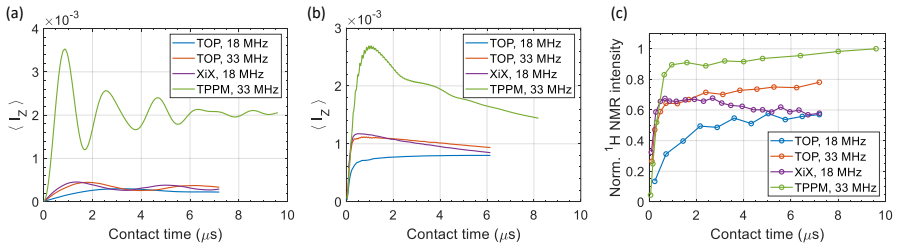
- The dependence of the enhancement factor on the electron Rabi frequency, including the contrast between XiX (roughly constant) and TOP (steadily increasing) DNP, is reproduced.
- The steady orbit during repeated pulse application differs from the trajectory of the first transfer, so pulse-sequence design should target the steady orbit rather than a single transfer.
- Ensemble averaging over electron-proton distances and electron Rabi frequencies improves agreement with experiments, indicating that these distributions matter for quantitative prediction.
Reading between the lines
- A testable extension is to apply the Newton-Raphson steady-state approach to adiabatic-passage sequences such as frequency-swept or ramped-amplitude NOVEL, which the authors expect to be equally useful.
- The observation that steady orbits preserve the electron-proton dipolar coupling better than single-transfer analysis suggests that optimized sequences could exploit this mismatch to achieve efficient high-field pulsed DNP at lower peak microwave power.
- The model's success with a single electron-proton pair, after calibrating the coupling and ensemble range against experiments, implies that the same procedure could be used to calibrate effective spin-system parameters for other polarizing agents and matrices, provided the calibration data exist.
- The documented numerical instability of the matrix-logarithm method in dissipative Liouville space suggests that steady-state optimal-control sequence design will require either a stable effective-generator method or a workaround such as direct gradient-based optimization of the fixed-point equation.
Editorial analysis
A structured set of objections, weighed in public.
Referee Report
Summary. The paper introduces three algorithms for computing the stroboscopic steady state of a periodically driven dissipative spin system, tailored to pulsed dynamic nuclear polarization (DNP). The first algorithm, propagator squaring, is stable but expensive; the second, based on matrix-logarithm effective Hamiltonians, is numerically unstable for dissipative DNP; the third, Newton-Raphson iteration on the fixed-point equation of the one-period propagator, is claimed to be stable and efficient. The authors implement these in Spinach, benchmark them on CPU and GPU, and compare steady-state simulations with experimental field profiles, repetition-time scans, polarization-transfer curves, and Rabi-frequency dependences for NOVEL, TOP, XiX, and TPPM DNP at 0.34 T, 1.2 T, and 3.4 T, including new W-band XiX DNP data. The central claim is that steady-state simulations reproduce experimental results remarkably well, substantially better than single-transfer simulations, and that the steady orbit differs from the one-time-transfer trajectory.
Significance. The algorithmic contribution is a genuine step forward: the Newton-Raphson steady-state method is clearly explained, the condition-number bound in Sec. 2.3 is parameter-free and system-size independent, and the comparison among three algorithms is useful for practitioners. The code and data are deposited in Spinach and Zenodo, which aids reproducibility. The new W-band XiX DNP experiments provide valuable reference data. The validation of the method against multiple pulse sequences and magnetic fields is ambitious, and the improvement over single-transfer simulations is demonstrated qualitatively. However, the predictive claim is weakened by several hand-adjusted parameters, notably the effective electron-proton coupling and the distance-ensemble cutoff, so the paper's central conclusion that agreement is 'remarkably good' and predictive needs stronger support.
major comments (4)
- [Sec. 4.2 (W-band field profile) and Sec. 3.5] The W-band validation is partially circular by the paper's own description. Sec. 4.2 states that 'the largest distance in the ensemble (20 A) was adjusted to reproduce the relative peak intensities in the experimental field profile,' while Sec. 3.5 says the same value 'was empirically found to converge the radial part of the average.' These statements are in tension: if 20 A is a converged integration cutoff, it is not a free parameter, but if it is adjusted to the data, the W-band comparison is a fit rather than a prediction. The authors should disambiguate this and ideally provide a leave-one-out or cross-validation analysis, e.g., fitting Rmax on one subset of the field profile and testing on the rest, to establish the predictive content of the model.
- [Sec. 4.3, Figure 7 (NOVEL with flip-back)] The paper reports that the steady-state simulation of NOVEL with a flip-back pulse predicts nuclear polarization 'above the maximum theoretical enhancement factor of 329.' This is a red flag: the theoretical maximum enhancement is a fundamental bound, and exceeding it indicates either an inconsistency in the simulation model (e.g., in how the flip-back pulse or relaxation is treated) or a misstatement. The manuscript does not comment on this discrepancy, yet it appears in a figure supporting the claim of good agreement. The authors should investigate whether this is a modeling error, a unit/definition issue, or a genuine prediction that requires explanation.
- [Sec. 5 and Secs. 3.3-3.5] The claim in Sec. 5 that 'the different pulsed-DNP experiments were successfully simulated with the same set of parameters' is overstated. Some parameters are fixed across experiments, but others are not: T1n,bulk is 26 s at X band but 52 s at Q and W band; the electron Rabi frequency ensemble ranges differ per experiment (e.g., 14-16 MHz for NOVEL at X band, 10-20 MHz for TOP/XiX at Q band, 25-35 MHz for TPPM); and the effective electron-proton coupling is fitted to 0.34 T transfer times. A precise inventory of which parameters are global constants, which are field-specific, and which are fitted to the data being compared would be necessary to support the 'same set of parameters' claim and to assess the degrees of freedom used in the validation.
- [Secs. 4.2-4.5, Figures 3-9] The agreement between simulation and experiment is assessed only visually. Given the number of adjustable parameters and the qualitative nature of the comparisons, the central claim of 'remarkably good' agreement would be much strengthened by a quantitative metric, such as normalized root-mean-square deviation between simulated and experimental field profiles, repetition-time curves, or transfer curves, ideally with a statement of which features are used for fitting and which are tested. Without such a metric, it is difficult to distinguish genuine prediction from overfitting, especially in the W-band field profile where Rmax is explicitly adjusted.
minor comments (5)
- [Abstract and Sec. 4.2] The abstract contains a typo: 'a greement is good' should be 'agreement is good.'
- [Eq. (9)] Equation (9) is garbled: the expression 'min 12i T rTr T e e' is not readable as printed. Please rewrite it with proper exponential notation and define all symbols in the surrounding text.
- [Sec. 3.1] The solvent composition 'd₈-glycerol:D₂O:H₂O 60:30:10' would be clearer with volume/volume percentages explicitly stated, and the isotope subscript formatting should be consistent throughout.
- [Sec. 4.3, Figure 7] The phrase 'peaks above the maximum theoretical enhancement factor of 329' is ambiguous; if the plotted quantity is Iz, the maximum possible value is 0.5, so the reader cannot tell whether the simulation is exceeding a thermal-polarization enhancement bound or a different definition. Please clarify the ordinate and the theoretical bound.
- [Sec. 2.3 and Sec. 4.1] The benchmarks in Table S1 cover systems up to one electron and nine protons, but the main-text statement that Newton-Raphson is 'up to three times' faster than squaring is based on a single representative point at each dimension; reporting error bars or multiple benchmark points would make the performance claim more robust.
Circularity Check
W-band field-profile agreement is partially fit-defined: Rmax is adjusted to the experimental profile that is then presented as agreement.
-
fitted input called prediction
[Section 4.2, discussion of Figure 4; supported by Section 3.5]
"Some improvement is accomplished with the steady-state simulation based on a single parameter set, but the shapes are still off and intensities at resonance offsets ±60 and ±230 MHz come out too strong. Both problems are corrected when the electron-proton distance ensemble is included; the largest distance in the ensemble (20 Å) was adjusted to reproduce the relative peak intensities in the experimental field profile."
The W-band field profile in Figure 4 is presented as evidence that the steady-state simulation reproduces experiments, but the ensemble cutoff Rmax = 20 Å, which changes the relative peak intensities, is explicitly adjusted to match that same experimental profile. Therefore the relative peak intensities are an input to the simulation, not a prediction from it. Section 3.5 says Rmax 'was empirically found to converge the radial part of the average', which would make it a converged integration limit and not a free knob; but Section 4.2 describes it as adjusted to the data, so the W-band comparison is at least partly forced by construction unless the convergence statement removes the degree of freedom.
full rationale
The Newton-Raphson steady-state algorithm itself is self-contained: the fixed-point equations in Section 2.3, the Jacobian condition-number bound in Eq. (9), and the performance benchmarks in Section 4.1 are internally derived and parameter-free. The Q-band comparisons (Figures 3, 6, 8, 9) and the X-band NOVEL repetition-time comparison (Figure 7) involve parameters chosen once and then transferred across fields and pulse sequences: the electron-proton coupling is matched to 0.34 T transfer times, relaxation times are taken from literature or prior experimental measurements, and Rabi-frequency ensemble ranges are reported as physical B1 inhomogeneity distributions. That is model calibration followed by cross-validation, not circularity. The concrete circular step is the W-band field profile: Section 4.2 states that Rmax = 20 Å 'was adjusted to reproduce the relative peak intensities in the experimental field profile', and that same profile is then presented in the conclusion as part of the 'remarkably good' agreement at X, Q, and W band. The W-band relative peak intensities are therefore partly a fit target rather than an independent prediction. The remaining model choices, such as the asymmetric Rabi-frequency ensemble ranges in Section 4.5, could in principle be additional fitted inputs, but the paper does not state that they were adjusted to the displayed experimental curves, so they are not scored as circular under the evidence standard. Overall: the algorithmic core is independent, but one of the central validation claims reduces, in part, to a fitted parameter; score 6.
Assumptions & free parameters
free parameters (7)
- Electron-proton effective coupling (distance set to 3.5 Å, dipolar coupling 1.8 MHz) =
3.5 Å / 1.8 MHz
- Distance ensemble maximum Rmax =
20 Å
- Electron Rabi frequency ensemble ranges =
e.g., 10-20 MHz for TOP/XiX at Q band; 25-35 MHz for TPPM; 14-16 MHz for NOVEL
- Electron longitudinal relaxation time T1e =
1 ms
- Electron phase memory time T2e =
5 µs
- Bulk proton longitudinal relaxation T1n,bulk =
52 s (Q/W band), 26 s (X band)
- Proton transverse relaxation T2n =
20 µs
assumptions (5)
- standard math A periodically driven linear dissipative spin system has a unique steady orbit and converges to it from any initial condition.
- standard math The relaxation superoperator R is negative definite and drives the system to thermal equilibrium.
- domain assumption State-space restriction (product states up to a cut-off) preserves the relevant dynamics.
- domain assumption The longitudinal relaxation of protons near the electron follows Eq. (11) from Abragam and Goldman, with parameters from King et al.
- ad hoc to paper The electron-proton distance distribution is uniform between 3.5 Å and 20 Å; the Rabi frequency distribution is uniform over the stated ranges.
Cite this review
Pith. "Pith review of Simulation of pulsed dynamic nuclear polarization in the steady state." pith.science (2026). https://pith.science/paper/XGTTNGLR
@misc{pith2026250524444,
  author       = {Pith},
  title        = {Pith review of: Simulation of pulsed dynamic nuclear polarization in the steady state},
  year         = {2026},
  howpublished = {\url{https://pith.science/paper/XGTTNGLR}},
  note         = {Machine review of arXiv:2505.24444}
}
read the original abstract
In pulsed dynamic nuclear polarization (DNP), enhancement of the polarization of bulk nuclei requires the repeated application of a microwave pulse sequence. So far, analysis of a one-time transfer of electron spin polarization to a dipolar-coupled nuclear spin has guided the design of DNP pulse sequences. This has obvious shortcomings, such as an inability to predict the optimal repetition time. In an actual pulsed DNP experiment, a balance is reached between the polarization arriving from the unpaired electrons and nuclear relaxation. In this article, we explore three algorithms to compute this stroboscopic steady state: (1) explicit time evolution by propagator squaring, (2) generation of an effective propagator using the matrix logarithm, and (3) direct calculation of the steady state with the Newton-Raphson method. Algorithm (2) is numerically unstable for this purpose. Algorithm (1) and (3) are both stable; algorithm (3) is the most efficient. We compare the steady-state simulations to existing experimental results at 0.34 T and 1.2 T and to the first experimental observation of X-inverse-X (XiX) DNP at 3.4 T: agreement is good, and improves further when electron-proton distance and electron Rabi frequency distributions are accounted for. We demonstrate that the trajectory of the spin system during one-time application of a microwave pulse sequence differs from the steady orbit. This has implications for DNP pulse sequence design.
Figures


Reference graph
Works this paper leans on
-
[1]
Orientation dependence of T1n near an unpaired electron ................................ ................................ ....... 2
-
[2]
Performance benchmarks ................................ ................................ ................................ ........................ 2
-
[3]
Dependence on electron Rabi frequency at W band................................ ................................ ................. 4
-
[4]
Repetition-time profiles ................................ ................................ ................................ ........................... 4
-
[5]
Polarization transfer during the DNP sequence ................................ ................................ ........................ 5
-
[6]
Effects of alternative relaxation times ................................ ................................ ................................ ...... 6 *Email: guinevere.mathies@uni-konstanz.de 2
-
[10]
Orientation dependence of T1n near an unpaired electron Figure S1. Longitudinal relaxation (a) times and (b) rates for a spin-1/2 nucleus at 3.5 Å from an unpaired electron, plotted as a function of the angle between the dipolar vector and the external magnetic field (Eq. (13) from the main manuscript). Close to 0° and 180°, 1nT is 191 ms; close to 90°, 1...
-
[11]
Performance benchmarks Benchmarking of the steady-state algorithms was conducted on a Dell T550 server equipped with 32 Intel Xeon 6326 CPU cores, 512 GB of RAM, and an Nvidia A100 GPU (80 GB of RAM, 9.7 TFLOPS FP64). As a representative case, two points of the XiX DNP field profile at Q band were computed for 100 points in the spherical orientation grid ...
work page 2000
Show all 14 references
-
[12]
Single-transfer parameter scan for XiX DNP at W band with pt = 18 ns and ct = 1000 ns
Dependence on electron Rabi frequency at W band Figure S3. Single-transfer parameter scan for XiX DNP at W band with pt = 18 ns and ct = 1000 ns. The spin system consists of one unpaired electron at the origin and two protons at (0.0, 3.5, 0.0) and (2.475, 2.475, 0.0) Å. g-ani...
-
[13]
Optimization of repetition times for TOP , XiX, and TPPM DNP at Q band
Repetition-time profiles Figure S4. Optimization of repetition times for TOP , XiX, and TPPM DNP at Q band. Steady-state simulations with (a) a single parameter set, (b) electron-proton distance ensemble, and (c) electron-proton distance and electron -Rabi-frequency ensembles....
-
[14]
Transfer of longitudinal magnetization during the TOP , XiX, and TPPM DNP pulse sequences at Q band
Polarization transfer during the DNP sequence Figure S5. Transfer of longitudinal magnetization during the TOP , XiX, and TPPM DNP pulse sequences at Q band. Steady- state simulations with (a) a single parameter set, (b) electron-proton distance ensemble, and (c) electron-prot...
-
[15]
Effects of alternative electron and nuclear spin relaxation times on field profiles, repetition -time profiles, and polarization transfer for XiX DNP at Q band
Effects of alternative relaxation times Figure S 6. Effects of alternative electron and nuclear spin relaxation times on field profiles, repetition -time profiles, and polarization transfer for XiX DNP at Q band. (a-c) Electron spin longitudinal relaxation, (d-f) electron spin...
-
[171]
(54) Bowman, M
https://doi.org/10.1038/s42004-023-00963-w. (54) Bowman, M. K.; Mailer, C.; Halpern, H. J. The Solution Conformation of Triarylmethyl Radicals. J. Magn. Reson. 2005, 172 (2), 254–267. https://doi.org/10.1016/j.jmr .2004.10.010. (55) Trukhan, S. N.; Yudanov, V. F.; Tormyshev, V...
2005
-
[305]
25 (72) Menzildjian, G.; Schlagnitweit, J.; Casano, G.; Ouari, O.; Gajan, D.; Lesage, A
https://doi.org/10.1016/j.jmr .2004.11.004. 25 (72) Menzildjian, G.; Schlagnitweit, J.; Casano, G.; Ouari, O.; Gajan, D.; Lesage, A. Polarizing Agents for Effi- cient High Field DNP Solid-State NMR Spectroscopy under Magic-Angle Spinning: From Design Principles to For- mulatio...
2004 doi
Reviewed August 7, 2026 · model on record in the stance chip above.
Discussion (0). Continue with ORCID to comment.