REVIEW 4 major objections 6 minor 84 references
Disentanglement in the macroscopic limit
T0 review · 4 major / 6 minor · reviewed 2026-08-06 · deepseek-v4-flash
Pith's one-line read The spontaneous disentanglement hypothesis implies that non-locally entangled many-body ground states become unstable in the macroscopic limit, while locally entangled states such as the AKLT ground state may remain stable.
desk verdict A plausible scaling heuristic with a real gap: the paper computes ground-state Q_D scaling for three models, but never shows that zeta controls the nonlinear dynamics, so the instability claim is not supported. read the letter →
The pith
A machine-rendered reading of the paper's core claim, the machinery that carries it, and where it could break.
The reading
What carries the argument
The load-bearing object is the disentanglement operator $Q_D=\sum_{s'<s''} C_{s',s''}$, where each $C_{s',s''}$ is a pairwise correlation operator built from generalized Gell-Mann matrices and proportional to the linear relative entropy of entanglement, bounded in $[0,1]$. The dynamics of Eq. (1) monotonically suppresses $\langle\Theta\rangle=\gamma_H\langle Q_H\rangle+\gamma_D\langle Q_D\rangle$, so the ground-state value $q_{\mathrm{gs}}$ of $\langle Q_D\rangle$ sets the strength of the disentangling drive. Comparing this to the thermal scale $\beta\,\mathrm{spr}(H)$ defines the dimensionless parameter $\zeta=\beta\,\mathrm{spr}(H)/q_{\mathrm{gs}}$; analyzing how $q_{\mathrm{gs}}$ scales with $N$ or $L$ in exactly solvable models is what converts the hypothesis into concrete macroscopic predictions.
What would settle it
Numerically integrate the nonlinear master equation (1) for the Lieb-Mattis model with $2N=8,12,16$ spins, starting from the ground state, and measure the survival probability; the paper's scaling predicts a disentanglement rate that grows as $q_{\mathrm{gs}}\sim N^2$, so larger systems decay faster, whereas if $\zeta$ is not the correct control parameter the decay may be negligible or scale differently. An essentially undecayed ground state for large $N$ even when $\zeta\ll1$ would falsify the central claim.
Extended reading notes
Core claim
The central claim is that spontaneous disentanglement, formulated as the nonlinear Kraus-operator dynamics of Eq. (1) with $\Theta=\gamma_H Q_H+\gamma_D Q_D$, makes the macroscopic stability of an entangled state depend on the ground-state entanglement quantifier $q_{\mathrm{gs}}=\langle Q_D\rangle$. Because the nonlinear term suppresses $\langle Q_D\rangle$, the impact of disentanglement is estimated by the dimensionless ratio $\zeta = \beta\,\mathrm{spr}(H)/q_{\mathrm{gs}}$. For the Lieb-Mattis model the ground-state pairwise entanglement scales as $q_{\mathrm{gs}}\sim N^2$, for the AKLT ring as $q_{\mathrm{gs}}\sim L$ (following the exponentially decaying two-site entanglement $\tau_l=\frac{16}{27}(1/9)^{l-2}$), and for the Kitaev chain at $\mu=0$ as $q_{\mathrm{gs}}\sim L^2$ with constant two-site entanglement $\tau=1/3$. Thus $\zeta\to 0$ for the Lieb-Mattis and Kitaev ground states in the macroscopic limit—they are predicted to be destabilized by spontaneous disentanglement—whereas the AKLT ground state may remain stable. The paper presents these three exactly solvable models as evidence that the spontaneous disentanglement hypothesis can bridge the quantum microscopic realm and the classical macroscopic one, and notes that the stability distinction tracks whether correlations obey an area law.
Load-bearing premise
The argument assumes that the dimensionless ratio $\zeta$ of the Hamiltonian's energy spread (times $\beta$) to the ground-state value of the entanglement operator $Q_D$ is the correct measure of whether spontaneous disentanglement destabilizes a state; the paper relies on this as an estimate, not on a derivation from the nonlinear master equation.
Editorial extensions
If this is right
- Non-locally entangled ground states of the Lieb-Mattis type and the Kitaev chain at $\mu=0$ cannot survive as macroscopic quantum states; spontaneous disentanglement should drive them toward classically correlated states.
- Locally entangled states such as the AKLT valence-bond solid, with exponentially decaying correlations, may remain stable at arbitrarily large system sizes, preserving a form of quantumness in the macroscopic limit.
- The crossover between stability and instability is controlled by the ground-state entanglement scaling relative to the energy spread: volume-law-like entanglement ($q_{\mathrm{gs}}\sim N^2$) is fragile, while area-law entanglement can persist.
- Because the disentangling drive is proportional to $q_{\mathrm{gs}}$ and can be made arbitrarily weak at the microscopic scale by choosing $\gamma_D$ small, the hypothesis offers a size-dependent mechanism for the appearance of classicality without a fundamental collapse postulate.
- The alternative, causality-safe construction in Appendix A, based on mutual-information minimization, leads to the same scaling conclusions via the entanglement area-law bound, suggesting the macroscopic instability is not an artifact of the specific choice of $Q_D$.
Reading between the lines
- If the scaling criterion is generic, then any model whose ground state has pairwise entanglement growing faster than the thermal energy spread will be disentangled at large $N$; this predicts that long-range entangled topological order cannot persist macroscopically, while short-range entangled topological phases can.
- A direct numerical test: integrate the nonlinear master equation (1) for the Lieb-Mattis model at $2N=8,12,16$ and measure the ground-state survival probability; the claimed instability predicts a decay rate growing as $\gamma_D N^2$, a clear, falsifiable signature.
- The paper's use of the ground-state value $q_{\mathrm{gs}}$ rather than the evolving state's $\langle Q_D\rangle$ leaves open the possibility that during disentanglement the state moves to a region of lower $Q_D$, slowing the decay; a closed equation for $\langle Q_D\rangle$ may alter the predicted timescales.
- The same logic applied to degenerate ground-state manifolds suggests that spontaneous disentanglement may select the least entangled state in the manifold, offering a dynamical principle for symmetry breaking beyond thermal fluctuations.
Editorial analysis
A structured set of objections, weighed in public.
Referee Report
Summary. The paper analyzes the macroscopic limit of the 'spontaneous disentanglement hypothesis' by studying the nonlinear Kraus-map dynamics (Eq. (1)) with Θ = γH QH + γD QD, where QD is a sum of pairwise correlation operators. The author introduces a dimensionless parameter ζ = β spr(H)/q_gs, with q_gs the ground-state expectation of QD, and computes q_gs for three exactly solvable models: the Lieb-Mattis antiferromagnet (q_gs ~ N²), the AKLT ring (q_gs ~ L), and the Kitaev chain at µ=0 (q_gs ~ L²). Based on the scaling of ζ, the paper concludes that the Lieb-Mattis and Kitaev ground states become unstable in the macroscopic limit, while the AKLT ground state may remain stable. An appendix discusses an alternative causality-preserving formulation and a bound from the entanglement area law.
Significance. If the central claim were correct, the paper would offer a concrete dynamical mechanism for a quantum-classical transition, with a falsifiable distinction between states with long-range and short-range correlations. The manuscript has clear strengths: the two-site reduced density matrices for the Lieb-Mattis and AKLT models are provided explicitly, and the scaling of q_gs for those models follows transparently from the exact formulas. However, the dynamical conclusion rests on an asserted, rather than derived, control parameter ζ, and the Kitaev model computation appears to contain a factual error. Thus the paper's significance is real but conditional.
major comments (4)
- [Macroscopic limit and Discussion] The dimensionless parameter ζ = β spr(H)/q_gs is introduced as an estimate of the impact of disentanglement, but it is never derived from the dynamics in Eq. (1). The only exact dynamic statement in the paper is that for H=0, d⟨Θ⟩/dt = -2⟨(Θ-⟨Θ⟩)²⟩; for H≠0 the unitary evolution contributes and can oppose or balance the nonlinear suppression. ζ contains neither γD nor γH and uses the ground-state value q_gs rather than the variance of Θ on the evolving state. Consequently the conclusion in the Discussion that Lieb-Mattis and Kitaev ground states 'become unstable' because ζ→0 is not supported by the equations of motion.
- [Kitaev model, Eq. (15)] The statement that for µ=0 and arbitrary L, τ(l′,l′′)=1/3 independent of l′ and l′′ is inconsistent with the ground state of the quadratic Hamiltonian (14). In a non-interacting translation-invariant chain, the two-site reduced density matrix is determined by the two-point correlation functions; these decay with distance for the gapped Kitaev ground state, so for distant sites the reduced state approaches the product of single-site mixed states (purity 1/4, τ=0). For L=2 the ground state is a pure Bell state with τ=1, so Eq. (15) fails already in the smallest case. The claimed q_gs ~ L² scaling for the Kitaev model and the associated instability conclusion are therefore unsupported.
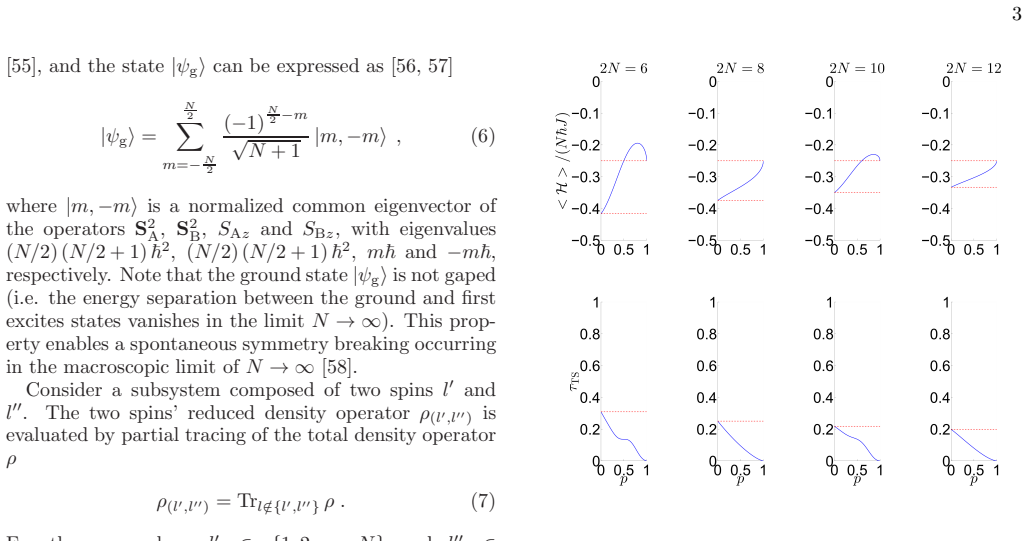
- [Figure 1 and Appendix A] The static family of states |ψ(p)⟩ in Fig. 1 shows that reducing QD along a particular manually chosen interpolation costs energy of order spr(H), but it does not show that the nonlinear master equation drives the system along that path or that the ground state is dynamically unstable. Appendix A's inequality (A2) is explicitly a 'cannot be excluded' statement, which is strictly weaker than the 'become unstable' claim made in the Discussion. The manuscript would need an actual trajectory analysis or a bound on the rate of decrease of ⟨QD⟩ under Eq. (1) to substantiate the headline instability.
- [Eqs. (2)-(3), construction of QD] The operator QD is defined as a sum of pairwise correlation operators, so the statement that QD is large for states with long-range two-site correlations is built into the definition. The paper does not provide an independent argument, e.g., from the measurement problem, that this particular observable is the one that spontaneous disentanglement should suppress; the scaling conclusions for the three models therefore directly inherit the choice of QD. This is acceptable as an assumption, but it should be stated as such rather than presented as a finding about 'disentanglement' in general.
minor comments (6)
- [Throughout] There are several typos: 'Affleck-Kennedy-Lieb-Tasa' should be 'Tasaki', 'forth column' should be 'fourth column', and 'under–study' is awkward.
- [Eq. (10)] The normalization denominator is written with double bars; please clarify the norm notation used for the superposition state |ψ(p)⟩.
- [Eqs. (8), (13), (15)] The paper relies on the author's lecture notes [44] for several key results; since these are load-bearing, the author should either derive them in the text or cite independent, peer-reviewed sources.
- [Appendix A] The scaling of ‖V‖∞ is stated as N² for Lieb-Mattis and L² for Kitaev, but for a bipartite cut of a local chain the interaction norm should scale with the boundary rather than the volume; this weakens the appendix's argument, even though it is not the main route to the central conclusion.
- [Figure 2] The text identifies q=1 as the AKLT ground state, but the dashed lines in Fig. 2 label q=±1; please clarify whether both signs correspond to equivalent ground states.
- [Introduction and Refs. [24-27]] The paper is built on the author's prior work; it would help the reader to state explicitly which elements of the nonlinear Kraus construction and the definition of QD are new in this manuscript relative to Ref. [24].
Circularity Check
The macroscopic-instability split is read off from a control parameter ζ whose denominator is q_gs, the ground-state value of the author-defined entanglement operator QD; the qualitative conclusion is therefore built into the definition rather than derived from the nonlinear dynamics.
-
self definitional
[Macroscopic limit section and Discussion section (definition of ζ; stability conclusions)]
"The dimensionless parameter ζ is defined by ζ =β spr (H)/qgs, where spr ( H) is the spread of H (i.e. the gap between largest and smallest energy eigenvalues), and qgs is the ground state value of ⟨QD⟩. The impact of disentanglement in the macroscopic limit can be estimated by evaluating the dependency of ζ on system’s size. ... Thus, both the Lieb-Mattis and Kitaev (for µ = 0) ground states become unstable in the macroscopic limit (the dimensionless parameter ζ → 0 in this limit for the Kitaev model)."
The instability conclusion is taken from the sign and scaling of ζ, but ζ is constructed with qgs in the denominator, and qgs is the ground-state expectation of QD, which Eq. (2) defines as a sum of pairwise correlation operators. Therefore 'non-local entanglement becomes unstable' is equivalent by construction to 'the ground state has a large value of the very operator QD that the nonlinear term is designed to suppress'. The paper never derives from Eq. (1) that ζ is the control parameter: the only exact statement, d⟨Θ⟩/dt = -2⟨(Θ-⟨Θ⟩)^2⟩, is for H=0 and fixed Θ, and it involves the instantaneous variance of Θ, not the ground-state value qgs; the H≠0 unitary term is not analyzed.
full rationale
The exact many-body computations in the paper are not circular: the ground-state reduced density matrices, purities, and the pairwise entanglement values for the Lieb-Mattis, AKLT, and Kitaev models are standard results derived from the stated Hamiltonians, and the scalings q_gs∼N², L, L² are genuine model-specific calculations. The circularity lies in the bridge from those computations to the paper's central dynamical claim. The dimensionless parameter ζ=β spr(H)/q_gs is introduced with the words 'the impact ... can be estimated', and the Discussion then declares instability whenever ζ→0. Because q_gs is by construction the ground-state value of QD, a sum of pairwise correlation operators defined in the author's prior framework, the assertion that states with superextensive QD are unstable is a restatement of the way the control parameter was defined, not a prediction obtained from solving or analyzing Eq. (1). The exact H=0 result d⟨Θ⟩/dt = -2⟨(Θ-⟨Θ⟩)^2⟩ only shows monotone suppression of the expectation of a fixed operator in the absence of a Hamiltonian; it does not justify replacing the evolving state's variance by the initial ground-state expectation q_gs, nor does it account for the unitary term for H≠0. Appendix A's bound (A2) is an upper bound on thermal mutual information and is used only to say that instability 'cannot be excluded', which is too weak to support the central classification. Thus the qualitative unstable/stable split is partially circular, while the underlying integrable-model results retain independent content; the score is 6 rather than higher because the exact ground-state calculations and their scalings are not themselves manufactured.
Assumptions & free parameters
assumptions (5)
- ad hoc to paper The nonlinear Kraus-map dynamics (Eq. 1) with Theta = gamma_H Q_H + gamma_D Q_D is a valid description of physical time evolution.
- ad hoc to paper The disentanglement operator Q_D (Eqs. 2-3), a sum of pairwise correlation operators, correctly quantifies what spontaneous disentanglement suppresses.
- ad hoc to paper zeta = beta spr(H)/q_gs is an adequate estimate of disentanglement impact in the macroscopic limit.
- ad hoc to paper The ground-state value q_gs controls the fate of the state under the nonlinear dynamics.
- standard math The area-law inequality sigma(rho_0 || rho_a otimes rho_b) <= 2 beta ||V||_infinity (Appendix A) from reference [79] applies.
invented entities (1)
-
Spontaneous disentanglement process (rho-dependent nonlinear term in the master equation)
Cite this review
Pith. "Pith review of Disentanglement in the macroscopic limit." pith.science (2026). https://pith.science/paper/XGVYTZ5W
@misc{pith2026260804858,
  author       = {Pith},
  title        = {Pith review of: Disentanglement in the macroscopic limit},
  year         = {2026},
  howpublished = {\url{https://pith.science/paper/XGVYTZ5W}},
  note         = {Machine review of arXiv:2608.04858}
}
read the original abstract
The recently proposed spontaneous disentanglement hypothesis is formulated using a modified Schr\"{o}dinger equation having an added nonlinear term. The hypothesis is motivated by some outstanding issues in the foundations of quantum mechanics, including the problem of quantum measurement. Spontaneous disentanglement is explored in the current study for the macroscopic limit. This is done using some many--body models having known exact solutions. For the under--study models, it is found that non--local entanglement becomes unstable in the macroscopic limit. On the other hand, stability in the macroscopic limit of local entanglement is not excluded. These findings demonstrate that the spontaneous disentanglement hypothesis can bridge between the quantumness of the microscopic realm, and the classicalness of the macroscopic one.
Figures


Reference graph
Works this paper leans on
-
[1]
Die gegenwartige situation in der quan- tenmechanik
E. Schrodinger, “Die gegenwartige situation in der quan- tenmechanik”, Naturwissenschaften, vol. 23, pp. 807, 1935
1935
-
[2]
Uncertainty in quantum mechanics: faith or fantasy?
Roger Penrose, “Uncertainty in quantum mechanics: faith or fantasy?”, Philosophical Transactions of the Royal Society A: Mathematical, Physical and Engineer- ing Sciences, vol. 369, no. 1956, pp. 4864–4890, 2011
1956
-
[3]
Von Neumann, Mathematical Foundations of Quantum Mechanics, Princeton University Press, Princeton, 1983
J. Von Neumann, Mathematical Foundations of Quantum Mechanics, Princeton University Press, Princeton, 1983
1983
-
[4]
Nonlinear relaxation and fluctuations of damped quantum systems
H Grabert, “Nonlinear relaxation and fluctuations of damped quantum systems”, Zeitschrift f¨ ur Physik B Condensed Matter, vol. 49, no. 2, pp. 161–172, 1982
1982
-
[5]
Two recent theoretical ad- vances with potential impact on quantum technology
Hans Christian ¨Ottinger, “Two recent theoretical ad- vances with potential impact on quantum technology”, APL Quantum , vol. 2, no. 2, pp. 026121, 2025
2025
-
[6]
Models of wave-function collapse, underlying theories, and experimental tests
Angelo Bassi, Kinjalk Lochan, Seema Satin, Tejinder P Singh, and Hendrik Ulbricht, “Models of wave-function collapse, underlying theories, and experimental tests”, Reviews of Modern Physics , vol. 85, no. 2, pp. 471, 2013
2013
-
[7]
Reduction of the state vector by a non- linear schr¨ odinger equation
Philip Pearle, “Reduction of the state vector by a non- linear schr¨ odinger equation”,Physical Review D , vol. 13, no. 4, pp. 857, 1976
1976
-
[8]
Linear and integrable nonlinear evolution of the qutrit
Krzysztof Kowalski, “Linear and integrable nonlinear evolution of the qutrit”, Quantum Information Process- ing, vol. 19, no. 5, pp. 1–31, 2020
work page 2020
Show all 84 references
-
[9]
Bifurcations and chaos in nonlinear lindblad equations
Bernd Fernengel and Barbara Drossel, “Bifurcations and chaos in nonlinear lindblad equations”, Journal of Physics A: Mathematical and Theoretical , vol. 53, no. 38, pp. 385701, 2020
2020
-
[10]
Present status and future challenges of non- interferometric tests of collapse models
Matteo Carlesso, Sandro Donadi, Luca Ferialdi, Mauro Paternostro, Hendrik Ulbricht, and Angelo Bassi, “Present status and future challenges of non- interferometric tests of collapse models”, Nature Physics, vol. 18, no. 3, pp. 243–250, 2022
2022
-
[11]
Underground test of gravity-related wave function col- lapse
Sandro Donadi, Kristian Piscicchia, Catalina Curceanu, Lajos Di´ osi, Matthias Laubenstein, and Angelo Bassi, “Underground test of gravity-related wave function col- lapse”, Nature Physics, vol. 17, no. 1, pp. 74–78, 2021
2021
-
[12]
Precision tests of quantum mechan- ics
Steven Weinberg, “Precision tests of quantum mechan- ics”, in THE OSKAR KLEIN MEMORIAL LECTURES 1988–1999, pp. 61–68. World Scientific, 2014
1988
-
[13]
Introducing non- linear gauge transformations in a family of nonlinear schr¨ odinger equations
H-D Doebner and Gerald A Goldin, “Introducing non- linear gauge transformations in a family of nonlinear schr¨ odinger equations”,Physical Review A , vol. 54, no. 5, pp. 3764, 1996
1996
-
[14]
The quantum-state diffusion model applied to open systems
Nicolas Gisin and Ian C Percival, “The quantum-state diffusion model applied to open systems”, Journal of Physics A: Mathematical and General , vol. 25, no. 21, pp. 5677, 1992
1992
-
[15]
A simple nonlinear dissipative quantum evolution equation
Nicolas Gisin, “A simple nonlinear dissipative quantum evolution equation”, Journal of Physics A: Mathematical and General, vol. 14, no. 9, pp. 2259, 1981
1981
-
[16]
Causal frame- work for nonlinear quantum mechanics
David E Kaplan and Surjeet Rajendran, “Causal frame- work for nonlinear quantum mechanics”, Physical Review D, vol. 105, no. 5, pp. 055002, 2022
2022
-
[17]
Simulating nonlinear dynamics of collective spins via quantum measurement and feedback
Manuel H Mu˜ noz-Arias, Pablo M Poggi, Poul S Jessen, and Ivan H Deutsch, “Simulating nonlinear dynamics of collective spins via quantum measurement and feedback”, Physical review letters, vol. 124, no. 11, pp. 110503, 2020
2020
-
[18]
Fast quantum state discrimination with nonlinear positive trace-preserving channels
Michael R Geller, “Fast quantum state discrimination with nonlinear positive trace-preserving channels”, Ad- vanced Quantum Technologies, p. 2200156, 2023
2023
-
[19]
Unified dynamics for microscopic and macroscopic sys- tems
Gian Carlo Ghirardi, Alberto Rimini, and Tullio Weber, “Unified dynamics for microscopic and macroscopic sys- tems”, Physical review D , vol. 34, no. 2, pp. 470, 1986
1986
-
[20]
A postquantum theory of clas- sical gravity
Jonathan Oppenheim, “A postquantum theory of clas- sical gravity”, Physical Review X , vol. 13, no. 4, pp. 041040, 2023. 7
2023
-
[21]
Can closed timelike curves or nonlin- ear quantum mechanics improve quantum state discrim- ination or help solve hard problems?
Charles H Bennett, Debbie Leung, Graeme Smith, and John A Smolin, “Can closed timelike curves or nonlin- ear quantum mechanics improve quantum state discrim- ination or help solve hard problems?”, Physical review letters, vol. 103, no. 17, pp. 170502, 2009
2009
-
[22]
Nonlocal-looking equations can make nonlinear quantum dynamics local
Marek Czachor, “Nonlocal-looking equations can make nonlinear quantum dynamics local”, Physical Review A , vol. 57, no. 6, pp. 4122, 1998
1998
-
[23]
Macroscopic quantum test with bulk acoustic wave resonators
Bj¨ orn Schrinski, Yu Yang, Uwe von L¨ upke, Marius Bild, Yiwen Chu, Klaus Hornberger, Stefan Nimmrichter, and Matteo Fadel, “Macroscopic quantum test with bulk acoustic wave resonators”, Physical Review Letters , vol. 130, no. 13, pp. 133604, 2023
2023
-
[24]
Spontaneous disentanglement and thermal- ization
Eyal Buks, “Spontaneous disentanglement and thermal- ization”, Advanced Quantum Technologies, vol. 7, no. 5, pp. 2400036, 2024
2024
-
[25]
Disentanglement-induced multistability
Eyal Buks, “Disentanglement-induced multistability”, Physical Review A , vol. 110, no. 1, pp. 012439, 2024
2024
-
[26]
Disentanglement–induced bistability in a magnetic resonator
Eyal Buks, “Disentanglement–induced bistability in a magnetic resonator”, Advanced Quantum Technologies, p. 2400587, 2025
2025
-
[27]
Disentanglement–induced superconductiv- ity
Eyal Buks, “Disentanglement–induced superconductiv- ity”, Entropy, vol. 27, no. 6, pp. 630, 2025
2025
-
[28]
Superoperator structures and no-go theorems for dissipative quantum phase transitions
Thomas Barthel and Yikang Zhang, “Superoperator structures and no-go theorems for dissipative quantum phase transitions”, Physical Review A , vol. 105, no. 5, pp. 052224, 2022
2022
-
[29]
Quantum mechan- ics versus macroscopic realism: Is the flux there when nobody looks?
A. J. Leggett and Anupam Garg, “Quantum mechan- ics versus macroscopic realism: Is the flux there when nobody looks?”, Phys. Rev. Lett. , vol. 54, pp. 857–860, 1985
1985
-
[30]
Against ?measurement?
John Bell, “Against ?measurement?”, Physics world, vol. 3, no. 8, pp. 33–41, 1990
1990
-
[31]
Why decoherence has not solved the measurement problem: a response to pw anderson
Stephen L Adler, “Why decoherence has not solved the measurement problem: a response to pw anderson”, Studies in History and Philosophy of Science Part B: Studies in History and Philosophy of Modern Physics , vol. 34, no. 1, pp. 135–142, 2003
2003
-
[32]
Mixed-state entanglement from local randomized measurements
Andreas Elben, Richard Kueng, Hsin-Yuan Robert Huang, Rick van Bijnen, Christian Kokail, Marcello Dalmonte, Pasquale Calabrese, Barbara Kraus, John Preskill, Peter Zoller, et al., “Mixed-state entanglement from local randomized measurements”, Physical Review Letters, vol. 125,...
2020
-
[33]
Non- hermitian quantum dynamics of a two-level system and models of dissipative environments
Alessandro Sergi and Konstantin G Zloshchastiev, “Non- hermitian quantum dynamics of a two-level system and models of dissipative environments”, International Jour- nal of Modern Physics B , vol. 27, no. 27, pp. 1350163, 2013
2013
-
[34]
Mixed-state evo- lution in the presence of gain and loss
Dorje C Brody and Eva-Maria Graefe, “Mixed-state evo- lution in the presence of gain and loss”, Physical review letters, vol. 109, no. 23, pp. 230405, 2012
2012
-
[35]
Non-unitarity maximizing unraveling of open quantum dynamics
Ruben Daraban, Fabrizio Salas-Ram´ ırez, and Johannes Schachenmayer, “Non-unitarity maximizing unraveling of open quantum dynamics”, SciPost Physics , vol. 18, no. 2, pp. 048, 2025
2025
-
[36]
Exactly solvable time-dependent pseudo-hermitian su (1, 1) hamiltonian models
R Grimaudo, Asm De Castro, M Ku´ s, and A Messina, “Exactly solvable time-dependent pseudo-hermitian su (1, 1) hamiltonian models”, Physical Review A , vol. 98, no. 3, pp. 033835, 2018
2018
-
[37]
Integrable nonlinear evolution of the qubit
K Kowalski and J Rembieli´ nski, “Integrable nonlinear evolution of the qubit”, Annals of Physics , vol. 411, pp. 167955, 2019
2019
-
[38]
The spontaneous disentanglement hypothe- sis and causality
Eyal Buks, “The spontaneous disentanglement hypothe- sis and causality”, arXiv:2604.10562, 2026
2026 arXiv
-
[39]
Completely positive dy- namical semigroups of n-level systems
Vittorio Gorini, Andrzej Kossakowski, and Ennackal Chandy George Sudarshan, “Completely positive dy- namical semigroups of n-level systems”, Journal of Math- ematical Physics, vol. 17, no. 5, pp. 821–825, 1976
1976
-
[40]
Nonlinear thermodynamic quantum master equation: Properties and examples
Hans Christian ¨Ottinger, “Nonlinear thermodynamic quantum master equation: Properties and examples”, Physical Review A , vol. 82, no. 5, pp. 052119, 2010
2010
-
[41]
The minimum entropy production principle
Edwin T Jaynes, “The minimum entropy production principle”, Annual Review of Physical Chemistry , vol. 31, no. 1, pp. 579–601, 1980
1980
-
[42]
Principles of maximum entropy and maximum cal- iber in statistical physics
Steve Press´ e, Kingshuk Ghosh, Julian Lee, and Ken A Dill, “Principles of maximum entropy and maximum cal- iber in statistical physics”, Reviews of Modern Physics , vol. 85, no. 3, pp. 1115–1141, 2013
2013
-
[43]
Stability of the grabert master equation
Eyal Buks and Dvir Schwartz, “Stability of the grabert master equation”, Physical Review A, vol. 103, no. 5, pp. 052217, 2021
2021
-
[44]
Eyal Buks, Quantum mechanics - Lecture Notes , http://buks.net.technion.ac.il/teaching/, 2026
2026
-
[45]
Linear entropy fails to predict entanglement behavior in low-density fermionic systems
T Pauletti, MAG Silva, GA Canella, and VV Fran¸ ca, “Linear entropy fails to predict entanglement behavior in low-density fermionic systems”, Physica A: Statisti- cal Mechanics and its Applications , vol. 644, pp. 129824, 2024
2024
-
[46]
66, Springer, 2020
Hal Tasaki, Physics and mathematics of quantum many- body systems, vol. 66, Springer, 2020
2020
-
[47]
Ordering energy levels of interacting spin systems
Elliott Lieb and Daniel Mattis, “Ordering energy levels of interacting spin systems”, Journal of Mathematical Physics, vol. 3, no. 4, pp. 749–751, 1962
1962
-
[48]
Rigorous results on valence-bond ground states in antiferromagnets
Ian Affleck, Tom Kennedy, Elliott H Lieb, and Hal Tasaki, “Rigorous results on valence-bond ground states in antiferromagnets”, Physical review letters , vol. 59, no. 7, pp. 799, 1987
1987
-
[49]
Valence bond ground states in isotropic quan- tum antiferromagnets
Ian Affleck, Tom Kennedy, Elliott H Lieb, and Hal Tasaki, “Valence bond ground states in isotropic quan- tum antiferromagnets”, Communications in Mathemati- cal Physics, vol. 115, no. 3, pp. 477–528, 1988
1988
-
[50]
Unpaired majorana fermions in quan- tumwires
A Yu Kitaev, “Unpaired majorana fermions in quan- tumwires”, Physics-uspekhi, vol. 44, no. 10S, pp. 131, 2001
2001
-
[51]
Continuum dynamics of the 1-d heisenberg antiferromagnet: Identification with the o (3) nonlinear sigma model
F Duncan M Haldane, “Continuum dynamics of the 1-d heisenberg antiferromagnet: Identification with the o (3) nonlinear sigma model”, Physics letters a , vol. 93, no. 9, pp. 464–468, 1983
1983
-
[52]
Nonlinear field theory of large-spin heisenberg antiferromagnets: semiclassicall y quantized solitons of the one-dimensional easy-axis n´ eel state
F Duncan M Haldane, “Nonlinear field theory of large-spin heisenberg antiferromagnets: semiclassicall y quantized solitons of the one-dimensional easy-axis n´ eel state”, Physical review letters , vol. 50, no. 15, pp. 1153, 1983
1983
-
[53]
Com- petition between neel, haldane nematic, plaquette va- lence bond solid, and ( π, π) valence bond solid phases in su (n) analogs of s= 1 square-lattice antiferromagnets
Souvik Kundu, Nisheeta Desai, and Kedar Damle, “Com- petition between neel, haldane nematic, plaquette va- lence bond solid, and ( π, π) valence bond solid phases in su (n) analogs of s= 1 square-lattice antiferromagnets”, Physical Review B , vol. 109, no. 19, pp. 195146, 2024
2024
-
[54]
Gapped quantum systems and entanglement area law
Bei Zeng, Xie Chen, Duan-Lu Zhou, and Xiao-Gang Wen, “Gapped quantum systems and entanglement area law”, in Quantum Information Meets Quantum Matter: From Quantum Entanglement to Topological Phases of Many-Body Systems, pp. 115–153. Springer, 2019
2019
-
[55]
Exact ground state of the lieb-mattis hamiltonian as a superposition of n´ eel states
Louk Rademaker, “Exact ground state of the lieb-mattis hamiltonian as a superposition of n´ eel states”, Physical Review Research, vol. 1, no. 3, pp. 032018, 2019
2019
-
[56]
Entanglement entropy in collective models
Julien Vidal, S´ ebastien Dusuel, and Thomas Barthel, 8 “Entanglement entropy in collective models”, Journal of Statistical Mechanics: Theory and Experiment , vol. 2007, no. 01, pp. P01015, 2007
2007
-
[57]
Stability and absence of a tower of states in ferrimag- nets
Louk Rademaker, Aron Beekman, and Jasper van Wezel, “Stability and absence of a tower of states in ferrimag- nets”, Physical Review Research, vol. 2, no. 1, pp. 013304, 2020
2020
-
[58]
An introduction to spontaneous symmetry breaking
Aron Beekman, Louk Rademaker, and Jasper Van Wezel, “An introduction to spontaneous symmetry breaking”, SciPost Physics Lecture Notes , p. 011, 2019
2019
-
[59]
Separability criterion for density matri- ces
Asher Peres, “Separability criterion for density matri- ces”, Physical Review Letters , vol. 77, no. 8, pp. 1413, 1996
1996
-
[60]
Lieb-mattis states for robust entangled differential phase sensing
Raphael Kaubruegger, Diego Fallas Padilla, Athreya Shankar, Christoph Hotter, Sean R Muleady, Jacob Bringewatt, Youcef Baamara, Erfan Abbasgholinejad, Alexey V Gorshkov, Klaus Mølmer, et al., “Lieb-mattis states for robust entangled differential phase sensing”, arXiv:2506.10151, 2025
2025 arXiv
-
[61]
The asymmetric valence-bond-solid states in quantum spin chains: The difference between odd and even spins
Daisuke Maekawa and Hal Tasaki, “The asymmetric valence-bond-solid states in quantum spin chains: The difference between odd and even spins”, Journal of Math- ematical Physics, vol. 64, no. 3, pp. 031901, 2023
2023
-
[62]
Ground- state properties of a generalized vbs-model
A Kl¨ umper, A Schadschneider, and J Zittartz, “Ground- state properties of a generalized vbs-model”, Zeitschrift f¨ ur Physik B Condensed Matter, vol. 87, no. 3, pp. 281– 287, 1992
1992
-
[63]
Spectral gaps of affleck-kennedy-lieb-tasaki hamiltoni- ans using tensor network methods
Artur Garcia-Saez, Valentin Murg, and Tzu-Chieh Wei, “Spectral gaps of affleck-kennedy-lieb-tasaki hamiltoni- ans using tensor network methods”, Physical Review B , vol. 88, no. 24, pp. 245118, 2013
2013
-
[64]
Assa Auerbach, Interacting electrons and quantum mag- netism, Springer Science & Business Media, 2012
2012
-
[65]
Density-matrix mean-field theory
Junyi Zhang and Zhengqian Cheng, “Density-matrix mean-field theory”, SciPost Physics , vol. 17, no. 2, pp. 062, 2024
2024
-
[66]
Entanglement spectra of the q- deformed affleck-kennedy-lieb-tasaki model and matrix product states
Raul A Santos, Francis NC Paraan, Vladimir E Korepin, and Andreas Kl¨ umper, “Entanglement spectra of the q- deformed affleck-kennedy-lieb-tasaki model and matrix product states”, Europhysics Letters, vol. 98, no. 3, pp. 37005, 2012
2012
-
[67]
Sig- natures of majorana zero modes in an isolated one- dimensional superconductor
Rohith Sajith, Kartiek Agarwal, and Ivar Martin, “Sig- natures of majorana zero modes in an isolated one- dimensional superconductor”, Physical Review B , vol. 109, no. 18, pp. 184509, 2024
2024
-
[68]
Entan- glement topological invariants for one-dimensional topo- logical superconductors
Pierre Fromholz, Giuseppe Magnifico, Vittorio Vitale, Tiago Mendes-Santos, and Marcello Dalmonte, “Entan- glement topological invariants for one-dimensional topo- logical superconductors”, Physical Review B , vol. 101, no. 8, pp. 085136, 2020
2020
-
[69]
Local and nonlocal order parame- ters in the kitaev chain
Gennady Y Chitov, “Local and nonlocal order parame- ters in the kitaev chain”, Physical Review B , vol. 97, no. 8, pp. 085131, 2018
2018
-
[70]
Exact mean-field solution of a spin chain with short-range and long-range interactions
Etienne Granet, “Exact mean-field solution of a spin chain with short-range and long-range interactions”, Sci- Post Physics , vol. 14, no. 5, pp. 133, 2023
2023
-
[71]
Phase separation in kitaev chain
Kazuhiro Kuboki, “Phase separation in kitaev chain”, arXiv:2510.20312, 2025
2025
-
[72]
Gauging the kitaev chain
Umberto Borla, Ruben Verresen, Jeet Shah, and Sergej Moroz, “Gauging the kitaev chain”, SciPost Physics , vol. 10, no. 6, pp. 148, 2021
2021
-
[73]
Correlation functions of the kitaev model with a spatially modulated phase in the superconducting order parameter
Fabian G Medina Cuy and Fabrizio Dolcini, “Correlation functions of the kitaev model with a spatially modulated phase in the superconducting order parameter”, Physical Review B, vol. 110, no. 21, pp. 214512, 2024
2024
-
[74]
Col- loquium: Area laws for the entanglement entropy
Jens Eisert, Marcus Cramer, and Martin B Plenio, “Col- loquium: Area laws for the entanglement entropy”, Re- views of modern physics , vol. 82, no. 1, pp. 277–306, 2010
2010
-
[75]
Entanglement rates and area laws
Karel Van Acoleyen, Micha¨ el Mari¨ en, and Frank Ver- straete, “Entanglement rates and area laws”, Physical review letters, vol. 111, no. 17, pp. 170501, 2013
2013
-
[76]
Weinberg’s non-linear quantum mechan- ics and supraluminal communications
Nicolas Gisin, “Weinberg’s non-linear quantum mechan- ics and supraluminal communications”, Physics Letters A, vol. 143, no. 1-2, pp. 1–2, 1990
1990
-
[77]
Nonlinear evo- lution and signaling
Jakub Rembieli´ nski and Pawe/suppress l Caban, “Nonlinear evo- lution and signaling”, Physical Review Research, vol. 2, no. 1, pp. 012027, 2020
2020
-
[78]
General properties of entropy
Alfred Wehrl, “General properties of entropy”, Reviews of Modern Physics , vol. 50, no. 2, pp. 221, 1978
1978
-
[79]
Area laws in quantum systems: mutual information and correlations
Michael M Wolf, Frank Verstraete, Matthew B Hastings, and J Ignacio Cirac, “Area laws in quantum systems: mutual information and correlations”, Physical review letters, vol. 100, no. 7, pp. 070502, 2008
2008
-
[80]
Second law-like inequalities with quantum relative entropy: An introduction
Takahiro Sagawa, “Second law-like inequalities with quantum relative entropy: An introduction”, Tech. Rep., 2023
2023
-
[81]
Thermodynamics from relative entropy
Stefan Floerchinger and Tobias Haas, “Thermodynamics from relative entropy”, Physical Review E , vol. 102, no. 5, pp. 052117, 2020
2020
-
[82]
Zur quantenmechanischen begr¨ undung des zweiten hauptsatzes der w¨ armelehre
Otto Klein, “Zur quantenmechanischen begr¨ undung des zweiten hauptsatzes der w¨ armelehre”, Zeitschrift f¨ ur Physik, vol. 72, no. 11, pp. 767–775, 1931
1931
-
[83]
Optimal estimation of entanglement
Marco G Genoni, Paolo Giorda, and Matteo GA Paris, “Optimal estimation of entanglement”, Physical Review A, vol. 78, no. 3, pp. 032303, 2008
2008
-
[84]
Nonlinearity is needed for disentanglement because the subset of disentangled states is generally not a subspace of the system’s Hilbert space (see also Ref
For the process of thermalization, nonlinearity is needed because the entropy is a nonlinear function of the den- sity operator. Nonlinearity is needed for disentanglement because the subset of disentangled states is generally not a subspace of the system’s Hilbert space (see ...
Reviewed August 6, 2026 · model on record in the stance chip above.
Discussion (0). Continue with ORCID to comment.