REVIEW 4 major objections 5 minor 294 references
Lyman-break galaxies from UNIONS are reliable cosmological tracers via cross-correlations with CMB lensing and quasars, not via their own clustering.
Reviewed by Pith at T0; open to challenge. T0 means a machine referee read the full paper against a public rubric. the ladder, T0–T4 →
T0 review · deepseek-v4-flash
2026-08-02 07:27 UTC pith:XH23DCJO
load-bearing objection Honest feasibility study: UNIONS LBG cross-correlations are measurable and useful, but the unbiasedness claim outruns the tests since correlated systematics were never simulated. the 4 major comments →
Assessing the large-scale angular clustering of UNIONS Lyman Break Galaxies via cross-correlations
The pith
A machine-rendered reading of the paper's core claim, the machinery that carries it, and where it could break.
Core claim
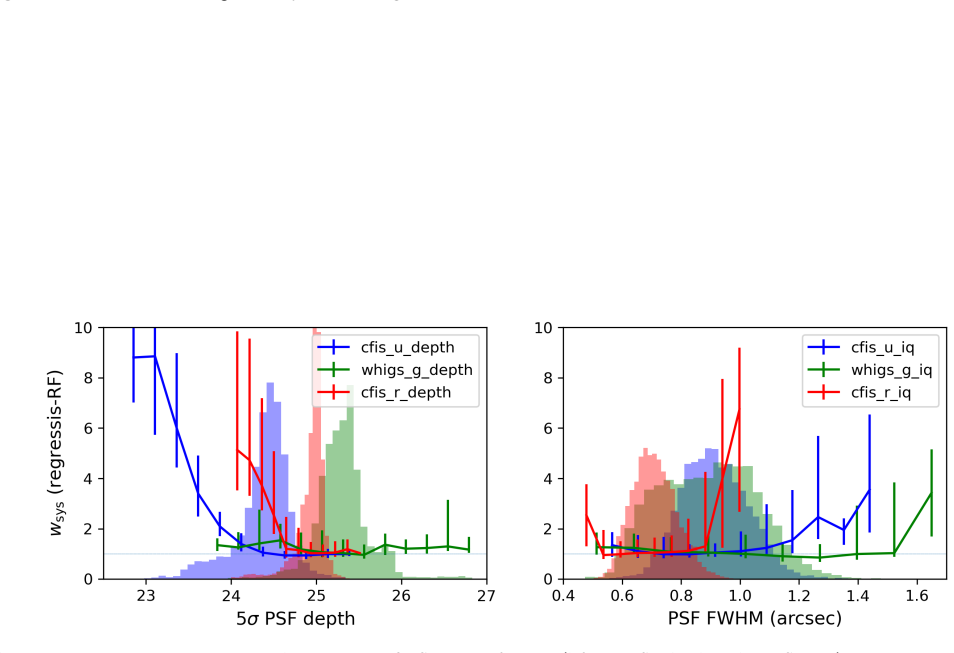
For u-dropout LBGs drawn from the UNIONS GAaP ugri catalog (roughly 1,400 galaxies per square degree, effective area 2,400-2,800 square degrees), variations in PSF depth, seeing, Galactic extinction, and stellar density imprint large-scale fluctuations in the observed density that cannot be removed by linear or Random-Forest regression-based deprojection; the auto-spectrum remains orders of magnitude above the fiducial clustering model at ell < 300. The cross-power spectrum with Planck PR4 CMB lensing, however, is recovered robustly in mock contamination-decontamination tests, and in the real data shows a positive signal consistent with the fiducial model across ell ~ 30-300, with the caveat
What carries the argument
The pseudo-angular power spectrum (pseudo-C_ell) estimator with mode-coupling decoupling, plus template-based deprojection of imaging systematics: linear regression deprojection and Random-Forest systematic weights derived from imaging templates. The load-bearing mechanism is that cross-spectra between the LBG density field and external tracers are insensitive to systematics that are uncorrelated between the two maps; mock tests contaminated the LBG map only, confirming that cross-spectra survive strong linear and non-linear contamination while auto-spectra do not.
Load-bearing premise
The claim that residual systematics add variance but not bias rests on the untested premise that those systematics are statistically independent of the external tracer fields (CMB lensing and quasar maps).
What would settle it
Contaminate mock LBG maps with the same systematic weight pattern applied to the external CMB lensing or quasar maps (correlated contamination), then measure the recovered cross-spectrum amplitude; if it shifts by more than the Jackknife error bars, the 'no significant bias' claim fails. Alternatively, split the LBG sample by imaging depth and check whether the cross-spectrum amplitude varies across splits.
If this is right
- LBG samples from wide photometric surveys at z~2.5 can deliver cosmological constraints through cross-correlations with CMB lensing and quasar samples, even when their auto-spectra are unusable.
- Residual imaging systematics in faint, near-depth-limited samples must be budgeted as excess variance (via Jackknife) rather than assumed Gaussian, which strongly degrades constraints on local primordial non-Gaussianity.
- The scale-dependent bias signature of local primordial non-Gaussianity is best pursued through cross-correlation rather than auto-clustering for these samples.
- Mock contamination-decontamination validation with data-derived weights is a practicable way to test systematics robustness before cosmological interpretation.
- Detection of the LBG-CMB lensing cross-power over roughly 6.6% of the sky is a first step toward competitive high-redshift PNG constraints for upcoming surveys.
Where Pith is reading between the lines
- The robustness argument assumes systematics in the LBG map are statistically independent of the external tracer maps; a natural extension is to inject correlated contamination into both maps in mocks to see at what amplitude bias appears.
- The excess Jackknife variance at large scales implies that survey-systematics mitigation should target the covariance, not just the mean; estimators that model or downweight contaminated modes may recover fNL sensitivity.
- The technique transfers directly to LSST-scale surveys; UNIONS acts as a pathfinder for u-dropout LBG samples at scale.
- Cross-correlation with spectroscopic quasar samples can serve as an independent systematic audit for CMB-lensing cross-spectra, since the two external tracers have separate selection functions.
Editorial analysis
A structured set of objections, weighed in public.
Referee Report
Summary. Using the UNIONS GAaP ugri catalogue, the authors build a u-dropout LBG sample (~1,400 deg^-2) and measure angular auto- and cross-power spectra. They show that the LBG auto-spectrum remains contaminated by PSF-depth, seeing, extinction, and stellar-density systematics after NaMaster deprojection and regressis corrections, and therefore focus on cross-correlations with Planck PR4 lensing, DESI DR1 QSOs, and Quaia. Controlled mocks with linear and non-linear contamination are used to argue that the cross-spectrum is recovered even when linear auto-spectrum mitigation fails. In the data, the LBG-lensing and LBG-QSO cross-spectra are positive and broadly match a fiducial model, while the jackknife covariance exceeds the Gaussian-only variance by factors of ~3-15. A simplified f_NL analysis shows that this excess variance substantially weakens constraints. The paper concludes that UNIONS LBGs are reliable tracers for cross-correlation cosmology at z~2.5.
Significance. If the conclusion holds, the paper is a valuable proof of concept for using faint, depth-limited photometric samples in cross-correlation cosmology: the failure of the auto-spectrum is honestly demonstrated, and the cross-spectrum route is subjected to a non-linear contamination stress test. Strengths include the controlled mock pipeline (Section 4.3), the alpha=3 test where only Random-Forest mitigation recovers the input auto-spectrum, and the explicit jackknife-versus-Gaussian covariance comparison. The first large-area LBG-lensing cross-correlation measurement at this redshift is interesting in its own right. However, two load-bearing assumptions are not independently established: the decorrelation between residual LBG systematics and external tracer fields, and the amplitude normalization of the theoretical prediction. These issues affect the strength of the abstract's 'no significant bias' claim, so the paper needs revision rather than acceptance in its current form.
major comments (4)
- [Sec. 4.3, Step 3; Figs. 11-13] The mock validation contaminates only the LBG map: 'no contamination is applied to the external map.' This demonstrates robustness against systematics that are uncorrelated with the external tracer, but the central claim that residual systematics 'manifest as excess variance... without introducing a significant bias' requires the stronger assumption that any remaining systematics are also uncorrelated with the external fields. Section 4.1 shows that the LBG density depends on E(B-V) and Gaia stellar density; the same Galactic fields can modulate Quaia selection and leave residuals in DESI QSO corrections and in Planck lensing maps. If a common template component is present, the cross-spectrum acquires a term <delta_sys delta_ext> != 0 and is biased, not merely noisier. A mock test with correlated contamination injected into both maps, or a null test against the shared E(B-V)/stellar-dens
- [Sec. 5.1] The statement that the LBG-lensing cross-spectrum amplitude is 'consistent with theoretical predictions' is partly built in by construction. The theory curve is normalized by b0=0.65, chosen because it 'was found to provide a good description of the LBG bias inferred from clustering measurements for the same LBG selection' in Payerne et al. (2025a) - the same team and the same selection. The f_NL+b0 fit in Table 1 then returns b0 ~ 0.6-0.8. Thus the data-theory agreement is not an independent validation of the bias model or of the cross-spectrum amplitude calibration. Please separate the predicted amplitude (with b0 fixed from external clustering constraints) from the fitted amplitude, or explicitly frame the consistency check as shape-only, not amplitude-calibration.
- [Sec. 5.2, Table 1] The abstract's 'without introducing a significant bias' is in tension with Table 1. With Gaussian-only covariance, the inferred f_NL changes from +158 +/- 56 (no correction) to -166 +/- 49 (NaMaster), which is a several-sigma shift; the values become mutually consistent only after adopting the jackknife covariance, whose diagonal is inflated by a factor of 6-7. Thus the conclusion that residual systematics produce only excess variance depends critically on which covariance estimator is adopted. The paper should quantify the per-bin effect of the correction on the cross-spectrum itself (e.g., Delta C / sigma_JK for the ell < 100 bins) and explicitly discuss whether the suppression seen in Fig. 6 at low ell is consistent with zero within the final error bars.
- [Eq. (1)] As typeset, Eq. (1) defines the pseudo-spectrum as (2l+1)^-1 sum |a_X^* a_Y|^2. For X != Y this is not a cross-power spectrum; it reduces to a product of auto-spectra. The standard estimator is (2l+1)^-1 sum Re(a_X^* a_Y). If this is only a typographical error, it should be corrected because Eq. (6) and all subsequent uses rely on the usual cross-spectrum definition. If the code actually implements Eq. (1) as written, the cross-spectrum measurements are not what the paper claims them to be. Please fix this and confirm that the analysis pipeline uses the standard estimator.
minor comments (5)
- [Sec. 3.1] The survey area is quoted as 3,580 deg^2 initially, then 2,800 deg^2 effective after masking, then 2,400 deg^2 after systematics-based cleaning. Please make explicit which area is used for the number density, the masks, and the power-spectrum normalization.
- [Fig. 4 caption] Typo: 'mutliply' should be 'multiply'. Also, the caption says the fiducial model is multiplied by 5 to fit in the frame; this should be stated clearly in the main text so the reader does not misread the amplitude ratio.
- [Sec. 5.1] The text refers to 'the fifth l-bin' showing a significant deviation, but the bin edges are not specified. Please identify the l range explicitly and state whether this bin is included or excluded in the f_NL fit.
- [Appendix C, Fig. 13] The main text says the original C^gg is 10 times larger and C^kappag is 'resp. 5 times' larger, while the figure caption only states C^gg. Align the text and caption for reproducibility.
- [Sec. 2 / Eq. (6)] The noise term N^XY_b is introduced as delta_XY^K N^X_b. For clarity, state explicitly that this means the shot-noise/reconstruction-noise term appears only in auto-spectra and is zero for cross-spectra between different fields.
Circularity Check
No significant circularity: cross-spectrum claims are calibrated against independent observables and the mock tests are self-consistency checks, not input=output reductions.
full rationale
The paper's central claims are data measurements with explicit estimator validation, not derivations from self-defined inputs. The angular power spectrum formalism (Eqs. 1-7) is standard projection theory; the mock pipeline in Sec. 4.3 generates an input C^gg, contaminates it, and tests recovery with NaMaster/regressis. That is a self-consistency test of the estimator, not a circular derivation of the cosmological signal. The known limitation is stated in Sec. 4.3 Step 3: 'no contamination is applied to the external map', so the mocks only validate robustness against LBG-only systematics. This is an untested-correlation caveat (a correctness risk), not a circular step. The theory curves in Sec. 5.1 use b0=0.65 from Payerne et al. (2025a), the same team's clustering analysis of the same LBG selection. However, this is a calibration from a different statistic, explicitly framed as 'a consistency check', and the paper also reports a fitted b0 from the cross-spectrum (Table 1: b0 ~ 0.6-0.8) and compares the amplitude to DESI QSO-CMB lensing, which is an external benchmark. The amplitude agreement is therefore a cross-check between related but distinct observables, not an identity forced by construction. The fNL results are explicitly presented as a proof of concept, and the large Jackknife-vs-Gaussian covariance ratio is reported rather than hidden, so no fitted parameter is renamed as a prediction. No equation is shown to reduce to its own input, and no load-bearing result depends on an unverified self-citation chain.
Axiom & Free-Parameter Ledger
free parameters (5)
- b0 (bias rescaling factor) =
0.65
- b0 (in f_NL fit) =
0.6-0.8 +/- 0.1-0.2
- Mock contamination amplitudes A_t =
Gaussian random variables matched to data-template correlations
- First-ell-bin transfer function =
0.8
- LBG selection and footprint cleaning thresholds =
23.5<r<24.2; 23<u10sigma<24.5; 0.5<PSFsize<1.2; etc.
axioms (7)
- standard math Flat LCDM and linear perturbation theory with a standard matter power spectrum at ell<300 (k<~0.05-0.075 h/Mpc)
- domain assumption LBG bias is linear, approximately scale-independent in the absence of PNG, and its amplitude follows Wilson & White (2019) times b0
- domain assumption Residual imaging systematics of the LBG field are statistically independent of the Planck lensing and QSO fields
- domain assumption The LePhare photo-z n(z) measured in the 2 sq-deg XMM-LSS overlap is representative of the full 2,800 sq-deg sample
- domain assumption Magnification bias and RSD contributions follow Payerne et al. (2025a) with no propagated uncertainty
- domain assumption Universality relation p_Phi=1 in the PNG scale-dependent bias
- domain assumption Jackknife covariance over N_JK=110 patches captures the true estimator variance including systematics
read the original abstract
Lyman-break galaxies (LBGs), selected via the strong spectral break blueward of the Lyman limit, are powerful tracers of large-scale structure at redshifts $z>2$. In this work, we assess the feasibility of using LBGs selected from the Ultraviolet Near Infrared Optical Northern Survey (UNIONS) multi-band photometric catalog as cosmological probes of the high-redshift Universe using two-point statistics. We demonstrate that spatially varying imaging systematics, driven by variations in PSF depth, seeing across the UNIONS footprint, limit robust measurements of the LBG auto-angular power spectrum on large scales, even after correcting the LBG field with linear or non-linear mitigation techniques. This study shows that clustering analyses of faint galaxy samples close to survey depth are challenging. We therefore turn to cross-correlation measurements with external tracers, in particular the \textit{Planck} CMB lensing convergence and quasars from DESI DR1 and \textit{Quaia}, which are less sensitive to the angular imaging systematics. Using both data and mock catalogues, we demonstrate that the LBG--CMB lensing cross-power spectrum can be measured more robustly than the auto-spectrum, with an amplitude consistent with theoretical predictions. Residual systematics primarily manifest as excess variance at large angular scales, without introducing a significant bias in the recovered signal. Taken together, these results establish UNIONS-selected LBGs as reliable tracers for cross-correlation cosmology at $z\sim 2.5$, and highlight cross-correlation techniques as a powerful and robust avenue for extracting cosmological information from photometric high-redshift galaxy samples in the presence of complex imaging systematics.
Figures




Reference graph
Works this paper leans on
-
[1]
Tukey, J. W. , year =. Unknown title , journal =
-
[2]
B-mode validation for cosmic shear
UNIONS-3500 Weak Lensing: II. B-mode validation for cosmic shear. arXiv e-prints , keywords =. doi:10.48550/arXiv.2604.03227 , archivePrefix =. 2604.03227 , primaryClass =
-
[3]
2D Cosmological Constraints in Configuration Space
UNIONS-3500 Weak Lensing: III. 2D Cosmological Constraints in Configuration Space. arXiv e-prints , keywords =. doi:10.48550/arXiv.2605.13547 , archivePrefix =. 2605.13547 , primaryClass =
-
[4]
2D cosmological constraints in harmonic space
UNIONS-3500 Weak Lensing: IV. 2D cosmological constraints in harmonic space. arXiv e-prints , keywords =. doi:10.48550/arXiv.2605.13543 , archivePrefix =. 2605.13543 , primaryClass =
-
[5]
A Galaxy Shape Catalogue in the Northern Sky
UNIONS-3500 Weak Lensing: I. A Galaxy Shape Catalogue in the Northern Sky. arXiv e-prints , keywords =. doi:10.48550/arXiv.2605.13549 , archivePrefix =. 2605.13549 , primaryClass =
-
[6]
Mitigating systematic errors in angular correlation function measurements from wide field surveys. , keywords =. doi:10.1093/mnras/stv2103 , archivePrefix =. 1509.04290 , primaryClass =
-
[8]
Recovering redshift distributions with cross-correlations: pushing the boundaries. , keywords =. doi:10.1093/mnras/stt410 , archivePrefix =. 1303.0292 , primaryClass =
-
[9]
Astrophysics Source Code Library, record ascl:1508.007 , year = 2015, month = aug, eid =
TreeCorr: Two-point correlation functions. Astrophysics Source Code Library, record ascl:1508.007 , year = 2015, month = aug, eid =
2015
-
[10]
ASCL , year = 2011, month = aug, eid =
BPZ: Bayesian Photometric Redshift Code , keywords =. ASCL , year = 2011, month = aug, eid =
2011
-
[12]
Constraints on primordial non-Gaussianity from Quaia. , keywords =. doi:10.1088/1475-7516/2026/02/056 , archivePrefix =. 2504.20992 , primaryClass =
Pith/arXiv arXiv 2026
-
[13]
The CFHT large area U-band deep survey (CLAUDS). , keywords =. doi:10.1093/mnras/stz2522 , archivePrefix =. 1909.05898 , primaryClass =
Pith/arXiv arXiv 1909
-
[14]
Dark Energy Survey Year 3 results: magnification modelling and impact on cosmological constraints from galaxy clustering and galaxy-galaxy lensing. , keywords =. doi:10.1093/mnras/stad1594 , archivePrefix =. 2209.09782 , primaryClass =
-
[15]
Euclid preparation. XIX. Impact of magnification on photometric galaxy clustering. , keywords =. doi:10.1051/0004-6361/202142419 , archivePrefix =. 2110.05435 , primaryClass =
-
[16]
Full calibration of the tomographic redshift distribution from the HSC PDR3 Shape Catalog with DESI. arXiv e-prints , keywords =. doi:10.48550/arXiv.2511.18133 , archivePrefix =. 2511.18133 , primaryClass =
-
[17]
Dark Energy Survey Year 6 Results: Clustering-redshifts and importance sampling of Self-Organised-Maps n(z) realizations for 3 2 pt samples. arXiv e-prints , keywords =. doi:10.48550/arXiv.2510.23565 , archivePrefix =. 2510.23565 , primaryClass =
-
[18]
Sampling Bayesian probabilities given only sampled priors. arXiv e-prints , keywords =. doi:10.48550/arXiv.2506.00758 , archivePrefix =. 2506.00758 , primaryClass =
-
[19]
Clustering-based redshift estimation: method and application to data. arXiv e-prints , keywords =. doi:10.48550/arXiv.1303.4722 , archivePrefix =. 1303.4722 , primaryClass =
-
[20]
Euclid: Photometric redshift calibration performance with the clustering-redshifts technique in the Flagship 2 simulation. , keywords =. doi:10.1051/0004-6361/202555551 , archivePrefix =. 2505.10416 , primaryClass =
-
[21]
KiDS-Legacy: Redshift distributions and their calibration. arXiv e-prints , keywords =. doi:10.48550/arXiv.2503.19440 , archivePrefix =. 2503.19440 , primaryClass =
-
[22]
GetDist: a Python package for analysing Monte Carlo samples. arXiv e-prints , keywords =. doi:10.48550/arXiv.1910.13970 , archivePrefix =. 1910.13970 , primaryClass =
-
[23]
Computing in Science and Engineering , keywords =
Matplotlib: A 2D Graphics Environment. Computing in Science and Engineering , keywords =. doi:10.1109/MCSE.2007.55 , adsurl =
-
[24]
Dark Energy Survey Year 6 Results: Redshift Calibration of the MagLim++ Lens Sample. arXiv e-prints , keywords =. doi:10.48550/arXiv.2509.07964 , archivePrefix =. 2509.07964 , primaryClass =
-
[25]
Dark Energy Survey Year 3 results: redshift calibration of the weak lensing source galaxies. , keywords =. doi:10.1093/mnras/stab1515 , archivePrefix =. 2012.08566 , primaryClass =
Pith/arXiv arXiv 2012
-
[26]
Dark Energy Survey Year 3 Results: clustering redshifts - calibration of the weak lensing source redshift distributions with redMaGiC and BOSS/eBOSS. , keywords =. doi:10.1093/mnras/stab3311 , archivePrefix =. 2012.08569 , primaryClass =
arXiv 2012
-
[27]
MASTER of the Cosmic Microwave Background Anisotropy Power Spectrum: A Fast Method for Statistical Analysis of Large and Complex Cosmic Microwave Background Data Sets. , keywords =. doi:10.1086/338126 , archivePrefix =. astro-ph/0105302 , primaryClass =
-
[28]
A unified pseudo-C _ framework. , keywords =. doi:10.1093/mnras/stz093 , archivePrefix =. 1809.09603 , primaryClass =
-
[29]
Classical and Quantum Gravity , keywords =
Primordial non-Gaussianity from the large-scale structure. Classical and Quantum Gravity , keywords =. doi:10.1088/0264-9381/27/12/124011 , archivePrefix =. 1003.5020 , primaryClass =
-
[30]
QuasarNET: Human-level spectral classification and redshifting with Deep Neural Networks. arXiv e-prints , keywords =. doi:10.48550/arXiv.1808.09955 , archivePrefix =. 1808.09955 , primaryClass =
-
[31]
The Spectroscopic Data Processing Pipeline for the Dark Energy Spectroscopic Instrument. , keywords =. doi:10.3847/1538-3881/acb212 , archivePrefix =. 2209.14482 , primaryClass =
-
[32]
Primordial non-Gaussianities with weak lensing: information on non-linear scales in the ULAGAM full-sky simulations. , keywords =. doi:10.1088/1475-7516/2024/03/062 , archivePrefix =. 2310.02349 , primaryClass =
Pith/arXiv arXiv 2024
-
[33]
Scale-dependent local primordial non-Gaussianity as a solution to the S8 tension. , keywords =. doi:10.1103/PhysRevD.110.063501 , archivePrefix =. 2404.03244 , primaryClass =
-
[34]
Calibrating Redshift Distributions beyond Spectroscopic Limits with Cross-Correlations. , keywords =. doi:10.1086/589982 , archivePrefix =. 0805.1409 , primaryClass =
-
[35]
Constraining primordial non-Gaussianity from DESI quasar targets and Planck CMB lensing. , keywords =. doi:10.1088/1475-7516/2024/03/021 , archivePrefix =. 2305.07650 , primaryClass =
Pith/arXiv arXiv 2024
-
[36]
Can we actually constrain f _ NL using the scale-dependent bias effect? An illustration of the impact of galaxy bias uncertainties using the BOSS DR12 galaxy power spectrum. , keywords =. doi:10.1088/1475-7516/2022/11/013 , archivePrefix =. 2205.05673 , primaryClass =
Pith/arXiv arXiv 2022
-
[37]
Primordial non-Gaussianity and the statistics of weak lensing and other projected density fields. , keywords =. doi:10.1103/PhysRevD.83.123005 , archivePrefix =. 1104.0926 , primaryClass =
-
[38]
KiDS-1000 catalogue: Redshift distributions and their calibration. , keywords =. doi:10.1051/0004-6361/202039018 , archivePrefix =. 2007.15635 , primaryClass =
Pith/arXiv arXiv 2007
-
[39]
Estimating the redshift distribution of photometric galaxy samples. , keywords =. doi:10.1111/j.1365-2966.2008.13510.x , archivePrefix =. 0801.3822 , primaryClass =
arXiv 2008
-
[40]
CFHTLenS and RCSLenS: testing photometric redshift distributions using angular cross-correlations with spectroscopic galaxy surveys. , keywords =. doi:10.1093/mnras/stw2241 , archivePrefix =. 1512.03626 , primaryClass =
-
[41]
Constraining primordial non-Gaussianity from DESI DR1 quasars and Planck PR4 CMB Lensing. arXiv e-prints , keywords =. doi:10.48550/arXiv.2512.17865 , archivePrefix =. 2512.17865 , primaryClass =
-
[42]
Impact of redshift distribution uncertainties on Lyman-break galaxy cosmological parameter inference. , keywords =. doi:10.1093/mnras/staf2115 , archivePrefix =. 2506.06475 , primaryClass =
-
[43]
Cosmic microwave background lensing reconstruction on the full sky. , keywords =. doi:10.1103/PhysRevD.67.083002 , archivePrefix =. astro-ph/0301031 , primaryClass =
-
[44]
Weak gravitational lensing of the CMB. , keywords =. doi:10.1016/j.physrep.2006.03.002 , archivePrefix =. astro-ph/0601594 , primaryClass =
Pith/arXiv arXiv 2006
-
[45]
, year = 1953, month = jan, volume =
The Analysis of Counts of the Extragalactic Nebulae in Terms of a Fluctuating Density Field. , year = 1953, month = jan, volume =. doi:10.1086/145672 , adsurl =
doi:10.1086/145672 1953
-
[46]
Abazajian, Kevork and Abdulghafour, Arwa and Addison, Graeme E and Adshead, Peter and Ahmed, Zeeshan and Ajello, Marco and Akerib, Daniel and Allen, Steven W and Alonso, David and Alvarez, Marcelo and Amin, Mustafa A and Amiri, Mandana and Anderson, Adam and Ansarinejad, Behzad and Archipley, Melanie and Arnold, Kam S and Ashby, Matt and Aung, Han and Bac...
-
[47]
Cosmic microwave background temperature and polarization pseudo-C _ l estimators and covariances. , keywords =. doi:10.1111/j.1365-2966.2005.09111.x , archivePrefix =. astro-ph/0410394 , primaryClass =
arXiv 2005
-
[48]
Alexander, David M. and Davis, Tamara M. and Chaussidon, E. and Fawcett, V. A. and Gonzalez-Morales, Alma X. and Lan, Ting-Wen and Y. The Astronomical Journal , keywords =. doi:10.3847/1538-3881/ACACFC , eprint =
-
[49]
arXiv e-prints , month =
Alonso, David , eprint =. arXiv e-prints , month =
-
[50]
Alves, Otavio , journal =
-
[51]
Andrade, U. and Mena-Fern. arXiv e-prints , month =. arXiv , arxivId =:2404.07282 , file =
-
[52]
Angulo, Raul E. and Hahn, Oliver , doi =. Living Reviews in Computational Astrophysics , keywords =. arXiv , arxivId =:2112.05165 , file =
-
[53]
Angulo, Raul E. and Pontzen, Andrew , doi =. Monthly Notices of the Royal Astronomical Society: Letters , keywords =. arXiv , arxivId =:1603.05253 , file =
-
[54]
Antoja, T. and Ramos, P. and Mateu, C. and Helmi, A. and Anders, F. and Jordi, C. and Carballo-Bello, J. A. , doi =. Astronomy and Astrophysics , keywords =. arXiv , arxivId =:2001.10012 , file =
Pith/arXiv arXiv 2001
-
[55]
Monthly Notices of the Royal Astronomical Society , month =
Bahr-Kalus, Benedict and Parkinson, David and Mueller, Eva-Maria , doi =. Monthly Notices of the Royal Astronomical Society , month =
-
[56]
Bailey, Stephen J , journal =
-
[57]
GaaP: PSF- and aperture-matched photometry using shapelets. , keywords =. doi:10.1051/0004-6361:20066601 , archivePrefix =. astro-ph/0610606 , primaryClass =
-
[58]
The fourth data release of the Kilo-Degree Survey: ugri imaging and nine-band optical-IR photometry over 1000 square degrees. , keywords =. doi:10.1051/0004-6361/201834918 , archivePrefix =. 1902.11265 , primaryClass =
Pith/arXiv arXiv 1902
-
[59]
The Lyman- forest from LBGs: First 3D correlation measurement with DESI and prospects for cosmology. , keywords =. doi:10.1088/1475-7516/2025/12/053 , archivePrefix =. 2507.21852 , primaryClass =
arXiv 2025
-
[60]
The effective field theory of large-scale structure and multi-tracer. , keywords =. doi:10.1088/1475-7516/2022/04/021 , archivePrefix =. 2108.11363 , primaryClass =
Pith/arXiv arXiv 2022
-
[61]
Astropy: A community Python package for astronomy. , keywords =. doi:10.1051/0004-6361/201322068 , archivePrefix =. 1307.6212 , primaryClass =
-
[62]
IOS Press , year = 2016, pages =
Jupyter Notebooks a publishing format for reproducible computational workflows. IOS Press , year = 2016, pages =
2016
-
[63]
Computing in Science and Engineering , keywords =
The NumPy Array: A Structure for Efficient Numerical Computation. Computing in Science and Engineering , keywords =. doi:10.1109/MCSE.2011.37 , archivePrefix =. 1102.1523 , primaryClass =
Pith/arXiv arXiv 2011
-
[64]
and Haberland, Matt and Reddy, Tyler and Cournapeau, David and Burovski, Evgeni and Peterson, Pearu and Weckesser, Warren and Bright, Jonathan and
Virtanen, Pauli and Gommers, Ralf and Oliphant, Travis E. and Haberland, Matt and Reddy, Tyler and Cournapeau, David and Burovski, Evgeni and Peterson, Pearu and Weckesser, Warren and Bright, Jonathan and. Nature Methods , year =
-
[65]
HEALPix: A Framework for High-Resolution Discretization and Fast Analysis of Data Distributed on the Sphere. , keywords =. doi:10.1086/427976 , archivePrefix =. astro-ph/0409513 , primaryClass =
-
[66]
emcee: The MCMC Hammer. , keywords =. doi:10.1086/670067 , archivePrefix =. 1202.3665 , primaryClass =
-
[67]
GetDist: a Python package for analysing Monte Carlo samples. , keywords =. doi:10.1088/1475-7516/2025/08/025 , archivePrefix =. 1910.13970 , primaryClass =
Pith/arXiv arXiv 2025
-
[68]
Taking the weight off: mitigating parameter bias from catastrophic outliers in 3 2pt analysis. , keywords =. doi:10.1088/1475-7516/2025/12/037 , archivePrefix =. 2509.08052 , primaryClass =
arXiv 2025
-
[69]
CMB lensing from Planck PR4 maps. , keywords =. doi:10.1088/1475-7516/2022/09/039 , archivePrefix =. 2206.07773 , primaryClass =
Pith/arXiv arXiv 2022
-
[70]
Galaxy bias and primordial non-Gaussianity: insights from galaxy formation simulations with IllustrisTNG. , keywords =. doi:10.1088/1475-7516/2020/12/013 , archivePrefix =. 2006.09368 , primaryClass =
Pith/arXiv arXiv 2020
-
[71]
Bautista, Julian E. and Paviot, Romain and. Monthly Notices of the Royal Astronomical Society , keywords =. doi:10.1093/mnras/staa2800 , eprint =
-
[72]
doi:10.1051/0004-6361/201629178 , eprint =
Astronomy and Astrophysics , keywords =. doi:10.1051/0004-6361/201629178 , eprint =
-
[73]
arXiv , arxivId =:2412.10279 , journal =
Bermejo-Climent, Jos. arXiv , arxivId =:2412.10279 , journal =
-
[74]
Journal of Cosmology and Astroparticle Physics , keywords =
Beutler, Florian and Castorina, Emanuele and Zhang, Pierre , doi =. Journal of Cosmology and Astroparticle Physics , keywords =. arXiv , arxivId =:1810.05051 , file =
-
[75]
Journal of Cosmology and Astroparticle Physics , keywords =
Beutler, Florian and. Journal of Cosmology and Astroparticle Physics , keywords =. doi:10.1088/1475-7516/2020/07/048 , eprint =
-
[76]
Journal of Cosmology and Astroparticle Physics , number =
Beutler, Florian and McDonald, Patrick , doi =. Journal of Cosmology and Astroparticle Physics , number =. arXiv , arxivId =:2106.06324 , file =
-
[77]
Beutler, Florian and Saito, Shun and Seo, Hee Jong and Brinkmann, Jon and Dawson, Kyle S. and Eisenstein, Daniel J. and Font-Ribera, Andreu and Ho, Shirley and McBride, Cameron K. and Montesano, Francesco and Percival, Will J. and Ross, Ashley J. and Ross, Nicholas P. and Samushia, Lado and Schlegel, David J. and S. Monthly Notices of the Royal Astronomic...
-
[78]
Monthly Notices of the Royal Astronomical Society , keywords =
Beutler, Florian and Seo, Hee Jong and Saito, Shun and Chuang, Chia Hsun and Cuesta, Antonio J and Eisenstein, Daniel J and Gil-Mar. Monthly Notices of the Royal Astronomical Society , keywords =. doi:10.1093/mnras/stw3298 , eprint =
-
[79]
Monthly Notices of the Royal Astronomical Society , keywords =
Biagetti, Matteo and Lazeyras, Titouan and Baldauf, Tobias and Desjacques, Vincent and Schmidt, Fabian , doi =. Monthly Notices of the Royal Astronomical Society , keywords =. arXiv , arxivId =:1611.04901 , file =
-
[80]
Bianchi, David and Hanif, M. M. S and Rosell, A. Carnero and Lasker, J. and Ross, A. J. and Pinon, M. and de Mattia, A. and White, M. and Ahlen, S. and Bailey, S. and Brooks, D. and Burtin, E. and Chaussidon, E. and Claybaugh, T. and Cole, S. and de la Macorra, A. and Ferraro, S. and Font-Ribera, A. and Forero-Romero, J. E. and Gazta. arXiv , arxivId =:24...
-
[81]
Journal of Cosmology and Astroparticle Physics , keywords =
Blas, Diego and Lesgourgues, Julien and Tram, Thomas , doi =. Journal of Cosmology and Astroparticle Physics , keywords =. arXiv , arxivId =:1104.2933 , file =
-
[82]
Advances in Neural Information Processing Systems , eprint =
Blondel, Mathieu and Berthet, Quentin and Cuturi, Marco and Frostig, Roy and Hoyer, Stephan and Llinares-L. Advances in Neural Information Processing Systems , eprint =
discussion (0)
Sign in with ORCID, Apple, or X to comment. Anyone can read and Pith papers without signing in.