Generalized parameter-space metrics for continuous gravitational-wave searches
Pith reviewed 2026-05-22 22:27 UTC · model grok-4.3
The pith
Generalized parameter-space metrics for the F-statistic improve mismatch predictions by incorporating data gaps and varying noise floors.
A machine-rendered reading of the paper's core claim, the machinery that carries it, and where it could break.
Core claim
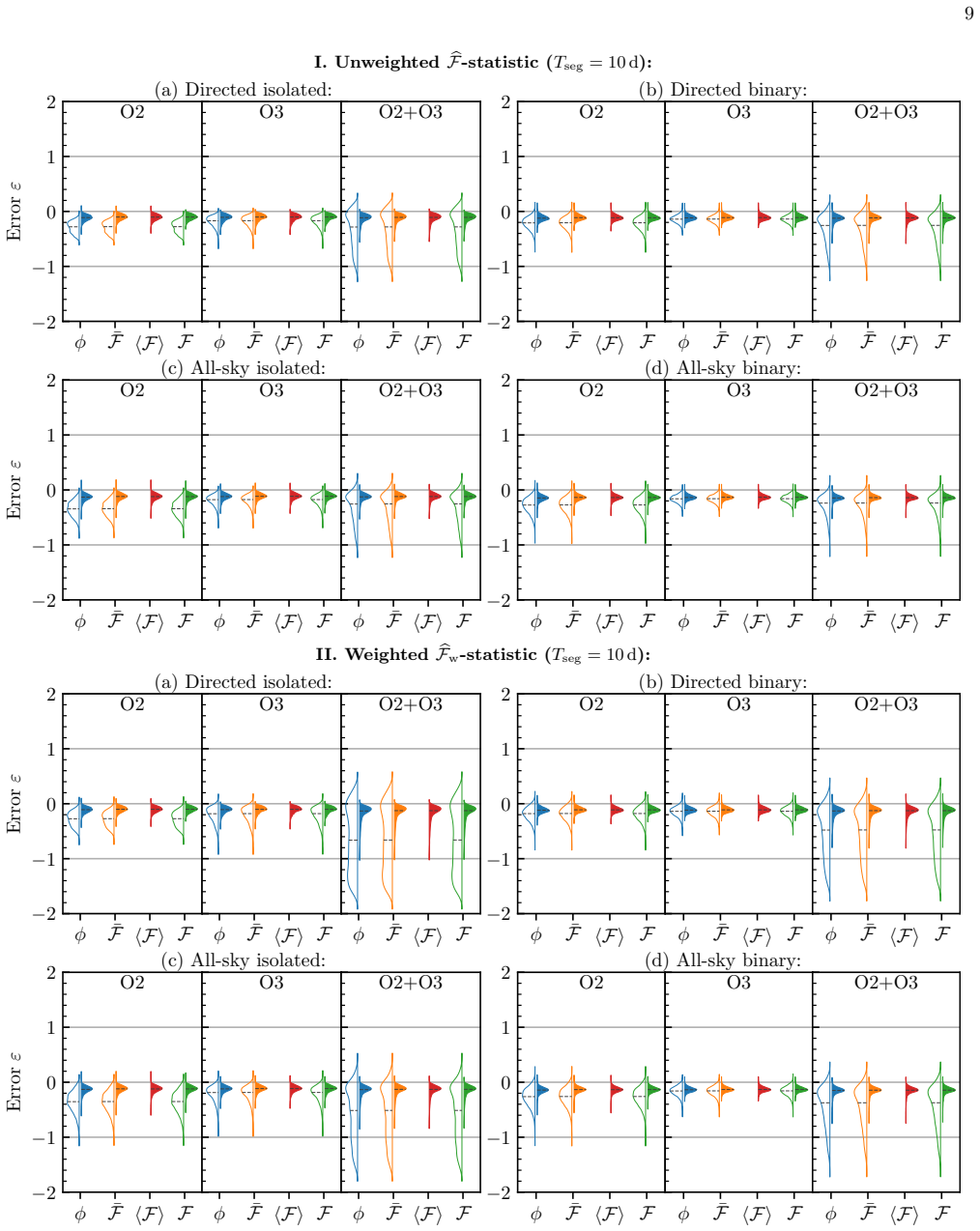
We present generalized parameter-space metrics for the F-statistic that improve upon previous idealized metrics by incorporating realistic effects such as data gaps and varying noise floors. We derive a new marginalized F-statistic metric that is more accurate than the previous averaged F-statistic metric, especially for short coherent segments. We also derive a more accurate semi-coherent metric that properly accounts for the signal-power variability over segments. Numerical tests illustrate that the new generalized metrics provide more accurate mismatch predictions than previous expressions.
What carries the argument
The generalized F-statistic parameter-space metric, extended to include data gaps and varying noise floors in the mismatch calculation.
If this is right
- More accurate mismatch predictions allow a search to use fewer templates while keeping the same coverage.
- The new marginalized metric is especially useful for analyses that employ short coherent segments.
- The revised semi-coherent metric better captures power changes between segments, reducing placement errors.
- Fewer templates for a given mismatch tolerance can lower the computational cost of future searches.
Where Pith is reading between the lines
- The same modeling approach could be applied to other detection statistics that rely on parameter-space metrics.
- Search pipelines could adopt these expressions to build more efficient template banks for real detector data.
- Direct application to archived LIGO or Virgo data sets would provide an independent check of the accuracy gains.
- The framework might extend to additional non-stationary effects such as calibration variations or transient lines.
Load-bearing premise
The effects of data gaps and varying noise floors can be modeled inside the metric derivations so that the resulting mismatch predictions remain valid for actual observational data.
What would settle it
A side-by-side numerical comparison on data containing gaps and non-stationary noise where the new metrics produce mismatch errors no smaller than those from the prior averaged or idealized expressions.
Figures




read the original abstract
Many searches for continuous gravitational waves face significant computational challenges due to the need to explore large parameter spaces characterized by unknown parameters. Parameter-space metrics are used to predict the relative loss of signal power when the searched parameters differ from the true signal parameters. In this paper we present generalized parameter-space metrics for the $\mathcal{F}$-statistic (a detection statistic used in many searches) that improve upon previous idealized metrics by incorporating realistic effects such as data gaps and varying noise floors. We derive a new marginalized $\mathcal{F}$-statistic metric that is more accurate than the previous averaged $\mathcal{F}$-statistic metric, especially for short coherent segments. We also derive a more accurate semi-coherent metric that properly accounts for the signal-power variability over segments. We provide numerical tests illustrating that the new generalized metrics provide more accurate mismatch predictions than previous expressions. More accurate metrics can result in a reduced number of templates needed for a given search, a feature that could improve the sensitivity of future searches.
Editorial analysis
A structured set of objections, weighed in public.
Referee Report
Summary. The paper derives generalized parameter-space metrics for the F-statistic in continuous gravitational-wave searches. These incorporate data gaps and varying noise floors, yielding a new marginalized F-statistic metric claimed to be more accurate than the averaged version (especially for short segments) and a semi-coherent metric that accounts for signal-power variability across segments. Numerical tests are presented to show improved mismatch predictions relative to prior idealized expressions, with the potential to reduce template counts and improve search sensitivity.
Significance. If the central derivations and numerical validations hold, the work provides a practical improvement to template placement in computationally intensive CW searches. Accurate mismatch prediction directly affects the efficiency of parameter-space coverage, which is a known bottleneck; the explicit handling of realistic data features is a clear strength over idealized metrics.
major comments (2)
- [Numerical tests section] Numerical tests section: The abstract and results claim that the generalized metrics yield more accurate mismatch predictions under realistic effects, but the test descriptions do not confirm that the simulations include data gaps or non-stationary noise floors. This is load-bearing for the improvement claim, as idealized (contiguous, stationary) simulations would not validate the new terms.
- [§3] Derivation of marginalized F-statistic metric (likely §3): The claim of improved accuracy over the averaged metric for short coherent segments requires explicit comparison of the mismatch predictions against injected signals with gaps; without that, the advantage remains unquantified in the realistic regime.
minor comments (2)
- Notation for the generalized metric components could be clarified with a summary table comparing the new expressions to the prior idealized forms.
- The abstract states 'numerical tests illustrating...' but the corresponding section should include quantitative mismatch error reductions (e.g., percentage improvement) rather than qualitative statements.
Simulated Author's Rebuttal
We thank the referee for their careful reading of the manuscript and for the constructive comments. We address each major comment below and will revise the manuscript to improve the clarity and strength of the numerical validation sections.
read point-by-point responses
-
Referee: [Numerical tests section] Numerical tests section: The abstract and results claim that the generalized metrics yield more accurate mismatch predictions under realistic effects, but the test descriptions do not confirm that the simulations include data gaps or non-stationary noise floors. This is load-bearing for the improvement claim, as idealized (contiguous, stationary) simulations would not validate the new terms.
Authors: We appreciate the referee drawing attention to the need for explicit confirmation in the test descriptions. The numerical tests were performed using simulations that incorporate data gaps and non-stationary noise floors to validate the generalized metrics against the idealized cases. To address the concern, we will revise the Numerical tests section to explicitly describe the inclusion of these realistic features in the simulation setups, thereby more clearly linking the results to the improvement claims. revision: yes
-
Referee: [§3] Derivation of marginalized F-statistic metric (likely §3): The claim of improved accuracy over the averaged metric for short coherent segments requires explicit comparison of the mismatch predictions against injected signals with gaps; without that, the advantage remains unquantified in the realistic regime.
Authors: We agree that direct comparisons using injected signals with gaps would provide stronger quantification of the advantage for short segments. While the existing tests demonstrate overall improvement, we will add explicit mismatch comparisons in the revised manuscript, using short coherent segments with injected signals that include data gaps, to directly contrast the marginalized and averaged metrics in the realistic regime. revision: yes
Circularity Check
Derivations of generalized F-statistic metrics are self-contained mathematical extensions
full rationale
The paper derives new marginalized and semi-coherent metrics by extending the standard F-statistic framework to include data gaps and varying noise floors. These are presented as first-principles derivations with numerical tests used only for validation of mismatch predictions, not as inputs to the metric expressions themselves. No self-citation chains, fitted parameters renamed as predictions, or self-definitional reductions appear in the abstract or described claims. The central results remain independent of the paper's own outputs.
Axiom & Free-Parameter Ledger
Reference graph
Works this paper leans on
-
[1]
Riles, Living Reviews in Relativity 26, 3 (2023)
K. Riles, Living Reviews in Relativity 26, 3 (2023)
work page 2023
-
[2]
P. Jaranowski, A. Kr´ olak, and B. F. Schutz, Phys. Rev. D 58, 063001 (1998)
work page 1998
- [3]
-
[4]
Wette, Astroparticle Physics 153, 102880 (2023)
K. Wette, Astroparticle Physics 153, 102880 (2023)
work page 2023
-
[5]
P. R. Brady and T. Creighton, Phys. Rev. D 61, 082001 (2000)
work page 2000
- [6]
-
[7]
H. J. Pletsch, Phys. Rev. D 82, 042002 (2010)
work page 2010
- [8]
-
[9]
LIGO Scientific Collaboration, Virgo Collaboration, and KAGRA Collaboration, 10.7935/nfnt-hm34 (2021)
-
[10]
LIGO Scientific Collaboration, Virgo Collaboration, and KAGRA Collaboration, 10.7935/pr1e-j706 (2021)
- [11]
-
[12]
B. Steltner, M. A. Papa, and H.-B. Eggenstein, Phys. Rev. D 105, 022005 (2022)
work page 2022
- [13]
- [14]
- [15]
-
[16]
M. Sieniawska and D. I. Jones, Monthly Notices of the Royal Astronomical Society 509, 5179 (2021)
work page 2021
-
[17]
J. S. Speagle, Monthly Notices of the Royal Astronomical Society 493, 3132 (2020)
work page 2020
-
[18]
P. B. Covas and R. Prix, Phys. Rev. D 106, 084035 (2022)
work page 2022
- [19]
- [20]
- [21]
-
[22]
C. Dreissigacker, R. Prix, and K. Wette, Phys. Rev. D 98, 084058 (2018)
work page 2018
- [23]
-
[24]
R. Prix, S. Giampanis, and C. Messenger, Phys. Rev. D 84, 023007 (2011). 16 FIG. 8. Histogram showing εk, defined in Eq. (D1). The 1 000 simulated signals of each histogram are isotropically distributed over the sky. For the left column, the antenna pattern matrix coefficients have been obtained with 1 800 s SFTs without gaps from the H1 and L1 detectors ...
work page 2011
-
[25]
with a segment time of (from top row to bottom) Tseg = 900 s (d), Tseg = 1.2 days (e), and Tseg = 12.1 days (f). 17
- [26]
- [27]
-
[28]
P. R. Brady, T. Creighton, C. Cutler, and B. F. Schutz, Phys. Rev. D 57, 2101 (1998)
work page 1998
-
[29]
LIGO Scientific Collaboration, Virgo Collaboration, and KAGRA Collaboration, 10.7935/GT1W-FZ16 (2018)
-
[30]
J. T. Whelan, S. Sundaresan, Y. Zhang, and P. Peiris, Phys. Rev. D 91, 102005 (2015)
work page 2015
-
[31]
J. Ming, B. Krishnan, M. A. Papa, C. Aulbert, and H. Fehrmann, Phys. Rev. D 93, 064011 (2016)
work page 2016
-
[32]
P. B. Covas and R. Prix, Phys. Rev. D 105, 124007 (2022)
work page 2022
- [33]
- [34]
-
[35]
P. B. Covas, R. Prix, and J. Martins, Phys. Rev. D 110, 024053 (2024)
work page 2024
-
[36]
LIGO Scientific Collaboration, Virgo Collaboration, and KAGRA Collaboration, 10.7935/CA75-FM95 (2019)
- [37]
-
[38]
Abbott et al., The Astrophysical Journal Supplement Series 267, 29 (2023)
R. Abbott et al., The Astrophysical Journal Supplement Series 267, 29 (2023)
work page 2023
discussion (0)
Sign in with ORCID, Apple, or X to comment. Anyone can read and Pith papers without signing in.