REVIEW 3 major objections 5 minor 1 cited by
Frozen natural spinors for Cholesky decomposition based two-component relativistic coupled cluster method
T0 review · 3 major / 5 minor · reviewed 2026-08-11 · deepseek-v4-flash
Pith's one-line read The paper claims that the FNS-CD-X2CAMF-CCSD/CCSD(T) implementation reproduces four-component relativistic coupled cluster accuracy for heavy-element molecules while cutting storage and wall time by one to two orders of magnitude.
desk verdict Genuine new implementation combining FNS with CD in X2CAMF-CC; solid benchmarks, but fix the overstated 1000-spinor claim and validate the loose-threshold uranium run before trusting the central claims. read the letter →
The pith
A machine-rendered reading of the paper's core claim, the machinery that carries it, and where it could break.
The reading
What carries the argument
Frozen natural spinors are the eigenvectors of the correlated one-body density matrix; here the virtual-virtual block is built from MP2 amplitudes, diagonalized, and truncated by occupation-number threshold, then re-canonicalized. Cholesky decomposition writes the two-electron integrals as sums of products of Cholesky vectors, so three- and four-virtual integrals are reconstructed on the fly instead of stored. The X2CAMF Hamiltonian puts spin-orbit coupling into an effective one-electron atomic mean-field operator, leaving the two-electron part nonrelativistic. Together these ingredients let the implementation transform only LOO- and LOV-type Cholesky vectors into the canonical basis, form LVV vectors directly in the FNS basis, and never construct four- or three-virtual integrals.
What would settle it
Compute the CCSD(T) atomization energy of a heavy-element hydride such as AtH with the NORMALFNS threshold and compare it to the canonical four-component CCSD(T) value; if the FNS truncation plus MP2 correction error exceeds about 1 kcal/mol, the MP2 occupation ranking is not reliable for spin-orbit-coupled virtual spinors.
Extended reading notes
Core claim
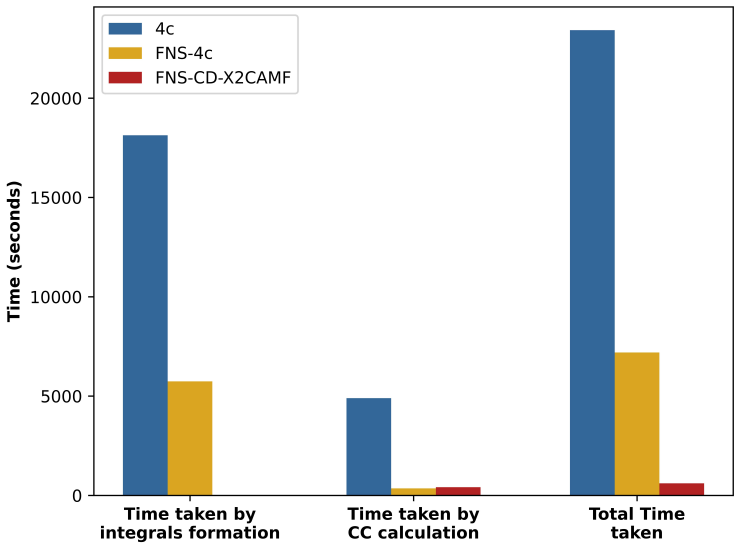
The central discovery is that MP2-derived natural spinor occupation numbers, combined with a Cholesky-decomposed two-component Hamiltonian whose spin-orbit coupling enters through an atomic mean-field potential, yield a compact virtual space whose CCSD/CCSD(T) energies differ from canonical four-component results by only a few tenths of a kcal/mol for thermochemical benchmarks and by under a milliangstrom and a few wavenumbers for the hydrogen halide series, once an MP2 correction for the truncation error is added. The cost saving is not incremental: for HI, the FNS-CD-X2CAMF-CCSD calculation is about 38 times faster than canonical four-component CCSD and 11 times faster than the four-component FNS-CCSD, with the formerly dominant VVVV and OVVV integrals no longer stored at all.
Load-bearing premise
The whole approach rests on the premise that MP2 occupation numbers rank the most important virtual spinors for CCSD and CCSD(T), and that the MP2 correction for the truncated virtual space is close to the CCSD/CCSD(T) correction; if that ranking is wrong for spin-orbit-coupled heavy elements, the reported agreement with canonical four-component results would not hold.
Editorial extensions
If this is right
- At the TIGHTFNS threshold (FNS 10^-5, CD 10^-5), errors for bond lengths and harmonic frequencies of HX (X=F, Cl, Br, I) stay within about 0.0003 Å and 3 cm^-1 of canonical four-component results, so the method can replace canonical four-component CC for spectroscopic constants.
- With the NORMALFNS threshold, mean absolute errors against canonical CD-X2CAMF-CC remain below 0.14 kcal/mol for CCSD and CCSD(T) over 18 metal-ligand dissociation enthalpies, so one threshold setting can be recommended for thermochemistry.
- The method removes the need to store four-virtual (VVVV) and three-virtual (OVVV) integrals; only OOVV and OOOV type integrals are stored, and the particle-particle ladder contraction becomes a dominant cost.
- For the uranyl nitrate complex, a CCSD calculation with 562 correlated virtual spinors and 2441 Cholesky vectors completed in about two days on one node, indicating that mid-sized heavy-element systems are accessible without a multi-node cluster.
Reading between the lines
- The paper benchmarks only ground-state energies and dissociation enthalpies; nothing here says the FNS truncation is safe for excited states, response properties, or spin-orbit-induced near-degeneracies, and those would need separate tests.
- Because the Cholesky and FNS thresholds enter independently, a two-parameter error surface could be mapped to find the cheapest threshold pairing for a target accuracy; the paper only scans three discrete settings.
- The same MP2-based FNS ranking could be reused to accelerate equation-of-motion CC or analytic gradients, but the perturbative MP2 correction would have to be revalidated for energy differences.
- If a system is substantially multi-reference, MP2 occupation numbers can mis-order spinors; a cheap diagnostic would be comparing MP2 and CCSD natural spinor occupations for a difficult heavy atom before trusting the truncation.
Editorial analysis
A structured set of objections, weighed in public.
Referee Report
Summary. The manuscript describes an implementation of frozen natural spinors (FNS) combined with Cholesky decomposition (CD) in an exact two-component atomic mean-field (X2CAMF) based coupled cluster framework, covering CCSD and CCSD(T). The virtual space is truncated using MP2-based natural spinors, a perturbative correction is applied for the truncation error, and three- and four-virtual integrals are generated on the fly from Cholesky vectors. The paper benchmarks the method with dissociation enthalpies for 18 coinage-metal cation complexes, compares bond lengths and harmonic frequencies of the hydrogen halides against canonical four-component and FNS four-component references, reports storage and timing comparisons for HI, and presents a CCSD calculation on [UO2(NO3)3]−.
Significance. If the central claim is accepted, the method offers a practical route to relativistic CCSD/CCSD(T) for medium-sized heavy-element systems with substantially reduced storage and floating-point costs. The manuscript has clear strengths: the FNS and CD thresholds are predefined convergence parameters rather than fitted values; the 18-complex dissociation enthalpy set provides statistical measures beyond a single error; the HX section compares directly with canonical four-component results; and the HI section gives concrete storage and timing comparisons. The main gaps are that the headline accuracy claim rests on only four closed-shell HX molecules, and the large-system uranium demonstration lacks a canonical or tighter-threshold reference; these issues need to be addressed before the claim can be taken at face value.
major comments (3)
- [Abstract/Introduction and §4.4] The abstract and Introduction state that the uranium demonstration involves "the correlation of over 1000 virtual spinors," but §4.4 reports that after LOOSEFNS truncation the [UO2(NO3)3]− calculation has 562 correlated virtual spinors out of 1392 canonical virtuals. This internal inconsistency should be corrected. More importantly, the uranium calculation is not benchmarked against the canonical full-virtual CD-X2CAMF result or against a tighter FNS threshold. Since Table 1 shows that LOOSEFNS already gives absolute maximum errors of 0.89 kcal/mol (CCSD) and 0.57 kcal/mol (CCSD(T)) in the small benchmark set, the large-system accuracy component of the central claim is unsupported. A tighter-threshold or full-virtual reference, or at least an explicit error estimate for the LOOSEFNS truncation in this system, is needed.
- [§4.2, Tables 2–3] The conclusion that the FNS-CD-X2CAMF approach gives "similar accuracy as that of the canonical four-component relativistic coupled cluster method" is based on only four closed-shell hydrogen halides. The agreement at the TIGHT and NORMAL thresholds is good, but this set is too narrow to establish the broad claim for heavy-element, open-shell, and actinide systems such as the uranium complex in §4.4. Either extend the four-component comparison to more representative systems or explicitly qualify the claim as demonstrated only for the HX series.
- [§2.4, Eqs. (35)–(37)] The ΔEMP2 correction for the frozen-virtual truncation error is a key assumption, but the manuscript reports only the final corrected errors. Since this assumption is what makes the FNS approach reliable, please provide the uncorrected FNS errors in Table 1 or the Supporting Information to demonstrate that the MP2 correction is actually improving the CCSD/CCSD(T) results, and state explicitly whether Table 1 includes the correction. Without this decomposition, the reader cannot assess whether the method is robust across the threshold settings.
minor comments (5)
- [§4.2 heading] The heading contains a typo: "Comparision" should be "Comparison."
- [Tables 2–3] Please clarify the caption and column labels in Tables 2 and 3: the "4c" column contains the reference value, while the remaining numeric columns are errors relative to that reference. It would also help to state that the FNS-4c error values are taken from Ref. 40.
- [§2.4, Eq. (35)] The notation ΔECCSD/CCSD(T) = ECanonical − EFNS is ambiguous; please state the sign convention and specify whether all reported errors are FNS − canonical or canonical − FNS, so that the direction of the correction is clear.
- [Table 4] In Table 4, the "—" entries for VVVV and OVVV in the FNS-CD-X2CAMF columns should be explained in the caption, because these integrals are not stored or formed in the present implementation; without that explanation the entries look like missing data.
- [§5] The concluding paragraph says the method "can be routinely used for accurate relativistic calculations of small molecules," but the preceding demonstration is for a medium-sized uranium complex; please revise to "small and medium-sized molecules" or otherwise reconcile the wording.
Circularity Check
No material circularity: the FNS/CD accuracy claims are benchmarked against canonical full-virtual references and external experimental data; self-cited 4c benchmarks and the MP2-based truncation correction are approximations and evidence, not inputs that make the claimed result true by construction.
full rationale
The central derivation is self-contained. The FNS truncation and Cholesky thresholds are pre-set convergence parameters (LOOSE/NORMAL/TIGHT), not fitted values, and the paper reports errors at all three thresholds against canonical full-virtual CD-X2CAMF results (Section 4.1, Table 1) as well as experimental dissociation enthalpies (Figure 3). The claim of accuracy comparable to canonical four-component CC is supported by comparison to canonical 4c spectroscopic constants (Section 4.2, Tables 2-3); although the canonical 4c values are taken from the authors' prior work (ref 40), those are independent computational results, not outputs of the present method, so this self-citation is not load-bearing in a circular sense. The Delta-EMP2 correction for FNS truncation error (Eqs. 35-37) is explicitly an approximation to the CCSD truncation error, tested against canonical values rather than defined to vanish; it is an assumption, not a circular reduction. The only notable defect is a reporting inconsistency: the abstract and Section 1 state the uranium demonstration involves correlation of over 1000 virtual spinors, while Section 4.4 reports 562 correlated virtuals at the LOOSEFNS threshold with no tighter-threshold or full-virtual reference for that system. That is an accuracy/verifiability concern, not a circularity: the large-system claim is unsupported, but it is not made true by definition or by fitting.
Assumptions & free parameters
free parameters (2)
- FNS occupation threshold =
LOOSE 10^-4, NORMAL 10^-4.5, TIGHT 10^-5
- Cholesky decomposition threshold =
LOOSE 10^-3, NORMAL 10^-4, TIGHT 10^-5
assumptions (6)
- domain assumption No-pair approximation: only positive-energy spinors are included in the Hamiltonian.
- domain assumption Atomic mean-field approximation for spin-dependent two-electron integrals.
- domain assumption Scalar two-electron picture-change correction is neglected.
- domain assumption MP2-based natural spinors and the MP2 perturbative correction are valid for CCSD/CCSD(T) virtual-space truncation.
- domain assumption External geometries and thermal corrections from Cavallo and coworkers are accurate enough for the BDE benchmark.
- domain assumption Three-point Peterson-Dunning extrapolation reaches the complete basis set limit.
Cite this review
Pith. "Pith review of Frozen natural spinors for Cholesky decomposition based two-component relativistic coupled cluster method." pith.science (2026). https://pith.science/paper/XH6EW7XN
@misc{pith2026241218395,
  author       = {Pith},
  title        = {Pith review of: Frozen natural spinors for Cholesky decomposition based two-component relativistic coupled cluster method},
  year         = {2026},
  howpublished = {\url{https://pith.science/paper/XH6EW7XN}},
  note         = {Machine review of arXiv:2412.18395}
}
read the original abstract
We present an efficient and cost-effective implementation for the exact two-component atomic mean field (X2CAMF) based coupled cluster (CC) method, which integrates frozen natural spinors (FNS) and the Cholesky decomposition (CD) technique. The use of CD approximation greatly reduces the storage requirement of the calculation without any significant reduction in accuracy. Compared to four-component methods, the FNS and CD-based X2CAMF-CC approach gives similar accuracy as that of the canonical four-component relativistic coupled cluster method at a fraction of the cost. The efficiency of the method is demonstrated by the calculation of a medium-sized uranium complex involving the correlation of over 1000 virtual spinors.
Figures


Figures from the paper (2 more)

Forward citations
Cited by 1 Pith paper
-
On the rank-reduced relativistic coupled cluster method
A rank-reduced relativistic CCSD method is proposed that compresses complex double-excitation amplitudes with SVD; benchmark tests indicate 1 kJ/mol accuracy with only a few percent of amplitudes retained for gold and...
Reference graph
Works this paper leans on
-
[1]
Open-shell relativistic coupled-cluster method with Dirac-Fock-Breit wave functions: Energies of the gold atom and its cation
Eliav, E.; Kaldor, U.; Ishikawa, Y. Open-shell relativistic coupled-cluster method with Dirac-Fock-Breit wave functions: Energies of the gold atom and its cation. Phys. Rev. A 1994, 49, 1724--1729
1994
-
[2]
Relativistic coupled cluster theory based on the no-pair dirac-coulomb-breit hamiltonian: Relativistic pair correlation energies of the xe atom
Eliav, E.; Kaldor, U.; Ishikawa, Y. Relativistic coupled cluster theory based on the no-pair dirac-coulomb-breit hamiltonian: Relativistic pair correlation energies of the xe atom. Int. J. Quantum Chem. 1994, 52, 205--214
1994
-
[3]
G.; Lee, T
Visscher, L.; Dyall, K. G.; Lee, T. J. Kramers-restricted closed-shell CCSD theory. Int. J. Quantum Chem. 1995, 56, 411--419
1995
-
[4]
Visscher, L.; Lee, T. J.; Dyall, K. G. Formulation and implementation of a relativistic unrestricted coupled-cluster method including noniterative connected triples . J. Chem. Phys. 1996, 105, 8769--8776
work page 1996
-
[5]
Lee, H.-S.; Han, Y.-K.; Kim, M. C.; Bae, C.; Lee, Y. S. Spin-orbit effects calculated by two-component coupled-cluster methods: test calculations on AuH, Au _2 , TlH and Tl _2 . Chem. Phys. Lett. 1998, 293, 97--102
work page 1998
-
[6]
Nataraj, H. S.; K\'allay, M.; Visscher, L. General implementation of the relativistic coupled-cluster method . J. Chem. Phys. 2010, 133, 234109
work page 2010
-
[7]
Relativistic coupled-cluster and equation-of-motion coupled-cluster methods
Liu, J.; Cheng, L. Relativistic coupled-cluster and equation-of-motion coupled-cluster methods. WIREs Comput. Mol. Sci. 2021, 11, e1536
work page 2021
-
[8]
Hess, B. A. Relativistic electronic-structure calculations employing a two-component no-pair formalism with external-field projection operators. Phys. Rev. A 1986, 33, 3742--3748
1986
Show all 83 references
-
[9]
J.; Snijders, J
van Lenthe, E.; van Leeuwen, R.; Baerends, E. J.; Snijders, J. G. Relativistic regular two-component Hamiltonians. Int. J. Quantum Chem. 1996, 57, 281--293
1996
-
[10]
Dyall, K. G. Interfacing relativistic and nonrelativistic methods. I. Normalized elimination of the small component in the modified Dirac equation . J. Chem. Phys. 1997, 106, 9618--9626
1997
-
[11]
A new relativistic theory: a relativistic scheme by eliminating small components (RESC)
Nakajima, T.; Hirao, K. A new relativistic theory: a relativistic scheme by eliminating small components (RESC). Chem. Phys. Lett. 1999, 302, 383--391
1999
-
[12]
Barysz, M.; Sadlej, A. J. Two-component methods of relativistic quantum chemistry: from the Douglas-Kroll approximation to the exact two-component formalism. J. Mol. Struct.: THEOCHEM 2001, 573, 181--200
2001
-
[13]
Exact two-component Hamiltonians revisited
Liu, W.; Peng, D. Exact two-component Hamiltonians revisited . J. Chem. Phys. 2009, 131, 031104
2009
-
[14]
Relativistic Hamiltonians for Chemistry : A Primer
Saue, T. Relativistic Hamiltonians for Chemistry : A Primer . ChemPhysChem 2011, 12, 3077--3094
2011
-
[15]
Quasirelativistic theory equivalent to fully relativistic theory
Kutzelnigg, W.; Liu, W. Quasirelativistic theory equivalent to fully relativistic theory . J. Chem. Phys. 2005, 123, 241102
2005
-
[16]
An infinite-order two-component relativistic Hamiltonian by a simple one-step transformation
Ilia s , M.; Saue, T. An infinite-order two-component relativistic Hamiltonian by a simple one-step transformation . J. Chem. Phys. 2007, 126, 064102
2007
-
[17]
G.; Faegri, K
Dyall, K. G.; Faegri, K. Introduction to Relativistic Quantum Chemistry; Oxford University Press, 2007
2007
-
[18]
Analytic evaluation of first-order properties within the mean-field variant of spin-free exact two-component theory
Kirsch, T.; Engel, F.; Gauss, J. Analytic evaluation of first-order properties within the mean-field variant of spin-free exact two-component theory . J. Chem. Phys. 2019, 150, 204115
2019
-
[19]
Development and application of the analytical energy gradient for the normalized elimination of the small component method
Zou, W.; Filatov, M.; Cremer, D. Development and application of the analytical energy gradient for the normalized elimination of the small component method . J. Chem. Phys. 2011, 134, 244117
2011
-
[20]
Calculation of response properties with the normalized elimination of the small component method
Filatov, M.; Zou, W.; Cremer, D. Calculation of response properties with the normalized elimination of the small component method. Int. J. Quantum Chem. 2014, 114, 993--1005
2014
-
[21]
Analytic energy gradients for the spin-free exact two-component theory using an exact block diagonalization for the one-electron Dirac Hamiltonian
Cheng, L.; Gauss, J. Analytic energy gradients for the spin-free exact two-component theory using an exact block diagonalization for the one-electron Dirac Hamiltonian . J. Chem. Phys. 2011, 135, 084114
2011
-
[22]
The molecular mean-field approach for correlated relativistic calculations
Sikkema, J.; Visscher, L.; Saue, T.; Ilia s , M. The molecular mean-field approach for correlated relativistic calculations . J. Chem. Phys. 2009, 131, 124116
2009
-
[23]
Communication: Relativistic Fock-space coupled cluster study of small building blocks of larger uranium complexes
Tecmer, P.; Severo Pereira Gomes, A.; Knecht, S.; Visscher, L. Communication: Relativistic Fock-space coupled cluster study of small building blocks of larger uranium complexes . J. Chem. Phys. 2014, 141, 041107
2014
-
[24]
V.; Papadopoulos, A.; Lyakh, D
Pototschnig, J. V.; Papadopoulos, A.; Lyakh, D. I.; Repisky, M.; Halbert, L.; Severo Pereira Gomes, A.; Jensen, H. J. A.; Visscher, L. Implementation of Relativistic Coupled Cluster Theory for Massively Parallel GPU-Accelerated Computing Architectures. J. Chem. Theory Comput. ...
2021
-
[25]
Inclusion of mean-field spin-orbit effects based on all-electron two-component spinors: Pilot calculations on atomic and molecular properties
Ilia s , M.; Kell\"o, V.; Visscher, L.; Schimmelpfennig, B. Inclusion of mean-field spin-orbit effects based on all-electron two-component spinors: Pilot calculations on atomic and molecular properties . J. Chem. Phys. 2001, 115, 9667--9674
2001
-
[26]
N.; Valeev, E
Zhang, T.; Banerjee, S.; Koulias, L. N.; Valeev, E. F.; DePrince, A. E. I.; Li, X. Dirac-Coulomb-Breit Molecular Mean-Field Exact-Two-Component Relativistic Equation-of-Motion Coupled-Cluster Theory. J. Phys. Chem. A 2024, 128, 3408--3418, PMID: 38651293
2024
-
[27]
A.; Marian, C
He , B. A.; Marian, C. M.; Wahlgren, U.; Gropen, O. A mean-field spin-orbit method applicable to correlated wavefunctions. Chem. Phys. Lett. 1996, 251, 365--371
1996
-
[28]
An atomic mean-field spin-orbit approach within exact two-component theory for a non-perturbative treatment of spin-orbit coupling
Liu, J.; Cheng, L. An atomic mean-field spin-orbit approach within exact two-component theory for a non-perturbative treatment of spin-orbit coupling . J. Chem. Phys. 2018, 148, 144108
2018
-
[29]
Atomic Mean-Field Approach within Exact Two-Component Theory Based on the Dirac-Coulomb-Breit Hamiltonian
Zhang, C.; Cheng, L. Atomic Mean-Field Approach within Exact Two-Component Theory Based on the Dirac-Coulomb-Breit Hamiltonian. J. Phys. Chem. A 2022, 126, 4537--4553, PMID: 35763592
2022
-
[30]
Knecht, S.; Repisky, M.; Jensen, H. J. A.; Saue, T. Exact two-component Hamiltonians for relativistic quantum chemistry: Two-electron picture-change corrections made simple . J. Chem. Phys. 2022, 157, 114106
2022
-
[31]
S.; Shiozaki, T
Kelley, M. S.; Shiozaki, T. Large-scale Dirac-Fock-Breit method using density fitting and 2-spinor basis functions . J. Chem. Phys. 2013, 138, 204113
2013
-
[32]
E.; Shiozaki, T
Bates, J. E.; Shiozaki, T. Fully relativistic complete active space self-consistent field for large molecules: Quasi-second-order minimax optimization . J. Chem. Phys. 2015, 142, 044112
2015
-
[33]
Relativistic Cholesky-decomposed density matrix MP2
Helmich-Paris, B.; Repisky, M.; Visscher, L. Relativistic Cholesky-decomposed density matrix MP2. Chem. Phys. 2019, 518, 38--46
2019
-
[34]
G.; Li, X
Banerjee, S.; Zhang, T.; Dyall, K. G.; Li, X. Relativistic resolution-of-the-identity with Cholesky integral decomposition . J. Chem. Phys. 2023, 159, 114119
2023
-
[35]
Cholesky Decomposition in Spin-Free Dirac-Coulomb Coupled-Cluster Calculations
Uhl\' r ov\'a, T.; Cianchino, D.; Nottoli, T.; Lipparini, F.; Gauss, J. Cholesky Decomposition in Spin-Free Dirac-Coulomb Coupled-Cluster Calculations. J. Phys. Chem. A 2024, 128, 8292--8303, PMID: 39268870
2024
-
[36]
Cholesky Decomposition-Based Implementation of Relativistic Two-Component Coupled-Cluster Methods for Medium-Sized Molecules
Zhang, C.; Lipparini, F.; Stopkowicz, S.; Gauss, J.; Cheng, L. Cholesky Decomposition-Based Implementation of Relativistic Two-Component Coupled-Cluster Methods for Medium-Sized Molecules. J. Chem. Theory Comput. 2024, 20, 787--798, PMID: 38198515
2024
-
[37]
S.; Mart\' nez, T
Ufimtsev, I. S.; Mart\' nez, T. J. Quantum Chemistry on Graphical Processing Units. 1. Strategies for Two-Electron Integral Evaluation. J. Chem. Theory Comput. 2008, 4, 222--231, PMID: 26620654
2008
-
[38]
DePrince, A. E. I.; Hammond, J. R. Coupled Cluster Theory on Graphics Processing Units I. The Coupled Cluster Doubles Method. J. Chem. Theory Comput. 2011, 7, 1287--1295, PMID: 26610123
2011
-
[39]
Quantum Theory of Many-Particle Systems
L\"owdin, P.-O. Quantum Theory of Many-Particle Systems. I. Physical Interpretations by Means of Density Matrices, Natural Spin-Orbitals, and Convergence Problems in the Method of Configurational Interaction. Phys. Rev. 1955, 97, 1474--1489
1955
-
[40]
K.; Dutta, A
Chamoli, S.; Surjuse, K.; Jangid, B.; Nayak, M. K.; Dutta, A. K. A reduced cost four-component relativistic coupled cluster method based on natural spinors . J. Chem. Phys. 2022, 156, 204120
2022
-
[41]
K.; Dutta, A
Surjuse, K.; Chamoli, S.; Nayak, M. K.; Dutta, A. K. A low-cost four-component relativistic equation of motion coupled cluster method based on frozen natural spinors: Theory, implementation, and benchmark . J. Chem. Phys. 2022, 157, 204106
2022
-
[42]
K.; Dutta, A
Chamoli, S.; Nayak, M. K.; Dutta, A. K. Electron Density; John Wiley & Sons, Ltd, 2024; Chapter 5, pp 83--96
2024
-
[43]
Yuan, X.; Visscher, L.; Gomes, A. S. P. Assessing MP2 frozen natural orbitals in relativistic correlated electronic structure calculations . J. Chem. Phys. 2022, 156, 224108
2022
-
[44]
Foundations of the relativistic theory of many-electron atoms
Sucher, J. Foundations of the relativistic theory of many-electron atoms. Phys. Rev. A 1980, 22, 348--362
1980
-
[45]
Dyall, K. G. An exact separation of the spin-free and spin-dependent terms of the Dirac-Coulomb-Breit Hamiltonian . J. Chem. Phys. 1994, 100, 2118--2127
1994
-
[46]
Shavitt, I.; Bartlett, R. J. Many-Body Methods in Chemistry and Physics: MBPT and Coupled-Cluster Theory; Cambridge Molecular Science; Cambridge University Press, 2009
2009
-
[47]
Beebe, N. H. F.; Linderberg, J. Simplifications in the generation and transformation of two-electron integrals in molecular calculations. Int. J. Quantum Chem. 1977, 12, 683--705
1977
-
[48]
G.; Schmidt, M
Zeng, T.; Fedorov, D. G.; Schmidt, M. W.; Klobukowski, M. Two-component natural spinors from two-step spin-orbit coupled wave functions . J. Chem. Phys. 2011, 134, 214107
2011
-
[49]
G.; Schmidt, M
Zeng, T.; Fedorov, D. G.; Schmidt, M. W.; Klobukowski, M. Effects of Spin-Orbit Coupling on Covalent Bonding and the Jahn-Teller Effect Are Revealed with the Natural Language of Spinors. J. Chem. Theory Comput. 2011, 7, 2864--2875, PMID: 26605477
2011
-
[50]
G.; Schmidt, M
Zeng, T.; Fedorov, D. G.; Schmidt, M. W.; Klobukowski, M. Natural Spinors Reveal How the Spin-Orbit Coupling Affects the Jahn-Teller Distortions in the Hexafluorotungstate(V) Anion. J. Chem. Theory Comput. 2012, 8, 3061--3071, PMID: 26605717
2012
-
[51]
Configuration-Interaction Calculation of H _3 and H _2
Edmiston, C.; Krauss, M. Configuration-Interaction Calculation of H _3 and H _2 . J. Chem. Phys. 1965, 42, 1119--1120
1965
-
[52]
Direct Calculation of Approximate Natural Orbitals and Natural Expansion Coefficients of Atomic and Molecular Electronic Wavefunctions
Ahlrichs, R.; Kutzelnigg, W. Direct Calculation of Approximate Natural Orbitals and Natural Expansion Coefficients of Atomic and Molecular Electronic Wavefunctions. II. Decoupling of the Pair Equations and Calculation of the Pair Correlation Energies for the Be and LiH Ground ...
1968
-
[53]
L.; Davidson, E
Barr, T. L.; Davidson, E. R. Nature of the Configuration-Interaction Method in Ab Initio Calculations. I. Ne Ground State. Phys. Rev. A 1970, 1, 644--658
1970
-
[54]
Jensen, H. J. A.; Jo/rgensen, P.; A gren, H.; Olsen, J. Second-order Mo/ller-Plesset perturbation theory as a configuration and orbital generator in multiconfiguration self-consistent field calculations . J. Chem. Phys. 1988, 88, 3834--3839
1988
-
[55]
G.; Bartlett, R
Taube, A. G.; Bartlett, R. J. Frozen natural orbitals: systematic basis set truncation for coupled-cluster theory. Collect. Czech. Chem. Commun. 2005, 70, 837--850
2005
-
[56]
Efficient and accurate local approximations to coupled-electron pair approaches: An attempt to revive the pair natural orbital method
Neese, F.; Wennmohs, F.; Hansen, A. Efficient and accurate local approximations to coupled-electron pair approaches: An attempt to revive the pair natural orbital method . J. Chem. Phys. 2009, 130, 114108
2009
-
[57]
Neese, F.; Hansen, A.; Liakos, D. G. Efficient and accurate approximations to the local coupled cluster singles doubles method using a truncated pair natural orbital basis . J. Chem. Phys. 2009, 131, 064103
2009
-
[58]
Landau, A.; Khistyaev, K.; Dolgikh, S.; Krylov, A. I. Frozen natural orbitals for ionized states within equation-of-motion coupled-cluster formalism . J. Chem. Phys. 2010, 132, 014109
2010
-
[59]
A.; Stoll, H
Mata, R. A.; Stoll, H. An incremental correlation approach to excited state energies based on natural transition/localized orbitals . J. Chem. Phys. 2011, 134, 034122
2011
-
[60]
Kumar, A.; Crawford, T. D. Frozen Virtual Natural Orbitals for Coupled-Cluster Linear-Response Theory. J. Phys. Chem. A 2017, 121, 708--716, PMID: 28045265
2017
-
[61]
R.; K\'allay, M
Mester, D.; Nagy, P. R.; K\'allay, M. Reduced-cost linear-response CC2 method based on natural orbitals and natural auxiliary functions . J. Chem. Phys. 2017, 146, 194102
2017
-
[62]
Scalable Electron Correlation Methods
Schwilk, M.; Ma, Q.; K\" o ppl, C.; Werner, H.-J. Scalable Electron Correlation Methods. 3. Efficient and Accurate Parallel Local Coupled Cluster with Pair Natural Orbitals (PNO-LCCSD). J. Chem. Theory Comput. 2017, 13, 3650--3675, PMID: 28661673
2017
-
[63]
R.; Samu, G.; K\'allay, M
Nagy, P. R.; Samu, G.; K\'allay, M. Optimization of the Linear-Scaling Local Natural Orbital CCSD(T) Method: Improved Algorithm and Benchmark Applications. J. Chem. Theory Comput. 2018, 14, 4193--4215, PMID: 29965753
2018
-
[64]
Pokhilko, P.; Izmodenov, D.; Krylov, A. I. Extension of frozen natural orbital approximation to open-shell references: Theory, implementation, and application to single-molecule magnets . J. Chem. Phys. 2020, 152, 034105
2020
-
[65]
D.; Koch, H
Folkestad, S. D.; Koch, H. Multilevel CC2 and CCSD Methods with Correlated Natural Transition Orbitals. J. Chem. Theory Comput. 2020, 16, 179--189, PMID: 31743013
2020
-
[66]
Gyevi-Nagy, L.; K\'allay, M.; Nagy, P. R. Accurate Reduced-Cost CCSD(T) Energies: Parallel Implementation, Benchmarks, and Large-Scale Applications. J. Chem. Theory Comput. 2021, 17, 860--878, PMID: 33400527
2021
-
[67]
K.; Manna, A.; Jangid, B.; Majee, K.; Surjuse, K.; Mukherjee, M.; Thapa, M.; Arora, S.; Chamoli, S.; Haldar, S.; Chakraborty, S.; Mukhopadhyay, T
Dutta, A. K.; Manna, A.; Jangid, B.; Majee, K.; Surjuse, K.; Mukherjee, M.; Thapa, M.; Arora, S.; Chamoli, S.; Haldar, S.; Chakraborty, S.; Mukhopadhyay, T. BAGH: A Quantum Chemistry Software Package . 2023; https://sites.google.com/iitb.ac.in/bagh, Accessed: 2023-09-19
2023
-
[68]
2024; https://github.com/xubwa/socutils, Accessed: 2024-12-24
Xubwa socutils. 2024; https://github.com/xubwa/socutils, Accessed: 2024-12-24
2024
-
[69]
Accuracy of DLPNO-CCSD(T) Method for Noncovalent Bond Dissociation Enthalpies from Coinage Metal Cation Complexes
Minenkov, Y.; Chermak, E.; Cavallo, L. Accuracy of DLPNO-CCSD(T) Method for Noncovalent Bond Dissociation Enthalpies from Coinage Metal Cation Complexes. J. Chem. Theory Comput. 2015, 11, 4664--4676, PMID: 26574257
2015
-
[70]
A.; Woon, D
Peterson, K. A.; Woon, D. E.; Dunning, J., Thom H. Benchmark calculations with correlated molecular wave functions. IV. The classical barrier height of the H + H _2 H _2 + H reaction . J. Chem. Phys. 1994, 100, 7410--7415
1994
-
[71]
Meyer, F.; Chen, Y.-M.; Armentrout, P. B. Sequential Bond Energies of Cu(CO) _x^+ and Ag(CO) _x^+ (x = 1-4). J. Am. Chem. Soc. 1995, 117, 4071--4081
1995
-
[72]
F.; Honma, K.; Sunderlin, L
Dalleska, N. F.; Honma, K.; Sunderlin, L. S.; Armentrout, P. B. Solvation of Transition Metal Ions by Water. Sequential Binding Energies of M ^+ \,(H _2 O) _x (x = 1-4) for M = Ti to Cu Determined by Collision-Induced Dissociation. J. Am. Chem. Soc. 1994, 116, 3519--3528
1994
-
[73]
Walter, D.; Armentrout, P. B. Sequential Bond Dissociation Energies of M ^+ \,(NH _3 ) _x (x = 1-4) for M = Ti-Cu. J. Am. Chem. Soc. 1998, 120, 3176--3187
1998
-
[74]
R.; Jarvis, L
Sievers, M. R.; Jarvis, L. M.; Armentrout, P. B. Transition-Metal Ethene Bonds: Thermochemistry of M ^+ \,(C _2 H _4 ) _n (M = Ti-Cu, n = 1 and 2) Complexes. J. Am. Chem. Soc. 1998, 120, 1891--1899
1998
-
[75]
B.; Huang, H.; Amunugama, R.; Rodgers, M
Vitale, G.; Valina, A. B.; Huang, H.; Amunugama, R.; Rodgers, M. T. Solvation of Copper Ions by Acetonitrile. Structures and Sequential Binding Energies of Cu ^+ \,(CH _3 CN) _x , x = 1-5, from Collision-Induced Dissociation and Theoretical Studies. J. Phys. Chem. A 2001, 105,...
2001
-
[76]
Koizumi, H.; Zhang, X.-G.; Armentrout, P. B. Collision-Induced Dissociation and Theoretical Studies of Cu ^+ -Dimethyl Ether Complexes. J. Phys. Chem. A 2001, 105, 2444--2452
2001
-
[77]
F.; Hopkinson, A
El Aribi, H.; Shoeib, T.; Ling, Y.; Rodriquez, C. F.; Hopkinson, A. C.; Siu, K. W. M. Binding Energies of the Silver Ion to Small Oxygen-Containing Ligands: Determination by Means of Density Functional Theory and Threshold Collision-Induced Dissociation. J. Phys. Chem. A 2002,...
2002
-
[78]
The bonding strength of Ag ^+ \,(C _2 H _4 ) and Ag ^+ \,(C _2 H _4 ) _2 complexes
Guo, B.; Castleman, A. The bonding strength of Ag ^+ \,(C _2 H _4 ) and Ag ^+ \,(C _2 H _4 ) _2 complexes. Chem. Phys. Lett. 1991, 181, 16--20
1991
-
[79]
M.; Castleman, J., A
Holland, P. M.; Castleman, J., A. W. The thermochemical properties of gas-phase transition metal ion complexes. J. Chem. Phys. 1982, 76, 4195--4205
1982
-
[80]
Shoeib, T.; El Aribi, H.; Siu, K. W. M.; Hopkinson, A. C. A Study of Silver (I) Ion-Organonitrile Complexes: Ion Structures, Binding Energies, and Substituent Effects. J. Phys. Chem. A 2001, 105, 710--719
2001
-
[81]
Multifragmentation of the Au(H _2 O) _n _ _ 10 ^+ Cluster Ions by Collision with Helium
Poisson, L.; Lepetit, F.; Mestdagh, J.-M.; Visticot, J.-P. Multifragmentation of the Au(H _2 O) _n _ _ 10 ^+ Cluster Ions by Collision with Helium. J. Phys. Chem. A 2002, 106, 5455--5462
2002
-
[82]
Relativistic Effects in Gas-Phase Ion Chemistry: An Experimentalist's View
Schwarz, H. Relativistic Effects in Gas-Phase Ion Chemistry: An Experimentalist's View. Angew. Chem., Int. Ed. 2003, 42, 4442--4454
2003
-
[83]
Formulation and implementation of a relativistic unrestricted coupled-cluster method including noniterative connected triples
DIRAC , a relativistic ab initio electronic structure program, Release DIRAC22 (2022), written by H. J. Aa . Jensen, R. Bast, A. S. P. Gomes, T. Saue and L. Visscher, with contributions from I. A. Aucar, V. Bakken, C. Chibueze, J. Creutzberg, K. G. Dyall, S. Dubillard, U. Ekst...
2022
Reviewed August 11, 2026 · model on record in the stance chip above.
Discussion (0). Continue with ORCID to comment.