REVIEW 3 major objections 4 minor 85 references
ASNets: Deep Learning for Generalised Planning
T0 review · 3 major / 4 minor · reviewed 2026-08-14 · deepseek-v4-flash
Pith's one-line read By tying network weights to planning-domain schemas, the paper claims a policy learned on small problems transfers to much larger ones.
desk verdict A solid, transparent empirical paper on learning generalised planning policies; the headline Blocksworld result is real but rests on a tuning choice and an unproven transfer assumption. read the letter →
The pith
A machine-rendered reading of the paper's core claim, the machinery that carries it, and where it could break.
The reading
What carries the argument
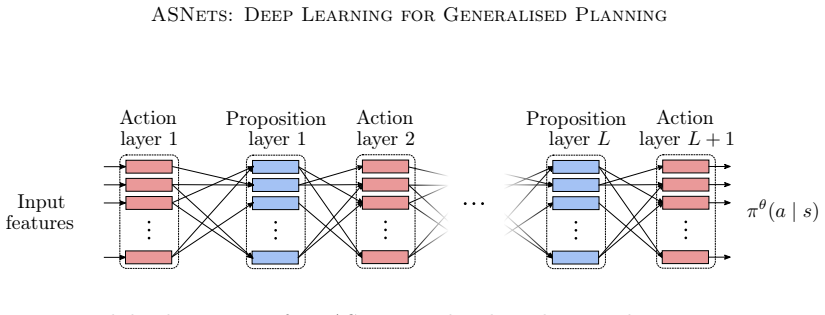
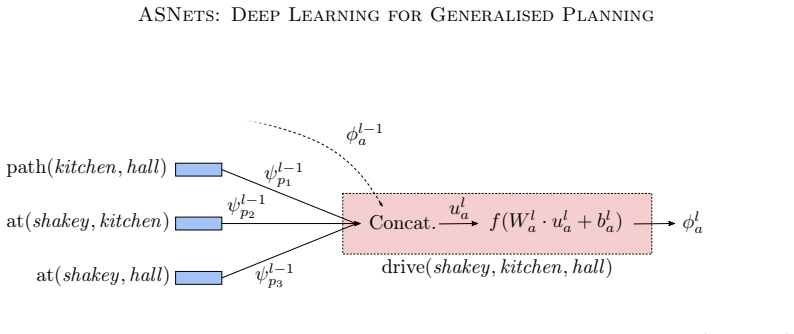
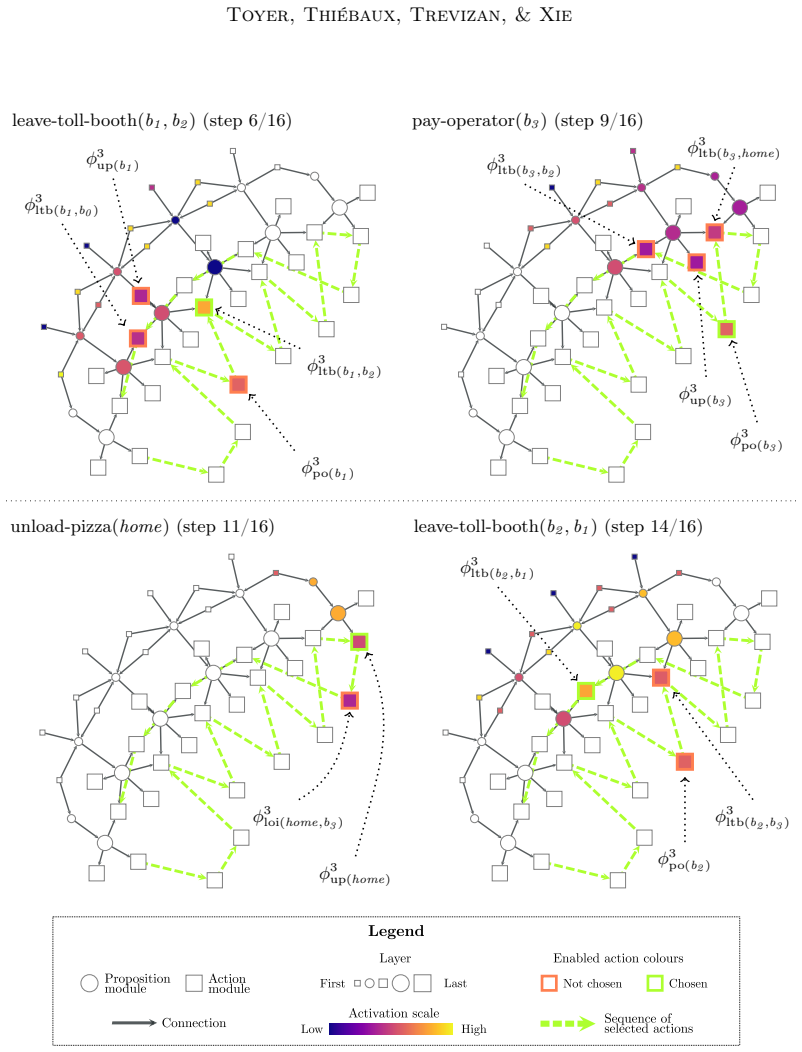
The central mechanism is the action-proposition relatedness graph: each action module receives, at each layer, the hidden representations of propositions appearing at unique positions in its action schema, while each proposition module pools over related actions grouped by schema and position. Weight tying across modules instantiated from the same action schema or predicate makes the parameter set $ heta$ independent of problem size, and first-layer inputs add proposition truth values, goal indicators, action applicability, LM-cut landmark indicators, and action counts. The output layer uses a masked softmax to produce a distribution over applicable actions. This construction is what lets a fixed set of weights act as a generalised policy over an entire lifted-SSP domain.
What would settle it
Train an ASNet on Blocksworld problems whose goal towers contain misplaced blocks only near the top, then test on an instance where the only misplaced block sits at the bottom of a tall tower; if the network's actions loop or fail there, the transfer assumption is violated. A more direct check is the paper's own receptive-field experiment: a fixed-depth ASNet should fail on a chain-length problem longer than its number of proposition layers.
Extended reading notes
Core claim
An ASNet is a neural network instantiated over the graph of ground actions and propositions of a (P)PDDL problem, with shared weights that depend only on action schemas and predicates, so the same parameter set applies to every instance of a domain. Trained by imitation learning against the value estimates of a heuristic-search teacher on small problems, the resulting reactive policy is claimed to transfer to much larger instances, with the strongest result being 18,300 of 18,300 Blocksworld test instances solved. The paper presents the architecture's position-sensitive pooling, skip connections, and heuristic input features as improvements that make such transfer possible, while acknowledging structural limits: no support for quantifiers or arbitrary goal formulae, a receptive-field limit on chains of reasoning, and failure to produce reliable policies for n-Puzzle and Sokoban.
Load-bearing premise
The small training problems are representative of the larger test problems, so the structure needed for a general policy is present in the training set; the paper offers strong empirical evidence in some domains but no formal transfer guarantee.
Editorial extensions
If this is right
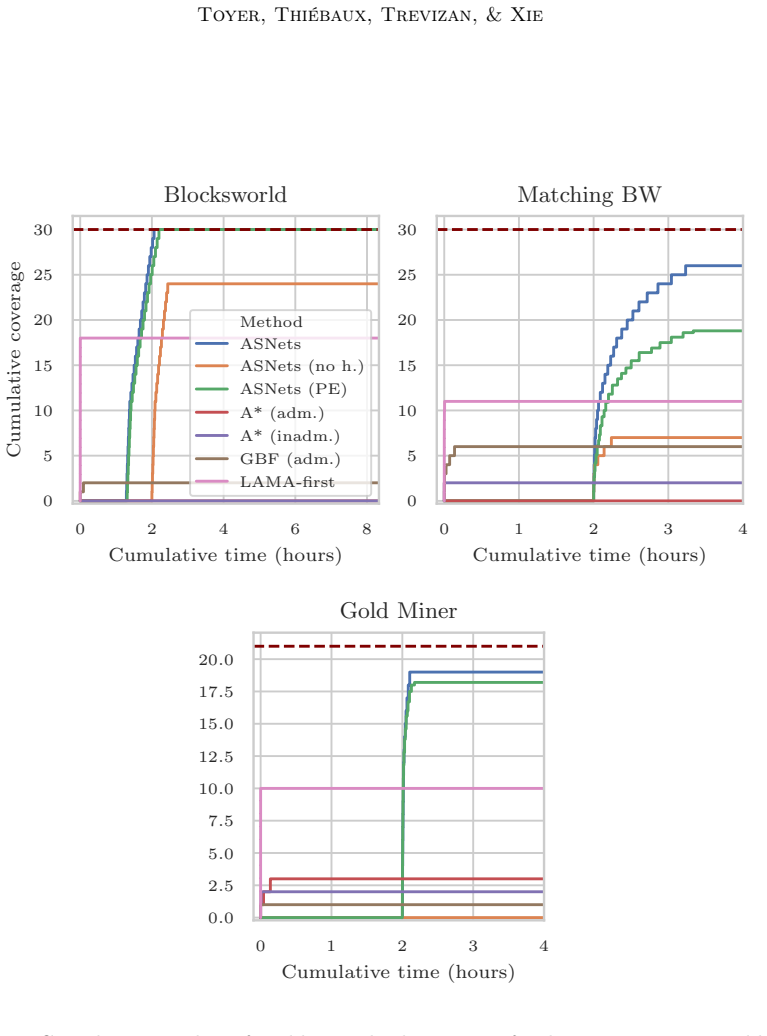
- A policy trained on small instances can solve problems that heuristic-search planners cannot solve within a three-hour budget, as demonstrated on Blocksworld, CosaNostra Pizza, Triangle Tireworld, and other domains.
- The same architecture can handle both probabilistic and deterministic PPDDL domains because probabilistic semantics only enter through training data; the network itself reads the same relational structure.
- Heuristic input features such as LM-cut landmarks and action-count history are essential in several domains, and removing them sharply reduces coverage.
- The receptive-field limit implies that a fixed-depth network cannot generalise across domains where correct actions require reasoning over arbitrarily long relatedness chains, as shown by the paper's own chain-length experiments.
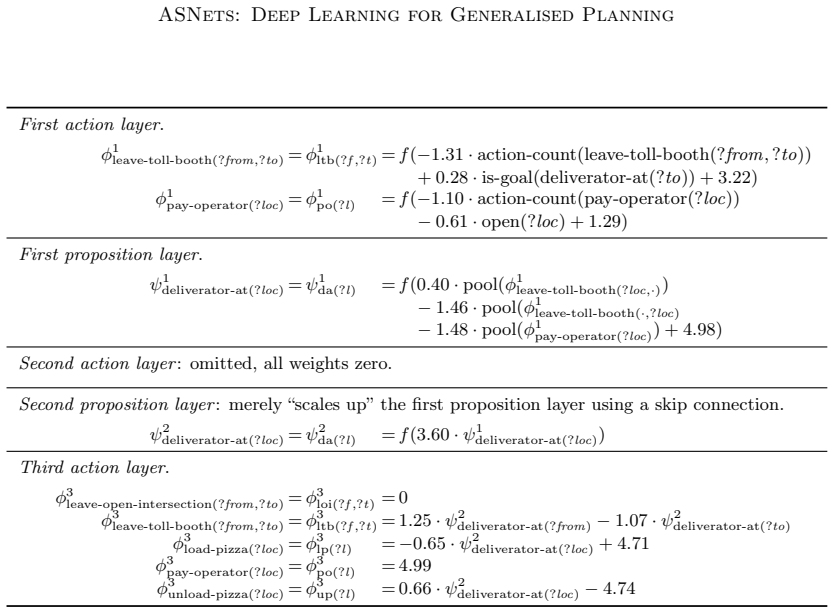
- Sparsity regularisation can reduce a policy to very few nonzero parameters, producing a lifted policy that a human can read and check against the domain definition.
Reading between the lines
- An implication the author leaves implicit is that the practical bottleneck for this approach is training-set design: to generalise, the small training problems must contain the rare structures (deep towers, dead-end configurations, long chains) that will appear in larger instances, and the paper's failures on n-Puzzle and Sokoban illustrate that this is not automatic.
- A natural extension would be to combine ASNet policies with search at test time, using the learned policy to guide rather than replace a planner; the paper mentions this direction but does not evaluate it.
- Because the sparse Triangle Tireworld policy reduces to eight nonzero weights, a further step would be to verify such policies formally against a specification of the domain, turning learned control knowledge into a checked artefact rather than an empirical claim.
- The ASNet recipe of schema-derived graph structure plus shared weights and heuristic inputs could plausibly transfer to numeric and concurrent planning domains, though the paper leaves those extensions open.
Signed reviews
Editorial analysis
A structured set of objections, weighed in public.
Referee Report
Summary. The paper presents Action Schema Networks (ASNets), a graph-convolutional architecture for learning generalized policies in (P)PDDL planning domains. The network is structured by the relatedness of ground actions and propositions, with weight sharing across the same lifted action schemas and predicates, so that a fixed set of parameters can be applied to problems of arbitrary size. Policies are trained by imitation learning from a teacher planner on a handful of small instances, then executed greedily on much larger held-out instances. The paper extends the earlier ASNet architecture with position-aware pooling and skip connections, adds LM-cut landmark and action-count inputs to mitigate the receptive-field limitation, and reports experiments on seven probabilistic and deterministic domains, an extended Blocksworld evaluation of 18,300 instances, ablations, and an interpretability study using L1-regularized sparse policies.
Significance. If the results hold, this is an important contribution to generalized planning and to structured deep learning for planning. The architecture is a clean and general way to obtain size-invariant neural policies with strong inductive biases, the comparison against strong non-learning baselines is extensive and fairly presented, and the authors honestly report domains where the approach fails (n-Puzzle, Sokoban, Parking, Thoughtful). The paper ships code, provides detailed cost/coverage tables, and demonstrates a genuinely interpretable policy for Triangle Tireworld. The main limitations are the absence of a formal generalization guarantee and the reliance on hand-engineered heuristic input features, both of which the paper acknowledges; the empirical strength of the flagship 18,300-instance result is the key remaining question.
major comments (3)
- [Section 5.5] The headline claim that the trained policy solves all 18,300 test instances is reported after modifying the hyperparameters and training setup from Section 5.1 (20 instead of 16 channels, 50 instead of 25 training problems, six instead of two hours, dropout 0.3 instead of 0.1). No seed variance or separate validation set is reported, and the text does not describe a model-selection protocol that would rule out using the extended test set to choose these settings. As a result, the 100% coverage figure is best interpreted as an optimistic point estimate rather than a reliable generalization rate. Please report coverage over multiple training seeds and clarify the selection protocol, or soften the claim accordingly.
- [Section 3.5] The receptive-field limitation means the architecture alone cannot solve large instances in most domains; the LM-cut landmark features and action-count features are essential, as shown by the 'no h.' rows in Table 1 and the receptive-field experiments in Appendix C. This does not invalidate the method, but it does mean the claimed generalization is a property of the ASNet-plus-heuristic-features system rather than of the learned weights alone. The abstract and conclusion should qualify the claim, for example by stating that the policy is learned on top of a domain-independent landmark heuristic.
- [Section 5.1.1] The hyperparameters were selected by automated tuning and manual interpolation to maximize coverage on the benchmark problems, and the same benchmark suite is later used to evaluate the final system. This creates a selection bias that is not quantified. Please report a sensitivity analysis over the flagged hyperparameters (dropout, L2 coefficient, learning rate, hidden dimension) or a nested evaluation with a separate validation set, so that the comparison against untuned off-the-shelf baselines is not systematically disadvantaged.
minor comments (4)
- [Figure 4 caption] The caption says 'four drive actions related to at(shakey, kitchen)', but the text in Section 3.3 uses at(shakey, hall) for this example; the caption should be corrected to match the text.
- [Section 6.2] The sentence 'the ELU is simply the identify function on [0,∞)' contains a typo: 'identify' should be 'identity'.
- [Table 2] The column layout of Table 2 is confusing; please add explicit labels for the instance groups (e.g., '18 blocks, constrained towers', '25 blocks, random towers') so that the row structure matches the 18,300 total.
- [Section 4.1] The phrase 'containing structural elements representative of those found in larger problems' is vague; a brief concrete characterization (e.g., range of tower counts, goal configurations) would help readers understand the transfer assumption.
Circularity Check
No significant circularity: the paper is an empirical imitation-learning study evaluated on held-out instances, with no prediction that reduces to a fitted parameter or self-citation chain.
full rationale
The paper's central claim is that ASNets can learn a generalised policy by imitating a teacher planner on small instances and then solve larger held-out instances. This is an empirical claim, not a derivation: the network weights are learned from teacher-labelled states on training problems, and performance is measured on separate test problems from the same domains (Sections 4.1 and 5). There is no step in which a fitted parameter is renamed as a prediction. The architecture is described in full (Section 3), and the extensions over the prior ASNets paper (Toyer et al. 2018) are presented with their own ablations and analyses, so the self-citation is background rather than load-bearing. The heuristic inputs derived from LM-cut landmarks are not circular because the paper explicitly shows that baseline planners using LM-cut alone do not achieve ASNet coverage (Section 5.3.3, 'Are LM-cut heuristic values sufficient to trivially solve our test tasks?'). The extended Blocksworld experiment is a strong empirical result, and the paper transparently reports that the hyperparameters were modified for that experiment; this is a robustness concern about tuning and validation, not a circular reduction of the claim to its inputs. The paper also openly reports domains where the method fails (n-Puzzle, Sokoban, Parking, Thoughtful in Section 5.3.3), which is consistent with an honest empirical evaluation rather than a circular argument. Overall, no circular step can be exhibited from the text, so the appropriate score is 0.
Assumptions & free parameters
free parameters (7)
- hidden dimension dh =
16 (20 for extended Blocksworld)
- number of proposition layers L =
2 (ablated 1 and 3)
- dropout probability =
0.1 (0.3 for extended Blocksworld)
- L2 regularization coefficient =
2e-4
- learning rate =
1e-3 (decayed for sparse policies)
- L1 regularization coefficient (sparse policies) =
1e-2 (CosaNostra 0.02)
- training time cap =
2 hours (6 hours extended, 8 hours sparse)
assumptions (5)
- domain assumption The relatedness graph derived from PPDDL action schemas captures the structural information needed for a generalised policy.
- domain assumption The teacher planner produces Q-values that identify optimal or near-optimal actions in the training states.
- domain assumption The training problem distribution is representative of the test distribution.
- standard math The ELU activation function is strictly increasing.
- ad hoc to paper LM-cut landmarks and action counts provide enough information to overcome the receptive field limitation.
Cite this review
Pith. "Pith review of ASNets: Deep Learning for Generalised Planning." pith.science (2026). https://pith.science/paper/XHGOEB2D
@misc{pith2026190801362,
  author       = {Pith},
  title        = {Pith review of: ASNets: Deep Learning for Generalised Planning},
  year         = {2026},
  howpublished = {\url{https://pith.science/paper/XHGOEB2D}},
  note         = {Machine review of arXiv:1908.01362}
}
read the original abstract
In this paper, we discuss the learning of generalised policies for probabilistic and classical planning problems using Action Schema Networks (ASNets). The ASNet is a neural network architecture that exploits the relational structure of (P)PDDL planning problems to learn a common set of weights that can be applied to any problem in a domain. By mimicking the actions chosen by a traditional, non-learning planner on a handful of small problems in a domain, ASNets are able to learn a generalised reactive policy that can quickly solve much larger instances from the domain. This work extends the ASNet architecture to make it more expressive, while still remaining invariant to a range of symmetries that exist in PPDDL problems. We also present a thorough experimental evaluation of ASNets, including a comparison with heuristic search planners on seven probabilistic and deterministic domains, an extended evaluation on over 18,000 Blocksworld instances, and an ablation study. Finally, we show that sparsity-inducing regularisation can produce ASNets that are compact enough for humans to understand, yielding insights into how the structure of ASNets allows them to generalise across a domain.
Figures

Figures from the paper (10 more)




Reference graph
Works this paper leans on
-
[1]
\ \ Fukunaga, A
Asai, M. \ \ Fukunaga, A. 2018 . Classical planning in deep latent space: Bridging the subsymbolic-symbolic boundary \ In AAAI Conference on Artificial Intelligence (AAAI)
2018
-
[2]
N., Garg, S., \ Mausam 2018
Bajpai, A. N., Garg, S., \ Mausam 2018 . Transfer of deep reactive policies for mdp planning \ In Conference on Neural Information Processing Systems (NeurIPS)
2018
-
[3]
G., Bradtke, S
Barto, A. G., Bradtke, S. J., \ Singh, S. P. 1995 . Learning to act using real-time dynamic programming \ Artificial Intelligence
1995
-
[4]
\ \ Tsitsiklis, J
Bertsekas, D. \ \ Tsitsiklis, J. N. 1996 . Neuro-Dynamic Programming . Athena Scientific
1996
-
[5]
\ \ de Raedt, L
Blockeel, H. \ \ de Raedt, L. 1998 . Top-down induction of first-order logical decision trees \ Artificial Intelligence
1998
-
[6]
Bonet, B., Frances, G., \ Geffner, H. 2019 . Learning features and abstract actions for computing generalized plans \ In AAAI Conference on Artificial Intelligence (AAAI) , 33, \ 2703--2710
work page 2019
-
[7]
Bonet, B. \ \ Geffner, H. 2003 . Labeled RTDP : Improving the convergence of real-time dynamic programming \ In International Conference on Automated Planning and Scheduling (ICAPS)
work page 2003
-
[8]
Features, Projections, and Representation Change for Generalized Planning
Bonet, B. \ \ Geffner, H. 2018 . Features, projections, and representation change for generalized planning \ arXiv:1801.10055
work page Pith review arXiv 2018
Show all 85 references
-
[9]
M., Bruna, J., LeCun, Y., Szlam, A., \ Vandergheynst, P
Bronstein, M. M., Bruna, J., LeCun, Y., Szlam, A., \ Vandergheynst, P. 2017 . Geometric deep learning: going beyond Euclidean data \ IEEE Signal Processing Magazine
2017
-
[10]
\ \ Buffet, O
Bryce, D. \ \ Buffet, O. 2008 . 6th I nternational P lanning C ompetition: Uncertainty part \ In Workshop on the International Planning Competition
2008
-
[11]
\ \ Aberdeen, D
Buffet, O. \ \ Aberdeen, D. 2009 . The factored policy-gradient planner \ Artificial Intelligence
2009
-
[12]
Camacho, E. F. \ \ Alba, C. B. 2007 . Model predictive control . Springer Science & Business Media
2007
-
[13]
G., Jim \'e nez, S., L \'o pez, C
Coles, A., Coles, A., Olaya, A. G., Jim \'e nez, S., L \'o pez, C. L., Sanner, S., \ Yoon, S. 2012 . A survey of the seventh international planning competition \ AI Magazine
2012
-
[14]
Culberson, J. 1997 . S okoban is PSPACE -complete \ https://webdocs.cs.ualberta.ca/ joe/Preprints/Sokoban/paper.html
1997
-
[15]
\ \ Fuentetaja, R
de la Rosa, T. \ \ Fuentetaja, R. 2017 . Bagging strategies for learning planning policies \ Annals of Mathematics and Artificial Intelligence
2017
-
[16]
de la Rosa, T., Jim \'e nez, S., Fuentetaja, R., \ Borrajo, D. 2011 . Scaling up heuristic planning with relational decision trees \ Journal of Artificial Intelligence Research (JAIR)
2011
-
[17]
Dietterich, T. G. 2000 . Ensemble methods in machine learning \ Multiple classifier systems
2000
-
[18]
K., Maclaurin, D., Iparraguirre, J., Bombarell, R., Hirzel, T., Aspuru-Guzik, A., \ Adams, R
Duvenaud, D. K., Maclaurin, D., Iparraguirre, J., Bombarell, R., Hirzel, T., Aspuru-Guzik, A., \ Adams, R. P. 2015 . Convolutional networks on graphs for learning molecular fingerprints \ In Conference on Neural Information Processing Systems (NeurIPS)
2015
-
[19]
Ferber, P., Helmert, M., \ Hoffman, J. 2020 . Neural network heuristics for classical planning: A study of hyperparameter space \ In ECAI
2020
-
[20]
Fern, A., Khardon, R., \ Tadepalli, P. 2011 . The first learning track of the international planning competition \ Machine Learning
2011
-
[21]
Fern, A., Yoon, S., \ Givan, R. 2004 . Approximate policy iteration with a policy language bias \ In Conference on Neural Information Processing Systems (NeurIPS)
2004
-
[22]
B., Geissmann, C., \ Pommerening, F
Franc \`e s, G., Corr \^e a, A. B., Geissmann, C., \ Pommerening, F. 2019 . Generalized potential heuristics for classical planning \ In International Joint Conferences on Artificial Intelligence (IJCAI)
2019
-
[23]
Size-independent neural transfer for rddl planning \ In International Conference on Automated Planning and Scheduling (ICAPS)
Garg, S., Bajpai, A., \ Mausam 2019 . Size-independent neural transfer for rddl planning \ In International Conference on Automated Planning and Scheduling (ICAPS)
2019
-
[24]
Geffner, H. 2018a . International Joint Conferences on Artificial Intelligence (IJCAI)-ECAI keynote: Model-free, model-based, and general intelligence . Recording at https://www.youtube.com/watch?v=g3lc8BxTPiU&t=1906
1906
-
[25]
Geffner, H. 2018b . Model-free, model-based, and general intelligence \ arXiv:1806.02308
-
[26]
Gomoluch, P., Alrajeh, D., \ Russo, A. 2019 . Learning classical planning strategies with policy gradient \ In International Conference on Automated Planning and Scheduling (ICAPS)
2019
-
[27]
\ \ Thi \'e baux, S
Gretton, C. \ \ Thi \'e baux, S. 2004 . Exploiting first-order regression in inductive policy selection \ In Conference on Uncertainty in Artificial Intelligence (UAI)
2004
-
[28]
Groshev, E., Goldstein, M., Tamar, A., Srivastava, S., \ Abbeel, P. 2018 . Learning generalized reactive policies using deep neural networks \ In International Conference on Automated Planning and Scheduling (ICAPS)
2018
-
[29]
\ \ Geffner, H
Haslum, P. \ \ Geffner, H. 2000 . Admissible heuristics for optimal planning \ In International Conference on Artificial Intelligence Planning and Scheduling (AIPS)
2000
-
[30]
Helmert, M. 2006 . The F ast D ownward planning system \ Journal of Artificial Intelligence Research (JAIR)
2006
-
[31]
\ \ Domshlak, C
Helmert, M. \ \ Domshlak, C. 2009 . Landmarks, critical paths and abstractions: what's the difference anyway? \ In International Conference on Automated Planning and Scheduling (ICAPS)
2009
-
[32]
\ \ Schmidhuber, J
Hochreiter, S. \ \ Schmidhuber, J. 1997 . Long short-term memory \ Neural computation
1997
-
[33]
Hoffmann, J. 2001 . FF : The Fast-Forward planning system \ AI Magazine
2001
-
[34]
\ \ De Giacomo, G
Hu, Y. \ \ De Giacomo, G. 2011 . Generalized planning: Synthesizing plans that work for multiple environments \ In International Joint Conferences on Artificial Intelligence (IJCAI)
2011
-
[35]
Issakkimuthu, M., Fern, A., \ Tadepalli, P. 2018 . Training deep reactive policies for probabilistic planning problems \ In International Conference on Automated Planning and Scheduling (ICAPS)
2018
-
[36]
R., Savarese, S., \ Saxena, A
Jain, A., Zamir, A. R., Savarese, S., \ Saxena, A. 2016 . Structural- RNN : Deep learning on spatio-temporal graphs \ In Computer Vision and Pattern Recognition (CVPR)
2016
-
[37]
Jim \'e nez, S., de la Rosa, T., Fern \'a ndez, S., Fern \'a ndez, F., \ Borrajo, D. 2012 . A review of machine learning for automated planning \ The Knowledge Engineering Review
2012
-
[38]
A., Eldawy, M., L \'a zaro-Gredilla, M., Lou, X., Dorfman, N., Sidor, S., Phoenix, S., \ George, D
Kansky, K., Silver, T., M \'e ly, D. A., Eldawy, M., L \'a zaro-Gredilla, M., Lou, X., Dorfman, N., Sidor, S., Phoenix, S., \ George, D. 2017 . Schema networks: Zero-shot transfer with a generative causal model of intuitive physics \ In International Conference on Machine Lear...
2017
-
[39]
L., Julian, K., \ Kochenderfer, M
Katz, G., Barrett, C., Dill, D. L., Julian, K., \ Kochenderfer, M. J. 2017 . Reluplex: An efficient SMT solver for verifying deep neural networks \ In International Conference on Computer-Aided Verification (CAV)
2017
-
[40]
Kearnes, S., McCloskey, K., Berndl, M., Pande, V., \ Riley, P. 2016 . Molecular graph convolutions: moving beyond fingerprints \ Journal of Computer-Aided Molecular Design
2016
-
[41]
Khardon, R. 1999 . Learning action strategies for planning domains \ Artificial Intelligence
1999
-
[42]
Krizhevsky, A., Sutskever, I., \ Hinton, G. E. 2012 . Imagenet classification with deep convolutional neural networks \ In Conference on Neural Information Processing Systems (NeurIPS)
2012
-
[43]
\ \ Bengio, Y
LeCun, Y. \ \ Bengio, Y. 1995 . Convolutional networks for images, speech, and time series \ The handbook of brain theory and neural networks
1995
-
[44]
LeCun, Y., Bengio, Y., \ Hinton, G. 2015 . Deep learning \ Nature
2015
-
[45]
E., \ Stoica, I
Liaw, R., Liang, E., Nishihara, R., Moritz, P., Gonzalez, J. E., \ Stoica, I. 2018 . T une: A research platform for distributed model selection and training \ arXiv:1807.05118
2018 arXiv
-
[46]
Lipton, Z. C. 2016 . The mythos of model interpretability \ arXiv:1606.03490
2016 arXiv
-
[47]
\ \ Thi \'e baux, S
Little, I. \ \ Thi \'e baux, S. 2007 . Probabilistic planning vs. replanning \ In International Conference on Automated Planning and Scheduling (ICAPS) workshops
2007
-
[48]
Long, J., Shelhamer, E., \ Darrell, T. 2015 . Fully convolutional networks for semantic segmentation \ In Computer Vision and Pattern Recognition (CVPR)
2015
-
[49]
\ \ Geffner, H
Martin, M. \ \ Geffner, H. 2000 . Learning generalized policies in planning using concept languages \ In International Conference on Principles of Knowledge Representation and Reasoning (KR)
2000
-
[50]
Mausam \ \ Kolobov, A. 2012 . Planning with Markov Decision Processes . Morgan & Claypool
2012
-
[51]
Mnih, V., Kavukcuoglu, K., Silver, D., Graves, A., Antonoglou, I., Wierstra, D., \ Riedmiller, M. 2013 . Playing Atari with deep reinforcement learning \ In NIPS workshops
2013
-
[52]
C., \ Kova c evi \'c , J
Niu, S., Chen, S., Guo, H., Targonski, C., Smith, M. C., \ Kova c evi \'c , J. 2017 . Generalized value iteration networks: Life beyond lattices \ arXiv:1706.02416
2017 arXiv
-
[53]
Quinlan, J. R. 1986 . Induction of decision trees \ Machine learning
1986
-
[54]
\ \ Warmuth, M
Ratner, D. \ \ Warmuth, M. K. 1986 . Finding a shortest solution for the n n extension of the 15-puzzle is intractable. \ In AAAI Conference on Artificial Intelligence (AAAI)
1986
-
[55]
Richter, S., Westphal, M., \ Helmert, M. 2011 . LAMA 2008 and 2011 \ In International Planning Competition , \ 117--124
2011
-
[56]
Rivest, R. L. 1987 . Learning decision lists \ Machine learning
1987
-
[57]
Ross, S., Gordon, G., \ Bagnell, D. 2011 . A reduction of imitation learning and structured prediction to no-regret online learning \ In AISTATS
2011
-
[58]
Q., \ Sanner, S
Say, B., Wu, G., Zhou, Y. Q., \ Sanner, S. 2017 . Nonlinear hybrid planning with deep net learned transition models and mixed-integer linear programming \ In International Joint Conferences on Artificial Intelligence (IJCAI)
2017
-
[59]
Shen, W., Trevizan, F., \ Thi \'e baux, S. 2020 . Learning domain-independent planning heuristics with hypergraph networks \ International Conference on Automated Planning and Scheduling (ICAPS)
2020
-
[60]
W., Toyer, S., Thi \' e baux, S., \ Xie, L
Shen, W., Trevizan, F. W., Toyer, S., Thi \' e baux, S., \ Xie, L. 2019 . Guiding search with generalized policies for probabilistic planning \ In Symposium on Combinatorial Search (SOCS)
2019
-
[61]
Sievers, S., Katz, M., Sohrabi, S., Samulowitz, H., \ Ferber, P. 2019 . Deep learning for cost-optimal planning: Task-dependent planner selection \ In AAAI Conference on Artificial Intelligence (AAAI)
2019
-
[62]
J., Guez, A., Sifre, L., Van Den Driessche, G., Schrittwieser, J., Antonoglou, I., Panneershelvam, V., \ Lanctot, M
Silver, D., Huang, A., Maddison, C. J., Guez, A., Sifre, L., Van Den Driessche, G., Schrittwieser, J., Antonoglou, I., Panneershelvam, V., \ Lanctot, M. 2016 . Mastering the game of Go with deep neural networks and tree search \ Nature
2016
-
[63]
\ \ Thi \'e baux, S
Slaney, J. \ \ Thi \'e baux, S. 2001 . Blocks world revisited \ Artificial Intelligence
2001
-
[64]
Sourek, G., Aschenbrenner, V., Zelezny, F., Schockaert, S., \ Kuzelka, O. 2018 . Lifted relational neural networks: Efficient learning of latent relational structures \ Journal of Artificial Intelligence Research (JAIR)
2018
-
[65]
Srivastava, S., Immerman, N., Zilberstein, S., \ Zhang, T. 2011 . Directed search for generalized plans using classical planners. \ In International Conference on Automated Planning and Scheduling (ICAPS)
2011
-
[66]
Tamar, A., Wu, Y., Thomas, G., Levine, S., \ Abbeel, P. 2016 . Value iteration networks \ In Conference on Neural Information Processing Systems (NeurIPS)
2016
-
[67]
Tibshirani, R. 1996 . Regression shrinkage and selection via the lasso \ J.\@ Royal Stat.\@ Soc.: Series B (Methodological)
1996
-
[68]
Y., \ Tedrake, R
Tjeng, V., Xiao, K. Y., \ Tedrake, R. 2019 . Evaluating robustness of neural networks with mixed integer programming \ In International Conference on Learning Representations (ICLR)
2019
-
[69]
Toyer, S., Trevizan, F., Thi \'e baux, S., \ Xie, L. 2018 . Action schema networks: Generalised policies with deep learning \ In AAAI Conference on Artificial Intelligence (AAAI)
2018
-
[70]
Trevizan, F., Thi \'e baux, S., \ Haslum, P. 2017 . Occupation measure heuristics for probabilistic planning \ In International Conference on Automated Planning and Scheduling (ICAPS)
2017
-
[71]
Trevizan, F. W. \ \ Veloso, M. M. 2012 . Short-sighted stochastic shortest path problems \ In International Conference on Automated Planning and Scheduling (ICAPS)
2012
-
[72]
\ \ Blockeel, H
Uwents, W. \ \ Blockeel, H. 2005 . Classifying relational data with neural networks \ In International Conference on Inductive Logic Programming (ILP)
2005
-
[73]
L., Roberts, M., \ Sanner, S
Vallati, M., Chrpa, L., Grze \'s , M., McCluskey, T. L., Roberts, M., \ Sanner, S. 2015 . The 2014 International Planning Competition : Progress and trends \ AI Magazine
2015
-
[74]
N., Kaiser, ., \ Polosukhin, I
Vaswani, A., Shazeer, N., Parmar, N., Uszkoreit, J., Jones, L., Gomez, A. N., Kaiser, ., \ Polosukhin, I. 2017 . Attention is all you need \ In Conference on Neural Information Processing Systems (NeurIPS)
2017
-
[75]
Vinyals, O., Fortunato, M., \ Jaitly, N. 2015 . Pointer networks \ In Conference on Neural Information Processing Systems (NeurIPS)
2015
-
[76]
Weston, J., Chopra, S., \ Bordes, A. 2014 . Memory networks \ arXiv:1410.3916
2014 arXiv
-
[77]
V., Norouzi, M., Macherey, W., Krikun, M., Cao, Y., Gao, Q., \ Macherey, K
Wu, Y., Schuster, M., Chen, Z., Le, Q. V., Norouzi, M., Macherey, W., Krikun, M., Cao, Y., Gao, Q., \ Macherey, K. 2016 . G oogle's neural machine translation system: Bridging the gap between human and machine translation \ arXiv:1609.08144
2016 arXiv
-
[78]
Xu, Y., Fern, A., \ Yoon, S. W. 2007 . Discriminative learning of beam-search heuristics for planning \ In International Joint Conferences on Artificial Intelligence (IJCAI)
2007
-
[79]
W., Fern, A., \ Givan, R
Yoon, S. W., Fern, A., \ Givan, R. 2007 . Using learned policies in heuristic-search planning \ In International Joint Conferences on Artificial Intelligence (IJCAI)
2007
-
[80]
Yoon, S., Fern, A., \ Givan, R. 2006 . Discrepancy search with reactive policies for planning \ In AAAI-06 Workshop on Learning for Search
2006
-
[81]
Yoon, S., Fern, A., \ Givan, R. 2002 . Inductive policy selection for first-order MDPs \ In Conference on Uncertainty in Artificial Intelligence (UAI)
2002
-
[82]
Younes, H. L. \ \ Littman, M. L. 2004 . PPDDL1.0: an extension to PDDL for expressing planning domains with probabilistic effects \ , CMU
2004
-
[83]
L., Littman, M
Younes, H. L., Littman, M. L., Weissman, D., \ Asmuth, J. 2005 . The first probabilistic track of the international planning competition \ Journal of Artificial Intelligence Research (JAIR)
2005
-
[84]
Zambaldi, V., Raposo, D., Santoro, A., Bapst, V., Li, Y., Babuschkin, I., Tuyls, K., Reichert, D., Lillicrap, T., Lockhart, E., Shanahan, M., Langston, V., Pascanu, R., Botvinick, M., Vinyals, O., \ Battaglia, P. 2019 . Deep reinforcement learning with relational inductive bia...
2019
-
[85]
write newline
" write newline "" before.all 'output.state := FUNCTION fin.entry add.period write newline FUNCTION new.block output.state before.all = 'skip after.block 'output.state := if FUNCTION new.sentence output.state after.block = 'skip output.state before.all = 'skip after.sentence '...
Reviewed August 14, 2026 · model on record in the stance chip above.
Discussion (0). Continue with ORCID to comment.