Modification of jet-energy flow in heavy-ion collisions
Pith reviewed 2026-06-26 15:06 UTC · model grok-4.3
The pith
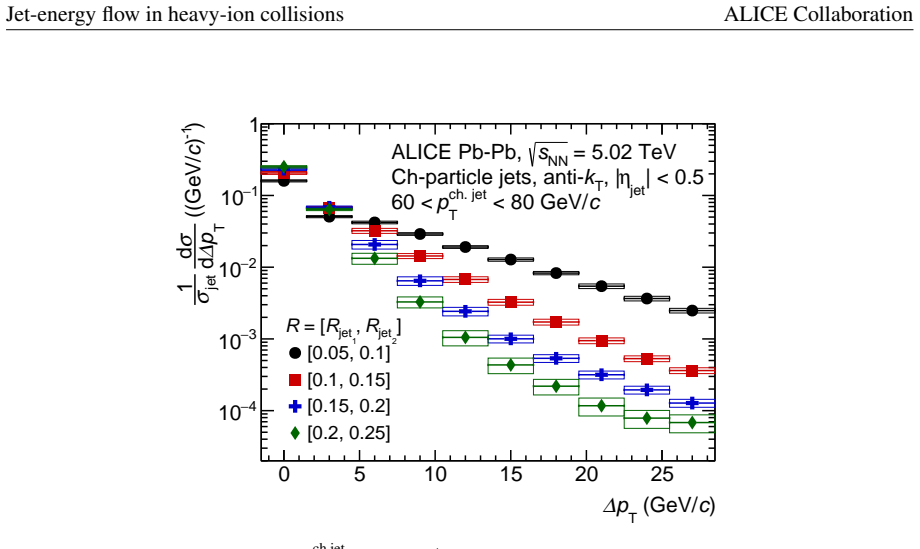
Heavy-ion collisions suppress jet energy flow at larger radii, narrowing the distribution relative to proton-proton collisions.
A machine-rendered reading of the paper's core claim, the machinery that carries it, and where it could break.
Core claim
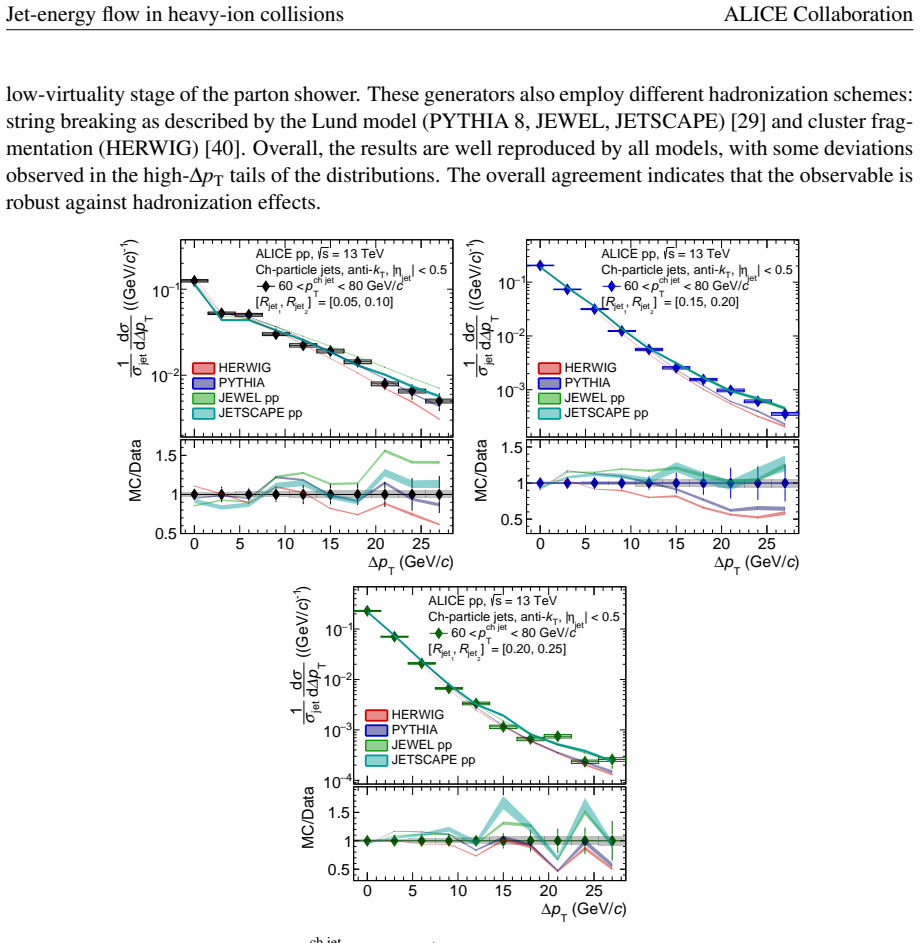
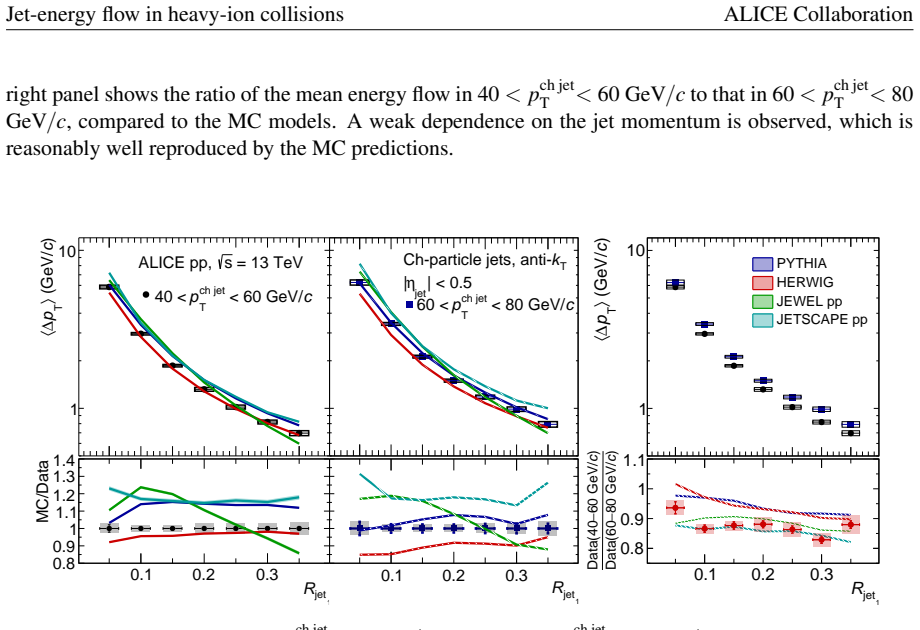
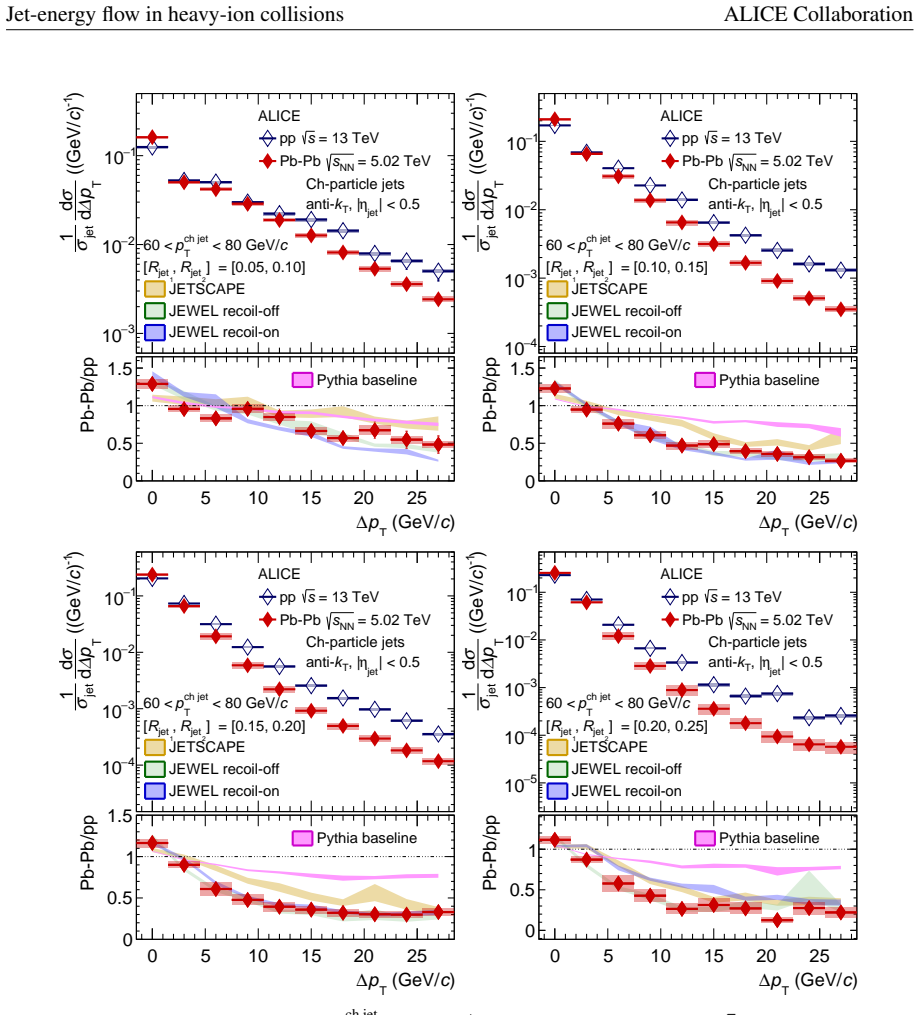
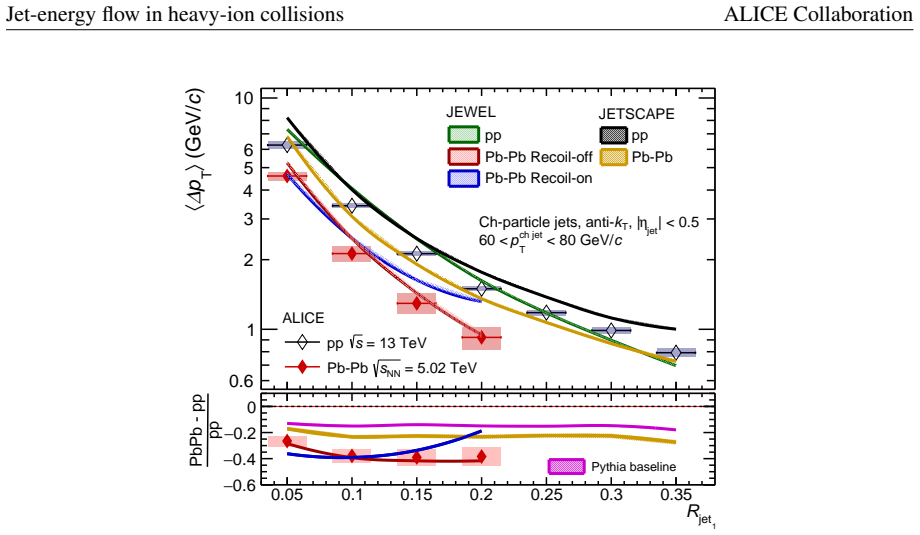
The measurements establish a clear suppression of jet-energy flow at larger radii in Pb-Pb collisions relative to pp, with a significance of 3.5-4.5 sigma, indicating a narrowing of the radial energy distribution. The pp reference is reproduced by PYTHIA 8, HERWIG, JEWEL and JETSCAPE with only minor tail deviations, while the Pb-Pb modification is described well by JEWEL without recoil but deviates from JEWEL with recoil and from JETSCAPE.
What carries the argument
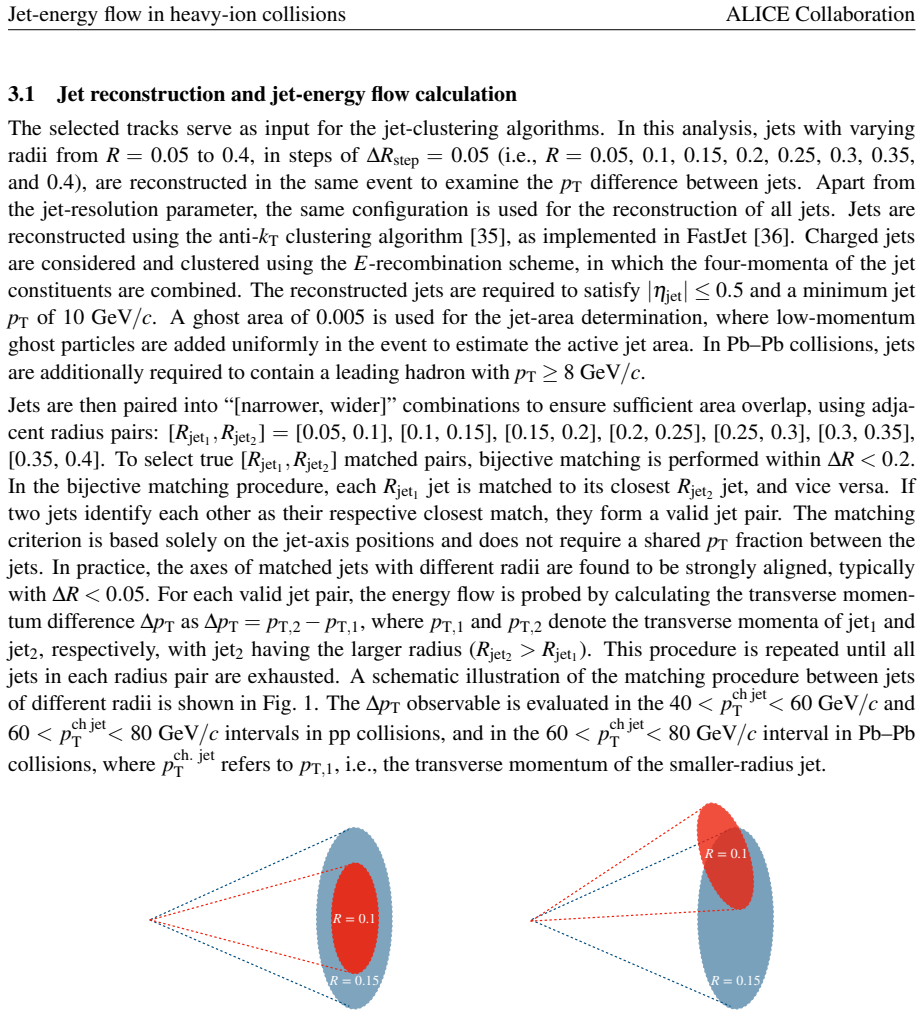
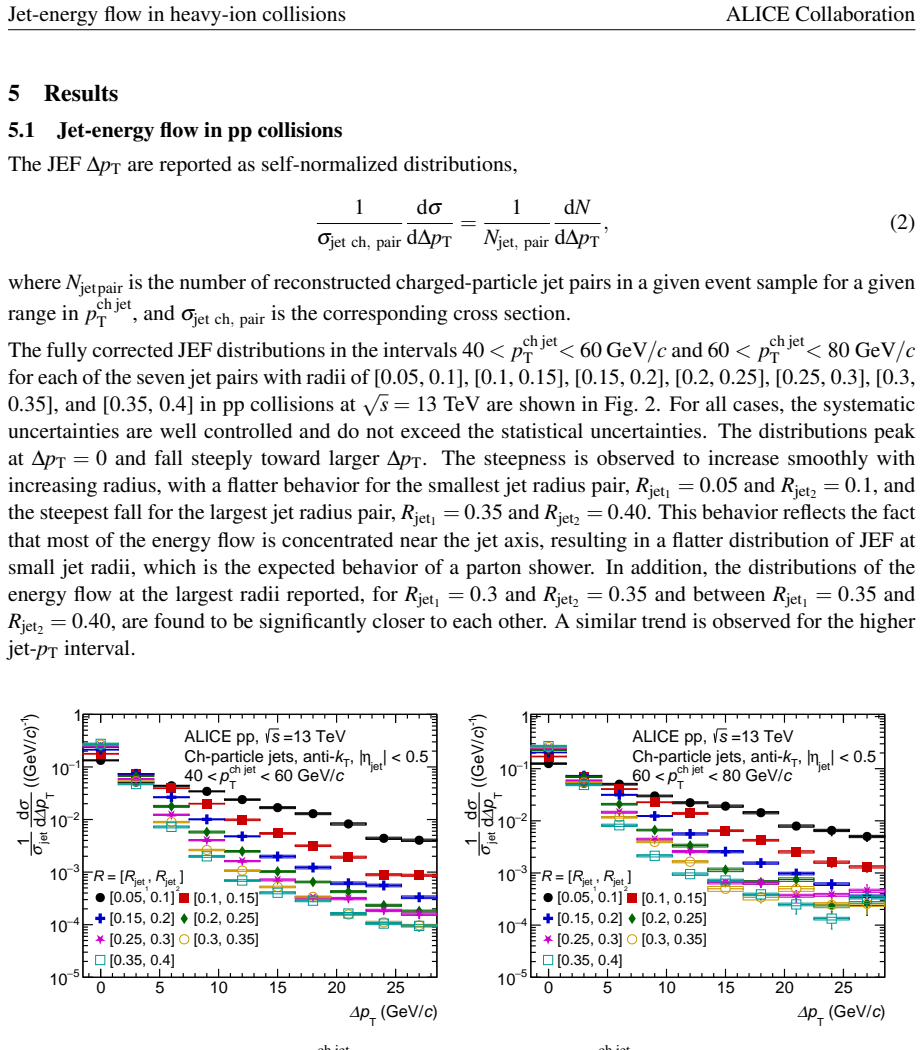
The jet-energy flow (Δp_T) observable, which quantifies the radial distribution of transverse momentum around the jet axis in an infrared- and collinear-safe manner.
If this is right
- The narrowing implies that the quark-gluon plasma preferentially affects energy carried by partons at larger angles from the jet axis.
- Models that include medium recoil or response produce trends with radius that are disfavored by the data.
- Most parton energy remains concentrated in the jet core even after passage through the medium.
- The observable isolates medium effects on the parton shower while remaining insensitive to certain reconstruction biases.
- JEWEL without recoil captures the relative modification, while versions with recoil and JETSCAPE do not.
Where Pith is reading between the lines
- The result suggests that softer particles at wider angles are more readily modified by the medium, which could be tested with identified-particle correlations inside jets.
- Repeating the measurement at matched collision energies would isolate purely medium-induced effects from any residual initial-state differences.
- The narrowing pattern may constrain the angular scale at which jet quenching becomes active, offering input for hydrodynamic or transport-model calculations of the plasma.
- Extensions to higher jet momenta or to photon-jet events could reveal whether the narrowing persists or saturates with increasing parton energy.
Load-bearing premise
The 60-80 GeV/c pp sample at 13 TeV can be scaled and compared directly to the Pb-Pb sample at 5.02 TeV without residual initial-state or fragmentation differences that would mimic medium-induced narrowing.
What would settle it
A direct measurement of the same jet-energy flow observable in pp collisions at 5.02 TeV to test whether the scaled reference matches the Pb-Pb baseline after energy adjustment.
Figures
read the original abstract
The ALICE Collaboration presents the first measurements of the jet-energy flow ($\Delta p_{\rm T}$) observable in proton-proton and heavy-ion collisions. Jets are excellent probes for the quark$-$gluon plasma, a deconfined state of matter produced in heavy-ion collisions. The jet-energy flow observable characterizes the radial distribution of energy from the jet axis in an infrared and collinear-safe way and is sensitive to medium-induced parton-shower modifications. Inclusive charged jets are measured in Pb$-$Pb collisions at $\sqrt{s_{\rm NN}} = 5.02$ TeV for the transverse-momentum interval 60$-$80 GeV/$c$. For pp collisions at $\sqrt{s}=13$ TeV, measurements include the 40$-$60 and 60$-$80 GeV/$c$ intervals, where the latter serves as the reference for investigating medium-induced modifications. Results show that most parton energy is concentrated in the jet core, with a clear suppression of energy flow in heavy-ion collisions at larger radii (significance 3.5$-$4.5$\sigma$) indicating a narrowing of the energy flow. While all models -- PYTHIA 8, HERWIG, JEWEL, and JETSCAPE -- reproduce the pp results with only small deviations in the tails, the relative modification in Pb$-$Pb collisions is well described by JEWEL without recoil. Conversely, JEWEL with recoil (medium response) and JETSCAPE show significant deviations, exhibiting increasing or more constant trends with radius that are disfavored by the data.
Editorial analysis
A structured set of objections, weighed in public.
Referee Report
Summary. The manuscript reports the first measurements of the infrared- and collinear-safe jet-energy flow observable Δp_T for inclusive charged jets. In Pb-Pb collisions at √s_NN = 5.02 TeV (60–80 GeV/c) a statistically significant (3.5–4.5σ) suppression of Δp_T is observed at larger radii relative to a pp reference at √s = 13 TeV (60–80 GeV/c), interpreted as medium-induced narrowing of the jet energy flow. The 40–60 GeV/c pp interval at 13 TeV is also presented. All tested models reproduce the pp data; only JEWEL without recoil describes the Pb-Pb modification, while JEWEL with recoil and JETSCAPE are disfavored.
Significance. If the central result holds, the work supplies a new, infrared-safe observable that directly constrains the radial redistribution of jet energy in the QGP and provides useful model discrimination. The explicit comparison of multiple Monte Carlo implementations (PYTHIA 8, HERWIG, JEWEL, JETSCAPE) is a strength of the analysis.
major comments (1)
- [Results and discussion of the Pb-Pb to pp comparison] The central claim of medium-induced narrowing rests on the direct comparison of the 60–80 GeV/c Pb-Pb sample at 5.02 TeV to the 60–80 GeV/c pp sample at 13 TeV. Because parton distributions, initial-state radiation, and fragmentation functions retain a mild √s dependence even at fixed jet p_T, any residual difference in the large-radius tails of the vacuum baseline would shift the extracted significance. The manuscript does not present an explicit same-energy (5.02 TeV) pp reference or a dedicated study of the residual √s dependence after the standard scaling; this assumption is therefore load-bearing for the 3.5–4.5σ result.
minor comments (1)
- [Abstract and Methods] The abstract states that details of background subtraction, unfolding, and systematic uncertainties are not provided; the full manuscript should make these procedures and the associated covariance matrices explicit so that the quoted significance can be independently verified.
Simulated Author's Rebuttal
We thank the referee for the positive assessment of the work's significance and for the detailed comment on the Pb-Pb to pp comparison. We address the point below and will strengthen the manuscript accordingly.
read point-by-point responses
-
Referee: The central claim of medium-induced narrowing rests on the direct comparison of the 60–80 GeV/c Pb-Pb sample at 5.02 TeV to the 60–80 GeV/c pp sample at 13 TeV. Because parton distributions, initial-state radiation, and fragmentation functions retain a mild √s dependence even at fixed jet p_T, any residual difference in the large-radius tails of the vacuum baseline would shift the extracted significance. The manuscript does not present an explicit same-energy (5.02 TeV) pp reference or a dedicated study of the residual √s dependence after the standard scaling; this assumption is therefore load-bearing for the 3.5–4.5σ result.
Authors: We agree that quantifying any residual √s dependence strengthens the robustness of the result. The 13 TeV pp sample was selected for its high statistical precision. In the revised manuscript we will add a dedicated study using PYTHIA 8 (and, where applicable, HERWIG) comparing Δp_T in pp collisions at 5.02 TeV versus 13 TeV for the same jet-p_T interval. This will explicitly show the size of the difference in the large-radius region and demonstrate that it remains well below the observed medium-induced modification, preserving the reported significance. The medium models are already run at the correct √s for each system, providing further consistency checks. revision: yes
Circularity Check
No circularity: direct experimental measurement with external model comparisons
full rationale
This is an experimental paper reporting measurements of the jet-energy flow observable Δp_T in pp and Pb-Pb collisions. The central results are raw distributions and ratios extracted from data, compared to external Monte Carlo generators (PYTHIA 8, HERWIG, JEWEL, JETSCAPE) that are not fitted to the present dataset. No derivation step reduces by construction to a parameter defined from the same data, no self-citation chain carries the load-bearing claim, and the pp reference at 13 TeV is an external baseline (with acknowledged energy mismatch) rather than a self-derived quantity. The analysis is self-contained against external benchmarks.
Axiom & Free-Parameter Ledger
axioms (2)
- domain assumption Standard model of strong interactions and perturbative QCD applies to jet production and fragmentation in vacuum.
- domain assumption Jet reconstruction and background subtraction procedures in Pb-Pb collisions do not introduce artificial radial narrowing.
Reference graph
Works this paper leans on
-
[1]
Highly Relativistic Nucleus-Nucleus Collisions: The Central Rapidity Region
J. D. Bjorken, “Highly Relativistic Nucleus-Nucleus Collisions: The Central Rapidity Region”, Phys. Rev. D27(1983) 140–151
1983
-
[2]
Heavy Ion Collisions: The Big Picture, and the Big Questions
W. Busza, K. Rajagopal, and W. van der Schee, “Heavy Ion Collisions: The Big Picture, and the Big Questions”,Ann. Rev. Nucl. Part. Sci.68(2018) 339–376,arXiv:1802.04801 [hep-ph]
Pith/arXiv arXiv 2018
-
[3]
Energy Loss of Energetic Partons in Quark - Gluon Plasma: Possible Extinction of Highp T Jets in Hadron - Hadron Collisions
J. D. Bjorken, “Energy Loss of Energetic Partons in Quark - Gluon Plasma: Possible Extinction of Highp T Jets in Hadron - Hadron Collisions”, FERMILAB-PUB-82-059-THY , FERMILAB-PUB-82-059-T
-
[4]
Jets as a probe of quark-gluon plasmas
D. A. Appell, “Jets as a probe of quark-gluon plasmas”,Phys. Rev. D33(Feb, 1986) 717–722
1986
-
[5]
Jet Quenching in Dense Matter
M. Gyulassy and M. Plumer, “Jet Quenching in Dense Matter”,Phys. Lett. B243(1990) 432–438
1990
-
[6]
Jet substructure at the Large Hadron Collider
R. Kogleret al., “Jet substructure at the Large Hadron Collider”,Rev. Mod. Phys.91(Dec, 2019) 045003,arXiv:1803.06991 [hep-ex]. [7]ATLASCollaboration, G. Aadet al., “Observation of a Centrality-Dependent Dijet Asymmetry in Lead-Lead Collisions at √sNN =2.77 TeV with the ATLAS Detector at the LHC”,Phys. Rev. Lett. 105(2010) 252303,arXiv:1011.6182 [hep-ex]
arXiv 2019
-
[7]
Jets in QCD Media: From Color Coherence to Decoherence
Y . Mehtar-Tani, C. A. Salgado, and K. Tywoniuk, “Jets in QCD Media: From Color Coherence to Decoherence”,Phys. Lett. B707(2012) 156–159,arXiv:1102.4317 [hep-ph]
Pith/arXiv arXiv 2012
-
[8]
Origins of the di-jet asymmetry in heavy ion collisions
J. G. Milhano and K. C. Zapp, “Origins of the di-jet asymmetry in heavy ion collisions”,Eur . Phys. J. C76(2016) 288,arXiv:1512.08107 [hep-ph]
Pith/arXiv arXiv 2016
-
[9]
Evolution of the jet opening angle distribution in holographic plasma
K. Rajagopal, A. V . Sadofyev, and W. van der Schee, “Evolution of the jet opening angle distribution in holographic plasma”,Phys. Rev. Lett.116(2016) 211603,arXiv:1602.04187 [nucl-th]
Pith/arXiv arXiv 2016
-
[10]
On the Evolution of Jet Energy and Opening Angle in Strongly Coupled Plasma
P. M. Chesler and K. Rajagopal, “On the Evolution of Jet Energy and Opening Angle in Strongly Coupled Plasma”,JHEP05(2016) 098,arXiv:1511.07567 [hep-th]. [12]CMSCollaboration, A. Hayrapetyanet al., “Girth and groomed radius of jets recoiling against isolated photons in lead-lead and proton-proton collisions at √sNN =5.02 TeV”,Phys. Lett. B861 (2025) 13908...
Pith/arXiv arXiv 2016
-
[11]
J. Almeet al., “The ALICE TPC, a large 3-dimensional tracking device with fast readout for ultra-high multiplicity events”,Nucl. Instrum. Meth. A622(2010) 316–367,arXiv:1001.1950 [physics.ins-det]. [27]ALICECollaboration, B. B. Abelevet al., “Performance of the ALICE Experiment at the CERN LHC”,Int. J. Mod. Phys. A29(2014) 1430044,arXiv:1402.4476 [nucl-ex...
Pith/arXiv arXiv 2010
-
[12]
T. Sjöstrandet al., “An introduction to PYTHIA 8.2”,Comput. Phys. Commun.191(2015) 159–177,arXiv:1410.3012 [hep-ph]
Pith/arXiv arXiv 2015
-
[13]
Tuning PYTHIA 8.1: the Monash 2013 Tune
P. Skands, S. Carrazza, and J. Rojo, “Tuning PYTHIA 8.1: the Monash 2013 Tune”,Eur . Phys. J. C74(2014) 3024,arXiv:1404.5630 [hep-ph]. 16 Jet-energy flow in heavy-ion collisions ALICE Collaboration
Pith/arXiv arXiv 2013
-
[14]
Simulation program for particle physics experiments, GEANT: user guide and reference manual
R. Brun, R. Hagelberg, M. Hansroul, and J. C. Lassalle, “Simulation program for particle physics experiments, GEANT: user guide and reference manual”, CERN-DD-78-2. [32]ALICECollaboration, E. Abbaset al., “Performance of the ALICE VZERO system”,JINST8 (2013) P10016,arXiv:1306.3130 [nucl-ex]. [33]ALICECollaboration, K. Aamodtet al., “The ALICE experiment a...
Pith/arXiv arXiv 2013
-
[15]
The anti-kt jet clustering algorithm
M. Cacciari, G. P. Salam, and G. Soyez, “The anti-kt jet clustering algorithm”,JHEP04(2008) 063,arXiv:0802.1189 [hep-ph]
Pith/arXiv arXiv 2008
-
[16]
M. Cacciari, G. P. Salam, and G. Soyez, “FastJet User Manual”,Eur . Phys. J. C72(2012) 1896, arXiv:1111.6097 [hep-ph]
Pith/arXiv arXiv 2012
-
[17]
Particle-level pileup subtraction for jets and jet shapes
P. Berta, M. Spousta, D. W. Miller, and R. Leitner, “Particle-level pileup subtraction for jets and jet shapes”,JHEP06(2014) 092,arXiv:1403.3108 [hep-ex]
Pith/arXiv arXiv 2014
-
[18]
Improved iterative Bayesian unfolding
G. D’Agostini, “Improved iterative Bayesian unfolding”,arXiv:1010.0632 [physics.data-an]
-
[19]
RooUnfold: an unfolding framework for ROOT
T. Adye, R. Claridge, K. Tackmann, and F. Wilson, “RooUnfold: an unfolding framework for ROOT”,https://gitlab.cern.ch/RooUnfold/RooUnfold
-
[20]
Herwig 7.0/Herwig++ 3.0 release note
J. Bellmet al., “Herwig 7.0/Herwig++ 3.0 release note”,Eur . Phys. J. C76(Apr, 2016) 196, arXiv:1512.01178 [hep-ph]
Pith/arXiv arXiv 2016
-
[21]
JEWEL 2.0.0: directions for use
K. C. Zapp, “JEWEL 2.0.0: directions for use”,Eur . Phys. J. C74(2014) 2762, arXiv:1311.0048 [hep-ph]
Pith/arXiv arXiv 2014
-
[22]
A perturbative framework for jet quenching
K. C. Zapp, F. Krauss, and U. A. Wiedemann, “A perturbative framework for jet quenching”, JHEP03(2013) 080,arXiv:1212.1599 [hep-ph]. [43]JETSCAPECollaboration, A. Kumaret al., “JETSCAPE framework:p+presults”,Phys. Rev. C 102(2020) 054906,arXiv:1910.05481 [nucl-th]
Pith/arXiv arXiv 2013
-
[23]
Incorporating Space-Time Within Medium-Modified Jet Event Generators
A. Majumder, “Incorporating Space-Time Within Medium-Modified Jet Event Generators”,Phys. Rev. C88(2013) 014909,arXiv:1301.5323 [nucl-th]
Pith/arXiv arXiv 2013
-
[24]
Y . He, T. Luo, X.-N. Wang, and Y . Zhu, “Linear Boltzmann Transport for Jet Propagation in the Quark-Gluon Plasma: Elastic Processes and Medium Recoil”,Phys. Rev. C91(2015) 054908, arXiv:1503.03313 [nucl-th]. [Erratum: Phys.Rev.C 97, 019902 (2018)]
Pith/arXiv arXiv 2015
-
[25]
J. H. Putschkeet al., “The JETSCAPE framework”,arXiv:1903.07706 [nucl-th]
Pith/arXiv arXiv 1903
-
[26]
Alternative ansatz to wounded nucleon and binary collision scaling in high-energy nuclear collisions
J. S. Moreland, J. E. Bernhard, and S. A. Bass, “Alternative ansatz to wounded nucleon and binary collision scaling in high-energy nuclear collisions”,Phys. Rev. C92(2015) 011901, arXiv:1412.4708 [nucl-th]
Pith/arXiv arXiv 2015
-
[27]
Pre-equilibrium evolution effects on heavy-ion collision observables
J. Liu, C. Shen, and U. Heinz, “Pre-equilibrium evolution effects on heavy-ion collision observables”,Phys. Rev. C91(2015) 064906,arXiv:1504.02160 [nucl-th]. [Erratum: Phys.Rev.C 92, 049904 (2015)]. 17 Jet-energy flow in heavy-ion collisions ALICE Collaboration
Pith/arXiv arXiv 2015
-
[28]
Causal viscous hydrodynamics in 2+1 dimensions for relativistic heavy-ion collisions
H. Song and U. W. Heinz, “Causal viscous hydrodynamics in 2+1 dimensions for relativistic heavy-ion collisions”,Phys. Rev. C77(2008) 064901,arXiv:0712.3715 [nucl-th]
Pith/arXiv arXiv 2008
-
[29]
Medium response in JEWEL and its impact on jet shape observables in heavy ion collisions
R. Kunnawalkam Elayavalli and K. C. Zapp, “Medium response in JEWEL and its impact on jet shape observables in heavy ion collisions”,JHEP07(2017) 141,arXiv:1707.01539 [hep-ph]
Pith/arXiv arXiv 2017
-
[30]
Improved background subtraction and a fresh look at jet sub-structure in JEWEL
J. G. Milhano and K. Zapp, “Improved background subtraction and a fresh look at jet sub-structure in JEWEL”,Eur . Phys. J. C82(2022) 1010,arXiv:2207.14814 [hep-ph]. [52]CMSCollaboration, S. Chatrchyanet al., “Modification of Jet Shapes in PbPb Collisions at√sNN =2.76 TeV”,Phys. Lett. B730(2014) 243–263,arXiv:1310.0878 [nucl-ex]. 18 Jet-energy flow in heav...
arXiv 2022
discussion (0)
Sign in with ORCID, Apple, or X to comment. Anyone can read and Pith papers without signing in.