REVIEW 3 major objections 5 minor 18 references
WM-Cov: Test Adequacy for Interactive World-Model-Style Autonomous Driving Simulation
T0 review · 3 major / 5 minor · reviewed 2026-08-04 · deepseek-v4-flash
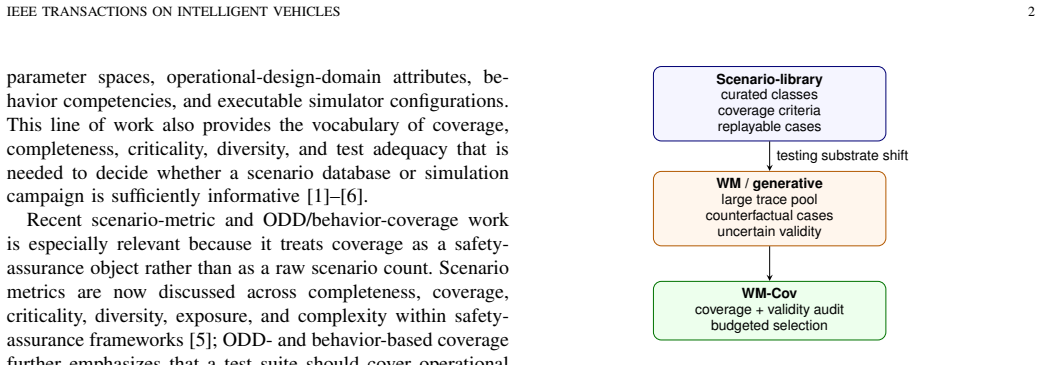
Pith's one-line read World-model-based autonomous-driving testing should be judged by convergence of valid interactive evidence under budget, not by raw generated failures or prompt coverage.
desk verdict Valid evidence is the right thing to count, but with kappa 0.281 on the validity labels, the counting instrument needs independent calibration before the headline numbers can be trusted. read the letter →
The pith
A machine-rendered reading of the paper's core claim, the machinery that carries it, and where it could break.
The reading
What carries the argument
The key machinery is WM-Cov's requested–realized–valid coverage ledger: three counters that separate what the test asked for, what the provider actually produced, and what passes an audit as plausible, non-duplicate, non-artifact evidence. The ledger feeds a budgeted greedy selector score that rewards marginal valid coverage gain, risk, and realism while penalizing redundancy and artifact risk, and a windowed stopping rule that halts when coverage growth, new valid failure modes, and uncertainty-width thresholds saturate.
What would settle it
An independent blind audit of the same traces using the paper's rubric; if inter-rater agreement remains low (e.g., kappa below ~0.4) and the set of traces labeled as valid failures changes materially across raters, then WM-Cov's reported valid-failure counts and stopping points are not reproducible. Concretely: have two raters label the 141-row stratified audit sample and compute the overlap of the resulting valid-evidence sets—if overlap is low, the framework's adequacy conclusions are labeler-dependent.
Extended reading notes
Core claim
The paper's central claim is that test adequacy for interactive world-model-style simulators is not a property of the generator's output volume or the number of prompts that were answered, but of a triple: requested coverage (what the test intended), realized coverage (what actually happened in closed loop), and valid realized coverage (what is plausible, replayable, non-duplicate, and relevant to the ADS under test). WM-Cov is the accounting layer that tracks this triple and reports it via coverage growth, valid-failure discovery, failure-mode diversity, realism, artifact suppression, duplicate accounting, and valid-evidence precision. The empirical evidence—from an executed simulator event
Load-bearing premise
The load-bearing premise is that the validity labels—which determine what counts as valid evidence—are reliable and reproducible; the paper's own author-verified audit reports exact agreement of 0.411 and Cohen's kappa of 0.281, so if independent raters cannot reproduce these labels, every downstream coverage and stopping conclusion collapses.
Editorial extensions
If this is right
- Test campaigns should report valid-evidence precision and artifact counts, not just collision rates.
- Stopping decisions can be based on evidence-saturation windows, reducing wasted simulation budget.
- Requested-to-realized tracking exposes provider-chain failures that raw request counts hide, such as horizon- and planner-conditioned partial realizations.
- Generators that produce many dangerous-looking traces but low valid yield are identifiable and can be penalized as test infrastructure.
- Adequacy reports become a standard contract: coverage + validity + budget, enabling cross-provider comparison.
Reading between the lines
- The framework implies that the quality of a generative simulator as a test oracle can be measured by its valid evidence yield per rollout, a metric the authors do not name but that follows directly from their validity ledger.
- If independent raters reproduce the low agreement seen in the author audit (exact 0.411, Cohen's kappa 0.281), then WM-Cov's outputs depend on who performs the audit; the natural extension is an automated validity classifier trained on the rubric.
- The requested-to-realized gap could itself become a quality signal for prompt conditioning: a drop in realization rate at longer horizons, as in the paper's 7.5-second cells, indicates the provider chain loses conditionality over time.
- A testable extension: apply WM-Cov's ledger to other closed-loop simulators (e.g., rule-based traffic simulators) to confirm the validity categories transfer beyond the providers studied.
Signed reviews
Editorial analysis
A structured set of objections, weighed in public.
Referee Report
Summary. The paper introduces WM-Cov, a provider-agnostic evaluation layer for interactive world-model-style autonomous-driving simulation. A scenario is formalized as an interactive family F(q) = {m, ρ, x0, e, π_bg, p, Z}, and each closed-loop trace is classified along requested, realized, and valid coverage dimensions. The framework defines a validity ledger, a budgeted trace-selection objective, and a stopping rule based on coverage growth, valid-failure discovery, and uncertainty. Experiments use an executed TeraSim/SUMO event pool, a WM-like mixed trace pool, and a real DriveArena TrafficManager–WorldDreamer matrix with UniAD and VAD planners. The headline results are that WM-Cov selects 99/100 valid failures on the executed pool and 76/100 on the WM-like pool with zero artifacts, and that on the DriveArena matrix 304/360 requested attempts are fully realized and 56 are partial. The central claim is that world-model-style testing adequacy should be judged by convergence of valid interactive evidence under budget rather than by raw generated failures or prompt coverage alone.
Significance. If the validity-labeling layer is reliable, WM-Cov addresses a real gap: modern generative simulators produce dangerous-looking traces whose evidential status is uncertain, and the paper provides a structured accounting mechanism (requested/realized/valid coverage, duplicate/artifact ledger, budgeted selection, stopping rule) that is provider-agnostic and reusable. The paper includes a public replication package and concrete provider-chain evidence from DriveArena, and its sensitivity and contamination stress tests are useful checks. However, the central claim depends entirely on the trustworthiness of the validity labels, and the paper's own audit reports low inter-rater agreement (Cohen's kappa 0.281). The stopping rule is also under-specified, with no concrete values for the tolerances or window size. These issues are load-bearing because every headline number—99, 76, 66—is a count of 'valid' evidence.
major comments (3)
- [Section V-F and Limitations (Section VIII)] The central results (Tables VII and VIII, Figure 6) count 'valid ADS failures' and 'artifact/invalid' cases, but the validity labels are assigned by the authors using a rubric and audited only by the authors. The reported 141-row audit gives exact agreement 0.411 and Cohen's kappa 0.281, with the main disagreements at the duplicate boundary. A duplicate-boundary disagreement can flip a trace between 'valid ADS failure' and 'duplicate failure', directly changing VF, FM, and valid-evidence precision Π_v. The Limitations section itself states that labels 'should be evaluated across ... independently audited cases,' which confirms that no independent audit exists. Without an independent audit or a conservative duplicate-label variant, the headline precision-of-1.00 claims are not reproducible by an external tester. Please provide an independent audit (or at least a sensitivity analysis under
- [Section III-A, Eqs. (8)–(10), and Figure 6] The stopping-oriented adequacy rule is formally defined but never instantiated. No values are given for the tolerances ε_c, ε_f, ε_p or the window size w, and Figure 6 merely says 'under a windowed rule.' This makes the stopping claim (66 traces) non-reproducible and untestable. Please specify the exact parameter values used for the figure, justify them, and report sensitivity of the stopping point and precision to these parameters. Without this, the paper's stopping-oriented adequacy contribution is only a schema, not an evaluated procedure.
- [Section V-F and Section VI (Tables VII–X)] There is a circularity concern in the validation strategy. WM-Cov is validated on pools where the 'valid' / 'artifact' / 'duplicate' ground truth is itself assigned by the authors using the same ledger categories that WM-Cov is supposed to audit. The reported artifact precision/recall of 1.00 in the author-verified audit is therefore partly self-confirmation. The executed TeraSim/SUMO pool and the WM-like pool have no external ground truth. Please either use independently established labels, or clearly re-frame the evaluation as a consistency check of the accounting layer rather than as evidence that WM-Cov can distinguish valid from invalid evidence in an objective sense.
minor comments (5)
- [Section IV-D, Eq. (14)] The greedy selection weights β_r, β_q, β_c, β_m, β_a are not given concrete values. The sensitivity grid in Table IX varies only a subset of weights and only on the WM-like pool. Please report the exact default weights and include at least one sensitivity row on the executed TeraSim/SUMO pool.
- [Table IV and Figure 4] The heatmap in Figure 4 is not visually self-contained; the numeric realization rates are printed only in the table. Adding values inside the heatmap cells would improve readability. Also, the color scale is not defined in the caption.
- [Section III, Eq. (3)] The feature vector ϕ(τ_i) = (o_i, u_i, r_i, b_i, f_i, v_i) is introduced before the ODD/interaction/risk/behavior taxonomy is described in Section IV-B. A forward reference or a brief definition of each component at Eq. (3) would help the reader.
- [Section V-B] The description says the UniAD default-cloudy 7.5-s cell produces 'partial artifacts but no UniAD planner responses.' It is not clear whether this is a provider-chain failure, a timeout, or a semantic mismatch. Please clarify the concrete failure mechanism, since this cell is used as a key example of requested-to-realized accounting.
- [References] Several references have future dates (e.g., [6], [12], [13], [14], [15]) relative to the arXiv submission. If these are accepted or online-first papers, please add DOIs or publication status; if they are preprints, mark them accordingly.
Circularity Check
WM-Cov's headline valid-evidence results are scored against the authors' own validity ledger; the only audit is author-adjudicated and reports low inter-rater agreement (κ=0.281), making the central 'valid evidence' claim partly self-confirming.
-
self definitional
[Section III Eqs. (3)-(6), Section V-F author-verified audit, Tables VII-VIII and Figure 6]
"Initial labels are assigned using a written rubric and then reviewed by the authors for all disagreement cases. ... exact agreement is 0.411 and Cohen's kappa is 0.281, mainly due to duplicate-boundary disagreements."
The evidence quantities used as results (Cvalid, VF, PI_v, zero-artifact selections) are computed from validity labels defined by the Table II ledger, and those labels are assigned and adjudicated by the same authors who then report 'artifact precision and recall are both 1.00'. The audit therefore scores the rubric against itself; with kappa only 0.281, the 1.00 precision is not independent confirmation. Headline outcomes such as 99 valid failures in Table VII, 76 in Table VIII, and the Figure 6 stop at 66 traces are consequently the ledger categories applied to themselves rather than evidence that the labels track an external ground truth. The Limitations section concedes that independently audited cases are still needed.
-
self definitional
[Section V-E artifact-contamination stress test / Table X]
"For each contamination level, we construct fixed-size trace pools by mixing valid traces with artifact-like or duplicate traces and repeat the selection three times."
The stress test constructs its own ground truth using exactly the 'valid/artifact-like/duplicate' classes that the WM-Cov validity ledger defines. Reporting 'WM-Cov artifact 0.00' across all contamination levels is therefore guaranteed by construction: the artifact-likeness of the injected traces is determined by the same categories WM-Cov is designed to reject, rather than by an independent characterization of artifacts from a deployed world model. The paper itself notes the stress test is synthetic, but the circularity is that the synthetic ground truth is generated from the ledger being validated.
full rationale
The paper contains no self-citation chain: all references are external, and WM-Cov is introduced as new work. The DriveArena requested-to-realized accounting (304/360 fully realized, 74/80 in the disjoint route slice) is grounded in drive_arena.pkl artifacts and provider logs, and is largely independent of the validity rubric; that independent content prevents a higher circularity score. However, the central claim that testing should be judged by convergence of 'valid interactive evidence' is operationalized through WM-Cov's own validity ledger (Table II, Eqs. 3-6), and the only audit of those labels is the author-verified audit, which shows substantial disagreement (exact agreement 0.411, Cohen's kappa 0.281). The headline zero-artifact precision and valid-failure counts are therefore partly self-confirming: the framework is evaluated against the same subjective categories it defines. The paper's Limitations explicitly state that validity labels 'should be evaluated across additional maps, simulators, planners, and independently audited cases,' which is a missing-support caveat that should be weighed in the verdict. Overall, this is a partial, definitional circularity in the validity-accounting layer, not a fully circular derivation.
Assumptions & free parameters
free parameters (5)
- Selection weights λr, λq, λa (Eq. 7)
- Greedy selection weights β_r, β_q, β_c, β_m, β_a (Eq. 14)
- Coverage aggregation balance α and per-dimension weights w_d (Eq. 13)
- Stopping tolerances ϵ_c, ϵ_f, ϵ_p and window w (Eqs. 8–10)
- Risk, realism, and artifact scoring functions R(τ), Q(τ), A(τ)
assumptions (6)
- domain assumption World-model-style provider outputs can be standardized into the adapter schema (Table I) without losing evidence-relevant information.
- domain assumption The feature taxonomy (ODD, interaction, risk, behavior, failure mode) and admissible bin sets Ω_d are complete and sufficient for testing adequacy.
- domain assumption Validity labels can be assigned consistently using the rubric in Table II.
- ad hoc to paper The WM-like mixed pools and contamination pools are representative of world-model provider output distributions.
- ad hoc to paper The stopping rule (Eqs. 8–10) is a sound operational criterion for adequacy.
- domain assumption The DriveArena TrafficManager–WorldDreamer chain is a valid instantiation of an interactive world-model-style provider.
invented entities (4)
-
Scenario family F(q) = {m, ρ, x0, e, π_bg, p, Z}
-
Requested/realized/valid coverage levels (Creq→real, Creal→valid, Cvalid)
-
Validity ledger categories (valid ADS failure, valid safety-critical, duplicate, conditioning failure, artifact/invalid)
-
Valid-evidence precision Π_v = VF/(VF + AI)
Cite this review
Pith. "Pith review of WM-Cov: Test Adequacy for Interactive World-Model-Style Autonomous Driving Simulation." pith.science (2026). https://pith.science/paper/XIBTIBEP
@misc{pith2026260800298,
  author       = {Pith},
  title        = {Pith review of: WM-Cov: Test Adequacy for Interactive World-Model-Style Autonomous Driving Simulation},
  year         = {2026},
  howpublished = {\url{https://pith.science/paper/XIBTIBEP}},
  note         = {Machine review of arXiv:2608.00298}
}
read the original abstract
World models and generative simulators are emerging as interactive testing infrastructure for autonomous driving because they can react to the ego planner and produce counterfactual, rare, and safety-critical rollouts. This changes a test scenario from a fixed replayed trajectory into an interactive scenario family whose realized evolution depends on the planner under test. The unresolved question is therefore not only whether dangerous rollouts can be generated, but what valid closed-loop evidence is enough to support a specified testing intent and stopping decision. This paper formulates interactive world-model-style testing adequacy and introduces WM-Cov, a provider-agnostic evaluation layer that converts raw provider outputs into requested, realized, and valid evidence. WM-Cov reports adequacy through coverage growth, valid-failure discovery, failure-mode diversity, realism, artifact suppression, duplicate accounting, and valid-evidence precision. Studies on executed TeraSim/SUMO events, WM-like mixed trace pools, and a real DriveArena TrafficManager--WorldDreamer matrix show that dangerous-looking events can include valid ADS failures, duplicates, partial realizations, and artifacts. The DriveArena matrix evaluates two planners, two horizons, six prompt conditions, and 360 ego-route requests; 304 attempts become fully realized evidence and 56 remain partial. A disjoint 80-request route-slice check yields 74 fully realized and 6 partial attempts. The results support evaluating world-model-style testing by convergence of valid interactive evidence under budget, rather than by raw generated failures or prompt coverage alone.
Figures


Figures from the paper (3 more)


Reference graph
Works this paper leans on
-
[1]
A survey on automated driving system testing: Landscapes and trends,
S. Tang, Z. Zhang, Y . Zhang, J. Zhou, Y . Guo, S. Liu, S. Guo, Y .-F. Li, L. Ma, Y . Xue, and Y . Liu, “A survey on automated driving system testing: Landscapes and trends,”ACM Transactions on Software Engineering and Methodology, vol. 32, no. 5, pp. 1–62, Jul. 2023. [Online]. Available: https://doi.org/10.1145/3579642
doi:10.1145/3579642 2023
-
[2]
Parameter coverage for testing of autonomous driving systems under uncertainty,
T. Laurent, S. Klikovits, P. Arcaini, F. Ishikawa, and A. Ventresque, “Parameter coverage for testing of autonomous driving systems under uncertainty,”ACM Transactions on Software Engineering and Methodology, vol. 32, no. 3, pp. 1–31, Apr. 2023. [Online]. Available: https://doi.org/10.1145/3550270
-
[3]
Neelofar and A. Aleti, “Towards reliable ai: Adequacy metrics for ensuring the quality of system-level testing of autonomous vehicles,” inProceedings of the IEEE/ACM 46th International Conference on Software Engineering, ser. ICSE ’24. ACM, 2024, pp. 1–12. [Online]. Available: https://doi.org/10.1145/3597503.3623314
arXiv 2024
-
[4]
E. de Gelder, M. Buermann, and O. Op Den Camp, “Coverage metrics for a scenario database for the scenario-based assessment of automated driving systems,” in2024 IEEE International Automated Vehicle Validation Conference. IEEE, 2024, pp. 1–8. [Online]. Available: https://doi.org/10.1109/IA VVC63304.2024.10786405
arXiv 2024
-
[5]
E. de Gelder, T. Singh, F. Hadj-Selem, S. Vidal Bazan, and O. Op den Camp, “Scenario metrics for the safety assurance framework of automated vehicles: A review of its application,” Vehicles, vol. 7, no. 3, p. 100, 2025. [Online]. Available: https: //doi.org/10.3390/vehicles7030100
-
[6]
ODD and behavior-based approach to scenario coverage for automated driving systems testing,
E. Chodowiec, P. Irvine, J.-K. Tiele, K. Takenaka, X. Zhang, S. Khastgir, and P. A. Jennings, “ODD and behavior-based approach to scenario coverage for automated driving systems testing,”IEEE Access, vol. 14, pp. 33 117–33 139, 2026. [Online]. Available: https://doi.org/10.1109/ACCESS.2026.3665396
arXiv 2026
-
[7]
Leveraging triggering conditions for efficient scenario-based testing of automated vehicles,
Z. Zhu, R. Philipp, and F. Howar, “Leveraging triggering conditions for efficient scenario-based testing of automated vehicles,”SAE International Journal of Connected and Automated Vehicles, vol. 8, no. 4, pp. 537–549, 2025. [Online]. Available: https://doi.org/10.4271/ 12-08-04-0035
2025
-
[8]
A survey on safety-critical driving scenario generation—a methodological perspective,
W. Ding, C. Xu, M. Arief, H. Lin, B. Li, and D. Zhao, “A survey on safety-critical driving scenario generation—a methodological perspective,”IEEE Transactions on Intelligent Transportation Systems, vol. 24, no. 7, pp. 6971–6988, Jul. 2023. [Online]. Available: https://doi.org/10.1109/TITS.2023.3259322
arXiv 2023
Show all 18 references
-
[9]
Terasim: Uncovering unknown unsafe events for autonomous vehicles through generative simulation,
H. Sun, X. Yan, Z. Qiao, H. Zhu, Y . Sun, J. Wang, S. Shen, D. Hogue, R. Ananta, D. Johnson, G. Stevens, G. McGuire, Y . Wei, W. Zheng, Y . Sun, Y . Fukai, and H. X. Liu, “Terasim: Uncovering unknown unsafe events for autonomous vehicles through generative simulation,” 2025, a...
2025 arXiv
-
[10]
Gaia-1: A generative world model for autonomous driving,
A. Hu, L. Russell, H. Yeo, Z. Murez, G. Fedoseev, A. Kendall, J. Shotton, and G. Corrado, “Gaia-1: A generative world model for autonomous driving,” 2023, arXiv preprint. [Online]. Available: https://arxiv.org/abs/2309.17080
2023 arXiv
-
[11]
Drivearena: A closed-loop generative simulation platform for autonomous driving,
X. Yang, L. Wen, T. Wei, Y . Ma, J. Mei, X. Li, W. Lei, D. Fu, P. Cai, M. Dou, L. He, Y . Liu, B. Shi, and Y . Qiao, “Drivearena: A closed-loop generative simulation platform for autonomous driving,” in 2025 IEEE/CVF International Conference on Computer Vision. IEEE, 2025, pp....
2025
-
[12]
Resim: Reliable world simulation for autonomous driving,
J. Yang, K. Chitta, S. Gao, L. Chen, Y . Shao, X. Jia, H. Li, A. Geiger, X. Yue, and L. Chen, “Resim: Reliable world simulation for autonomous driving,” 2026, arXiv preprint. [Online]. Available: https://arxiv.org/abs/2506.09981
2026 arXiv
-
[13]
World models for autonomous driving: An initial survey,
Y . Guan, H. Liao, Z. Li, J. Hu, R. Yuan, G. Zhang, and C. Xu, “World models for autonomous driving: An initial survey,” IEEE Transactions on Intelligent Vehicles, pp. 1–17, 2025. [Online]. Available: https://doi.org/10.1109/TIV .2024.3398357
2025
-
[14]
Foundation models in autonomous driving: A survey on scenario generation and scenario analysis,
Y . Gao, M. Piccinini, Y . Zhang, D. Wang, K. Moller, R. Brusnicki, B. Zarrouki, A. Gambi, J. F. Totz, K. Storms, S. Peters, A. Stocco, B. Alrifaee, M. Pavone, and J. Betz, “Foundation models in autonomous driving: A survey on scenario generation and scenario analysis,”IEEE Op...
2026
-
[15]
Generative ai for testing of autonomous driving systems: A survey,
Q. Song, H. Ye, M. Harman, and F. Sarro, “Generative ai for testing of autonomous driving systems: A survey,”ACM Transactions on Software Engineering and Methodology, 2026. [Online]. Available: https://doi.org/10.1145/3806653
2026 doi
-
[16]
Active world model for testing autonomous systems using CEFSM,
A. Andrews, M. Abdelgawad, and A. Gario, “Active world model for testing autonomous systems using CEFSM,” inProceedings of the 12th Workshop on Model-Driven Engineering, Verification and Validation, ser. CEUR Workshop Proceedings, vol. 1514, 2015, pp. 1–10. [Online]. Available...
2015
-
[17]
World model for testing autonomous systems using petri nets,
——, “World model for testing autonomous systems using petri nets,” in2016 IEEE 17th International Symposium on High Assurance Systems Engineering. IEEE, 2016, pp. 65–69. [Online]. Available: https://doi.org/10.1109/HASE.2016.11
2016 doi
-
[18]
Synthetic versus real: An analysis of critical scenarios for autonomous vehicle testing,
C. E. Tuncali, S. Yaghoubi, G. Fainekos, and H. Ito, “Synthetic versus real: An analysis of critical scenarios for autonomous vehicle testing,” Automated Software Engineering, vol. 32, no. 2, 2025. [Online]. Available: https://doi.org/10.1007/s10515-025-00499-4
2025 doi
Reviewed August 4, 2026 · model on record in the stance chip above.
Discussion (0). Continue with ORCID to comment.