REVIEW 5 major objections 6 minor 15 references
Optimizing Quantum Embedding using Genetic Algorithm for QML Applications
T0 review · 5 major / 6 minor · reviewed 2026-08-12 · deepseek-v4-flash
Pith's one-line read Genetic algorithm finds better quantum embeddings than random choice
desk verdict Solid empirical observation that embedding permutation matters, but the GA-vs-random claim needs repeated runs and error bars before it holds. read the letter →
The pith
A machine-rendered reading of the paper's core claim, the machinery that carries it, and where it could break.
The reading
What carries the argument
The machinery is the angle-embedding circuit that pairs two features per qubit, one encoded in an RX gate and one in an RY gate, making a feature-to-qubit mapping a permutation of feature indices. The fitness score is the mean of training and inference accuracy after training the QNN for a fixed number of epochs. The genetic algorithm explores the permutation space with a population of 20, 5 generations, tournament selection of size 2, a crossover that takes a prefix from one parent and fills the remaining positions in the order they appear in the other parent, and a low-probability swap mutation (rate 0.001). The search is run under a fixed training configuration, and the best-scoring permutation is the proposed optimal embedding.
What would settle it
For a fixed binary-class pair such as MNIST classes 0 and 1 on 4 qubits, rerun the GA search multiple times with different random seeds and model initializations, or train the resulting embeddings for many more epochs. If the embeddings found by GA under the original fixed setup do not consistently outperform randomly sampled embeddings when the training configuration changes, the claim that GA finds a task-optimal embedding would be falsified.
Extended reading notes
Core claim
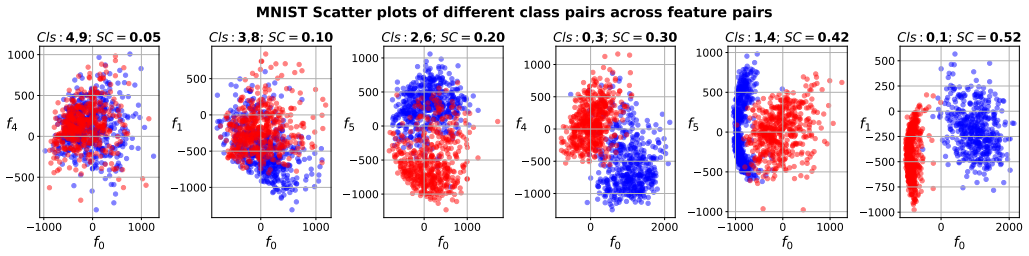
The central discovery is that feature-to-qubit permutations are a meaningful axis of performance in quantum neural networks, and that a genetic algorithm can search this discrete space effectively. Evidence for the existence of an optimal mapping comes from a full sweep of all 720 permutations on 3 qubits for six MNIST binary-class pairs: under fixed data, model initialization, and hyperparameters, the combined accuracy score spans about 20 points, with the best embedding scoring 93.18 and the worst 74.75 on classes 2 and 6. The GA, using tournament selection, order-based crossover, and swap mutation over a population of 20 permutations for 5 generations, matches or exceeds random selection in both noiseless and noisy (FakeBrisbane) simulations; in the noisy case it often beats even the best randomly chosen embedding. On higher qubit counts (6–8 qubits) and on Tiny ImageNet, the advantage persists, with fitness-score gains up to 3.33–3.36 and runtime savings up to 8.8–15%.
Load-bearing premise
All fitness evaluations use one fixed training setup, 5 epochs, a learning rate of 3e-3, a fixed model initialization, and for noisy runs the FakeBrisbane noise model, so the best embedding found is assumed to be the best for the task under that single configuration.
Editorial extensions
If this is right
- The feature-to-qubit mapping is a first-class design choice in quantum embedding, not a detail to be left to chance.
- Because the GA only requires a fitness score from training, it can be applied to other embedding circuit families and to other classical datasets without changing the search procedure.
- Under noisy simulation, the GA found embeddings that beat the best of 100 randomly chosen permutations, suggesting that evolutionary search is particularly useful when noise makes performance fluctuate.
- The runtime of GA search is comparable to or lower than random selection at the same evaluation budget, so the search can be run as a standard part of QML model development on NISQ hardware.
Reading between the lines
- One extension the paper leaves implicit is using the GA to search not only the feature order but also which embedding circuit template to use, since the same permutation representation extends to any circuit with a discrete parameter-assignment step.
- The optimality claim rests on a single training configuration, so testing whether the GA-selected embedding remains optimal under different hyperparameters or seeds would tell whether the search is finding a property of the data or an artifact of the fixed training setup.
- The reported gains over QEK, QAOA embedding, and QRAC are small in multiplicative terms, so the practical significance may lie less in raw accuracy and more in the ability to find a good embedding quickly without gradient-based training of the embedding itself.
Signed reviews
Editorial analysis
A structured set of objections, weighed in public.
Referee Report
Summary. The paper proposes framing the selection of a quantum embedding (feature-to-qubit mapping) for QML as a discrete search problem, solved with a genetic algorithm (GA). Experiments on MNIST and Tiny ImageNet binary classification, using angle embedding and a strongly entangling PQC, compare GA-selected embeddings with randomly selected mappings, report runtime improvements, and compare against QEK, QAOA-embedding, and QRAC. The authors also present a full 720-permutation sweep on 3 qubits to argue that an optimal embedding exists.
Significance. The idea of using a genetic algorithm to search over embedding permutations is reasonable and addresses a real practical question in QML. The complete sweep of all 720 permutations on 3 qubits is a useful empirical observation, and the authors provide code on GitHub. However, the current evidence does not support the paper's main comparative claims: the GA-vs-random comparison is compromised by selection on the test metric, the noiseless sweep uses a single model initialization, and the abstract omits numerous negative results. With additional experiments and more careful statistical reporting, the approach could become a solid contribution.
major comments (5)
- [III.A-B] The noiseless 720-permutation sweep uses a single fixed model initialization and only 5 training epochs. With such short training, final accuracies are strongly influenced by the random PQC initialization. The claim that the ~20-point spread "proves that there exists an optimal embedding configuration" is not supported without demonstrating that the ranking of permutations is stable across multiple initializations; otherwise the best permutation may be an artifact of one seed. Please repeat the sweep over several initializations and report rank correlations or the distribution of best/worst permutations.
- [IV.B-C, Table I] The fitness function is the combined score, defined as the mean of training and inferencing accuracies. Using test-set accuracy in the fitness function means the GA is directly selecting on the test metric, while the random baseline performs no such selection. The comparison is therefore biased in favor of GA, and the reported fitness improvements are inflated. Use a separate validation set for selection and report test accuracy only after the final embedding is chosen.
- [Abstract, Table I] The abstract states that GA outperforms random selection by 0.33-3.33 for MNIST, but Table I lists many negative improvements (GA best minus random best), e.g., -3.8 for (0,3,5) noiseless and -3.1 for (2,6,3) noisy. The quoted range is from the high-qubit MNIST subset only; the low-qubit noiseless results are mostly negative. Please report all results and make the abstract consistent with the full table.
- [IV.D, Table III] The comparison with QEK, QAOA-embedding, and QRAC is not controlled: QEK and QRAC results are taken from the original papers without re-running under identical conditions, and no error bars are given for any method. The improvements (1.003X-1.06X) are small and may be within noise. Please either run all methods under the same setup or clearly label the comparison as indicative.
- [IV.A, IV.C] The GA hyperparameters (population size 20, generations 5, crossover 0.8, retention 0.1, mutation 0.001) are fixed without sensitivity analysis, and no repeated GA runs are reported, so the reported fitness scores have no error bars. Additionally, the runtime advantage of GA over random selection is not explained given that both evaluate 100 permutations; please clarify how GA runtime can be lower and report variance across repetitions.
minor comments (6)
- [III.B, IV.A, IV.C] There are several typos: "existance" should be "existence", "indiviuduals" should be "individuals", "Addtionally" should be "Additionally", and "varation" should be "variation".
- [Table I] The header "mean best runtime best runtime" is ambiguous; please label columns clearly as RS and GA, and specify whether runtime refers to the best individual or the mean.
- [II.D] The description of reference [3] as "quantum metric learning" does not match the cited paper (Lloyd et al., "Quantum embeddings for machine learning"); please correct the description.
- [Algorithm 1] Variable names such as "f s" and "os" are not descriptive, and the "random(parents, 2)" notation is unclear; please use more explicit naming and explain the selection step.
- [IV.D] In the sentence "where perform training for proposed GA and QAOA-embedding-based methods" there is a missing pronoun; should be "we perform training".
- [Table III] The "1X" in the improvement column should be written as "1.0X" for consistency with the other ratios, and the decimal formatting should be uniform.
Circularity Check
No circularity found: the GA search is evaluated against an external random baseline, and the exhaustive sweep is an independent empirical observation.
full rationale
The paper's central claims are empirical rather than derivational. The GA optimizes the same combined training/inference fitness score that is later used to report performance, but this is the algorithm's objective function, not a circular reduction: the random-selection baseline is an external control, and the reported improvements are measured quantities with concrete runtime and accuracy values. The 720-permutation sweep in Section III is an exhaustive empirical enumeration; the fact that a finite set of scores has a maximum is definitional, but the substantive finding is the observed spread in accuracy across permutations, which is not entailed by the definition. The paper relies on no load-bearing self-citations: references such as Schuld, Lloyd et al., and Thumwanit et al. are independent prior work, and no uniqueness theorem or ansatz is imported from the authors' own publications. The limitation stated in Section IV.E, that the GA result is valid only for the chosen backend, is an honest scope restriction rather than a circular step. Methodological concerns about fixed initialization, single-seed noiseless runs, and selection on the evaluation metric are robustness/fairness issues, not circularity, and do not raise the circularity score.
Assumptions & free parameters
free parameters (8)
- GA population size spop =
20
- GA generations g =
5
- GA crossover rate cr =
0.8
- GA retention rate rr =
0.1
- GA mutation rate mr =
0.001
- Fitness function weights =
1/2 train + 1/2 inference
- Training epochs and learning rate =
5 epochs, 3e-3 LR
- Features per qubit in angle embedding =
2 (RX and RY)
assumptions (4)
- domain assumption Angle embedding with two features per qubit (one RX, one RY) is a sufficient and representative embedding family for the search problem.
- domain assumption The best embedding under one fixed training configuration transfers to the QML task in general.
- domain assumption FakeBrisbane simulated noise is representative of the target hardware.
- domain assumption The genetic operators (tournament selection, order-preserving crossover, swap mutation) are effective for this permutation search space.
Cite this review
Pith. "Pith review of Optimizing Quantum Embedding using Genetic Algorithm for QML Applications." pith.science (2026). https://pith.science/paper/XIGAWVSE
@misc{pith2026241200286,
  author       = {Pith},
  title        = {Pith review of: Optimizing Quantum Embedding using Genetic Algorithm for QML Applications},
  year         = {2026},
  howpublished = {\url{https://pith.science/paper/XIGAWVSE}},
  note         = {Machine review of arXiv:2412.00286}
}
read the original abstract
Quantum Embeddings (QE) are essential for loading classical data into quantum systems for Quantum Machine Learning (QML). The performance of QML algorithms depends on the type of QE and how features are mapped to qubits. Traditionally, the optimal embedding is found through optimization, but we propose framing it as a search problem instead. In this work, we use a Genetic Algorithm (GA) to search for the best feature-to-qubit mapping. Experiments on the MNIST and Tiny ImageNet datasets show that GA outperforms random feature-to-qubit mappings, achieving 0.33-3.33 (MNIST) and 0.5-3.36 (Tiny ImageNet) higher fitness scores, with up to 15% (MNIST) and 8.8% (Tiny ImageNet) reduced runtime. The GA approach is scalable with both dataset size and qubit count. Compared to existing methods like Quantum Embedding Kernel (QEK), QAOA-based embedding, and QRAC, GA shows improvements of 1.003X, 1.03X, and 1.06X, respectively.
Figures


Figures from the paper (4 more)


Reference graph
Works this paper leans on
-
[1]
Quantum computing in the nisq era and beyond
John Preskill. Quantum computing in the nisq era and beyond. Quantum, 2:79, August 2018
work page 2018
-
[2]
Supervised quantum machine learning models are kernel methods
Maria Schuld. Supervised quantum machine learning models are kernel methods. arXiv preprint arXiv:2101.11020 , 2021
arXiv 2021
-
[3]
Quantum embeddings for machine learning, 2020
Seth Lloyd, Maria Schuld, Aroosa Ijaz, Josh Izaac, and Nathan Killoran. Quantum embeddings for machine learning, 2020. 4GitHub repository link: https://github.com/KoustubhPhalak/ quantum-embed-genetic/
work page 2020
-
[4]
Invited: Trainable discrete feature embeddings for quantum machine learning
Napat Thumwanit, Chayaphol Lortaraprasert, and Rudy Raymond. Invited: Trainable discrete feature embeddings for quantum machine learning. In 2021 58th ACM/IEEE Design Automation Conference (DAC), pages 1352–1355, 2021
work page 2021
-
[5]
Simulating a perceptron on a quantum computer
Maria Schuld, Ilya Sinayskiy, and Francesco Petruccione. Simulating a perceptron on a quantum computer. Physics Letters A , 379(7):660–663, March 2015
work page 2015
-
[6]
Stephanie Forrest. Genetic algorithms. ACM computing surveys (CSUR), 28(1):77–80, 1996
work page 1996
-
[7]
Doriguello and Ashley Montanaro
João F. Doriguello and Ashley Montanaro. Quantum Random Access Codes for Boolean Functions. Quantum, 5:402, March 2021
work page 2021
-
[8]
Thomas Hubregtsen, David Wierichs, Elies Gil-Fuster, Peter-Jan H. S. Derks, Paul K. Faehrmann, and Johannes Jakob Meyer. Training quantum embedding kernels on near-term quantum computers. Phys. Rev. A, 106:042431, Oct 2022
work page 2022
Show all 15 references
-
[9]
Automatic and effective discovery of quantum kernels, 2023
Massimiliano Incudini, Daniele Lizzio Bosco, Francesco Martini, Michele Grossi, Giuseppe Serra, and Alessandra Di Pierro. Automatic and effective discovery of quantum kernels, 2023
2023
-
[10]
Emre Sahin, Benjamin C
M. Emre Sahin, Benjamin C. B. Symons, Pushpak Pati, Fayyaz Minhas, Declan Millar, Maria Gabrani, Stefano Mensa, and Jan Lukas Robertus. Efficient parameter optimisation for quantum kernel alignment: A sub- sampling approach in variational training. Quantum, 8:1502, October 2024
2024
-
[11]
Circuit-centric quantum classifiers
Maria Schuld, Alex Bocharov, Krysta M Svore, and Nathan Wiebe. Circuit-centric quantum classifiers. Physical Review A , 101(3):032308, 2020
2020
-
[12]
Finding groups in data: an introduction to cluster analysis
Leonard Kaufman and Peter J Rousseeuw. Finding groups in data: an introduction to cluster analysis . John Wiley & Sons, 2009
2009
-
[13]
Karl Pearson. Liii. on lines and planes of closest fit to systems of points in space. The London, Edinburgh, and Dublin philosophical magazine and journal of science , 2(11):559–572, 1901
1901
-
[14]
Tiny imagenet visual recognition challenge
Ya Le and Xuan Yang. Tiny imagenet visual recognition challenge. CS 231N, 7(7):3, 2015
2015
-
[15]
Uniform manifold approximation and projection for dimension reduction
McInnes Leland, Healy John, and Melville James. Uniform manifold approximation and projection for dimension reduction. arXiv preprint arXiv:1802.03426, 2018
2018 arXiv
Reviewed August 12, 2026 · model on record in the stance chip above.
Discussion (0). Continue with ORCID to comment.