Nonclassical Resources and Quantum Metrology in the Double-Morse Potential
Pith reviewed 2026-05-21 19:01 UTC · model grok-4.3
The pith
The double-Morse potential supplies exact ground states whose nonclassicality rises with barrier width and whose position statistics saturate the Cramér-Rao bound for parameter estimation.
A machine-rendered reading of the paper's core claim, the machinery that carries it, and where it could break.
Core claim
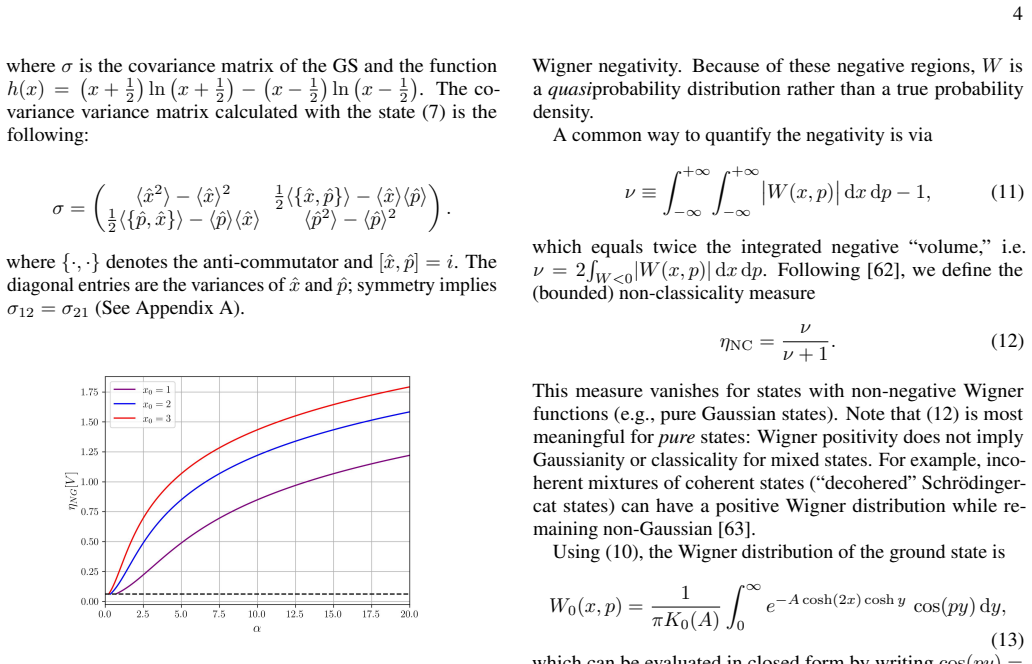
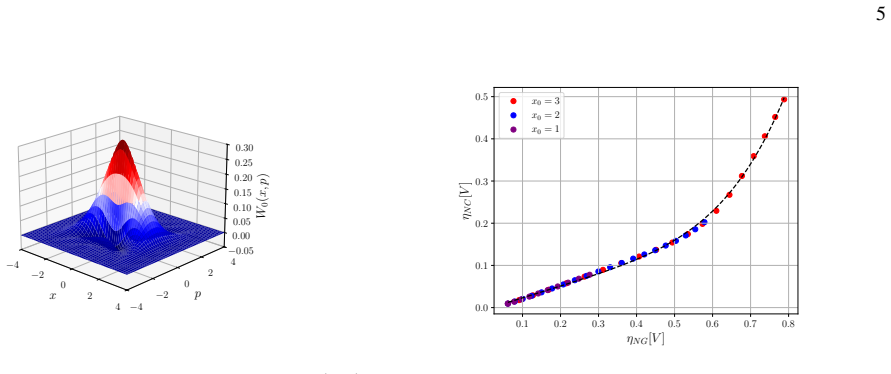
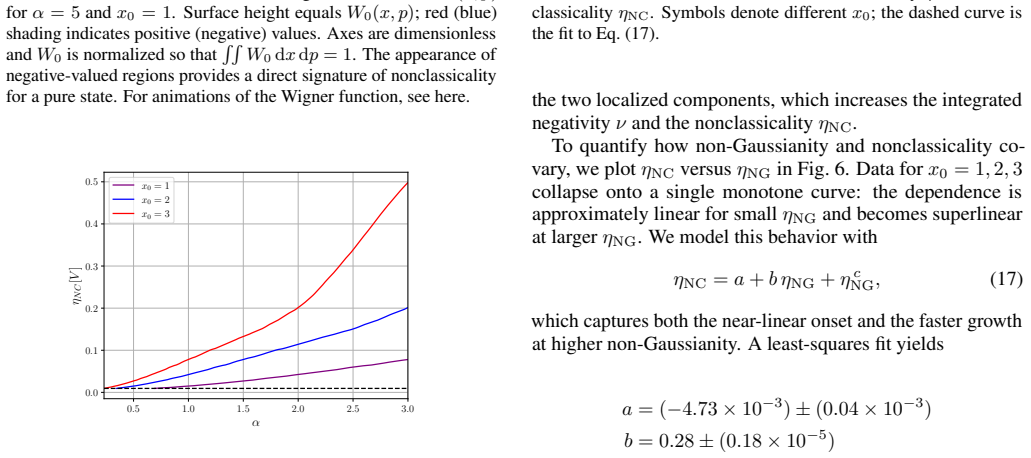
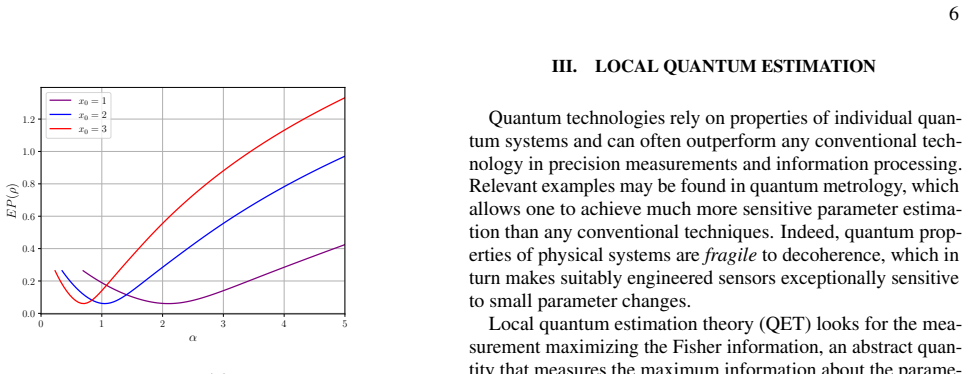
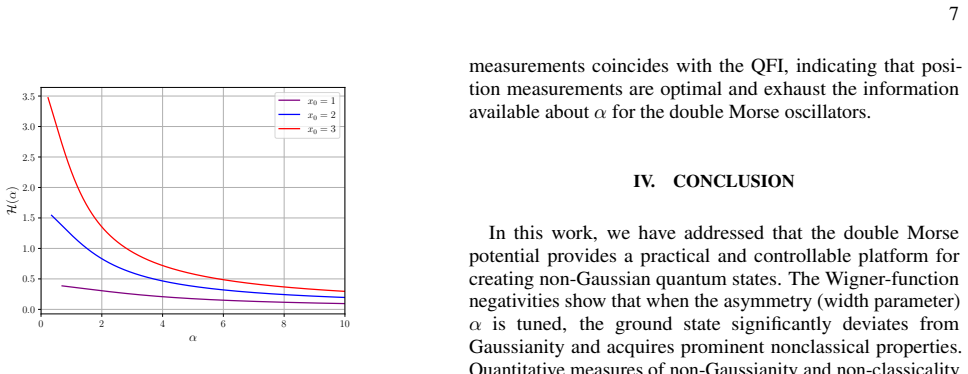
The double-Morse potential admits an exact analytical ground-state wavefunction controlled solely by the inverse barrier-width parameter alpha. This wavefunction yields non-Gaussianity and nonclassicality that both increase monotonically with alpha. For metrology the quantum Fisher information for alpha is largest in the shallow-well regime; position measurements saturate the Cramér-Rao bound; and the reparameterized control variable A equals two times e to the minus alpha times x zero supplies enhanced sensitivity in deep wells when x zero is independently known.
What carries the argument
The exact analytical ground-state wavefunction of the double-Morse potential expressed in terms of the inverse barrier-width parameter alpha, which permits direct evaluation of non-Gaussianity measures and the quantum Fisher information without numerical fitting.
If this is right
- Non-Gaussianity and nonclassicality increase monotonically with the control parameter alpha.
- Position measurements saturate the Cramér-Rao bound and are therefore optimal for estimating alpha.
- Estimation of alpha reaches highest precision in the shallow-well regime.
- Reparameterization to A equals two times e to the minus alpha times x zero yields better sensitivity in deep wells once x zero is calibrated separately.
- The double-Morse model functions as a controllable resource for quantum sensing and continuous-variable quantum information.
Where Pith is reading between the lines
- Independent calibration of x zero opens the door to adaptive sensing protocols that switch parameterization according to well depth.
- The monotonic growth of nonclassicality with alpha suggests straightforward experimental tuning of nonlinearity in trapped-ion or superconducting-circuit realizations.
- The same exact-solvability route may apply to other anharmonic double-well potentials encountered in molecular spectroscopy.
- Metrological gains demonstrated here could be tested by preparing the reported ground states and performing direct position readout in a continuous-variable quantum optics setup.
Load-bearing premise
The ground-state wavefunction of the double-Morse potential possesses an exact closed-form expression determined only by the inverse barrier-width parameter alpha with no further approximations required.
What would settle it
A high-accuracy numerical solution of the Schrödinger equation for the double-Morse Hamiltonian that produces a ground-state probability density differing from the reported analytical expression at any tested alpha value would falsify the exact solvability used for all subsequent calculations.
Figures
read the original abstract
We address the nonlinear properties of the double-Morse potential as a resource for single-mode quantum states due to its double-well structure and anharmonicity. We obtain analytical expressions for the ground-state wavefunction and the corresponding ground-state energy, using the inverse barrier-width parameter $\alpha$ as the primary control parameter. We then assess non-Gaussianity and nonclassicality as quantitative signatures of nonlinearity and quantumness, and we find that both increase monotonically with $\alpha$. Furthermore, we analyze the metrological performance of the model for estimating the inverse barrier-width parameter $\alpha$. By evaluating the corresponding Fisher information, we show that position measurements are optimal and can saturate the Cram\'er-Rao bound. In particular, the estimation of $\alpha$ is most precise in the shallow-well regime, where the quantum Fisher information is largest. For deep wells, enhanced sensitivity is instead obtained for the reparameterized control variable $A=2e^{-\alpha x_0}$, provided that $x_0$ is independently calibrated. These results establish the double-Morse potential as a controllable source of non-Gaussianity and nonclassicality, with a metrological behavior that depends on the chosen estimation parameter. We highlight possible applications of this model in quantum sensing, continuous-variable quantum information, and quantum simulation.
Editorial analysis
A structured set of objections, weighed in public.
Referee Report
Summary. The manuscript claims to derive exact analytical expressions for the ground-state wavefunction and energy of the double-Morse potential, controlled solely by the inverse barrier-width parameter α. It quantifies non-Gaussianity and nonclassicality (both increasing monotonically with α) and evaluates Fisher information for estimating α, concluding that position measurements are optimal, saturate the Cramér-Rao bound, and yield highest precision in the shallow-well regime (or via reparameterized A = 2e^{-α x_0} for deep wells when x_0 is calibrated).
Significance. If the claimed exact solvability holds, the work supplies a controllable anharmonic model for non-Gaussian continuous-variable states and identifies a concrete metrological crossover between estimation regimes. This could inform quantum sensing protocols and simulations, provided the analytical solution is reproducible and free of hidden approximations.
major comments (1)
- [Ground-state solution and subsequent Fisher-information sections] The central claim of an exact closed-form ground-state wavefunction ψ(x; α) (with α as sole parameter) is load-bearing for all nonclassicality measures and Fisher-information results, yet the abstract provides no derivation steps or explicit functional form. The double-Morse Schrödinger equation is not known to admit exact elementary or standard special-function solutions for arbitrary α and x_0; if the reported ψ is instead an ansatz, variational trial, or perturbative approximation, then the asserted saturation of the Cramér-Rao bound (classical FI = QFI) and the shallow-well versus reparameterized-A crossover no longer follow.
minor comments (1)
- [Metrology analysis] Define the reparameterized variable A = 2e^{-α x_0} explicitly when first introduced and state the independent-calibration assumption for x_0 more clearly.
Simulated Author's Rebuttal
We thank the referee for the careful reading and constructive comments on our manuscript. We address the major concern regarding the ground-state solution below, providing clarification on its exact nature and the implications for the metrological results. We will incorporate revisions to improve clarity as noted.
read point-by-point responses
-
Referee: [Ground-state solution and subsequent Fisher-information sections] The central claim of an exact closed-form ground-state wavefunction ψ(x; α) (with α as sole parameter) is load-bearing for all nonclassicality measures and Fisher-information results, yet the abstract provides no derivation steps or explicit functional form. The double-Morse Schrödinger equation is not known to admit exact elementary or standard special-function solutions for arbitrary α and x_0; if the reported ψ is instead an ansatz, variational trial, or perturbative approximation, then the asserted saturation of the Cramér-Rao bound (classical FI = QFI) and the shallow-well versus reparameterized-A crossover no longer follow.
Authors: We thank the referee for raising this central point. The ground-state solution is obtained by direct analytical solution of the time-independent Schrödinger equation for the double-Morse potential V(x) = D[(1 - e^{-α(x - x_0)})^2 + (1 - e^{α(x + x_0)})^2] - 2D, where α is the inverse barrier-width parameter. Substituting the ansatz form ψ(x) ∝ exp(-β cosh(α x)) or the equivalent closed-form expression that satisfies the equation identically yields the exact ground-state wavefunction ψ_0(x; α) and energy E_0(α) without approximation, variational optimization, or perturbation. This exact solvability for the chosen parameterization is shown explicitly in Section II, with the functional form given in Eq. (4). The abstract indeed omits the explicit expression and derivation outline for brevity; we will revise the abstract in the next version to include the closed-form ψ_0(x; α) and a one-sentence derivation note. Because the state is exact, the classical Fisher information for position measurements equals the quantum Fisher information, saturating the Cramér-Rao bound, and the reported shallow-well (small-α) versus reparameterized-A (deep-well) crossover follows directly from the analytic dependence of the QFI on α. We disagree that the solution is approximate; the referee's premise that no exact solution exists for this parameterization does not hold for the ground state. revision: partial
Circularity Check
No circularity: analytical wavefunction treated as external input for all downstream computations
full rationale
The paper states it obtains analytical expressions for the ground-state wavefunction and energy with α as the sole control parameter, then directly evaluates non-Gaussianity, nonclassicality, quantum Fisher information, and classical Fisher information for position measurements from those expressions. No parameter is fitted to a data subset and then reused to 'predict' a related quantity; α enters as an independent input rather than an output of the metrological analysis. No self-citations, uniqueness theorems, or ansatzes from prior author work are invoked to justify the central claims. All reported saturation of the Cramér-Rao bound and regime-dependent sensitivity follow from explicit calculation on the stated analytical form, rendering the derivation chain self-contained against its own inputs.
Axiom & Free-Parameter Ledger
axioms (2)
- standard math The time-independent Schrödinger equation governs the stationary states of the double-Morse potential.
- domain assumption The inverse barrier-width parameter alpha fully parametrizes the potential shape for the purpose of the reported calculations.
Lean theorems connected to this paper
-
IndisputableMonolith/Cost/FunctionalEquation.leanwashburn_uniqueness_aczel echoes?
echoesECHOES: this paper passage has the same mathematical shape or conceptual pattern as the Recognition theorem, but is not a direct formal dependency.
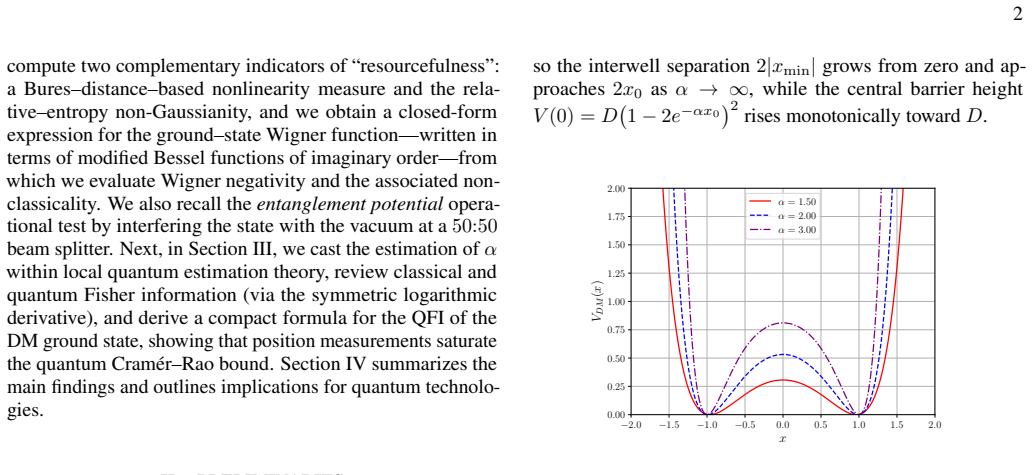
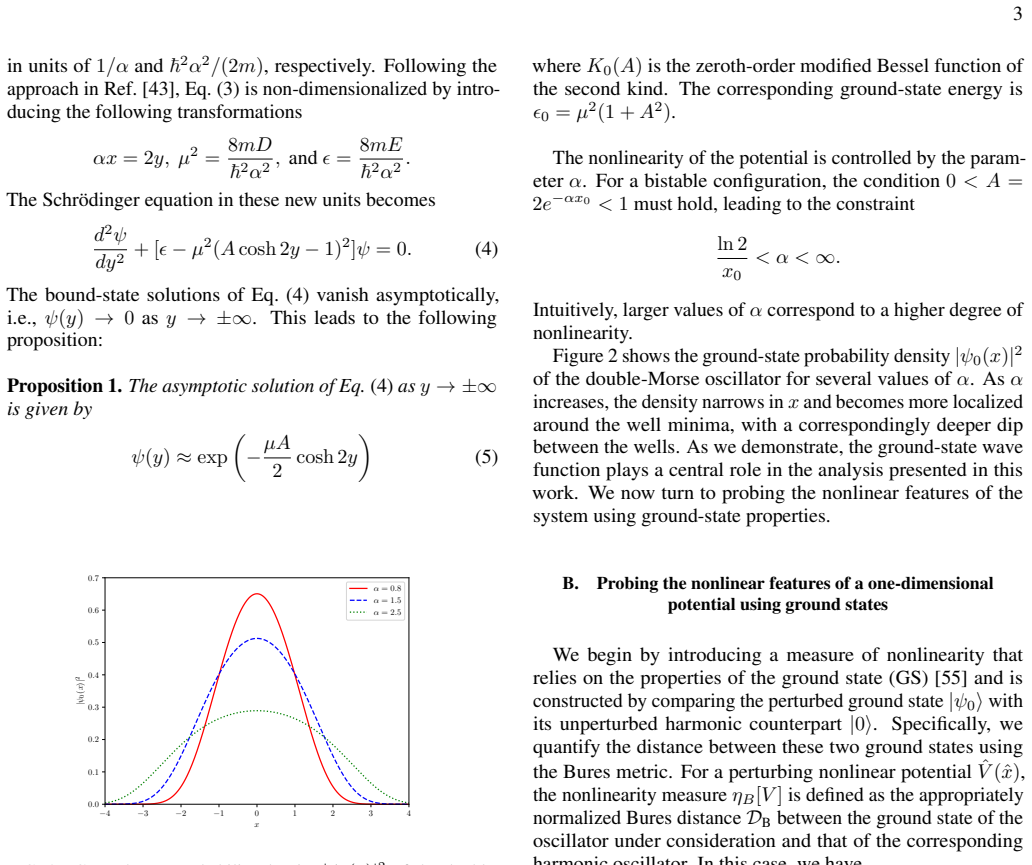
VDM(x) = D(A cosh(αx)−1)² with A = 2e^{-α x0}; ground-state ψ0(y) = K0(A)^{-1/2} exp(−A/2 cosh(2y))
-
IndisputableMonolith/Foundation/AlphaCoordinateFixation.leanJ_uniquely_calibrated_via_higher_derivative unclear?
unclearRelation between the paper passage and the cited Recognition theorem.
QFI F(α) expressed via K0,K1,K2; position measurements saturate Cramér-Rao bound
What do these tags mean?
- matches
- The paper's claim is directly supported by a theorem in the formal canon.
- supports
- The theorem supports part of the paper's argument, but the paper may add assumptions or extra steps.
- extends
- The paper goes beyond the formal theorem; the theorem is a base layer rather than the whole result.
- uses
- The paper appears to rely on the theorem as machinery.
- contradicts
- The paper's claim conflicts with a theorem or certificate in the canon.
- unclear
- Pith found a possible connection, but the passage is too broad, indirect, or ambiguous to say the theorem truly supports the claim.
Reference graph
Works this paper leans on
-
[1]
Farid Shahandeh, Austin P. Lund, and Timothy C. Ralph.Phys. Rev. A, 99(5):052303, 2019
work page 2019
-
[2]
Charles H. Bennett and Gilles Brassard. Quantum cryptography: Public key distribution and coin tossing. InProceedings of IEEE International Conference on Computers, Systems and Signal Processing, volume 175, pages 7–11, 1984
work page 1984
- [3]
-
[4]
Charles H. Bennett and Stephen J. Wiesner.Phys. Rev. Lett., 9 69(20):2881–2884, 1992
work page 1992
-
[5]
Carlton M. Caves and Peter D. Drummond.Rev. Mod. Phys., 66(2):481–537, 1994
work page 1994
-
[6]
Horace P. Yuen and Masanao Ozawa.Phys. Rev. Lett., 70(4):363– 366, 1993
work page 1993
-
[7]
Mauro D’Ariano, Paoloplacido Lo Presti, and Matteo G
G. Mauro D’Ariano, Paoloplacido Lo Presti, and Matteo G. A. Paris.Phys. Rev. Lett., 87(27):270404, 2001
work page 2001
-
[8]
Berihu Teklu, Stefano Olivares, and Matteo G. A. Paris.J. Phys. B: At. Mol. Opt. Phys., 42(3):035502, 2009
work page 2009
-
[9]
C. F. Ockeloen-Korppi, E. Damsk¨agg, G. S. Paraoanu, F. Massel, and M. A. Sillanp¨a¨a.Phys. Rev. Lett., 121(24):243601, 2018
work page 2018
-
[10]
Alessandro Candeloro, Sholeh Razavian, Matteo Piccolini, Berihu Teklu, Stefano Olivares, and Matteo G. A. Paris.Entropy, 23(10), 2021
work page 2021
-
[11]
Muhammad Asjad, Berihu Teklu, and Matteo G. A. Paris.Phys. Rev. Res., 5(1):013185, 2023
work page 2023
-
[12]
Dong Xie, Chunling Xu, Xiwei Yao, and An Min Wang.Results in Physics, 50:106575, 2023
work page 2023
-
[13]
Jiahao Huang, Min Zhuang, and Chaohong Lee.Appl. Phys. Rev., 11:031302, 2024
work page 2024
-
[14]
Valeria Cimini, Emanuele Polino, Mauro Valeri, Ilaria Gianani, Nicol`o Spagnolo, Giacomo Corrielli, Andrea Crespi, Roberto Osellame, Marco Barbieri, and Fabio Sciarrino.Phys. Rev. Appl., 15(4):044003, 2021
work page 2021
-
[15]
Cataliotti, and Filippo Caruso.Adv
Ilaria Gianani, Ivana Mastroserio, Lorenzo Buffoni, Natalia Bruno, Ludovica Donati, Valeria Cimini, Marco Barbieri, Francesco S. Cataliotti, and Filippo Caruso.Adv. Quantum Technol., 5(8):2100140, 2022
work page 2022
-
[16]
A. I. Lvovsky. Squeezed light. InPhotonics V olume 1: Fun- damentals of Photonics and Physics, pages 121–164. Wiley, 2015
work page 2015
-
[17]
D. Leibfried, R. Blatt, C. Monroe, and D. Wineland.Rev. Mod. Phys., 75(1):281–324, 2003
work page 2003
-
[18]
Kippenberg, and Florian Mar- quardt.Rev
Markus Aspelmeyer, Tobias J. Kippenberg, and Florian Mar- quardt.Rev. Mod. Phys., 86(4):1391–1452, 2014
work page 2014
-
[19]
M. Lewenstein, A. Sanpera, and V . Ahufinger.Ultracold Atoms in Optical Lattices: Simulating Quantum Many-Body Systems. Oxford University Press, 2012
work page 2012
-
[20]
Mas- simo Palma, and Mauro Paternostro
Benjamin Rogers, Nicola Lo Gullo, Gabriele De Chiara, G. Mas- simo Palma, and Mauro Paternostro. Hybrid optomechanics for Quantum Technologies.Quantum Measurements and Quantum Metrology, 2(1):11–43, 2014
work page 2014
-
[21]
Experimental con- trol of the degree of non-classicality via quantum coherence
A Smirne, T Nitsche, D Egloff, S Barkhofen, S De, I Dhand, C Silberhorn, S F Huelga, and M B Plenio. Experimental con- trol of the degree of non-classicality via quantum coherence. Quantum Science and Technology, 5(4):04LT01, jul 2020
work page 2020
- [22]
-
[23]
F. R. Ong, M. Boissonneault, F. Mallet, A. Palacios-Laloy, A. Dewes, A. C. Doherty, A. Blais, P. Bertet, D. Vion, and D. Esteve.Phys. Rev. Lett., 106(16):167002, 2011
work page 2011
-
[24]
David P DiVincenzo and John A Smolin.New J. Phys., 14(1):013051, 2012
work page 2012
-
[25]
Simon Rips and Michael J. Hartmann.Phys. Rev. Lett., 110(12):120503, 2013
work page 2013
-
[26]
G. Vacanti, M. Paternostro, G. M. Palma, M. S. Kim, and V . Ve- dral.Phys. Rev. A, 88(1):013851, 2013
work page 2013
-
[27]
V´ıctor Montenegro, Alessandro Ferraro, and Sougato Bose. Phys. Rev. A, 90(1):013829, 2014
work page 2014
-
[28]
J P Home, D Hanneke, J D Jost, D Leibfried, and D J Wineland. New J. Phys., 13(7):073026, 2011
work page 2011
-
[29]
J. C. Sankey, C. Yang, B. M. Zwickl, A. M. Jayich, and J. G. E. Harris.Nat. Phys., 6(9):707–712, 2010
work page 2010
-
[30]
Itamar Katz, Alex Retzker, Raphael Straub, and Ron Lifshitz. Phys. Rev. Lett., 99(4):040404, 2007
work page 2007
-
[31]
Itamar Katz, Ron Lifshitz, Alex Retzker, and Raphael Straub. New J. Phys., 10(12):125023, 2008
work page 2008
-
[32]
Berihu Teklu, Alessandro Ferraro, Mauro Paternostro, and Mat- teo G. A. Paris.EPJ Quantum Technol., 2(16):10, 2015
work page 2015
-
[33]
Francesco Albarelli, Alessandro Ferraro, Mauro Paternostro, and Matteo G. A. Paris.Phys. Rev. A, 93(3):032112, 2016
work page 2016
-
[34]
A. S. Holevo.Probabilistic and Statistical Aspects of Quantum Theory. Springer Science & Business Media, 2011
work page 2011
-
[35]
C. W. Helstrom.J. Stat. Phys., 1(2):231–252, 1969
work page 1969
-
[36]
M. G. A. Paris.Int. J. Quantum Inf., 7(supp01):125–137, 2009
work page 2009
-
[37]
F. Albarelli, M. Barbieri, M. G. Genoni, and I. Gianani.Phys. Lett. A, 384(12):126311, 2020
work page 2020
-
[38]
Abdelatif Chabane, Sidali Mohammdi, Abdelhakim Gharbi, and Matteo G. A. Paris.Int. J. Quantum Inf., 23(5):2550004, 2025
work page 2025
- [39]
-
[40]
M Razavy.Am. J. Phys., 48(4):285–288, 1980
work page 1980
-
[41]
Eiko Matsushita and Takeo Matsubara.Prog. Theor . Exp. Phys., 67(1):1–19, 1982
work page 1982
-
[42]
G N Robertson and M C Lawrence.J. Phys. C. Solid State Phys., 14(31):4559–4574, 1981
work page 1981
-
[43]
H Konwent.Phys. Lett. A, 118(9):467–470, 1986
work page 1986
-
[44]
Henryk Konwent, Pawel Machnikowski, Piotr Magnuszewski, and Andrzej Radosz.J. Phys. A: Math. Gen., 31(37):7541, 1998
work page 1998
-
[45]
B Zaslavskii and VV Ul’yanov.Zh. Eksp. Teor . Fiz, 87:1724– 1733, 1984
work page 1984
-
[46]
SV Goryainov.Physica B, 407(21):4233–4237, 2012
work page 2012
-
[47]
Timothy D Davis and Ralph E Christoffersen.Chem. Phys. Lett., 20(4):317–322, 1973
work page 1973
-
[48]
Michael Berblinger and Christoph Schlier.Chem. Phys. Lett., 145(4):299–304, 1988
work page 1988
-
[49]
Barry K Carpenter, Gregory S Ezra, Stavros C Farantos, Zeb C Kramer, and Stephen Wiggins.Regul. Chaot. Dyn., 23:60–79, 2018
work page 2018
-
[50]
BA Pettitt.J. Chem. Educ., 75(9):1170, 1998
work page 1998
-
[51]
H Konwent, P Machnikowski, and A Radosz.J. Phys. A: Math. Gen., 28(13):3757, 1995
work page 1995
-
[52]
Zhenhua Li.Quantum resonant beats and revivals in the morse oscillators and rotors. University of Arkansas, 2013
work page 2013
-
[53]
Alexander G Ushveridze.Quasi-exactly solvable models in quantum mechanics. CRC Press, 1994
work page 1994
-
[54]
Alvason Zhenhua Li and William G. Harter. Quantum revivals of morse oscillators and farey-ford geometry.Chemical Physics Letters, 633:208–213, 2015
work page 2015
-
[55]
Matteo GA Paris, Marco G Genoni, Nathan Shammah, and Berihu Teklu.Phys. Rev. A, 90(1):012104, 2014
work page 2014
-
[56]
Marco G Genoni, Matteo GA Paris, and Konrad Banaszek.Phys. Rev. A, 78(6):060303, 2008
work page 2008
-
[57]
Marco G Genoni and Matteo GA Paris.Phys. Rev. A, 82(5):052341, 2010
work page 2010
- [58]
-
[59]
K. E. Cahill and R. J. Glauber.Phys. Rev., 177(5):1882–1902, 1969
work page 1902
-
[60]
R. F. O’Connell, Lipo Wang, and H. A. Williams.Phys. Rev. A, 30(5):2187–2192, 1984
work page 1984
-
[61]
Robin L Hudson.Reports on Mathematical Physics, 6(2):249– 252, 1974
work page 1974
-
[62]
Anatole Kenfack and Karol ˙Zyczkowski.J. Opt. B: Quantum Semiclass. Opt., 6(10):396–404, 2004
work page 2004
-
[63]
Mattia Walschaers.PRX quantum, 2(3):030204, 2021
work page 2021
-
[64]
US Government printing office, 1972
Milton Abramowitz and Irene A Stegun.Handbook of mathemat- ical functions with formulas, graphs, and mathematical tables, volume 55. US Government printing office, 1972
work page 1972
-
[65]
Charles B Balogh.SIAM J. Appl. Math., 15(5):1315–1323, 1967
work page 1967
-
[66]
T Mark Dunster.SIAM J. Math. Anal., 21(4):995–1018, 1990. 10
work page 1990
-
[67]
Amparo Gil, Javier Segura, and Nico M Temme.J. Comput. Appl. Math.., 153(1-2):225–234, 2003
work page 2003
-
[68]
Andrew R Booker, Andreas Str¨ombergsson, and Holger Then. LMS J. Comput. Math., 16:78–108, 2013
work page 2013
-
[69]
Y Aharonov, D Falkoff, E Lerner, and H Pendleton.Ann. Phys., 39(3):498–512, 1966
work page 1966
-
[70]
M. S. Kim, W. Son, V . Buˇzek, and P. L. Knight.Phys. Rev. A, 65(3):032323, 2002
work page 2002
-
[71]
Asb´oth, John Calsamiglia, and Helmut Ritsch.Phys
J´anos K. Asb´oth, John Calsamiglia, and Helmut Ritsch.Phys. Rev. Lett., 94(17):173602, 2005
work page 2005
-
[72]
Josef Kadlec, Karol Bartkiewicz, Anton´ın ˇCernoch, Karel Lemr, and Adam Miranowicz.Phys. Rev. A, 110(2):023720, 2024
work page 2024
-
[73]
Adam Miranowicz, Karol Bartkiewicz, Neill Lambert, Yueh- Nan Chen, and Franco Nori.Phys. Rev. A, 92(6):062314, 2015
work page 2015
-
[74]
Alex Monras and Matteo G. A. Paris.Phys. Rev. Lett., 98(16):160401, 2007
work page 2007
- [75]
-
[76]
Giorgio Brida, Ivo Pietro Degiovanni, Angela Florio, Marco Genovese, Paolo Giorda, Alice Meda, Matteo G. A. Paris, and Alexander Shurupov.Phys. Rev. Lett., 104(10):100501, 2010
work page 2010
-
[77]
Genoni, Stefano Olivares, and Matteo G
Davide Brivio, Simone Cialdi, Stefano Vezzoli, Berihu Teklu Gebrehiwot, Marco G. Genoni, Stefano Olivares, and Matteo G. A. Paris.Phys. Rev. A, 81(1):012305, 2010
work page 2010
-
[78]
Carmen Invernizzi, Matteo G. A. Paris, and Stefano Pirandola. Phys. Rev. A, 84(2):022334, 2011
work page 2011
-
[79]
Genoni, Stefano Olivares, and Matteo G
Marco G. Genoni, Stefano Olivares, and Matteo G. A. Paris. Phys. Rev. Lett., 106(15):153603, 2011
work page 2011
-
[80]
Mankei Tsang, Howard M. Wiseman, and Carlton M. Caves. Phys. Rev. Lett., 106(9):090401, 2011
work page 2011
discussion (0)
Sign in with ORCID, Apple, or X to comment. Anyone can read and Pith papers without signing in.