REVIEW 4 major objections 5 minor 50 references
Can Peter Pan Survive MT? A Stylometric Study of LLMs, NMTs, and HTs in Children's Literature Translation
T0 review · 4 major / 5 minor · reviewed 2026-08-06 · deepseek-v4-flash
Pith's one-line read The paper claims that, across 447 features and 21 translations of Peter Pan, LLM outputs are closer to human translations than NMT outputs on the creative-text features that matter for children's literature.
desk verdict Useful corpus and feature set, but the LLM-over-NMT claim on CTT features is built into the prompt, not the models. read the letter →
The pith
A machine-rendered reading of the paper's core claim, the machinery that carries it, and where it could break.
The reading
What carries the argument
The machinery is a comparative stylometric pipeline built on a parallel corpus: 21 English-to-Chinese translations of Peter Pan, each annotated with word segmentation, part-of-speech tags, and dependency parses. The feature set has 447 features in two layers—generic textual features (lexical diversity, parts of speech, syntactic and dependency measures, readability scores, n-grams) and CTT-specific features for creative text translation (repetition patterns such as AA/AAA/ABAB, rhythm, translatability including foreignness, and miscellaneous markers including the Chinese -er suffix and onomatopoeia). Chi-square ranking keeps the top 30 features, and five classifiers plus k-means and hierarchical clustering turn stylistic distance into numbers: high classification accuracy means two groups are stylistically separable, low accuracy means they are close. The load-bearing comparison is distributional proximity, not human quality judgment.
What would settle it
Run the same LLMs on the same Peter Pan chapters with a plain neutral translation prompt, measure foreignness, -er suffix, and AA repetition, and compare with the NMT outputs; if the LLM values move toward the NMT range, the reported closeness to human translations is prompt-driven. A complementary check is to translate a less canonical children's novel that is unlikely to be in LLM training data and see whether LLMs still cluster near the human translations.
Extended reading notes
Core claim
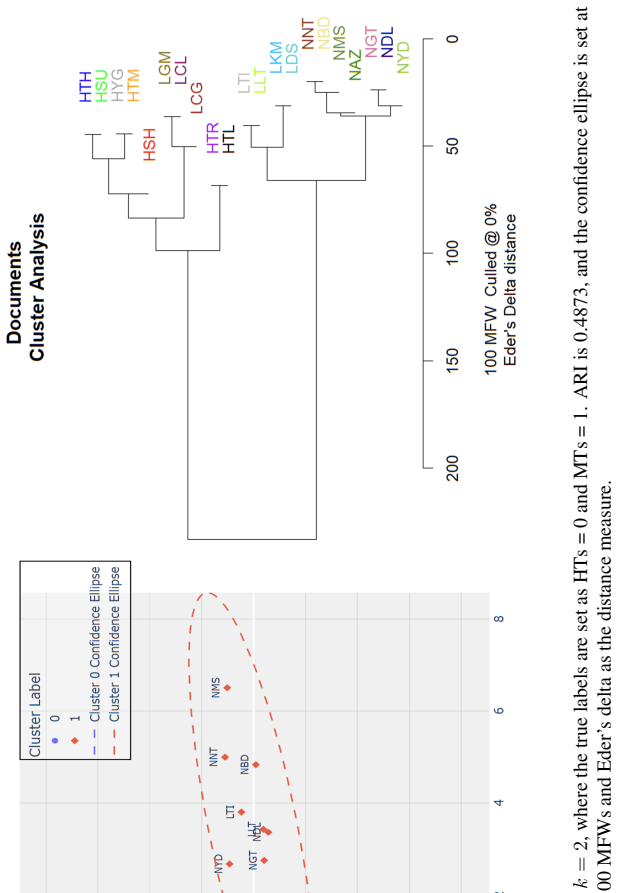
The paper's central claim is that, in this Peter Pan corpus, LLM translations are distributionally more similar to human translations than NMT translations are, and this is most visible on the features designed for creative text translation. Classification accuracy for distinguishing LLMs from NMTs is 0.7464 with all features, well below the 0.9376 for distinguishing humans from NMTs, and clustering places three LLMs (ChatGPT, Claude, Gemini) near the human cluster while other LLMs sit with NMTs. On foreignness, the -er suffix, and AA-pattern repetition, LLMs move in the human direction relative to NMTs. The paper also reports generic-feature differences where LLMs use more descriptive words and more adverbs than NMTs, again in the human direction. It does not claim that LLMs equal human translators; it claims a gradient on which LLMs outperform NMTs in approximating human stylistic choices for this text and language pair.
Load-bearing premise
The result depends on a comparison in which LLMs were explicitly prompted to perform child-friendly transcreation and to use onomatopoeia, reduplication, and rhyming phrases, while NMT engines received no such instruction, so the measured LLM advantage on exactly those features could be an artifact of the prompt rather than a property of the models.
Editorial extensions
If this is right
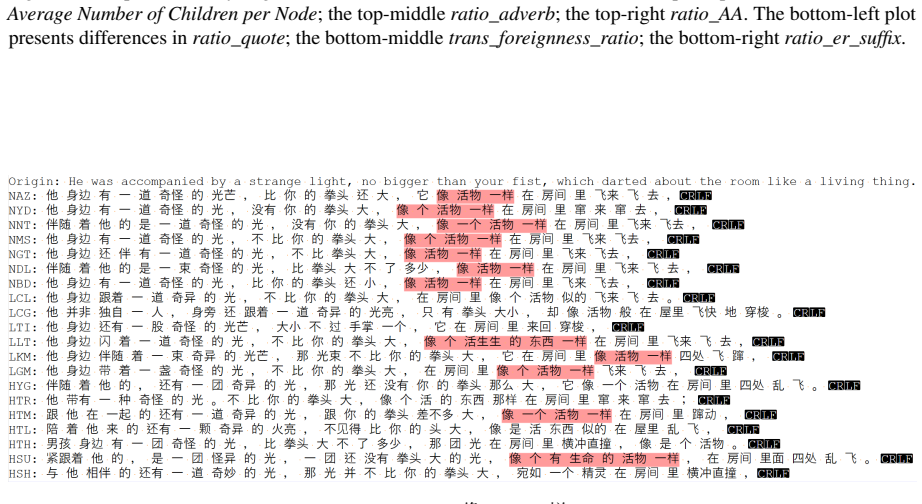
- In English-to-Chinese children's literature, NMT output is more likely than LLM output to show source-bound explicitation, such as overused conjunctions and the fixed simile pattern 像...一样.
- For stylistic features central to child readers—AA repetition, the playful -er suffix, and low foreignness—general LLMs such as ChatGPT and Claude can come measurably closer to human practice than NMT systems.
- Marketed 'creative' or MT-tailored LLMs may not deliver the advertised stylistic gain; in this corpus LaraTranslate and TowerInstruct showed no clear advantage over other LLMs on the CTT-specific features.
- Classification and clustering over a rich feature set can serve as a screening tool for stylistic translationese in children's literature, independent of fluency judgments.
Reading between the lines
- Editorially, the prompt is a confound the paper partly concedes: the LLM instruction explicitly asks for reduplication and onomatopoeia, so a neutral-prompt replication is the natural next experiment before attributing the style gap to model capability.
- Editorially, if the prompt-driven effect is real, prompt engineering becomes a cheap control knob for child-appropriate style in LLM translation, potentially closing part of the HT-LLM gap without fine-tuning.
- Editorially, because Peter Pan is a canonical public-domain text likely present in LLM training data, the human-like closeness could be inflated by memorization; a less canonical book would isolate stylistic skill from data contamination.
- Editorially, the foreignness result implies LLMs are more domesticating than NMTs, and whether that counts as an advantage depends on translation norms; reader-response testing with children would be a natural test.
Editorial analysis
A structured set of objections, weighed in public.
Referee Report
Summary. The paper builds a corpus of 21 Chinese translations of J.M. Barrie's Peter Pan (7 human translations, 7 NMT outputs, 7 LLM outputs), extracts 447 stylometric features grouped into generic and CTT-specific categories, and applies classification and clustering to compare the three translation groups. It reports that for generic features, MTs differ from HTs in conjunction-word distributions and the occurrence of the 1-word-gram '一样', while NMTs and LLMs differ in descriptive-word and adverb ratios. For CTT-specific features, the paper claims that LLMs outperform NMTs in matching HT-style distributions of foreignness, the er-suffix, and AA-pattern repetition, concluding that LLMs show potential for children's literature translation.
Significance. If the central claim were established, the paper would make a useful empirical contribution to quantitative CLT research and to the ongoing discussion of whether LLMs offer advantages over NMTs for creative texts. The main assets are the parallel 21-version Peter Pan corpus and the explicit taxonomy of CTT-specific features. The generic lexical findings, such as the overuse of explicit connectives and '像...一样' in NMT outputs, are plausible and interesting. However, the design as presented does not isolate LLM capability from the prompt instructions, and the classification and statistical methodology needs strengthening. The paper is also commendably transparent by providing the full prompt in Appendix A, which allows the central confound to be identified directly from the manuscript.
major comments (4)
- [§3.1, Appendix A, §5.2.1–5.2.3] The LLM translations were produced with a prompt that explicitly instructs the model to 'incorporate onomatopoeia, reduplication, rhyming phrases,' 'avoid rigid literal translation,' and perform 'cultural adaptation,' as shown in Appendix A. The NMT systems received no such instruction. The CTT-specific features used to support the main claim are exactly the categories the prompt demands: AA repetition is reduplication, er-suffix is a playful/colloquial marker, and foreignness is reduced by the cultural-adaptation instruction. Therefore the LLM-vs-NMT differences in Figure 6 and the 'LLMs outperform NMTs' conclusion in §5.2 do not establish an intrinsic LLM advantage; they may simply reflect the prompt. The Limitations section acknowledges possible training-data contamination but does not mention this prompt confound. The authors should add a neutral-prompt or no-prompt LLM condition (or an ablation removing the stylistic instructions) and show that the advantage persists.
- [§3.3.1, §4.1, Table 2] Feature selection is performed by chi-square ranking on the full dataset, with the top 30 features retained, and classification accuracy is then reported on the same dataset. With n=21 and 447 features, this procedure can substantially inflate accuracy and makes the reported values (e.g., 0.9376 for HTs–NMTs) difficult to interpret. No cross-validation, nested feature selection, or permutation baseline is described. The accuracy numbers in Table 2 therefore need to be re-estimated with feature selection performed inside each cross-validation fold, or accompanied by a permutation-based null distribution.
- [§5.1, Table 4] The paper reports ANOVA and Kruskal–Wallis p-values for individual features, but with 447 features tested, raw p-values such as p < 0.0001 are not sufficient to establish significance without multiple-comparison correction. The salient features summarized in Table 4 should be accompanied by adjusted p-values (e.g., false-discovery-rate control) or a clear statement about the number of tests performed. Otherwise, the 'significant differences' claims for conjunctions, '一样', descriptive words, and adverbs remain vulnerable to false positives.
- [§4.1, §3.3.2] The classification experiments do not specify the evaluation protocol. With only 7 texts per group, the paper must state whether leave-one-out cross-validation, a fixed train/test split, or another resampling scheme is used. The intra-group classification with 7 classes and 7 samples appears degenerate unless a stable resampling scheme is defined. Without this information, the pairwise ACC values and the intra-group comparisons (HTs 0.6785, NMTs 0.5965, LLMs 0.5917) cannot be properly assessed.
minor comments (5)
- [Throughout] Please fix typographical issues, including 'V olansky' (should be 'Volansky') and 'translatibility' (should be 'translatability').
- [§4.2, Figure 2] The text says k is 'determined based on performance evaluation,' but Figure 2 uses k=2; please clarify how k was chosen and whether other k values were considered.
- [§4.1, Figure 1 discussion] The claim that 'NMTs are much more similar to LLMs in style' should be qualified, as the pairwise ACC values are not directly comparable across comparisons with different base rates and feature sets.
- [§4.1, end] The statement that 'no significant differences are found between MT systems developed by Chinese companies and those by international companies' is reported without the associated test statistic or p-value; please provide it.
- [§5.1.1] The interpretation of higher conjunction ratios as 'explicitation' should acknowledge alternative explanations, such as source-language interference or target-language norms, as the authors themselves note for other features.
Circularity Check
The CTT-specific LLM advantage is substantially built into the Appendix A prompt, which explicitly instructs reduplication, rhyme, onomatopoeia, and cultural adaptation—exactly the features measured in §5.2; a neutral-prompt control is needed before attributing the effect to LLMs.
-
self definitional
[Appendix A (LLM prompt); §3.2.2 (CTT feature definitions); §5.2.1–§5.2.3 (results)]
"Incorporate onomatopoeia, reduplication, rhyming phrases, and other playful linguistic elements as appropriate. Cultural Adaptation: Modify cultural references that may be difficult for Chinese readers to grasp, ensuring they fit the Chinese linguistic and cultural context while preserving the mystical and fantastical essence of the original. LLMs display a substantially lower foreignness ratio compared to NMT, approaching HT-like tendencies."
The prompt given only to LLMs instructs precisely the CTT features later used as evidence of HT alignment: reduplication maps directly to ratio_AA, onomatopoeia/rhyme are CTT rhythm/miscellaneous features, and the Cultural Adaptation instruction directly suppresses the trans_foreignness_ratio. NMT engines receive no equivalent instruction. Thus the §5.2 result that LLMs are closer to HTs on AA repetition, er-suffix, and foreignness is produced by the prompting condition rather than by an unassisted LLM property; the LLM-vs-NMT comparison does not isolate model capability, so the abstract's “demonstrating the potential of LLMs” is not independent of the input prompt.
-
other
[Limitations and future work]
"Moreover, it should be noted that the training data of LLMs may contain human translations of Peter Pan, potentially influencing the results and blurring the boundaries between human and LLM translations."
The paper itself admits that LLM outputs may resemble the HTs because the HTs of the same book may have been in LLM training data. If so, the observed HT-LLM stylistic closeness is partly memorization or reproduction, not evidence of general CLT capability. This potential identity between training input and evaluation target is noted only in Limitations and is not used to qualify the abstract's conclusion that LLMs “demonstrate the potential” in CLT.
full rationale
The generic-feature findings (conjunction ratio, 1-word-gram 一样, descriptive-word and adverb ratios) are not instructed by the prompt and stand as independent, non-circular observations. However, the central CTT-specific claim is different: Appendix A's transcreation prompt explicitly names reduplication, onomatopoeia, rhyming, and cultural adaptation, and §5.2 measures AA repetition, er-suffix, foreignness, and rhythm as evidence of HT alignment. NMTs were run without this prompt, so the LLM-vs-NMT contrast on those features is a contrast between “LLM plus explicit instruction to produce these devices” and “NMT with no instruction.” The result therefore reduces by construction to prompt compliance rather than demonstrating an intrinsic LLM advantage. The paper's Limitations paragraph adds a second, independent loop by acknowledging that LLM training data may contain human Peter Pan translations. No load-bearing self-citation chain is present (the Macken 2024 citation is illustrative only), so the circularity is confined to the CTT-specific experimental design and its interpretation in the abstract. A neutral-prompt or prompt-ablated control would be needed to support the stated conclusion; until then the central CTT claim is substantially circular.
Assumptions & free parameters
free parameters (3)
- Top-k feature count for classification =
30
- Number of k-means clusters =
2
- Top-MFW count in hierarchical clustering =
100
assumptions (5)
- domain assumption LTP tool provides accurate segmentation, PoS tags, and dependency parses for Chinese.
- domain assumption LCMC is an appropriate Chinese reference corpus for n-gram comparison.
- domain assumption Distributional closeness to HTs is a valid indicator of translation quality or stylistic success.
- ad hoc to paper ANOVA and Kruskal-Wallis p-values can be interpreted without multiple-comparison correction across 447 features.
- ad hoc to paper LLM training data does not fully determine the measured alignment with HTs.
Cite this review
Pith. "Pith review of Can Peter Pan Survive MT? A Stylometric Study of LLMs, NMTs, and HTs in Children's Literature Translation." pith.science (2026). https://pith.science/paper/XITB242Y
@misc{pith2026250622038,
  author       = {Pith},
  title        = {Pith review of: Can Peter Pan Survive MT? A Stylometric Study of LLMs, NMTs, and HTs in Children's Literature Translation},
  year         = {2026},
  howpublished = {\url{https://pith.science/paper/XITB242Y}},
  note         = {Machine review of arXiv:2506.22038}
}
read the original abstract
This study focuses on evaluating the performance of machine translations (MTs) compared to human translations (HTs) in English-to-Chinese children's literature translation (CLT) from a stylometric perspective. The research constructs a Peter Pan corpus, comprising 21 translations: 7 human translations (HTs), 7 large language model translations (LLMs), and 7 neural machine translation outputs (NMTs). The analysis employs a generic feature set (including lexical, syntactic, readability, and n-gram features) and a creative text translation (CTT-specific) feature set, which captures repetition, rhythm, translatability, and miscellaneous levels, yielding 447 linguistic features in total. Using classification and clustering techniques in machine learning, we conduct a stylometric analysis of these translations. Results reveal that in generic features, HTs and MTs exhibit significant differences in conjunction word distributions and the ratio of 1-word-gram-YiYang, while NMTs and LLMs show significant variation in descriptive words usage and adverb ratios. Regarding CTT-specific features, LLMs outperform NMTs in distribution, aligning more closely with HTs in stylistic characteristics, demonstrating the potential of LLMs in CLT.
Figures


Figures from the paper (5 more)


Reference graph
Works this paper leans on
-
[1]
Sheila Castilho, Clodagh Mallon, Rahel Meister, and Shengya Yue. 2023. https://aclanthology.org/2023.eamt-1.39 Do online machine translation systems care for context? What about a GPT model? Tampere, Finland. European Association for Machine Translation (EAMT)
work page 2023
-
[2]
Wanxiang Che, Yunlong Feng, Libo Qin, and Ting Liu. 2021. https://doi.org/10.18653/v1/2021.emnlp-demo.6 N- LTP : an open-source neural language technology platform for Chinese . In Proceedings of the 2021 Conference on Empirical Methods in Natural Language Processing : System Demonstrations , pages 42--49, Online and Punta Cana, Dominican Republic. Associ...
-
[3]
Andong Chen, Yuchen Song, Wenxin Zhu, Kehai Chen, Muyun Yang, Tiejun Zhao, and Min zhang. 2025. https://arxiv.org/abs/2502.11544 Evaluating o1-like llms: Unlocking reasoning for translation through comprehensive analysis . Preprint, arXiv:2502.11544
arXiv 2025
-
[4]
Matthew Y. Chen. 2000. https://books.google.com/books?hl=zh-CN&lr=&id=D328u70WNgMC&oi=fnd&pg=PP1&dq=Tone+Sandhi+Patterns+across+Chinese+Dialects&ots=WZu_cOspvU&sig=QECPyj-J6hzT1ZfEYt5Z4AfcFV0 Tone sandhi: patterns across Chinese dialects , volume 92. Cambridge University Press
work page 2000
-
[5]
B. Lee Cooper. 1989. https://doi.org/10.1080/03007768908591344 Rhythm ‘n’ rhymes: character and theme images from children's literature in contemporary recordings, 1950–1985 . Popular Music & Society
-
[6]
Joke Daems. 2022. https://library.oapen.org/handle/20.500.12657/59125 Dutch literary translators' use and perceived usefulness of technology: the role of awareness and attitude . In Using Technologies for Creative -text Translation . Routledge
work page 2022
-
[7]
Joke Daems, Orphée De Clercq, and Lieve Macken. 2017. https://doi.org/10.52034/lanstts.v16i0.434 Translationese and post-editese: how comparable is comparable quality? Linguistica Antverpiensia, New Series – Themes in Translation Studies, 16:89--103
-
[8]
Joke Daems, Paola Ruffo, and Lieve Macken. 2024. https://aclanthology.org/2024.ctt-1.6/ Impact of translation workflows with and without MT on textual characteristics in literary translation . In Proceedings of the 1st Workshop on Creative -text Translation and Technology , pages 57--64, Sheffield, United Kingdom. European Association for Machine Translation
work page 2024
Show all 50 references
-
[9]
Orphée De Clercq, Gert De Sutter, Rudy Loock, Bert Cappelle, and Koen Plevoets. 2021. https://hal.science/hal-03406287/ Uncovering machine translationese using corpus analysis techniques to distinguish between original and machine-translated French . Translation Quarterly, (10...
2021
-
[10]
Guoqi Ding. 2024. https://doi.org/10.1093/llc/fqae039 Triangulating text relationship in literary retranslation: The Great Gatsby in Chinese . Digital Scholarship in the Humanities, (39):849--863
2024 doi
-
[11]
Maciej Eder. 2015. https://doi.org/10.1093/llc/fqv010 Rolling stylometry . Digital Scholarship in the Humanities, 31(3):457--469
2015 doi
- [12]
-
[13]
Michael Farrell. 2018. https://apeiron.iulm.it/handle/10808/47325 Machine translation markers in post-edited machine translation output . In Proceedings of the 40th Conference Translating and the Computer , pages 50--59
2018
-
[14]
Anna Fornalczyk-Lipska. 2022. https://doi.org/10.24193/JRHE.2022.2.2 Repetitive or innovative? Children ’s literature in translation as the main focus of B . A . and M . A . theses . Journal of Research in Higher Education, 6:38--51
2022 doi
-
[15]
Boer Fu. 2022. https://doi.org/10.16995/glossa.5801 Contrast preservation in mandarin R -suffixation: a comparative study of beijing and liaoning dialects . Glossa: a Journal of General Linguistics, 7(1)
2022 doi
-
[16]
Ana Guerberof-Arenas and Antonio Toral. 2024. https://doi.org/10.1075/target.22134.gue To be or not to be . Target. International Journal of Translation Studies, 36(2):215--244
2024 doi
-
[17]
James Luke Hadley, Kristiina Taivalkoski-Shilov , Carlos S. C. Teixeira , and Antonio Toral . 2022. https://www.routledge.com/Using-Technologies-for-Creative-Text-Translation/LukeHadley-Taivalkoski-Shilov-SCTeixeira-Toral/p/book/9781003094159 Using Technologies for Creative - ...
2022
-
[18]
Maya Hickmann. 2003. https://www.cambridge.org/be/universitypress/subjects/languages-linguistics/discourse-analysis/childrens-discourse-person-space-and-time-across-languages?format=HB&isbn=9780521584418 Children's discourse: person, space, and time across languages . Cambridg...
2003
-
[19]
Wei Huang and Haitao Liu. 2009. https://kns.cnki.net/KCMS/detail/detail.aspx?dbcode=CJFD&dbname=CJFD2009&filename=JSGG200929008&v= Application of quantitative characteristics of Chinese genres in text clustering [ In Chinese ] . Computer Engineering and Applications, 45(29):25--27, 33
2009
-
[20]
Yue Jiang and Jiang Niu. 2022. https://doi.org/10.1556/084.2022.00182 A corpus-based search for machine translationese in terms of discourse coherence . Across Languages and Cultures, 23(2):148--166
2022
-
[21]
Wenxiang Jiao, Wenxuan Wang, Jen-tse Huang, Xing Wang, and Zhaopeng Tu. 2023. https://wxjiao.github.io/downloads/tech_chatgpt_arxiv.pdf Is ChatGPT a good translator? A preliminary study . arXiv preprint arXiv:2301.08745, 1(10)
2023 arXiv
-
[22]
Tom Kocmi, Eleftherios Avramidis, Rachel Bawden, Ondřej Bojar, Anton Dvorkovich, Christian Federmann, Mark Fishel, Markus Freitag, Thamme Gowda, Roman Grundkiewicz, Barry Haddow, Marzena Karpinska, Philipp Koehn, Benjamin Marie, Christof Monz, Kenton Murray, Masaaki Nagata, Ma...
2024 doi
-
[23]
Gillian Lathey. 2015. https://www.routledge.com/Translating-Childrens-Literature/Lathey/p/book/9781138803763?srsltid=AfmBOooSu7WpPqj0Z87daMEH4gPeZfdPuxlIlxhfJ94yOM1dhEKIAknF Translating children's literature . Routledge, London
2015
-
[24]
Lei Lei, Yaoyu Wei, and Kanglong Liu. 2024. https://link.oversea.cnki.net/doi/10.13458/j.cnki.flatt.004997 AlphaReadabilityChinese : a tool for the measurement of readability in Chinese texts and its applications . Foreign Languages and Their Teaching, 46(1):83--93
2024 doi
-
[25]
Gerard Lynch and Carl Vogel. 2018. https://doi.org/10.1016/j.csl.2018.05.002 The translator’s visibility: detecting translatorial fingerprints in contemporaneous parallel translations . Computer Speech & Language, 52:79--104
2018 doi
-
[26]
Lieve Macken. 2024. https://aclanthology.org/2024.ctt-1.7/ Machine translation meets large language models: evaluating ChatGPT `s ability to automatically post-edit literary texts . In Proceedings of the 1st Workshop on Creative -text Translation and Technology , pages 65--81,...
2024
-
[27]
Lorenzo Mastropierro. 2022. https://www.taylorfrancis.com/chapters/edit/10.4324/9781003298328-9/avoidance-repetition-translation-lorenzo-mastropierro The avoidance of repetition in translation: a multifactorial study of repeated reporting verbs in the Italian translation of th...
2022 doi
-
[28]
Joss Moorkens, Antonio Toral, Sheila Castilho, and Andy Way. 2018. https://doi.org/10.1075/ts.18014.moo Translators’ perceptions of literary post-editing using statistical and neural machine translation . Translation Spaces, 7(2):240--262
2018 doi
-
[29]
Esther Ploeger, Huiyuan Lai, Rik Noord, and Antonio Toral. 2024. https://arxiv.org/abs/2408.17308 Towards tailored recovery of lexical diversity in literary machine translation
2024 arXiv
-
[30]
Puurtinen
T. Puurtinen. 2003. https://doi.org/10.1093/llc/18.4.389 Genre-specific features of translationese? Linguistic differences between translated and non-translated finnish children's literature . Literary and Linguistic Computing, 18(4):389--406
2003 doi
-
[31]
Simon Päpcke, Thomas Weitin, Katharina Herget, Anastasia Glawion, and Ulrik Brandes. 2022. https://doi.org/10.1093/llc/fqac039 Stylometric similarity in literary corpora: non-authorship clustering and Deutscher novellenschatz . Digital Scholarship in the Humanities, 38(1):277--295
2022 doi
-
[32]
Mostafizer Rahman, Ariful Islam Shiplu, and Yutaka Watanobe
Md. Mostafizer Rahman, Ariful Islam Shiplu, and Yutaka Watanobe. 2024. https://doi.org/10.1007/s44196-024-00589-3 CommentClass : a robust ensemble machine learning model for comment classification . International Journal of Computational Intelligence Systems, 17(1):184
2024 doi
-
[33]
Paola Ruffo. 2022. Collecting literary translators' narratives: towards a new paradigm for technological innovation in literary translation. In Using Technologies for Creative -text Translation . Routledge
2022
-
[34]
Jan Rybicki. 2025. https://doi.org/10.1093/llc/fqaf010 Can machine translation of literary texts fool stylometry? Digital Scholarship in the Humanities, page fqaf010
2025 doi
-
[35]
Kristiina Taivalkoski-Shilov. 2018. https://doi.org/10.1080/0907676X.2018.1520907 Ethical issues regarding machine(-assisted) translation of literary texts . Perspectives, 27(5):689--703
2018
-
[36]
Deborah Tannen. 1989. Talking voices: repetition, dialogue, and imagery in conversational discourse. Cambridge University Press, Cambridge, UK
1989
-
[37]
Antonio Toral. 2019. https://aclanthology.org/W19-6627/ Post-editese: an exacerbated translationese . arXiv preprint arXiv:1907.00900
2019 arXiv
-
[38]
Antonio Toral and Andy Way. 2014. https://aclanthology.org/2014.tc-1.23 Is machine translation ready for literature . In Proceedings of Translating and the Computer 36 , London, UK. AsLing
2014
-
[39]
Antonio Toral and Andy Way. 2015. https://doi.org/10.1075/ts.4.2.04tor Machine-assisted translation of literary text: a case study . Translation Spaces, 4(2):240--267
2015 doi
-
[40]
Antonio Toral and Andy Way. 2018. https://doi.org/10.1007/978-3-319-91241-7_12 What level of quality can Neural Machine Translation attain on literary text? In Joss Moorkens, Sheila Castilho, Federico Gaspari, and Stephen Doherty, editors, Translation Quality Assessment : from...
2018 doi
-
[41]
Jan Van Coillie and Jack McMartin, editors. 2020. https://library.oapen.org/handle/20.500.12657/42580 Children’s literature in translation: texts and contexts . Leuven University Press
2020
-
[42]
Volansky, N
V. Volansky, N. Ordan, and S. Wintner. 2013. https://doi.org/10.1093/llc/fqt031 On the features of translationese . Digital Scholarship in the Humanities, 30(1):98--118
2013 doi
-
[43]
Warrens and Hanneke van der Hoef
Matthijs J. Warrens and Hanneke van der Hoef. 2022. https://doi.org/10.1007/s00357-022-09413-z Understanding the adjusted rand index and other partition comparison indices based on counting object pairs . Journal of Classification, 39(3):487--509
2022 doi
-
[44]
Andy Way, Andrew Rothwell, and Roy Youdale. 2023. https://doi.org/10.5565/rev/tradumatica.344 Why literary translators should embrace translation technology . Tradumàtica Tecnologies De La Traducció, pages 87--102
2023 doi
-
[45]
Xu Xu and Jiayin Li. 2020. https://doi.org/10.1371/journal.pone.0232133 Concreteness/abstractness ratings for two-character chinese words in MELD - SCH . PLOS ONE, 15(6):e0232133
2020 doi
-
[46]
Xiaomin Zhang, Haidee Kotze (Kruger), and Jing Fang. 2019. https://doi.org/10.1080/0907676X.2019.1689276 Explicitation in children’s literature translated from English to Chinese : a corpus-based study of personal pronouns . Perspectives, 28(5):717--736
2019
-
[47]
Meijuan Zhao, Lay Hoon Ang, Sabariah Md Rashid, and Florence Haw Ching Toh. 2022. https://doi.org/10.1177/21582440211068498 Translating narrative space in children’s fiction bronze and sunflower from Chinese to English . Sage Open, 12(1):21582440211068498
2022 doi
-
[48]
Anna Čermáková. 2018. https://doi.org/10.5007/2175-8026.2018v71n1p117 Translating children’s literature: some insights from corpus stylistics . Ilha Do Desterro, 71:117--133
2018
-
[49]
online" 'onlinestring :=
ENTRY address archivePrefix author booktitle chapter edition editor eid eprint eprinttype howpublished institution journal key month note number organization pages publisher school series title type volume year doi pubmed url lastchecked label extra.label sort.label short.list...
-
[50]
write newline
" write newline "" before.all 'output.state := FUNCTION n.dashify 't := "" t empty not t #1 #1 substring "-" = t #1 #2 substring "--" = not "--" * t #2 global.max substring 't := t #1 #1 substring "-" = "-" * t #2 global.max substring 't := while if t #1 #1 substring * t #2 gl...
Reviewed August 6, 2026 · model on record in the stance chip above.
Discussion (0). Sign in to comment.