REVIEW 4 major objections 5 minor 48 references
On integrability of tri-vector deformed Type II string
T0 review · 4 major / 5 minor · reviewed 2026-08-16 · deepseek-v4-flash
Pith's one-line read Tri-vector deformed Type II string backgrounds show regular, non-chaotic dynamics, evidence they stay integrable.
desk verdict A credible first probe of tri-vector-deformed integrability with some nice analytic extras, but the non-abelian evidence is largely a fixed-coordinate truncation and the abstract overstates the Lyapunov coverage. read the letter →
The pith
A machine-rendered reading of the paper's core claim, the machinery that carries it, and where it could break.
The reading
What carries the argument
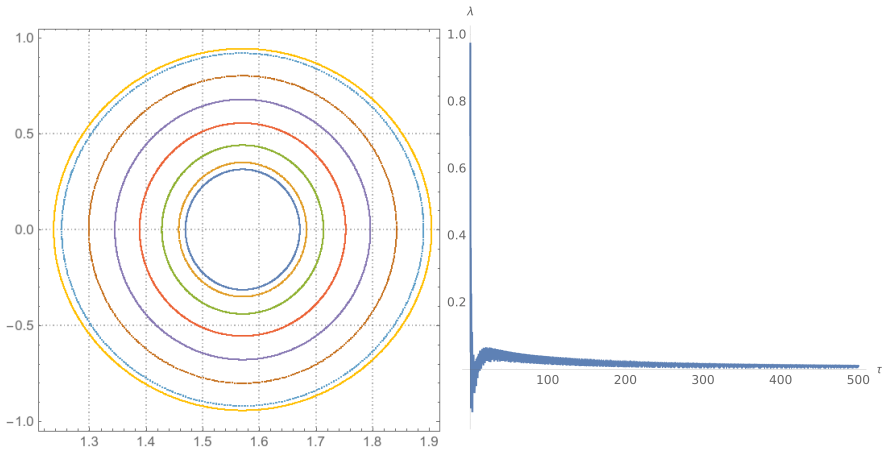
The machinery is the reduction of the 2d $\sigma$-model to a finite-dimensional Hamiltonian system by a rigid-rod embedding ansatz: the string wraps isometry directions with integer winding numbers $\lambda_i$ and all oscillator modes are switched off, so dynamics reduce to a few angle-momentum pairs governed by the light-cone gauge-fixed Hamiltonian. Integrability is diagnosed by two standard numerical signatures: Poincaré sections, planes in the phase space whose intersection with phase curves forms closed curves exactly when trajectories wind invariant tori, and Lyapunov exponents, which measure whether nearby trajectories converge or diverge. The load-bearing analytical result for the non-abelian PPM deformation is the conserved angular integral $p_{\xi}^{2} + 4 p_{\theta_1}^{2}/\cos^{2}\xi = \text{const}$, which forces the $(\xi, p_{\xi})$ section to be an ellipse that merely deforms with time.
What would settle it
Compute the Poincaré sections and Lyapunov exponents after including the first few non-zero Fourier modes in the embedding ansatz; if the closed curves break apart or the exponents turn positive for large deformation parameter, the observed regularity is an artifact of the truncation. A sharper test is to construct an explicit flat Lax connection for the PPM-deformed Type IIA sigma-model with all R-R fields included; failing to find such a connection would undercut the integrability claim.
Extended reading notes
Core claim
The central claim is that tri-vector deformations of the $\mathrm{AdS}_4 \times \mathbb{CP}^3$ solution do not destroy the regular structure of string dynamics, at least in the sectors probed. For the abelian $U(1)^3$ deformation, the deformation parameter drops out of the NS-NS (metric and Kalb–Ramond) Hamiltonian, so invariant tori are trivially preserved. For the non-abelian PPM deformation the paper finds an exact second integral $p_{\xi}^{2} + 4 p_{\theta_1}^{2}/\cos^{2}\xi = \text{const}$ governing the angular motion, and shows numerically that fixing the AdS coordinates $z$ and $x_2$ yields closed Poincaré sections for deformation parameter values up to $\gamma = 1000$, with Lyapunov exponents that decay rather than grow. The DPP deformation is shown to be locally equivalent to the PPM one after a coordinate shift, so the same dynamics apply. These results are presented as strong numerical and partial analytical signatures that the full Type IIA superstring on these deformed backgrounds is integrable in the Liouville sense.
Load-bearing premise
The load-bearing premise is that the rigid-rod embedding, which sets all oscillatory modes of the string to zero, faithfully represents the dynamics of the full sigma-model; the paper itself notes that integrability of such a truncation does not imply integrability of the full theory.
Editorial extensions
If this is right
- If the central claim is right, an explicit Lax connection should exist for the PPM-deformed Type IIA sigma-model, and the paper's numerical evidence directly motivates trying to construct it.
- The tori remain stable at large deformation parameters (up to $\gamma = 1000$ in the PPM case), so the integrability-like regularity is not a small-parameter accident.
- Because the DPP deformation is locally equivalent to the PPM one via a coordinate shift, the integrability evidence carries over to DPP-deformed backgrounds.
- The energy transfer from the $\mathbb{CP}^3$ angular sector to the $z$-direction seen in the PPM numerical solutions, and reproduced in the T/S-dual Type IIB model, is compatible with integrability rather than a chaos signature.
Reading between the lines
- The rigid-rod truncation is the paper's acknowledged blind spot: if the first oscillatory Fourier modes couple chaotically, the closed sections could be an artifact; testing this requires including those modes or constructing a Lax pair for the full sigma-model.
- The explicit angular integral found for PPM looks like a conserved charge inherited from an underlying Lax connection; it is worth checking whether it deforms continuously to the known $\mathrm{AdS}_4 \times \mathbb{CP}^3$ conserved charges as $\gamma \to 0$.
- Because the deformation parameter enters the Type IIB dual through the combination $\gamma p_2 x_2$, the model may admit an exact treatment as a class of $O(d,d)$-transformed integrable sigma-models, extending the paper's duality argument.
Signed reviews
Editorial analysis
A structured set of objections, weighed in public.
Referee Report
Summary. The paper investigates classical bosonic string dynamics on tri-vector deformed Type II supergravity backgrounds as a numerical probe of integrability. The authors gauge-fix the sigma-model in light-cone gauge, truncate to rigid-rod embeddings with winding numbers, and examine Poincaré sections and Lyapunov exponents. For the abelian U(1)^3 deformation of AdS4 x CP3 they derive the Hamiltonian (3.6) and note that it is independent of gamma; for the non-abelian PPM deformation they derive (3.16), obtain an elliptic integral (3.19) for an angular subsystem, and produce Poincaré sections in Fig. 4 after fixing z and x2. A T/S-dual Type IIB family and the DPP deformation are argued to be equivalent to or simpler than the PPM case. The paper concludes that the full deformed string dynamics is likely integrable in the Liouville sense.
Significance. Should the claim hold, this would be a nontrivial indication that non-abelian tri-vector deformations, governed by the generalized classical Yang-Baxter equation, preserve integrability beyond the well-studied abelian Lunin-Maldacena class. The paper has clear strengths: the gauge-fixed Hamiltonians are derived explicitly, the method is benchmarked against the known integrable Lunin-Maldacena model, and the analytic conserved quantity (3.19) for an angular sector is a concrete positive result. The evidence, however, is confined to truncated low-dimensional sectors, and the non-abelian case is not tested in the full phase space. The conclusion therefore substantially exceeds the numerical support. The manuscript is a useful step, but it needs either full-sector numerical evidence or a carefully scaled-down statement of what has been shown.
major comments (4)
- [Section 3.1, Eq. (3.6)] The abelian case provides no independent evidence for preservation of invariant tori under tri-vector deformation, because the deformation parameter gamma is absent from the gauge-fixed Hamiltonian (3.6); the text itself calls the tori 'trivially' invariant. Since the abstract states that Poincaré sections 'are not destroyed under tri-vector deformation,' this claim is literally true for the abelian case only by construction, and the non-abelian case is where the evidence is needed. The section should be reframed as a benchmark of the numerical method rather than as evidence for the main claim.
- [Section 3.2, Eqs. (3.19), (3.22), Fig. 4] The only non-abelian Poincaré sections are computed after manually fixing z=1 and x2=-1, although Eqs. (3.22) show that z and x2 are dynamical and Fig. 3 shows z(tau) falling to zero while x2 keeps decreasing. The analytic ellipse (3.19) concerns only the (xi, p_xi) angular subsystem with p_theta1 constant; it does not establish invariant tori for the full finite-dimensional system, and the status of z and x2 in Fig. 4 is an additional truncation that is not justified by the equations of motion. The manuscript should either provide Poincaré sections and Lyapunov exponents in the full phase space, or in a reduced system whose reduction is justified, or explicitly restrict the non-abelian claim to the angular sector.
- [Abstract and Section 4] The abstract claims that 'the corresponding Lyapunov exponents decay,' but no Lyapunov exponent is plotted for any non-abelian deformation; the Lyapunov plots in Figs. 1 and 2 belong to the Lunin-Maldacena benchmark and the abelian gamma-independent case. The Conclusion's statement that 'there is a pretty good chance that the full dynamics ... is integrable in the Liouville sense' is also stronger than the evidence, especially because Section 2.1 correctly notes that integrability of a truncation does not imply integrability of the full theory. The abstract and conclusion should be revised to describe regular sections in the chosen truncations and to identify the full-integrability statement as speculative.
- [Section 3.3, Eq. (3.29)] The Type IIB T/S-dual example is used to argue that energy transfer between sectors can occur in integrable systems, but in that example the deformation parameter drops out at p2=0, so it is again an undeformed system up to dualities; it therefore does not strengthen the non-abelian PPM evidence. This is not an error, but it should be labeled as an integrable benchmark rather than as evidence for deformation invariance of tori.
minor comments (5)
- [Section 2.1] Please provide an explicit definition and numerical implementation of the Lyapunov exponent, including whether a two-trajectory or tangent-space method is used, the normalization procedure, and the integration time, so that the plots can be reproduced.
- [Section 3.2, Eqs. (3.16)-(3.22)] The notation for momenta is inconsistent: p_z appears in (3.16), while p_3 is used in (3.17) and in the equation for dot z in (3.22), and the equation for dot p_z uses p_z again. Please unify the notation and clearly distinguish p_2 (the momentum conjugate to x2) from the winding number lambda_2.
- [Section 2.2] There is a typo in the text: 'Poincarśections' should be 'Poincaré sections'. The use of accents in 'Poincaré' is also inconsistent in a few places.
- [Section 3.2, Fig. 3] Figure 3 plots only tau < 10 although the computation is stated to run over tau in [0,1000]. Please explain the cutoff and what happens as z approaches zero, since the square root in (3.16) may become problematic.
- [Section 3.4] The claim that the DPP Hamiltonian becomes 'precisely the same' as the PPM case after the light-cone gauge deserves an explicit derivation, because the quadratic constraint (3.33) prevents simply setting rho_0 = 0 and the mapping (3.35) is only local.
Circularity Check
No circularity: the numerical integrability diagnostics are computed from explicit Hamiltonians, and the acknowledged truncations are limitations rather than disguised inputs.
full rationale
The paper's numerical statements do not reduce to their inputs by construction. The gauge-fixed Hamiltonians (2.16), (3.6), (3.16), and (3.27) are explicit functions of canonical variables and the deformation parameter, and the Poincaré sections and Lyapunov exponents are obtained by solving the corresponding equations of motion rather than by fitting any parameter to a target answer. The abelian U(1)^3 example is the only case where the deformation parameter drops out, and the authors explicitly label the resulting invariance as trivial: 'Since the deformation parameter drops from the Hamiltonian in the NS-NS sector the tori are (trivially) invariant under the deformation.' Thus no vacuous check is disguised as a nontrivial prediction. The non-abelian PPM analysis is derived from the Hamiltonian (3.16); the integral of motion (3.19) is verified directly from the equations of motion, and the Poincaré sections in Fig. 4 with manually fixed z and x2 are presented under an explicit ('somehow fixed') restriction, not as full-phase-space invariant tori. The DPP and Type IIB discussions are coordinate or duality transformations of the same explicit systems. The paper also states its own central caveat: 'integrability of any such a truncation does not imply integrability of the full theory in any sense.' The final claim that the full dynamics may be integrable is therefore an extrapolation from numerical evidence, not an equation identical to its input. The self-citations [19,20] supply the known deformed background solutions used as starting points, not the integrability claim, and the numerical computation itself is self-contained.
Assumptions & free parameters
free parameters (4)
- Deformation parameter gamma (PPM) and rho (DPP) =
gamma = 5, 100, 500, 1000 in Fig. 4; rho2 = gamma = 100 in Fig. 3
- Winding numbers lambda_i =
(1,2,3), (1,1,1), (1,0,2)
- Initial conditions and energy =
E = pi/5, pi/10; p_theta(0) = pi/10; beta(0), theta(0) as in eqs.
- Manually fixed coordinates z = 1, x2 = -1 =
z = 1, x2 = -1
assumptions (6)
- domain assumption The tri-vector deformed backgrounds (abelian U(1)^3, PPM, DPP) are genuine solutions of 11D/10D supergravity.
- standard math The light-cone gauge fixing and elimination of Virasoro constraints in Section 2.1 are valid for the considered backgrounds.
- ad hoc to paper Truncating the string to a rigid rod with only winding modes preserves the integrability-relevant dynamics.
- domain assumption Closed Poincaré curves and decaying Lyapunov exponents are valid signatures of Liouville integrability.
- domain assumption Buscher T-duality along the isometric but non-cyclic direction x1, followed by S-duality, preserves the classical integrability properties of the sigma-model.
- domain assumption The coordinate transformation (3.35) maps DPP deformations to PPM deformations locally, so the dynamics are identical.
Cite this review
Pith. "Pith review of On integrability of tri-vector deformed Type II string." pith.science (2026). https://pith.science/paper/XIXTKR63
@misc{pith2026250416773,
  author       = {Pith},
  title        = {Pith review of: On integrability of tri-vector deformed Type II string},
  year         = {2026},
  howpublished = {\url{https://pith.science/paper/XIXTKR63}},
  note         = {Machine review of arXiv:2504.16773}
}
read the original abstract
We analyse dynamics of the closed Type IIA and IIB string on various tri-vector deformed background searching for signatures of integrability. Using numerical methods we construct Poincar\'e sections for particular embeddings of the string and show that these are not destroyed under tri-vector deformation. We find that the corresponding Lyapunov exponents decay showing that trajectories do not diverge.
Figures


Figures from the paper (1 more)

Reference graph
Works this paper leans on
-
[1]
Lectures on Classical Integrability,
A. Torrielli, “Lectures on Classical Integrability,”J. Phys. A 49 no. 32, (2016) 323001, arXiv:1606.02946 [hep-th]
arXiv 2016
-
[2]
Hidden symmetries of the AdS(5) x S**5 superstring,
I. Bena, J. Polchinski, and R. Roiban, “Hidden symmetries of the AdS(5) x S**5 superstring,” Phys. Rev. D 69 (2004) 046002, arXiv:hep-th/0305116
arXiv 2004
-
[3]
On classicalq-deformations of integrable sigma-models,
F. Delduc, M. Magro, and B. Vicedo, “On classicalq-deformations of integrable sigma-models,” JHEP 11 (2013) 192, arXiv:1308.3581 [hep-th] . CITATION = ARXIV:1308.3581
arXiv 2013
-
[4]
An integrable deformation of the AdS5×S5 superstring action,
F. Delduc, M. Magro, and B. Vicedo, “An integrable deformation of the AdS5×S5 superstring action,” Phys. Rev. Lett. 112 no. 5, (2014) 051601,arXiv:1309.5850 [hep-th]. CITATION = ARXIV:1309.5850
arXiv 2014
-
[5]
Yang-Baxter sigma models and dS/AdS T duality,
C. Klimčík, “Yang-Baxter sigma models and dS/AdS T duality,”JHEP 12 (2002) 051, arXiv:hep-th/0210095 [hep-th] . CITATION = HEP-TH/0210095
arXiv 2002
-
[6]
Relativistically Invariant Quasiclassical Limits of Integrable Two-dimensional Quantum Models,
I. V. Cherednik, “Relativistically Invariant Quasiclassical Limits of Integrable Two-dimensional Quantum Models,”Theor. Math. Phys. 47 (1981) 422–425
work page 1981
-
[7]
Exact approaches on the string worldsheet,
S. Demulder, S. Driezen, B. Knighton, G. Oling, A. L. Retore, F. K. Seibold, A. Sfondrini, and Z. Yan, “Exact approaches on the string worldsheet,”J. Phys. A 57 no. 42, (2024) 423001,arXiv:2312.12930 [hep-th] . 25
arXiv 2024
-
[8]
AdS3 Integrability, Tensionless Limits, and Deformations: A Review,
F. K. Seibold and A. Sfondrini, “AdS3 Integrability, Tensionless Limits, and Deformations: A Review,” arXiv:2408.08414 [hep-th]
Show all 48 references
-
[9]
Review of AdS/CFT Integrability: An Overview,
N. Beisert et al., “Review of AdS/CFT Integrability: An Overview,”Lett. Math. Phys. 99 (2012) 3–32, arXiv:1012.3982 [hep-th]
2012 arXiv
-
[10]
Puzzles ofη-deformed AdS5× S5,
G. Arutyunov, R. Borsato, and S. Frolov, “Puzzles ofη-deformed AdS5× S5,” JHEP 12 (2015) 049, arXiv:1507.04239 [hep-th] . CITATION = ARXIV:1507.04239
2015 arXiv
-
[11]
Type IIB supergravity solution for the T-dual of the η-deformed AdS5× S5 superstring,
B. Hoare and A. A. Tseytlin, “Type IIB supergravity solution for the T-dual of the η-deformed AdS5× S5 superstring,” JHEP 10 (2015) 060, arXiv:1508.01150 [hep-th] . CITATION = ARXIV:1508.01150
2015 arXiv
-
[12]
Deforming field theories with U(1) x U(1) global symmetry and their gravity duals,
O. Lunin and J. M. Maldacena, “Deforming field theories with U(1) x U(1) global symmetry and their gravity duals,”JHEP 05 (2005) 033, arXiv:hep-th/0502086
2005 arXiv
-
[13]
I in generalized supergravity,
T. Araujo, E. Ó Colgáin, J. Sakamoto, M. M. Sheikh-Jabbari, and K. Yoshida, “I in generalized supergravity,” Eur. Phys. J. C77 no. 11, (2017) 739,arXiv:1708.03163 [hep-th]. CITATION = ARXIV:1708.03163
2017 arXiv
-
[14]
Yang-Baxterσ-models, conformal twists, and noncommutative Yang-Mills theory,
T. Araujo, I. Bakhmatov, E. Ó Colgáin, J. Sakamoto, M. M. Sheikh-Jabbari, and K. Yoshida, “Yang-Baxterσ-models, conformal twists, and noncommutative Yang-Mills theory,” Phys. Rev. D95 no. 10, (2017) 105006,arXiv:1702.02861 [hep-th] . CITATION = ARXIV:1702.02861
2017 arXiv
-
[15]
Classical Yang-Baxter Equation from Supergravity,
I. Bakhmatov, O. Kelekci, E. Ó Colgáin, and M. M. Sheikh-Jabbari, “Classical Yang-Baxter Equation from Supergravity,”Phys. Rev. D98 no. 2, (2018) 021901, arXiv:1710.06784 [hep-th] . CITATION = ARXIV:1710.06784
2018 arXiv
-
[16]
Yang-Baxter Deformations Beyond Coset Spaces (a slick way to do TsT),
I. Bakhmatov, E. Ó Colgáin, M. M. Sheikh-Jabbari, and H. Yavartanoo, “Yang-Baxter Deformations Beyond Coset Spaces (a slick way to do TsT),”JHEP 06 (2018) 161, arXiv:1803.07498 [hep-th] . CITATION = ARXIV:1803.07498
2018 arXiv
-
[17]
Target space supergeometry ofη and λ-deformed strings,
R. Borsato and L. Wulff, “Target space supergeometry ofη and λ-deformed strings,” JHEP 10 (2016) 045, arXiv:1608.03570 [hep-th] . CITATION = ARXIV:1608.03570
2016 arXiv
-
[18]
Yang-Baxter Deformation as an O(d,d) Transformation,
A. Çatal-Özer and S. Tunalı, “Yang-Baxter Deformation as an O(d,d) Transformation,” Class. Quant. Grav. 37 no. 7, (2020) 075003,arXiv:1906.09053 [hep-th] . 26
2020 arXiv
-
[19]
Tri-vector deformations ind = 11 supergravity,
I. Bakhmatov, N. S. Deger, E. T. Musaev, E. O. Colgáin, and M. M. Sheikh-Jabbari, “Tri-vector deformations ind = 11 supergravity,” JHEP 08 (2019) 126, arXiv:1906.09052 [hep-th]
2019 arXiv
-
[20]
Non-abelian tri-vector deformations in d = 11 supergravity,
I. Bakhmatov, K. Gubarev, and E. T. Musaev, “Non-abelian tri-vector deformations in d = 11 supergravity,” JHEP 05 (2020) 113, arXiv:2002.01915 [hep-th]
2020 arXiv
-
[21]
Polyvector deformations in eleven-dimensional supergravity,
K. Gubarev and E. T. Musaev, “Polyvector deformations in eleven-dimensional supergravity,” Phys. Rev. D 103 no. 6, (2021) 066021,arXiv:2011.11424 [hep-th]
2021 arXiv
-
[22]
Tri-vector deformations with external fluxes,
S. Barakin, K. Gubarev, and E. T. Musaev, “Tri-vector deformations with external fluxes,” Eur. Phys. J. C 84 no. 12, (2024) 1312,arXiv:2410.01629 [hep-th]
2024
-
[23]
Exceptional Form of D=11 Supergravity,
O. Hohm and H. Samtleben, “Exceptional Form of D=11 Supergravity,”Phys.Rev.Lett. 111 (2013) 231601, arXiv:1308.1673 [hep-th] . CITATION = ARXIV:1308.1673
2013 arXiv
-
[24]
Exceptional Field Theory I:E6(6) covariant Form of M-Theory and Type IIB,
O. Hohm and H. Samtleben, “Exceptional Field Theory I:E6(6) covariant Form of M-Theory and Type IIB,”Phys.Rev. D89 (2014) 066016, arXiv:1312.0614 [hep-th] . CITATION = ARXIV:1312.0614
2014 arXiv
-
[25]
Exceptional field theory:SL(5),
E. T. Musaev, “Exceptional field theory:SL(5),” JHEP 02 (2016) 012, arXiv:1512.02163 [hep-th] . CITATION = ARXIV:1512.02163
2016 arXiv
-
[26]
E6(6) Exceptional Field Theory: Review and Embedding of Type IIB,
A. Baguet, O. Hohm, and H. Samtleben, “E6(6) Exceptional Field Theory: Review and Embedding of Type IIB,”PoS CORFU2014 (2015) 133, arXiv:1506.01065 [hep-th] . CITATION = ARXIV:1506.01065
2015 arXiv
-
[27]
The Geometry, Branes and Applications of Exceptional Field Theory,
D. S. Berman and C. D. Blair, “The Geometry, Branes and Applications of Exceptional Field Theory,” Int. J. Mod. Phys. A 35 no. 30, (6, 2020) 2030014,arXiv:2006.09777 [hep-th]
2020 arXiv
-
[28]
U-Dualities in Type II and M-Theory: A Covariant Approach,
E. T. Musaev, “U-Dualities in Type II and M-Theory: A Covariant Approach,” Symmetry 11 no. 8, (2019) 993
2019
-
[29]
Polyvector deformations of Type IIB backgrounds,
K. Gubarev, E. T. Musaev, and T. Petrov, “Polyvector deformations of Type IIB backgrounds,” Eur. Phys. J. C 84 no. 10, (2024) 1085,arXiv:2408.05004 [hep-th]
2024
-
[30]
Integrability structures in string theory,
K. A. Gubarev and E. T. Musaev, “Integrability structures in string theory,”Phys. Usp. 67 no. 3, (2024) 219–250,arXiv:2301.06486 [hep-th] . 27
2024 arXiv
-
[31]
Chaos in the Gauge / Gravity Correspondence,
L. A. Pando Zayas and C. A. Terrero-Escalante, “Chaos in the Gauge / Gravity Correspondence,” JHEP 09 (2010) 094, arXiv:1007.0277 [hep-th]
2010 arXiv
-
[32]
On Marginal Deformations and Non-Integrability,
D. Giataganas, L. A. Pando Zayas, and K. Zoubos, “On Marginal Deformations and Non-Integrability,” JHEP 01 (2014) 129, arXiv:1311.3241 [hep-th]
2014 arXiv
-
[33]
Integrability and non-integrability for marginal deformations of 4dN = 2 SCFTs,
J. Pal, S. Roychowdhury, A. Lala, and D. Roychowdhury, “Integrability and non-integrability for marginal deformations of 4dN = 2 SCFTs,”JHEP 10 (2023) 173, arXiv:2307.12079 [hep-th]
2023 arXiv
-
[34]
The Gravity duals of N=2 superconformal field theories,
D. Gaiotto and J. Maldacena, “The Gravity duals of N=2 superconformal field theories,” JHEP 10 (2012) 189, arXiv:0904.4466 [hep-th]
2012 arXiv
-
[35]
Holographic aspects of four dimensionalN = 2 SCFTs and their marginal deformations,
C. Núñez, D. Roychowdhury, S. Speziali, and S. Zacarías, “Holographic aspects of four dimensionalN = 2 SCFTs and their marginal deformations,”Nucl. Phys. B 943 (2019) 114617, arXiv:1901.02888 [hep-th]
2019 arXiv
-
[36]
Non-chaotic dynamics for Yang–Baxter deformed AdS4×CP3 superstrings,
J. Pal, H. Rathi, A. Lala, and D. Roychowdhury, “Non-chaotic dynamics for Yang–Baxter deformed AdS4×CP3 superstrings,” Eur. Phys. J. C 84 no. 3, (2024) 264, arXiv:2208.09599 [hep-th]
2024 arXiv
-
[37]
Lax pair for strings in Lunin-Maldacena background,
S. Frolov, “Lax pair for strings in Lunin-Maldacena background,”JHEP 05 (2005) 069, arXiv:hep-th/0503201
2005 arXiv
-
[38]
V. I. Arnold,Mathematical Methods of Classical Mechanics . Graduate Texts in Mathematics. Springer, 1989
1989
-
[39]
A new metric invariant of transient dynamical systems and automorphisms in Lebesgue spaces,
A. N. Kolmogorov, “A new metric invariant of transient dynamical systems and automorphisms in Lebesgue spaces,”Dokl. Akad. Nauk SSSR 119 (1958) 861–864. http://mi.mathnet.ru/dan22922
1958
-
[40]
Superstrings on AdS(4) x CP**3 as a Coset Sigma-model,
G. Arutyunov and S. Frolov, “Superstrings on AdS(4) x CP**3 as a Coset Sigma-model,” JHEP 09 (2008) 129, arXiv:0806.4940 [hep-th]
2008 arXiv
-
[41]
Green-Schwarz action for Type IIA strings on AdS(4) x CP**3,
B. Stefanski, jr, “Green-Schwarz action for Type IIA strings on AdS(4) x CP**3,”Nucl. Phys. B 808 (2009) 80–87, arXiv:0806.4948 [hep-th]
2009 arXiv
-
[42]
Evidence for the classical integrability of the complete AdS4xCP 3 superstring,
D. Sorokin and L. Wulff, “Evidence for the classical integrability of the complete AdS4xCP 3 superstring,” JHEP 11 (2010) 143, arXiv:1009.3498 [hep-th] . 28
2010 arXiv
-
[43]
O(d,d) transformations preserve classical integrability,
D. Orlando, S. Reffert, Y. Sekiguchi, and K. Yoshida, “O(d,d) transformations preserve classical integrability,” Nucl. Phys. B 950 (2020) 114880, arXiv:1907.03759 [hep-th]
2020 arXiv
-
[44]
Homogeneous Yang-Baxter deformations as generalized diffeomorphisms,
J.-i. Sakamoto, Y. Sakatani, and K. Yoshida, “Homogeneous Yang-Baxter deformations as generalized diffeomorphisms,”J. Phys. A50 no. 41, (2017) 415401,arXiv:1705.07116 [hep-th]. CITATION = ARXIV:1705.07116
2017 arXiv
-
[45]
The Exceptional Sigma Model,
A. S. Arvanitakis and C. D. A. Blair, “The Exceptional Sigma Model,”JHEP 04 (2018) 064, arXiv:1802.00442 [hep-th]
2018 arXiv
-
[46]
Poisson-Lie U-duality in Exceptional Field Theory,
E. Malek and D. C. Thompson, “Poisson-Lie U-duality in Exceptional Field Theory,” JHEP 04 (2020) 058, arXiv:1911.07833 [hep-th]
2020 arXiv
-
[47]
U-duality extension of Drinfel’d double,
Y. Sakatani, “U-duality extension of Drinfel’d double,”PTEP 2020 no. 2, (2020) 023B08, arXiv:1911.06320 [hep-th]
2020 arXiv
-
[48]
Anomalous radius shift in AdS(4)/CFT(3),
O. Bergman and S. Hirano, “Anomalous radius shift in AdS(4)/CFT(3),”JHEP 07 (2009) 016, arXiv:0902.1743 [hep-th] . 29
2009 arXiv
Reviewed August 16, 2026 · model on record in the stance chip above.
Discussion (0). Continue with ORCID to comment.