A quarkyonic matter model
Pith reviewed 2026-06-28 17:21 UTC · model grok-4.3
The pith
Quark-level statistical constraints induce effective repulsion among hyperons, stiffening dense matter in neutron stars.
A machine-rendered reading of the paper's core claim, the machinery that carries it, and where it could break.
Core claim
The IdylliQ model explicitly links baryon and quark occupation probabilities so that quark saturation triggers stiffening of the equation of state. In applications to hyperonic matter, this linkage generates statistical repulsion between baryon species at the quark level, which counters the usual softening effect of hyperons on neutron star equations of state.
What carries the argument
The relation between baryon and quark occupation probabilities in the IdylliQ model, which enforces quark saturation before baryon core overlap.
If this is right
- A peak appears in the sound speed at neutron-star densities.
- The stiffening happens at densities below spatial overlap of baryons.
- Hyperon-induced softening is reduced without additional interactions.
- The description applies to charge-neutral dense matter including multiple baryon species.
Where Pith is reading between the lines
- Similar saturation effects might appear in other fermionic systems at high density.
- Future neutron star radius measurements could distinguish this crossover from pure hadronic or quark models.
- The approach offers a way to connect moderate-density constraints to astrophysical observations.
Load-bearing premise
Quark saturation sets in at lower densities than the point where baryon cores spatially overlap.
What would settle it
Measurement of the speed of sound in neutron star matter showing no peak near two to three times nuclear saturation density.
Figures
read the original abstract
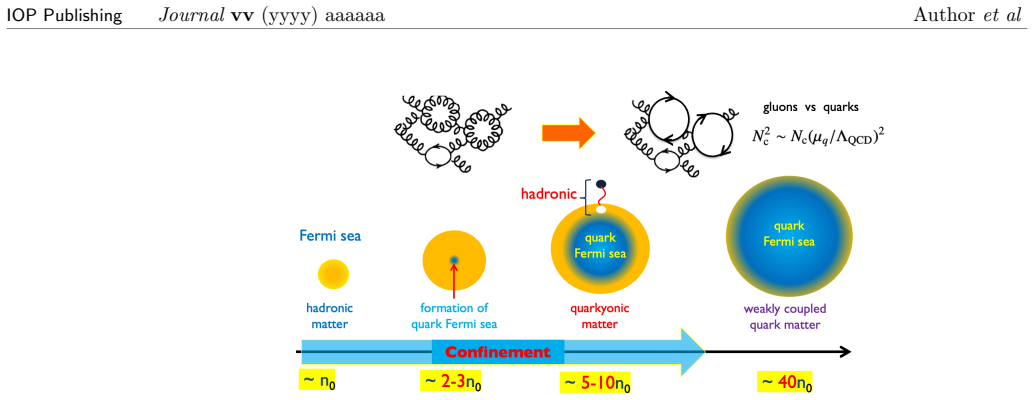
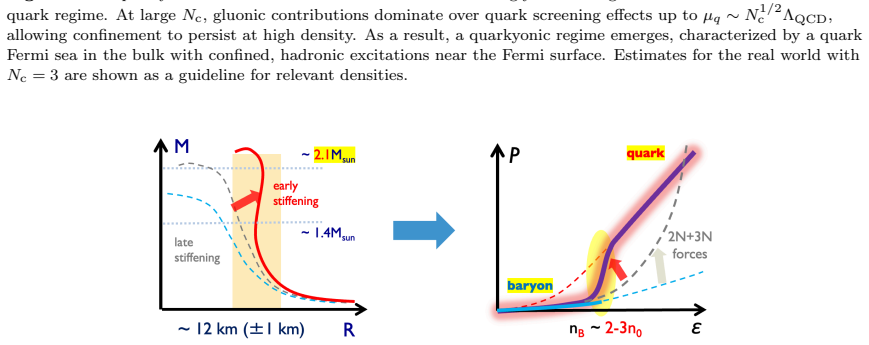
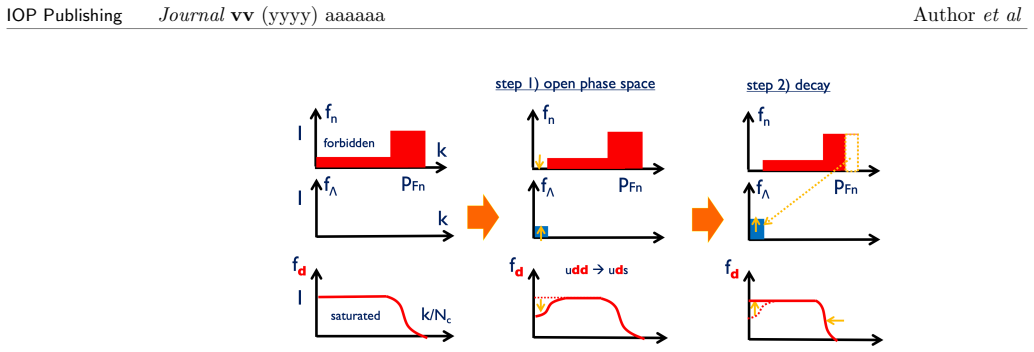
Quarkyonic matter is a state of matter in dense QCD whose bulk thermodynamics is dominated by quarks, while low-energy excitations remain confined. This picture leads to a crossover description from baryonic matter to quark matter, which is triggered by the saturation of quark states in dense matter ({\it quark saturation}). The crossover driven by the quark saturation accompanies rapid growth in pressure but moderate increase in energy density, resulting in a peak in the sound speed which has been indicated by observational constraints from neutron star physics. The quark saturation can occur at a few times nuclear saturation density, which is smaller than the density at which the baryon cores of $\sim 0.5$--$0.8$ fm spatially overlap. In this contribution we discuss an ideal model of quarkyonic matter, the IdylliQ model, and we explicitly describe how the baryon and quark occupation probabilities are related, and explain how stiffening of matter occurs. The model is further applied to charge neutral matter including hyperons, and it is shown that the statistical constraints at quark level induce effective repulsion among different baryon species, mitigating the hyperon softening problem in neutron star physics.
Editorial analysis
A structured set of objections, weighed in public.
Referee Report
Summary. The manuscript introduces the IdylliQ model, an idealized realization of quarkyonic matter in which quark saturation at a few times nuclear saturation density drives a crossover from baryon- to quark-dominated thermodynamics while low-energy excitations remain confined. The model supplies explicit relations between baryon and quark occupation probabilities that produce a rapid rise in pressure relative to energy density, generating a peak in the speed of sound. When extended to charge-neutral matter containing hyperons, the same quark-level statistical constraints are shown to induce effective repulsion among distinct baryon species, thereby reducing the softening of the equation of state that hyperons would otherwise produce.
Significance. If the occupation-probability mechanism and the placement of the saturation density are substantiated, the work supplies a compact, single-parameter account of the stiffening required by neutron-star observations and converts the hyperon problem into a statistical effect rather than an interaction problem. The explicit mapping between baryon and quark occupations is a concrete strength that could be checked against microscopic calculations.
major comments (1)
- [Abstract and model definition] Abstract and model definition: the assertion that quark saturation 'can occur' at a few times nuclear saturation density (below the spatial overlap of baryon cores of size 0.5–0.8 fm) is stated without derivation from the single free parameter of the IdylliQ model or from the explicit baryon-quark occupation probability relation. Because this density scale is load-bearing for the activation of the statistical repulsion in the neutron-star regime, the hyperon-mitigation result remains conditional on an assumption rather than a model prediction.
Simulated Author's Rebuttal
We thank the referee for the careful reading and constructive criticism of our manuscript. We address the single major comment below and will revise the text accordingly to strengthen the presentation of the model.
read point-by-point responses
-
Referee: [Abstract and model definition] Abstract and model definition: the assertion that quark saturation 'can occur' at a few times nuclear saturation density (below the spatial overlap of baryon cores of size 0.5–0.8 fm) is stated without derivation from the single free parameter of the IdylliQ model or from the explicit baryon-quark occupation probability relation. Because this density scale is load-bearing for the activation of the statistical repulsion in the neutron-star regime, the hyperon-mitigation result remains conditional on an assumption rather than a model prediction.
Authors: The IdylliQ model is an idealized effective construction whose single free parameter directly controls the onset density of quark saturation and thereby fixes the explicit functional relations between baryon and quark occupation probabilities. Once that parameter is specified, the statistical constraints, the rapid rise in pressure, the sound-speed peak, and the induced effective repulsion among hyperons all follow as direct consequences. The abstract statement that saturation 'can occur' at a few times nuclear saturation density is therefore a statement of the model's domain of applicability rather than an independent assumption; the numerical range is the regime in which the parameter is chosen to lie in order to be relevant to neutron-star densities. We nevertheless agree that the connection between the free parameter and the quoted density interval is not stated with sufficient explicitness in the abstract and model-definition section. We will revise both to (i) define the free parameter as the saturation-onset density, (ii) show how the occupation-probability relations are obtained from it, and (iii) emphasize that all subsequent results, including hyperon mitigation, are model predictions conditional on the parameter lying in the stated range. This change will make the conditional nature of the results transparent without altering the model's content. revision: yes
Circularity Check
No circularity; model derives occupation relations and effective repulsion from stated statistical constraints
full rationale
The paper introduces the IdylliQ model to explicitly relate baryon and quark occupation probabilities, from which stiffening and inter-species repulsion follow. The density scale for quark saturation is described as possible ('can occur') rather than a fitted input renamed as a prediction. No equations reduce a claimed result to its own inputs by construction, no self-citation chains are load-bearing, and no uniqueness theorems or ansatze are smuggled via prior work. The derivation remains self-contained against the model's occupation-probability relations.
Axiom & Free-Parameter Ledger
free parameters (1)
- quark saturation density =
a few times nuclear saturation density
axioms (1)
- domain assumption Bulk thermodynamics of quarkyonic matter are dominated by quarks while low-energy excitations remain confined.
invented entities (1)
-
IdylliQ model
no independent evidence
Reference graph
Works this paper leans on
-
[1]
McLerran L and Pisarski R D 2007Nucl. Phys. A79683–100 (Preprint0706.2191)
-
[2]
’t Hooft G 1974Nucl. Phys. B72461
-
[3]
Witten E 1979Nucl. Phys. B16057–115
-
[4]
Shuster E and Son D T 2000Nucl. Phys. B573434–446 (Preprinthep-ph/9905448) 10 IOP PublishingJournalvv(yyyy) aaaaaa Authoret al
-
[5]
Sch¨ afer T and Wilczek F 1999Phys. Rev. Lett.823956–3959 (Preprinthep-ph/9811473)
-
[6]
Hatsuda T, Tachibana M, Yamamoto N and Baym G 2006Phys. Rev. Lett.97122001 (Preprinthep-ph/0605018)
-
[7]
Baym G, Hatsuda T, Kojo T, Powell P D, Song Y and Takatsuka T 2018Rept. Prog. Phys.81 056902 (Preprint1707.04966)
-
[8]
Fukushima K, Kojo T and Weise W 2020Phys. Rev. D102096017 (Preprint2008.08436)
-
[9]
Freedman B A and McLerran L D 1977Phys. Rev. D161169
-
[10]
Kurkela A, Romatschke P and Vuorinen A 2010Phys. Rev. D81105021 (Preprint0912.1856)
-
[11]
Masuda K, Hatsuda T and Takatsuka T 2013Astrophys. J.76412 (Preprint1205.3621)
-
[12]
Masuda K, Hatsuda T and Takatsuka T 2013PTEP2013073D01 (Preprint1212.6803)
-
[13]
Kojo T, Powell P D, Song Y and Baym G 2015Phys. Rev. D91045003 (Preprint1412.1108)
-
[14]
Kojo T 2021Phys. Rev. D104074005 (Preprint2106.06687)
-
[15]
Akmal A, Pandharipande V R and Ravenhall D G 1998Phys. Rev. C581804–1828 (Preprint nucl-th/9804027)
-
[16]
Drischler C, Han S, Lattimer J M, Prakash M, Reddy S and Zhao T 2021Phys. Rev. C103 045808 (Preprint2009.06441)
-
[17]
Kojo T, Baym G and Hatsuda T 2022Astrophys. J.93446 (Preprint2111.11919)
-
[18]
Huang Y J, Baiotti L, Kojo T, Takami K, Sotani H, Togashi H, Hatsuda T, Nagataki S and Fan Y Z 2022Phys. Rev. Lett.129181101 (Preprint2203.04528)
-
[19]
Hensh S, Huang Y J, Kojo T, Baiotti L, Takami K, Nagataki S and Sotani H 2025Astrophys. J. Lett.991L12 (Preprint2407.09446)
-
[20]
Fujimoto Y, Kojo T and McLerran L D 2024Phys. Rev. Lett.132112701 (Preprint 2306.04304)
- [21]
-
[22]
Togashi H, Nakazato K, Takehara Y, Yamamuro S, Suzuki H and Takano M 2017Nucl. Phys. A96178–105 (Preprint1702.05324)
-
[23]
Baym G, Furusawa S, Hatsuda T, Kojo T and Togashi H 2019Astrophys. J.88542 (Preprint 1903.08963)
arXiv 1903
-
[24]
Annala E, Gorda T, Kurkela A, N¨ attil¨ a J and Vuorinen A 2020Nature Phys.16907–910 (Preprint1903.09121)
-
[25]
Witten E 1984Phys. Rev. D30272–285
-
[26]
J.629969–978 (Preprint nucl-th/0411016)
Alford M, Braby M, Paris M W and Reddy S 2005Astrophys. J.629969–978 (Preprint nucl-th/0411016)
-
[27]
McLerran L and Reddy S 2019Phys. Rev. Lett.122122701 (Preprint1811.12503)
-
[28]
Lonardoni D, Lovato A, Gandolfi S and Pederiva F 2015Phys. Rev. Lett.114092301 (Preprint1407.4448)
-
[29]
Tolos L and Fabbietti L 2020Prog. Part. Nucl. Phys.112103770 (Preprint2002.09223)
-
[30]
Gerstung D, Kaiser N and Weise W 2020Eur. Phys. J. A56175 (Preprint2001.10563)
-
[31]
Fujimoto Y, Kojo T and McLerran L 2026Phys. Rev. C113035206 (Preprint2410.22758)
-
[32]
Kogut J B, Stephanov M A and Toublan D 1999Phys. Lett. B464183–191 (Preprint hep-ph/9906346)
-
[33]
Sun G f, He L and Zhuang P 2007Phys. Rev. D75096004 (Preprinthep-ph/0703159) 11 IOP PublishingJournalvv(yyyy) aaaaaa Authoret al
-
[34]
Brauner T, Fukushima K and Hidaka Y 2009Phys. Rev. D80074035 [Erratum: Phys.Rev.D 81, 119904 (2010)] (Preprint0907.4905)
Pith/arXiv arXiv 2010
-
[35]
Kojo T and Suenaga D 2022Phys. Rev. D105076001 (Preprint2110.02100)
-
[36]
Iida K and Itou E 2022PTEP2022111B01 (Preprint2207.01253)
-
[37]
Brandt B B, Cuteri F and Endrodi G 2023JHEP07055 (Preprint2212.14016)
-
[38]
Abbott R, Detmold W, Illa M, Parre˜ no A, Perry R J, Romero-L´ opez F, Shanahan P E and Wagman M L (NPLQCD) 2025Phys. Rev. Lett.134011903 (Preprint2406.09273)
-
[39]
Chiba R and Kojo T 2024Phys. Rev. D109076006 (Preprint2304.13920)
-
[40]
Kojo T, Suenaga D and Chiba R 2024Universe10293 (Preprint2406.11059)
-
[41]
Brandt B B, Chelnokov V, Endrodi G, Marko G, Scheid D and von Smekal L 2025 (Preprint 2502.04025)
arXiv 2025
-
[42]
Nagatsuka M and Kojo T 2026Phys. Rev. D113054030 (Preprint2512.15434)
-
[43]
Rischke D H, Son D T and Stephanov M A 2001Phys. Rev. Lett.87062001 (Preprint hep-ph/0011379)
-
[44]
Boz T, Giudice P, Hands S and Skullerud J I 2020Phys. Rev. D101074506 (Preprint 1912.10975)
arXiv 1912
-
[45]
Iida K, Itou E and Lee T G 2020JHEP01181 (Preprint1910.07872)
-
[46]
Iida K, Itou E, Murakami K and Suenaga D 2024JHEP10022 (Preprint2405.20566)
-
[47]
Boz T, Hajizadeh O, Maas A and Skullerud J I 2019Phys. Rev. D99074514 (Preprint 1812.08517)
-
[48]
Kurebayashi Y, Kojo T and Suenaga D 2025Universe11357 (Preprint2509.20874)
-
[49]
Fukushima K and Minato S 2025Phys. Rev. D111094006 (Preprint2411.03781)
-
[50]
Fujimoto Y 2024 (Preprint2408.12514)
arXiv 2024
-
[51]
Kojo T 2012Nucl. Phys. A87770–94 (Preprint1106.2187)
-
[52]
Hayata T, Hidaka Y and Nishimura K 2024JHEP07106 (Preprint2311.11643)
-
[53]
Fujikura K and Hidaka Y 2026 (Preprint2605.17183)
Pith/arXiv arXiv 2026
-
[54]
Koch V, McLerran L, Miller G A and Vovchenko V 2024Phys. Rev. C110025201 (Preprint 2403.15375)
-
[55]
McLerran L and Miller G A 2024Phys. Rev. C110045203 (Preprint2405.11074)
-
[56]
Bluhm M, Fujimoto Y, McLerran L and Nahrgang M 2025Phys. Rev. C111044914 (Preprint 2409.12088)
-
[57]
Bluhm M, Fujimoto Y and Nahrgang M 2026 (Preprint2604.00247)
arXiv 2026
-
[58]
Chiba R, Kojo T and Suenaga D 2024 (Preprint2403.02538)
arXiv 2024
-
[59]
Tajima H, Iida K, Kojo T and Liang H 2025Phys. Rev. Lett.135042701 (Preprint 2412.04971) 12
discussion (0)
Sign in with ORCID, Apple, or X to comment. Anyone can read and Pith papers without signing in.