Point-Cloud-Assistant Localized Statistical Channel Prediction by Tangent Gaussian Splatting
Pith reviewed 2026-06-26 19:51 UTC · model grok-4.3
The pith
Point-cloud-assisted tangent Gaussian splatting extrapolates angular power spectra to unmeasured outdoor locations.
A machine-rendered reading of the paper's core claim, the machinery that carries it, and where it could break.
Core claim
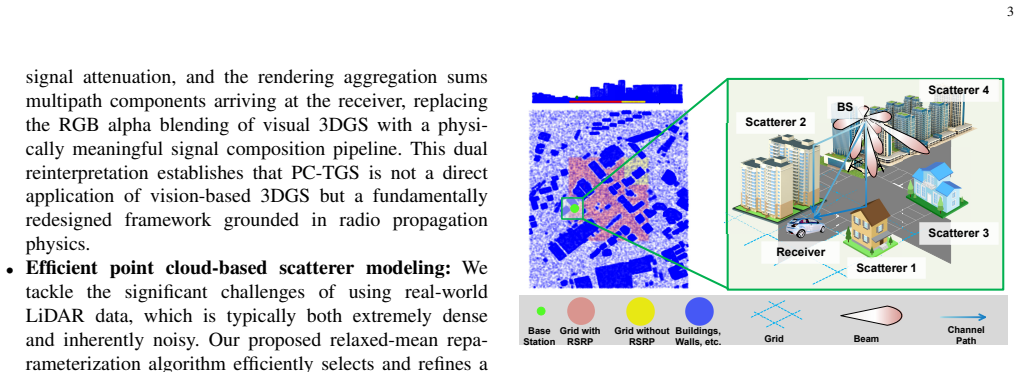
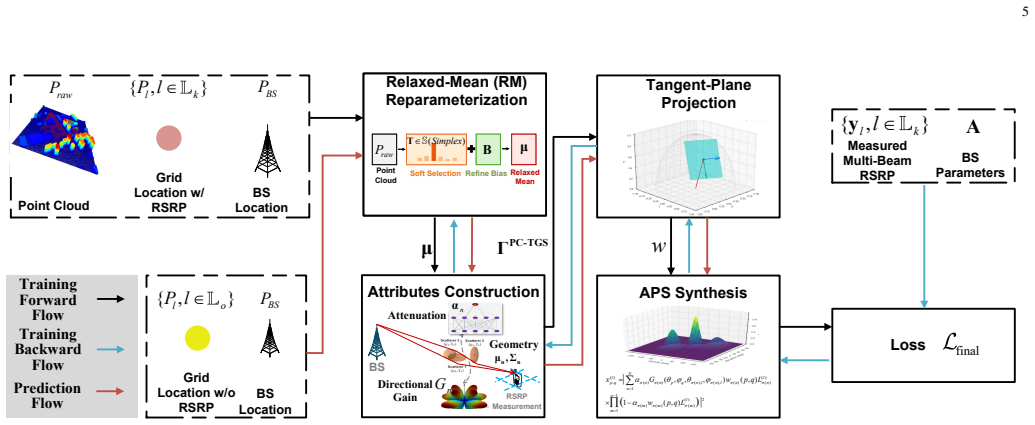
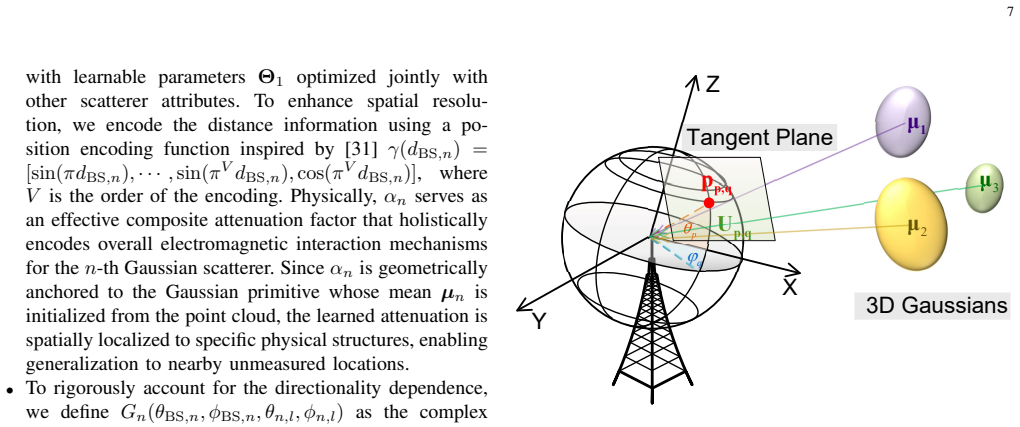
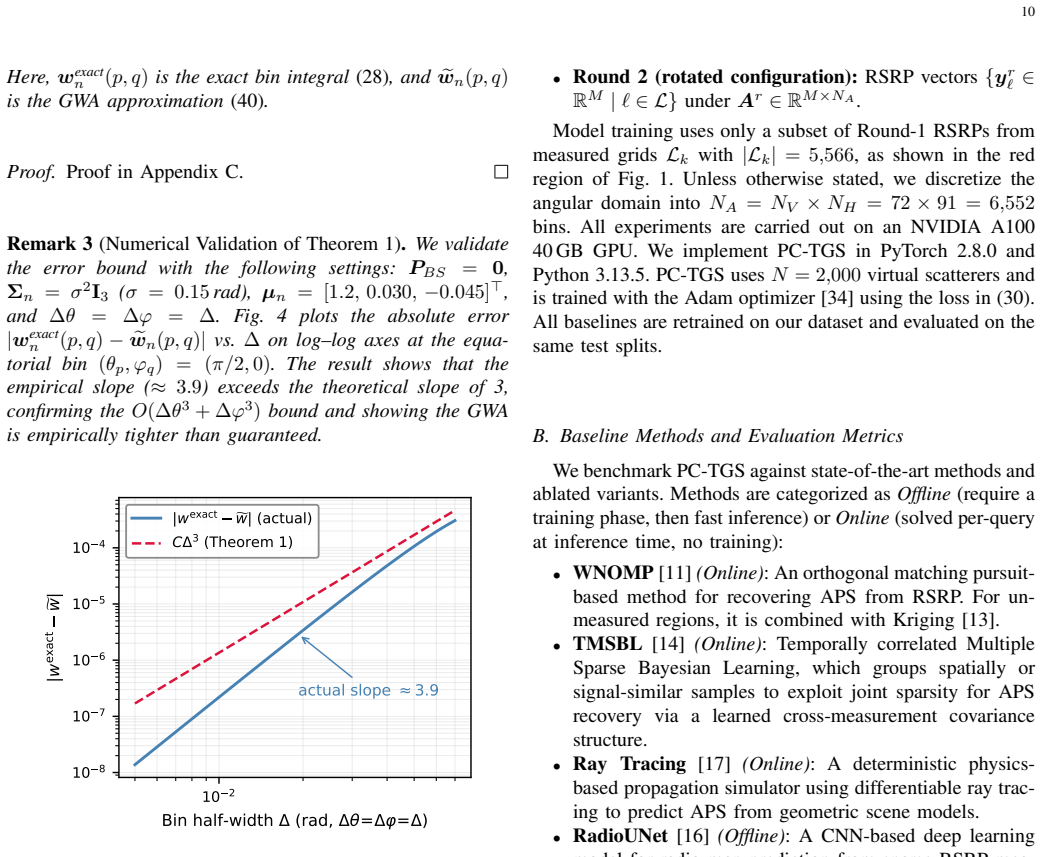
PC-TGS represents environmental scatterers as anisotropic 3D Gaussians initialized and refined through a relaxed-mean reparameterization of the raw point cloud. A tangent-plane projection accurately maps each Gaussian into the local angular domain, while a depth-aware electromagnetic splatting process aggregates their contributions. A closed-form Gaussian-weighted average for APS bin integration and a provable error bound are derived. Evaluations on a LiDAR-scanned city-scale dataset with 5M points and 6310 RSRP samples show better APS and RSRP prediction performance than state-of-the-art baselines along with faster inference.
What carries the argument
Point-cloud-assisted tangent Gaussian splatting, which models scatterers as anisotropic 3D Gaussians from LiDAR data and uses tangent projection plus depth-aware splatting to compute APS.
If this is right
- APS predictions become possible across the vast majority of outdoor grids that lack radio measurements.
- Performance exceeds prior baselines on city-scale LiDAR and RSRP data while inference remains faster.
- Closed-form integration and provable error bound support practical large-scale use.
- Geometry from LiDAR enables data-efficient, site-specific channel modeling for wireless digital twins.
Where Pith is reading between the lines
- The same Gaussian representation could be tested on indoor or mixed environments where point clouds are also available.
- Lower measurement density might become viable if the geometry prior is strong enough.
- Periodic refresh of the point cloud could allow tracking of slowly changing scatterers without new radio campaigns.
Load-bearing premise
Anisotropic 3D Gaussians initialized from the point cloud, refined, projected on tangent planes, and splatted with depth awareness will produce accurate APS predictions at locations without any RSRP measurements.
What would settle it
Gather fresh RSRP measurements at a set of previously unmeasured grid points and check whether the PC-TGS predictions match those measurements within the claimed error bound.
Figures
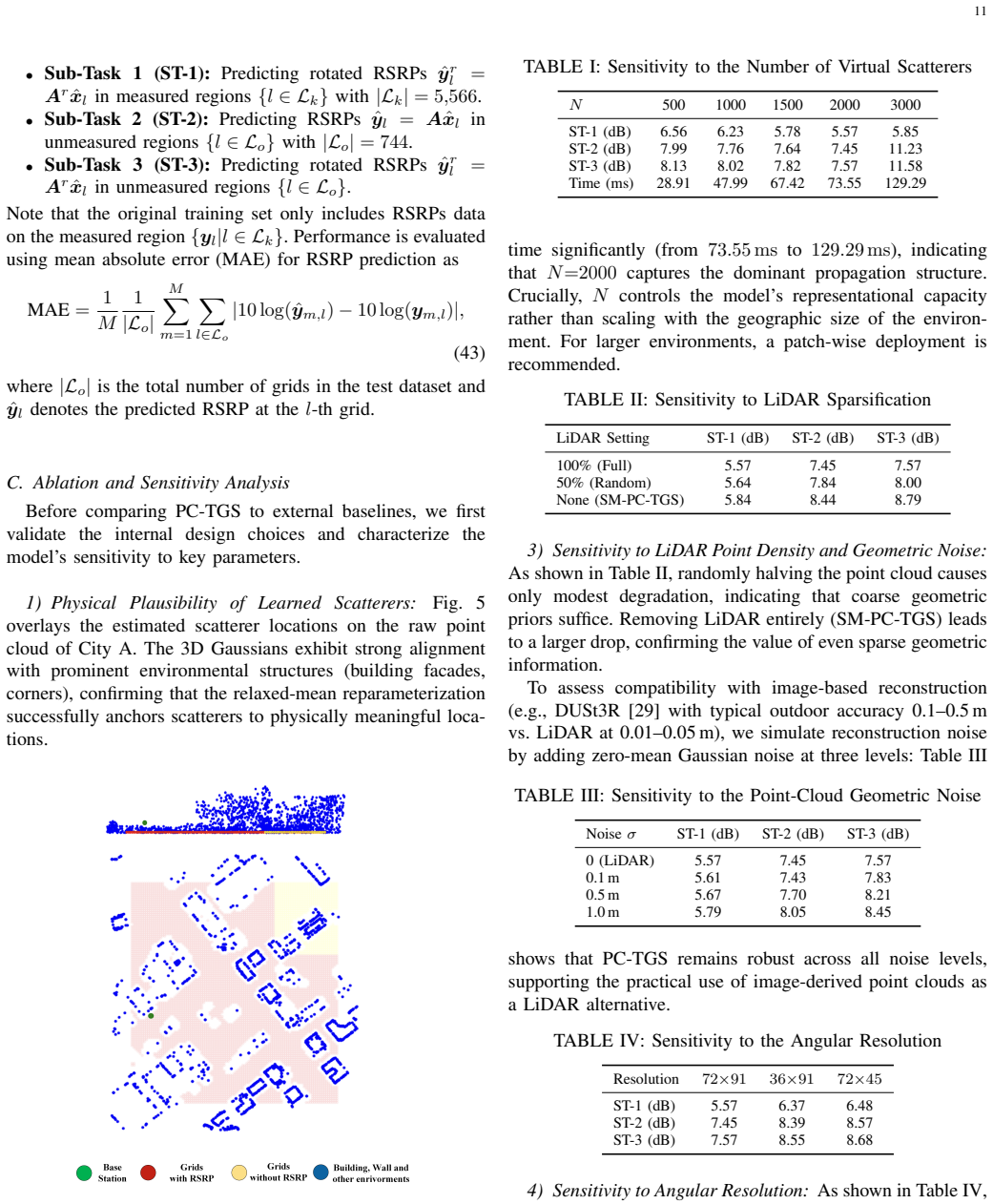
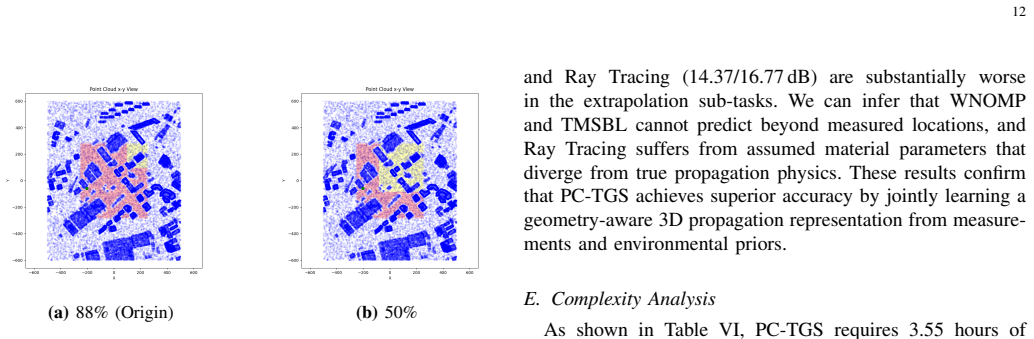
read the original abstract
Accurate, site-specific channel information is crucial for optimizing next-generation wireless networks. Among various approaches, localized statistical channel modeling (LSCM), which models the channel multipath angular power spectrum (APS) from the reference signal received power (RSRP) measurement, has emerged as a state-of-the-art method tailored for efficient network optimization. However, despite its effectiveness, LSCM cannot predict APS at the vast majority of locations where no measurements are available, which significantly restricts its applicability in large-scale, real-world scenarios. To address this challenge, we present \emph{point-cloud-assisted tangent Gaussian splatting} (PC-TGS), the first framework to \emph{extrapolate} APS to unmeasured outdoor grids by integrating sparse radio measurements with dense LiDAR-based geometry. PC-TGS represents environmental scatterers as anisotropic 3D Gaussians, initialized and refined through a relaxed-mean reparameterization of the raw point cloud. A tangent-plane projection accurately maps each Gaussian into the local angular domain, while a depth-aware electromagnetic splatting process aggregates their contributions. To ensure practical deployment, we derive a closed-form Gaussian-weighted average (GWA) for APS bin integration and provide a provable error bound. { Evaluations on a LiDAR-scanned city-scale dataset (5M points, 6,310 RSRP samples) demonstrate that PC-TGS achieves better APS and RSRP prediction performance compared to state-of-the-art baselines and faster inference time for APS extrapolation task. These results highlight the potential of PC-TGS to enable geometry-aware and data-efficient channel prediction in large-scale wireless digital twins.
Editorial analysis
A structured set of objections, weighed in public.
Referee Report
Summary. The manuscript introduces point-cloud-assisted tangent Gaussian splatting (PC-TGS) as a framework to extrapolate the angular power spectrum (APS) to unmeasured outdoor locations. It represents scatterers via anisotropic 3D Gaussians initialized from LiDAR point clouds via relaxed-mean reparameterization, applies tangent-plane projection and depth-aware electromagnetic splatting to aggregate contributions, derives a closed-form Gaussian-weighted average (GWA) for APS bin integration together with a provable error bound, and reports improved APS/RSRP prediction and faster inference versus baselines on a city-scale dataset containing 5M LiDAR points and 6310 RSRP samples.
Significance. If the extrapolation performance holds under proper spatial separation, the integration of dense geometry with sparse radio measurements via Gaussian splatting could materially advance site-specific statistical channel modeling for large-scale wireless networks and digital twins. The closed-form GWA and accompanying error bound constitute a concrete technical contribution that would support practical deployment.
major comments (1)
- [§5] §5 (Experimental Evaluation): The manuscript does not report the spatial distribution of the 6310 RSRP samples, the train/test split procedure, or the minimum distance between training and held-out test locations. This information is load-bearing for the central claim of true extrapolation to unmeasured grids; without it, reported gains could reflect local interpolation near measured points rather than geometry-driven prediction across distant unmeasured areas.
minor comments (2)
- [Abstract, §3] Abstract and §3: The phrase 'relaxed-mean reparameterization' is introduced without a concise definition or reference to the exact optimization objective used for Gaussian initialization.
- [§3] Notation throughout: The mapping from 3D Gaussian parameters to the local angular domain via tangent-plane projection would benefit from an explicit equation relating the covariance matrix to the APS bin centers.
Simulated Author's Rebuttal
We thank the referee for the constructive comment and the positive assessment of the technical contributions. We address the concern on experimental evaluation below.
read point-by-point responses
-
Referee: [§5] §5 (Experimental Evaluation): The manuscript does not report the spatial distribution of the 6310 RSRP samples, the train/test split procedure, or the minimum distance between training and held-out test locations. This information is load-bearing for the central claim of true extrapolation to unmeasured grids; without it, reported gains could reflect local interpolation near measured points rather than geometry-driven prediction across distant unmeasured areas.
Authors: We agree that these details are essential to substantiate the extrapolation claim. The current manuscript does not explicitly report the spatial distribution of the 6310 RSRP samples, the train/test split procedure, or the minimum distance between training and test locations. In the revised version we will add a geographic map of all sample locations with train/test labels, describe the split procedure including any spatial constraints applied, and report the minimum distance between any training and held-out test location. revision: yes
Circularity Check
No circularity: derivation uses independent geometry and derives closed-form expressions
full rationale
The abstract describes a new PC-TGS framework that initializes Gaussians from LiDAR point clouds, applies tangent projection and depth-aware splatting, then derives a closed-form GWA for APS integration with a provable error bound. No equations or steps are shown reducing a claimed prediction to a fitted parameter by construction, nor any self-citation load-bearing the central result. The integration of sparse RSRP with dense geometry is presented as an independent modeling choice, not a renaming or self-definition. This is the common case of a self-contained technical derivation.
Axiom & Free-Parameter Ledger
invented entities (1)
-
Anisotropic 3D Gaussians representing scatterers
no independent evidence
Reference graph
Works this paper leans on
-
[1]
SRCON: A data- driven network performance simulator for real-world wireless networks,
Z.-Q. Luo, X. Zheng, D. L ´opez-P´erez, Q. Yan, X. Chen, N. Wang, Q. Shi, T.-H. Chang, and A. Garcia-Rodriguez, “SRCON: A data- driven network performance simulator for real-world wireless networks,” vol. 61, no. 6, pp. 96–102, 2023
2023
-
[2]
Real-world wireless network modeling and optimization: From model/data-driven perspective,
Y . Li, S. Zhang, X. Ren, J. Zhu, J. Huang, P. He, K. Shen, Z. Yao, J. Gong, T. Changet al., “Real-world wireless network modeling and optimization: From model/data-driven perspective,”Chinese Journal of Electronics, vol. 31, no. 6, pp. 991–1012, 2022
2022
-
[3]
Minimization of drive tests in 3GPP release 11,
J. Johansson, W. A. Hapsari, S. Kelley, and G. Bodog, “Minimization of drive tests in 3GPP release 11,” vol. 50, no. 11, pp. 36–43, 2012
2012
-
[4]
Robust network optimization by deep generative models and stochastic optimization,
S. Zhang, Y . Xue, Z. Tang, H. Wang, C. Shen, Q. Shi, and T.-H. Chang, “Robust network optimization by deep generative models and stochastic optimization,”IEEE Transactions on Wireless Communications, vol. 24, no. 7, pp. 6069–6084, 2025
2025
-
[5]
Coverage optimization for large-scale mobile networks with digital twin and multi-agent reinforcement learning,
H. Liu, T. Li, F. Jiang, W. Su, and Z. Wang, “Coverage optimization for large-scale mobile networks with digital twin and multi-agent reinforcement learning,” pp. 1–1, 2024
2024
-
[6]
H. Liu, W. Su, T. Li, W. Huang, and Y . Li, “Digital twin enhanced multi-agent reinforcement learning for large-scale mobile network coverage optimization,”ACM Trans. Knowl. Discov. Data, vol. 19, no. 1, Dec. 2024. [Online]. Available: https://doi.org/10.1145/3702644
-
[7]
Digital twin channel for 6G: Concepts, architectures and potential applications,
H. Wang, J. Zhang, G. Nie, L. Yu, Z. Yuan, T. Li, J. Wang, and G. Liu, “Digital twin channel for 6G: Concepts, architectures and potential applications,”IEEE Communications Magazine, vol. 63, no. 3, pp. 24– 30, 2025
2025
-
[8]
A novel 3D non-stationary GBSM for 6G thz ultra-massive mimo wireless systems,
J. Wang, C.-X. Wang, J. Huang, H. Wang, X. Gao, X. You, and Y . Hao, “A novel 3D non-stationary GBSM for 6G thz ultra-massive mimo wireless systems,”IEEE Transactions on Vehicular Technology, vol. 70, no. 12, pp. 12 312–12 324, 2021
2021
-
[9]
Deterministic ray tracing: A promising approach to thz channel modeling in 6G deployment scenarios,
J. Zhang, J. Lin, P. Tang, W. Fan, Z. Yuan, X. Liu, H. Xu, Y . Lyu, L. Tian, and P. Zhang, “Deterministic ray tracing: A promising approach to thz channel modeling in 6G deployment scenarios,” Comm. Mag., vol. 62, no. 2, p. 48–54, Feb. 2024. [Online]. Available: https://doi.org/10.1109/MCOM.001.2200486
-
[10]
Comparison of empirical propagation path loss models for fixed wireless access systems,
V . Abhayawardhana, I. Wassell, D. Crosby, M. Sellars, and M. Brown, “Comparison of empirical propagation path loss models for fixed wireless access systems,” in2005 IEEE 61st Vehicular Technology Conference, vol. 1, 2005, pp. 73–77 V ol. 1
2005
-
[11]
A physics-based and data-driven approach for localized statistical channel modeling,
S. Zhang, X. Ning, X. Zheng, Q. Shi, T.-H. Chang, and Z.-Q. Luo, “A physics-based and data-driven approach for localized statistical channel modeling,” vol. 23, no. 6, pp. 5409–5424, 2024
2024
-
[12]
GNN-based structured bayesian inference for multi-grid localized statistical channel modeling,
Y . Wang, Y . Xue, S. Zhang, and T.-H. Chang, “GNN-based structured bayesian inference for multi-grid localized statistical channel modeling,” pp. 1–1, 2025
2025
-
[13]
Radio environment map construction with joint space-frequency interpolation,
K. Sato, K. Inage, and T. Fujii, “Radio environment map construction with joint space-frequency interpolation,” in2020 International Con- ference on Artificial Intelligence in Information and Communication (ICAIIC). IEEE, 2020, pp. 051–054
2020
-
[14]
Sparse signal recovery with temporally correlated source vectors using sparse Bayesian learning,
Z. Zhang and B. D. Rao, “Sparse signal recovery with temporally correlated source vectors using sparse Bayesian learning,”IEEE Journal of Selected Topics in Signal Processing, vol. 5, no. 5, pp. 912–926, 2011
2011
-
[15]
Discriminant minimization search for large- scale RF-based localization systems,
S.-P. Kuo and Y .-C. Tseng, “Discriminant minimization search for large- scale RF-based localization systems,”IEEE Transactions on Mobile Computing, vol. 10, no. 2, pp. 291–304, 2010
2010
-
[16]
RadioUNet: Fast radio map estimation with convolutional neural networks,
R. Levie, C ¸ . Yapar, G. Kutyniok, and G. Caire, “RadioUNet: Fast radio map estimation with convolutional neural networks,”IEEE Transactions on Wireless Communications, vol. 20, no. 6, pp. 4001–4015, 2021
2021
-
[17]
Demonstrating DiffeRT: An open-source library for optimizing radio networks with differentiable ray tracing,
J. Eertmans, C. Oestges, and L. Jacques, “Demonstrating DiffeRT: An open-source library for optimizing radio networks with differentiable ray tracing,” inProceedings of the IEEE International Conference on Machine Learning for Communication and Networking (ICMLCN), 2025, pp. 1–2
2025
-
[18]
NeRF2: Neural radio-frequency radiance fields,
X. Zhao, Z. An, Q. Pan, and L. Yang, “NeRF2: Neural radio-frequency radiance fields,” inProceedings of the 29th Annual International Conference on Mobile Computing and Networking, ser. ACM MobiCom ’23. New York, NY , USA: Association for Computing Machinery,
-
[19]
Transmitting, Fast and Slow: Scheduling Satellite Traffic Through Space and Time,
[Online]. Available: https://doi.org/10.1145/3570361.3592527
-
[20]
NeWRF: a deep learning framework for wireless radiation field reconstruction and channel prediction,
H. Lu, C. Vattheuer, B. Mirzasoleiman, and O. Abari, “NeWRF: a deep learning framework for wireless radiation field reconstruction and channel prediction,” inProceedings of the 41st International Conference on Machine Learning, ser. ICML’24. JMLR.org, 2024
2024
-
[21]
3d gaussian splatting for real-time radiance field rendering,
B. Kerbl, G. Kopanas, T. Leimkuehler, and G. Drettakis, “3D Gaussian splatting for real-time radiance field rendering,”ACM Trans. Graph., vol. 42, no. 4, Jul. 2023. [Online]. Available: https://doi.org/10.1145/3592433 15
-
[22]
WRF-GS: Wireless radiation field reconstruction with 3D Gaussian splatting,
C. Wen, J. Tong, Y . Hu, Z. Lin, and J. Zhang, “WRF-GS: Wireless radiation field reconstruction with 3D Gaussian splatting,” inIEEE IN- FOCOM 2025-IEEE Conference on Computer Communications. IEEE, 2025, pp. 1–10
2025
-
[23]
GaussianPro: 3D Gaussian splatting with progressive propagation,
K. Cheng, X. Long, K. Yang, Y . Yao, W. Yin, Y . Ma, W. Wang, and X. Chen, “GaussianPro: 3D Gaussian splatting with progressive propagation,” inProceedings of the 41st International Conference on Machine Learning, ser. ICML’24. JMLR.org, 2024
2024
-
[24]
Dngaus- sian: Optimizing sparse-view 3D Gaussian radiance fields with global- local depth normalization,
J. Li, J. Zhang, X. Bai, J. Zheng, X. Ning, J. Zhou, and L. Gu, “Dngaus- sian: Optimizing sparse-view 3D Gaussian radiance fields with global- local depth normalization,” inProceedings of the IEEE/CVF conference on computer vision and pattern recognition, 2024, pp. 20 775–20 785
2024
-
[25]
Colmap-free 3D Gaussian splatting,
Y . Fu, S. Liu, A. Kulkarni, J. Kautz, A. A. Efros, and X. Wang, “Colmap-free 3D Gaussian splatting,” inProceedings of the IEEE/CVF Conference on Computer Vision and Pattern Recognition, 2024, pp. 20 796–20 805
2024
-
[26]
Study on channel model for frequencies from 0.5 to 100 GHz (Release 16),
3GPP, “Study on channel model for frequencies from 0.5 to 100 GHz (Release 16),” Technical Report (TR) 38.901, Jan. 2020, version 16.1.0
2020
-
[27]
Sparse channel estimation for IRS-assisted millimeter wave mimo ofdm systems,
M. Liu, T. Lin, Y . Zhu, and Y .-J. A. Zhang, “Sparse channel estimation for IRS-assisted millimeter wave mimo ofdm systems,” vol. 72, no. 10, pp. 6553–6568, 2024
2024
-
[28]
Minimization of drive tests solution in 3GPP,
W. A. Hapsari, A. Umesh, M. Iwamura, M. Tomala, B. Gyula, and B. Sebire, “Minimization of drive tests solution in 3GPP,”IEEE Com- munications Magazine, vol. 50, no. 6, pp. 28–36, 2012
2012
-
[29]
Scalability in perception for autonomous driving: Waymo open dataset,
P. Sun, H. Kretzschmar, X. Dotiwalla, A. Chouard, V . Patnaik, P. Tsui, J. Guo, Y . Zhou, Y . Chai, B. Caine, V . Vasudevan, W. Han, J. Ngiam, H. Zhao, A. Timofeev, S. M. Ettinger, M. Krivokon, A. Gao, A. Joshi, Y . Zhang, J. Shlens, Z. Chen, and D. Anguelov, “Scalability in perception for autonomous driving: Waymo open dataset,”2020 IEEE/CVF Conference o...
2020
-
[30]
DUSt3R: Geometric 3D vision made easy,
S. Wang, V . Leroy, Y . Cabon, B. Charpiat, and J. Revaud, “DUSt3R: Geometric 3D vision made easy,” inProc. IEEE/CVF Conf. Comput. Vis. Pattern Recognit. (CVPR), 2024, pp. 20 697–20 709
2024
-
[31]
Plenoxels: Radiance fields without neural networks,
S. Fridovich-Keil, A. Yu, M. Tancik, Q. Chen, B. Recht, and A. Kanazawa, “Plenoxels: Radiance fields without neural networks,” inProceedings of the IEEE/CVF conference on computer vision and pattern recognition, 2022, pp. 5501–5510
2022
-
[32]
Fourier features let networks learn high frequency functions in low dimensional domains,
M. Tancik, P. Srinivasan, B. Mildenhall, S. Fridovich-Keil, N. Raghavan, U. Singhal, R. Ramamoorthi, J. Barron, and R. Ng, “Fourier features let networks learn high frequency functions in low dimensional domains,” Advances in neural information processing systems, vol. 33, pp. 7537– 7547, 2020
2020
-
[33]
Characterization of 3D spatial wireless channels,
T. Abhayapala, T. Pollock, and R. Kennedy, “Characterization of 3D spatial wireless channels,” in2003 IEEE 58th Vehicular Technology Conference. VTC 2003-Fall (IEEE Cat. No.03CH37484), vol. 1, 2003, pp. 123–127 V ol.1
2003
-
[34]
D. L. Colton, R. Kress, and R. Kress,Inverse acoustic and electromag- netic scattering theory. Springer, 1998, vol. 93
1998
-
[35]
A method for stochastic optimization,
K. D. B. J. Adamet al., “A method for stochastic optimization,”arXiv preprint arXiv:1412.6980, vol. 1412, no. 6, 2014
Pith/arXiv arXiv 2014
-
[36]
Multi-modal neural radio radiance field for localized statistical channel modelling,
Y . Wang, S. Zhang, Y . Xue, and T.-H. Chang, “Multi-modal neural radio radiance field for localized statistical channel modelling,”arXiv preprint arXiv:2508.06054, 2025
arXiv 2025
discussion (0)
Sign in with ORCID, Apple, or X to comment. Anyone can read and Pith papers without signing in.