REVIEW 4 major objections 5 minor 86 references
Reactive Glass Metal Interaction under Ambient Conditions Enables Surface Modification of Gold Nanoislands
T0 review · 4 major / 5 minor · reviewed 2026-08-07 · deepseek-v4-flash
Pith's one-line read Gold nanoislands on a sodium aluminophosphosilicate glass incorporate sodium and phosphorus from the glass at 550 °C in air, forming stable multi-element islands with altered lattice and electronic properties.
desk verdict A valuable dataset undermined by an internally contradictory structural argument: HRTEM/XRD show lattice dilation while NBD shows contraction, so the solid-solution claim is not secured, though the glass–gold interaction itself is probably real. read the letter →
The pith
A machine-rendered reading of the paper's core claim, the machinery that carries it, and where it could break.
The reading
Extended reading notes
Core claim
At moderate temperatures (~550 °C) under ambient conditions, interfacial reactions between NAPS glass and GNIs drive glass element migration onto nanoparticle surfaces, generating multi-element gold nano-islands (MEGNIs), a previously unreported phenomenon designated reactive glass-metal interaction (RGMI). If correct, this establishes a new class of reactive metal-support interaction using non-reducible glass under oxidizing conditions, in contrast to classical RMSI that require reducible oxides and hydrogen atmospheres.
Load-bearing premise
The interpretation that Na and P are incorporated into or onto the Au(111) lattice, forming an Au-rich solid solution, rather than being present as residual glass particles adhered to the island surfaces or as a surface oxide film, is the load-bearing premise for the lattice-distortion and electronic-modification claims. The paper does not provide direct atomic-resolution cross-sectional imaging of the GNI-glass interface, and sputter-based XPS depth profiling can introduce mixing artifacts. This assumption enters in the 'Atomic-Scale Architecture' section where HRTEM d-spacing and NBD patterns are interpreted as evidence of glass element incorporation.
Signed reviews
Editorial analysis
A structured set of objections, weighed in public.
Referee Report
Summary. The manuscript reports that annealing 50 nm DC-sputtered gold films on sodium aluminophosphosilicate (NAPS-X) glasses at 550 °C in air causes the films to dewet into gold nano-islands (GNIs) that become enriched in Na, P, Al, and some Si, while being mechanically anchored in the glass. The authors introduce the term reactive glass-metal interaction (RGMI) to describe this process, arguing that it is a new class of metal-support interaction distinct from classical RMSI because it uses a non-reducible glass under oxidizing conditions. Supporting experiments include EDS/STEM mapping of extracted islands, XPS depth profiles and angle-resolved XPS, HRTEM/IFFT and nano-beam diffraction, ex-situ/in-situ XRD, AFM morphology and cavity-depth analysis, and transient absorption spectroscopy. These are complemented by molecular-dynamics simulations of the NAPS-X glasses and DFT models of Na and P adsorption on Au(111). The paper concludes that RGMI yields multi-element gold nano-islands with modified electronic structure, lattice distortion, and hot-carrier dynamics, with potential applications in catalysis, sensing, and optoelectronics.
Significance. The proposed RGMI concept is potentially significant because it would extend metal-support interaction chemistry to non-reducible glass supports under ambient, oxidizing conditions, in contrast to RMSI on reducible oxides in hydrogen-rich environments. The experimental effort is broad and largely well documented: several glass compositions are compared, the mechanical-anchoring evidence based on post-ultrasonication cavities is convincing, the XPS/EDS association of glass elements with the islands is reproducible, and the MD and DFT calculations are described in sufficient detail to be checked. The authors also state limitations of the in-situ measurements, which is commendable. However, the strongest structural claim—that Na and P dissolve in the Au lattice and distort the Au(111) planes—is currently built on internally contradictory diffraction evidence, and the chemical-state evidence for elemental P or Au-P bonding is missing. These points must be resolved before the central mechanistic and electronic-structure conclusions can be accepted.
major comments (4)
- [Atomic-Scale Architecture (Figs 2C–H, S13–S14, S19, S24)] The manuscript presents mutually incompatible lattice-parameter evidence for the same extracted NAPS-15 GNIs. HRTEM/IFFT (Figs 2C–E, S13–S14) and ex-situ/in-situ XRD (Fig S24A–B) are interpreted as showing an increased Au(111) d-spacing (lattice dilation), whereas NBD (Figs 2G–H, S19) yields d(1-11)=0.218 nm and d(220)=0.131 nm, approximately 7% contracted relative to pure Au and corresponding to a≈0.37–0.38 nm. These two results cannot both describe a single Au-rich phase. The text needs a quantitative reconciliation, including calibration and error analysis for the IFFT and NBD measurements and a statement of whether core and periphery are different phases, or the solid-solution/lattice-distortion claim should be withdrawn. As written, the conclusion that Na/P incorporation distorts the Au lattice is not secured.
- [Mechanistic Insights (reaction pathway; Table S2)] The proposed dominant reaction Au + yBOx → AuBy + xyO2, with B = P, Si, Al, requires reduction of phosphate to elemental P and its solution in Au. However, the angle-resolved XPS in Table S2 assigns the P 2p signal to P(PO4^3-), and no P 2p chemical-state spectrum is provided for the extracted GNIs; the EDS maps are equally consistent with phosphate-containing glass or a phosphate-based surface layer attached to the islands. Without direct chemical-state evidence on the extracted particles, or a control that removes residual glass, the claim of Au-rich solid-solution/alloy formation is not established. The data as presented support glass-element association with the islands and mechanical anchoring, which are the robust parts of the RGMI observation.
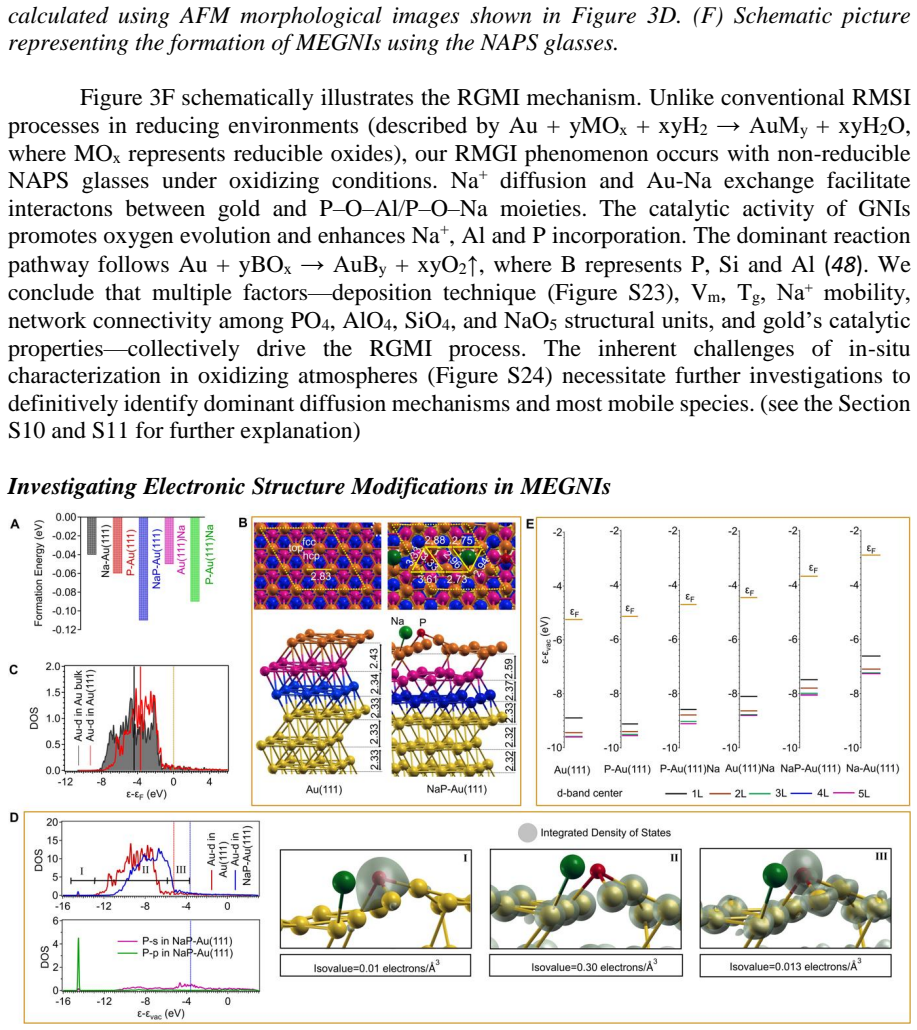
- [DFT section (Fig 4; S12, S25)] The DFT modeling is presented as 'further validation' of the TEM-observed interlayer expansion, but the NaP-Au(111) model was selected because it best reproduces that same disputed TEM result (Section S12; Fig S25). This comparison cannot independently confirm the lattice-distortion claim. Please state the predictive content of the DFT, for example quantitative agreement with measured interlayer changes and bond lengths, and, if possible, compare the models against the NBD contraction or against a measurement that does not depend on the HRTEM IFFT analysis.
- [Ultrafast Carrier Dynamics (Fig 5; S13)] The main text states that the electron-phonon coupling constant g 'increases systematically with silica concentration up to 25 mol% before decreasing for NAPS-30-Au,' while Section S13 states the opposite: 'The g value for MEGNIs decreases with increasing SiO2 concentration in NAPS-X-Au glasses up to 25 mol% and then increases for NAPS-30-Au glass.' Since the g-versus-composition trend is the central evidence for composition-controlled hot-carrier dynamics, this contradiction must be resolved. In addition, attributing the g changes to density-of-states variations near the Fermi level is speculative without direct electronic-structure measurements on the MEGNIs.
minor comments (5)
- [Atomic-Scale Architecture] The text refers to 'elemental mapping in HAADF-STEM mode (Figure 1F, S15-S16),' but the relevant main-text panel appears to be Figure 2F, not Figure 1F; please correct the cross-reference.
- [Throughout] The acronyms RGMI and RMGI are used interchangeably, for example 'our RMGI phenomenon' in the Mechanistic section; please use RGMI consistently.
- [S13 (Transient Absorption Spectroscopy)] Section S13 refers to 'Figure 5G' for the zero-power extrapolation, but Figure 5 in the main text has no panel G; the corresponding result appears to be in Figure S29C. Please fix the reference.
- [Eq (1) and Table S1] Equation (1) uses x in the denominator of the Fermi function exponent, while Table S1 lists x with units of nm^-1; for dimensional consistency x should be a length in nm. Please define x unambiguously.
- [XPS depth profiling] The fitted d1/2 values (123 nm and 84 nm) are much larger than the deposited 50 nm Au film; this may reflect island topography and sputter-induced roughening, so the absolute depth scale should be presented with appropriate caveats.
Assumptions & free parameters
free parameters (4)
- d1/2 (sputter depth at half-maximum Au intensity) =
123 nm (NAPS-15-Au), 84 nm (NAPS-30-Au)
- dw (interface width) =
68 nm (NAPS-15-Au), 34 nm (NAPS-30-Au)
- electron-phonon coupling constant g =
Not stated numerically; derived from zero-pump-power extrapolation of tau_e-ph (Fig. S29C)
- sputter yield calibration =
~2 A/s
assumptions (3)
- domain assumption PBE-GGA with empirical van der Waals correction accurately describes Au-Na and Au-P interactions in the slab models
- domain assumption The Pedone empirical potential reproduces the structure and diffusion behavior of NAPS-X glasses
- domain assumption XPS sputter depth profiling reflects original composition gradients without major sputter-induced mixing or preferential sputtering
Cite this review
Pith. "Pith review of Reactive Glass Metal Interaction under Ambient Conditions Enables Surface Modification of Gold Nanoislands." pith.science (2026). https://pith.science/paper/XJBQCHPK
@misc{pith2026250514095,
  author       = {Pith},
  title        = {Pith review of: Reactive Glass Metal Interaction under Ambient Conditions Enables Surface Modification of Gold Nanoislands},
  year         = {2026},
  howpublished = {\url{https://pith.science/paper/XJBQCHPK}},
  note         = {Machine review of arXiv:2505.14095}
}
read the original abstract
Stabilizing gold nanoparticles with tunable surface composition via reactive metal support interactions under ambient conditions remains a significant challenge. We discovered that a reactive glass metal interaction (RGMI) under ambient conditions, driven by the intrinsic catalytic activity of gold nanoislands (GNIs) and the unique properties of sodium aluminophosphosilicate glass, including its chemical composition, molar volume, and high Na ion mobility, enables the formation of robustly anchored GNIs with altered surface compositions. Comprehensive characterization reveals that the adsorption of Na and P at the GNI surfaces induces lattice distortions in the Au(111) planes. Additionally, a smooth GNI glass interface significantly influences the hot carrier dynamics of the GNIs. Altogether, RGMI presents a versatile strategy for engineering stable, multi element nanostructures with potential applications in heterogeneous catalysis, sensing, and optoelectronics.
Figures


Figures from the paper (1 more)
Reference graph
Works this paper leans on
-
[1]
C. Gao, O. Terasaki, Counting charges per metal nanoparticle. Science (1979) 378, 133–134 (2022)
1979
-
[2]
H. Frey, A. Beck, X. Huang, J. A. van Bokhoven, M. G. Willinger, Dynamic interplay between metal nanoparticles and oxide support under redox conditions. Science (1979) 376, 982–987 (2022)
1979
-
[3]
Lykhach, S
Y. Lykhach, S. M. Kozlov, T. Skála, A. Tovt, V. Stetsovych, N. Tsud, F. Dvořák, V. Johánek, A. Neitzel, J. Mysliveček, S. Fabris, V. Matolín, K. M. Neyman, J. Libuda, Counting electrons on supported nanoparticles. Nat Mater 15, 284–288 (2016)
2016
-
[4]
Linic, P
S. Linic, P. Christopher, D. B. Ingram, Plasmonic-metal nanostructures for efficient conversion of solar to chemical energy. Nat Mater 10, 911–921 (2011)
2011
-
[5]
Altug, S.-H
H. Altug, S.-H. Oh, S. A. Maier, J. Homola, Advances and applications of nanophotonic biosensors. Nat Nanotechnol 17, 5–16 (2022)
2022
-
[6]
Hu, W.-X
S. Hu, W.-X. Li, Sabatier principle of metal-support interaction for design of ultrastable metal nanocatalysts. Science (1979) 374, 1360–1365 (2021)
1979
-
[7]
Z.-P. Wu, S. Shan, S.-Q. Zang, C.-J. Zhong, Dynamic Core–Shell and Alloy Structures of Multimetallic Nanomaterials and Their Catalytic Synergies. Acc Chem Res 53, 2913– 2924 (2020)
work page 2020
-
[8]
G. Pacchioni, H.-J. Freund, Controlling the charge state of supported nanoparticles in catalysis: lessons from model systems. Chem Soc Rev 47, 8474–8502 (2018)
work page 2018
Show all 86 references
-
[9]
H. Tang, Y. Su, B. Zhang, A. F. Lee, M. A. Isaacs, K. Wilson, L. Li, Y. Ren, J. Huang, M. Haruta, B. Qiao, X. Liu, C. Jin, D. Su, J. Wang, T. Zhang, Classical strong metal–support 15 interactions between gold nanoparticles and titanium dioxide. Sci Adv 3, e1700231 (2024)
2024
-
[10]
C. T. Campbell, The Active Site in Nanoparticle Gold Catalysis. Science (1979) 306, 234–235 (2004)
1979
-
[11]
M. Xu, M. Peng, H. Tang, W. Zhou, B. Qiao, D. Ma, Renaissance of Strong Metal– Support Interactions. J Am Chem Soc 146, 2290–2307 (2024)
2024
-
[12]
H. Wang, Z. Gao, B. Sun, S. Mu, F. Dang, X. Guo, D. Ma, C. Shi, Engineering metal- support interaction to construct catalytic interfaces and redisperse metal nanoparticles. Chem Catalysis 3, 100768 (2023)
2023
-
[13]
T. Wang, J. Hu, R. Ouyang, Y. Wang, Y. Huang, S. Hu, W.-X. Li, Nature of metal-support interaction for metal catalysts on oxide supports. Science (1979) 386, 915–920 (2024)
1979
-
[14]
Jackson, G
C. Jackson, G. T. Smith, D. W. Inwood, A. S. Leach, P. S. Whalley, M. Callisti, T. Polcar, A. E. Russell, P. Levecque, D. Kramer, Electronic metal-support interaction enhanced oxygen reduction activity and stability of boron carbide supported platinum. Nat Commun 8, 15802 (2017)
2017
-
[15]
Ahmadi, H
M. Ahmadi, H. Mistry, B. Roldan Cuenya, Tailoring the Catalytic Properties of Metal Nanoparticles via Support Interactions. J Phys Chem Lett 7, 3519–3533 (2016)
2016
-
[16]
Sankar, Q
M. Sankar, Q. He, R. V Engel, M. A. Sainna, A. J. Logsdail, A. Roldan, D. J. Willock, N. Agarwal, C. J. Kiely, G. J. Hutchings, Role of the Support in Gold-Containing Nanoparticles as Heterogeneous Catalysts. Chem Rev 120, 3890–3938 (2020)
2020
-
[17]
J. Han, J. Yang, Z. Zhang, X. Jiang, W. Liu, B. Qiao, J. Mu, F. Wang, Strong Metal– Support Interaction Facilitated Multicomponent Alloy Formation on Metal Oxide Support. J Am Chem Soc 145, 22671–22684 (2023)
2023
-
[18]
X. Liu, Q. Gu, Y. Zhang, X. Xu, H. Wang, Z. Sun, L. Cao, Q. Sun, L. Xu, L. Wang, S. Li, S. Wei, B. Yang, J. Lu, Atomically Thick Oxide Overcoating Stimulates Low-Temperature Reactive Metal–Support Interactions for Enhanced Catalysis. J Am Chem Soc 145, 6702–6709 (2023)
2023
-
[19]
Z. Li, Y. Cui, Z. Wu, C. Milligan, L. Zhou, G. Mitchell, B. Xu, E. Shi, J. T. Miller, F. H. Ribeiro, Y. Wu, Reactive metal–support interactions at moderate temperature in two- dimensional niobium-carbide-supported platinum catalysts. Nat Catal 1, 349–355 (2018)
2018
-
[20]
Penner, M
S. Penner, M. Armbrüster, Formation of Intermetallic Compounds by Reactive Metal– Support Interaction: A Frequently Encountered Phenomenon in Catalysis. ChemCatChem 7, 374–392 (2015)
2015
-
[21]
Y. Sun, Z. Yang, S. Dai, Nonclassical Strong Metal–Support Interactions for Enhanced Catalysis. J Phys Chem Lett 14, 2364–2377 (2023)
2023
-
[22]
T. W. van Deelen, C. Hernández Mejía, K. P. de Jong, Control of metal-support interactions in heterogeneous catalysts to enhance activity and selectivity. Nat Catal 2, 955–970 (2019)
2019
-
[23]
C. H. Bartholomew, Mechanisms of catalyst deactivation. Appl Catal A Gen 212, 17– 60 (2001)
2001
-
[24]
Kusada, M
K. Kusada, M. Mukoyoshi, D. Wu, H. Kitagawa, Chemical Synthesis, Characterization, and Properties of Multi-Element Nanoparticles. Angewandte Chemie International Edition 61, e202209616 (2022)
2022
-
[25]
L. Bu, N. Zhang, S. Guo, X. Zhang, J. Li, J. Yao, T. Wu, G. Lu, J.-Y. Ma, D. Su, X. Huang, Biaxially strained PtPb/Pt core/shell nanoplate boosts oxygen reduction catalysis. Science (1979) 354, 1410–1414 (2016). 16
1979
-
[26]
S. G. Kwon, G. Krylova, P. J. Phillips, R. F. Klie, S. Chattopadhyay, T. Shibata, E. E. Bunel, Y. Liu, V. B. Prakapenka, B. Lee, E. V Shevchenko, Heterogeneous nucleation and shape transformation of multicomponent metallic nanostructures. Nat Mater 14, 215–223 (2015)
2015
-
[27]
Aslam, S
U. Aslam, S. Chavez, S. Linic, Controlling energy flow in multimetallic nanostructures for plasmonic catalysis. Nat Nanotechnol 12, 1000–1005 (2017)
2017
-
[28]
P.-C. Chen, X. Liu, J. L. Hedrick, Z. Xie, S. Wang, Q.-Y. Lin, M. C. Hersam, V. P. Dravid, C. A. Mirkin, Polyelemental nanoparticle libraries. Science (1979) 352, 1565–1569 (2016)
1979
-
[29]
K. Loza, M. Heggen, M. Epple, Synthesis, Structure, Properties, and Applications of Bimetallic Nanoparticles of Noble Metals. Adv Funct Mater 30, 1909260 (2020)
2020
-
[30]
Larrañaga-Tapia, B
M. Larrañaga-Tapia, B. Betancourt-Tovar, M. Videa, M. Antunes-Ricardo, J. L. Cholula- Díaz, Green synthesis trends and potential applications of bimetallic nanoparticles towards the sustainable development goals 2030. Nanoscale Adv 6, 51–71 (2024)
2024
-
[31]
L. Wang, L. Wang, X. Meng, F.-S. Xiao, New Strategies for the Preparation of Sinter- Resistant Metal-Nanoparticle-Based Catalysts. Advanced Materials 31, 1901905 (2019)
2019
-
[32]
G. Wu, Y. Liu, J. Wang, Oxidative-Atmosphere-Induced Strong Metal–Support Interaction and Its Catalytic Application. Acc Chem Res 56, 911–923 (2023)
2023
-
[33]
G. Cao, J. Liang, Z. Guo, K. Yang, G. Wang, H. Wang, X. Wan, Z. Li, Y. Bai, Y. Zhang, J. Liu, Y. Feng, Z. Zheng, C. Lu, G. He, Z. Xiong, Z. Liu, S. Chen, Y. Guo, M. Zeng, J. Lin, L. Fu, Liquid metal for high-entropy alloy nanoparticles synthesis. Nature 619, 73–77 (2023)
2023
-
[34]
A. S. Nugraha, V. Malgras, J. Kim, J. Bo, C. Li, M. Iqbal, Y. Yamauchi, T. Asahi, Trimetallic Mesoporous AuCuNi Electrocatalysts with Controlled Compositions Using Block Copolymer Micelles as Templates. Small Methods 2, 1800283 (2018)
2018
-
[35]
J. F. Callejas, C. G. Read, C. W. Roske, N. S. Lewis, R. E. Schaak, Synthesis, Characterization, and Properties of Metal Phosphide Catalysts for the Hydrogen- Evolution Reaction. Chemistry of Materials 28, 6017–6044 (2016)
2016
-
[36]
Chang, B
H. Chang, B. H. Kim, S. G. Lim, H. Baek, J. Park, T. Hyeon, Role of the Precursor Composition in the Synthesis of Metal Ferrite Nanoparticles. Inorg Chem 60, 4261– 4268 (2021)
2021
-
[37]
G. K. Wertheim, S. B. DiCenzo, S. E. Youngquist, Unit Charge on Supported Gold Clusters in Photoemission Final State. Phys Rev Lett 51, 2310–2313 (1983)
1983
-
[38]
Fernando, T
D. Fernando, T. A. E. Nigro, I. D. Dyer, S. M. Alia, B. S. Pivovar, Y. Vasquez, Synthesis and catalytic activity of the metastable phase of gold phosphide. J Solid State Chem 242, 182–192 (2016)
2016
-
[39]
H. Tang, J. Wei, F. Liu, B. Qiao, X. Pan, L. Li, J. Liu, J. Wang, T. Zhang, Strong Metal– Support Interactions between Gold Nanoparticles and Nonoxides. J Am Chem Soc 138, 56–59 (2016)
2016
-
[40]
W. Yan, S. Brown, Z. Pan, S. M. Mahurin, S. H. Overbury, S. Dai, Ultrastable Gold Nanocatalyst Supported by Nanosized Non-Oxide Substrate. Angewandte Chemie International Edition 45, 3614–3618 (2006)
2006
-
[41]
Machida, K
M. Machida, K. Murakami, S. Hinokuma, K. Uemura, K. Ikeue, M. Matsuda, M. Chai, Y. Nakahara, T. Sato, AlPO4 as a Support Capable of Minimizing Threshold Loading of Rh in Automotive Catalysts. Chemistry of Materials 21, 1796–1798 (2009). 17
2009
-
[42]
Yang, L.-N
C.-L. Yang, L.-N. Wang, P. Yin, J. Liu, M.-X. Chen, Q.-Q. Yan, Z.-S. Wang, S.-L. Xu, S.-Q. Chu, C. Cui, H. Ju, J. Zhu, Y. Lin, J. Shui, H.-W. Liang, Sulfur-anchoring synthesis of platinum intermetallic nanoparticle catalysts for fuel cells. Science (1979) 374, 459– 464 (2021)
1979
-
[44]
G. M. Veith, A. R. Lupini, S. Rashkeev, S. J. Pennycook, D. R. Mullins, V. Schwartz, C. A. Bridges, N. J. Dudney, Thermal stability and catalytic activity of gold nanoparticles supported on silica. J Catal 262, 92–101 (2009)
2009
-
[46]
Yaguchi, T
M. Yaguchi, T. Uchida, K. Motobayashi, M. Osawa, Speciation of Adsorbed Phosphate at Gold Electrodes: A Combined Surface-Enhanced Infrared Absorption Spectroscopy and DFT Study. J Phys Chem Lett 7, 3097–3102 (2016)
2016
-
[47]
L. K. Ono, F. Behafarid, B. R. Cuenya, Nano-Gold Diggers: Au-Assisted SiO2- Decomposition and Desorption in Supported Nanocatalysts. ACS Nano 7, 10327– 10334 (2013)
2013
-
[48]
Labich, A
S. Labich, A. Kohl, E. Taglauer, H. Knözinger, Silicide formation by high-temperature reaction of Rh with model SiO2 films. J Chem Phys 109, 2052–2055 (1998)
1998
-
[49]
F. Wang, S. Niu, X. Liang, G. Wang, M. Chen, Phosphorus incorporation activates the basal plane of tungsten disulfide for efficient hydrogen evolution catalysis. Nano Res 15, 2855–2861 (2022)
2022
-
[50]
H. Kim, D. Kim, M. Cho, Chemomechanical Design Factors for High Performance in Manganese-Based Spinel Cathode Materials for Advanced Sodium-Ion Batteries. ACS Appl Mater Interfaces 12, 22789–22797 (2020)
2020
-
[51]
P.-C. Chen, M. Liu, J. S. Du, B. Meckes, S. Wang, H. Lin, V. P. Dravid, C. Wolverton, C. A. Mirkin, Interface and heterostructure design in polyelemental nanoparticles. Science (1979) 363, 959–964 (2019)
1979
-
[52]
D. Wu, K. Kusada, Y. Nanba, M. Koyama, T. Yamamoto, T. Toriyama, S. Matsumura, O. Seo, I. Gueye, J. Kim, L. S. Rosantha Kumara, O. Sakata, S. Kawaguchi, Y. Kubota, H. Kitagawa, Noble-Metal High-Entropy-Alloy Nanoparticles: Atomic-Level Insight into the Electronic Structure. J ...
2022
-
[53]
Zhang, S
Y. Zhang, S. He, W. Guo, Y. Hu, J. Huang, J. R. Mulcahy, W. D. Wei, Surface-Plasmon- Driven Hot Electron Photochemistry. Chem Rev 118, 2927–2954 (2018)
2018
-
[54]
A. N. Koya, M. Romanelli, J. Kuttruff, N. Henriksson, A. Stefancu, G. Grinblat, A. De Andres, F. Schnur, M. Vanzan, M. Marsili, M. Rahaman, A. Viejo Rodríguez, T. Tapani, H. Lin, B. D. Dana, J. Lin, G. Barbillon, R. Proietti Zaccaria, D. Brida, D. Jariwala, L. Veisz, E. Cortés...
2023
-
[55]
Engelbrekt, K
C. Engelbrekt, K. T. Crampton, D. A. Fishman, M. Law, V. A. Apkarian, Efficient Plasmon-Mediated Energy Funneling to the Surface of Au@Pt Core–Shell Nanocrystals. ACS Nano 14, 5061–5074 (2020). 18
2020
-
[56]
N. J. Divins, I. Angurell, C. Escudero, V. Pérez-Dieste, J. Llorca, Influence of the support on surface rearrangements of bimetallic nanoparticles in real catalysts. Science (1979) 346, 620–623 (2014)
1979
-
[57]
Zhang, C
X. Zhang, C. Huang, M. Wang, P. Huang, X. He, Z. Wei, Transient localized surface plasmon induced by femtosecond interband excitation in gold nanoparticles. Sci Rep 8, 10499 (2018)
2018
-
[59]
J. H. Hodak, A. Henglein, G. V Hartland, Tuning the spectral and temporal response in PtAu core–shell nanoparticles. J Chem Phys 114, 2760–2765 (2001)
2001
-
[61]
Gangareddy, P
J. Gangareddy, P. Rudra, M. Chirumamilla, S. Ganisetti, S. Kasimuthumaniyan, S. Sahoo, K. Jayanthi, J. Rathod, V. R. Soma, S. Das, N. N. Gosvami, N. M. A. Krishnan, K. Pedersen, S. Mondal, S. Ghosh, A. R. Allu, Multi-Functional Applications of H-Glass Embedded with Stable Plas...
2024
-
[62]
Mandal, J
I. Mandal, J. Gangareddy, A. Sethurajaperumal, M. NK, M. Majji, S. Bera, P. Rudra, V. Ravichandran, S. Bysakh, N. Jacob, K. D. M. Rao, R. K. Singh, N. M. A. Krishnan, M. Chirumamilla, T. Palanisamy, M. Motapothula, E. Varrla, S. Ghosh, A. R. Allu, H-Glass Supported Hybrid Gold...
2024
-
[63]
O" mark region (a) of Au nanoparticle shown in (i). (iii) The nanobeam diffraction pattern (NBD) acquired along the Au[-111] zone axis from the
S. Karmakar, S. Ash, S. Haque, N. K. Murugasenapathi, M. Sridevi, I. Mandal, G. Ghorai, A. V Muhammed Ali, N. N. Gosvami, N. M. A. Krishnan, S. Kanungo, M. Chirumamilla, T. Palanisamy, R. K. Singh, A. R. Allu, K. D. M. Rao, On-Chip Full-UV- Band Photodetectors Enabled by Hot H...
2025
-
[64]
S. R. Keshri, I. Mandal, S. Ganisetti, S. Kasimuthumaniyan, R. Kumar, A. Gaddam, A. Shelke, T. G. Ajithkumar, N. N. Gosvami, N. M. A. Krishnan, A. R. Allu, Elucidating the influence of structure and Ag+-Na+ ion-exchange on crack-resistance and ionic conductivity of Na3Al1.8Si1...
2022
-
[65]
Giannozzi, S
P. Giannozzi, S. Baroni, N. Bonini, M. Calandra, R. Car, C. Cavazzoni, D. Ceresoli, G. L. Chiarotti, M. Cococcioni, I. Dabo, A. Dal Corso, S. de Gironcoli, S. Fabris, G. Fratesi, R. Gebauer, U. Gerstmann, C. Gougoussis, A. Kokalj, M. Lazzeri, L. Martin-Samos, N. Marzari, F. Ma...
2009
-
[66]
Vanderbilt, Soft self-consistent pseudopotentials in a generalized eigenvalue formalism
D. Vanderbilt, Soft self-consistent pseudopotentials in a generalized eigenvalue formalism. Phys Rev B 41, 7892–7895 (1990)
1990
-
[67]
J. P. Perdew, K. Burke, M. Ernzerhof, Generalized Gradient Approximation Made Simple. Phys Rev Lett 77, 3865–3868 (1996)
1996
-
[68]
H. J. Monkhorst, J. D. Pack, Special points for Brillouin-zone integrations. Phys Rev B 13, 5188–5192 (1976)
1976
-
[69]
Marzari, D
N. Marzari, D. Vanderbilt, A. De Vita, M. C. Payne, Thermal Contraction and Disordering of the Al(110) Surface. Phys Rev Lett 82, 3296–3299 (1999)
1999
-
[70]
Barone, M
V. Barone, M. Casarin, D. Forrer, M. Pavone, M. Sambi, A. Vittadini, Role and effective treatment of dispersive forces in materials: Polyethylene and graphite crystals as test cases. J Comput Chem 30, 934–939 (2009)
2009
-
[71]
Y. Xu, Z. Shi, X. Shi, K. Zhang, H. Zhang, Recent progress in black phosphorus and black- phosphorus-analogue materials: properties, synthesis and applications. Nanoscale 11, 14491–14527 (2019)
2019
-
[72]
Plimpton, Fast Parallel Algorithms for Short-Range Molecular Dynamics
S. Plimpton, Fast Parallel Algorithms for Short-Range Molecular Dynamics. J Comput Phys 117, 1–19 (1995)
1995
-
[73]
Pedone, G
A. Pedone, G. Malavasi, M. C. Menziani, A. N. Cormack, U. Segre, A New Self-Consistent Empirical Interatomic Potential Model for Oxides, Silicates, and Silica-Based Glasses. J Phys Chem B 110, 11780–11795 (2006)
2006
-
[74]
Ganisetti, A
S. Ganisetti, A. Gaddam, R. Kumar, S. Balaji, G. C. Mather, M. J. Pascual, M. Fabian, R. Siegel, J. Senker, V. V Kharton, J. Guénolé, N. M. A. Krishnan, J. M. F. Ferreira, A. R. Allu, Elucidating the formation of Al–NBO bonds, Al–O–Al linkages and clusters in alkaline-earth al...
2019
-
[75]
Moğulkoç, K
B. Moğulkoç, K. M. Knowles, H. V Jansen, H. J. M. Ter Brake, M. C. Elwenspoek, Surface Devitrification and the Growth of Cristobalite in Borofloat® (Borosilicate 8330) Glass. Journal of the American Ceramic Society 93, 2713–2719 (2010)
2010
-
[76]
X. Hu, D. G. Cahill, R. S. Averback, Burrowing of Pt nanoparticles into SiO2 during ion-beam irradiation. J Appl Phys 92, 3995–4000 (2002)
2002
-
[77]
Lunkenheimer, A
P. Lunkenheimer, A. Loidl, B. Riechers, A. Zaccone, K. Samwer, Thermal expansion and the glass transition. Nat Phys 19, 694–699 (2023). 46
2023
-
[78]
Kapoor, R
S. Kapoor, R. E. Youngman, L. Ma, N. Lönnroth, S. J. Rzoska, M. Bockowski, L. R. Jensen, M. Bauchy, M. M. Smedskjaer, Permanent Densification of Calcium Aluminophosphate Glasses. Front Mater 6 (2019)
2019
-
[79]
Balzer, H
R. Balzer, H. Behrens, T. Waurischk, S. Reinsch, R. Müller, P. Kiefer, J. Deubener, M. Fechtelkord, Water in Alkali Aluminosilicate Glasses. Front Mater 7 (2020)
2020
-
[80]
L. K. Ono, F. Behafarid, B. R. Cuenya, Nano-Gold Diggers: Au-Assisted SiO2-Decomposition and Desorption in Supported Nanocatalysts. ACS Nano 7, 10327–10334 (2013)
2013
-
[81]
L. Yang, M. P. Seah, E. H. Anstis, I. S. Gilmore, J. L. S. Lee, Sputtering Yields of Gold Nanoparticles by C60 Ions. The Journal of Physical Chemistry C 116, 9311–9318 (2012)
2012
-
[82]
Kalahe, T
J. Kalahe, T. S. Mahadevan, M. Ono, K. Miyatani, S. Urata, J. Du, Composition Effect on Interfacial Reactions of Sodium Aluminosilicate Glasses in Aqueous Solution. J Phys Chem B 127, 269–284 (2023)
2023
-
[83]
V Hartland, Optical Studies of Dynamics in Noble Metal Nanostructures
G. V Hartland, Optical Studies of Dynamics in Noble Metal Nanostructures. Chem Rev 111, 3858–3887 (2011)
2011
-
[84]
Tagliabue, J
G. Tagliabue, J. S. DuChene, M. Abdellah, A. Habib, D. J. Gosztola, Y. Hattori, W.-H. Cheng, K. Zheng, S. E. Canton, R. Sundararaman, J. Sá, H. A. Atwater, Ultrafast hot-hole injection modifies hot-electron dynamics in Au/p-GaN heterostructures. Nat Mater 19, 1312–1318 (2020)
2020
-
[85]
S. L. Logunov, T. S. Ahmadi, M. A. El-Sayed, J. T. Khoury, R. L. Whetten, Electron Dynamics of Passivated Gold Nanocrystals Probed by Subpicosecond Transient Absorption Spectroscopy. J Phys Chem B 101, 3713–3719 (1997)
1997
-
[86]
C. O. Karaman, A. Yu. Bykov, F. Kiani, G. Tagliabue, A. V Zayats, Ultrafast hot-carrier dynamics in ultrathin monocrystalline gold. Nat Commun 15, 703 (2024)
2024
-
[87]
Dowgiallo, K
A.-M. Dowgiallo, K. L. Knappenberger, Ultrafast electron–phonon coupling in hollow gold nanospheres. Physical Chemistry Chemical Physics 13, 21585–21592 (2011)
2011
-
[88]
Y. U. Staechelin, D. Hoeing, F. Schulz, H. Lange, Size-Dependent Electron–Phonon Coupling in Monocrystalline Gold Nanoparticles. ACS Photonics 8, 752–757 (2021)
2021
-
[89]
Z. Lin, L. V Zhigilei, V. Celli, Electron-phonon coupling and electron heat capacity of metals under conditions of strong electron-phonon nonequilibrium. Phys Rev B 77, 75133 (2008)
2008
-
[90]
Geske, J
T. Geske, J. Li, M. Worden, X. Shan, M. Chen, S. G. R. Bade, Z. Yu, Deterministic Nucleation for Halide Perovskite Thin Films with Large and Uniform Grains. Adv Funct Mater 27, 1702180 (2017)
2017
Reviewed August 7, 2026 · model on record in the stance chip above.
Discussion (0). Continue with ORCID to comment.