REVIEW 2 major objections 2 minor 34 references
Cascade adaptive optics with a second stage based on a Zernike wavefront sensor for exoplanet observations II. Validation in broadband light on the ESO/GHOST testbed
T0 review · 2 major / 2 minor · reviewed 2026-06-26 · grok-4.3
Pith's one-line read A Zernike wavefront sensor second stage improves contrast by up to a factor of ten in broadband light after static aberration removal.
desk verdict The paper delivers a clean experimental validation of broadband ZWFS second-stage correction on the GHOST testbed, extending the prior monochromatic work with consistent contrast gains, though the simulated first-stage residuals remain the key untested link to real conditions. read the letter →
The pith
A machine-rendered reading of the paper's core claim, the machinery that carries it, and where it could break.
The reading
What carries the argument
The Zernike wavefront sensor (ZWFS) second-stage control loop that senses and corrects residual aberrations from a first-stage extreme AO system in cascade adaptive optics.
What would settle it
No measurable contrast improvement when the ZWFS loop is closed during on-sky broadband observations with an actual telescope would falsify the performance claim.
Extended reading notes
Core claim
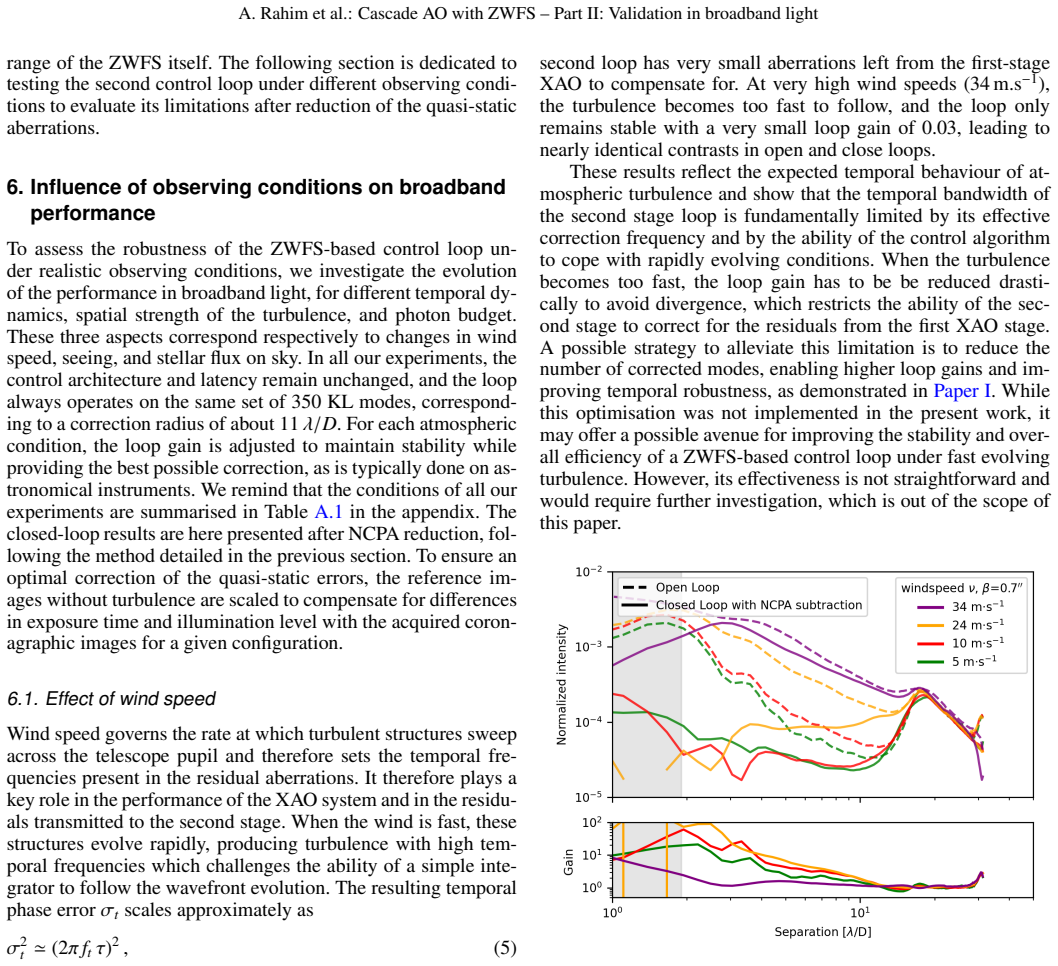
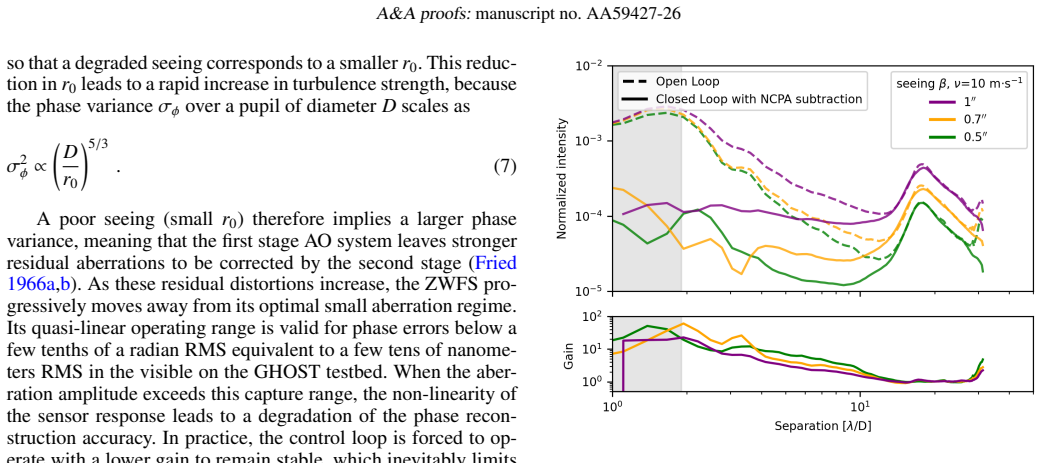
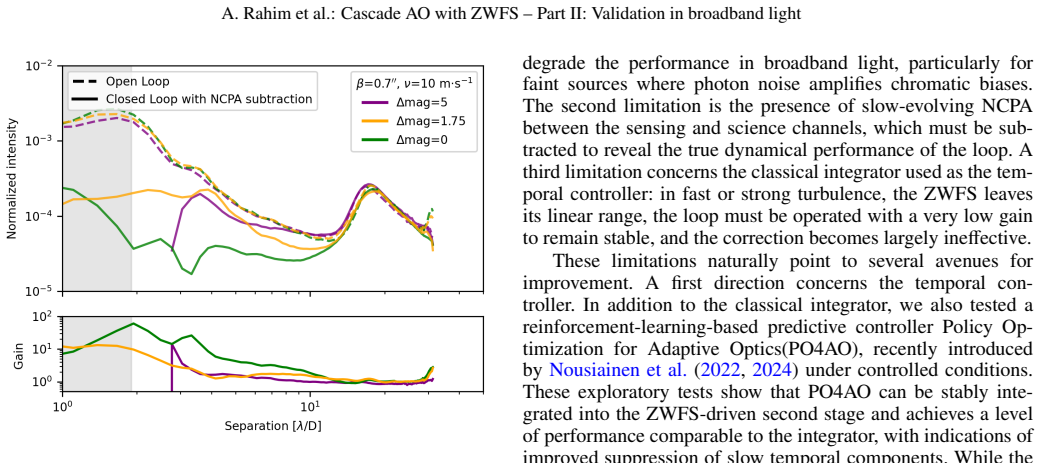
On the GHOST testbed, closing the Zernike wavefront sensor control loop on simulated first-stage XAO residuals consistently improves contrast in Lyot coronagraphic images within the correction region. After subtraction of quasi-static aberrations the loop delivers a contrast gain up to one order of magnitude. This gain is independent of bandwidth and turbulence strength. Broadband and narrowband performance match for bright sources, while narrowband remains slightly preferable for faint targets.
Load-bearing premise
Simulated first-stage XAO residuals on the testbed accurately represent real telescope conditions and quasi-static aberrations can be subtracted without introducing new errors.
Editorial extensions
If this is right
- The ZWFS-based cascade loop is feasible in polychromatic light across a wide range of seeings, wind speeds, and stellar fluxes.
- Contrast gains remain independent of bandwidth once quasi-static aberrations are removed.
- Narrowband operation offers only a modest advantage for the faintest targets.
- The scheme points toward use on Extremely Large Telescopes once achromatic masks and accurate quasi-static calibration are available.
Reading between the lines
- If the testbed results translate to on-sky conditions, second-stage ZWFS loops could relax requirements on first-stage XAO speed for future high-contrast instruments.
- Accurate subtraction of quasi-static aberrations emerges as the dominant practical limit rather than bandwidth or turbulence strength.
- The approach could be tested on existing 8-meter-class telescopes by adding a ZWFS channel to current extreme AO systems.
- Extending the method to even broader wavelength ranges would require verifying that the Zernike mask remains effective without chromatic errors.
Signed reviews
Editorial analysis
A structured set of objections, weighed in public.
Referee Report
Summary. The manuscript experimentally validates a cascade adaptive optics scheme on the GHOST testbed in which a Zernike wavefront sensor (ZWFS) serves as the second stage. Simulated residuals from a first-stage XAO are injected into the testbed; the ZWFS loop is closed in both narrowband and broadband light across a range of seeing, wind speed, and stellar flux conditions. Contrast is measured in Lyot coronagraphic images, and the central claim is that loop closure yields contrast gains up to one order of magnitude after quasi-static aberration subtraction, with performance independent of bandwidth and turbulence strength (narrowband slightly preferred only for faint targets).
Significance. If the testbed results translate to on-sky conditions, the work would provide a practical path to mitigate the dominant temporal-error floor of current XAO systems for exoplanet imaging on ELTs. The hardware demonstration in polychromatic light is a necessary step beyond the prior monochromatic validation and directly addresses the photon-efficiency requirement of real wavefront sensors. The experimental nature supplies concrete contrast numbers rather than purely simulated predictions.
major comments (2)
- [Abstract and Results] Abstract and Results section: the headline claim of 'contrast gain up to one order of magnitude, independently of bandwidth and turbulence strength' is stated without error bars, standard deviations across repeated measurements, or explicit criteria for data inclusion/exclusion. Because the independence statement is load-bearing for the broadband feasibility conclusion, the absence of these statistics prevents quantitative assessment of robustness.
- [Methods] Methods section (description of injected residuals): the first-stage XAO residuals are described only as 'simulated' with no quantitative match provided to on-sky power spectral densities, temporal power spectra, or chromatic content (including NCPA and differential refraction). This omission directly affects the validity of the bandwidth-independence result, as any mismatch in spatial-frequency or wavelength dependence would alter ZWFS performance in ways not captured by the testbed data.
minor comments (2)
- [Abstract] The abstract would be clearer if it listed the precise wavelength ranges and bandwidths used for the narrowband and broadband cases.
- [Figures] Figure captions and axis labels should explicitly state whether contrast curves represent single realizations or averages, and whether the plotted values are raw or post-subtraction.
Simulated Author's Rebuttal
We thank the referee for the constructive feedback. The comments highlight opportunities to strengthen the statistical presentation and the description of the injected residuals. We address each point below and will revise the manuscript accordingly.
read point-by-point responses
-
Referee: [Abstract and Results] Abstract and Results section: the headline claim of 'contrast gain up to one order of magnitude, independently of bandwidth and turbulence strength' is stated without error bars, standard deviations across repeated measurements, or explicit criteria for data inclusion/exclusion. Because the independence statement is load-bearing for the broadband feasibility conclusion, the absence of these statistics prevents quantitative assessment of robustness.
Authors: We agree that quantitative error estimates would strengthen the robustness claim. In the revised manuscript we will add standard deviations derived from repeated measurements (where available in the dataset) to the contrast-gain values reported in the Results section and abstract, and we will explicitly state the data-inclusion criteria used. This will allow readers to assess the statistical support for the reported independence from bandwidth and turbulence strength. revision: yes
-
Referee: [Methods] Methods section (description of injected residuals): the first-stage XAO residuals are described only as 'simulated' with no quantitative match provided to on-sky power spectral densities, temporal power spectra, or chromatic content (including NCPA and differential refraction). This omission directly affects the validity of the bandwidth-independence result, as any mismatch in spatial-frequency or wavelength dependence would alter ZWFS performance in ways not captured by the testbed data.
Authors: The injected residuals were generated from a standard first-stage XAO simulation employing Kolmogorov turbulence with parameters (seeing, wind speed, actuator count) chosen to match typical ELT conditions. The testbed experiment directly measures ZWFS performance in broadband light on those residuals; the observed bandwidth independence is therefore an empirical result under the tested conditions rather than a claim of perfect spectral fidelity. To address the concern we will expand the Methods section with the power spectral density and temporal spectrum of the injected residuals and note the absence of differential refraction and NCPA in the simulation. Full on-sky chromatic matching lies outside the scope of this controlled testbed validation. revision: partial
Circularity Check
No circularity: purely experimental validation on hardware with measured contrasts
full rationale
The paper reports testbed experiments on the GHOST facility using simulated first-stage XAO residuals injected into a ZWFS-based second-stage loop. Performance is quantified via direct contrast measurements in Lyot coronagraphic images under varying bandwidth, seeing, wind speed, and flux conditions. No derivations, first-principles predictions, fitted parameters renamed as outputs, or load-bearing self-citations appear in the abstract or described content. The central result (up to 10× contrast gain after quasi-static subtraction) is a measured hardware outcome, not a reduction to prior inputs by construction. Self-citation to prior monochromatic validation is present but not load-bearing for the broadband claims, which rest on new measurements.
Assumptions & free parameters
assumptions (1)
- domain assumption Testbed simulation of first-stage XAO residuals accurately represents on-sky conditions
Cite this review
Pith. "Pith review of Cascade adaptive optics with a second stage based on a Zernike wavefront sensor for exoplanet observations II. Validation in broadband light on the ESO/GHOST testbed." pith.science (2026). https://pith.science/paper/XJWVNYFS
@misc{pith2026260626895,
  author       = {Pith},
  title        = {Pith review of: Cascade adaptive optics with a second stage based on a Zernike wavefront sensor for exoplanet observations II. Validation in broadband light on the ESO/GHOST testbed},
  year         = {2026},
  howpublished = {\url{https://pith.science/paper/XJWVNYFS}},
  note         = {Machine review of arXiv:2606.26895}
}
abstract
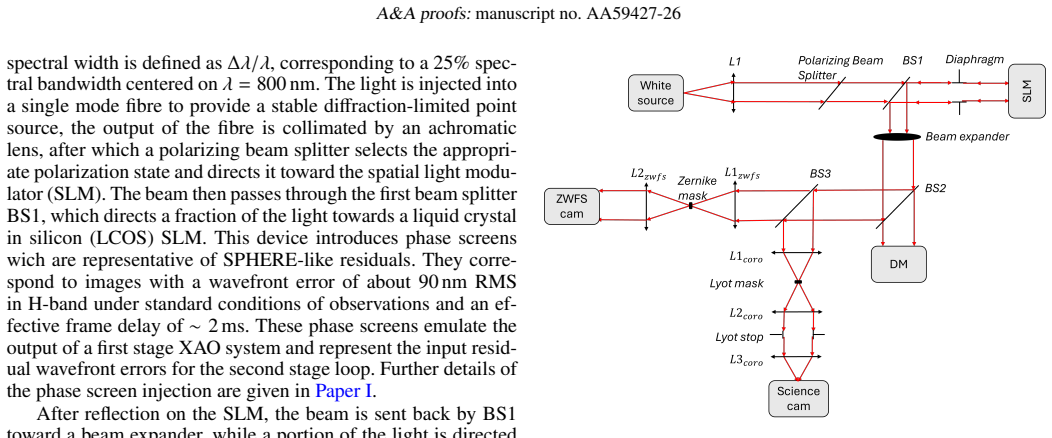
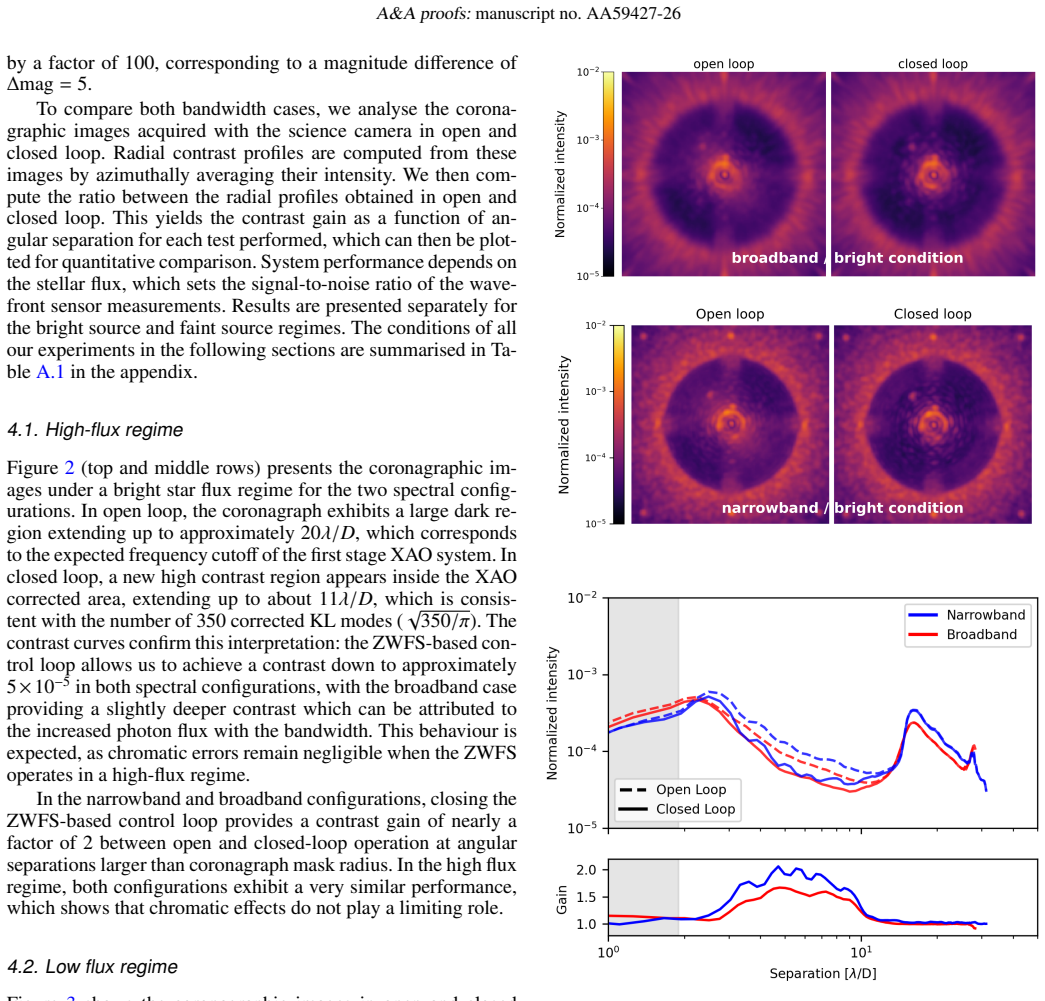
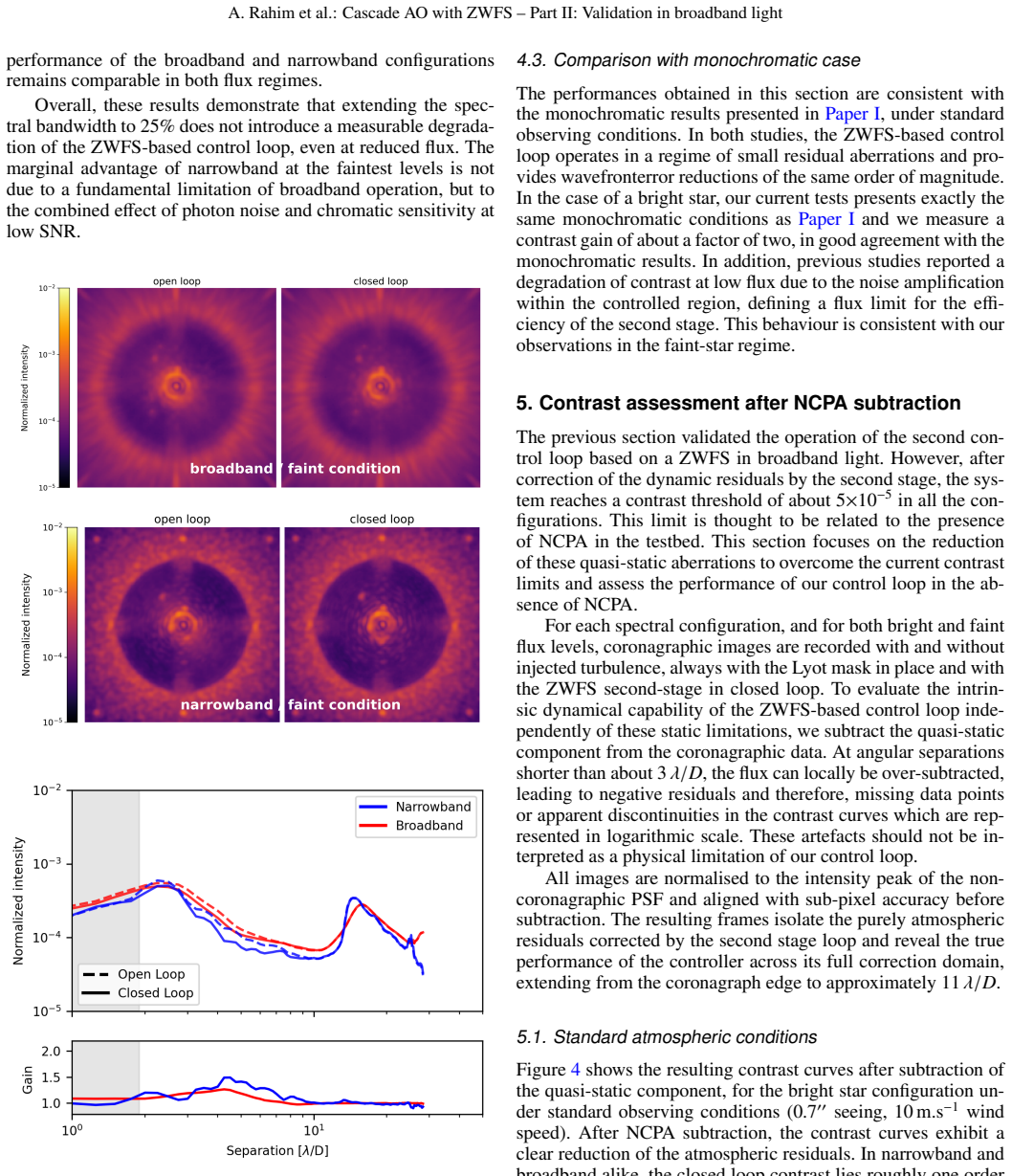
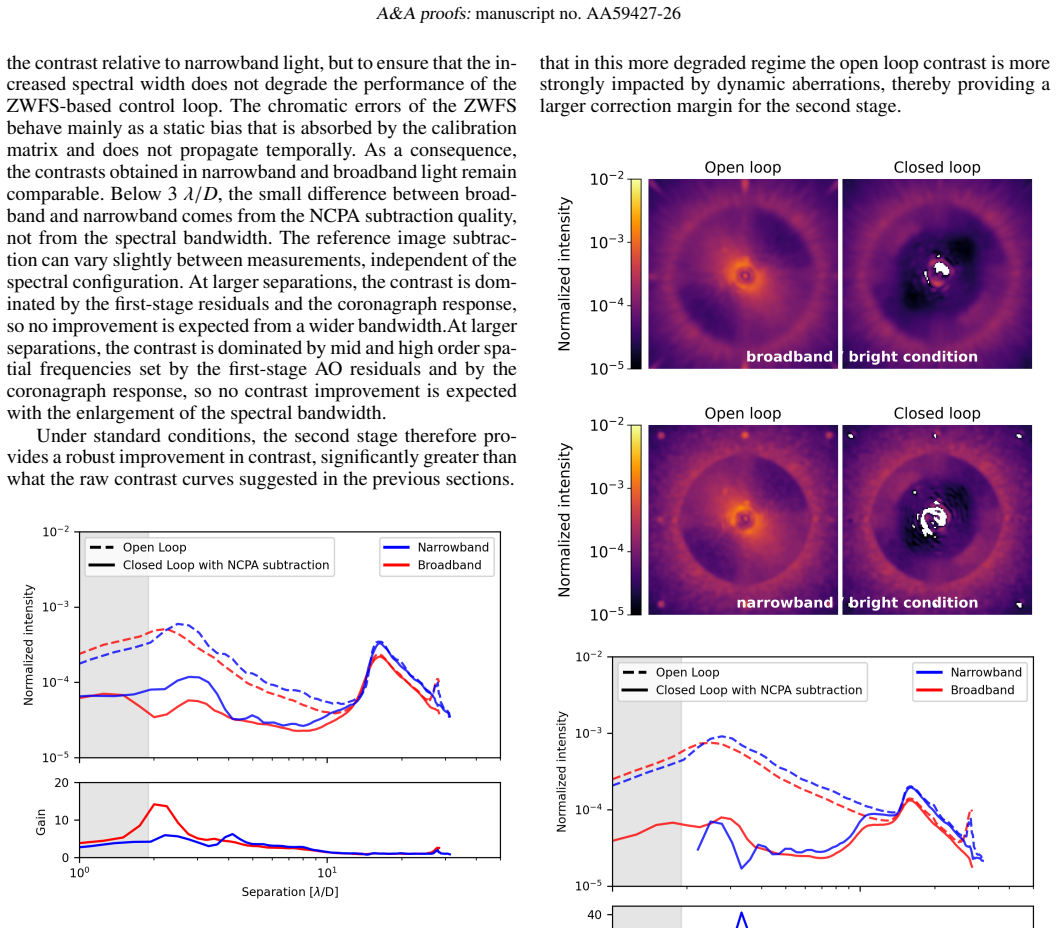
Current high-contrast facilities on the ground use extreme adaptive optics (XAO) systems to achieve contrasts down to $10^{-6}$ at 200\,mas for exoplanet observations. This performance is mainly limited by the XAO residuals due to the temporal errors in the XAO control loop. To overcome this issue, a promising solution consists in using cascade adaptive optics with a fast second stage. This approach was recently validated for a control loop based on a Zernike wavefront sensor (ZWFS) in monochromatic light. As wavefront sensors operate in broadband light to maximise photon sensitivity, this work aims to validate the ZWFS-based control loop in polychromatic light and assess its performance over a wide range of seeings, wind speeds, and stellar fluxes. Experiments were conducted on the ESO's GPU-based High-order adaptive OpticS Testbench (GHOST) testbed to probe our scheme in polychromatic light. Residual aberrations from a first-stage XAO system were simulated and our approach was evaluated in narrowband and broadband light through contrast in Lyot coronagraphic images. Closing the ZWFS-based control loop consistently improves contrast within its correction region in most tested conditions. After subtraction of quasi-static aberrations, our loop reaches a contrast gain up to one order of magnitude, independently of bandwidth and turbulence strength. The broadband and narrowband cases match in performance for bright sources, while narrowband remains slightly preferable for faint targets. These results demonstrate the feasibility of broadband ZWFS-based control loop and underline promising avenues with achromatic masks and an accurate calibration of quasi-static aberrations for future high-contrast imaging on Extremely Large Telescopes.
Figures
Figures from the paper (4 more)
Reference graph
Works this paper leans on
-
[1]
T., & Oberti, S
Agapito, G., Pinna, E., Esposito, S., Heritier, C. T., & Oberti, S. 2023, A&A, 677, A168
2023
-
[2]
P., Bendek, E., Monacelli, B., & et al
Bailey, V . P., Bendek, E., Monacelli, B., & et al. 2023, in Society of Photo- Optical Instrumentation Engineers (SPIE) Conference Series, V ol. 12680 (SPIE), 126800T
2023
-
[3]
2019, A&A, 631, A155
Beuzit, J.-L., Vigan, A., Mouillet, D., & et al. 2019, A&A, 631, A155
2019
-
[4]
2022, in Proceedings of the SPIE, V ol
Boccaletti, A., Chauvin, G., Wildi, F., & et al. 2022, in Proceedings of the SPIE, V ol. 12184, Ground-based and Airborne Instrumentation for Astronomy IX, ed. C. J. Evans, J. J. Bryant, & K. Motohara, 622–634
2022
-
[5]
2024, in Proc
Burgett, W., Bernstein, R., Ashby, D., et al. 2024, in Proc. SPIE 13094, Ground- based and Airborne Telescopes X, 13094E–17
2024
-
[6]
2022, JATIS, 8, 019001
Cerpa-Urra, N., Deo, V ., Kolb, J., Osborn, J., & Correia, C. 2022, JATIS, 8, 019001
2022
-
[7]
Chauvin, G. 2024, C. R. Phys., 24, 139
2024
-
[8]
T., et al
Cisse, M., Muslimov, E., Heritier, C. T., et al. 2023, in AO4ELT7 Conference Proceedings, 1–6
2023
Show all 34 references
-
[9]
1995, JOSA A, 12, 1559
Conan, J.-M., Rousset, G., & Madec, P.-Y . 1995, JOSA A, 12, 1559
1995
-
[10]
2023, in ASP Conf
Currie, T., Biller, B., Lagrange, A., et al. 2023, in ASP Conf. Ser., V ol. 534, Protostars and Planets VII, ed. S. Inutsuka, Y . Aikawa, T. Muto, K. Tomida, & M. Tamura, 799
2023
-
[11]
Darcis, S. et al. 2025, A&A, 701, A157
2025
-
[12]
S., Fagginger Auer, F., Escuti, M
Doelman, D. S., Fagginger Auer, F., Escuti, M. J., & Snik, F. 2019, Opt. Lett., 44, 17
2019
-
[13]
2024, arXiv preprint arXiv:2411.05408 [arXiv:2411.05408]
Engler, B., Kasper, M., Leveratto, S., et al. 2024, arXiv preprint arXiv:2411.05408 [arXiv:2411.05408]
2024
-
[14]
2022, in 2022 IEEE Workshop on Signal Processing Systems (SiPS) (IEEE), 1–6
Ferreira, F., Bernard, J., Sevin, A., Doucet, N., & Gratadour, D. 2022, in 2022 IEEE Workshop on Signal Processing Systems (SiPS) (IEEE), 1–6
2022
-
[15]
Fitzgerald, M. P. et al. 2019, BAAS, 51, 251
2019
-
[16]
Fried, D. L. 1990, JOSA A, 7, 1224
1990
-
[17]
2018, ARA&A, 56, 315
Guyon, O. 2018, ARA&A, 56, 315
2018
-
[18]
Haffert, S. Y . 2024, A&A, 683, A113 Héritier, C. T., Vérinaud, C., & Correia, C. 2023, OOPAO: Object Oriented Python Adaptive Optics, Proceedings of the AO for Extremely Large Tele- scopes Conference (AO4ELT)
2024
-
[19]
2015, PASP, 127, 890
Jovanovic, N., Guyon, O., Martinache, F., & et al. 2015, PASP, 127, 890
2015
-
[20]
2021, The Messenger, 182, 37
Kasper, M., Cerpa Urra, N., Pathak, P., et al. 2021, The Messenger, 182, 37
2021
-
[21]
P., et al
Kasper, M., Fedrigo, E., Looze, D. P., et al. 2004, JOSA A, 21, 1004
2004
-
[22]
1932, Zeitschrift für Astrophysik, 5, 73
Lyot, B. 1932, Zeitschrift für Astrophysik, 5, 73
1932
-
[23]
R., Ingraham, P., & et al
Macintosh, B., Graham, J. R., Ingraham, P., & et al. 2014, PNAS, 111, 12661
2014
-
[24]
2024, JATIS, 10, 035004
Mennesson, B., Belikov, R., Por, E., et al. 2024, JATIS, 10, 035004
2024
-
[25]
2021, in Opti- cal Instrument Science, Technology, and Applications II (SPIE), 56–68, arXiv:2110.10263 N’Diaye, M., Dohlen, K., Fusco, T., & Paul, B
Muslimov, E., Levraud, N., Chambouleyron, V ., et al. 2021, in Opti- cal Instrument Science, Technology, and Applications II (SPIE), 56–68, arXiv:2110.10263 N’Diaye, M., Dohlen, K., Fusco, T., & Paul, B. 2013, A&A, 555, A94 N’Diaye, M., Vigan, A., Engler, B., et al. 2024, A&A,...
2021
-
[26]
2024, JATIS, 10, 019001
Nousiainen, J., Engler, B., Kasper, M., et al. 2024, JATIS, 10, 019001
2024
-
[27]
2022, A&A, 664, A71
Nousiainen, J., Rajani, C., Kasper, M., et al. 2022, A&A, 664, A71
2022
-
[28]
Ragazzoni, R. 1996, J. Mod. Opt., 43, 289
1996
-
[29]
& Farinato, J
Ragazzoni, R. & Farinato, J. 1999, A&AS, 136, 205
1999
-
[30]
& Roddier, F
Sarazin, M. & Roddier, F. 1990, A&A, 227, 294
1990
-
[31]
2019, A&A, 629, A11
Vigan, A., N’Diaye, M., Dohlen, K., et al. 2019, A&A, 629, A11
2019
-
[32]
& Smith, B
Vilas, F. & Smith, B. A. 1987, Appl. Opt., 26, 664
1987
-
[33]
K., Rao, S., Jensen-Clem, R
Wallace, J. K., Rao, S., Jensen-Clem, R. M., & Serabyn, G. 2011, in Proceedings of the SPIE, V ol. 8126, Adaptive Optics Systems II, 81260F
2011
-
[34]
1934, MNRAS, 94, 377 Article number, page 12 of 13 A
Zernike, F. 1934, MNRAS, 94, 377 Article number, page 12 of 13 A. Rahim et al.: Cascade AO with ZWFS – Part II: Validation in broadband light Appendix A: Summary of the experiments Table A.1presents the second-stage AO loop parameters with the corresponding coronagraphic perfo...
1934
Reviewed June 26, 2026 · model on record in the stance chip above.
Discussion (0). Continue with ORCID to comment.