REVIEW 5 major objections 5 minor 3 cited by
Scalable Quantum Computing with Optical Links
T0 review · 5 major / 5 minor · reviewed 2026-08-16 · deepseek-v4-flash
Pith's one-line read Near-term microwave-to-optics transducers, despite low efficiency and added noise, can generate on-demand entanglement between separated quantum processors with greater than 99% Bell-state fidelity after distillation, turning distributed…
desk verdict A useful, honest roadmap for optical links between superconducting processors, but the >99% fidelity claim hinges on an undemonstrated parameter (η_MW=0.95) and Example 1's arithmetic is off. read the letter →
The pith
A machine-rendered reading of the paper's core claim, the machinery that carries it, and where it could break.
The reading
What carries the argument
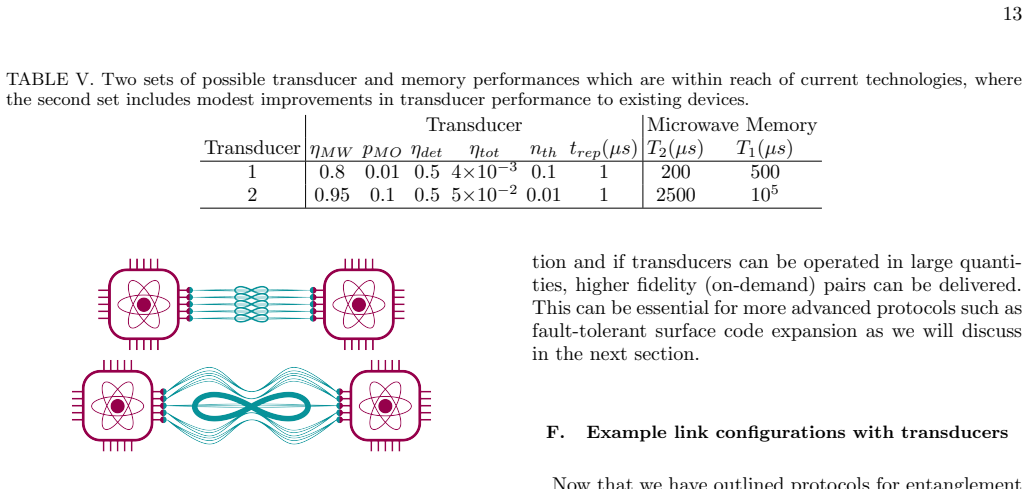
The load-bearing element is the on-demand entanglement link: each processor module has a communication qubit coupled to a transducer plus a storage qubit, and the link repeatedly runs a heralded entanglement attempt until an optical Bell-state measurement (a beamsplitter and photon detectors that project the qubits into an entangled state) reports success, or until a timeout $t_{\mathrm{del}}$; the storage qubit then delivers an entangled state on schedule, whether or not a herald arrived. The link is loss-resilient because the protocols herald success with photon detection instead of requiring the transduced photon to survive with high probability. Two protocol families carry the examples: one-photon two-mode squeezing, in which the transducer emits a microwave-optical pair with small probability $p_{\mathrm{MO}}$ and the microwave photon is absorbed by the qubit, and two-photon upconversion, in which time-bin photons emitted by the qubit are transduced to optics and both early and late herald photons must be detected. The governing quantity is the link capacity $\eta_{\mathrm{link}}=T_{\mathrm{coh}}p_{\mathrm{her}}/t_{\mathrm{rep}}$: storage coherence must outlast the mean time to a herald. Parallelization multiplies the heralding rate by the number of channels, and entanglement distillation consumes extra raw pairs to compress infidelity, while the transducer parameter sets in Table V (microwave loading $\eta_{\mathrm{MW}}$, pair probability $p_{\mathrm{MO}}$, detector efficiency $\eta_{\mathrm{det}}$, added noise $n_{\mathrm{th}}$, repetition time $t_{\mathrm{rep}}$) supply the numerical input for the examples.
What would settle it
Assemble a single integrated transducer with the Table V Transducer 1 parameters and measure the qubit state after a microwave round trip through the transducer; if the nondestructive transfer efficiency $\eta_{\mathrm{MW}}$ falls below 0.8 at an input-referred added noise of 0.1, the 88 microsecond on-demand link fidelity of Example 1 cannot be reached.
Extended reading notes
Core claim
On the paper's own terms, the central discovery is that deterministic conversion is the wrong benchmark. The authors show that loss-resilient entanglement protocols in which a Bell-state measurement at an optical beamsplitter herald success, combined with storage qubits that hold the entangled state until a fixed delivery time, make transducer efficiency unimportant for link fidelity: a conservative parameter set (total efficiency $4\times10^{-3}$, added noise 0.1, microwave loading efficiency 0.8) already gives an on-demand link fidelity of 0.73 in 88 microseconds, above the classical threshold of 0.55. With a projected parameter set (added noise 0.01, efficiency 0.1, microwave loading 0.95) plus a qubit-cavity optical memory and a 2.5 ms microwave memory, the memory-enhanced two-photon upconversion protocol delivers 91% fidelity in 400 microseconds, and a 20-link parallel one-photon two-mode-squeezing scheme delivers 91% in 15 microseconds. Consuming 16 raw pairs in four rounds of entanglement distillation reduces the infidelity by an order of magnitude, giving net fidelities near 99%. The authors conclude that on-demand optical links can surpass the performance of individual cryogenic modules before transducers reach unity efficiency, with near-term gains in sparse-link, graph-state, and switching-based architectures rather than full lattice surgery.
Load-bearing premise
The load-bearing premise is that a qubit can hand its quantum state to the converter and receive it back nondestructively at 80 to 95 percent efficiency while all the other claimed noise and efficiency numbers hold simultaneously in one device, a combined capability that has not yet been demonstrated.
Editorial extensions
If this is right
- With transducer parameters already demonstrated piecewise, a one-photon two-mode-squeezing link delivers entangled states on demand in 88 microseconds with fidelity 0.73, above the classical threshold of 0.55.
- With modest projected improvements plus a qubit-cavity optical memory and longer-lived microwave storage, a memory-enhanced two-photon upconversion link reaches 91% fidelity in 400 microseconds, and 20 parallel one-photon links reach 91% in 15 microseconds.
- Four rounds of entanglement distillation over 16 raw Bell pairs reduce the infidelity by an order of magnitude, giving about 99% net fidelity, at the cost of more transducers and communication qubits per link.
- Full clock-cycle lattice surgery would require a 10- to 100-fold increase in link speed or efficiency, so near-term benefits come from sparse links, remote graph-state generation, and optical switching rather than full edge connectivity.
- Scaling estimates place the requirement at 100 to 10,000 transducer channels per cryostat, a number compatible with already demonstrated integrated, low-power transducer designs, making dozens of on-demand links per processor a realistic target.
Reading between the lines
- If these links mature as described, the practical bottleneck may shift from the converter to the supporting qubit infrastructure: the 99% example consumes 16 raw Bell pairs per distilled link, and clock-rate delivery would need hundreds of qubits and transducers per processor per link, so communication-qubit count and memory lifetime become the scarce resources.
- The protocol toolbox generalizes beyond superconducting qubits: because the argument rests on heralding and storage rather than on any particular qubit platform, visible-wavelength systems such as trapped ions or neutral atoms could adopt the same on-demand link design with a different frequency converter at the front end.
- A concrete near-term milestone implied by the paper is to demonstrate one on-demand link with greater than 90% fidelity in the 15- to 400-microsecond delivery window using a single integrated transducer; success would validate the projected parameter set before attempting the hundreds-of-channels scaling needed for architectural demonstrations.
Signed reviews
Editorial analysis
A structured set of objections, weighed in public.
Referee Report
Summary. The paper argues that microwave-to-optical transducers with currently demonstrated or near-term parameters can enable on-demand, high-fidelity entanglement links between superconducting quantum processors, contrary to the common view that deterministic transducers are required. The authors introduce figures of merit for transducers (efficiency, bandwidth, noise, integration), review state-of-the-art devices, propose two idealized transducer parameter sets (Tables II and V), and analyze four entanglement protocols (one- and two-photon upconversion and two-mode squeezing). Three example link configurations are computed, with claimed on-demand fidelities of 0.73, 0.91, and 0.91 (the last two boosted to 99% by distillation). The paper also discusses architectures such as lattice surgery, sparse links, remote graph states, and optical switching, concluding that sparse links and graph-state generation are feasible in the near term, while full lattice surgery is not.
Significance. The central claim—if correct—is significant: it would reframe distributed quantum computing over optical links as a near-term engineering target rather than a distant ideal. The paper draws on established entanglement protocols (DLCZ, Barrett-Kok) and clearly states its hardware assumptions, which helps the community calibrate feasibility. Its strength is the concrete parameter-based analysis linking transducer metrics to protocol performance, and its explicit admission of which parameters remain undemonstrated. However, the quantitative examples contain arithmetic inconsistencies and rely on a microwave transfer efficiency (η_MW) that the authors themselves state has not been achieved, so the numerical headline claims are not yet reproducible.
major comments (5)
- [§IV.F, Example 1 (Table VI)] The stated fidelity of 0.73 for Example 1 is not consistent with the stated infidelities. From Table III, the one-photon TMS protocol infidelity is ηMW·pMO + (1−ηMW) = 0.8×0.01 + 0.2 = 0.208 (≈0.21), and the thermal infidelity is 2·nth·ηMW² = 2×0.1×0.64 = 0.128 (≈0.13). Combining these as additive errors gives fidelity ≈ 1−0.21−0.13 = 0.66; as independent multiplicative errors it gives (1−0.21)(1−0.13) ≈ 0.69. Neither equals 0.73. Please show the exact expression used or correct the number, because this is the first quantitative demonstration that on-demand links exceed the classical bound.
- [§III.D and §IV.F, Tables V and VI] All three examples depend critically on η_MW = 0.8 or 0.95, yet §III.D explicitly states: 'The only not yet accomplished parameter is non-demolition state transfer between a qubit and a transducer with high efficiency, η_MW.' For the one-photon TMS protocol used in Examples 1 and 3, Table III shows that (1−η_MW) enters the protocol infidelity directly, and η_MW also affects p_her through η_tot. If η_MW were 0.5 instead of 0.95, Example 3's protocol infidelity would rise from ≈0.07 to ≈0.52, collapsing the claimed 91% fidelity to roughly 50%. The abstract's phrase 'existing or near-term performance levels' therefore overstates the current evidence; the possibility of non-demolition transfer at any efficiency is not yet demonstrated. Please qualify the central claim accordingly and treat this parameter as a projection, not a near-term given.
- [§IV.B and Table III] The formulas for pher, protocol infidelity, and thermal noise infidelity in Table III are presented without derivation or explicit source. The protocols are attributed to prior work (Krastanov et al. [84], Zeuthen et al. [37], Barrett and Kok [85]), but the specific expressions are not linked to equations in those references. Since the entire quantitative analysis in §IV.F rests on these entries, please either provide a self-contained derivation in an appendix or state exactly which equation in which reference yields each formula (including the one-photon upconversion thermal term 6nth/ηMW and the two-photon TMS terms).
- [§IV.F, Example 2] The claimed heralding probability of 3×10⁻² and fidelity of 91% are not traceable from the stated parameters. With transducer 2, η_tot = η_MW·p_MO·η_det = 0.95×0.1×0.5 = 0.0475 ≈ 0.05, and Table IV gives the memory-enhanced two-photon upconversion probability as η_tot·η_mem/2 ≈ 0.024 for η_mem=1, not 3×10⁻². The fidelity is described as limited by 'thermal infidelity, link efficiency and decoherence', but the individual contributions are not quantified. Please show the full calculation, including the decoherence term from T2=2500 µs and t_del=400 µs, so the 0.91 result can be reproduced.
- [§IV.F, distillation claim] The statement that 'By consuming 16 Bell pairs for four rounds of entanglement distillation, the infidelity can be reduced by an order of magnitude ... resulting in a net fidelity of 99% [34]' is not supported by a specific distillation protocol. The fidelity gain of a 16-to-1 distillation schedule depends on the input state structure (e.g., Werner vs. dephased) and the chosen purification circuit. Please specify the protocol and provide a reference or calculation demonstrating the quoted infidelity reduction for the states produced by the examples.
minor comments (5)
- [Throughout] There are numerous typos, including 'collectivelly', 'archictecture', 'frequenices', 'expored', 'contruct', 'achieavable', and 'succesful'. A careful proofreading pass is needed.
- [§IV.A, Fig. 3] Box 3, step 4 writes the projected state as (|ge> + e^{iφ}|eg>)/√2 + √pMO|ee> without normalization. This is acceptable only in the limit pMO≪1; please state this approximation explicitly.
- [Fig. 7] The dashed line at 0.1 is described as a 'threshold for surface code error correction with lattice surgery', but no reference or derivation is given for this threshold. Please cite a source or define the context.
- [Table IV] The row for '2-photon TMS, catch and release' gives pher with memory = (η_tot·η_MW·η_mem²)/2. It would help to state whether η_mem includes the herald efficiency of the parity check mentioned in the text, since that is not clear from the current definition.
- [Reference [74]] Reference [74] ('Deterministic quantum state and gate teleportation between distant superconducting chips') is missing author names and journal volume/page information; please complete the citation.
Circularity Check
No significant circularity: link fidelities are computed from explicit protocol formulas with stated transducer parameters, and the 99% claim uses external distillation results, so the derivation does not reduce to its inputs.
full rationale
The central derivation is not circular. The link fidelities in Section IV F are computed from explicit protocol expressions in Table III (for one-photon TMS, protocol infidelity = ηMW pMO + (1−ηMW), thermal infidelity = 2 nth ηMW², and heralding probability = 2ηtot/ηMW), with transducer parameters listed in Table V as near-term projections supported by both the authors' experimental work and independent groups. These parameters are inputs, not outputs, of the fidelity calculation: the paper does not fit ηMW, pMO, nth, or ηdet to the reported fidelities, and the headline 99% is obtained by applying an external distillation result [34] to the computed ~91% links. The paper explicitly flags the key missing experimental capability in Section III D: 'The only not yet accomplished parameter is non-demolition state transfer between a qubit and a transducer with high efficiency, ηMW.' This makes the practical claim conditional but does not make the calculation circular. The statement in Table VI that 'we intentionally reduce pMO to 0.02 in order to reduce the protocol infidelity' is a design trade-off between rate and protocol infidelity, not a fitted parameter renamed as a prediction. Self-citations [43,61,66] are used to justify feasibility of parameter values and integration metrics, but those are experimental reports, and the fidelity derivation would stand with the same parameter values regardless of their source. No uniqueness theorem or ansatz is imported from the authors' prior work, and no step reduces by construction to its own input.
Assumptions & free parameters
free parameters (5)
- Transducer 1 parameter set =
eta_MW=0.8, pMO=0.01, eta_det=0.5, nth=0.1, trep=1 us, BW=10 MHz
- Transducer 2 parameter set =
eta_MW=0.95, pMO=0.1, eta_det=0.5, nth=0.01, trep=1 us, BW=10 MHz
- pMO in Example 3 =
0.02
- Microwave storage coherence time T2 =
200 us (Examples 1 and 3) and 2500 us (Example 2)
- Optical memory efficiency eta_mem =
approximately 1
assumptions (4)
- ad hoc to paper Non-demolition qubit-to-transducer state transfer with eta_MW = 0.8 to 0.95 is achievable.
- domain assumption Protocol infidelity formulas in Table III are valid under the stated limits (nth, pMO, alpha much less than 1).
- domain assumption On-demand delivery requires storage coherence T2 much greater than tdel and link capacity eta_link = Tcoh pher / trep much greater than 1.
- standard math Linear-optics Bell-state measurement and single-photon detectors are ideal apart from stated detection efficiencies.
Cite this review
Pith. "Pith review of Scalable Quantum Computing with Optical Links." pith.science (2026). https://pith.science/paper/XKEAZGF6
@misc{pith2026250500542,
  author       = {Pith},
  title        = {Pith review of: Scalable Quantum Computing with Optical Links},
  year         = {2026},
  howpublished = {\url{https://pith.science/paper/XKEAZGF6}},
  note         = {Machine review of arXiv:2505.00542}
}
read the original abstract
Quantum computers have great potential to solve problems which are intractable on classical computers. However, quantum processors have not yet reached the required scale to run applications which outperform traditional computers. Leading hardware platforms, such as superconducting qubit based processors, will soon become bottlenecked by the physical constraints of their low temperature environments, and the expansion of quantum computers will necessitate quantum links between multiple processor modules. Optical frequencies offer the most promising path for these links due to their resilience to noise even at ambient temperature and the maturity of classical optical networks. However, required microwave-to-optics transducers cannot operate deterministically yet, which has widely been seen as a key challenge for their integration into fault-tolerant quantum computers. In this work, we examine implementations of optical links between cryogenic units that surpass the performance of individual cryogenic modules even with the performance of existing or near-term microwave-to-optics transducers. We show methods for these transducers to provide on-demand entanglement between separated quantum processors with high fidelity and lay out key steps for adoption of the technology including scaling transducer numbers and integration with other hardware. Finally, we discuss a number of architectures comprised of these links which can drive the expansion of quantum data centers to utility scale.
Figures


Figures from the paper (6 more)




Forward citations
Cited by 3 Pith papers
-
A two-dimensional piezo-optomechanical transducer
A two-dimensional optomechanical crystal with a single engineered mechanical mode performs bidirectional microwave-optical conversion at 0.85% internal efficiency.
-
Efficient and scalable inter-module switching for distributed quantum computing architectures
GMZI-based decentralized switch designs achieve any-to-any module connectivity with half the active depth and coupler count of GMZI-Spanke switches.
-
Entanglement Cost of Erasure Correction in Quantum MDS Codes
For an [[n,2t-n]]_Q quantum MDS code, correcting a single erased node over a star network costs exactly 2t qudits when the replacement node is the hub and 2t minus 1 qudits when a helper node is the hub.
Reference graph
Works this paper leans on
-
[84]
L. Chen, A. R. Korsch, C. M. Kersul, R. Benevides, Y. Yu, T. P. M. Alegre, and S. Groeblacher, Bandwidth- tunable telecom single photons enabled by low- noise optomechanical transduction, arXiv:2410.10947 10.48550/arXiv.2410.10947 (2024)
-
[37]
Awschalom, K
D. Awschalom, K. K. Berggren, H. Bernien, S. Bhave, L. D. Carr, P. Davids, S. E. Economou, D. Englund, A. Faraon, M. Fejer, S. Guha, M. V. Gustafsson, E. Hu, L. Jiang, J. Kim, B. Korzh, P. Kumar, P. G. Kwiat, 20 M. Lonˇ car, M. D. Lukin, D. A. Miller, C. Monroe, S. W. Nam, P. Narang, J. S. Orcutt, M. G. Raymer, A. H. Safavi-Naeini, M. Spiropulu, K. Sriniv...
2021
-
[85]
Mirhosseini, A
M. Mirhosseini, A. Sipahigil, M. Kalaee, and O. Painter, Superconducting qubit to optical photon transduction, Nature 588, 599 (2020)
2020
-
[34]
Cheng, M
Q. Cheng, M. Bahadori, M. Glick, S. Rumley, and K. Bergman, Recent advances in optical technologies for data centers: a review, Optica 5, 1354 (2018)
2018
-
[1]
Initiate both communication qubits in the ground state|g⟩
-
[2]
Generate a microwave-optical photon pair in each transducer with a small probability, pMO , resulting in the state |ψ⟩MW 1O1,|ψ⟩MW 2O2 = √pMO|11⟩ +√1−pMO|00⟩
-
[3]
Absorb the emitted microwave photon with the communication qubit, resulting in the state |ψ⟩Q1O1,|ψ⟩Q2O2 =√pMO|e1⟩ +√1−pMO|g0⟩
-
[4]
If no photon is detected go back to step 1
Combine the optical signals on a beamsplitter A. If no photon is detected go back to step 1. B. If a single photon (herald) is detected, the communication qubits are projected onto the state: |ψ⟩Q1Q2 = 1√ 2 ( |ge⟩ +eiϕ|eg⟩ ) +√pMO|ee⟩ where the phase, ϕ, is determined by which detector received a photon
Show all 140 references
-
[5]
Transfer the state of the communication qubits to the storage qubits, replacing the state if a herald was al- ready received
-
[6]
If no herald was received, randomly ini- tialize one of the two storage qubits in the ground state and one in the excited state( ρQ1Q2 = 1 2|ge⟩⟨ge| + 1 2|eg⟩⟨eg| )
Repeat the entanglement generation (steps 1-5) until the delivery time tdel A. If no herald was received, randomly ini- tialize one of the two storage qubits in the ground state and one in the excited state( ρQ1Q2 = 1 2|ge⟩⟨ge| + 1 2|eg⟩⟨eg| )
-
[7]
Deliver the state in the storage qubits. FIG. 3. As a first example of how entanglement can be generated, we use a single photon protocol with a two-mode-squeezer (Figure 2c) which is adapted from the DLCZ protocol [83]. The protocol is described in detail for the specific cas...
-
[8]
Initiate the communication qubit in a superposition state, using the higher order |f ⟩ state: |ψ⟩Q1, |ψ⟩Q2 = 1√ 2 (|f ⟩ + |e⟩)
-
[9]
Emit a photon from the second excited state of the communication qubit into a microwave waveg- uide, resulting in the state |ψ⟩Q1MW 1e , |ψ⟩Q2MW 2e = 1√ 2 (|g1⟩ + |e0⟩)
-
[10]
Transduce the emitted photon from the microwave waveguide into an optical photon and combine the photonic signals on a beam-splitter and detect the outcome of the “early” time bin ( MW 1e or MW 2e)
-
[11]
Excite the communication qubit to a higher state |ψ⟩Q1MW 1e , |ψ⟩Q2MW 2e 1√ 2 (|e1⟩ + |f 0⟩)
-
[12]
Emit the state of the communication qubit into a microwave waveguide, resulting in the state |ψ⟩Q1MW 1eMW 1l , |ψ⟩Q2MW 2eMW 2l = 1√ 2 (|e01⟩ + |g10⟩)
-
[13]
If photons are not detected in both the early and late time bin go back to step 1
Transduce the emitted photon from the microwave waveguide into an optical photon and combine the photonic signals on a beamsplitter and detect the out- come of the “late” time bin ( MW 1l or MW 2l) A. If photons are not detected in both the early and late time bin go back to s...
-
[14]
Transfer the state of the communication qubits to storage qubits, replacing the state if a herald was al- ready received
-
[15]
Repeat the entanglement generation (steps 1-5) until the delivery time tdel. A. If no herald was received, randomly ini- tialize one of the two storage qubits in the ground state and one in the excited state( ρQ1Q2 = 1 2 |ge⟩ ⟨ge| + 1 2 |eg⟩ ⟨eg| )
-
[16]
on-demand
Deliver the state in the storage qubits. FIG. 4. As a second example of how entanglement can be generated we use a two-photon protocol which is adapted from the Barrett and Kok protocol [85]. A variant of this protocol is described in detail for the specific case of transducer...
-
[17]
The time spent on intra-module operation is am- ple to prepare and distill the long-range entangled states that enable teleportation between each cycle of graph consumption
-
[18]
The inter-module pipes are only required to transfer the states of the logical qubits between the widgets
The number of inter-module physical channels that are required in each ‘pipe’ corresponds to the dis- tance of the code, so links are not required for all edge states such as in lattice surgery. The inter-module pipes are only required to transfer the states of the logical qub...
-
[19]
Horowitz and E
M. Horowitz and E. Grumbling, Quantum comput- ing: progress and prospects (National Academies Press, 2019)
2019
-
[20]
Alexeev, D
Y. Alexeev, D. Bacon, K. R. Brown, R. Calderbank, L. D. Carr, F. T. Chong, B. Demarco, D. Englund, E. Farhi, B. Fefferman, A. V. Gorshkov, A. Houck, J. Kim, S. Kimmel, M. Lange, S. Lloyd, M. D. Lukin, D. Maslov, P. Maunz, C. Monroe, J. Preskill, M. Roet- 19 teler, M. J. Savage...
2021
-
[21]
Gyongyosi and S
L. Gyongyosi and S. Imre, A survey on quantum com- puting technology, Computer Science Review 31, 51 (2019)
2019
-
[22]
C. D. Bruzewicz, J. Chiaverini, R. McConnell, and J. M. Sage, Trapped-ion quantum computing: Progress and challenges, Applied physics reviews 6 (2019)
2019
-
[23]
Strohm, K
T. Strohm, K. Wintersperger, F. Dommert, D. Basile- witsch, G. Reuber, A. Hoursanov, T. Ehmer, D. Vodola, and S. Luber, Ion-based quantum computing hard- ware: Performance and end-user perspective (2024), arXiv:2405.11450 [quant-ph]
2024 arXiv
-
[24]
Slussarenko and G
S. Slussarenko and G. J. Pryde, Photonic quantum in- formation processing: A concise review, Applied physics reviews 6 (2019)
2019
-
[25]
Kjaergaard, M
M. Kjaergaard, M. E. Schwartz, J. Braum¨ uller, P. Krantz, J. I.-J. Wang, S. Gustavsson, and W. D. Oliver, Superconducting qubits: Current state of play, Annual Review of Condensed Matter Physics 11, 369 (2020)
2020
-
[26]
Bravyi, O
S. Bravyi, O. Dial, J. M. Gambetta, D. Gil, and Z. Nazario, The future of quantum computing with su- perconducting qubits, Journal of Applied Physics 132, 160902 (2022)
2022
-
[27]
Henriet, L
L. Henriet, L. Beguin, A. Signoles, T. Lahaye, A. Browaeys, G.-O. Reymond, and C. Jurczak, Quan- tum computing with neutral atoms, Quantum 4, 327 (2020)
2020
-
[28]
Wintersperger, F
K. Wintersperger, F. Dommert, T. Ehmer, A. Hour- sanov, J. Klepsch, W. Mauerer, G. Reuber, T. Strohm, M. Yin, and S. Luber, Neutral atom quantum comput- ing hardware: performance and end-user perspective, EPJ Quantum Technology 10, 32 (2023)
2023
-
[29]
A. Gold, J. Paquette, A. Stockklauser, M. J. Reagor, M. S. Alam, A. Bestwick, N. Didier, A. Nersisyan, F. Oruc, A. Razavi, et al. , Entanglement across sep- arate silicon dies in a modular superconducting qubit device, npj Quantum Information 7, 142 (2021)
2021
-
[30]
Arute et al., Quantum supremacy using a pro- grammable superconducting processor, Nature 574, 505 (2019)
F. Arute et al., Quantum supremacy using a pro- grammable superconducting processor, Nature 574, 505 (2019)
2019
-
[31]
Roffe, Quantum error correction: an introductory guide, Contemporary Physics 60, 226 (2019)
J. Roffe, Quantum error correction: an introductory guide, Contemporary Physics 60, 226 (2019)
2019
-
[32]
Acharya, D
R. Acharya, D. A. Abanin, L. Aghababaie-Beni, I. Aleiner, T. I. Andersen, M. Ansmann, F. Arute, K. Arya, A. Asfaw, N. Astrakhantsev, J. Atalaya, R. Babbush, D. Bacon, B. Ballard, J. C. Bardin, J. Bausch, A. Bengtsson, A. Bilmes, S. Blackwell, S. Boixo, G. Bortoli, A. Bourassa,...
2025
-
[33]
A. M. Dalzell, S. McArdle, M. Berta, P. Bienias, C.- F. Chen, A. Gily´ en, C. T. Hann, M. J. Kastoryano, E. T. Khabiboulline, A. Kubica, G. Salton, S. Wang, and F. G. S. L. Brand˜ ao, Quantum algorithms: A sur- vey of applications and end-to-end complexities (2023), arXiv:2310...
2023 arXiv
-
[35]
P. A. Baziana, Optical data center networking: A com- prehensive review on traffic, switching, bandwidth allo- cation, and challenges, IEEE Access (2024)
2024
-
[36]
Barral, F
D. Barral, F. J. Cardama, G. D´ ıaz-Camacho, D. Fa´ ılde, I. F. Llovo, M. Mussa-Juane, J. V´ azquez-P´ erez, J. Villa- suso, C. Pi˜ neiro, N. Costas, J. C. Pichel, T. F. Pena, and A. G´ omez, Review of distributed quantum computing: From single qpu to high performance quantum ...
2025
-
[38]
Caleffi, M
M. Caleffi, M. Amoretti, D. Ferrari, J. Illiano, A. Man- zalini, and A. S. Cacciapuoti, Distributed quantum com- puting: a survey, Computer Networks 254, 110672 (2024)
2024
-
[39]
J. C. Boschero, N. M. P. Neumann, W. van der Schoot, T. Sijpesteijn, and R. Wezeman, Distributed quan- tum computing: Applications and challenges (2024), arXiv:2410.00609 [quant-ph]
2024 arXiv
-
[40]
D. L. Moehring, P. Maunz, S. Olmschenk, K. C. Younge, D. N. Matsukevich, L.-M. Duan, and C. Monroe, En- tanglement of single-atom quantum bits at a distance, Nature 449, 68 (2007)
2007
-
[41]
Ritter, C
S. Ritter, C. N¨ olleke, C. Hahn, A. Reiserer, A. Neuzner, M. Uphoff, M. M¨ ucke, E. Figueroa, J. Bochmann, and G. Rempe, An elementary quantum network of single atoms in optical cavities, Nature 484, 195 (2012)
2012
-
[42]
Bernien, B
H. Bernien, B. Hensen, W. Pfaff, G. Koolstra, M. S. Blok, L. Robledo, T. H. Taminiau, M. Markham, D. J. Twitchen, L. Childress, et al. , Heralded entanglement between solid-state qubits separated by three metres, Nature 497, 86 (2013)
2013
-
[43]
Magnard, S
P. Magnard, S. Storz, P. Kurpiers, J. Sch¨ ar, F. Marxer, J. L¨ utolf, J.-C. Besse, M. Gabureac, K. Reuer, A. Akin, B. Royer, A. Blais, and A. Wallraff, Microwave quan- tum link between superconducting circuits housed in spatially separated cryogenic systems, Phys. Rev. Lett. ...
2020
-
[44]
S. J. Devitt, A. D. Greentree, A. M. Stephens, and R. Van Meter, High-speed quantum networking by ship, Scientific Reports 6, 36163 (2016)
2016
-
[45]
Kanamori, Transmission loss of optical fibers; achievements in half a century, IEICE Transactions on Communications E104-B, 922 (2021)
H. Kanamori, Transmission loss of optical fibers; achievements in half a century, IEICE Transactions on Communications E104-B, 922 (2021)
2021
-
[46]
M. T. Rakher, L. Ma, O. Slattery, X. Tang, and K. Srini- vasan, Quantum transduction of telecommunications- band single photons from a quantum dot by frequency upconversion, Nature Photonics 4, 786 (2010)
2010
-
[47]
X. Han, W. Fu, C.-L. Zou, L. Jiang, and H. X. Tang, Microwave-optical quantum frequency conversion, Op- tica 8, 1050 (2021)
2021
-
[48]
Chu and S
Y. Chu and S. Gr¨ oblacher, A perspective on hybrid quantum opto- and electromechanical systems, Appl. Phys. Lett. 117, 150503 (2020)
2020
-
[49]
N. J. Lambert, A. Rueda, F. Sedlmeir, and H. G. L. Schwefel, Coherent conversion between microwave and optical photons – an overview of physical implementa- tions, Adv. Quantum Technol. 3, 1900077 (2020)
2020
-
[50]
B. M. Brubaker, J. M. Kindem, M. D. Urmey, S. Mit- tal, R. D. Delaney, P. S. Burns, M. R. Vissers, K. W. Lehnert, and C. A. Regal, Optomechanical ground-state cooling in a continuous and efficient electro-optic trans- ducer, Phys. Rev. X 12, 021062 (2022)
2022
-
[51]
Wehner, D
S. Wehner, D. Elkouss, and R. Hanson, Quantum inter- net: A vision for the road ahead, Science 362, eaam9288 (2018)
2018
-
[52]
J. Ang, G. Carini, Y. Chen, I. Chuang, M. Demarco, S. Economou, A. Eickbusch, A. Faraon, K.-M. Fu, S. Girvin, M. Hatridge, A. Houck, P. Hilaire, K. Kr- sulich, A. Li, C. Liu, Y. Liu, M. Martonosi, D. McKay, J. Misewich, M. Ritter, R. Schoelkopf, S. Stein, S. Suss- man, H. Tang...
2024
-
[53]
Parekh, A
R. Parekh, A. Ricciardi, A. Darwish, and S. DiAdamo, Quantum algorithms and simulation for parallel and distributed quantum computing, in 2021 IEEE/ACM Second International Workshop on Quantum Comput- ing Software (QCS) (IEEE, 2021) pp. 9–19
2021
-
[54]
Ferrari, A
D. Ferrari, A. S. Cacciapuoti, M. Amoretti, and M. Cal- effi, Compiler design for distributed quantum comput- ing, IEEE Transactions on Quantum Engineering 2, 1 (2021)
2021
-
[55]
Zeuthen, A
E. Zeuthen, A. Schliesser, A. S. Sørensen, and J. M. Tay- lor, Figures of merit for quantum transducers, Quantum Sci. Technol. 5, 34009 (2020)
2020
-
[56]
R. W. Andrews, R. W. Peterson, T. P. Purdy, K. Ci- cak, R. W. Simmonds, C. A. Regal, and K. W. Lehn- ert, Bidirectional and efficient conversion between mi- crowave and optical light, Nature Phys. 10, 321 (2014)
2014
-
[57]
Zhong, X
C. Zhong, X. Han, and L. Jiang, Microwave and optical entanglement for quantum transduction with electro- optomechanics, Phys. Rev. Appl. 18, 054061 (2022)
2022
-
[58]
Kurizki, P
G. Kurizki, P. Bertet, Y. Kubo, K. Mølmer, D. Pet- rosyan, P. Rabl, and J. Schmiedmayer, Quantum tech- nologies with hybrid systems, Proc. Natl. Acad. Sci. 112, 3866 (2015)
2015
-
[59]
N. Lauk, N. Sinclair, S. Barzanjeh, J. P. Covey, M. Saffman, M. Spiropulu, and C. Simon, Perspectives on quantum transduction, Quantum Sci. Technol. 5, 20501 (2020)
2020
-
[60]
A. A. Clerk, K. W. Lehnert, P. Bertet, J. R. Petta, and Y. Nakamura, Hybrid quantum systems with circuit quantum electrodynamics, Nature Phys.16, 257 (2020)
2020
-
[61]
M. J. Weaver, P. Duivestein, A. C. Bernasconi, S. Scharmer, M. Lemang, T. C. van Thiel, F. Hijazi, B. Hensen, S. Groeblacher, and R. Stockill, An inte- grated microwave-to-optics interface for scalable quan- tum computing, Nature Nanotechnology19, 166 (2024)
2024
-
[62]
Jiang, F
W. Jiang, F. M. Mayor, S. Malik, R. V. Laer, T. P. McKenna, R. N. Patel, J. D. Witmer, and A. H. Safavi- Naeini, Optically heralded microwave photon addition, Nature Physics 19, 1423 (2023)
2023
-
[63]
Meesala, S
S. Meesala, S. Wood, D. Lake, P. Chiappina, C. Zhong, A. D. Beyer, M. D. Shaw, L. Jiang, and O. Painter, Non- classical microwave–optical photon pair generation with a chip-scale transducer, Nature Physics 20, 871 (2024)
2024
-
[64]
H. Zhao, W. D. Chen, A. Kejriwal, and M. Mirhosseini, Quantum-enabled continuous microwave-to-optics fre- quency conversion (2024), arXiv:2406.02704 [quant-ph]
2024 arXiv
-
[65]
H. K. Warner, J. Holzgrafe, B. Yankelevich, D. Bar- ton, S. Poletto, C. J. Xin, N. Sinclair, D. Zhu, E. Sete, B. Langley, E. Batson, M. Colangelo, A. Shams-Ansari, G. Joe, K. K. Berggren, L. Jiang, M. J. Reagor, and M. Lonˇ car, Coherent control of a superconducting qubit usin...
2025 doi
-
[66]
M. Shen, J. Xie, Y. Xu, S. Wang, R. Cheng, W. Fu, Y. Zhou, and H. X. Tang, Photonic link from single-flux- quantum circuits to room temperature, Nature Photon- 21 ics 18, 371 (2024)
2024
-
[67]
T. Xie, R. Fukumori, J. Li, and A. Faraon, Scalable microwave-to-optical transducers at the single-photon level with spins, Nature Physics , 1 (2025)
2025
-
[68]
Y. Xu, A. A. Sayem, L. Fan, C. L. Zou, S. Wang, R. Cheng, W. Fu, L. Yang, M. Xu, and H. X. Tang, Bidi- rectional interconversion of microwave and light with thin-film lithium niobate, Nature Commun. 12, 4453 (2021)
2021
-
[69]
Fan, C.-L
L. Fan, C.-L. Zou, R. Cheng, X. Guo, X. Han, Z. Gong, S. Wang, and H. X. Tang, Superconducting cavity electro-optics: A platform for coherent photon con- version between superconducting and photonic circuits, Sci. Adv. 4, eaar4994 (2018)
2018
-
[70]
C. Wang, Z. Li, J. Riemensberger, G. Lihachev, M. Chu- raev, W. Kao, X. Ji, J. Zhang, T. Blesin, A. Davydova, Y. Chen, K. Huang, X. Wang, X. Ou, and T. J. Kip- penberg, Lithium tantalate photonic integrated circuits for volume manufacturing, Nature 629, 784 (2024)
2024
-
[71]
M¨ ohl, A
C. M¨ ohl, A. Riedhauser, M. Glantschnig, D. Caimi, U. Drechsler, A. Olziersky, D. Sabonis, D. I. Indolese, T. M. Karg, and P. Seidler, Bidirectional microwave- optical conversion with an integrated soft-ferroelectric barium titanate transducer (2025), arXiv:2501.09728 [physic...
2025 arXiv
-
[72]
C. P. Anderson, G. Scuri, A. Chan, S. Eun, A. D. White, G. H. Ahn, C. Jilly, A. Safavi-Naeini, K. V. Gasse, L. Li, and J. Vuˇ ckovi´ c, Quantum critical electro-optic and piezo-electric nonlinearities (2025), arXiv:2502.15164 [cond-mat.mtrl-sci]
2025 arXiv
-
[73]
Tsang, Cavity quantum electro-optics, Physical Re- view A 81, 063837 (2010)
M. Tsang, Cavity quantum electro-optics, Physical Re- view A 81, 063837 (2010)
2010
-
[74]
R. Sahu, L. Qiu, W. Hease, G. Arnold, Y. Minoguchi, P. Rabl, and J. M. Fink, Entangling microwaves with light, Science 380, 718 (2023)
2023
-
[75]
Arnold, T
G. Arnold, T. Werner, R. Sahu, L. N. Kapoor, L. Qiu, and J. M. Fink, All-optical superconducting qubit read- out, Nature Physics , 1 (2025)
2025
-
[76]
R. Sahu, W. Hease, A. Rueda, G. Arnold, L. Qiu, and J. M. Fink, Quantum-enabled operation of a microwave- optical interface, Nature Commun. 13, 1276 (2022)
2022
-
[77]
M. Wu, E. Zeuthen, K. C. Balram, and K. Srinivasan, Microwave-to-optical transduction using a mechanical supermode for coupling piezoelectric and optomechani- cal resonators, Phys. Rev. Applied 13, 014027 (2020)
2020
-
[78]
C. Wang, I. Gonin, A. Grassellino, S. Kazakov, A. Romanenko, V. P. Yakovlev, and S. Zorzetti, High-efficiency microwave-optical quantum transduc- tion based on a cavity electro-optic superconducting sys- tem with long coherence time, npj Quantum Informa- tion 8, 10.1038/s41534...
2022 doi
-
[79]
T. C. van Thiel, M. J. Weaver, F. Berto, P. Duivestein, M. Lemang, K. L. Schuurman, M. ˇZemliˇ cka, F. Hijazi, A. C. Bernasconi, C. Ferrer, E. Cataldo, E. Lachman, M. Field, Y. Mohan, F. K. de Vries, C. C. Bultink, J. C. van Oven, J. Y. Mutus, R. Stockill, and S. Gr¨ oblacher,...
2025
-
[80]
Arnold, M
G. Arnold, M. Wulf, S. Barzanjeh, E. S. Redchenko, A. Rueda, W. J. Hease, F. Hassani, and J. M. Fink, Converting microwave and telecom photons with a sil- icon photonic nanomechanical interface, Nature Com- mun. 11, 4460 (2020)
2020
-
[81]
Eichenfield, J
M. Eichenfield, J. Chan, R. M. Camacho, K. J. Vahala, and O. Painter, Optomechanical crystals, Nature 462, 78 (2009)
2009
-
[82]
Sonar, U
S. Sonar, U. Hatipoglu, S. Meesala, D. P. Lake, H. Ren, and O. Painter, High-efficiency low-noise optomechan- ical crystal photon-phonon transducers, Optica 12, 99 (2025)
2025
-
[83]
F. M. Mayor, S. Malik, A. G. Primo, S. Gyger, W. Jiang, T. P. Alegre, and A. H. Safavi-Naeini, High photon- phonon pair generation rate in a two-dimensional op- tomechanical crystal, Nature Communications 16, 2576 (2025)
2025
-
[86]
K. J. Satzinger, Y. P. Zhong, H.-S. Chang, G. A. Peairs, A. Bienfait, M.-H. Chou, A. Y. Cleland, C. R. Conner, E. Dumur, J. Grebel, I. Gutierrez, B. H. November, R. G. Povey, S. J. Whiteley, D. D. Awschalom, D. I. Schuster, and A. N. Cleland, Quantum control of surface acousti...
2018
-
[87]
Y. Chu, P. Kharel, T. Yoon, L. Frunzio, P. T. Rakich, and R. J. Schoelkopf, Creation and control of multi- phonon fock states in a bulk acoustic-wave resonator, Nature 563, 666 (2018)
2018
-
[88]
Eichler, C
C. Eichler, C. Lang, J. M. Fink, J. Govenius, S. Filipp, and A. Wallraff, Observation of Entanglement between Itinerant Microwave Photons and a Superconducting Qubit, Physical Review Letters 109, 240501 (2012)
2012
-
[89]
Kurpiers, M
P. Kurpiers, M. Pechal, B. Royer, P. Magnard, T. Wal- ter, J. Heinsoo, Y. Salath´ e, A. Akin, S. Storz, J.- C. Besse, S. Gasparinetti, A. Blais, and A. Wallraff, Quantum Communication with Time-Bin Encoded Mi- crowave Photons, Physical Review Applied 12, 044067 (2019)
2019
-
[90]
Ilves, S
J. Ilves, S. Kono, Y. Sunada, S. Yamazaki, M. Kim, K. Koshino, and Y. Nakamura, On-demand generation and characterization of a microwave time-bin qubit, npj Quantum Information 6, 1 (2020)
2020
-
[91]
Zhong, H.-S
Y. Zhong, H.-S. Chang, A. Bienfait, E. Dumur, M.-H. Chou, C. R. Conner, J. Grebel, R. G. Povey, H. Yan, D. I. Schuster, and A. N. Cleland, Deterministic multi- qubit entanglement in a quantum network, Nature 590, 571 (2021)
2021
-
[92]
Deterministic quantum state and gate teleportation be- tween distant superconducting chips, Science Bulletin https://doi.org/10.1016/j.scib.2024.11.047 (2024)
2024 doi
-
[93]
R. D. Delaney, M. D. Urmey, S. Mittal, B. M. Brubaker, J. M. Kindem, P. S. Burns, C. A. Regal, and K. W. Lehnert, Superconducting-qubit readout via low- backaction electro-optic transduction, Nature 606, 489 (2022)
2022
-
[94]
Alexander, A
K. Alexander, A. Benyamini, D. Black, D. Bon- neau, S. Burgos, B. Burridge, H. Cable, G. Camp- bell, G. Catalano, A. Ceballos, C.-M. Chang, S. S. Choudhury, C. Chung, F. Danesh, T. Dauer, M. Davis, E. Dudley, P. Er-Xuan, J. Fargas, A. Farsi, C. Fen- rich, J. Frazer, M. Fukami,...
2025
-
[95]
Meesala, D
S. Meesala, D. Lake, S. Wood, P. Chiappina, C. Zhong, A. D. Beyer, M. D. Shaw, L. Jiang, and O. Painter, Quantum entanglement between optical and microwave photonic qubits, Phys. Rev. X 14, 031055 (2024)
2024
-
[96]
J. Wu, C. Cui, L. Fan, and Q. Zhuang, Deterministic microwave-optical transduction based on quantum tele- portation, Phys. Rev. Appl. 16, 064044 (2021)
2021
-
[97]
Shi and Q
H. Shi and Q. Zhuang, Overcoming the fundamental limit of quantum transduction via intraband entangle- ment, Optica Quantum 2, 475 (2024)
2024
-
[98]
Wang and L
Z. Wang and L. Jiang, Passive environment-assisted quantum transduction with gkp states (2024), arXiv:2401.16781 [quant-ph]
2024 arXiv
-
[99]
H. K. Beukers, M. Pasini, H. Choi, D. Englund, R. Han- son, and J. Borregaard, Remote entanglement proto- cols for stationary qubits with photonic interfaces, PRX Quantum 5, 010202 (2024)
2024
-
[100]
d’Avossa, C
L. d’Avossa, C. Zhan, J. Chung, R. Kettimuthu, A. S. Cacciapuoti, and M. Caleffi, Simulation of quantum transduction strategies for quantum networks (2024), arXiv:2411.11377 [quant-ph]
2024
-
[101]
L. M. Duan, M. D. Lukin, J. I. Cirac, and P. Zoller, Long-distance quantum communication with atomic en- sembles and linear optics., Nature 414, 413 (2001)
2001
-
[102]
Krastanov, H
S. Krastanov, H. Raniwala, J. Holzgrafe, K. Jacobs, M. Lonˇ car, M. J. Reagor, and D. R. Englund, Optically- Heralded Entanglement of Superconducting Systems in Quantum Networks, Phys. Rev. Lett. 127, 040503 (2021)
2021
-
[103]
S. D. Barrett and P. Kok, Efficient high-fidelity quan- tum computation using matter qubits and linear optics, Phys. Rev. A 71, 060310 (2005)
2005
-
[104]
Hucul, I
D. Hucul, I. V. Inlek, G. Vittorini, C. Crocker, S. Deb- nath, S. M. Clark, and C. Monroe, Modular entangle- ment of atomic qubits using photons and phonons, Na- ture Physics 11, 37 (2015)
2015
-
[105]
P. C. Humphreys, N. Kalb, J. P. J. Morits, R. N. Schouten, R. F. L. Vermeulen, D. J. Twitchen, M. Markham, and R. Hanson, Deterministic delivery of remote entanglement on a quantum network, Nature 558, 268 (2018)
2018
-
[106]
If no herald is received, the fidelity of the delivered state is maximized by delivering a random classical anti- correlated state which has a 50% fidelity with the ideal state
-
[107]
D. Main, P. Drmota, D. P. Nadlinger, E. M. Ainley, A. Agrawal, B. C. Nichol, R. Srinivas, G. Araneda, and D. M. Lucas, Distributed quantum computing across an optical network link, Nature 10.1038/s41586-024-08404- x (2025)
2025 doi
-
[108]
Aspelmeyer, T
M. Aspelmeyer, T. J. Kippenberg, and F. Marquardt, Cavity optomechanics, Rev. Mod. Phys. 86, 1391 (2014)
2014
-
[109]
In the two-mode squeezing case, two qubits are neces- sary in each link which store early and late component and then perform a heralding parity measurement to ensure that early and late photons were not generated by the same transducer [39]
-
[110]
Briegel, W
H.-J. Briegel, W. D¨ ur, J. I. Cirac, and P. Zoller, Quan- tum repeaters: the role of imperfect local operations in quantum communication, Phys. Rev. Lett. 81, 5932 (1998)
1998
-
[111]
Azuma, S
K. Azuma, S. E. Economou, D. Elkouss, P. Hilaire, L. Jiang, H.-K. Lo, and I. Tzitrin, Quantum repeaters: From quantum networks to the quantum internet, Rev. Mod. Phys. 95, 045006 (2023)
2023
-
[112]
M. F. Askarani, M. G. Puigibert, T. Lutz, V. B. Verma, M. D. Shaw, S. W. Nam, N. Sinclair, D. Oblak, and W. Tittel, Storage and reemission of heralded telecommunication-wavelength photons using a crystal waveguide, Phys. Rev. Applied 11, 054056 (2019)
2019
-
[113]
J. V. Rakonjac, G. Corrielli, D. Lago-Rivera, A. Seri, M. Mazzera, S. Grandi, R. Osellame, and H. de Riedmatten, Storage and analysis of light-matter entanglement in a fiber-integrated system, Science Advances 8, eabn3919 (2022), https://www.science.org/doi/pdf/10.1126/sciadv.abn3919
2022 doi
-
[114]
S. E. Thomas, L. Wagner, R. Joos, R. Sittig, C. Nawrath, P. Burdekin, I. M. de Buy Wenniger, M. J. Rasiah, T. Huber-Loyola, S. Sagona-Stophel, S. H¨ ofling, M. Jetter, P. Michler, I. A. Walmsley, S. L. Portalupi, and P. M. Ledingham, Deterministic storage and retrieval of tele...
2024 doi
-
[115]
Y. Wang, A. N. Craddock, J. M. Mendoza, R. Sekelsky, M. Flament, and M. Namazi, High-fidelity entanglement between a telecom photon and a room-temperature quantum memory (2025), arXiv:2503.11564 [quant-ph]
2025 arXiv
-
[116]
Wallucks, I
A. Wallucks, I. Marinkovi´ c, B. Hensen, R. Stockill, and S. Gr¨ oblacher, A quantum memory at telecom wave- lengths, Nat. Phys. 16, 772 (2020)
2020
-
[117]
Krutyanskiy, M
V. Krutyanskiy, M. Canteri, M. Meraner, J. Bate, V. Krcmarsky, J. Schupp, N. Sangouard, and B. P. Lanyon, Telecom-wavelength quantum repeater node based on a trapped-ion processor, Phys. Rev. Lett. 130, 213601 (2023)
2023
-
[118]
Tchebotareva, S
A. Tchebotareva, S. L. N. Hermans, P. C. Humphreys, D. Voigt, P. J. Harmsma, L. K. Cheng, A. L. Verlaan, N. Dijkhuizen, W. de Jong, A. Dr´ eau, and R. Hanson, Entanglement between a diamond spin qubit and a pho- tonic time-bin qubit at telecom wavelength, Phys. Rev. Lett. 123,...
2019
-
[119]
van Leent, M
T. van Leent, M. Bock, R. Garthoff, K. Redeker, W. Zhang, T. Bauer, W. Rosenfeld, C. Becher, and 23 H. Weinfurter, Long-distance distribution of atom- photon entanglement at telecom wavelength, Phys. Rev. Lett. 124, 010510 (2020)
2020
-
[120]
M. K. Bhaskar, R. Riedinger, B. Machielse, D. S. Levo- nian, C. T. Nguyen, E. N. Knall, H. Park, D. Englund, M. Lonˇ car, D. D. Sukachev, and M. D. Lukin, Exper- imental demonstration of memory-enhanced quantum communication, Nature 580, 60 (2020)
2020
-
[121]
L. Ma, X. Lei, J. Yan, R. Li, T. Chai, Z. Yan, X. Jia, C. Xie, and K. Peng, High-performance cavity-enhanced quantum memory with warm atomic cell, Nature Com- munications 13, 2368 (2022)
2022
-
[122]
Vernaz-Gris, K
P. Vernaz-Gris, K. Huang, M. Cao, A. S. Sheremet, and J. Laurat, Highly-efficient quantum memory for polar- ization qubits in a spatially-multiplexed cold atomic en- semble, Nature Communications 9, 363 (2018)
2018
-
[123]
Dirnegger, M
N. Dirnegger, M. Malekakhlagh, V. Siddhu, A. Rao, C. Xiong, M. Kumph, J. Orcutt, and A. Falk, Monte carlo model of distilled remote entanglement between superconducting qubits across optical channels (2025), arXiv:2503.10842 [quant-ph]
2025
-
[124]
E. T. Campbell and S. C. Benjamin, Measurement- based entanglement under conditions of extreme photon loss, Phys. Rev. Lett. 101, 130502 (2008)
2008
-
[125]
Duan and H
L.-M. Duan and H. J. Kimble, Scalable photonic quan- tum computation through cavity-assisted interactions, Phys. Rev. Lett. 92, 127902 (2004)
2004
-
[126]
Reiserer, N
A. Reiserer, N. Kalb, G. Rempe, and S. Ritter, A quan- tum gate between a flying optical photon and a single trapped atom, Nature 508, 237 (2014)
2014
-
[127]
C. T. Nguyen, D. D. Sukachev, M. K. Bhaskar, B. Machielse, D. S. Levonian, E. N. Knall, P. Stroganov, R. Riedinger, H. Park, M. Lonˇ car, and M. D. Lukin, Quantum network nodes based on diamond qubits with an efficient nanophotonic interface, Phys. Rev. Lett. 123, 183602 (2019)
2019
-
[128]
M. Cao, F. Hoffet, S. Qiu, A. S. Sheremet, and J. Lau- rat, Efficient reversible entanglement transfer between light and quantum memories, Optica 7, 1440 (2020)
2020
-
[129]
N. Kalb, A. A. Reiserer, P. C. Humphreys, J. J. W. Bak- ermans, S. J. Kamerling, N. H. Nickerson, S. C. Ben- jamin, D. J. Twitchen, M. Markham, and R. Hanson, Entanglement distillation between solid-state quantum network nodes, Science 356, 928 (2017)
2017
-
[130]
Somoroff, Q
A. Somoroff, Q. Ficheux, R. A. Mencia, H. Xiong, R. Kuzmin, and V. E. Manucharyan, Millisecond co- herence in a superconducting qubit, Phys. Rev. Lett. 130, 267001 (2023)
2023
-
[131]
M. P. Bland, F. Bahrami, J. G. C. Martinez, P. H. Prestegaard, B. M. Smitham, A. Joshi, E. Hedrick, A. Pakpour-Tabrizi, S. Kumar, A. Jindal, R. D. Chang, A. Yang, G. Cheng, N. Yao, R. J. Cava, N. P. de Leon, and A. A. Houck, 2d transmons with lifetimes and coherence times exce...
2025 arXiv
-
[132]
Milul, B
O. Milul, B. Guttel, U. Goldblatt, S. Hazanov, L. M. Joshi, D. Chausovsky, N. Kahn, E. C ¸ ifty¨ urek, F. Lafont, and S. Rosenblum, Superconducting cavity qubit with tens of milliseconds single-photon coherence time, PRX Quantum 4, 030336 (2023)
2023
-
[133]
Y. Liu, H. Sun, Q. Liu, H. Wu, M. A. Sillanp¨ a¨ a, and T. Li, Long-lived microwave electromechanical sys- tems enabled by cubic silicon-carbide membrane crys- tals (2024), arXiv:2401.01020 [quant-ph]
2024 arXiv
-
[134]
Ramette, J
J. Ramette, J. Sinclair, N. P. Breuckmann, and V. Vuleti´ c, Fault-tolerant connection of error-corrected qubits with noisy links, npj Quantum Information 10, 58 (2024)
2024
-
[135]
S. N. Saadatmand, T. L. Wilson, M. Field, M. K. Vijayan, T. P. Le, J. Ruh, A. S. Maan, I. Moflic, A. Caesura, A. Paler, M. J. Hodson, S. J. Devitt, and J. Y. Mutus, Fault-tolerant resource estimation using graph-state compilation on a modular superconducting architecture (2024...
2024 arXiv
-
[136]
Sutcliffe, B
E. Sutcliffe, B. Jonnadula, C. L. Gall, A. E. Moylett, and C. M. Westoby, Distributed quantum error cor- rection based on hyperbolic floquet codes (2025), arXiv:2501.14029 [quant-ph]
2025
-
[137]
Gottesman, A
D. Gottesman, A. Kitaev, and J. Preskill, Encoding a qubit in an oscillator, Phys. Rev. A 64, 012310 (2001)
2001
-
[138]
A. J. Brady, A. Eickbusch, S. Singh, J. Wu, and Q. Zhuang, Advances in bosonic quantum error correc- tion with gottesman–kitaev–preskill codes: Theory, en- gineering and applications, Progress in Quantum Elec- tronics 93, 100496 (2024)
2024
-
[139]
V. V. Sivak, A. Eickbusch, B. Royer, S. Singh, I. Tsiout- sios, S. Ganjam, A. Miano, B. L. Brock, A. Z. Ding, L. Frunzio, S. M. Girvin, R. J. Schoelkopf, and M. H. Devoret, Real-time quantum error correction beyond break-even, Nature 616, 50 (2023)
2023
-
[140]
Konno, W
S. Konno, W. Asavanant, F. Hanamura, H. Nagayoshi, K. Fukui, A. Sakaguchi, R. Ide, F. China, M. Yabuno, S. Miki, H. Terai, K. Takase, M. Endo, P. Marek, R. Filip, P. van Loock, and A. Furusawa, Logical states for fault-tolerant quantum computation with propagat- ing light, Sci...
2024
Reviewed August 16, 2026 · model on record in the stance chip above.
Discussion (0). Continue with ORCID to comment.