Mixed Hermite-Legendre spectral method for kinetic plasma simulations
Pith reviewed 2026-06-27 07:54 UTC · model grok-4.3
The pith
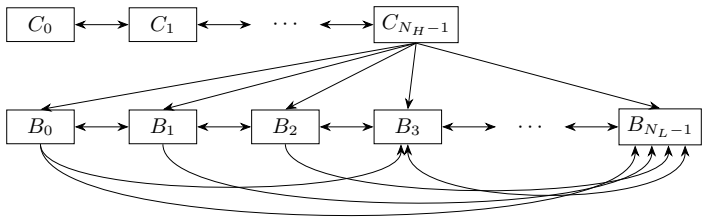
A mixed Hermite-Legendre spectral expansion conserves mass, momentum and energy exactly while achieving higher accuracy than either pure basis alone for the same number of degrees of freedom in kinetic plasma problems with localized non-Max
A machine-rendered reading of the paper's core claim, the machinery that carries it, and where it could break.
Core claim
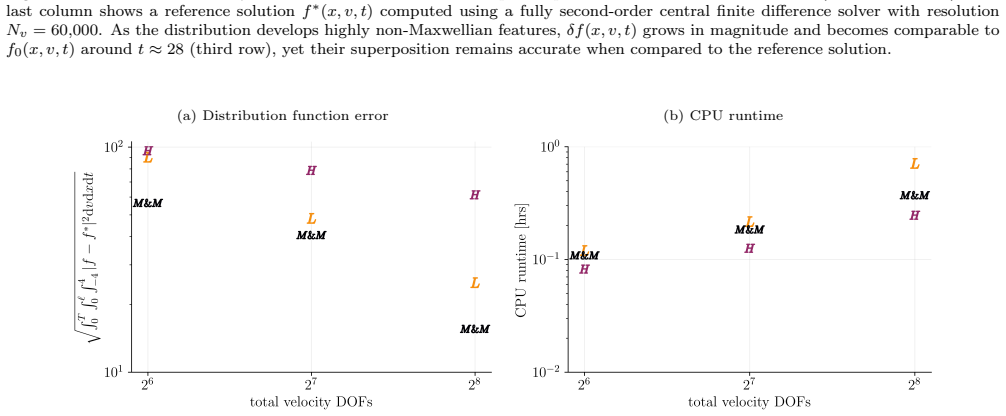
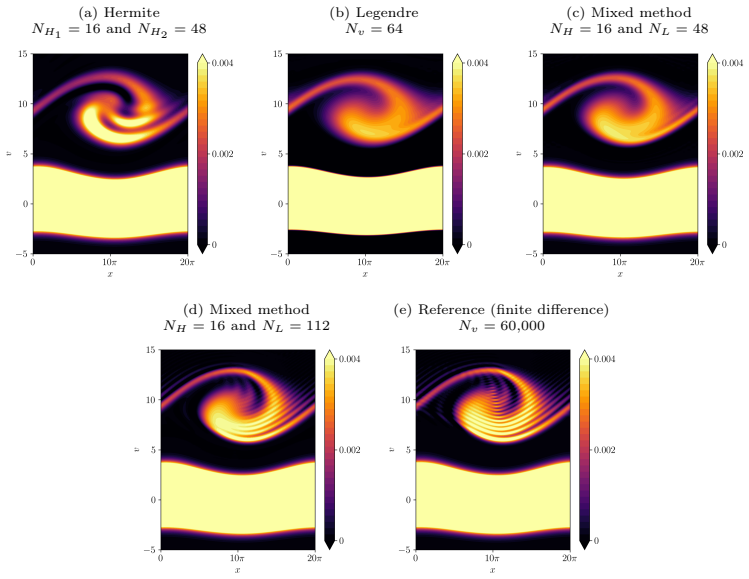
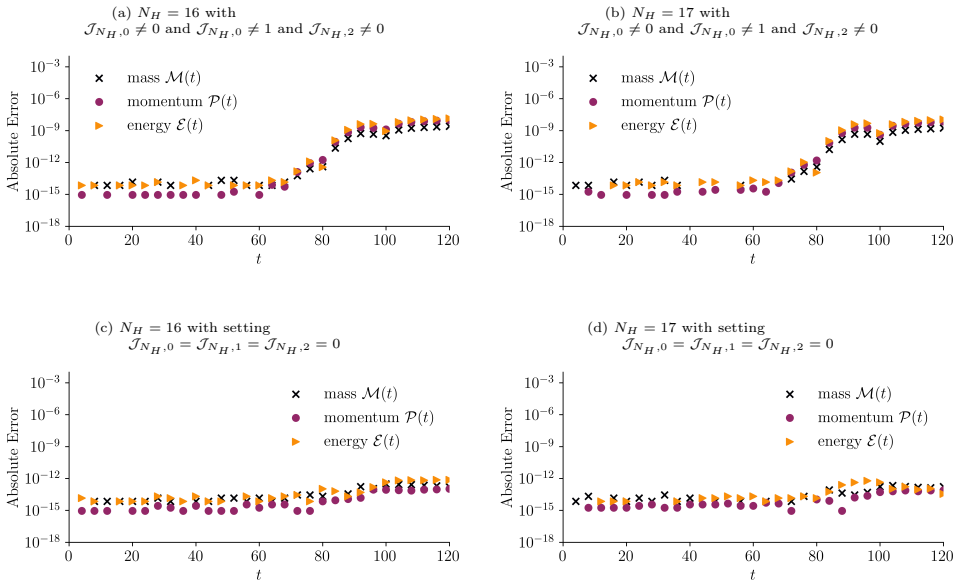
The mixed Hermite-Legendre method, formed by combining the two polynomial expansions, conserves total mass, momentum and energy once certain constraints are imposed; numerical experiments on problems containing localized non-Maxwellian features demonstrate that this representation attains lower error than either standalone Hermite or standalone Legendre discretization while using the same number of degrees of freedom and incurring essentially the same computational cost.
What carries the argument
The mixed Hermite-Legendre expansion that combines the two bases to represent distributions containing both near-Maxwellian and strongly non-Maxwellian localized regions, together with the constraints that enforce exact conservation of the first three moments.
If this is right
- The method becomes the preferred velocity-space discretization for any kinetic problem whose distribution develops isolated beams or plateaus.
- Exact conservation removes a common source of long-term numerical drift in moment-based diagnostics.
- The same number of degrees of freedom can be reused to reach a target accuracy, freeing resources for spatial or temporal resolution.
- Because the cost per degree of freedom stays comparable to the pure methods, the hybrid approach can be dropped into existing spectral codes with minimal refactoring.
Where Pith is reading between the lines
- The same switching logic between bases could be made spatially adaptive inside velocity space, activating Legendre only where the distribution deviates strongly from Maxwellian.
- Conservation constraints derived for three moments might be extended to higher-order moments or to additional invariants such as angular momentum in magnetized plasmas.
- Because the paper demonstrates gains only for one-dimensional velocity space, the scaling of the mixed-basis advantage in two- or three-dimensional velocity space remains an open question that could be tested directly.
Load-bearing premise
The constraints required to restore conservation can be applied without adding substantial new truncation error or computational overhead that would offset the accuracy improvement of the mixed basis.
What would settle it
A controlled test on a beam-plateau distribution in which the mixed method, after the constraints are enforced, produces larger L2 or moment errors than the better of the two pure expansions at identical degrees of freedom.
Figures
read the original abstract
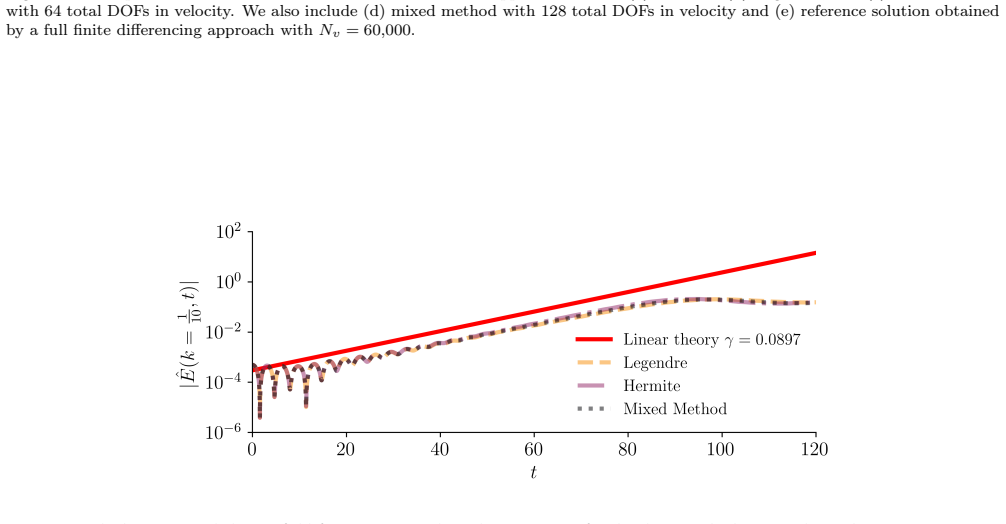
Kinetic collisionless plasma equations are commonly solved via spectral methods in velocity space. The most commonly used spectral method is based on Hermite polynomials with a Maxwellian weight, as this basis efficiently represents near-Maxwellian distributions with relatively few degrees of freedom. An alternative approach uses Legendre polynomials, which are better suited for resolving strongly non-Maxwellian features. In this paper, we propose a mixed method that combines the Hermite and Legendre expansions. The mixed method is particularly advantageous for problems in which non-Maxwellian features are localized in velocity space, such as beams and plateaus. We demonstrate analytically and numerically that the mixed method conserves total mass, momentum, and energy by imposing certain constraints. The numerical results show that, for the same number of degrees of freedom, the proposed mixed method can achieve improved accuracy in comparison to the individual Hermite or Legendre methods, while maintaining comparable computational cost.
Editorial analysis
A structured set of objections, weighed in public.
Referee Report
Summary. The manuscript proposes a mixed Hermite-Legendre spectral method for solving kinetic collisionless plasma equations in velocity space. It combines Hermite polynomials (efficient for near-Maxwellian distributions) with Legendre polynomials (suited to strongly non-Maxwellian features) and claims particular advantage for localized non-Maxwellian structures such as beams and plateaus. The central assertions are that the mixed method conserves total mass, momentum, and energy through imposition of certain constraints, and that it delivers improved accuracy relative to pure Hermite or Legendre expansions at the same number of degrees of freedom while retaining comparable computational cost.
Significance. If the conservation constraints can be shown to be compatible with the localization properties of the mixed basis and if the numerical gains are reproducible on standard test problems, the approach could supply a practical compromise between the efficiency of Hermite bases near equilibrium and the flexibility of Legendre bases for non-Maxwellian features.
major comments (2)
- Abstract: the claim that conservation of mass, momentum, and energy is achieved 'by imposing certain constraints' is load-bearing for both the conservation and accuracy statements, yet the abstract supplies no information on the form of the mixed expansion, the nature of the constraints (linear relations, projections, or basis modifications), or any proof that the constraints preserve the localization benefit of the Legendre component.
- Abstract: the numerical demonstration of accuracy improvement 'for the same number of degrees of freedom' is asserted without reference to the specific test problems, error norms, or velocity-space resolutions employed, making it impossible to assess whether the reported gains survive the addition of the conservation constraints.
minor comments (1)
- Abstract: a single sentence identifying the underlying kinetic equation (Vlasov or Vlasov-Fokker-Planck) would clarify the scope of the method.
Simulated Author's Rebuttal
We thank the referee for the careful review and constructive feedback. We agree that the abstract would benefit from additional detail to substantiate the central claims on conservation and accuracy. We address each major comment below and will revise the abstract accordingly in the resubmitted manuscript.
read point-by-point responses
-
Referee: Abstract: the claim that conservation of mass, momentum, and energy is achieved 'by imposing certain constraints' is load-bearing for both the conservation and accuracy statements, yet the abstract supplies no information on the form of the mixed expansion, the nature of the constraints (linear relations, projections, or basis modifications), or any proof that the constraints preserve the localization benefit of the Legendre component.
Authors: We acknowledge the abstract's brevity limits explanatory detail. The manuscript (Section 2) defines the mixed expansion as a global Hermite series for the near-Maxwellian core plus localized Legendre polynomials supported only on velocity intervals containing non-Maxwellian structures. The constraints are linear algebraic relations on the expansion coefficients obtained by enforcing exact equality of the first three velocity moments to their initial values; these relations are solved via a small dense linear system whose size is independent of the number of Legendre modes. Analytic proof that the constraints preserve localization appears in Section 3: because the Legendre support is compact and the moment constraints are enforced globally but act only through the already-localized coefficients, the spatial localization of non-Maxwellian features is unaffected. We will expand the abstract by one sentence summarizing the mixed basis and the linear nature of the constraints. revision: yes
-
Referee: Abstract: the numerical demonstration of accuracy improvement 'for the same number of degrees of freedom' is asserted without reference to the specific test problems, error norms, or velocity-space resolutions employed, making it impossible to assess whether the reported gains survive the addition of the conservation constraints.
Authors: Space constraints prevented naming the tests in the abstract. The full manuscript reports results on Landau damping, two-stream instability, and bump-on-tail problems, using relative L2 and L-infinity norms of the distribution function and its moments, with total degrees of freedom fixed at 32–64 across all methods. All runs incorporate the conservation constraints; the mixed method still shows lower error than pure Hermite or Legendre at equal DOF (Tables 1–3 and Figures 4–6). We will revise the abstract to cite the principal test problems and state that the accuracy advantage persists after constraint imposition. revision: yes
Circularity Check
No circularity; conservation and accuracy claims are independent derivations
full rationale
The paper defines a mixed Hermite-Legendre basis, then separately demonstrates (analytically and numerically) that conservation of mass/momentum/energy holds once certain constraints are imposed, and that accuracy improves versus pure Hermite or Legendre for the same DOF. No equation reduces to its own input by construction, no parameter is fitted on a subset and then relabeled a prediction, and no load-bearing step rests on a self-citation whose content is itself unverified. The derivation chain remains self-contained against the external benchmarks of the individual spectral methods.
Axiom & Free-Parameter Ledger
axioms (1)
- domain assumption Orthogonal polynomial expansions (Hermite and Legendre) can be used to represent particle distribution functions in velocity space for kinetic plasma equations.
Reference graph
Works this paper leans on
-
[1]
C. K. Birdsall and A. B. Langdon.Plasma Physics via Computer Simulation. Taylor & Francis, 1991
1991
-
[2]
R. W. Hockney and J. W. Eastwood.Computer Simulation Using Particles. Taylor & Francis, 1988
1988
-
[3]
Shiroto, N
T. Shiroto, N. Ohnishi, and Y. Sentoku. Quadratic conservative scheme for relativistic Vlasov-Maxwell system. Journal of Computational Physics, 379:32–50, 2019
2019
-
[4]
Carrié and B
M. Carrié and B. A. Shadwick. An unconditionally stable, time-implicit algorithm for solving the one- dimensional Vlasov-Poisson system.Journal of Plasma Physics, 88(2):905880201, 2022
2022
-
[5]
F. Filbet. Convergence of a Finite Volume Scheme for the Vlasov–Poisson System.SIAM Journal on Numerical Analysis, 39(4):1146–1169, 2001
2001
-
[6]
Vogman, U
G.V. Vogman, U. Shumlak, and P. Colella. Conservative fourth-order finite-volume Vlasov-Poisson solver for axisymmetric plasmas in cylindrical(r,vr,vθ)phase space coordinates.Journal of Computational Physics, 373: 877–899, 2018
2018
-
[7]
Kormann, M
K. Kormann, M. Nazarov, and J. Wen. A structure–preserving finite element framework for the Vlasov– Maxwell system.Computer Methods in Applied Mechanics and Engineering, 446:118290, 2025
2025
-
[8]
S. I. Zaki, L. R. T. Gardner, and T. J. M. Boyd. A finite element code for the simulation of one-dimensional Vlasov plasmas. I. Theory.Journal of Computational Physics, 79(1):184–199, 1988
1988
-
[9]
R. E. Heath, I. M. Gamba, P. J. Morrison, and C. Michler. A discontinuous Galerkin method for the Vlasov– Poisson system.Journal of Computational Physics, 231(4):1140–1174, 2012
2012
-
[10]
Cheng, A
Y. Cheng, A. J. Christlieb, and X. Zhong. Energy–conserving discontinuous Galerkin methods for the Vlasov- Ampère system.Journal of Computational Physics, 256:630–655, 2014
2014
-
[11]
J. Juno, A. Hakim, J. TenBarge, E. Shi, and W. Dorland. Discontinuous Galerkin algorithms for fully kinetic plasmas.Journal of Computational Physics, 353:110–147, 2018
2018
-
[12]
H. Grad. On the kinetic theory of rarefied gases.Communications on Pure and Applied Mathematics, 2(4): 331–407, 1949
1949
-
[13]
Manzini, G
G. Manzini, G. L. Delzanno, J. Vencels, and S. Markidis. A Legendre–Fourier spectral method with exact conservation laws for the Vlasov–Poisson system.Journal of Computational Physics, 317:82–107, 2016. 20
2016
-
[14]
A. J. Klimas. A numerical method based on the Fourier–Fourier transform approach for modeling 1–D electron plasma evolution.Journal of Computational Physics, 50(2):270–306, 1983
1983
-
[15]
Shoucri and G
M. Shoucri and G. Knorr. Numerical integration of the Vlasov equation.Journal of Computational Physics, 14(1):84–92, 1974
1974
-
[16]
J. Juno, A. Hakim, and J. M. TenBarge. A parallel–kinetic–perpendicular–moment model for magnetised plasmas.Journal of Plasma Physics, 91(5):E129, 2025
2025
-
[17]
T. P. Armstrong. Numerical Studies of the Nonlinear Vlasov Equation.The Physics of Fluids, 10(6):1269–1280, 1967
1967
-
[18]
F. C. Grant and M. R. Feix. Fourier–Hermite Solutions of the Vlasov Equations in the Linearized Limit.The Physics of Fluids, 10(4):696–702, 1967
1967
-
[19]
Schumer andJ.P.Holloway
J.W. Schumer andJ.P.Holloway. VlasovSimulationsUsingVelocity–Scaled HermiteRepresentations.Journal of Computational Physics, 144(2):626–661, 1998
1998
-
[20]
G. L. Delzanno. Multi-dimensional, fully-implicit, spectral method for the Vlasov–Maxwell equations with exact conservation laws in discrete form.Journal of Computational Physics, 301:338–356, 2015
2015
-
[21]
Camporeale, G
E. Camporeale, G. L. Delzanno, B. K. Bergen, and J. D. Moulton. On the velocity space discretization for the Vlasov–Poisson system: Comparison between implicit Hermite spectral and Particle–in–Cell methods. Computer Physics Communications, 198:47–58, 2016
2016
-
[22]
Koshkarov, G
O. Koshkarov, G. Manzini, G. L. Delzanno, C. Pagliantini, and V. Roytershteyn. The multi–dimensional Hermite–discontinuous Galerkin method for the Vlasov–Maxwell equations.Computer Physics Communica- tions, 264:107866, 2021
2021
-
[23]
Issan, O
O. Issan, O. Koshkarov, F. D. Halpern, B. Kramer, and G. L. Delzanno. Anti-symmetric and positivity preserving formulation of a spectral method for Vlasov–Poisson equations.Journal of Computational Physics, 514:113263, 2024
2024
-
[24]
Parker and P
J. Parker and P. Dellar. Fourier–Hermite spectral representation for the Vlasov–Poisson system in the weakly collisional limit.Journal of Plasma Physics, 81, 2014
2014
-
[25]
Barbour, W
N. Barbour, W. Dorland, I. G. Abel, and M. Landreman. Machine–learning closure for Vlasov–Poisson dy- namics in Fourier–Hermite space.Journal of Plasma Physics, 91(5):E140, 2025
2025
-
[26]
Filbet and T
F. Filbet and T. Xiong. Conservative discontinuous Galerkin/Hermite spectral method for the Vlasov–Poisson system.Communications on Applied Mathematics and Computation, pages 1–26, 2022
2022
-
[27]
Pezzi, F
O. Pezzi, F. Valentini, S. Servidio, E. Camporeale, and P. Veltri. Fourier–Hermite decomposition of the collisional Vlasov–Maxwell system: implications for the velocity-space cascade.Plasma Physics and Controlled Fusion, 61(5):054005, 2019
2019
-
[28]
Joyce, G
G. Joyce, G. Knorr, and H. K. Meier. Numerical integration methods of the Vlasov equation.Journal of Computational Physics, 8(1):53–63, 1971
1971
-
[29]
Issan, O
O. Issan, O. Chapurin, O. Koshkarov, and G. L. Delzanno. Effects of artificial collisions, filtering, and nonlocal closure approaches on Hermite–based Vlasov–Poisson simulations.Physics of Plasmas, 32(3):033906, 2025
2025
-
[30]
Issan, O
O. Issan, O. Koshkarov, F. D. Halpern, B. Kramer, and G. L. Delzanno. Conservative closures of the Vlasov– Poisson equations based on symmetrically weighted Hermite spectral expansion.Journal of Computational Physics, 524:113741, 2025
2025
-
[31]
Chapurin, O
O. Chapurin, O. Koshkarov, G. L. Delzanno, V. Roytershteyn, P. Brady, R. Chiodi, C. Harnish, and D. Livescu. Hybrid particle–spectral method for kinetic plasma simulations.Physics of Plasmas, 31(2):023903, 2024
2024
-
[32]
Kormann and A
K. Kormann and A. Yurova. A generalized Fourier–Hermite method for the Vlasov–Poisson system.BIT Numerical Mathematics, 61(3):881–909, 2021
2021
-
[33]
Funaro and G
D. Funaro and G. Manzini. Stability and conservation properties of Hermite–based approximations of the Vlasov-Poisson system.Journal of Scientific Computing, 88(1):29, 2021. 21
2021
-
[34]
Fatone, D
L. Fatone, D. Funaro, and G. Manzini. A Decision–Making Machine Learning Approach in Hermite Spectral Approximations of Partial Differential Equations.Journal of Scientific Computing, 92(1), 2022
2022
-
[35]
Pagliantini, G
C. Pagliantini, G. L. Delzanno, and S. Markidis. Physics–based adaptivity of a spectral method for the Vlasov–Poisson equations based on the asymmetrically–weighted Hermite expansion in velocity space.Journal of Computational Physics, 488:112252, 2023
2023
-
[36]
S. Shao, Y. Wang, and J. Wu. An adaptive Hermite spectral method for the Boltzmann equation.arXiv preprint arXiv:2509.17981, 2025
arXiv 2025
-
[37]
Abramowitz and I
M. Abramowitz and I. A. Stegun.Handbook of Mathematical Functions: With Formulas, Graphs, and Math- ematical Tables. Applied mathematics series. Dover Publications, 1965
1965
-
[38]
PlasmaOscillationswithDiffusioninVelocitySpace.Phys
A.LenardandI.B.Bernstein. PlasmaOscillationswithDiffusioninVelocitySpace.Phys. Rev., 112:1456–1459, 1958
1958
-
[39]
Hairer, C
E. Hairer, C. Lubich, and G. Wanner.Geometric numerical integration. Springer Series in Computational Mathematics. Springer-Verlag, Berlin, 2006
2006
-
[40]
D. A. Knoll and D. E. Keyes. Jacobian–free Newton–Krylov methods: a survey of approaches and applications. Journal of Computational Physics, 193(2):357–397, 2004
2004
-
[41]
A. H. Baker, E. R. Jessup, and T. Manteuffel. A Technique for Accelerating the Convergence of Restarted GMRES.SIAM Journal on Matrix Analysis and Applications, 26(4):962–984, 2005
2005
-
[42]
S. A. Smith. Dissipative closures for statistical moments, fluid moments, and subgrid scales in plasma turbu- lence.PhD Thesis, 1997
1997
-
[43]
S. P. Gary.Theory of Space Plasma Microinstabilities. Cambridge Atmospheric and Space Science Series. Cambridge University Press, 1993. 22
1993
discussion (0)
Sign in with ORCID, Apple, or X to comment. Anyone can read and Pith papers without signing in.