ECYSAP EYE: From Cyber Situational Awareness to Mission-Centric Decision Support for Enhanced Cyberspace Operations
Pith reviewed 2026-06-27 09:07 UTC · model grok-4.3
The pith
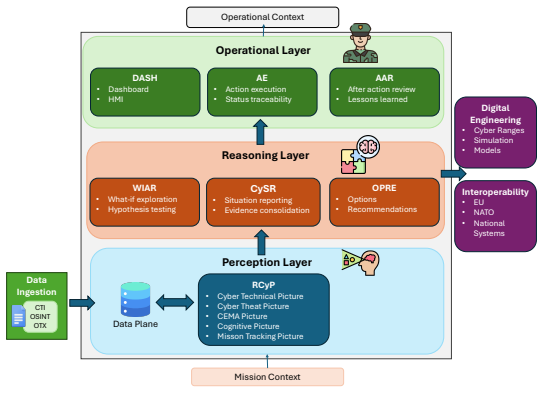
ECYSAP EYE architecture structures the move from cyber perception to mission decision support and execution through seven artefact groups.
A machine-rendered reading of the paper's core claim, the machinery that carries it, and where it could break.
Core claim
The ECYSAP EYE architecture structures the transition from perception (full-spectrum RCyP views), to decision-oriented reasoning (WIAR/CySRs/OPRE), and to operational execution and learning (DSH/AE/AAR), with explicit integration surfaces that support incremental deployment and validation.
What carries the argument
The seven groups of mission-focused artefacts (RCyP, CySRs, WIAR, OPRE, DSH, AE, AAR) inside a System-of-Systems architecture that connects perception to action with defined integration surfaces.
If this is right
- Mission-relevant artefacts become available for direct use inside mission planning and execution workflows.
- Incremental deployment and validation become feasible through the defined integration surfaces.
- The flow from perception to reasoning to execution supports learning via after-action reports.
- Cyberspace operations gain artefacts that replace isolated technical alerts with mission-centric outputs.
Where Pith is reading between the lines
- Existing security operations centers could adopt the artefact groups one layer at a time without replacing entire tool suites.
- Training programs for cyber operators might incorporate the WIAR and OPRE artefacts to practice decision steps before live events.
- Similar artefact groupings could be tested in domains such as supply-chain risk monitoring where awareness must feed rapid action.
Load-bearing premise
The seven groups of mission-focused artefacts can be effectively embedded into heterogeneous toolchains and cyber security or cyber defense processes.
What would settle it
A deployment attempt in an operational cyber defense exercise in which the seven artefact groups require major custom development to connect with existing toolchains would falsify the central claim.
Figures
read the original abstract
Operational organizations increasingly require Cyber Situational Awareness (CySA) capabilities that go beyond isolated technical alerts, providing mission-relevant artefacts that can be embedded into heterogeneous toolchains and cyber security or cyber defense processes. ECYSAP EYE addresses this need through an adoption-oriented System-of-Systems (SoS) architecture centered on seven groups of mission-focused artefacts: the Recognized Cyberspace Picture (RCyP), Cyber Situational Reports (CySRs), the What-If Analysis Report (WIAR), Option Recommendations (OPRE), an operator Dashboard/HMI (DSH), Action Enforcement (AE), and After-Action Reports (AAR). The ECYSAP EYE architecture structures the transition from perception (full-spectrum RCyP views), to decision-oriented reasoning (WIAR/CySRs/OPRE), and to operational execution and learning (DSH/AE/AAR), with explicit integration surfaces that support incremental deployment and validation. This paper presents this innovative project from a technology transfer perspective, summarizing the updated architecture, the functional role of seven groups of artefacts, and the expected impact of cyber situations on the decision-making process in the context of a mission planning and execution.
Editorial analysis
A structured set of objections, weighed in public.
Referee Report
Summary. The paper presents the ECYSAP EYE System-of-Systems architecture for cyber situational awareness, centered on seven groups of mission-focused artefacts (RCyP, CySRs, WIAR, OPRE, DSH, AE, AAR). It describes how these structure the transition from perception (full-spectrum RCyP views) to decision-oriented reasoning (WIAR/CySRs/OPRE) to operational execution and learning (DSH/AE/AAR), emphasizing explicit integration surfaces for incremental deployment and validation in heterogeneous toolchains. The work is framed as a technology-transfer summary of an updated architecture and its expected impact on mission planning and execution.
Significance. If the described architecture functions as outlined, it would offer a structured SoS framework for embedding mission-relevant cyber artefacts into operational processes. This could support incremental adoption in cyber defense contexts, but the absence of any implementation details, case studies, or metrics means the practical significance remains unassessed.
major comments (2)
- [Abstract] Abstract: The claim that the architecture 'structures the transition from perception ... to decision-oriented reasoning ... to operational execution and learning, with explicit integration surfaces that support incremental deployment and validation' is presented as the core contribution but is supported only by high-level naming of the seven artefact groups, with no diagrams, interface specifications, or deployment examples provided.
- [Abstract] Abstract: The opening motivation states a need for artefacts 'that can be embedded into heterogeneous toolchains and cyber security or cyber defense processes,' yet the manuscript contains no discussion, requirements analysis, or integration mechanisms for any of the seven artefact groups, which is load-bearing for the technology-transfer framing.
minor comments (1)
- [Abstract] Abstract: Acronyms such as RCyP, WIAR, CySRs, OPRE, DSH, AE, and AAR are introduced without expansion or reference to later sections where they are presumably defined.
Simulated Author's Rebuttal
We thank the referee for the review. This manuscript is a technology-transfer summary of the ECYSAP EYE SoS architecture rather than a detailed technical specification or implementation report. We address the two major comments on the abstract below.
read point-by-point responses
-
Referee: [Abstract] Abstract: The claim that the architecture 'structures the transition from perception ... to decision-oriented reasoning ... to operational execution and learning, with explicit integration surfaces that support incremental deployment and validation' is presented as the core contribution but is supported only by high-level naming of the seven artefact groups, with no diagrams, interface specifications, or deployment examples provided.
Authors: The core contribution lies in defining the seven artefact groups and their sequential roles that structure the overall flow: RCyP provides the perception layer, WIAR/CySRs/OPRE handle decision-oriented reasoning, and DSH/AE/AAR cover execution and learning. The explicit integration surfaces are the standardized artefact handoffs between these groups, which by design enable incremental deployment across heterogeneous toolchains. As this is explicitly a technology-transfer summary paper, the manuscript intentionally remains at the conceptual level without including diagrams, low-level interface specifications, or deployment examples. The high-level naming combined with the described functional roles is sufficient to support the stated claim within the paper's scope. revision: no
-
Referee: [Abstract] Abstract: The opening motivation states a need for artefacts 'that can be embedded into heterogeneous toolchains and cyber security or cyber defense processes,' yet the manuscript contains no discussion, requirements analysis, or integration mechanisms for any of the seven artefact groups, which is load-bearing for the technology-transfer framing.
Authors: The motivation is grounded in operational requirements identified during the ECYSAP project. The architecture directly addresses embeddability by structuring artefacts as mission-centric outputs that can interface with existing processes. Integration mechanisms are provided through the SoS composition itself, where each artefact group defines clear input/output relationships with the others and with external systems. A separate requirements analysis is outside the scope of this summary, which instead presents the resulting architecture and its expected impact on mission planning. The functional descriptions of the seven groups convey the intended integration approach for technology transfer purposes. revision: no
Circularity Check
No significant circularity
full rationale
The paper is a descriptive technology-transfer summary of an SoS architecture for cyber situational awareness. It defines seven artefact groups (RCyP, CySRs, WIAR, OPRE, DSH, AE, AAR) and their role in structuring perception-to-decision-to-execution transitions via explicit integration surfaces, but advances no mathematical derivations, equations, predictions, fitted quantities, or uniqueness theorems. All central assertions are presented as design choices rather than results derived from prior inputs or self-citations. No load-bearing steps reduce to the paper's own definitions or citations by construction, satisfying the default expectation of a non-circular descriptive work.
Axiom & Free-Parameter Ledger
Reference graph
Works this paper leans on
-
[1]
Cuaderno de Inteligencia 3
Montero, Juan Adolfo , title =. Cuaderno de Inteligencia 3. La innovación tecnológica en el área de la inteligencia de ciberamenazas y por extensión de la ciberdefensa , year =
-
[2]
IEEE Security & Privacy , volume =
Assessing Mission Impact of Cyberattacks: Toward a Model-Driven Paradigm , author =. IEEE Security & Privacy , volume =. 2017 , doi =
2017
-
[3]
IEEE Access , volume =
Systematic Literature Review on Cyber Situational Awareness Visualizations , author =. IEEE Access , volume =. 2022 , doi =
2022
-
[4]
2019 , howpublished =
2019
-
[5]
and Tejero, J
Legaz, A. and Tejero, J. and Su. ECySAP y la conciencia situacional en operaciones de guerra multidominio , journal =. 2025 , volume =
2025
-
[6]
Toward a Military Smart Cyber Situational Awareness (CSA) , booktitle =
Feij. Toward a Military Smart Cyber Situational Awareness (CSA) , booktitle =. 2025 , month = jun, pages =. doi:10.48550/arXiv.2602.14116 , note =
-
[7]
Montero, J. A. , title =. Cuaderno de Inteligencia 3: La innovaci. 2025 , volume =
2025
-
[8]
2020 , howpublished =
2020
-
[9]
Journal of Cognitive Engineering and Decision Making , volume=
Final reflections: Situation awareness models and measures , author=. Journal of Cognitive Engineering and Decision Making , volume=. 2015 , publisher=
2015
discussion (0)
Sign in with ORCID, Apple, or X to comment. Anyone can read and Pith papers without signing in.